
Che cosa fare ora che siamo in stagflazione
 

Abbiamo anticipato il tema “stagflazione” ai lettori del Blog già nell’agosto 2020, ovvero 20 mesi fa.

Da allora ad oggi, abbiamo trattato questo argomento con regolarità, anche qui nel Blog: ma soprattutto, e solo per i nostri Clienti, abbiamo fatto tutto ciò che era necessario per preparare i portafogli modello al momento nel quale la stagflazione sarebbe diventata lo scenario dominante.

Quel momento è oggi.

Oggi, ve ne parlano tutti: il private banker, il wealth manager, il family banker, e persino quel robot che pretende di essere “advisor. Ve ne scrivono sul PLUS di Sole 24 ore, sul Corriere Economia, sui siti web (persino i siti per il trading-online!!!).

Il tema oggi “tira”, oggi “fa scattare i click”, un po’ come fino a sei mesi fa faceva Elon Musk.

Noi ci rendiamo conto che ne parlano e ne scrivono, per la grandissima maggior parte, individui che si muovono a tentoni su questo terreno, che non dispongono delle conoscenze necessarie, che si affidano all’intuizione, che puntano sul “click” e sul creare impatto emotivo.

Come sempre, vogliamo aiutare il nostro lettore, e portarlo fuori da questa “nebbia mediatica”: portare in condizioni di sicurezza lui, ed il suo patrimonio.

Per questa ragione, abbiamo fatto una attenta ed accurata selezione, e qui sotto per voi riportiamo un intero articolo del Financial Times, che ci informa che la stagflazione è già qui. E’ già arrivata.

L’articolo vi è utile perché invece di limitarsi alle chiacchiere generiche dei promotori finanziari, dei quotidiani, e della TV, vi offre qualche punto di riferimento più specifico, più concreto, e quindi più affidabile. Perché basato su una precisa metodologia (invece che sulle semplici chiacchiere che ascoltate ogni giorno).

E voi, amici lettori, avete idea di come si gestisce il vostro portafoglio in titoli, in una fase di stagflazione? sapete che cosa fare? Che cosa vi ha detto il wealth manager, il private banker, il family banker, e che cosa dice adesso il robot? Di chi vi fidate, amici lettodi: di che gente vi fidate?

Se volete un confronto con Recce’d, saremo felici di parlare con voi: contattateci attraverso il sito.


The twin perils of slowing growth and high inflation, or stagflation, will hit the global economy this year as Russia’s war against Ukraine exacerbates a slowdown in the recovery from the coronavirus pandemic, according to Financial Times research.

Mounting price pressures, slipping output expansion and sagging confidence will all pose a drag for most countries, according to the latest Brookings-FT tracking index. As a result, policymakers will be left with “grim quandaries”, said Eswar Prasad, senior fellow at the Brookings Institution.

The IMF is this week expected to downgrade its forecasts for most countries as finance ministers and central bankers convene at the spring meetings of the fund and the World Bank to discuss how to respond to the darkening economic outlook. Policymakers must work out how to address rapidly rising prices and the dangers of raising interest rates when debt levels are already high. Kristalina Georgieva, IMF managing director, on Thursday called the war in Ukraine a “massive setback” for the global economy.

Prasad said there was a risk that 2022 could become “a fraught period of geopolitical realignments, persistent supply disruptions and financial market volatility, all against the background of surging inflationary pressures and limited room for policy manoeuvre”.

The Brookings-FT Tracking Index for the Global Economic Recovery (Tiger) compares indicators of real activity, financial markets and confidence with their historical averages, both for the global economy and individual countries, capturing the extent to which data in the current period is better or worse than normal. In the twice-yearly series, the composite index shows a marked loss of growth momentum since late 2021 in advanced and emerging economies, with confidence levels also dropping from their peaks and financial market performance taking a dip more recently.

Each of the world’s three big economic blocs faces considerable difficulties, Prasad said. While spending remains strong in the US and the labour market has returned to pre-pandemic conditions, inflation poses severe difficulties for the Federal Reserve’s mandate of price stability. The pace of price growth surged to a 40-year high of 8.5 per cent in March. “The Fed is at real risk of losing control of the inflation narrative and could be forced to tighten even more aggressively than it has signalled, raising the risk of a marked slowdown in growth in 2023,” Prasad said.

China’s problems stem from its desire to stick with its zero-Covid strategy after a surge in cases of the more infectious Omicron coronavirus variant. Lockdowns, such as the severe restrictions in Shanghai, threaten consumer spending, investment and production, while the potential to ease monetary policy again will amplify longer-term risks to financial stability. China is set to report first-quarter gross domestic product figures on Monday and they are widely expected to show that Beijing faces a tough challenge in meeting its 5.5 per cent growth target over the course of this year.

For Europe, most exposed to the Ukraine conflict and struggling to reduce reliance on Russian energy imports, confidence levels have declined sharply. Prasad said there were no easy policy solutions and willingness to act appeared in short supply. “Keeping the global economy on a reasonable growth track will require concerted actions to fix the root problems, including measures to limit pandemic-induced disruptions, steps to tamp down geopolitical tensions and targeted measures such as infrastructure spending to boost long-term productivity rather than just fortify short-term demand,” he said.

Valter Buffo
Oggi tutti attaccano la Fed (con 20 mesi di ritardo)
 

Oggi leggete sul settimanale The Economist (immagine sopra) che “la Fed ha fallito ed è stata umiliata”.

Le medesime cose, noi di Recce’d le abbiamo elaborate, e poi scritte, e poi pubblicate, nell’agosto del 2020, ovvero 20 mesi fa.

E poi, nuovamente, le abbiamo approfondite sempre nel 2020, ma in ottobre e novembre. 18 mesi fa.

Questo tipo di competenza è ciò che vi serve, è ciò che è essenziale per la gestione di portafoglio: per gestire i vostri investimenti in modo consapevole ed ottenere una performance positiva, mantenendo però anche il controllo dei vostri rischi.

E non ci vuole un attimo, come dice la pubblicità in TV. Ci vuole tempo, competenza, attenzione ed intelligenza. Come viene dettagliato nella nostra pagina dedicata alla GESTIONE DI PORTAFOGLIO.

I dati PRESENTI E PASSATI dicono che noi di Recce’d lo sappiamo fare, mentre molti altri non lo sanno fare.

In questo Post vogliamo portare all’attenzione del nostro lettore un dato di fatto recentissimo, e di grande rilevanza: in poche settimane, si è formato un “partito della recessione”.

Oggi, scrivere e parlare di “boom economico” … fa sfigato, non è più popolare come sei mesi fa.

Sei mesi fa l’ottimismo era obbligatorio. Se mesi fa, chi non cavalcava l’onda dell’entusiasmo era definito un “contrarian”, o anche uno jettatore, oppure persino lo scemo del villaggio, quello che non riusciva a vedere che “è insensato in un momento come questo, stare fuori dall’azionario”. Ve lo ricordate, vero?

A poche settimane di distanza, abbiamo registrato la comparsa di un atteggiamento altrettanto ottuso, altrettanto semplicistico, altrettanto (permettetecelo) stupido: ma di orientamento opposto. Adesso chi vuole “fare il fenomeno” parla dei “rischi di recessione”. Senza capirci nulla, proprio come sei mesi fa con il “boom economico”.

Noi in Recce’d, come più e più volte abbiamo spiegato, non siamo mai pessimisti e mai ottimisti: non riusciamo, neppure, a capire che cosa significano queste due espressioni, nel mondo degli investimenti.

La realtà, è una sola: ed i mercati finanziari vanno, inevitabilmente, appresso alla realtà.

Non esistono due realtà parallele: quelle, esistono solo nei telefilm. La realtà è una sola: chi la vede nel modo giusto, e con il giusto anticipo, vince, tuti gli altri perdono (i loro soldi, e la loro serenità).

Noi di Recce’d, dal 2007 ad oggi, la abbiamo sempre vista gusta: e questo significa una cosa sola, ovvero che sappiamo fare il nostro mestiere, quello per il quale i nostri Clienti ci riconoscono le commissioni.

Per i nostri lettori, noi utilizziamo questo Post per ricordare che, per un investitore, il pessimismo di maniera, quello semplicistico e retorico, è altrettanto dannoso dell’ottimismo di maniera, quello stupidissimo del 2021 e quello meno esagerato che abbiamo visto dal 2017 al 2019.

Per questo, il nostro suggerimento per i lettori è: tenete alta l’attenzione e usate il senso critico, non seguite mai gli slogan dei media, non seguiteli se sono troppo ottimistici e neppure quando invece sono tutti, e tutti insieme, orientati al pessimismo.

Ragionate, e ragionate bene, ma solo sui fatti.

Un articolo come quello del Wall Street Journal pubblicato pochi giorni fa, e che leggete qui sotto, per che cosa vi è utile? Di che cosa ci informa, tutti quanti?

La risposta più immediata è: “del rischio di recessione”. Ed invece no: ci informa di un’altra cosa: ovvero che il mondo dei media ha mollato al suo destino la Banca Centrale, ne prende le distanze, scende dalla nave prima che sia troppo tardi.

Dopo avere, in modo ottuso ed anche stupido, esaltato le Banche Centrali per un decennio, e strillato la loro grandezza negli ultimi due anni, è arrivato il momento di rivoltare la giacchetta, come fanno tutti quelli che hanno qualche cosa da nascondere.

E’ su questo, che Recce’d vi suggerisce di riflettere a lungo, prima di riprendere in mano il vostro portafoglio titoli, e modificarlo come serve.

Ai suoi lettori, Recce’d raccomanda di leggere con massima attenzione tutto l’articolo, di esaminare i grafici, e poi di rileggere due o tre volte le parole di John Taylor, che sono illustrate anche da un nostro grafico da Bloomberg. Da questa parole, potete capire a che cosa i mercati vanno incontro nell’aprile del 2022.

By Jon Hilsenrath and Nick Timiraos

April 18, 2022 11:07 am ET

The Federal Reserve is setting out to do something it has never accomplished before: reduce inflation a lot without significantly raising unemployment.

Central bank officials think it is possible with calibrated interest-rate increases that slow booming demand just enough to take steam out of an overheated economy. But even one of the Fed’s closest allies, U.S. Treasury Secretary Janet Yellen, sees the risk of failure. “It will require skill and also good luck,” the former Fed chair said in public comments in Washington last week.

During the past 80 years, the Fed has never lowered inflation as much as it is setting out to do now—by 4 percentage points—without causing recession. In this case, the central bank will need a number of factors out of its control to break its way.

Still, Fed officials can find reason for both optimism and caution from history. In seven different episodes during the past 80 years, inflation has fallen as much as the Fed bank wants it to drop now, with varying outcomes. The episodes suggest that the desired scenario is theoretically possible though the risk of failure is high, especially because the bank is chasing inflation that already exists, rather than addressing the problem before it arises as it did in some earlier episodes.

If the Fed is to land the plane safely, the labor market will be key. Typically during a recession joblessness rises sharply. At 3.6% the unemployment rate is now exceptionally low and demand for workers is so intense that companies have listed millions of unfilled job openings.

Fed officials say they can curb that demand, causing employers to eliminate vacancies without laying off existing workers, and tamp down inflation without a recession—what economists would refer to as a “soft landing.”

“No one expects that bringing about a soft landing will be straightforward in the current context—very little is straightforward in the current context,” Fed Chairman Jerome Powell said last month. The central bank, he added, faces a “challenging task.”

Landing Scenarios

During the early 1980s, the U.S. experienced a classic hard landing as economists dub it—falling into a deep recession with double-digit unemployment after the Fed pushed its benchmark interest rate to nearly 20% to tame stubbornly high inflation that had been rising for more than a decade.

The U.S. had less severe, but bumpy landings during the 1950s, characterized by short-lived inflation spikes and recessions. During that period, the unemployment rate rarely got very high even when economic output contracted.

The 1970s delivered aborted landings, when inflation fell and then lurched higher, beset by outside shocks such as OPEC oil embargoes and policy missteps including a central bank that hesitated to raise interest rates aggressively.

The U.S. has had soft landings, too, most recently in 1994. Fed Chairman Alan Greenspan sharply raised rates to 6% in February 1995 from 3% one year earlier, and the unemployment rate kept going down. Unlike 1994, however, the Fed today is trying to reduce inflation that is already too high rather than prevent it from rising, as Mr. Greenspan did back then.

Fed officials have indicated that while they seek a soft landing, they will raise interest rates as much as necessary to lower inflation, even if that results in a downturn.

“My framework for thinking about the Fed right now is, 1994 is the goal, but they are not necessarily petrified of 1980 anymore, or at least not even close to as scared of 1980 as I thought they would have been,” said Jon Turek, founder of policy research firm JST Advisors.

The Fed’s hope

Even before Moscow’s invasion of Ukraine in February, Mr. Powell was laying the groundwork for a more aggressive series of rate increases driven by concerns that labor markets were overheating. The war and new Covid-19 lockdowns in China, which have boosted prices while further disrupting supply chains, have made life harder for the Fed.

Consumer prices rose 6.4% in February from a year earlier, according to the Fed’s preferred gauge, the Commerce Department’s personal-consumption expenditures price index. Core prices, which exclude volatile food and energy price swings, climbed 5.4%. Those readings were the highest in around four decades.

Demand was stoked by low interest rates and $6.4 trillion of government borrowing and spending since Covid struck. Businesses and households spent money faster than a pandemic-strained economy could deliver goods and services, then prices soared.

“We really poured things on in terms of expansionary policy, with good intentions but predictable effects,” said Robert Hall, a Stanford University professor who runs the National Bureau of Economic Research’s committee that dates the beginnings and ends of expansions.

The Fed lifted rates from near zero last month by a quarter percentage point and penciled in a series of rises this year and next. Interest-rate increases are meant to slow demand by restraining consumer and business borrowing.

In the scenario Fed officials mapped out, their benchmark interest rate will rise to around 2.75% by the end of next year, just above estimates of a rate that neither spurs nor slows growth.

They project inflation will drop to slightly above 2% by 2024, a rare 4-percentage-point decline in less than three years. They see economic output growing at a rate between 2% and 3% while unemployment holds below 4%.

“That scenario seems unlikely to me,” said Ellen Meade, who retired from the Fed last August as a senior policy adviser. “The probability of doing this without a hard landing has gone down.”

John Taylor, an economist at Stanford University who is the author of an influential policy-setting rule of thumb called the “Taylor rule,” says his formula calls for the Fed to set interest rates at 5% right now. Because the Fed is unlikely to lift rates so dramatically in one year, he said officials instead ought to raise rates to 3% by December and signal more increases after that unless inflation comes down.

“This is not the only time in history that they’ve been behind, but they are strikingly behind,” said Mr. Taylor. “They need to catch up and do it in a systematic and understandable way.”

Fixing imbalances

The Fed’s success will depend on several factors outside its control. Those include whether global energy supplies recover from the shock of Russia’s invasion of Ukraine, reducing energy prices; whether sidelined U.S. workers rejoin the labor force, easing the labor shortage and wage pressures; whether Chinese plants reopen in the face of more Covid-19 lockdowns, clearing supply bottlenecks; and whether Covid itself recedes for good in the U.S., ending other pandemic-related economic disruptions such as business closures.

The Fed’s job will be easier if these supply constraints ease. If they don’t, the central bank will need to push rates higher to squeeze demand, with a risk of more damage to the economy.

A great deal boils down to the job market.

In February, U.S. companies listed 11.3 million unfilled job openings, four million more than before the pandemic, which even then was a record. Those openings mean firms are competing for scarce workers by bidding up wages, which pressures them to raise prices to keep profits strong.

Some of this gap was driven by a dearth of workers. The U.S. labor-force participation rate, at 62.4% in March, was still a percentage point below prepandemic levels, meaning fewer workers are looking for jobs.

The mismatch was also caused by demand-driven hiring by employers. As of February, the combination of unfilled and filled jobs has exceeded the total number of workers by the largest margin since World War II, according to an analysis by Goldman Sachs.

Goldman analysts estimate the Fed can achieve its goal of bringing down inflation and slowing upward wage pressures by reducing job openings by about 2.5 million.

Monthly job openings

Source: Labor Department

If workforce participation rates return to prepandemic levels, that would add around one million workers, Goldman estimates, making the Fed’s job of easing supply-and-demand imbalances in the labor market somewhat easier.

In recent weeks, Fed officials have zeroed in on this logic.

“There is plenty of room for businesses to reduce the number of job openings,” said Lael Brainard, a Fed governor awaiting Senate confirmation to become Fed vice chairwoman, in an interview with The Wall Street Journal last week. “I see that as being consistent both in bringing inflation down and sustaining the recovery.”

A view from Gilbert

Tad Peelen, co-owner of a restaurant group in Gilbert, Ariz., sees the complexity of these supply and demand mismatches up close. For months he has been struggling to source supplies, such as plastic-foam cups, and couldn’t get them through normal supplier channels. For a while he thought the problem was production disruptions related to Covid. But he thinks the issue has morphed in the past 12 months. Now he thinks many suppliers are simply sold out because there are so many competitors opening around him.

His problem isn’t limited to serving cups.

“We had all come to the assumption there were fewer employees out there for us to choose from, but the pool of employees ready to go to work in restaurants is the same size or larger than before Covid,” he said. “The reason we are struggling so much is because so many restaurants are opening. It has started to make sense to me.”

He said he would welcome a modest slowdown, which could be a chance for him to give his workers a break and also might slow cost increases for supplies.

Parallels to the 1950s

Mr. Hall’s research has found that unemployment followed predictable patterns during and after recessions for several decades—sharp increases in the jobless rate during recession and then slow, steady declines during expansions, a pattern that held from the 1960s right up to 2020.

The pandemic scrambled those patterns, with the slow decline scenario being replaced by astonishingly fast descent. The unemployment rate swung during the pandemic from 3.5% in February 2020 to nearly 15% two months later and then back down, to 3.6% in March.

He said the lurching patterns he sees in unemployment today look more like they did in the 1950s, when he says there was “higher volatility of everything.”

The U.S. bears another economic resemblance to the 1940s and 1950s, which produced bumpy landings; like then, it is going through a cycle of lurching fiscal policy.

Between 2020 and 2021, federal spending rose from 21% of gross domestic product to 31% of gross domestic product, and is projected by the White House Office of Management and Budget to return to 24% of GDP in 2022 and less than 23% of GDP in 2023. These are the largest swings in federal spending since World War II, an era when the Fed also kept interest rates low to support a post-Depression economy and the war effort.

Compared with today, the unemployment rate was less volatile during the 1950s as the Fed worked to stabilize inflation. It averaged 4.5% and exceeded 7% for only two months during the whole decade.

Ms. Brainard said waning fiscal stimulus would help to restrain demand this time around, too.

There is another parallel that gives some hope the Fed can pull off its task without sending joblessness much higher: Japan. By one rule of thumb Japan has experienced seven recessions since the mid-1990s and its unemployment rate never got much over 5%. Its aging workforce meant that even when economic output contracted, it didn’t have an abundance of people who wanted work and couldn’t find it.

For now, Fed officials are in agreement they should seek to raise rates quickly to a level that no longer provides stimulus. They have signaled they are likely to approve a half-percentage-point increase at their meeting next month, and possibly again in June. The Fed hasn’t raised rates in such a large increment since 2000.

Write to Jon Hilsenrath at jon.hilsenrath@wsj.com and Nick Timiraos at nick.timiraos@wsj.com

Valter Buffo
Le tante cose che a noi non piacciono di questa guerra


Sopra vedete:

  1. a sinistra, una GIF ricavata dalla celebre serie comica “Seinfeld” ricavata da una puntata dove si citava l’Ucraina

  2. a destra, un grafico che racconta il cambio del rublo contro dollaro USA (in giallo)

Non è facile sorridere in momenti nei quali si sta svolgendo a una modesta distanza da casa propria, una tragedia immane.

Al tempo stesso, la lucidità e la chiarezza di idee vanno preservate sempre, anche nei momenti più bui.

A noi la guerra fa orrore e suscita repulsione: siamo contrari ad ogni guerra, in ogni parte del Mondo.

Allo stesso tempo, a noi risulta faticoso limitarci a reagire con la (seppure giustificata) emozione alle immagini TV degli orrori. Il nostro cervello a noi impone di andare oltre e continuare a ragionare.

Da questo punto di vista, l’invasione dell’Ucraina da parte della Russia non ci piace, e non ci piace per più di una ragione.

Non ci piace perché è una guerra. Non ci piace vedere in TV le devastazioni e gli orrori. Ma, altrettanto, a noi non piace la sensazione, sgradevolissima, che qualche cosa nella realtà dei fatti non coincida con tutto quello che vediamo ed ascoltiamo, in TV e sui quotidiani.

Come succede per il cambio del rublo, sopra a destra, un tema a cui abbiamo già dedicato un Blog recente.

E come succede per l’immagine che segue, con la dichiarazione del Governo turco: dichiarazione che ci mette a disagio, perché … non riusciamo a convincerci che quello che ha detto il Governo turco sia del tutto inventato.

Nella nostra vita privata, come tutti hanno fatto, anche noi di Recce’d abbiamo discusso per ore, per giorni, la vicenda.

Qui, nel nostro Blog, noi di Recce’d ci limitiamo ad analizzarne soltanto una piccola parte, che è quella che tocca la nostra professione, ovvero la parte economica e finanziaria.

Per cercare di capire qualche cosa di più, di capire meglio, e di capire il rublo, i tassi di interesse, e tutto il resto, noi riteniamo che sia utile, sia per noi, sia per i lettori, ascoltare, e poi analizzare, anche quello che dice l’altra parte: non quello che dice l’Occidente dell’economia e della finanza in Russia, bensì ciò che dice la Russia della propria economia e della propria finanza.

Ovviamente, affrontando queste affermazioni con il dovuto senso critico.

Come noi facciamo, peraltro, sempre: e non di certo soltanto quando ci parla la Russia.

L’articolo che segue, di La Repubblica (Gruppo GEDI) ci riporta alcune parole del Governatore della Banca Centrale russa.

Ci trovate un po’ di numeri, sia in merito alla crescita del PIL sia in merito all’inflazione ed alle scorte di valuta, insieme con altri commenti sulle forniture, le scorte, la necessità di adattarsi.

Temi sui quali noi abbiamo deciso di non aggiungere commenti: suggeriamo ai lettori di farsi, da soli, una propria opinione.

Abbiamo evidenziato anche una frase di Putin: frase che (piaccia oppure non piaccia Putin) racconta una cosa vera, racconta la realtà. Recce’d riceve, quasi ogni giorno, informazioni di prima mano e non di fonte ufficiale, e almeno finoa d oggi a Mosca non si è registrato alcun “crollo dell’economia”.

A noi risulta davvero difficile, molto difficile, capire la ragione per la quale la stampa e la TV in Occidente non hanno dedicato, a questo argomento, lo spazio che sarebbe stato necessario, per capire che cosa non è andato secondo le previsioni.

L’esercito russo si è fermato a Kiev. Ma le sanzioni sembrano essersi anche loro fermate, e ben prima del Volga.

MILANO - La governatrice della Banca centrale russa, Elvira Nabiullina, ammette che la Russia deve affrontare "nel secondo trimestre e nell'inizio del terzo", "cambiamenti strutturali della sua economia" a seguito delle sanzioni imposte dopo il conflitto in Ucraina, cambiando il suo "modello di business". Ma subito arrivano le dichiarazioni del leader, Vladimir Putin, a minimizzare la sofferenza economica di Mosca: il "tentato blitzkrieg economico dell'Occidente contro la Russia è fallito, gli stessi iniziatori delle sanzioni sono stati danneggiati", ha detto il presidente.

"Il calcolo doveva minare rapidamente la situazione finanziaria ed economica del nostro Paese, provocare il panico nei mercati, il crollo del sistema bancario, una carenza su larga scala di merci nei negozi", ha dichiarato Putin. Che ha poi aggiunto: "Possiamo già affermare con sicurezza che una tale politica nei confronti della Russia è fallita, la strategia della guerra lampo economica è fallita". Ed ha anzi ribaltato la prospettiva quando ha sostenuto che le sanzioni occidentali hanno portato al deterioramento dell'economia dell'Occidente stesso: "La Russia ha resistito a una pressione senza precedenti provocata dalle sanzioni. Il tentativo occidentale di far collassare il sistema bancario russo con le sanzioni non è riuscito", ha detto Putin.

Toni diversi dalla governatrice, che secondo le ricostruzioni avrebbe provato a dimettersi con l'invasione dello scorso 24 febbraio. Nabiullina ha parlato - come riportano la Bloomberg e la Tass - alla Duma, la camera bassa del Parlamento russo. Lì ha spiegato che le sanzioni imposte dopo il conflitto in Ucraina "hanno colpito in un primo momento il mercato finanziario, anche se ora avranno un impatto più forte sull'economia" russa.

Secondo le recenti stime della Banca mondiale, l'economia russa dovrebbe andare incontro a una recessione che porterà il Pil a cadere di oltre l'11% nel corso di quest'anno. Per l'Ucraina, il prezzo da pagare all'invasione sarà un quasi dimezzamento del Prodotto interno lordo, visto in calo del 45% nel 2022. Numeri sui quali, per ovvie ragioni, aleggia il massimo dell'incertezza.

Nabiullina ha ricordato che "il periodo in cui l'economia possa vivere sulle scorte è limitato". La sua istituzione ha subito il congelamento di circa 300 su 640 miliardi di dollari di riserve, tra valuta estera e oro. La governatrice ha sottolineato come la banca centrale non "proverà ad abbassare l'inflazione a ogni costo perchè questo limiterebbe l'adattamento dell'economia" alla nuova situazione caratterizzata dalle sanzioni. Secondo Putin, la situazione economica in Russia "si sta stabilizzando", così come l'inflazione, con il rublo che torna ai livelli di prima dell'inizio della guerra in Ucraina.

Nel suo discorso più significativo dall'avvio della "operazione militare speciale", come Mosca chiama la guerra, Nabiullina ha detto che ci vorrà fino al 2024 per riportare l'inflazione al suo obiettivo del 4 per cento. Nel mese di marzo, la rilevazione della corsa dei prezzi si è attestata al 17 per cento. E già nel secondo e terzo trimestre entreremo in un periodo di trasformazione strutturale e di "ricerca di nuovi modelli di business".

"I problemi principali saranno associati con le restrizioni sulle importazioni e la logistica del commercio estero, e in futuro per le esportazioni", ha spiegato aggiungendo che le aziende russe dovranno adattarsi. "I produttori russi dovranno cercare nuovi partner, logistica, o passare alla produzione di prodotti delle generazioni precedenti", ha detto. Gli esportatori avranno bisogno di cercare nuovi partner e accordi logistici e "tutto questo richiederà del tempo", ha aggiunto Nabiullina, che ha delineato diverse misure per aiutare l'economia ad adattarsi.

La banca centrale russa ha più che raddoppiato il suo tasso di interesse chiave al 20% - quattro giorni dopo l'invasione, quando le sanzioni internazionali hanno colpito - ma poi lo ha tagliato questo mese al 17%, l'8 aprile scorso, segnalando un ambiente economico difficile e un rallentamento dell'inflazione. Nel suo discorso ha messo sul tavolo la possibilità di ulteriori tagli in modo da "creare le condizioni per aumentare la disponibilità di credito per l'economia". E ha anche aperto alla revisione del meccanismo che prevede l'obbligo per gli esportatori (come Gazprom o Rosneft) di cedere l'80% dei ricavi in valuta estera sul mercato, in modo da sostenere il rublo.

Putin ha invece spinto sulla autarchia monetaria, raccomandando di "accelerare" il passaggio dal dollaro "al rublo e ad altre monete nazionali" nelle transazioni internazionali della Russia.

Valter Buffo
Longform'd della Pasqua 2022. Ho visto un Re
 

Questa Pasqua del 2022 per gli investitori sembra lontana 100 anni dalla Pasqua del 2021.

Come, non ricordate? Eppure la gran parte dei nostri lettori solo 12 mesi fa era sicura, anzi certissima, che davanti a tutti noi ci fosse il boom economico, che l’inflazione nel 2021 sarebbe scesa al 2% e che le Banche Centrali per l’intero 2022 ed anche per l’intero 2023 non avrebbero (MAI) alzato il costo del denaro.

La gestione del denaro, la gestione degli investimenti, la gestione del portafoglio titoli sono attività nella loro essenza semplicissime: è sufficiente saper distinguere le balle dalla realtà.

In questo specifico caso, tutti noi abbiamo assistito ad un ribaltamento del quadro in soli 12 mesi: ma (fate attenzione) del quadro che veniva presentato come l’unico possibile da Fideuram, da Mediolanum, da FINECO, da Generali e da Allianz allo scopo di vendere a voi investitori le polizze UCITS (oggi svalutatissime, tutte quante) e i Fondi Comuni di investimento. Con la ovvia, compiacente collaborazione delle varie Goldman Sachs, Morgan Stanley, UBS e BNP Paribas, e compagnia di giro.

Era solo una fantasia, un’invenzione. Una balla.

Soltanto quelli che (e non sono molti) hanno saputo un anno fa distinguere tra le balle e la realtà, hanno trascorso questa Pasqua nella piena serenità, perché possono guardare al proprio portafoglio di investimenti come ad una fonte di GUADAGNO. Tra questi, ci sono i Clienti di Recce’d.

Per tutti gli altri, la situazione è esattamente l’opposta: oggi il portafoglio titoli è fonte di future PERDITE e proprio per questo, oggi, domani e dopodomani, non sanno che fare. Seguono dubbi, ansie e preoccupazioni.

Il private banker, il wealth manager, il personal banker, il family banker, il robo advisor: loro oggi sono di NESSUN aiuto.

Loro, a voi, dicono solo di “non vendere mai”, ma .. non sanno neppure fornirvi una buona ragione. C’è solo un caso, nel quale loro sanno che cosa dirvi, e sanno che cosa dirvi si fare: quando i mercati SALGONO. Invece oggi, come disse qualche settimana fa Massimo Doris, in una intervista che Recce’d pubblicò nella pagina MERCATI del sito, tutto quello che a loro rimane da dire è che “i mercati alla lunga recuperano sempre”.

Nello sport è quello che si chiama “il tiro dell’Ave Maria”, oppure alla “spera in Dio”.

Ci sono decine e decine di opportunità, nel mercato finanziario del 2022, del 2023 e del 2024: stanno tutte nel campo opposto. Il vostro private banker, il vostro wealth maneger, il vostro robo advisor non può dirvi dove stanno queste opportunità grandissime, perché lui non sa dove stanno e perché lui non ha gli strumenti per coglierle. Lui è impotente ed è costretto a dirvi che la cosa migliore è “non vendere mai nulla, stare fermi” e pagare il 3% ogni anno sui Fondi Comuni, e sulle polizze UCITS anche di più.

Poveri loro, ma pure poveri voi, come nella canzone cantata da Enzo Jannacci.

Oggi, su qualsiasi quotidiano finanziario che vi capitasse di leggere, ma pure sui quotidiani della stampa generalista, e poi al TG Economia e poi sui canali tematici come CNBC, vi capita di leggere ed ascoltare argomenti, pareri, opinioni ed analisi soltanto su tre temi. Tre temi che, se torniamo alla Pasqua del 2021, proprio non esistevano. Non era proprio il caso di parlarne, un anno fa. E chi ne parlava, come noi di Recce’d, era un pazzo, o peggio, un catastrofista, un pessimista, uno che va “contro”.

“Contro” chi, poi? Non lo abbiamo mai capito.

In sintesi: oggi per noi investitori, per la stampa specializzata e no, e per i media in genere, esistono soltanto tre temi riferiti ai mercati finanziari: tre temi inesistenti (e per qualcuno assurdi) alla Pasqua del 2021.

I tre temi sono:

  1. la recessione

  2. gli Anni Settanta

  3. l’inflazione che avremo nel medio termine

Noi di Recce’d non abbiamo più grande interesse a scrivere di questi tre temi: ne abbiamo scritto, per un anno e mezzo, ai nostri Clienti ogni mattina, ed ai nostri lettori nel nostro sito. Abbiamo già esaminato ogni aspetto di questi tre argomenti. Per fortuna dei nostri Clienti, abbiamo fatto le dovute operazioni nei tempi giusti, e sicuramente senza attendere di leggere le notizie sui giornali.

Oggi, per noi di Recce’d e per i nostri Clienti, i tre temi che dominano sui media e tra i promotori finanziari sono di modesto interesse. Noi di Recce’d li lasciamo con piacere al private banker, al wealth manager, al personal banker, al family banker, al robo advisor: a tutti quelli che a voi dicono solo di “non vendere mai”, che “poi tutto si aggiusta”.

In Recce’d invece oggi dedichiamo per intero la nostra attenzione di professionisti, il nostro lavoro di analisti, e le simulazioni sulle quali basiamo le nostre scelte per il portafoglio modello a quello che verrà DOPO. Dopo che la attuale fase di mercato si sarà completata, nel modo che ormai è per tutti intuibile.

Di quello che verrà dopo, scriveremo e parleremo con i nostri Clienti. A partire da martedì 19 aprile, quando avvieremo una nuova fase di revisione del portafoglio modello, che ci porterà a nuove operazioni di vendita ed acquisto nelle prossime settimane.

Lo spirito di questo Blog, tuttavia, ci richiede di prestare attenzione anche ai temi che per noi sono “i temi di mercato di ieri” mentre per i quotidiani e le TV sono della massima attualità.

Noi vogliamo regalare, a chi ci legge, concreti elementi di valutazione di giudizio, che lo aiutino a preservare il proprio patrimonio dalle trappole preparate per la massa degli investitori dalle Reti che vendono i Fondi Comuni e UCITS, dai promotori finanziari con i nomi inglesi (private banker, robo advisor, eccetera) e dalle grandi banche globali di investimento.

Questo è esattamente il lavoro (fruttuoso e produttivo) che noi di Recce’d abbiamo fatto per i nostri Clienti dal 2007 ad oggi.

Come abbiamo già scritto, e in diverse occasioni, qui nel nostro Blog, molti investitori ingenui hanno sognato favolosi guadagni, nel 2021: ma si trattava soltanto di un sogno, con un risveglio amaro che coincide con il ritorno alla realtà.

Ed ecco perché lo staff di Recce’d, riunito grazie a Zoom anche nel weekend di Pasqua, ha confezionato questo lungo Post.

Per chi ci legge, e non è Cliente, questa è una lettura utilissima: è un grande regalo che facciamo per ringraziare i lettori che ci seguono regolarmente. Il regalo è frutto di quotidiano duro lavoro, e consiste in un supporto qualificato ed applicabile nel concreto.

La lettura del Post risulterà particolarmente utile se il nostro lettore (dopo avere aperto l’uovo ed affettato la colomba, la pastiera o il dolce tipico) dedicherà il tempo necessario a leggere il Post per intero.

Ogni sua parte è importante.

Perché il Post è utile in pratica? Perché è importante? Perché vi aiuterà a capire quello che vedrete le prossime settimane, nei prossimi mesi e nei prossimi anni. Insomma, che fine faranno i vostri soldi.

Prima di lasciarvi alla lettura dei contenuti del Post, vi anticipiamo la conclusione. Vi facciamo rileggere nell’immagine qui vicino una brano del testo della canzone cantata da Enzo Jannacci, brano che ci conferma che la cosiddetta “cultura popolare” del passato può aiutarci ad immaginare il futuro.

Entriamo ora nel merito del Post: torniamo ai tre temi dominanti, oggi, sui mercati finanziari, nella comunicazione finanziaria, e tra gli operatori e gli investitori.

Lo facciamo aiutandoci con tre contributi esterni: per i nostri lettori abbiamo selezionato, tra mille, i tre articoli più significativi ed efficaci nello spiegare a chi ci legge la situazione attuale, ed i possibili sviluppi. Si tratta di articoli utili perché vanno DECISAMENTE nella direzione opposta al “tiro dell’Ave Maria” di cui sopra, ovvero alla pratica consolatoria, verso i poveretti, dello “speriamo nella Provvidenza che a tutto provvede”.

Il primo articolo è dedicato al primo dei tre temi citati sopra: la recessione. Come sempre, noi di Recce’d abbiamo evidenziato i passaggi che, a nostro giudizio, sono i più utili per valutare le diverse probabilità degli scenari che potrebbero presentarsi, sui mercati finanziari ma pure nella vita sociale, politica ed economica.


In a speech delivered less than a week after the Federal Reserve raised interest rates for the first time since 2018, chair Jay Powell acknowledged the historic challenge confronting the US central bank: tame the highest inflation in 40 years without causing a “hard landing” with painful job losses and a sharp economic contraction. “No one expects that bringing about a soft landing will be straightforward in the current context,” he cautioned last month. “Monetary policy is often said to be a blunt instrument, not capable of surgical precision.”

Powell punctuated his warnings with optimism about the US economy’s ability to handle tighter monetary policy, but his comments underscore just how difficult the task ahead will be for the central bank as it charts a new course after two years of unprecedented support. He also poured fuel on an intensifying debate over the magnitude of the collateral damage from rate rises on the US economy.

“Recession risks are no doubt elevated,” said Karen Dynan, an economics professor at Harvard University, who previously worked at the US central bank. “In terms of addressing inflationary concerns, the Fed is facing the biggest challenge it has faced in decades.” Fears the Fed will struggle to moderate inflation while simultaneously sustaining an economic expansion have been stoked by the central bank’s spotty record in successfully engineering a slowdown without causing unintended economic harm.

In six of the past eight campaigns to rein in inflation since the 1970s, when the Fed raised interest rates to or above a “neutral” rate that neither aids nor constrains growth, a recession followed soon after, according to research by Roberto Perli, head of global policy at Piper Sandler. Even before the coronavirus pandemic hammered businesses and consumers, the economy was already slowing down, Perli said, as borrowing costs crimped demand for housing and other big-ticket items and businesses were forced to rethink hiring plans.

Compounding concerns is the enormity of the inflation problem the Fed must now grapple with, which intensified in March as a result of Russia’s invasion of Ukraine. New Covid-19 lockdowns in China that have further gummed up supply chains also risk pushing prices higher. “There’s generally a narrow path for achieving a soft landing, and the path looks extraordinarily narrow now given how far the economy is away from the Fed’s targets and how far policy is away from neutral at the moment,” said Matthew Luzzetti, chief US economist at Deutsche Bank, who forecasts a recession in 2023.

For most of past year, the Fed advocated a gradual scaling back of the pandemic stimulus it injected into the economy on the assumption that inflation would be “transitory” and moderate over time. But as price pressures ballooned and spilled into a broad range of sectors, the Fed was forced to pivot, signalling in recent months increasingly aggressive policy that economists fear could go overboard. “When you wait too long and you tighten aggressively, then you could hurt the people that are being hurt most by high prices,” said Rick Rieder, chief investment officer of global fixed income at BlackRock, referring to low- and middle-income households.

The Fed is now expected to implement at least one half-point interest rate increase this year — a tool it has not used in more than two decades — as part of its efforts to bring the benchmark policy rate closer to neutral, which officials estimate to be roughly 2.4 per cent. It will also soon begin rapidly reducing the size of its $9tn balance sheet at an expected pace of up to $95bn a month. Not all economists believe a recession is a foregone conclusion, however.

Like Powell, other top officials maintain confidence in the Fed’s ability to execute a soft landing. Lael Brainard, a governor tapped to be the next vice-chair, on Tuesday said the strength of the labour market, coupled with “significant underlying economic momentum”, bodes well for such an outcome. A shift in consumer spending away from goods and back into services as well as the waning of pandemic-era fiscal stimulus are also expected to take the heat off inflation, said Julia Coronado, a former Fed economist now at MacroPolicy Perspectives. She said the US central bank was “not doing all the work here”.

Moreover, the Fed will adjust policy on incoming data, many economists say. Donald Kohn, who served as vice-chair in the midst of the 2008 global financial crisis, said the Fed should fine-tune policy as it did in 1994 when the central bank raised rates and steered the economy towards a soft landing. “Chair Powell and the rest of the committee will very much be in the cockpit,” said Gregory Daco, chief economist at EY-Parthenon. “If the nose is diving too much, they will lift it up a little bit by either slowing the pace of tightening or by easing monetary policy.”

For Dennis Lockhart, who was president of the central bank’s Atlanta branch for a decade until 2017, an even bigger risk than a Fed-induced recession is that policymakers again fail to appreciate the severity of the inflation problem and tighten policy too slowly. Lockhart said: “I worry more about the Fed undershooting the situation and having inflation really seep into every crack of the economy and become really deeply embedded in the psychology that affects prices, the business practices of companies and wage demands of what appears to be a resurgent labour movement.”

Abbiamo accennato nell’introduzione all’articolo del Financial Times che avete appena letto alle implicazioni di tipo sociale, politico ed economico: tutti noi investitori dobbiamo comprendere la fase di cambiamento che è già in corso, e che non è eccessivo definire “epocale” (e non soltanto a giudizio di Recce’d).

Proprio per questo, noi abbiamo indicato chiaramente, in modo particolare ai nostri Clienti, che per comprendere dove stanno andando i mercati finanziari oggi è necessario guardare a fondo FUORI dai mercati finanziari. Sarà proprio lì, al di fuori dei mercati finanziari, che si deciderà lo scenario futuro, anche per i mercati stessi.

I mercati finanziari potranno solo adattarsi di conseguenza.

Ne scrive ancora il Financial Times, in un altro articolo recentissimo che segue qui sotto, articolo che ancora una volta propone un parallelo con gli Anni Settanta, un parallelo che questo Blog propose ai Lettori di Recce’d per la prima volta nell’agosto del 2020.

Di questo articolo, noi giudichiamo utilissimi tre richiami:

  • il richiamo a leggere con maggiore attenzione analisi e senso critico i dati già oggi a disposizione

  • il richiamo a rivedere con grande attenzione tutti gli episodi passati nei quali fu effettuata una azione eccessiva di “stimolo”

  • il terzo richiamo è il più importante di tutti: chi oggi dichiara di agire con “gradualità, cautela, prudenza” facendo intendere al pubblico che agire in questo modo per non fare il dispiacere di nessuno (pensate a Lagarde giovedì 14 aprile 2022), in realtà potrebbe invece attraverso le sue azioni “graduali” fare il danno di tutti. Un danno gravissimo.


For the past year, politicians and policymakers have watched the rising inflation on both sides of the Atlantic with growing disquiet. Rapidly increasing prices are the unavoidable result of the pandemic, they have said, before adding that at least the situation is nothing like the disastrous inflation of the 1970s. They need to have a closer look at the evidence.

Consumer price inflation in March hit a fresh 40-year high of 8.5 per cent in the US this week and a 30-year high of 7 per cent in the UK. It has two main causes, and bears many similarities to the first oil shock of late 1973, when Opec states enforced an oil embargo against countries supporting Israel in the Yom Kippur war. Then, as now, both the US and UK labour markets were showing signs of excess demand.

America’s unemployment rate fell to 3.6 per cent in March, only one-tenth of a percentage point higher than its lowest rate in over 50 years, allowing employees to bid up wages to an annual increase of 5.6 per cent. In the UK, the latest labour market figures this week showed an unemployment rate of 3.8 per cent, the lowest since 1973, an all-time record for the number of job vacancies. Total pay rose annually by 5.4 per cent. Compounding domestic excess demand in labour markets is a global supply shock, raising the price of fuel and energy.

In the mid-1970s, the cause was a powerful cartel of oil producers seeking to punish the west. This time round, the culprits are stretched supply chains resulting from the lasting effects of the pandemic alongside a widespread desire to limit gas purchases from Russia. Adding to these global constraints on supply are signs of a lasting domestic hangover from Covid in the labour market, which has reduced the numbers of people ready and willing to work in both the US and UK. Inflation in the US and the UK is therefore both a demand-pull and a cost-push phenomenon, just like it was in the 1970s, requiring us all to relearn the lessons of that decade.

The first, which has been a painful experience for President Joe Biden, is that there can be nasty economic and political consequences of running a high pressure economy. Stimulating demand was thought to be a policy with few downsides because it would increase employment, re-engage the marginalised with the labour market and raise real wages. But we have come to relearn that excessive fiscal and monetary stimulus alongside rapidly growing employment and nominal wages do not make middle-class Americans better off in aggregate if prices rise faster than incomes. Worse, those that are poorer give you no credit for helping other people into work if their struggles mount. Despite the UK’s extremely strong labour market, real household disposable incomes are on track this year to suffer their largest fall since comparable records began in 1956.

The second lesson was reiterated by one of the founding fathers of the European single currency this week. Criticising the European Central Bank for being too slow to increase interest rates, Otmar Issing noted that the Bundesbank was by far the most successful in the 1970s when it acted decisively to bring inflation down and West Germany suffered only a mild downturn. “The Fed waited too long”, he said, resulting “double-digit inflation and a deep, deep recession”. The UK authorities made even greater mistakes. Given the history and the current circumstances of excess demand, it is evident that the Federal Reserve and the Bank of England need to tighten monetary policy considerably, removing much of the stimulus that currently exists. The difficulty, as Issing himself noted, was knowing how much to remove and how quickly. The global supply shock element of higher energy, fuel and food prices will naturally reduce domestic demand, and by more in countries, such as the UK, which are net importers of these products.

Sadly, this brings us to the third and final lesson of the 1970s. Calibrating policy as successfully as the Bundesbank did back then is extremely difficult and will require as much luck as judgment. The risk of recession on both sides of the Atlantic is now very high. Perhaps it is already too late, the inflation genie is out of the bottle and monetary policy needs to generate a recession to drive it out of the system. Alternatively, policymakers will be too cautious, too slow and allow inflation to persist and embed itself in the economy with the same ultimate consequences.

The path we all desire is narrow and sits in between these economic disasters. It is possible we will eradicate high inflation without a deep economic downturn, but the odds on this favourable outcome are now low indeed.

Abbiamo affrontato, in questo Post, con dettaglio e specificità, il tema “recessione” e di seguito, qui sopra, il tema “Anni Settanta”. C’è un terzo tema che domina, oggi, tra gli investitori di tutto il Mondo, tra gli operatori dei mercati finanziari, sulla stampa finanziaria e non, sul canale CNBC.

Si tratta del tema della “inflazione di medio termine”. Oggi l’inflazione è vicina al 10%, ed il tasso di crescita dei prezzi alla produzione sta tra il 10% ed il 20% a seconda delle diverse Aree economiche. Il danno, è fatto, è qui, è ora.

Ma dove sarà tra 12 mesi? E tra 24? Un danno più piccolo? Oppure più grande ancora?

Le Banche Centrali oggi ci dicono tutte che “l’inflazione tornerà al 2%”, ma le Banche Centrali a Pasqua 2021 ci dicevano che sarebbe “tornato al 2%” già nel dicembre del 2021, e quindi .. a noi investitori, che ce ne importa, di quello che dicono le Banche Centrali? A noi, per decidere sulle scelte di vendita e di acquisto, non serve assolutamente a nulla.

Ecco dove, nello specifico, questo Post vi sarà utile: a differenza dei private bankers, dei wealth managers, dei venditori di GPM e di prodotti finanziari in generale, da Recce’d ottenete qualche cosa che non è semplicemente la “ministra riscaldata” delle dichiarazioni delle Banche Centrali che vi viene rifilata dal private banker.

Noi vi regaliamo questi supporti, critici e qualificati, allo scopo di consentirvi di fare una vostra valutazione: ci aspettiamo, ovviamente, di essere contattai da voi attraverso il sito se ritenete utile approfondire, e magari anche mettere in pratica, investendo meglio i vostri risparmi, rispetto a quanto fatto fino ad oggi. Ne potete ricavare un concreto, e notevole, beneficio, sia in termini di guadagno sia in termini di migliore comprensione di quello che state facendo dei vostri soldi.

Dell’articolo che segue, che vi chiediamo di leggere con attenzione, vogliamo evidenziare tre considerazioni:

  1. si sottolinea che con il trascorrere dei mesi l’inflazione diventa un fenomeno radicato in tutta la società: non è un problema che riguarda esclusivamente i mercati finanziari

  2. si mette in evidenza che questo radicamento è un costo per l’economia reale, di imprese e famiglie (e di nuovo, i mercati finanziari non c’entrano)

  3. ed infine, il punto più importante di tutti: dove si scrive che ad un certo punto la stabilità può diventare più importante del livello assoluto di inflazione.

Recce’d aggiunge: la stabilità può diventare più importante del livello assoluto di inflazione ma pure del livello assoluto di crescita economica, di crescita delle retribuzioni, di crescita del reddito disponibile.

E pure del livello assoluto dei mercati finanziari.

Benevenuti nel vostro scenario futuro. Molti, tra di noi, lo hanno già vissuto.

I vostri investimento, il vostro portafoglio, è pronto?

(Bloomberg Opinion) -- Now that inflation is back, it's not going away anytime soon. The Federal Reserve expects it to fall below 3% next year and eventually go back to 2%. But there are reasons to think that’s far too optimistic. We are living in a new world. Even after things get back to normal that could mean inflation averages 4% or even 5% for the foreseeable future.

The Fed can almost be forgiven for its optimism. The idea that inflation was no longer a concern had become conventional wisdom before the pandemic. Many articles were written explaining why. Pension funds pulled back on their promises to increase benefits with inflation, and hardly anyone noticed.

But now inflation is up to 8.5% and, between lockdowns in China and the war in Ukraine, it could go even higher this year. At some point, we hope, the world will fully open and some of the pressure will lessen. But these times could leave lasting scars on the economy and we may have seen the last of 2% inflation for a while. Americans used to live in a world where 4% or 5% inflation was the norm, and that could be where it settles in the future.

There are many reasons why inflation became so low and stable in the last 30 years. One popular explanation is after years of missteps, the Fed finally figured out what worked. During the last serious bout of price increases in the 1970s, Fed Chair Paul Volker raised interest rates high enough to cause a recession.

This created confidence that the Fed would do what it takes to keep inflation in check and that credibility helped keep inflation low, because today’s economy is largely driven by expectations about what future inflation will be. There were other economic forces that kept prices from rising.

Global trade grew, we bought more goods from countries with lower labor costs, and companies learned to keep tighter inventories, taking full advantage of the global supply chain and making production leaner and more efficient. The internet also empowered consumers to do more comparison shopping, which kept prices lower.

Inflation returned after the pandemic because the ripple effects of Covid disrupted global supply chains and created shortages of goods. People got extra money from the government as they hunkered down at home, and they spent it on goods instead of services just as supply contracted. Government policy poured fuel on the fire by sending even more checks, while the Fed continued to keep rates at zero and kept buying long-dated assets, all of which was designed to increase demand even further to avoid a recession and bring unemployment down. In short, prices went up because there was less supply and a lot more demand. And even after the government put the brakes on writing checks, the effects will linger for many months.

People saved some of that money and are still spending it. Monetary policy still is expansionary and its impacts will also be felt for many months. These are some of the reasons to believe that even after the dust settles on the pandemic, and hopefully on the war in Ukraine, we might still be in a higher-inflation world.

So far, the Fed has not indicated it deserves or will maintain its credibility for keeping inflation in check. It was slow to acknowledge price increases were a serious and persistent problem, and it still only plans to increase rates slowly to a level that may be below inflation. Many economists don’t think it will be enough.

So far, most indicators of inflation expectations, bond yields and surveys, are still fairly low. But the longer inflation sticks around the harder it is to get rid of. Inflation was not on anyone’s radar for a long time. Now it is. That means it may get baked into wage increases, companies will get used to raising their prices and inflation can become entrenched even as supply and demand pressures ease.

Meanwhile, some deflationary forces may soon reverse. Economist Charles Goodhart expects an aging population, especially in China, will spell the end to cheap labor that produced low-priced goods. Efficiency could suffer long term from the supply-chain disruptions if firms maintain bigger inventories as a cushion against future shortages.

The White House is pushing more domestic production and encouraging less trade, which will make goods more expensive. Democrats and Republicans both favor these policies; odds are they will continue no matter who is in office. On the bright side, higher inflation needn’t be bad for the economy. Uncertainty creates the biggest problems.

If people don’t know whether inflation will be 2% or 5% year-to-year, this can pose many costs. Firms don’t know how much they can increase prices without it affecting the demand for their goods and services, and workers don’t know how much of a raise they need to maintain their purchasing power. Saving, spending and investment decisions all become much harder.

All this uncertainty can cause people to pull back on economic activity, which harms the economy. Stability can become more important than the actual level of inflation. If it’s higher but remains in a tight range, it won't cause too much damage to the economy. When the average inflation rate was 4% or 5% for many years, the economy still grew.

Before the latest events, several economists even argued the Fed should target a 4% inflation rate because it would provide more room to conduct monetary policy. Ultimately, the Fed may not have much control over where inflation settles. It’s largely driven by the macroeconomic forces in our economy that the Fed has limited influence over.

But if the Fed pursues responsible, consistent and transparent policies it can promote price stability. That means we could be living in a stable, 4% inflation world, and that may be the best we can hope for.

Mercati oggiValter Buffo
La stagione della caccia (aprile 2022)
 

Oggi si apre la stagione delle trimestrali: il periodo nel quale le Società quotate in Borsa hanno l’obbligo di riferire al pubblico sui propri risultati del trimestre che si è appena concluso.

Negli ultimi anni, tutti noi investitori siamo stati abituati a dare per scontato che dalla stagione delle trimestrali uscissero solo buone notizie: questo perché abbiamo tutti vissuto, operato ed investito in un contesto artificiale ed artefatto.

La grande utilità della stagione delle trimestrali, al contrario, deriva proprio dal fatto che NON TUTTO va come si prevede: ci sono buone notizie, anche migliori del previsto, ma pure cattive notizie.

Soltanto così, un investitore capace di investire distingue il buono dal cattivo investimento.

Per qualche anni, i mercati sono stati calati in una situazione artificiale ed artefatta del “tutto è buono”, ma quella stagione è finita, per fortuna.

Per fortuna è finita, e quindi anche la stagione delle trimestrali torna ad occupare il suo ruolo centrale. Ed ecco che Recce’d, prontissima, dopo avere fornito ai propri Clienti nel The Morning brief per ben tre settimane tutte le notizie, i dati e le anticipazioni necessarie, adesso attraverso questo Post regala anche al pubblico dei propri lettori un contributo di informazione selezionata: così che i dati, che comincerete a leggere da oggi, vi risulteranno più chiari, e la reazione del mercato vi risulterà comprensibile.

Che cosa vi serve, per comprendere quello che succede sui mercati, e quindi anche ai vostri soldi?

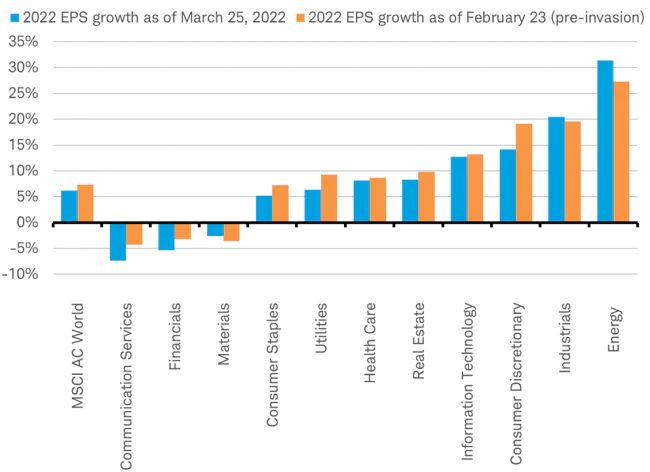
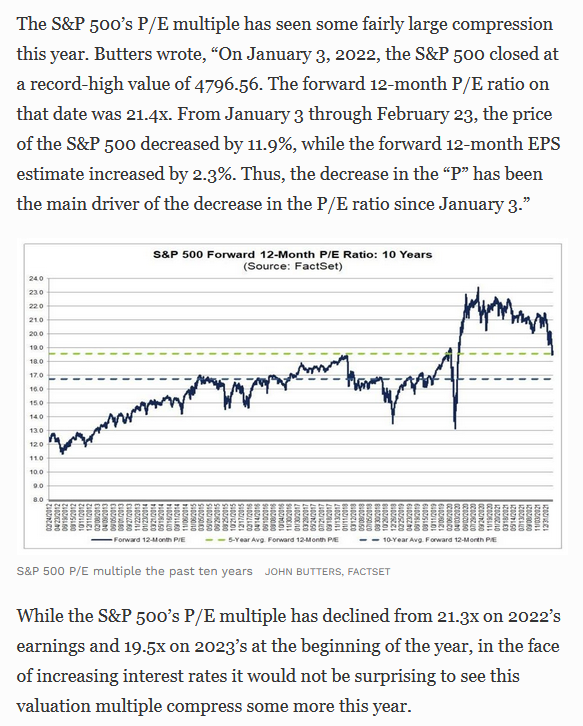
I dati delle immagini di questo Post, ad esempio.

E poi un po’ di semplice matematica, che trovate qui sotto sia nel testo sia nell’immagine. Non vi resta di farveli da soli, due conti, e poi continuare a leggere più in basso.

While we often search for reasons for why the stock market is dropping, sometimes it’s simple math. The yield on the benchmark 10-year U.S. Treasury yield has risen 0.038 percentage point to 2.753% on Monday, and higher bond yields put pressure on valuations by reducing the “equity risk premium,” or the amount of extra return an investor should expect to get from stocks.

The math works like this. The S&P 500 had a price/earnings ratio of 19.35 at Friday’s close. Flip the P/E to get the E/P, or earnings yield, in this case, 5.17%, subtract the 2.75% 10-year yield, and you get an equity risk premium of 2.4%. Now, compare that to the start of the year, when the 10-year traded at 1.5%, and stocks traded at 21.5 times earnings, or an earnings yield of 4.65%. That meant stocks, even at a higher valuation, offered 3.15% more than a Treasury, meaning that investors earned a higher risk premium, despite the S&P 500’s higher P/E at the time.

All of this, of course, is due to the Federal Reserve, which is expected to aggressively hike interest rates this year and next as it battles historically high inflation. It may also be planning to begin “quantitative tightening,” or reducing its balance sheet, as early as its May meeting. Last week, comments from a number of officials at the central bank and the minutes from the last Fed meeting suggested the Fed will move aggressively to tighten policy, with a sizable half-point rate hike expected soon.

“Last week’s unexpectedly aggressive pivot by several Fed officials, who are normally considered to be of a more dovish persuasion, [has seen] U.S. 10-year, 5-year, and 2-year yields hit their highest levels in over three years,” said Michael Hewson, an analyst at broker CMC Markets.

In the spotlight this week will be a key U.S. inflation reading. The release Tuesday of the consumer-price index for March will be the last CPI data the Fed receives before its next meeting on monetary policy.

Also in focus is the start of the first-quarter earnings season. While just 15 companies in the S&P 500 will report results, they include major U.S. financial groups JPMorgan Chase (ticker: JPM) and BlackRock (BLK) on Wednesday, before Citigroup (C), Morgan Stanley (MS), Goldman Sachs (GS), and Wells Fargo (WFG) on Thursday.

Detto qui sopra dei multipli e delle valutazioni, passiamo ora a tratare dei temi principali di questa stagione delle trimestrali: ve li abbiamo, per vostra comodità, evidenziati nel brano che segue.

The good news is that corporate sales are forecast to grow briskly in the first quarter, up from expectations earlier this year.

The bad news is that corporate profits are expected to grow about half as fast as sales. This margin compression doesn’t bode well for stock prices during earnings season, particularly since the market has run up in recent weeks.

The earnings should show an economy that continues to steam along, despite rampant inflation and war in Ukraine. Analysts expect first-quarter sales for S&P 500 companies, in aggregate, to have grown 10.7% year-over-year, up from 9.7% expected growth at the start of the year, according to FactSet. The increased revenue estimates come even as the Russian invasion of Ukraine—and Western sanctions on Russian energy—have boosted commodity prices. On top of that, the Federal Reserve has already begun lifting interest rates to curb economic demand and high inflation. Earnings per share on the S&P 500, are expected to rise 4.8% year-over-year, down from 5.7% expected growth at the beginning of the year. 

When sales growth is faster than profit growth, it means companies’ costs are rising faster than sales and their profit margins are declining. For some companies, higher commodity costs are hurting margins. Others are getting hurt by shortages of steel and other metals. And companies of all stripes are paying higher wages to workers. “We are seeing a real margin headwind for the average company,” says Christopher Harvey, chief U.S. equity strategist at Wells Fargo. 

The falling profit margins are particularly noticeable in the industrials sector. Caterpillar (CAT), is expected to see its operating margin fall to 13.4% in the first quarter from 15.3% in the first quarter last year. Even Deere & Co. (DE), which is usually able to lift prices of its farm equipment substantially when its costs rise, is expected to see its operating margin decline to 20.9% from 22% in the same quarter last year. 3M (MMM) is expected to see its operating margin fall to 20% from 22.5% last year. Indeed, the industrial sector has experienced the largest year-to-date decline in first-quarter earnings estimates out of any S&P 500 sector, according to FactSet. 

Meanwhile, the broader stock market, hit hard earlier this year, has been rebounding in recent weeks. The S&P 500 is up about 7% from its closing low of the year, struck on March 8. A more frothy market only makes future gains harder to come by.

So with stocks getting more expensive, it’s less likely that they will post big gains after reporting earnings. The S&P 500’s aggregate forward earrings multiple is now about 19.3 times, up from a low of just under 18 times last month. Stock prices are now reflecting a large expected earnings stream in the future. 

When stocks trade at such a lofty multiple, companies typically need to beat earnings estimates by a large percentage to send share prices moving up. “You’re setting up for an earnings season that needs to be good, both in terms of the numbers that come in and the forward guidance,” says Dave Donabedian, chief investment officer of CIBC Private Wealth US. “The bar is set high. It’s going to be tough to clear the bar.” 

That doesn’t mean equity investors should give up hope on finding good buys during earnings season. Companies whose shares have already been pounded before releasing earnings could see their shares rise after releasing less-than-stellar results. They could be enticing buys at the right moment. “How has the company traded into earnings?” Harvey says. If a stock is down, it presents “a little bit of a better risk/reward because it’s priced in some of the bad news.”

Lulu Lemon Athletica (LULU) is a good example. The company posted a mixed quarter, missing sales expectations and beating EPS estimates. The stock gained almost 10% the trading day after it reported earnings in late March. It had fallen 12% for the year through the day before earnings. 

It’s a tricky market. Finding beatdown names into earnings reports is one viable strategy. 

Abbiamo chiarito, grazie al brano che avete appena letto, quali saranno i temi intorno ai quali si concentrerà l’attenzione di chi investe in Borsa, negli Stati Uniti come in Europa, nel prossimo mese e più. per completare questo lavoro che Recce’d vi offre, ci concentriamo sulla strettissima attualità: da oggi vedremo quali sono i risultati trimestrali delle grandi banche USA, e quindi abbiamo valutato opportuno selezionare per voi un’analisi di questo specifico settore, analisi che vi offriamo in lettura qui di seguito e che chiude il Post.

Subito all’apertura dell’articolo che segue, leggete il tema “caldo”: la ricaduta dell’aumento dei tassi di interesse sui conti delle banche. Con i nostri Clienti, ne abbiamo discusso in dettaglio nelle ultime due settimane. Loro, i nostri Clienti, non avranno sorprese. Per voi lettori del Blog, nell’articolo abbiamo evidenziato i temi ai quali prestare maggiore attenzione nelle prossime due settimane.

For years, bank investors wanted to see the Federal Reserve launch an aggressive series of interest-rate increases. They are finally getting their wish, but it is unlikely to be much help to the stocks in the near term.

The big banks’ earnings begin this week, with JPMorgan Chase (ticker: JPM) the first out of the gate on Wednesday. Analysts are at a bit of a loss over what exactly to expect from the sector in light of the Fed’s promises of bold moves against high inflation on one side, and the war in Ukraine on the other. 

The Fed’s move to lift interest rates should be a boon for net interest income at the banks because that generally widens the gap between what they pay for funds and what they receive from loans. But the recent inversion of the yield curve, with yields on short-term debt above those on long-term securities, has Wall Street worrying about a recession, which obviously benefits no one. 

One thing Wall Street can agree on is that earnings will be weaker than a year ago because the first quarter of 2021 was so strong. Capital markets and trading activity has been slower and investors can’t count on banks releasing billions of dollars of reserves—money set aside to cover pandemic-era loan losses that didn’t materialize—to boost returns. Across the industry, the team at S&P Global Markets Intelligence expects, earnings will fall by 8.4% despite the benefit of higher rates.

“The Federal Reserve’s efforts to combat inflation will boost banks’ net interest margins, but mountains of excess liquidity will prevent the key metric from returning to prepandemic levels in excess of 3.30% until 2026,” according to Nathan Stovall, principal analyst at S&P Global.

It’s a sentiment widely held on Wall Street. Analysts at Baird expect an unspectacular performance from the stocks as earnings roll in.

“Even with rates being higher in recent weeks, sentiment has become more negative, reflecting general macro fears and the group being crowded and consensus earlier this year. With the stocks being de-risked in recent days, we expect the group to trade OK as we move through reporting,” David George, analyst at Baird, wrote in a recent note.

Barron’s warned earlier this year that it was time to be choosy on the banks. While the sector looks safe, some banks are better equipped to navigate today’s challenges than others.

One area of particular concern is how much Russia’s invasion of Ukraine will weigh on the U.S. banks. So far, the direct impact appears to be quite minimal as many banks pulled back on their dealings with Russia in response to sanctions levied following Russia’s annexation of Crimea in 2014. But little exposure doesn’t equal zero exposure.

Goldman Sachs (GS) and JPMorgan recently said that they plan to exit Russia. JPMorgan noted that it could lose $1 billion due to its Russia exposure. Citigroup (C) has said that it stands to lose $4 billion. Goldman’s exposure to Russia is $700 million, according to the bank’s financial filings.

And then there are the knock-on effects of geopolitical concerns. While the banks themselves may not be directly exposed to the crisis, their clients may be feeling the pain more in terms of higher prices and other difficulties running their businesses. No doubt Wall Street will be paying close attention to this when CEOs give their views on the macroeconomic outlook.

In the first-quarter results themselves, analysts expect to see weakness in investment banking, particularly in equity capital markets. Data from Dealogic shows that revenue is down 75% year over year and 61% quarter over quarter. The volume of deals that have been announced year to date has fallen by nearly a third compared with a blockbuster 2021. Backlogs of transactions appear strong, but completing deals is taking longer due to a tougher regulatory climate.

Trading is also going to be a challenging spot. The first quarter certainly brought volatility but it isn’t clear if it benefited banks. Still, strength in currency and commodity trading should offset weakness in equities.

Here’s what Wall Street expects for the big banks, according to FactSet data:

JPMorgan: Earnings of $2.72 per share on $30.6 billion in revenue. Net income of $8.2 billion, down 42% from last year.

Citigroup: Earnings of $1.43 per share on $18.3 billion in revenue. Net income of $3.1 billion, down 59% from last year.

Goldman Sachs: Earnings of $8.95 per share on $12 billion in revenue. Net income of $3.3 billion, down 51% from last year.

Morgan Stanley (MS): Earnings of $1.76 per share on $14.4 billion in revenue. Net income of $3.1 billion down 21% from last year.

Wells Fargo (WFC): Earnings of $0.82 per share on $17.8 billion in revenue. Net income of $3.3 billion, down 30.6% from last year.

Bank of America (BAC): Earnings of $0.75 per share on $23.3 billion in revenue. Net income of $6.2 billion, down 17.7%.

With the smallest expected drop in profits, Bank of America, which reports next Monday, is emerging as the favorite on the Street, with 61% of analysts ranking it a Buy. The consensus price target implies upside of 28% for the stock. While analysts at Keefe, Bruyette & Woods have a Market Perform rating on the stock, they note it is the “safe play” for this quarter, due to fewer risks for its capital markets business and its positive sensitivity to higher rates.

As for the others, expect a bumpy ride.

Mercati oggiValter Buffo