
Posts in Mercati oggi
La Federal Reserve del 4 maggio 2022: poche le opzioni rimaste (e nessuna buona)
 

Come tutti i lettori del Blog sanno, Recce’d ha smesso di scrivere di Federal Reserve un anno e mezzo fa: in questo ultimo anno e mezzo, sarebbe stato inutile.

Questo perché la Federal Reserve, dalla seconda metà del 2020, per tutto il 2021, e in questo inizio di 2022, è rimasta non soltanto senza parole, ma pure senza strumenti, senza leve, senza armi, senza spazio di manovra. (E la BCE sta messa ancora peggio, e di molto).

E quindi, nell’ultimo anno e mezzo, la Federal Reserve non è mai stata protagonista: ha semplicemente fatto ciò che era costretta a fare, data la situazione (assurda, ai limiti del folle) che lei stessa, la Banca Centrale, aveva contribuito a creare.

Recce’d tutto ciò che aveva da dire in proposito lo aveva chiarito nella parte finale del 2020. E prima ancora, nell’agosto 2020.

E ancora molto tempo prima, pensate: nel 2015.

Oggi, quello che Recce’d scriveva anni fa lo trovate sulla prima pagina dei più autorevoli quotidiani e periodici.

Perché allora, proprio oggi, Recce’d torna a scrivere ai suoi lettori della Federal Reserve?

La ragione è molto semplice: perché adesso la Federal Reserve ritorna a contare. Non tanto sul piano pratico, dove le scelte della Federal Reserve potranno incidere ben poco.

Bensì sul piano della psicologia collettiva. Saranno le parole, più che gli atti, della Federal Reserve, ad incidere.

Dopo avere fatto una drammatica (ed ennesima) “svolta ad U” smentendo sé stessa poche settimane fa, quando ha riconosciuto che l’idea stessa di una “inflazione transitoria” era stata una tragica sciocchezza, adesso la Federal Reserve deve scegliere se continuare a mentire oppure se rispondere con chiarezza, concretezza e in modo esplicito alle domande che con sempre maggiore insistenza i mercati finanziari ed il pubblico dei risparmiatori e consumatori le rivolgono.

In questo Post, vi aiutiamo a ragionare sulle possibili risposte alla seguente domanda: “Che cosa potrebbero fare, davvero, per uscire da questa situazione?”. Un tema affrontato nel Blog di Recce’d qualche settimana fa.

In questo articolo, Nuriel Roubini spiega, in modo efficace, perché i margini di manovra oggi sono molto limitati, se non ridotti a zero, a causa delle scelte effettuate negli anni precedenti.

Roubini in conclusione ci spiega quali sono, a suo parere, i due possibili sbocchi di questa situazione: ovvero, ci illustra i due possibili “endgame”, un tema affrontato anche da noi di Recce’d nel Blog qualche mese fa.
Like the COVID-19 pandemic, Russia's war in Ukraine has contributed to the stagflationary pressures in the United States and other advanced economies. While fiscal and monetary authorities currently have the situation under control, they are likely to run up against the limits of their policy options as conditions change.

The global economy has suffered two large negative supply-side shocks, first from the COVID-19 pandemic and now from Russian President Vladimir Putin’s invasion of Ukraine. The war has further disrupted economic activity and resulted in higher inflation, because its short-term effects on supply and commodity prices have combined with the consequences of excessive monetary and fiscal stimulus across advanced economies, especially the United States but also in other advanced economies.

Putting aside the war’s profound long-term geopolitical ramifications, the immediate economic impact has come in the form of higher energy, food, and industrial metal prices. This, together with additional disruptions to global supply chains, has exacerbated the stagflationary conditions that emerged during the pandemic.

A stagflationary negative supply shock poses a dilemma for central bankers. Because they care about anchoring inflation expectations, they need to normalize monetary policy quickly, even though that will lead to a further slowdown and possibly a recession. But because they also care about growth, they need to proceed slowly with policy normalization, even though that risks de-anchoring inflation expectations and triggering a wage-price spiral.

Fiscal policymakers also face a difficult choice. In the presence of a persistent negative supply shock, increasing transfers or reducing taxes is not optimal, because it prevents private demand from falling in response to the reduction in supply.

Fortunately, the European governments that are now pursuing higher spending on defense and decarbonization can count these forms of stimulus as investments – rather than as current spending – that would reduce supply bottlenecks over time. Still, any additional spending will increase debt and come on top of the excessive response to the pandemic, which accompanied a massive fiscal expansion with monetary accommodation and de facto monetization of the debts incurred.

To be sure, as the pandemic has receded (at least in advanced economies), governments have embarked on a very gradual fiscal consolidation, and central banks have begun policy-normalization programs to rein in price inflation and prevent a de-anchoring of inflation expectations. But the war in Ukraine has introduced a new complication as stagflationary pressures are now higher.

Fiscal-monetary coordination was the hallmark of the pandemic response. But now, whereas central banks have stuck with their newly hawkish stance, fiscal authorities have enacted easing policies (such as tax credits and reduction in fuel taxes) to soften the blow from surging energy prices. Thus, coordination seems to have given way to a division of labor, with central banks addressing inflation and legislatures tackling growth and supply issues.

In principle, most governments have three economic objectives:

  1. supporting economic activity,

  2. ensuring price stability, and

  3. keeping long-term interest rates or sovereign spreads in check through persistent monetization of public debt.

An additional goal is geopolitical:

  • Putin’s invasion must be met with a response that both punishes Russia and deters others from considering similar acts of aggression.

The instruments for pursuing these objectives are monetary policy, fiscal policy, and regulatory frameworks.

Each is being used, respectively, to address inflation, support economic activity, and enforce sanctions.

Moreover, until recently, re-investment policies and flight-to-safety capital flows had kept long-term interest rates low by maintaining downward pressure on ten-year Treasury and German bond yields.

Owing to this confluence of factors, the system has reached a temporary equilibrium, with each of the three objectives being partly addressed. But recent market signals – the significant rise in long-term rates and intra-euro spreads – suggest that this policy mix will become inadequate, producing new disequilibria.

Additional fiscal stimulus and sanctions on Russia may feed inflation, thus partly defeating monetary policymakers’ efforts. Moreover, central banks’ drive to tame inflation via higher policy rates will become inconsistent with accommodative balance-sheet policies, and this could result in higher longer-term interest rates and sovereign spreads, which are already drifting sharply upwards.

Central banks will have to continue juggling the incompatible objectives of taming inflation while also keeping long-term rates (or intra-eurozone spreads) low through balance-sheet maintenance policies. And all the while, governments will continue to fuel inflationary pressures with fiscal stimulus and persistent sanctions.

Over time, tighter monetary policies may cause a growth slowdown or outright recession. But another risk is that monetary policy will be constrained by the threat of a debt trap. With private and public debt levels at historic highs as a share of GDP, central bankers can take policy normalization only so far before risking a financial crash in debt and equity markets.

At that point, governments, under pressure from disgruntled citizens, may be tempted to come to the rescue with price and wage caps and administrative controls to tame inflation. These measures have proved unsuccessful in the past (causing, for example, rationing) – not least in the stagflationary 1970s – and there is no reason to think that this time would be different. If anything, some governments would make matters even worse by, say, re-introducing automatic indexation mechanisms for salaries and pensions.

In such a scenario, all policymakers would realize the limitations of their own tools. Central banks would see that their ability to control inflation is circumscribed by the need to continue monetizing public and private debts. And governments would see that their ability to maintain sanctions on Russia is constrained by the negative impacts on their own economies (in terms of both overall activity and inflation).

There are two possible endgames.

  1. Policymakers may abandon one of their objectives, leading to higher inflation, lower growth, higher long-term interest rates, or softer sanctions – accompanied perhaps by lower equity indices.

  2. Alternatively, policymakers may settle for only partly achieving each goal, leading to a suboptimal macro outcome of higher inflation, lower growth, higher long-term rates, and softer sanctions – with lower equity indices and debased fiat currencies then emerging.

Either way, households and consumers will feel the pinch, which will have political implications down the road.

Mercati oggiValter Buffo
La Federal Reserve del 4 maggio 2022: l'inflazione 2021 - 2022 - 2023
 

Come tutti i lettori del Blog sanno, Recce’d ha smesso di scrivere di Federal Reserve un anno e mezzo fa: in questo ultimo anno e mezzo, sarebbe stato inutile.

Questo perché la Federal Reserve, dalla seconda metà del 2020, per tutto il 2021, e in questo inizio di 2022, è rimasta non soltanto senza parole, ma pure senza strumenti, senza leve, senza armi, senza spazio di manovra. (E la BCE sta messa ancora peggio, e di molto).

E quindi, nell’ultimo anno e mezzo, la Federal Reserve non è mai stata protagonista: ha semplicemente fatto ciò che era costretta a fare, data la situazione (assurda, ai limiti del folle) che lei stessa, la Banca Centrale, aveva contribuito a creare.

Recce’d tutto ciò che aveva da dire in proposito lo aveva chiarito nella parte finale del 2020. E prima ancora, nell’agosto 2020.

E ancora molto tempo prima, pensate: nel 2015.

Oggi, quello che Recce’d scriveva anni fa lo trovate sulla prima pagina dei più autorevoli quotidiani e periodici.

Perché allora, proprio oggi, Recce’d torna a scrivere ai suoi lettori della Federal Reserve?

La ragione è molto semplice: perché adesso la Federal Reserve ritorna a contare. Non tanto sul piano pratico, dove le scelte della Federal Reserve potranno incidere ben poco.

Bensì sul piano della psicologia collettiva. Saranno le parole, più che gli atti, della Federal Reserve, ad incidere.

Dopo avere fatto una drammatica (ed ennesima) “svolta ad U” smentendo sé stessa poche settimane fa, quando ha riconosciuto che l’idea stessa di una “inflazione transitoria” era stata una tragica sciocchezza, adesso la Federal Reserve deve scegliere se continuare a mentire oppure se rispondere con chiarezza, concretezza e in modo esplicito alle domande che con sempre maggiore insistenza i mercati finanziari ed il pubblico dei risparmiatori e consumatori le rivolgono.

Le domande sono molte: anzi, sono decisamente troppe. la scelta della BCE e della Federal Reserve di fare per un anno e mezzo la parte del “pesce in barile” ha prodotto questo accumularsi di domande che ad oggi non anno una risposta.

Tra queste, una delle più importanti ed attuali è la seguente: “Quali sono le cause dell’inflazione 2021-2022?”.

Nell’articolo del Wall Street Journal che grazie a Recce’d avete la possibilità di leggere nella versione integrale qui di seguito viene presa una posizione forte: l’articolo è un editoriale firmato dal Board, dal Consiglio direttivo del quotidiano. Quindi, l’articolo esprime la “linea ufficiale” del maggiore quotidiani finanziario degli Stati Uniti.

Nell’articolo viene contesta la “versione ufficiale” oggi dominante, la “narrativa” che si vorrebbe imporre al pubblico: la storia che ci dice che la principale causa dell’inflazione è Putin.

E’ anche troppo facile smontare questa recente e nuova “narrativa”: sarà più che sufficiente rivedere i numeri per l’inflazione, negli Stati uniti ed in Europa, nei mesi di dicembre 2021 e di gennaio 2022. Ed il discorso è già chiuso.

Il Wall Street Journal pubblicava questo articolo una decina di giorni fa, a commento del più recente dato USA per l’inflazione nella versione CPI, che aveva fatto scrivere a molti di “peak inflation”, ovvero che negli Stati Uniti l’inflazione aveva toccato proprio con quel dato (riferito al mese di marzo 2022) il suo punto più alto.

Poi proprio ieri, venerdì 29 aprile, a smentire questa ipotesi di “peak inflation” è arrivato il dato per l’inflazione USA nella versione PCE, che nella seduta di quello stesso venerdì 29 aprile ha destabilizzato tutti i comparti del mercato finanziario.

Aggungete a questo dato il dato per l’inflazione tedesca, e per l’inflazione UE, che abbiamo letto sempre il 29 aprile, ed il quadro è completo ed esaustivo.

La lettura attenta di questo articolo, pertanto, è un contributo utilissimo per dare una risposta alla domanda: “Dove andrà l’inflazione nei prossimi mesi?”. Sia negli USA sia nell’Unione Europea. Una domanda alla quale nessun investitore può sottrarsi.

In aggiunta, vi aiuterà a riflettere sulle ricadute dell’inflazione sulla futura evoluzione della politica, sia negli Stati Uniti sia in Europa.

White House aides were out in force on Monday warning that Tuesday’s inflation report would be ugly and blaming it on Vladimir Putin. No doubt that beats blaming your own policies. But inflation didn’t wait to appear until the Ukraine invasion, and by now it will be hard to reduce.

The White House was right about the consumer-price index, which rose 1.2% in March, the highest monthly rise since the current inflation set in. The price rise in the last 12 months hit 8.5%, the fastest rate in 40 years.

Energy prices in the month contributed heavily to the increase, and some of that owes to the ructions in oil markets since the invasion. But so-called core prices, excluding food and energy, rose 6.5% over the last 12 months. Service prices excluding energy, which weren’t supposed to be affected by supply-chain disruptions, were up 0.6% for the month and 4.7% over 12 months.

The nearby chart shows that the inflation trend began in earnest a year ago at the onset of the Biden Presidency. It has accelerated for most of the last 12 months. That’s long before Mr. Putin decided to invade. The timing reflects too much money chasing too few goods, owing mainly to the combination of vast federal spending and easy monetary policy.

President Trump signed onto an unnecessary $900 billion Covid relief bill in December 2020, and Democrats threw kerosene on the kindling with another $1.9 trillion in March 2021. The Federal Reserve continues to support negative real interest rates nearly two years after the pandemic recession ended. This inflation was made in Washington, D.C.

Markets on Tuesday took the bad inflation report in stride, perhaps because they had (like the White House) already discounted the news. Or perhaps investors think the March report represents inflation’s peak. Oil prices may not keep rising, and the report did include some good news on used car and truck prices (down 3.8% in the month).

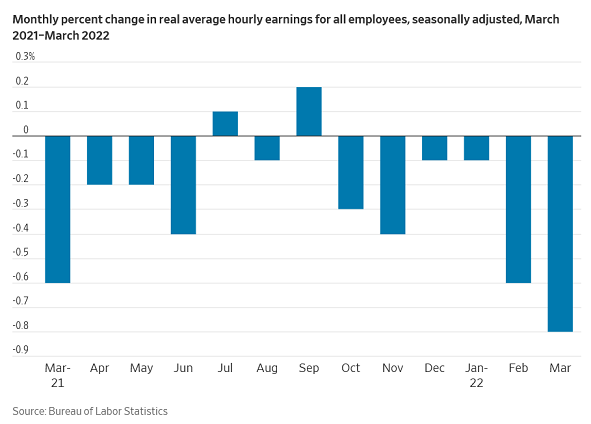
Still, the overall price news is terrible for American workers and consumers. The March surge means that real wages fell 0.8%, or a decline of 2.7% in the last year. (See the nearby chart.) Real average weekly earnings fell a striking $4.26 in March alone, and they’ve fallen nearly $18 during the Biden Presidency. If you want to know why Americans are sour about the economy even as jobs are plentiful, this is it. Their real wages are falling while the prices of everyday goods and services are rising fast. The average worker Democrats invoke when they demand more federal spending is getting crushed by the inflationary consequences of too much federal spending.

The inflation surge calls for a policy shift to tighter money and less spending that fuels excess demand. The Fed is now on the case, raising interest rates and starting to shrink its bloated $9 trillion balance sheet. Its task would be easier had it begun a year ago. Now it will have to move faster in an economy that is still growing, but with less business and consumer confidence.

Even core inflation of 6.5% is more than three times the Fed’s target rate of 2%. The Fed’s consensus target at its March meeting for a fed funds interest-rate peak of 2.8% in 2023 looks inadequate. History suggests that once inflation is this high, interest rates will have to exceed the inflation rate to break it.

That will run the risk of recession. The Fed’s anti-inflation resolve will be tested if growth ebbs and financial troubles erupt. Any central banker can cut interest rates. The Paul Volcker test of monetary mettle is raising rates when the political class is screaming at you.

As for the Biden Administration and Congress, the best anti-inflation policy would be a spending freeze on everything but defense. Cut tariffs, which would be a one-time price cut. Put a moratorium on new regulation that raises costs for business.

***

This advice conflicts with the Democrats’ Build Back Better agenda. But their inflation responses to date of allowing more ethanol fuel (see nearby) and releasing oil from the Strategic Petroleum Reserve are futile gestures. Republicans could pick up the spending freeze and moratorium for their election agenda.

Inflation is a powerful political force because it can’t be explained away. Nearly every voter feels it every day. If the November elections are a referendum on the cost of living, voters won’t blame the Kremlin. They’ll blame the party in power in Washington.

The 8.5% surge in the cost of living in the past year could represent the peak of the worst U.S. inflation in 40 years — but Americans can’t expect much relief from rising prices this year or even next.

The rate of inflation has jumped more than six-fold in the past 14 months from as low as 1.4% at the beginning of 2021. The cost of fuel, food, housing, cars and all sorts of stuff have soared.

Gas prices have jumped 48% from one year ago, for example, and the cost of groceries have climbed 10% to mark the biggest increase in four decades.

“Every time you fill up at the gas station it hurts,” said Robert Frick, corporate economist at Navy Federal Credit Union. “People are going to be paying even more for meat, to which they are very sensitive.”

The sharp and relatively sudden surge caught the Federal Reserve — the nation’s guardian against high inflation — entirely by surprise. Alarmed by the spike in prices, a late-reacting Fed is now speeding up plans to lift low U.S. interest rates quickly to try to put the genie back in the bottle.

Economists predict the increase in inflation will decelerate by year end to 4% to 5%, but they say the central bank waited too long to act. It could take several years, they say, before the Fed’s bitter new medicine pulls inflation closer to its 2% to 2.5% target.

“Clearly they waited too long to get going,” said chief economist Stephen Stanley of Amherst Pierpont Securities, one of the first Wall Street pros to sound the alarm on inflation last year. “It’s going to take them awhile to catch up.”

How the U.S. got here

The roots of today’s inflation run deep.

The Biden and Trump administrations pumped trillions of dollars into the economy during the pandemic to soften the blow. At the same time, the Fed slashed interest rates to record lows and kept them there until just last month.

In short, the economy was flooded with an unprecedented amount of money.

Then as the economy reopened last spring and Americans began to spend freely again, disruptions in global trade tied to the pandemic prevented businesses from being able to obtain enough labor and supplies to meet the demand.

The combination of huge fiscal and monetary stimulus and big shortages has spawned the worst bout of price increases since the late 1970s and early 1980s, when U.S. inflation peaked at almost 15%.

High inflation is also starting to feed into the biggest increase in worker pay in decades, spawning worries about a dreaded wage-price spiral that would make high inflation more long lasting and harder to conquer.

If Americans come to expect high inflation, they’ll ask for more pay. Businesses in turn will charge even higher prices. And on and on the merry-go-round would go — until the economy crashed.

Contrite Fed officials are trying to make amends by more aggressive increases in interest rates, but most still insist that inflation will taper off relatively quickly.

The Fed predicts the rate of inflation will slow to 4.3% by year end using its preferred PCE price barometer. And then drop to 2.3% by the end of 2024.

“This is not the kind of inflation from the 1960s and 70s,” Chicago Fed President Charles Evans said on Monday.

Evans contended the current burst of price pressures is more temporary in nature. He argued inflation will revert back to the low levels that prevailed before the pandemic in a year or two.

Fed officials are likely to take solace from a small 0.3% increase in March in a closely follow inflation barometer known as core consumer prices. It matched the smallest gain in six months.

Yet just as it took time to reduce inflation four decades ago, most economists predict a longer road ahead than the Fed expects.

“The Fed is still largely expecting inflation to self correct and mostly go down on its own,” said chief economist Aneta Markowska of Jefferies, another Wall Street analyst who raised questions about rising prices early on last year.

“I think they are too optimistic on inflation coming down.”

Is the worst over?

So why does the Fed and so many economists — even skeptics like Stanley and Markowska — expect the rate of inflation to slow this year? They think the inflation wave either crested in March or will do so in April. Some like UBS even see the runup in prices mostly reversing by year end.

Fed interest rate hikes this year might restrain inflation a little by making big-ticket items like new houses and autos more expensive, for one thing.

More importantly, the supply-chain bottlenecks that have contributed so much to high inflation are expected to continue to ease.

If businesses can obtain more supplies, the thinking goes, they won’t have to pay as much for materials or charge customers as much for their goods and services.

Finally there’s a statistical mirage of sorts known in economist lingo as “base effects.” As high monthly inflation readings from last year drop out of the 12-month average, it makes headline inflation seem lower.

Take last June, when the consumer price index leaped 0.9%. If several months from now, the CPI rises, say, 0.5% in June, it would make the yearly increase in inflation look smaller.

It wouldn’t necessarily mean that price pressures are easing, though.

A half-point increase in monthly inflation is still historically high, for one thing.

What’s more, the annualized rate of inflation in the first three months of 2022 is still extremely troublesome at 11.3%. That’s how much inflation would rise this year if it increased at the same pace in the final nine months as it did in the first three.

Then there’s the war in Ukraine and Covid lockdowns in China, both of which could exacerbate inflation in the short run.

Russia is a major producer of oil and grains and Ukraine is also a large grain grower. The war has added to the upward pressure on fuel and food prices and the effects could persist well after the conflict is over.

In China, factory closings and the lockdowns affecting millions of people could stanch the flow of goods to the U.S. and put renewed stress on strained supply lines.

The Fed’s big challenge

The real fight to significantly lower inflation is in 2023, economists say. And one of the most “dovish” Feds in history, as Stanley calls it, will only achieve some success if it is aggressive.

That could mean raising a key short-term U.S. interest rate above the central bank’s current goal of 2.8% by the end of 2023 — and possibly slowing the economy to the point of recession.

“Inflation is likely to decelerate, but left on its own, not very rapidly,” said Joel Naroff of Naroff Economic Advisors.

He said there’s still too much demand that businesses can’t meet, a problem that would only be rectified by the Fed icing down a hot economy.

Yet even an aggressive central bank may be limited in what it can achieve quickly. Markowska pointed to a New York Fed study showing consumers think inflation will rise 6.6% in the next year — the highest reading on record.

What do Americans plan to do in response? Keep spending, the survey shows.

Many households have the means to do so.

Wages, for example, have jumped 5.6% in past year to mark the biggest increase in decades and help Americans cope with a higher cost of living. And thanks to unprecedented government stimulus, Americans have an extra $2 trillion-plus of savings in the bank than they did before the pandemic.

“Nobody likes to pay higher prices. The question is, what are consumers going to do about it,” Markowska said. “They are not pushing back at all. They are paying higher prices and moving on.”

If that keeps up, though, Americans will have to use up their savings and eventually find other ways to afford the higher cost of fuel, steak or a beach vacation.

“That’s when you walk in and say to your boss, ‘I need a raise,’ ” Stanley said.

While rising pay would be a good thing for workers, it would give companies even more reason to raise prices and prolong the bout of high inflation.

“I think inflation is going to be around 3% to 4% around the end of the year, but stay stubbornly high relative to the preceding decade,” said Steve Blitz, chief economist of TS Lombard.

Mercati oggiValter Buffo
E' solo un pugno: non è il KO

Ci insegna Mike Tyson che ognuno ha un piano, fino a che non prende un pugno in faccia.

Ognuno è un fenomeno, ognuno si sente un genio, fino a che … non lo è più.

Ognuno si sente un toro, quando scrive in chat agli amici “devi assolutamente investire in Borsa”, “Netfix è un guadagno assicurato”, oppure “il petrolio andrà a 200$ entro tre mesi”.

Poi poi poi.

Poi un venerdì sera si siede davanti al suo pc, come quel signore nell’immagine qui sotto, oppure sta sul divano con il tablet, oppure sta in auto con lo smartphone in mano, e si rende conto che qualcosa non funziona.

I dubbi e le paure spingono subito a cercare sul Web, ma le pagine di informazione e persino i siti per il trading-on-line hanno anche loro cambiato tono.

Soltanto in fondo, piccolo piccolo piccolo, c’è ancora scritto il famoso slogan dei venditori: “bisogna guardare al lungo termine”, come vedete sotto nell’immagine.

Questo non è sufficiente: non basta per calmare le ansie e le paure.

Ma come??? Andava tutto bene ancora a gennaio, eravamo tutti felici e tutti ricchi e non c’erano dubbi e non c’erano motivi di preoccupazione. Come dice uno spot televisivo “investire è facile, basta un minuto”, oppure come dice ancora un altro spot televisivo “facciamo social investing”, è facile quanto scrivere i commenti su Facebook o farsi nuove conoscenze su Tik Tok oppure vedere su You Tube il canale dei comici The Jackal (divertentissimi).

Oggi, dove è finita tutta quella sicurezza di tre mesi fa? E perché è finita?

Cerchiamo una spiegazione subito, immediatamente. Ma che sia diretta, semplice, facile e richieda poco tempo: ad esempio, come le righe colorate sui grafici.

Il fatto, è che leggendo questi grafici e questi numeri … nessuno capisce nulla, e soprattutto non si capisce che cosa si deve fare, per tornare tutti felici e tutti ricchi con il “social investing” la sera comodissimi sul divano di casa con il gatto che fa le fusa.

Non può essere finita così, non può: era bellissimo!

Facciamo partire almeno una petizione, una raccolta firme, una iniziativa su Facebook: “Ridateci TINA”.

Ma TINA se ne è andata: sarà forse fuggita con un nuovo amore?

E allora io mi rattristo, mi deprimo, e non mi sento più toro: non sono più Toro Scatenato, ma soltanto un toro sdraiato.

Mercati oggiValter Buffo
Il grande errore da evitare nella gestione di portafoglio oggi
 

Nella nostra nuova pagina che si chiama GESTIONE DI PORTAFOGLIO raccoglieremo una serie di contributi, sia di Recce’d sia di terze parti, in merito alle tecniche, ai criteri, ai metodi che rendono la gestione di portafoglio un esercizio organizzato e produttivo.

Per generare consistenti performances positive sempre tenendo sotto stretto controllo la volatilità (ovvero, l’ampiezza delle minusvalenze del proprio portafoglio considerato nel suo insieme, e non nelle singole posizioni) è indispensabile procedere sempre in modo sistematico, evitare di “andare a braccio” evitare di “basarsi sull’intuizione”, evitare di “affidarsi all’istinto. Noi ve lo possiamo dire, semplicemente perché noi di Recce’d lo abbiamo fatto, per tutti i nostri Clienti.

L’istinto ci vuole, nell’arte dell’investire così come è indispensabile (ad esempio) per guidare una vettura di Formula 1. Ma se mancano la tecnologia, se mancano gli ingegneri, in Formula 1 non solo non si vince, ma si rischia pure di andare a sbattere violentemente.

Faremo un concreto esempio, che riguarda l’attualità dei mercati finanziari. Che è da mettere in pratica oggi stesso.

Recce’d vi dice: oggi, evitate di andare dietro a consigli come quello che leggete qui sotto.

Chiariamo subito: in questo post, Recce’d NON vuole prendere posizione sull’azionario. Le nostre posizioni sull’azionario, per i nostri Clienti, per fortuna (loro e nostra) le abbiamo già prese mesi fa, e bene abbiamo fatto.

Il Post che state leggendo quindi NON riguarda l’azionario, l’andare LONG oppure SHORT. Il Post si concentra sul metodo.

Andare dietro ad indicazioni come quella che leggete qui sopra è sbagliato, perché se ci andate dietro significa che non avete capito PERCHE’ vengono scritte certe cose.

Non abbiamo chiaramente l’intenzione di incolpare in modo specifico gli amici della versione italiana di Invetsing.com (prima immagine) che sono invece più bravi e capaci di molti loro colleghi del comparto (il trading-on-line) e che pubblicano attraverso il loro sito semplicemente quello che viene scritto sulla stampa e sul Web dedicato alla Finanza ed ai Mercati in lingua inglese.

Il loro obbiettivo? E’ chiarissimo. Loro non scrivono certo per informare il lettore di come LORO investono il denaro. Loro scrivono per una ragione diversa: loro scrivono per dire a VOI dove investire il denaro.

Quando scrivono “il rialzo dei tassi sarà moderato” non hanno la più pallida idea di ciò di cui stanno scrivendo.

Lo scopo è un altro. E’ facile capire che, per loro, c’è una bella differenza se voi investite in azioni, in obbligazioni oppure in altri strumenti: le commissioni, che loro percepiscono, sono diverse.

Lo stesso accade nel caso del vostro family banker, del vostro personal banker, del vostro wealth manager: lui vi dice dove investire, ma non pensa al risultato di quell’investimento. Lui pensa al risultato suo e della sua Azienda, Rete,. Banca. Sono due conti economici ben distinti e molto spesso distanti.

Eccovi spiegato perché ogni giorno leggete, e leggerete sempre, che la cosa migliore da fare è “buy the dip”, comperare i ribassi di Borsa.

Ed ecco perché ogni giorno leggete e leggerete che “nel lungo termine in Borsa si guadagna sempre”.

Magari fosse vero …

Chiudiamo quindi tornando alla nostra nuova pagina del sito GESTIONE DI PORTAFOGLIO. Pubblicheremo note e analisi sui metodi e sulle tecniche, sulle domande che bisogna assolutamente farsi, e sugli errori da evitare.

Un dei quali, oggi molto importante, è evitare di seguire consigli che sono motivati, unicamente, dal conflitto di interesse che domina ancora oggi nell’industria del risparmio, in Italia e nel Mondo.

Non fatevi fregare così facilmente.

Mercati oggiValter Buffo
Longform'd della Pasqua 2022. Ho visto un Re
 

Questa Pasqua del 2022 per gli investitori sembra lontana 100 anni dalla Pasqua del 2021.

Come, non ricordate? Eppure la gran parte dei nostri lettori solo 12 mesi fa era sicura, anzi certissima, che davanti a tutti noi ci fosse il boom economico, che l’inflazione nel 2021 sarebbe scesa al 2% e che le Banche Centrali per l’intero 2022 ed anche per l’intero 2023 non avrebbero (MAI) alzato il costo del denaro.

La gestione del denaro, la gestione degli investimenti, la gestione del portafoglio titoli sono attività nella loro essenza semplicissime: è sufficiente saper distinguere le balle dalla realtà.

In questo specifico caso, tutti noi abbiamo assistito ad un ribaltamento del quadro in soli 12 mesi: ma (fate attenzione) del quadro che veniva presentato come l’unico possibile da Fideuram, da Mediolanum, da FINECO, da Generali e da Allianz allo scopo di vendere a voi investitori le polizze UCITS (oggi svalutatissime, tutte quante) e i Fondi Comuni di investimento. Con la ovvia, compiacente collaborazione delle varie Goldman Sachs, Morgan Stanley, UBS e BNP Paribas, e compagnia di giro.

Era solo una fantasia, un’invenzione. Una balla.

Soltanto quelli che (e non sono molti) hanno saputo un anno fa distinguere tra le balle e la realtà, hanno trascorso questa Pasqua nella piena serenità, perché possono guardare al proprio portafoglio di investimenti come ad una fonte di GUADAGNO. Tra questi, ci sono i Clienti di Recce’d.

Per tutti gli altri, la situazione è esattamente l’opposta: oggi il portafoglio titoli è fonte di future PERDITE e proprio per questo, oggi, domani e dopodomani, non sanno che fare. Seguono dubbi, ansie e preoccupazioni.

Il private banker, il wealth manager, il personal banker, il family banker, il robo advisor: loro oggi sono di NESSUN aiuto.

Loro, a voi, dicono solo di “non vendere mai”, ma .. non sanno neppure fornirvi una buona ragione. C’è solo un caso, nel quale loro sanno che cosa dirvi, e sanno che cosa dirvi si fare: quando i mercati SALGONO. Invece oggi, come disse qualche settimana fa Massimo Doris, in una intervista che Recce’d pubblicò nella pagina MERCATI del sito, tutto quello che a loro rimane da dire è che “i mercati alla lunga recuperano sempre”.

Nello sport è quello che si chiama “il tiro dell’Ave Maria”, oppure alla “spera in Dio”.

Ci sono decine e decine di opportunità, nel mercato finanziario del 2022, del 2023 e del 2024: stanno tutte nel campo opposto. Il vostro private banker, il vostro wealth maneger, il vostro robo advisor non può dirvi dove stanno queste opportunità grandissime, perché lui non sa dove stanno e perché lui non ha gli strumenti per coglierle. Lui è impotente ed è costretto a dirvi che la cosa migliore è “non vendere mai nulla, stare fermi” e pagare il 3% ogni anno sui Fondi Comuni, e sulle polizze UCITS anche di più.

Poveri loro, ma pure poveri voi, come nella canzone cantata da Enzo Jannacci.

Oggi, su qualsiasi quotidiano finanziario che vi capitasse di leggere, ma pure sui quotidiani della stampa generalista, e poi al TG Economia e poi sui canali tematici come CNBC, vi capita di leggere ed ascoltare argomenti, pareri, opinioni ed analisi soltanto su tre temi. Tre temi che, se torniamo alla Pasqua del 2021, proprio non esistevano. Non era proprio il caso di parlarne, un anno fa. E chi ne parlava, come noi di Recce’d, era un pazzo, o peggio, un catastrofista, un pessimista, uno che va “contro”.

“Contro” chi, poi? Non lo abbiamo mai capito.

In sintesi: oggi per noi investitori, per la stampa specializzata e no, e per i media in genere, esistono soltanto tre temi riferiti ai mercati finanziari: tre temi inesistenti (e per qualcuno assurdi) alla Pasqua del 2021.

I tre temi sono:

  1. la recessione

  2. gli Anni Settanta

  3. l’inflazione che avremo nel medio termine

Noi di Recce’d non abbiamo più grande interesse a scrivere di questi tre temi: ne abbiamo scritto, per un anno e mezzo, ai nostri Clienti ogni mattina, ed ai nostri lettori nel nostro sito. Abbiamo già esaminato ogni aspetto di questi tre argomenti. Per fortuna dei nostri Clienti, abbiamo fatto le dovute operazioni nei tempi giusti, e sicuramente senza attendere di leggere le notizie sui giornali.

Oggi, per noi di Recce’d e per i nostri Clienti, i tre temi che dominano sui media e tra i promotori finanziari sono di modesto interesse. Noi di Recce’d li lasciamo con piacere al private banker, al wealth manager, al personal banker, al family banker, al robo advisor: a tutti quelli che a voi dicono solo di “non vendere mai”, che “poi tutto si aggiusta”.

In Recce’d invece oggi dedichiamo per intero la nostra attenzione di professionisti, il nostro lavoro di analisti, e le simulazioni sulle quali basiamo le nostre scelte per il portafoglio modello a quello che verrà DOPO. Dopo che la attuale fase di mercato si sarà completata, nel modo che ormai è per tutti intuibile.

Di quello che verrà dopo, scriveremo e parleremo con i nostri Clienti. A partire da martedì 19 aprile, quando avvieremo una nuova fase di revisione del portafoglio modello, che ci porterà a nuove operazioni di vendita ed acquisto nelle prossime settimane.

Lo spirito di questo Blog, tuttavia, ci richiede di prestare attenzione anche ai temi che per noi sono “i temi di mercato di ieri” mentre per i quotidiani e le TV sono della massima attualità.

Noi vogliamo regalare, a chi ci legge, concreti elementi di valutazione di giudizio, che lo aiutino a preservare il proprio patrimonio dalle trappole preparate per la massa degli investitori dalle Reti che vendono i Fondi Comuni e UCITS, dai promotori finanziari con i nomi inglesi (private banker, robo advisor, eccetera) e dalle grandi banche globali di investimento.

Questo è esattamente il lavoro (fruttuoso e produttivo) che noi di Recce’d abbiamo fatto per i nostri Clienti dal 2007 ad oggi.

Come abbiamo già scritto, e in diverse occasioni, qui nel nostro Blog, molti investitori ingenui hanno sognato favolosi guadagni, nel 2021: ma si trattava soltanto di un sogno, con un risveglio amaro che coincide con il ritorno alla realtà.

Ed ecco perché lo staff di Recce’d, riunito grazie a Zoom anche nel weekend di Pasqua, ha confezionato questo lungo Post.

Per chi ci legge, e non è Cliente, questa è una lettura utilissima: è un grande regalo che facciamo per ringraziare i lettori che ci seguono regolarmente. Il regalo è frutto di quotidiano duro lavoro, e consiste in un supporto qualificato ed applicabile nel concreto.

La lettura del Post risulterà particolarmente utile se il nostro lettore (dopo avere aperto l’uovo ed affettato la colomba, la pastiera o il dolce tipico) dedicherà il tempo necessario a leggere il Post per intero.

Ogni sua parte è importante.

Perché il Post è utile in pratica? Perché è importante? Perché vi aiuterà a capire quello che vedrete le prossime settimane, nei prossimi mesi e nei prossimi anni. Insomma, che fine faranno i vostri soldi.

Prima di lasciarvi alla lettura dei contenuti del Post, vi anticipiamo la conclusione. Vi facciamo rileggere nell’immagine qui vicino una brano del testo della canzone cantata da Enzo Jannacci, brano che ci conferma che la cosiddetta “cultura popolare” del passato può aiutarci ad immaginare il futuro.

Entriamo ora nel merito del Post: torniamo ai tre temi dominanti, oggi, sui mercati finanziari, nella comunicazione finanziaria, e tra gli operatori e gli investitori.

Lo facciamo aiutandoci con tre contributi esterni: per i nostri lettori abbiamo selezionato, tra mille, i tre articoli più significativi ed efficaci nello spiegare a chi ci legge la situazione attuale, ed i possibili sviluppi. Si tratta di articoli utili perché vanno DECISAMENTE nella direzione opposta al “tiro dell’Ave Maria” di cui sopra, ovvero alla pratica consolatoria, verso i poveretti, dello “speriamo nella Provvidenza che a tutto provvede”.

Il primo articolo è dedicato al primo dei tre temi citati sopra: la recessione. Come sempre, noi di Recce’d abbiamo evidenziato i passaggi che, a nostro giudizio, sono i più utili per valutare le diverse probabilità degli scenari che potrebbero presentarsi, sui mercati finanziari ma pure nella vita sociale, politica ed economica.


In a speech delivered less than a week after the Federal Reserve raised interest rates for the first time since 2018, chair Jay Powell acknowledged the historic challenge confronting the US central bank: tame the highest inflation in 40 years without causing a “hard landing” with painful job losses and a sharp economic contraction. “No one expects that bringing about a soft landing will be straightforward in the current context,” he cautioned last month. “Monetary policy is often said to be a blunt instrument, not capable of surgical precision.”

Powell punctuated his warnings with optimism about the US economy’s ability to handle tighter monetary policy, but his comments underscore just how difficult the task ahead will be for the central bank as it charts a new course after two years of unprecedented support. He also poured fuel on an intensifying debate over the magnitude of the collateral damage from rate rises on the US economy.

“Recession risks are no doubt elevated,” said Karen Dynan, an economics professor at Harvard University, who previously worked at the US central bank. “In terms of addressing inflationary concerns, the Fed is facing the biggest challenge it has faced in decades.” Fears the Fed will struggle to moderate inflation while simultaneously sustaining an economic expansion have been stoked by the central bank’s spotty record in successfully engineering a slowdown without causing unintended economic harm.

In six of the past eight campaigns to rein in inflation since the 1970s, when the Fed raised interest rates to or above a “neutral” rate that neither aids nor constrains growth, a recession followed soon after, according to research by Roberto Perli, head of global policy at Piper Sandler. Even before the coronavirus pandemic hammered businesses and consumers, the economy was already slowing down, Perli said, as borrowing costs crimped demand for housing and other big-ticket items and businesses were forced to rethink hiring plans.

Compounding concerns is the enormity of the inflation problem the Fed must now grapple with, which intensified in March as a result of Russia’s invasion of Ukraine. New Covid-19 lockdowns in China that have further gummed up supply chains also risk pushing prices higher. “There’s generally a narrow path for achieving a soft landing, and the path looks extraordinarily narrow now given how far the economy is away from the Fed’s targets and how far policy is away from neutral at the moment,” said Matthew Luzzetti, chief US economist at Deutsche Bank, who forecasts a recession in 2023.

For most of past year, the Fed advocated a gradual scaling back of the pandemic stimulus it injected into the economy on the assumption that inflation would be “transitory” and moderate over time. But as price pressures ballooned and spilled into a broad range of sectors, the Fed was forced to pivot, signalling in recent months increasingly aggressive policy that economists fear could go overboard. “When you wait too long and you tighten aggressively, then you could hurt the people that are being hurt most by high prices,” said Rick Rieder, chief investment officer of global fixed income at BlackRock, referring to low- and middle-income households.

The Fed is now expected to implement at least one half-point interest rate increase this year — a tool it has not used in more than two decades — as part of its efforts to bring the benchmark policy rate closer to neutral, which officials estimate to be roughly 2.4 per cent. It will also soon begin rapidly reducing the size of its $9tn balance sheet at an expected pace of up to $95bn a month. Not all economists believe a recession is a foregone conclusion, however.

Like Powell, other top officials maintain confidence in the Fed’s ability to execute a soft landing. Lael Brainard, a governor tapped to be the next vice-chair, on Tuesday said the strength of the labour market, coupled with “significant underlying economic momentum”, bodes well for such an outcome. A shift in consumer spending away from goods and back into services as well as the waning of pandemic-era fiscal stimulus are also expected to take the heat off inflation, said Julia Coronado, a former Fed economist now at MacroPolicy Perspectives. She said the US central bank was “not doing all the work here”.

Moreover, the Fed will adjust policy on incoming data, many economists say. Donald Kohn, who served as vice-chair in the midst of the 2008 global financial crisis, said the Fed should fine-tune policy as it did in 1994 when the central bank raised rates and steered the economy towards a soft landing. “Chair Powell and the rest of the committee will very much be in the cockpit,” said Gregory Daco, chief economist at EY-Parthenon. “If the nose is diving too much, they will lift it up a little bit by either slowing the pace of tightening or by easing monetary policy.”

For Dennis Lockhart, who was president of the central bank’s Atlanta branch for a decade until 2017, an even bigger risk than a Fed-induced recession is that policymakers again fail to appreciate the severity of the inflation problem and tighten policy too slowly. Lockhart said: “I worry more about the Fed undershooting the situation and having inflation really seep into every crack of the economy and become really deeply embedded in the psychology that affects prices, the business practices of companies and wage demands of what appears to be a resurgent labour movement.”

Abbiamo accennato nell’introduzione all’articolo del Financial Times che avete appena letto alle implicazioni di tipo sociale, politico ed economico: tutti noi investitori dobbiamo comprendere la fase di cambiamento che è già in corso, e che non è eccessivo definire “epocale” (e non soltanto a giudizio di Recce’d).

Proprio per questo, noi abbiamo indicato chiaramente, in modo particolare ai nostri Clienti, che per comprendere dove stanno andando i mercati finanziari oggi è necessario guardare a fondo FUORI dai mercati finanziari. Sarà proprio lì, al di fuori dei mercati finanziari, che si deciderà lo scenario futuro, anche per i mercati stessi.

I mercati finanziari potranno solo adattarsi di conseguenza.

Ne scrive ancora il Financial Times, in un altro articolo recentissimo che segue qui sotto, articolo che ancora una volta propone un parallelo con gli Anni Settanta, un parallelo che questo Blog propose ai Lettori di Recce’d per la prima volta nell’agosto del 2020.

Di questo articolo, noi giudichiamo utilissimi tre richiami:

  • il richiamo a leggere con maggiore attenzione analisi e senso critico i dati già oggi a disposizione

  • il richiamo a rivedere con grande attenzione tutti gli episodi passati nei quali fu effettuata una azione eccessiva di “stimolo”

  • il terzo richiamo è il più importante di tutti: chi oggi dichiara di agire con “gradualità, cautela, prudenza” facendo intendere al pubblico che agire in questo modo per non fare il dispiacere di nessuno (pensate a Lagarde giovedì 14 aprile 2022), in realtà potrebbe invece attraverso le sue azioni “graduali” fare il danno di tutti. Un danno gravissimo.


For the past year, politicians and policymakers have watched the rising inflation on both sides of the Atlantic with growing disquiet. Rapidly increasing prices are the unavoidable result of the pandemic, they have said, before adding that at least the situation is nothing like the disastrous inflation of the 1970s. They need to have a closer look at the evidence.

Consumer price inflation in March hit a fresh 40-year high of 8.5 per cent in the US this week and a 30-year high of 7 per cent in the UK. It has two main causes, and bears many similarities to the first oil shock of late 1973, when Opec states enforced an oil embargo against countries supporting Israel in the Yom Kippur war. Then, as now, both the US and UK labour markets were showing signs of excess demand.

America’s unemployment rate fell to 3.6 per cent in March, only one-tenth of a percentage point higher than its lowest rate in over 50 years, allowing employees to bid up wages to an annual increase of 5.6 per cent. In the UK, the latest labour market figures this week showed an unemployment rate of 3.8 per cent, the lowest since 1973, an all-time record for the number of job vacancies. Total pay rose annually by 5.4 per cent. Compounding domestic excess demand in labour markets is a global supply shock, raising the price of fuel and energy.

In the mid-1970s, the cause was a powerful cartel of oil producers seeking to punish the west. This time round, the culprits are stretched supply chains resulting from the lasting effects of the pandemic alongside a widespread desire to limit gas purchases from Russia. Adding to these global constraints on supply are signs of a lasting domestic hangover from Covid in the labour market, which has reduced the numbers of people ready and willing to work in both the US and UK. Inflation in the US and the UK is therefore both a demand-pull and a cost-push phenomenon, just like it was in the 1970s, requiring us all to relearn the lessons of that decade.

The first, which has been a painful experience for President Joe Biden, is that there can be nasty economic and political consequences of running a high pressure economy. Stimulating demand was thought to be a policy with few downsides because it would increase employment, re-engage the marginalised with the labour market and raise real wages. But we have come to relearn that excessive fiscal and monetary stimulus alongside rapidly growing employment and nominal wages do not make middle-class Americans better off in aggregate if prices rise faster than incomes. Worse, those that are poorer give you no credit for helping other people into work if their struggles mount. Despite the UK’s extremely strong labour market, real household disposable incomes are on track this year to suffer their largest fall since comparable records began in 1956.

The second lesson was reiterated by one of the founding fathers of the European single currency this week. Criticising the European Central Bank for being too slow to increase interest rates, Otmar Issing noted that the Bundesbank was by far the most successful in the 1970s when it acted decisively to bring inflation down and West Germany suffered only a mild downturn. “The Fed waited too long”, he said, resulting “double-digit inflation and a deep, deep recession”. The UK authorities made even greater mistakes. Given the history and the current circumstances of excess demand, it is evident that the Federal Reserve and the Bank of England need to tighten monetary policy considerably, removing much of the stimulus that currently exists. The difficulty, as Issing himself noted, was knowing how much to remove and how quickly. The global supply shock element of higher energy, fuel and food prices will naturally reduce domestic demand, and by more in countries, such as the UK, which are net importers of these products.

Sadly, this brings us to the third and final lesson of the 1970s. Calibrating policy as successfully as the Bundesbank did back then is extremely difficult and will require as much luck as judgment. The risk of recession on both sides of the Atlantic is now very high. Perhaps it is already too late, the inflation genie is out of the bottle and monetary policy needs to generate a recession to drive it out of the system. Alternatively, policymakers will be too cautious, too slow and allow inflation to persist and embed itself in the economy with the same ultimate consequences.

The path we all desire is narrow and sits in between these economic disasters. It is possible we will eradicate high inflation without a deep economic downturn, but the odds on this favourable outcome are now low indeed.

Abbiamo affrontato, in questo Post, con dettaglio e specificità, il tema “recessione” e di seguito, qui sopra, il tema “Anni Settanta”. C’è un terzo tema che domina, oggi, tra gli investitori di tutto il Mondo, tra gli operatori dei mercati finanziari, sulla stampa finanziaria e non, sul canale CNBC.

Si tratta del tema della “inflazione di medio termine”. Oggi l’inflazione è vicina al 10%, ed il tasso di crescita dei prezzi alla produzione sta tra il 10% ed il 20% a seconda delle diverse Aree economiche. Il danno, è fatto, è qui, è ora.

Ma dove sarà tra 12 mesi? E tra 24? Un danno più piccolo? Oppure più grande ancora?

Le Banche Centrali oggi ci dicono tutte che “l’inflazione tornerà al 2%”, ma le Banche Centrali a Pasqua 2021 ci dicevano che sarebbe “tornato al 2%” già nel dicembre del 2021, e quindi .. a noi investitori, che ce ne importa, di quello che dicono le Banche Centrali? A noi, per decidere sulle scelte di vendita e di acquisto, non serve assolutamente a nulla.

Ecco dove, nello specifico, questo Post vi sarà utile: a differenza dei private bankers, dei wealth managers, dei venditori di GPM e di prodotti finanziari in generale, da Recce’d ottenete qualche cosa che non è semplicemente la “ministra riscaldata” delle dichiarazioni delle Banche Centrali che vi viene rifilata dal private banker.

Noi vi regaliamo questi supporti, critici e qualificati, allo scopo di consentirvi di fare una vostra valutazione: ci aspettiamo, ovviamente, di essere contattai da voi attraverso il sito se ritenete utile approfondire, e magari anche mettere in pratica, investendo meglio i vostri risparmi, rispetto a quanto fatto fino ad oggi. Ne potete ricavare un concreto, e notevole, beneficio, sia in termini di guadagno sia in termini di migliore comprensione di quello che state facendo dei vostri soldi.

Dell’articolo che segue, che vi chiediamo di leggere con attenzione, vogliamo evidenziare tre considerazioni:

  1. si sottolinea che con il trascorrere dei mesi l’inflazione diventa un fenomeno radicato in tutta la società: non è un problema che riguarda esclusivamente i mercati finanziari

  2. si mette in evidenza che questo radicamento è un costo per l’economia reale, di imprese e famiglie (e di nuovo, i mercati finanziari non c’entrano)

  3. ed infine, il punto più importante di tutti: dove si scrive che ad un certo punto la stabilità può diventare più importante del livello assoluto di inflazione.

Recce’d aggiunge: la stabilità può diventare più importante del livello assoluto di inflazione ma pure del livello assoluto di crescita economica, di crescita delle retribuzioni, di crescita del reddito disponibile.

E pure del livello assoluto dei mercati finanziari.

Benevenuti nel vostro scenario futuro. Molti, tra di noi, lo hanno già vissuto.

I vostri investimento, il vostro portafoglio, è pronto?

(Bloomberg Opinion) -- Now that inflation is back, it's not going away anytime soon. The Federal Reserve expects it to fall below 3% next year and eventually go back to 2%. But there are reasons to think that’s far too optimistic. We are living in a new world. Even after things get back to normal that could mean inflation averages 4% or even 5% for the foreseeable future.

The Fed can almost be forgiven for its optimism. The idea that inflation was no longer a concern had become conventional wisdom before the pandemic. Many articles were written explaining why. Pension funds pulled back on their promises to increase benefits with inflation, and hardly anyone noticed.

But now inflation is up to 8.5% and, between lockdowns in China and the war in Ukraine, it could go even higher this year. At some point, we hope, the world will fully open and some of the pressure will lessen. But these times could leave lasting scars on the economy and we may have seen the last of 2% inflation for a while. Americans used to live in a world where 4% or 5% inflation was the norm, and that could be where it settles in the future.

There are many reasons why inflation became so low and stable in the last 30 years. One popular explanation is after years of missteps, the Fed finally figured out what worked. During the last serious bout of price increases in the 1970s, Fed Chair Paul Volker raised interest rates high enough to cause a recession.

This created confidence that the Fed would do what it takes to keep inflation in check and that credibility helped keep inflation low, because today’s economy is largely driven by expectations about what future inflation will be. There were other economic forces that kept prices from rising.

Global trade grew, we bought more goods from countries with lower labor costs, and companies learned to keep tighter inventories, taking full advantage of the global supply chain and making production leaner and more efficient. The internet also empowered consumers to do more comparison shopping, which kept prices lower.

Inflation returned after the pandemic because the ripple effects of Covid disrupted global supply chains and created shortages of goods. People got extra money from the government as they hunkered down at home, and they spent it on goods instead of services just as supply contracted. Government policy poured fuel on the fire by sending even more checks, while the Fed continued to keep rates at zero and kept buying long-dated assets, all of which was designed to increase demand even further to avoid a recession and bring unemployment down. In short, prices went up because there was less supply and a lot more demand. And even after the government put the brakes on writing checks, the effects will linger for many months.

People saved some of that money and are still spending it. Monetary policy still is expansionary and its impacts will also be felt for many months. These are some of the reasons to believe that even after the dust settles on the pandemic, and hopefully on the war in Ukraine, we might still be in a higher-inflation world.

So far, the Fed has not indicated it deserves or will maintain its credibility for keeping inflation in check. It was slow to acknowledge price increases were a serious and persistent problem, and it still only plans to increase rates slowly to a level that may be below inflation. Many economists don’t think it will be enough.

So far, most indicators of inflation expectations, bond yields and surveys, are still fairly low. But the longer inflation sticks around the harder it is to get rid of. Inflation was not on anyone’s radar for a long time. Now it is. That means it may get baked into wage increases, companies will get used to raising their prices and inflation can become entrenched even as supply and demand pressures ease.

Meanwhile, some deflationary forces may soon reverse. Economist Charles Goodhart expects an aging population, especially in China, will spell the end to cheap labor that produced low-priced goods. Efficiency could suffer long term from the supply-chain disruptions if firms maintain bigger inventories as a cushion against future shortages.

The White House is pushing more domestic production and encouraging less trade, which will make goods more expensive. Democrats and Republicans both favor these policies; odds are they will continue no matter who is in office. On the bright side, higher inflation needn’t be bad for the economy. Uncertainty creates the biggest problems.

If people don’t know whether inflation will be 2% or 5% year-to-year, this can pose many costs. Firms don’t know how much they can increase prices without it affecting the demand for their goods and services, and workers don’t know how much of a raise they need to maintain their purchasing power. Saving, spending and investment decisions all become much harder.

All this uncertainty can cause people to pull back on economic activity, which harms the economy. Stability can become more important than the actual level of inflation. If it’s higher but remains in a tight range, it won't cause too much damage to the economy. When the average inflation rate was 4% or 5% for many years, the economy still grew.

Before the latest events, several economists even argued the Fed should target a 4% inflation rate because it would provide more room to conduct monetary policy. Ultimately, the Fed may not have much control over where inflation settles. It’s largely driven by the macroeconomic forces in our economy that the Fed has limited influence over.

But if the Fed pursues responsible, consistent and transparent policies it can promote price stability. That means we could be living in a stable, 4% inflation world, and that may be the best we can hope for.

Mercati oggiValter Buffo