
Ucraina: un evento storico, non il solo evento storico del 2022
 

Tutta la simpatia di noi di Recce’d va alle vittime del conflitto che si è scatenato in Ucraina, e da sempre pensiamo che la guerra è una tragedia da evitare ad ogni costo.

Non sempre è evitabile, questo lo sappiamo: ed è per questa semplice ragione, che ci leggete qui intenti a fare il nostro lavoro, anche quando la nostra emotività ci porterebbe a impegnarci a favore delle vittime di questa tragedia.

Il nostro lavoro ci impone, in momenti come questi, di mantenere al massimo la lucidità, la concentrazione sui temi sui quali dobbiamo risposte ai nostri Clienti, ed una visuale il più ampia possibile, anche al di là del conflitto bellico.

Il nostro lavoro ci impone di ricordare, ai Clienti ed in questo Post anche ai lettori, che la guerra NON costituisce, oggi nel marzo 2022, il principale problema che i mercati finanziari si trovano di fronte. Non è quello dell’Ucraina, e lo vedrete, il tema centrale di questo 2022: non dipenderanno da questo (e lo scrivevamo proprio qui nel Blog già alcune settimane fa) i rendimenti ed i rischi delle diverse classi di attività finanziarie nel 2022.

O meglio, non dipenderanno PRINCIPALMENTE da questa vicenda, bensì soprattutto da altre vicende.

Non ci dilunghiamo: l’incalzare dell’attualità ci costringe questa settimana ad un utilizzo molto attento dei tempi, che per noi sono strettissimi data la grande mole di lavoro che dobbiamo fare per i Clienti.

Ci faremo quindi aiutare: il nostro lavoro di raccolta e selezione delle informazioni per il Cliente ci consente di individuare i commenti più utili ad anticipare gli sviluppi dei mercati finanziari, ed alcuni di questi (una piccola parte) li pubblichiamo poi nel nostro Blog.

L’articolo che segue vi può essere utile per una serie di ragioni: tra le tante, noi vi segnaliamo con questo articolo che il conflitto in Ucraina non è il solo evento storico a cui state assistendo.

Ha ragione chi dice, alla Tv, che il conflitto in Ucraina è storico perché è il primo conflitto di questo tipo in Europa dalla Seconda Guerra Mondiale. Ma, pensando al nostro portafoglio in titoli, ed ai nostri investimenti sui mercati finanziari, a nostro giudizio risulta ancora più “storico” l’errore fatto dalle Banche Centrali sull’inflazione.

Che cosa lo dimostra? Il fatto che, per ritrovare un episodio della medesima gravità, è necessario ritornare a prima, della Seconda Guerra Mondiale. Al periodo tra le due Guerre Mondiali.

Il titolo dell’articolo, giustamente, è il seguente: “L’errore storico della Federal Reserve”.

CAMBRIDGE, England (Project Syndicate)—A close friend who has been incredibly successful in his tech career once observed that an initial suboptimal decision is likely to lead to a series of subsequent bad decisions. Economists call this “multiple equilibria.” And the Federal Reserve, the world’s most influential monetary institution, finds itself in the midst of such a situation regarding inflation—with implications that extend well beyond U.S. economics and finance.

The initial phase of the Fed’s ongoing inflation mistake—an error that will likely be remembered as one of its biggest ever—started with last year’s protracted mischaracterization and dismissal of price increases as “transitory.” Although evidence of persistently high inflation dynamics was increasingly visible, the Fed repeatedly dismissed these signs, failing, most notably, to heed the warnings expressed by firms on one earnings call after another.

Double down on the wrong policy

It is not entirely clear what was behind the Fed’s initial misstep on inflation. What remains baffling is that, for most of 2021, policy makers seemed eager to double down on their “transitory” claim, rather than show humility as their inflation forecasts were revealed to be repeatedly and spectacularly wrong.

Even today, officials are hindering the restoration of the Fed’s badly damaged credibility by not explaining why they made this protracted mistake. I suspect the reason involves some combination of cognitive capture, loss of focus, unwillingness to admit error, and reluctance to abandon a “new monetary framework” that quickly became outdated and counterproductive.

It was not until the end of November 2021 that Fed Chair Jerome Powell—finally and belatedly—declared it was time to “retire” the word “transitory.” But then came the second stage of the Fed’s multifaceted blunder. The policy adjustments that followed Powell’s statement were extremely modest, with the Fed announcing only that its large-scale asset-purchase program, known as quantitative easing (QE), would be wound down entirely by March 2022.

Losing control of narrative

That was the time for the Fed to do two things to restore its inflation credentials and retain adequate control of its policy narrative. First, it should have explained why it messed up its inflation call so badly and how it had adjusted its forecasting models to be less wrong in future. Second, the Fed should have taken significant initial policy steps and provided guidance about what would follow.

Having failed to do either, the Fed then entered the third stage of its historic mistake by losing control of the policy narrative just as inflation readings were getting worse.

Nothing highlighted better the big hole that the Fed had dug itself than the fact that, as late as February 2022, it was continuing its QE liquidity injections, even though inflation was running at 7.5%, a 40-year high. Astoundingly, and despite calls to act, the Fed had rejected an immediate halt to QE at both its December and January policy meetings.

All of which brings us to today. Inflation readings continue to surprise on the upside, and Russia’s invasion of Ukraine will increase the risk of a stagflationary shock. Meanwhile, Fed officials have offered different views publicly regarding how the central bank should approach both interest-rate hikes and reducing its bloated $9 trillion balance sheet.

Lacking any proper guidance from the Fed, the market rushed to price 7 to 8 rate hikes in 2022 alone. Some Wall Street analysts went as far as 10, including a 50-basis-point hike as soon as the Fed’s mid-March meeting. Others urged the Fed to implement an emergency intra-meeting rate increase.

You can’t get there from here

The Fed’s suboptimal decisions over the past 12 months mean that its next policy decision also is likely to be suboptimal. Even if it had a good feel for the current “first best” policy response, the Fed is unlikely to be able to implement it, given how far policy makers have fallen behind economic realities. To paraphrase the old Irish joke, you can’t get to a first-best policy starting from here.

Rather than being able to deliver a smooth landing for the U.S. economy, the Fed must now judge what constitutes the least harmful alternative. Such a choice is like being forced to select an already dirty shirt because no clean ones are available anymore. And that is not a good look.

Mohamed A. El-Erian, president of Queens’ College at the University of Cambridge, is a professor at the Wharton School of the University of Pennsylvania and the author of “The Only Game in Town: Central Banks, Instability, and Avoiding the Next Collapse” (Random House, 2016).

This commentary was published with permission of Project Syndicate — The Fed’s Historic Error

La nostra intenzione, con questo Post ed attraverso la lettura dell’articolo precedente, è precisa: vogliamo ricordare ai nostri lettori che NON è dai titoli dei TG che potete ricavare le informazioni che sono le più importanti per le vostre scelte di investimento.

Oggi, tutta l’attenzione si concentra, comprensibilmente, sull’Ucraina. Ma voi, in quanto investitori, non potete permettervi di andare in confusione.

Oggi, per noi e voi e per tutti gli investitori, ci sono altri temi, che avranno in prospettiva un impatto ancora maggiore sui vostri investimenti e quindi sui vostri guadagni o perdite.

La nostra intenzione, quindi, è quella di esservi utili, nello stabilire un giusto ordine di importanza e di priorità.

Tra i lettori del nostro Blog, non sono molti quelli che hanno vissuto le precedenti esperienze delle economie occidentali con l’inflazione, ed in particolare l’esperienza dell’iperinflazione tra le due Guerre Mondiali. Proprio per questa ragione, noi offriamo in lettura qui sotto un’utile articolo di Martin Wolf, che aiuterà il nostro lettore a collocare il problema di cui ha letto nell’articolo precedente nella giusta prospettiva storica.

E’ appropriato definire storico l’errore commesso dalle Banche Centrali, come si faceva nell’articolo qui sopra. Per noi investitori adesso si tratta di capire se risulteranno storiche anche le conseguenze di questo errore, ed in quale ambito.

Perché Recce’d insiste proprio su questo punto? Per una ragione pratica: l’investitore che oggi non è consapevole di essere di fronte ad un evento storico, cade nella trappola di quelli che dicono che “tutto va avanti come sempre”, ed opera sul proprio portafoglio titoli come se tutto dovesse andare avanti “come sempre”. E’ un grave errore.: stiamo affrontando una fase di cambiamento radicale, una fase storica, e lo capirete bene leggendo l’articolo che segue. E, nel caso eventuale in cui questo secondo articolo non sia sufficiente, allora dopo l’articolo abbiamo pubblicato, in una immagine, una parte dell’Audizione di Jerome Powell della settimana scorsa al Congresso. Che elimina, in modo definitivo, ogni dubbio.

Una fase di profondo cambiamento richiede un cambiamento altrettanto profondo nei modi e nei tempi della gestione dei propri investimenti. Troverete noi di Recce’d pronti e disponibili ad accompagnarvi lungo questo percorso di cambiamento.


“Inflation is always and everywhere a monetary phenomenon.” Milton Friedman made this remark in 1963. At that time, few macroeconomists agreed with him. Twenty years later a high proportion did. Twenty years after that, again most did not. Today, almost another two decades later, economists have to take money seriously again. If money is ignored, it will take revenge.

As Bridgewater’s Ray Dalio recently asked: “Where is the understanding of history and the common sense about the quantity of money and credit and the amount of inflation?”

The idea that there is a link between the money supply and inflation is very old. When people are holding more money than they desire, they will want to get rid of it. With any other asset, this would lower its price. But the nominal price of money is fixed: a dollar is a dollar. The adjustment comes via higher prices for everything else — or inflation. After an exceptional monetary expansion in 2020, we are surely seeing this. I noted the possibility in May that year.

Tim Congdon, a well-known monetarist, had argued this before me. According to the Center for Financial Stability, “Divisia M4” (an index that weights the components by their role in transactions) grew by 30 per cent in the year to July 2020, almost three times as fast as in any similar period since 1967. No such thing happened after the 2008 financial crisis. Many then worried over the expansion of the monetary base. But that did not matter because it did not affect broader aggregates.

A big lesson of history is that if economists think they understand how the macroeconomy works, they will be wrong.

  1. In the 1930s, the conventional wisdom was that the economy was self-stabilising.

  2. In the 1960s, it was that inflation expectations and money did not matter.

  3. In the 1980s, it was that only money mattered. In the 2000s, it was that credit expansion would not destabilise the financial system.

  4. In 2020, it was that money was irrelevant.

Again and again, we fall in love with naive stories. We want to believe the economy is a simple mechanism, but it is not. In 1975, the British economist Charles Goodhart argued that “any observed statistical regularity will tend to collapse once pressure is placed upon it for control purposes”. His insight was applied to the failure of monetarism to steer the economy.

But Friedman would not have been surprised. He had argued that money affected the economy with “a lag that is both long and variable”. But he did not believe in steering the economy. Those who did moved on to inflation targeting instead. Yet “Goodhart’s law” has a plausible corollary: once a measure ceases to be a target, it will again become meaningful.

As Mervyn King, former governor of the Bank of England, noted in an outstanding recent lecture: “Money has disappeared from modern models of inflation.” That is ridiculous. So, why has this happened? It is because technocrats have a foolish tendency to prefer being precisely wrong to being roughly right. So, where are we today? Optimists argue that the inflation we are seeing is just the result of temporary shortages caused by the pandemic. That is indeed part of the story, as a recent paper from the IMF explains. Yet the requirement, it asserts, is “to sustain a still-incomplete recovery and ensure that output catches up with its pre-pandemic trend — without allowing wages and prices to spiral upwards”. Indeed.

The difficulty is that, as Robin Brooks of the Institute of International Finance has shown, inflation has become general: in the US, the weight in the index of items with price rises of over 2 per cent in the year to January 2022 was just under 90 per cent.

To make things worse, Alex Domash and Lawrence Summers argue that measures showing a very tight US labour market, such as the vacancy and quit rates, are better indicators of inflationary pressures than non-employment. Worse, today’s labour market tightness would previously have been associated with sub-2 per cent unemployment. In sum, the inflationary genie is out of the bottle, especially in the US.

The danger is that this ignites a spiral, in which inflation expectations shift upwards, causing a flight from money and so further destabilising expectations. There is no point in insisting this will not happen, because it clearly might do so when inflation is so far above the target and previous forecasts. Credibility will have to be preserved, whatever it takes. Line chart of Inflation generalisation: weight (%) of items in basket with year-on-year inflation above 2% showing Year-on-year inflation is far from restricted to just a few items

What this means in policy now is difficult enough. But as King powerfully argues, central bankers also have to reconsider some of their recent doctrines. Just as the financial crisis showed that banking matters, so this inflationary upsurge shows that money matters. It also indicates that forward guidance assumes more knowledge than anybody possesses. Central banks may explain their reaction function, but cannot say what they are going to do, because they do not know what the economy will do.

Last but not least, average inflation targeting is surely stillborn. It never made sense to target future inflation in the light of past mistakes. Is the US Federal Reserve really going to lower inflation below 2 per cent in order to make up for a prolonged overshoot? What does make sense is to reassert its determination to hit its forward-looking target. But it is also possible we are going to see a degree of financial instability that will force deeper thinking on this, too.

We should always remember how little we know about the economy. Central banks must be humble and prudent. They cannot ignore valuable information just because they do not like what it shows. Yes, we cannot steer the economy via the money supply. But we cannot ignore it either. It carries warnings.

martin.wolf@ft.com

Era facile sentirsi ricchi: ma era un miraggio
 

Come scritto oggi in un altro Post, anche i poveri si sentivano ricchi nel 2021: per merito della Borsa, del Bitcoin, o di una truffa sui ristori, noi non lo possiamo sapere.

Come tutti avete visto, anche da questo punto di vista il 2022 ha poco o nulla in comune con il 2021..

Nei primi mesi del 2022, non avete più sentito parlare di auto nuova, barca nuova, casa nuova: è cambiata la psicologia della massa.

Da un clima di “festa per la quale nessuno pagherà il conto”, si è passati al classico clima da “la festa è finita”.

Ma la cosa peggiore non è questa: la cosa peggiore è rendersi conto che una festa, una vera festa, non è mai esistita: mentre purtroppo ci resta, a tutti quanti da pagare un conto molto salato. Da pagare soltanto per avere avuto il gusto di raccontare in giro di “avere fatto dei gran bei soldi”, che poi nessuno ha fatto veramente.

Non si tratta di una previsione: le cose stanno già così oggi. Nel Regno Unito, si stima che sia in arrivo già nei prossimi mesi, tra tasse e bollette, un calo del potere di acquisto di dimensioni eccezionali (lo documenta qui sotto l’articolo).

E se pensate che soffriranno “soltanto i poveri”, beh … siete degli ingenui. Soffriranno tutti, poveri e meno poveri o futuri poveri, perché quel calo del potere di acquisto, ovviamente, colpirà tutti i generi di beni di prima necessità, dal pane al latte al gasolio all’immobile … fino al Bitcoin e alle azioni Tesla.

Ve lo documentiamo con l’articolo che segue.

Quanto alle implicazioni per le scelte di investimento, come sempre trovate Recce’d disponibile a confrontarsi ed a mettere a vostra disposizione le nostre competenze e la nostra esperienza. Contattateci, quanto prima, attraverso il nostro sito, se non volete perdere altro tempo a correre dietro al miraggio.

Millions of Britons who previously found themselves financially 'comfortable' are feeling the heat over accelerating inflation, record energy bills, and tax increases which kick in this year.

According to the Bank of England, scorching inflation will result in the largest drop in disposable income in 30 years when adjusted for inflation.

In April, UK energy bills are due to jump 54% to around 2,000 pounds ($2,723) a year per household. While some of it will be offset by emergency government support - and social security will also increase, it will be against the backdrop of rising interest rates according to Reuters.

"There's just too much going up at once," said 38-yaer-old care worker Nicola Frape, who huddles under blankets with her 14-year-old daughter to conserve heat, and have limited roadtrips due to the price of gas. "The pressure is just going to be even worse in April," she added.

With economies around the world rebounding from coronavirus lockdowns, prices for everything from food and clothes to haircuts and rent, as well as energy are going up, fuelled by resurgent demand and shortages due to supply chain disruptions.

Accurate national comparisons of changes in living standards are hard to make but concerns about inflation are emerging as a big factor in elections including France's presidential race in April and U.S. midterm elections in November. -Reuters

A February survey found that the number of people experiencing food insecurity was 20% higher in January than the previous six months, according to FT.

The decline in living standards for much of the UK population prompted chancellor Rishi Sunak last week to announce a £9bn package to help struggling households.

On the same day energy regulator Ofgem announced a 54 per cent rise in energy bills and the Bank of England increased interest rates from 0.25 per cent to 0.5 per cent. It warned inflation could hit 7.25 per cent by April, threatening to limit people’s spending power as a planned increase in National Insurance contributions reduces their take-home pay.

In January, Britain's consumer price inflation hit 5.5% y/y, the highest since 1992. It's set to top 7% in April, at which point the BoE thinks they may begin to slow. That said, they also expect it will be above 5% in a year's time. 

In the US, 'official' inflation is north of 7% - the highest since the early 1980s.

According to the National Institute of Economic and Social Research think tank, the combination of April's payroll tax increase plus inflation could result in a 30% rise in destitution across the UK.

The rampant inflation in the UK has sent government interest rates soaring - hitting £6.1bn last month, the highest amount for a January since records began in April 1997 and up from £4.5bn last year, the BBC reports.

The payments are pegged to the Retail Prices Index (RPI) measure of inflation - which reached 7.8% in January.

January's interest payments were, however, below the all-time high of £9bn in June last year.

Paul Johnson, director of the Institute for Fiscal Studies, told the BBC it was worth noting that "overall interest payments by the government are still at remarkably low levels" despite UK debt levels at the highest for 60 years. -BBC

Meanwhile between April and September of 2021, food bank deliveries rose 11% vs. the same period in 2019, hitting one of its highest levels ever in December. At one West London food bank, Dad's House, some of the former donors to the charity are now recipients of support.

"I have to pay my bills," said Jackie Gordon, 52. "I'm behind with my rent and I don't want to get evicted."

Rebecca McDonald, a senior economist at the Joseph Rowntree Foundation, said this year will likely leave a lasting mark on poorer households regardless of whatever inflation does.

"It's going to feel like a much more longer-term issue because this year is going to be incredibly difficult," she said, adding that many formerly financially sound families will likely go into debt this year.

Mercati oggiValter Buffo
Guadagni favolosi con la Borsa 2021
 

In chat, al bar o al ristorante, negli ultimi mesi c’è sempre qualcuno che racconta dei suoi “guadagni di Borsa nel 2021”.

Nuova auto, nuova barca, nuova casa, e tutto pagato dalla Borsa che sale (oppure, magari, dal Bitcoin).

Non è la prima occasione nella quale noi ci troviamo ad affrontare, da professionisti, una situazione come questa: nel passato, ce ne furono altre e noi le ricordiamo perfettamente.

Mai, non oggi e non nelle precedenti occasioni, questi “vincitori della Lotteria” hanno documentato le loro favolose “vincite”, almeno davanti a noi.

Molti sono invece quelli che, in passato, davanti a noi hanno piano (lacrime vere) sulle perdite che poi sono maturate.

Non parliamo qui di minusvalenze, bensì di perdite. Sono due cose diversissime.

E proprio per questo, anche questa volta, invece di credere a quello che ci viene raccontato in chat oppure al bar, noi di Recce’d utilizziamo la nostra capacità di giudizio chiedendoci se quelle “vincite alla Lotteria della Borsa” non siamo piuttosto soldi che derivano da una truffa di massa allo Stato (quella dell’immagine qui vicino, e che tutti voi bene conoscete).

Quando uno Stato mette in atto manovre cosiddette “di stimolo a pioggia”, ma non ha poi ovviamente le risorse, ed il tempo, per controllare, ci si trova poi sempre di fronte a notizie come queste.

Si poteva prevederlo..

E tutto questo allo scopo di “fare credere in una ripresa che non c’è”. Come di recente è stato scritto molto lucidamente, proprio in merito agli stimoli al settore immobiliare italiano, anche dall’ex Ministro del Tesoro Tremonti.

Torniamo ai “guadagni da favola”: anche il vostro, cugino, il collega ed il vostro vicino di casa, nel 2021, hanno fatto “favolosi guadagni” in Borsa e con il Bitcoin, non è vero?

E’ molto facile, raccontare al bar di favolosi guadagni, quando c’è lo Stato che regala i soldi a pioggia. Che siano stati fatti in Borsa, o con le truffe, quello non è possibile verificarlo, dal bar.

Il 2022, lo avete già visto con i vostri occhi, genera minore entusiasmo collettivo: il vicino ed il collega (almeno, fino ad oggi) nel 2022 non hanno cambiato la macchina, non hanno comperato la barca, non hanno cambiato casa.

Auguriamoci che adesso, che ci sono da pagare le tasse, lo Stato faccia pagare queste tasse (che aumentano ed aumenteranno) a questi vostri amici e colleghi, e proprio con i loro favolosi guadagni: magari, perché no, rinunciando alla loro barca ed alla loro casa nuova. Purtroppo, la “tassa” dell’inflazione invece la dobbiamo pagare tutti noi, e non soltanto quelli che hanno fatto per conto nostro scelte sciagurate e dannose, mal calcolate e imprudenti, spregiudicate e sbagliate, come questo Blog affermava 24 mesi fa..

Purtroppo, per pagare tutte queste tasse nel 2022 (ma pure nel 2023) non si potranno più utilizzare quei “favolosi guadagni” sul Bitcoin e su Tesla.

Ma attenzione: sicuramente nel 2022 ci saranno alcuni investitori che guadagnano, e molto bene. Ma di certo non saranno le medesime persone che ci raccontavano dei loro “favolosi guadagni 2021”.

Guadagni che … forse, però, non ci sono mai stati, davvero.

Guadagni … solo al bar.

Mercati oggiValter Buffo
"La vicenda Ucraina non creerà problemi ai mercati finanziari"
 

Chiariamo subito che quello che dice il titolo qui sopra non è il pensiero di noi in Recce’d: è invece quello lo dicono TUTTE le banche globali di investimento, e tutte le Reti che in Italia vendono polizze UCITS e Fondi Comuni (come Mediolanum, Fideuram, FINECO, Generali, Allianz, Azimut e tutte le altre).

Il titolo del Post non riporta quindi il nostro pensiero, è il pensieri degli altri, o meglio dell’industria dei Fondi Comuni e delle banche di investimento: un modo di pensare che merita la nostra e la vostra attenzione, perché ci è utile per ragionare ancora con i lettori del Blog sul tema della “narrativa dominante”, come noi abbiamo fatto qui nel Blog più di una volta, ed anche nel corso del 2022.

L’ucraina ci fornisce un eccellente esempio, e noi abbiamo preso, come caso da analizzare, un articolo, molto ben scritto e molto interessante, pubblicato proprio questa settimana dal New York Times, il quotidiano più autorevole al Mondo.

Di Ucraina noi abbiamo già scritto, ed ogni giorno, nel corso della settimana appena conclusa, ai nostri Clienti nel nostro quotidiano The Morning Brief. Dove è stato citato anche questo articolo, che qui riportiamo per intero.

Vi lasciamo alla lettura integrale dell’articolo, nella sua lingua originale. Riconosciamo subito, che si tratta di un eccellente inquadramento della questione “che cosa fare dei propri investimenti dopo che la Russia ha invaso l’Ucraina”. Vengono toccati (quasi) tutti i punti di rilievo per le scelte di investimento da fare oggi (ieri).

Il punto, come vedremo, è che tutti vengono toccati nel modo più sbagliato: per noi investitori.

Più in basso vi proponiamo alcune nostre osservazioni a questo proposito3.

By Jeff Sommer

Feb. 22, 2022

Global markets usually weaken as wars approach, strengthen long before wars end and treat human calamity with breathtaking indifference.

That’s been a common historical pattern, anyway. And, with some important caveats, it seems to be playing out with Russia’s latest aggression toward Ukraine.

President Vladimir V. Putin of Russia has already rattled stock, bond and commodity markets around the world. On Tuesday, U.S. stocks stumbled, with the S&P 500 falling 1 percent, into what Wall Street calls a correction — a decline of least 10 percent from the most recent high.

The escalating conflict has shifted the value of mutual funds and exchange-traded funds in millions of retirement accounts, even for people who have not thought deeply about Eastern Europe and who have never invested directly in oil, gas or other commodities.

Mr. Putin’s announcement on Sunday that he was recognizing the sovereignty of two Russian-dominated breakaway Ukrainian regions and ordering the dispatch of Russian troops represented a serious increase in the risks of a much wider war.

Where the conflict may be heading exactly isn’t clear, but the short-term market implications are. “The near-term consequences for markets are relatively simple,” said Claus Vistesen, chief eurozone economist for the research firm Pantheon Macroeconomics. “Energy prices will keep rising, and equities will keep falling.”

Pockets of profit

Not all stocks have been falling, of course. Rising oil and gas prices have bolstered the S&P 500’s energy sector, the best performer this year, with a return of 21.8 percent through Monday. This came even as the overall index, which often serves as a proxy for the entire stock market, has fallen 8.8 percent.

Energy companies like Halliburton, Occidental Petroleum and Schlumberger are leading the S&P 500. And American investors have nearly $140 billion stashed in commodity E.T.F.s, mainly those focused on energy, like the $35 billion Energy Select SPDR Fund, which has returned 23.4 percent through Monday.

But the overall stock market has been afflicted by multiple troubles: fears of rising interest rates, sizzling inflation and continuing supply-chain bottlenecks. Russian threats to Ukraine are likely to whipsaw the market further.

Even so, long-term investors with well-diversified portfolios of stocks and high-quality bonds — whether held directly or through low-cost mutual funds and exchange-traded funds — will probably be able to ride out this crisis, as they have so many others.

While stocks often fall amid global turmoil, U.S. Treasury bonds tend to rally as investors seek havens and drive up their prices. Bond prices and yields move in opposite directions, and because interest rates are rising, Treasuries have declined in value this year. But in a major stock downturn, they usually provide a short-term buffer for portfolios that contain them.

Riding out a storm in the stock market has been a good strategy over the long term. One year after the 1941 bombing of Pearl Harbor, the S&P 500 gained 15 percent. A year after the U.S. invasion of Iraq in 2003, it was up 35 percent. History shows that just one year after most stock-market-shattering crises, the S&P 500 stock index has risen.

The stock market during the Cold War

The Russian hostilities in Ukraine could be the start of something much bigger: a geopolitical shift that plunges the world into a 21st-century version of the Cold War. But even if that’s the case, the hard numbers suggest that the financial implications for prudent, diversified investors who live far from immediate danger zones may not be all that severe.

The Cold War was destructive and debilitating for vast populations, but it was an excellent period for stock investors. Even during recessions and regional wars, the Dow Jones industrial average turned in an outstanding performance.

Here are the numbers, which I calculated over the long Presidents’ Day weekend:

From President Truman’s March 17, 1948, speech to Congress criticizing what he called the Soviet Union’s expansion of Communism in Eastern Europe, until the end of December, 1991, when the Soviet Union ceased to exist, the Dow returned 10.05 percent, annualized. In the roughly 30 years since then, through Friday, the Dow returned 10.77 percent, annualized, a bit better than during the Cold War, but not by much.

The immediate market effects

The price of oil is already steep: approaching $100 a barrel, from about $65 a year ago. It is likely to soar higher, especially if Russia mounts a full-scale invasion and, in return, faces harsh financial sanctions by the United States and its allies.

Oil prices are already painful for consumers. They are reflected in the most salient marker of inflation in the United States, the cost of gasoline, which already averages $3.53 a gallon, according to AAA. Inflation is already 7.5 percent, a 40-year high in the United States.

As Caroline Bain, chief commodities economist for the research firm Capital Economics, wrote on Feb. 16: “Much would depend on whether Western sanctions are placed on Russian energy companies and/or Russia decides to withhold energy supply to the West.” In a worst-case outcome, she said, “oil and gas prices could easily double temporarily and the impact on gas prices could last for longer.”

That said, Capital Economics and many other analysts view so severe an outcome as unlikely. Even if energy prices continue to spike — largely because of speculation in financial markets — they are likely to decline quickly, based on fundamental supply and demand, said Edward L. Morse, global head of commodities research at Citigroup and a former deputy assistant secretary of state for international energy policy.

He said it was unlikely that there would be a significant, long-term “disruption in supply of Russian oil or natural gas,” essentially because cutting off the flow of Russian exports is not in the interest of either Russia, European consumers or the United States.

Mr. Morse projects a decline in oil prices by the end of this year to less than $65 a barrel, with extra supplies probably coming from Iraq, Venezuela, the United States, Canada and Brazil. And a U.S.-Iran diplomatic deal could add more than one million barrels a day.

If the Federal Reserve and other central banks go ahead and tighten monetary policy to curb inflation, the economy will cool off, reducing demand for energy, all of which would add to the momentum of a reduction in energy prices, Mr. Morse said.

Hedge your bets

The economic damage caused by the conflict could spiral in unexpected ways. “The biggest danger, of course, is the unintended consequences that we’re bound to see,” Mr. Morse said.

Russia isn’t just a heavyweight in energy production, where it ranks third in petroleum (behind the United States and Saudi Arabia) and second in natural gas (behind the United States), according to the U.S. Energy Information Administration.

It is also one of the world’s most important producers of minerals and metals like platinum, nickel, aluminum cobalt, copper and gold and diamonds. Prices of these commodities have been rising, but that’s the least of it. Shortages of Russian commodities could cause further supply-chain bottlenecks in the United States.

Russia ranks No. 1 in production of palladium, for example, a critical component of the catalytic converters required to reduce emissions in gasoline-powered cars, whose rising prices have already contributed to a surge in American inflation. Much of Russia’s palladium is mined by Norilsk Nickel, which could be included on Western sanctions lists.

On Tuesday, Chancellor Olaf Scholz of Germany put a stop to the Nord Stream 2 natural gas pipeline linking Germany to Russia. But it will be challenging for policymakers to calibrate further sanctions and monetary policy in a manner that satisfies Western geopolitical objectives without damaging the global economy.

Economics aside, Russia’s grievances with the West have already led to a partial rapprochement with China. If that evolves into a strong alliance, it would shift the balance of global power in a direction that generations of Western strategists have tried to prevent.

“This crisis is a trip back to the future,” Ian Bremmer, president and founder of the risk consultancy firm Eurasia Group, said in a video conversation from the Munich Security Conference last week. Russia’s actions have moved the world closer to a great-power military conflict than at any time since the end of the Soviet Union.

The possibility of a confrontation between NATO forces and Russia, with its nuclear arsenal, raises the risks of the Ukraine crisis beyond rational calculation.

Even so, the markets will perform those calculations anyway.

History tells us that the worse things get, the more valuable cash and Treasuries seem. And it also says that Cold Warriors who stuck with the stock market ended up with big fat portfolios.

That’s likely to be the case in the future, too. But it’s impossible to be certain of it.

Allo scopo di confrontarci con i nostri lettori sui contenuti di questo articolo del New York Times, che ben rappresenta la “narrativa dominante “ sul tema “Ucraina e mercati”, ne abbiamo tradotti per voi due brani, che a noi sono sembrati i più significativi.

Ecco qui di seguito il primo dei due brani tradotto in italiano.

I mercati globali di solito si indeboliscono con l'avvicinarsi delle guerre, si rafforzano molto prima che le guerre finiscano e trattano le calamità umane con un'indifferenza mozzafiato. Questo è stato un modello storico comune, comunque. E, con alcuni importanti avvertimenti, sembra che si stia svolgendo l'ultima aggressione della Russia nei confronti dell'Ucraina.

Il presidente Vladimir V. Putin della Russia ha già sconvolto i mercati azionari, obbligazionari e delle materie prime in tutto il mondo. Martedì, le azioni statunitensi sono inciampate, con l'S&P 500 in calo dell'1%, in quella che Wall Street chiama una correzione: un calo di almeno il 10% dal massimo più recente. L'escalation del conflitto ha spostato il valore dei fondi comuni di investimento e dei fondi negoziati in borsa in milioni di conti pensionistici, anche per persone che non hanno riflettuto profondamente sull'Europa orientale e che non hanno mai investito direttamente in petrolio, gas o altre materie prime.

Non è chiaro dove possa dirigersi esattamente il conflitto, ma lo sono le implicazioni di mercato a breve termine. "Le conseguenze a breve termine per i mercati sono relativamente semplici", ha affermato Claus Vistesen, capo economista dell'eurozona per la società di ricerca Pantheon Macroeconomics. "I prezzi dell'energia continueranno a salire e le azioni continueranno a scendere".

Ma il mercato azionario in generale è stato afflitto da molteplici problemi: timori di aumento dei tassi di interesse, inflazione frizzante e continui colli di bottiglia nella catena di approvvigionamento. È probabile che le minacce russe all'Ucraina colpiscano ulteriormente il mercato. Anche così, gli investitori a lungo termine con portafogli ben diversificati di azioni e obbligazioni di alta qualità - detenuti direttamente o tramite fondi comuni di investimento a basso costo e fondi negoziati in borsa - saranno probabilmente in grado di superare questa crisi, poiché hanno così molti altri.

Mentre le azioni spesso cadono in mezzo alle turbolenze globali, i buoni del Tesoro statunitensi tendono a salire mentre gli investitori cercano rifugi e fanno salire i loro prezzi. I prezzi e i rendimenti delle obbligazioni si muovono in direzioni opposte e, poiché i tassi di interesse stanno aumentando, il valore dei Treasury quest'anno è diminuito. Ma in un'importante flessione dei titoli, di solito forniscono un buffer a breve termine per i portafogli che li contengono.

Superare una tempesta nel mercato azionario è stata una buona strategia a lungo termine. Un anno dopo il bombardamento di Pearl Harbor nel 1941, l'S&P 500 guadagnò il 15%. Un anno dopo l'invasione americana dell'Iraq nel 2003, è aumentato del 35%. La storia mostra che solo un anno dopo la maggior parte delle crisi sconvolgenti del mercato azionario, l'indice azionario S&P 500 è aumentato.

Trovate, nell’articolo del New York Times, sintetizzata alla perfezione la classica “retorica del promotore finanziario”, laddove si dice che “nel lungo periodo, le azioni salgono sempre”, ed anche che “per proteggersi dai rischi, bisogna aumentare le obbligazioni in portafoglio” e poi che “nel breve periodo ci saranno ribassi delle azioni, ma soltanto temporanei”.

Perché a voi vengono raccontate queste cose, offerte come certezze?

Il promotore finanziario (wealth manager, family banker o robot advisor) l’importante è vendere. Vendere a voi. Ormai lo avete ben compreso. E per Goldman Sachs o Morgan Stanley, il compito è vendere: ma loro vendono ai private bankers ed alle loro Reti di vendita.

Il singolo private banker non ha la minima idea di quello che succederà: in Ucraina, sui mercati o nelle economie. Lui sa che deve vendere, assolutamente: il suo reddito si basa sulla vendita.

E quindi, arriva a casa vostra con tanti grafici colorati sugli ultimi cinquanta o cento anni delle Borse.

Chi tra di voi è bene informato, e ragiona ancora con la sua testa in modo autonomo dalla “narrativa dominante”, ha sicuramente colto tanti segnali che dicono che siamo arrivati ad un punto di svolta: sicuramente, molti di voi hanno capito che guardare agli ultimi cinquanta anni, dei mercati e non solo, per immaginare i prossimi cinquanta anni, è totalmente sbagliato.

Ma soprattutto, oggi, nel mercato di oggi, è del tutto sbagliato ragionare su un orizzonte “di lungo termine” per i propri investimenti. Noi non siamo del parere che si guadagnano soldi facendo trading on line (e i dati supportano da sempre la nostra opinione), ma allo stesso tempo siamo certi che ragionare “sui prossimi dieci anni” nella costruzione del proprio portafoglio di investimenti finanziari è oggi un errore gravissimo.

Le ragioni, ve le abbiamo già fornite in precedenza, anche attraverso questo Blog che state leggendo: sono ragioni forti, sulle quali è basata per intero la nostra strategia di investimento: che sicuramente non è “la strategia di una giornata”, o una settimana, o un mese, ma neppure una strategia “per i prossimi dieci anni”.

Quando la fase di mercato che attualmente è in corso si chiuderà (e non dipende, per nulla, dall’Ucraina), noi chiuderemo tutte le posizioni, con profitto per il Cliente. E poi, il portafoglio lo si rifarà partendo da zero: senza un vincolo a una pre-definita asset allocation, bensì guardano alla nuova realtà.

A questo proposito, di quello che fecero le Borse, oppure le obbligazioni, dopo Pearl Harbor, a noi sul piano dell’operatività oggi importa tanto quanto sapere che cosa successe ai Buoni del Tesoro francesi dopo Waterloo. Ovvero: nulla.

Passiamo poi alla lettura di un secondo brano che abbiamo tradotto, sempre dall’articolo del The New York Times.

Nel brano che segue, il New York Times richiama (a nostro giudizio opportunamente) la vostra attenzione di lettori sull’equilibrio geopolitico globale, che è in una fase di profonda trasformazione. Ma non c’è solo questo: a noi risulta molto significativo il fatto che noi gestori di portafoglio (professionali o privati) facciamo ogni giorno un lavoro, a volte estenuante, per conciliare eventi irrazionali con mercati finanziari che alla fine rimangono sempre il prodotto di calcoli razionali.

E’ proprio questa, detta in estrema sintesi, l’attività che ogni giorno fa Recce’d: è proprio questo il servizio, di elevata qualità, che ogni giorno noi di Recce’d produciamo a favore dei nostri Clienti.

Da questo lavoro derivano i risultati, sia di rischio sia di rendimento, che noi abbiamo prodotto e produrremo anche in futuro.

Più sotto, come chiusura, noi vi parliamo del tema (secondario) dell’Ucraina.

Economia a parte, le lamentele della Russia con l'Occidente hanno già portato a un parziale riavvicinamento con la Cina. Se ciò si evolvesse in una forte alleanza, sposterebbe l'equilibrio del potere globale in una direzione che generazioni di strateghi occidentali hanno cercato di impedire. "Questa crisi è un viaggio nel futuro", ha affermato Ian Bremmer, presidente e fondatore della società di consulenza sui rischi Eurasia Group, in una conversazione video della Conferenza sulla sicurezza di Monaco la scorsa settimana.

Le azioni della Russia hanno avvicinato il mondo a un conflitto militare di grande potenza che mai dalla fine dell'Unione Sovietica. La possibilità di un confronto tra le forze NATO e la Russia, con il suo arsenale nucleare, solleva i rischi della crisi ucraina oltre ogni ragionevole calcolo.

Anche così, i mercati eseguiranno comunque quei calcoli. La storia ci dice che più le cose peggiorano, più il denaro contante e i buoni del tesoro sembrano preziosi. E dice anche che i Cold Warriors che sono rimasti con il mercato azionario si sono ritrovati con grandi portafogli grassi. È probabile che sia così anche in futuro. Ma è impossibile esserne certi.

Chiudiamo sull’Ucraina: non vorremmo che anche un solo e isolato lettore del Blog si sentisse autorizzato a credere che noi cerchiamo di evitare l’argomento.

E allora: che cosa pensiamo dell’Ucraina, sulla base dei fatti che tutti abbiamo visto ad oggi, 26 febbraio 2022?

Vogliamo rispondere nel modo più chiaro possibile: per questo noi, qui sotto, facciamo rispondere a Morgan Stanley.

Mercati oggiValter Buffo
Il tetto va sistemato d'estate quando c'è il sole
 

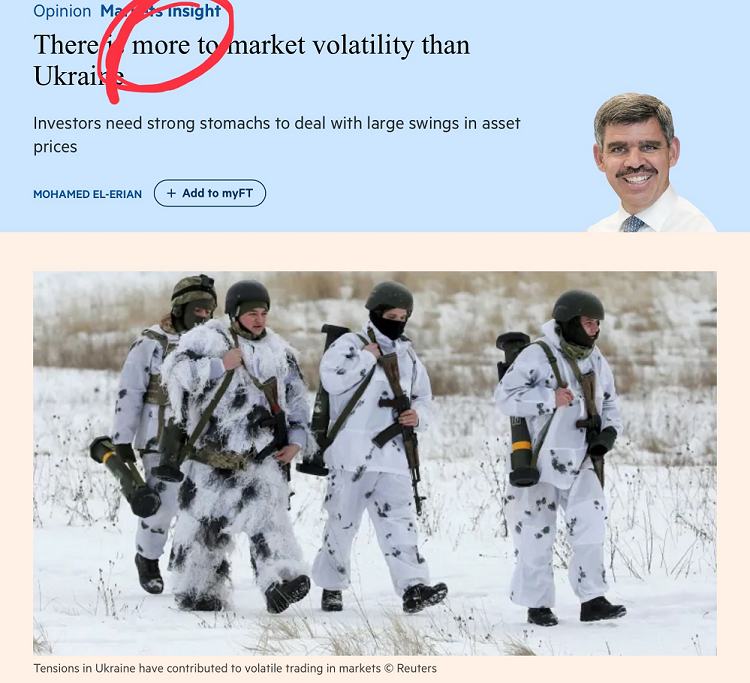
Non è nelle nostre capacità di scrivere una più concisa, più chiara e più utile descrizione dello stato dei mercati finanziari globali nel febbraio 2022 di quella pubblicata sul Financial Times da Mohamed El Erian, che vi riproponiamo in lettura qui di seguito, senza aggiungere commenti che non sono necessari.

Più in basso, riprendiamo il nostro discorso con altri argomenti.

The writer is president of Queens’ College, Cambridge, and an adviser to Allianz and Gramercy

It is tempting to pin the recent volatility in markets only on the fluidity of the Russia-Ukraine situation. After all, every day we seem to get competing indications of a stand-off that confronts Europe with the highest possibility of an armed conflict with Russia since the collapse of the Soviet Union.

After an initial flurry of activity, markets settled into mostly trading the conflict within a range bounded by the hope of an eventual diplomatic resolution and the more protracted period of “no peace and no war”. This has accounted for most of the daily volatility in the main US stock indices in the past few weeks when we have seen swings of 0 to 1.5 per cent.

The stronger moves occurred when markets sensed the possibility of a decisive move towards one of these bookends. After all, depending on which scenario is in play, the global economy would either benefit from a sharp reduction in commodity prices or, at the other end, deal with a major stagflationary shock.

But this should not blind us to two important structural issues that will be with us for a while, almost regardless of how the conflict plays out.

First, markets are losing the anchor of abundant and predictable liquidity provided by central banks. This unifying theme proved an extremely powerful driver to repress volatility, insulating markets from a wide range of worries while driving asset values higher. With a US Federal Reserve belatedly seeking to tackle high and persistent inflation, markets must now navigate a fundamental shift in their liquidity regime. This involves not only higher interest rates but also a contraction in the Fed’s $9tn balance sheet. Equity valuations may be more attractive than they were a few weeks ago but have not reached the level needed to constitute an obvious standalone and generalised investment case to buy stocks.

This is not to say that markets are without anchors. Solid corporate earnings and behavioural conditioning of investors tempted to ‘buy the dip’ are still in play.

But these are inherently less strong and highly sensitive to the Fed being able to deliver an economic soft-landing. The likelihood of this has been significantly undermined by the extent to which the Fed first mischaracterised inflation and then dithered in adjusting policies. Even today with 7.5 per cent consumer price inflation, the Fed is still injecting liquidity into the economy.

I would estimate the probability of a comfortable soft landing for the economy and markets over the next 12 months at 10 per cent, well below three other macroeconomic scenarios.

  1. One is that economic growth is severely damaged by a late Fed that is forced into slamming on the policy brakes in response to persistently high inflation (40 per cent probability).

  2. Another is a Fed that gives up for now on its inflation objective in the hope that exogenous favourable developments will emerge such as a productivity surge or fast-healing supply chains, helping to accommodate rising labour costs (30 per cent).

  3. A third scenario is stagflation (20 per cent), the most worrisome outcome for livelihoods, financial stability and policy effectiveness.

The second structural factor overhanging markets is the structural erosion of market liquidity. The past decade has seen a significant reduction in the risk absorption capacity of markets as intermediaries have been both less able and less willing to expose their balance sheets. This has coincided with an enormous expansion in the size of asset holders who deal through those intermediaries. As such, this mismatch in supply and demand can lead to big market moves. or ‘price gapping’, whenever there is a change in conventional wisdom, a phenomenon that has been visible not only for individual stocks but also for other market segments. Now lacking a strong unifying theme and navigating a wide range of potential macro scenarios without a first best Fed policy option, stocks will remain sensitive not just to the vagaries of the news on Russia-Ukraine, but also other factors such as competing remarks by central bankers and data releases that are significantly different from the median forecast.

This requires investors to anticipate more unsettling volatility and have a strong stomach for dealing with it (remember, many of the major investment mistakes occur at such times). It also warrants favouring individual name selection over indices, and subjecting holdings to granular quality reviews on a much higher frequency basis than has been warranted in recent years.

Tutto spiegato in modo semplice, chiaro, ed efficace. Nulla da aggiungere, a questo proposito: per noi investitori, c’è ben altro a cui guardare OLTRE gli eventi in Ucraina, nel 2022.

Proseguiamo però in questo Post, e portiamo alla vostra attenzione un secondo, altrettanto recente, articolo del medesimo autore, allo scopo di completare per voi il quadro: il precedente contributo vi è stato utile come perfetta descrizione dello stato attuale dei mercati finanziari e delle economie, mentre qui ci occupiamo delle prospettive.

Noi, delle prospettive così come El Erian le qualifica oggi, ve ne avevamo scritto sei mesi fa nel Blog (ed ovviamente, ai nostri Clienti ne abbiamo illustrato tutte le implicazioni per la gestione ottimale del portafoglio di investimenti finanziari).

Ovviamente il nostro amico El Erian scrive meglio di noi, ed è più autorevole di noi: quindi, per quelli tra i nostri lettori che sei mesi fa non avevano prestato la giusta attenzione al nostro argomento, ecco che la lettura dell’articolo seguente, che è un secondo articolo del medesimo autore, pubblicato la settimana scorsa, sarà sicuramente di una grande utilità pratica.

Vi sarà utile perché mentre il vostro private banker, il vostro family banker, il vostro promotore finanziario, il vostro robo-avisor cercherà di convincervi che “tutto dipende da quello che succede in Ucraina”, voi sarete in grado di spostare il vostro sguardo verso quello che davvero a voi interressa. verso i fattori che possono farvi guadagnare soldi oppure perdere soldi, nel 2022 e nel 2023 e nel 2024.

By

Mohamed A. El-Erian

22 febbraio 2022, 11:46 CET

“Fix the roof while the sun is shining.” This often-repeated advice from Christine Lagarde, then managing director of the International Monetary Fund, wasn’t heeded by enough policy makers in the years before the current rise in Russia-Ukraine tensions. Now, the global economy has less policy flexibility to deal with a possible stagflationary shock, and central banks have few good options to counter possible financial market malfunction that would amplify economic challenges.

The Federal Reserve, the world’s most powerful central bank, is a leading example of this syndrome of limited policy flexibility. Having missed multiple windows for orderly normalization, it finds itself in the midst of rising geopolitical strains with already very low interest rates and a bloated balance sheet. Making things more challenging, the Fed has eroded its inflation credibility and lost control of the monetary policy narrative.

This is a most unfortunate situation in the face of a possible stagflationary shock that would weaken global growth and give another impetus to inflation should a more significant armed conflict erupt between Russia and Ukraine — one that would likely lead to a spike in prices of energy and some other commodities, a proliferation of economic and financial sanctions, and a decline in both household and business confidence. It would be even worse if the functioning of financial markets were to be stressed — regrettably, a material risk for at least three important reasons:  

  • First, conditioned by massive and predictable injections of liquidity, risk-taking has been significant, with quite a few investors venturing far and wide in search of higher returns.

  • Second, the last decade has witnessed a growing imbalance between the increasing size and diversity of asset holders and the reduced ability of the system to accommodate a sudden generalized shift in the markets’ conventional wisdom.

  • Third, the QE-induced shift of “safe assets” from markets to central bank balance sheets has limited investors’ ability to “self-insure” in a timely fashion.

The risk of disruptions to the smooth functioning of financial markets is not accompanied by Fed policy flexibility to act. Rates are still floored at zero and the ever-growing balance sheet is already near $9 trillion. As all this coincides with worrisome inflation numbers, be it  7.5% for CPI or 9.7% for PPI. The Fed must also worry about its damaged inflation-fighting credibility. 

Lacking proper guidance from the Fed, Wall Street has sprinted to call for, and price, a growing number of interest rate hikes this year. Some have urged for these to be front-loaded. A few have gone as far as to advocate an emergency intra-meeting interest rate increase.

Regrettably, this unfortunate policy context is of the Fed’s own making, both short- and longer-term. Just within the last 12 months, for example, it mistakenly downplayed the severity and persistence of inflation. When the central bank finally acknowledged the need to “retire” its “transitory” inflation call — a gross mischaracterization — it hardly adjusted its policy stance to counter the risk of a de-anchoring of inflationary expectations.

This has weakened its policy reputation and involved the Fed missing one opportunity after another to rebuild resilience. As such, the central bank’s limited tools to counter market malfunction also involve a heightened risk of collateral damage and unintended circumstances. The alternative, of relying on government measures, is far from reassuring given the extent of policy polarization.

Mercati oggiValter Buffo