
Che recessione ci attende?
 

Ricordate il “soft landing”? Ricordate il dibattito tra “soft” ed “hard” landing?

Il dibattito era al centro dell’attenzione nel primo semestre, perché fino all’estate tutte le banche di investimento sostenevano la visione delle Banche centrali, secondo la quale “ce la faremo a frenare l’inflazione senza provocare la recessione”.

Oggi, come dice El Erian nell’immagine che apre il Post, una “recessione profonda” potrebbe essere persino, per tutti quanti noi, la migliore opzione che ci è rimasta.

Ed infatti tutti hanno cambiato idea, negli ultimi mesi: tranne Recce’d che era già più avanti, e da anni. Noi eravamo “contrarian”, fino a qualche mese fa, oggi siamo diventati “il leader della maggioranza”.

Nessuno oggi utilizza più l’espressione “soft landing” e le Banche centrali, tutte, hanno già promesso al pubblico che “ci sarà da soffrire”.

Ben arrivate! Era ora!

Noi avevamo su questo argomento le idee chiarissime già nel 2021, e lo avevamo reso pubblico anche qui nel nostro Blog.

Moltissimi nostri lettori, però, si affidano ancora alle vecchie Reti di promotori finanziari, che oggi si fanno chiamare wealth managers e personal bankers, e che ai loro Clienti hanno fatto perdere parecchi soldi nel 2022 mantenendoli su posizioni totalmente sbagliate, posizioni che nel corso del tempo erano state giustificate prima con il tema della “inflazione transitoria” e poi con il tema del “soft landing”.

Per tutti questi investitori, è utile ancora oggi rivedere, e correggere, le aspettative sul futuro delle economie. Cosa che noi aiutiamo, in questo Post, selezionando e ripubblicando due articoli dedicati proprio a questo argomento.

Argomento che, come leggete qui sotto, nell’ultima settimana ha portato persino le Nazioni Unite a lanciare un allarme, accompagnato dalla richiesta, a tutte le Banche Centrali, di rallentare nella manovra di rialzo dei tassi di interesse. Ragione ulteriore per un approfondimento del nostro tema.

L’argomento è, ovviamente, di massima attualità anche per le banche di investimento: Citigroup una settimana fa ha rivisto al ribasso il proprio target per la Borsa di New York, motivando questo taglio proprio sulla base delle elevate probabilità di una severa recessione.

Nel primo dei due articoli che abbiamo selezionato per questo Post, leggerete l’intervista di Marketwatch ad un noto gestore di portafoglio, che espone una visione di quello che ci aspetta dall’economia molto vicina a quella di Recce’d.

Ritorneremo anche in altri Post, sui temi di questa intervista. in modo particolare, quando tratteremo della prossima stagione delle trimestrali delle Società quotate, e commentando la strategia di gestione dei nostri portafogli modello.

Keith McCullough, founder and CEO of Hedgeye Risk Management, isn’t one to mince words about financial markets, the Federal Reserve or the economy.

Right now he has a few less-than-charitable things to say about how the Fed’s rate hikes have ground up stock and bond investors.

His investment-research firm’s economic models turned bearish on stocks and bonds at the beginning of 2022. Prices have since tumbled, but McCullough is still bearish. He’s now steering investors to defensive positions primarily in cash, the U.S. dollar, gold and income-producing equities.

McCullough is preparing investors for the painful recession he expects for both Wall Street and Main Street in 2023. To anyone expecting the Fed to realize its rate increases have been excessive and rescue the markets, McCullough is blunt: “There’s no dovish pivot,” he says.

Even if the Fed were to relent, McCullough says the damage is done. “They’re far too late,” he says of the Fed. “Just like it was impossible for them to stop inflation, it’s impossible for them to stop the pending U.S. corporate profit recession or the mainline recession.”

In this recent interview, which has been edited for length and clarity, McCullough outlines his base case for the U.S. economy and the financial markets going into 2023, and advises investors to take shelter from a coming storm many of them have never seen.

‘The recessionary economic data keeps getting worse.’

MarketWatch: In a MarketWatch interview last April, you said “the Fed always screws up” and predicted a bear market for U.S. stocks in the summer. That happened. What do you expect now from the Fed — learn from its mistakes or make more?

McCullough: Recession today is what “transitory” inflation was a year ago. The Fed is as wrong on recession risk as they were on inflation.

I’m about as bearish as I’ve been since 2008. Instead of the economy having a soft landing, I think the landing is going to be hard. The recessionary economic data keeps getting worse, not just in the U.S. but in Europe as well.

Free money forever created behavioral problems and a behavioral bubble for the markets and investors. You believe you’ll have unlimited access to easy money and your behavior, whether you’re building profitless growth companies through storytelling or cryptocurrencies that also are just stories. You’re coming from the mother of all behavioral bubbles that now will be addressed with tighter money. When you’re printing money and the economy is accelerating to the fastest growth rate ever, you’re going to have the mother of all bubbles. Now, GDP is going to slow to zero, and you get the opposite.

MarketWatch: A hard landing for the economy and an economic environment echoing the 2008 financial crisis is a pretty damning verdict. You’re not in the perma-bear camp with some forecasters, so what are you seeing now to have such a pessimistic outlook?

McCullough: On a lot of levels it’s worse now than in 2008. If 2008 was about Wall Street collapsing on itself, on all its conflicts of interests and lies, this one is more about Main Street. Main Street is broke. Main Street is taking all this inflation into their cost of living. Main Street has the highest credit-card interest going back to the 1990s. It’s way worse than 2008 on that basis. If you’re trying to pay your bills with credit, it’s getting worse and worse. And then they’re going to lose their jobs. Labor collapsing is always the last thing to go down. We’re right on the cusp of the labor cycle going the wrong way.

That’s what’s going on right now. GDP and profit growth are both going negative. The Fed is going to see all of that and have to change. The big screw-up people will have is that the minute they see Fed dovishness, they’re going to buy stocks and crypto. Then they’re going to realize they’re in a recession, which is an entirely different setup from what got those bubbles to begin with, which was unlimited easing and fiscal support plus GDP growth.

We have economic deceleration irrespective of what the Fed does. It’s impossible for the Federal Reserve to stop gravity. They’re far too late. Just like it was impossible for them to stop inflation, it’s impossible for them to stop the pending U.S. corporate profit recession or the mainline recession.

MarketWatch: It isn’t just the Fed that could miss the recession signs until it’s too late. Stock investors as well might find themselves on the wrong side of the tracks.

McCullough: The Fed first has to realize that what I’m talking about is the high-probability event. That will take time. It’s not going to take them a month. They have to realize we’re in a recession, then make the commensurate policy pivot. Then, when the Fed does go dovish and realize we’re in a recession, that’s bad for the stock market.

The Pavlovian response is the Fed is dovish, buy stocks. That’s true if you’re not in a recession. This next recession — which could be the biggest profits recession of the modern era — will be quite an education for people who are still bullish, with the expectation that the Fed is going to save them.

MarketWatch: Many Fed-watchers and market analysts expect the Fed to pause or slow rate hikes to assess the effects of their inflation-fighting efforts. Do you see a “Powell pivot” coming?

McCullough: There’s no dovish pivot. The level of inflation is nowhere near the Fed’s target. And there’s a midterm election coming up. They’ve already established that the rate hikes are going to go right up to November. Rate hikes are baked into the cake and anybody looking for it to turn into a birthday cake for the bulls will be sadly disappointed.

An entire generation of Americans hasn’t gone through a recession. A lot of companies in Silicon Valley have never been through a recession, for example. My definition of a U.S. corporate profits recession is when the rate of change of revenue growth has gone negative and the rate of change of year-over-year profit growth has gone negative. The Federal Reserve, even if it were to turn dovish on interest rates tomorrow, will have a hard time stopping the profits recession.

When the rate of economic change is accelerating and the Fed is printing money, you buy anything that’s got a good chart and a good story. You’re going to make a lot of money until the music stops.

And it did. Now we’re seeing the opposite. The rate of change of real GDP growth and inflation are slowing at the same time. You can’t own inflation, commodities or growth now. If you’re still long pretend growth or profitless growth or crypto, I recommend prayer.

MarketWatch: Given the grim picture you’ve drawn, where are you directing investors to put their money to weather the storm?

McCullough: There aren’t many places to hide. Our biggest position in equities is utilities.Utilities is a bond proxy. We still like gold .

If you have to own stocks, we like quality balance sheets, profitable companies that have high-quality cash-flow streams. We’re short growth — all of it. We’re short all of tech. Energy stocks are levered up on the long side. I’ll take my time on that. It is a place I’m interested in buying, but currently we’re only long natural gas and solar through the Invesco Solar ETF We’re bearish on oil , copper — every major commodity other than natural gas. We’re short Europe on the equity side and on the euro . I’m in no rush to cover those shorts. The trend is down for stocks and up for the U.S. dollar .

Also Treasury bonds, but you have to wait, watch and act as the game plays out. If the U.S. 10-year Treasury breaks down below 2.95% that’s a pretty obvious green light to make long-term Treasurys one of your top asset allocations. A lot of people are trying to pick bottoms in stocks. I’m much more interested in buying Treasury bonds than anything else.

A questa utile intervista aggiungiamo le considerazioni più recenti di Nouriel Roubini, che non a caso dai media è stato etichettato come “profeta di sventura”. Come abbiamo già scritto, la nostra visione delle cose è spesso distante da quella di Roubini: in questa specifica occasione però, a nostro giudizio, è particolarmente utile leggere i sui argomenti, tanto quanto fu utile negli anni 2006 e 2007.

Come sempre nelle sue analisi, Roubini mette insieme moltissime cose, argomenti di finanza, di economia, di sociologia, insieme con argomenti che riguardano la politica, l’ambiente, ed altro.

Una lettura attenta vi permetterà, comunque, di cogliere spunti importanti, come ad esempio quello della “fiscal capture” che si lega in modo stretto al tema della “financial instability” (al quale Recce’d oggi dedica un altro Post).

Vi segnaliamo poi il riferimento al portafoglio 60/40, che le nostre Reti di promotori finanziari e private bankers chiamano “portafoglio bilanciato ad asset allocation”, del quale Recce’d ha scritto e scriverà nella pagina SCELTE DI PORTAFOGLIO.

NEW YORK (Project Syndicate)—For a year now, I have argued that the increase in inflation would be persistent, that its causes include not only bad policies but also negative supply shocks, and that central banks’ attempt to fight it would cause a hard economic landing.

When the recession comes, I warned, it will be severe and protracted, with widespread financial distress and debt crises. Notwithstanding their hawkish talk, central bankers, caught in a debt trap, may still wimp out and settle for above-target inflation. Any portfolio of risky equities and less risky fixed-income bonds will lose money on the bonds, owing to higher inflation and inflation expectations.

How do these predictions stack up? First, Team Transitory clearly lost to Team Persistent in the inflation debate. On top of excessively loose monetary, fiscal, and credit policies, negative supply shocks caused price growth to surge. COVID-19 lockdowns led to supply bottlenecks, including for labor. China’s “zero-COVID” policy created even more problems for global supply chains. Russia’s invasion of Ukraine sent shock waves through energy and other commodity markets.

Central banks, regardless of their tough talk, will feel immense pressure to reverse their tightening once the scenario of a hard economic landing and a financial crash materializes.

And the broader sanctions regime—not least the weaponization of the dollar and other currencies—has further balkanized the global economy, with “friend-shoring” and trade and immigration restrictions accelerating the trend toward deglobalization.

Everyone now recognizes that these persistent negative supply shocks have contributed to inflation, and the European Central Bank, the Bank of England, and the Federal Reserve have begun to acknowledge that a soft landing will be exceedingly difficult to pull off. Fed Chair Jerome Powell now speaks of a “softish landing” with at least “some pain.” Meanwhile, a hard-landing scenario is becoming the consensus among market analysts, economists, and investors.

It is much harder to achieve a soft landing under conditions of stagflationary negative supply shocks than it is when the economy is overheating because of excessive demand. Since World War II, there has never been a case where the Fed achieved a soft landing with inflation above 5% (it is currently above 8%) and unemployment below 5% (it is currently 3.7%).

And if a hard landing is the baseline for the United States, it is even more likely in Europe, owing to the Russian energy shock, China’s slowdown, and the ECB falling even further behind the curve relative to the Fed.

The recession will be severe and protracted

Are we already in a recession? Not yet, but the U.S. did report negative growth in the first half of the year, and most forward-looking indicators of economic activity in advanced economies point to a sharp slowdown that will grow even worse with monetary-policy tightening. A hard landing by year’s end should be regarded as the baseline scenario.

While many other analysts now agree, they seem to think that the coming recession will be short and shallow, whereas I have cautioned against such relative optimism, stressing the risk of a severe and protracted stagflationary debt crisis. And now, the latest distress in financial markets—including bond and credit markets—has reinforced my view that central banks’ efforts to bring inflation back down to target will cause both an economic and a financial crash.

I have also long argued that central banks, regardless of their tough talk, will feel immense pressure to reverse their tightening once the scenario of a hard economic landing and a financial crash materializes. Early signs of wimping out are already discernible in the United Kingdom. Faced with the market reaction to the new government’s reckless fiscal stimulus, the BOE has launched an emergency quantitative-easing (QE) program to buy up government bonds (the yields on which have spiked).

Monetary policy is increasingly subject to fiscal capture. Recall that a similar turnaround occurred in the first quarter of 2019, when the Fed stopped its quantitative-tightening (QT) program and started pursuing a mix of backdoor QE and policy-rate cuts—after previously signaling continued rate hikes and QT—at the first sign of mild financial pressures and a growth slowdown.

The Great Stagflation

Central banks will talk tough; but there is good reason to doubt their willingness to do “whatever it takes” to return inflation to its target rate in a world of excessive debt with risks of an economic and financial crash.

Moreover, there are early signs that the Great Moderation has given way to the Great Stagflation, which will be characterized by instability and a confluence of slow-motion negative supply shocks.

In addition to the disruptions mentioned above, these shocks could include societal aging in many key economies (a problem made worse by immigration restrictions); Sino-American decoupling; a “geopolitical depression” and breakdown of multilateralism; new variants of COVID-19 and new outbreaks, such as monkeypox; the increasingly damaging consequences of climate change; cyberwarfare; and fiscal policies to boost wages and workers’ power.

Where does that leave the traditional 60/40 portfolio? I previously argued that the negative correlation between bond and equity prices would break down as inflation rises, and indeed it has. Between January and June of this year, U.S. (and global) equity indexes fell by over 20% while long-term bond yields rose from 1.5% to 3.5%, leading to massive losses on both equities and bonds (positive price correlation).

Moreover, bond yields fell during the market rally between July and mid-August (which I correctly predicted would be a dead-cat bounce), thus maintaining the positive price correlation; and since mid-August, equities have continued their sharp fall while bond yields have gone much higher. As higher inflation has led to tighter monetary policy, a balanced bear market for both equities and bonds has emerged.

But U.S. and global equities have not yet fully priced in even a mild and short hard landing. Equities will fall by about 30% in a mild recession, and by 40% or more in the severe stagflationary debt crisis that I have predicted for the global economy. Signs of strain in debt markets are mounting: sovereign spreads and long-term bond rates are rising, and high-yield spreads are increasing sharply; leveraged-loan and collateralized-loan-obligation markets are shutting down; highly indebted firms, shadow banks, households, governments, and countries are entering debt distress.

The crisis is here.


Nouriel Roubini, professor emeritus of economics at New York University’s Stern School of Business, is chief economist at Atlas Capital Team and author of the forthcoming “MegaThreats: Ten Dangerous Trends That Imperil Our Future, and How to Survive Them” (Little, Brown and Company, October 2022).

Valter Buffo
Pivot/Godot
 

Commentare di settimana in settimana gli alti e bassi degli indici è nella maggior parte dei casi tempo sprecato inutilmente.

Nel 2022, poi, commentare gli alti e bassi di Borsa di breve periodo è tempo sprecato nel 100% dei casi.

Se ci fermiamo, con questo Post, a commentare l’ultima settimana delle Borse, è unicamente per la ragione che dall’ultima settimana è possibile ricavare insegnamenti ed indicazioni di carattere generale.

Nell’ultima settimana, è tornato a circolare tra gli operatori il termine “pivot”: a questo scopo, le Reti di promotori finanziari e le banche globali di investimento hanno del tutto INVENTATO una previsione per il dato del 7 ottobre che avrebbe dovuto fare segnare un CALO degli occupati.

Per un sintetico commento prendiamo a prestito le parole di Mohamed El Erian che leggete sopra nell’immagine:

La visione di “picco” di tutto (picco del petrolio, picco dei tassi, picco del dollaro) è stata nuovamente messa in discussione dai mercati finanziari negli ultimi giorni.

La visione del “picco di tutto” aveva contribuito nei giorni a fare rinascere il sogno romantico dei mercati per il “pivot”.

Le parole di El Erian sono efficaci ed esaustive. Un investitore però deve domandarsi: perché questa storia del “pivot” ritorna regolarmente, anche se ogni volta poi viene (pesantemente) smentita?

Proviamo a ragionare di questo.

Nella seconda immagine qui sopra, è sempre El Erian che scrive, a proposito del “sogno romantico del pivot” che necessità di maggiore supporto fondamentale. Aggiungendo poi che:

Convincersi delle cose senza avere il supporto dei fondamentali non è un buon modo di investire.

Ecco quindi svelato, da El Erian, il mistero del “pivot”: che torna, e ritorna, e ritorna ancora, ad opera di soggetti (individui ed Istituzioni) che intenzionalmente lavorano per distrarre l’attenzione degli investitori dai dati fondamentali.

Questo è lo scopo del “pivot”: spingere gli investitori finali a spostarsi verso asset ed asset class che oggi NON hanno alcun supporto dai fondamentali.

Per ottenere questo risultato (almeno con una parte degli investitori) è necessario lavorare di fantasia, e nascondere la realtà.

Ecco spiegato perché “i mercato finanziari si muovono sulla base di narrative”, come dice proprio all’esordio l’interessante articolo che segue.

Articolo che ci serve per ricostruire la recente esperienza con il “pivot”, e che ci ha pure suggerito il titolo del Post: “Aspettando Godot”.

La lettura di questo articolo vi aiuta a realizzare quanto segue: la rappresentazione di un futuro in cui l’economia rallenta ma non troppo, mentre l’inflazione è un problema che si risolve da solo senza sforzo, è nulla di più di una favoletta da raccontare ai bambini, costruita ed utilizzata per “piazzare la merce” da parte delle Reti di vendita dei Fondi Comuni insieme con le banche globali di investimento.

Una favola: una cosa che NON esiste.


Financial markets trade on narratives. And for the past several weeks, the dominant story in both bond and equity markets has been that the Fed will pivot, and soon. Investors expect a rapidly weakening economy to force the US central bank to do an about-turn, and cut rates barely months after hikes finish.

This belief built up a head of steam across July, with many investors suggesting that the Fed could signal a shift at its Jackson Hole retreat in late August. Every weak housing data point fed into this narrative; every contraction in PMI was grist for this mill. A sharp pullback in commodities prices, a collapse in business and consumer confidence, a decline in market expectations for inflation over the next decade – all these pointed in that same direction.

And then there was history: the Fed did a volte-face in both of the last two hiking cycles. Hikes in the summer of 2007 gave way to cuts in 2008. And memorably, the Fed hiked in December 2018 only to change course by January 2019. Small wonder that markets have been waiting for the US central bank to signal a shift again.

Easier said than done. The data that matter most – inflation and wages – are still too strong for the US central bank to breathe easy. Way too strong. And the numbers are accelerating, even before July’s strong jobs report.

Consider the last inflation print. Core CPI (which excludes food and energy prices) over 6 months is running at an annualised pace of almost 7 per cent. But the 3-month rate is almost 8 per cent. And the 1-month number annualised is nearly 9 per cent. That means core CPI is speeding up, not slowing down, and is in a very different zip code than the Fed’s 2-per-cent target.

Even more important is the move in wages. For the past few months, it looked like wage growth was slowing down. Average hourly earnings, reported in the monthly jobs report, seemed to have settled into a 3.5- to 4-per-cent annual rate.

Then three things happened all at once.

  • First, the Atlanta Fed wage growth tracker showed that wages accelerated strongly in June (6.7 per cent annually):

  • Second, the average hourly earnings data were revised upwards. Lo and behold, wages are no longer slowing in that series.

  • But most significant was the latest release of the Employment Cost Index (ECI), the Fed’s preferred indicator. Private sector wages accelerated sharply to a 6.5-per-cent annualised pace in June.

The cherry on the cake, of course, was the unemployment rate reaching a post-Covid low last week. The US labour market is not just not slowing down. It is speeding up. It is true that labour markets are famously backward looking.

In September 2008, around the financial crisis, the jobless rate was still 6.1 per cent. When it peaked at 9.9 per cent a year and a half later, the US was well on its way to recovery. Even so, Fed officials care deeply about wages. If high wage expectations get embedded in an economy, high inflation can remain ‘sticky’ for far longer. A 2-per-cent inflation target is hard to achieve if per-capita wages rise 6 per cent in 2023.

Central bankers don’t like admitting it, but a primary goal of rate hikes is to cause enough job losses to ensure that wage growth slows down. And if that isn’t happening despite several rate increases, it adds pressure on the central bank to raise rates further, and keep them high for longer. Admittedly, monetary policy does work with a long and variable lag.

That is why central bank decisions are usually based on forecasts; today’s data is not supposed to be the dominant driver of today’s policy. But these are not normal times. The inflation spike of the last 12-15 months has been massive, persistent, and made a mockery of forecasts. And one by one, central banks have had to adjust policy to incoming inflation data.

The Fed broke its own forward guidance and hiked 75bp in June because of a strong May CPI report. And the ECB followed in July, hiking 50bp despite promising 25bp. Strong jobs reports are usually greeted with enthusiasm in the Marriner S Eccles building. But the starting point on inflation, including core inflation, is simply too high. Markets have gotten ahead of themselves in expecting the Fed to start taking a more dovish approach.

As things currently stand, any Fed surprises over the next few months are more likely to be hawkish. Investors waiting for an imminent pivot will have to keep waiting.

Valter Buffo
Tonnara (parte 2)
 

Nel Post con il medesimo titolo che abbiamo pubblicato nel weekend 1 - 2 ottobre, si discuteva di pubblicità TV e sui media.

Recce’d ha messo in evidenza le tante pubblicità il cui messaggio principale è che investire sui mercati finanziari è facile, che “basta un attimo”, e che lo si può fare mentre si gioca con lo smartphone, proprio come per gli altri canali social (ad esempio Tik Tok, Instagram e Twitter)

Magari, mentre si guarda il “Grande Fratello VIP”, si può dare uno sguardo al prezzo del petrolio oppure del titolo Tesla.

Tanto, sale sempre tutto.

In quel nostro Post del weekend, si citava, come esempio di una certa “cultura dell’investimento”, Dave “The Trader” Portnoy, personaggio popolarissimo sui social e pure sui media tradizionali solo un anno fa, ed oggi messo del tutto da parte sia dai social sia dai media tradizionali, che nel 2022 non lo intervistano più. Chissà perché.

Noi allora, per bilanciare le cose, abbiamo trovato un video di Dave che ci è parso interessante, e ben costruito. E lo proponiamo ai lettori.

Vi sarà sufficiente fare click sull’immagine qui sotto, per vederlo.

Fate massima attenzione, in basso, allo scorrere delle date. Tutta la magia di questo video sta lì, nelle date.

E non dimenticate che, come spiega un famoso spot TV “per investire basta un attimo”.

Valter Buffo
Tonnara (parte 1)
 

Sicuramente, tutti i lettori ricordano.

Come è possibile dimenticare uno spot Tv così riuscito?

Il “social investing”: il richiamo qui è ai “social network”. Se è così divertente stare su Tik Tok, oppure su Instagram, se è così piacevole, se è così facile, perché non estendere la cosa anche agli investimenti?

Perché non impiegare il proprio denaro con i medesimi criteri con i quali stiamo sui social? Su Instagram? Su Tik Tok?

Come diceva una seconda immagine di quello spot TV: “azioni? crypto? da dove iniziare?”

Vedi un po’ tu.

Seguendo la medesima logica, ma con un atteggiamento più convenzionale, un secondo spot TV, martellante quanto il primo, ci riportava ad un ambiente molto caldo e confortevole, con al centro una preparazione flambé, che fa sempre chic: in questa immagine, c’è un tizio con i capelli bianchi (a sinistra nell’immagine) che sta per porgere al tizio più giovane (a destra nell’immagine) uno smartphone con un logo in bella vista, pronunciando la (famigerata) frase “Ci vuole un attimo”.

Molti altri spot, in questo periodo, suggeriscono all’investitore di operare in quel modo: “Basta un click”, “Ci vuole un attimo”, “Investi sui social network”, “Non stare a pensarci troppo”, ““E’ tutto molto semplice”.

E’ stata la grande illusione degli ultimi anni: i cui responsabili, ovviamente, non sono le Aziende a cui fanno riferimento le pubblicità che noi abbiamo preso a esempio fino a qui.

Non sono loro i responsabili: la responsabilità fa capo a chi si è arrogato (senza averlo) il potere di fare scelte non soltanto sbagliate ma pure abnormi, creando la situazione che ha consentito la diffusione di una mentalità come questa.

Di quale mentalità stiamo parlando qui?

Nella parte bassa dell’immagine qui sopra, potete leggere: “Il 77% di conti di investitori al dettaglio perdono denaro”. Quattro su cinque.

E allora, leggendo questo dato, si deve pensare che i responsabili della situazione che oggi dobbiamo tutti affrontare sono gli investitori medesimi. Sono loro, gli investitori finali, privati e gestori di Fondi insieme, che a tutti i costi VOGLIONO perdere il loro denaro.

Da qui, è immediato arrivare all’immagine della tonnara.

La pesca del tonno è una nobile arte praticata da secoli, secondo le modalità che vedete ben descritte nell’immagine che segue.

Si attirano i tonni in uno spazio ristretto e limitato dalle reti, che si chiama appunto tonnara.

Quando i tonni sono tutti all’interno, il pescatore aziona la fiocina e procede alla pesca del tonno.

In quante occasioni del passato, la massa degli investitori (grandi come piccoli, professionali come individuali) si è fatta catturare all’interno della tonnara?

Quanti sono gli investitori che già in passato si sono fatti infilzare dalle fiocine?

Tra i lettori che leggono questo Post, sappiamo che è elevato il numero di quelli che oggi si trovano all’interno della tonnara.

A questi lettori, che affannosamente ogni mattina si domandano “che cosa dobbiamo fare?”, noi di Recce’d oggi vogliamo parlare in modo franco, diretto ed esplicito.

Siamo tutti adulti, noi e voi: ed allora parliamoci da adulti. Tutti, noi e voi, abbiamo un’età tale, da ricordare i successi del cantante Bobby Solo.

Recce’d vuole parlare con chiarezza: se oggi vi trovate nella tonnara, non c’è più niente da fare.

Se state pensando a “come recuperare”, siete fuori strada. Se state chiedendovi “quanto tempo ci vorrà per recuperare”, siete sulla strada sbagliata. Se state domandando a voi stessi ed ai vostri amici in chat “quando arriva il rimbalzo” questo significa che ancora non avete capito la situazione.

Quello a cui stiamo assistendo non è “un periodo”. Non si tratta della solita “correzione” a cui segue un recupero.

State invece attraversando una fase di cambiamento epocale, un “regime shift”, un “paradigm shift”. Recce’d ne scriveva già nel Blog che state leggendo, mesi e mesi fa.

E quindi: per il passato, e per le perdite accumulate, non c’è più niente da fare: non perdete ulteriore tempo. Azzerate tutto, portate a casa le perdite, e ripartite.

Ma come ripartire?

Una possibilità è quella di ascoltare quello che dicono le Reti che vendono i Fondi Comuni e le polizze assicurative UCITS: a titolo di puro esempio, potreste dare credito a quello che viene detto nell’immagine che segue a proposito dei mercati finanziari.

Tanto, prima o poi, avranno ragione anche loro.

In alternativa, potreste decidere di abbandonare i mercati finanziari, ed investire in una “autentica sicurezza”, che è il mattone.

Mattone che negli ultimi tempi è … andato di moda, anche sui social, come diceva questo titolo che segue, datato 21 febbraio 2021. E da non dimenticare mai.

Oppure potreste seguire i suggerimenti del tizio che vedete qui sotto in fotografia.

No, non ci riferiamo al tizio a sinistra nella fotografia: ci riferiamo al tizio che sta sulla destra, quello di “le Borse non scendono mai” (“stocks only go up”). Ricordate? Un anno fa?

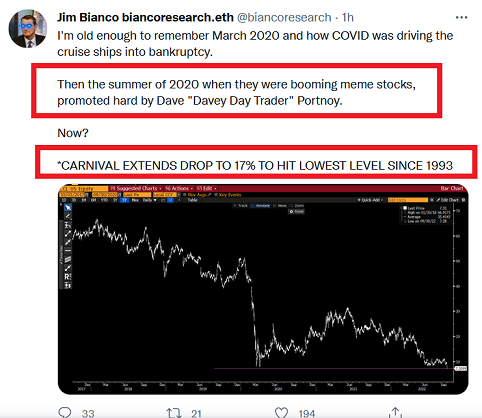
Come? Qualcuno non ricorda il mitico Dave “Day Trader” Portnoy?

Possibile.

Con una sola immagine, che segue, ve lo ricordiamo noi. Voi andatelo a cercare, sul Web: è davvero mitico, specie in queste settimane.

Ci sono ancora altre alternative che potreste prendere in considerazione: ad esempio, potreste seguire i suggerimenti dei quotidiani italiani (Corriere della Sera, La Repubblica, il Sole 24 Ore, La Stampa) che con regolarità pubblicano portafogli modello ed indicazioni operative per la gestione del portafoglio, come ad esempio con le immagini che seguono.

Nel caso nel quale, purtroppo, i vostri investimenti passati abbiano prodotto perdite così grandi, da impedirvi di proseguire nelle attività di “investimento social”, anche in quel caso non mancano le alternative per il vostro futuro

Ad esempio, ci sono grandi aziende che vi offrono concrete opportunità con campagne pubblicitarie dirette specificamente a chi ha perso il proprio denaro con “l’investimento social”.

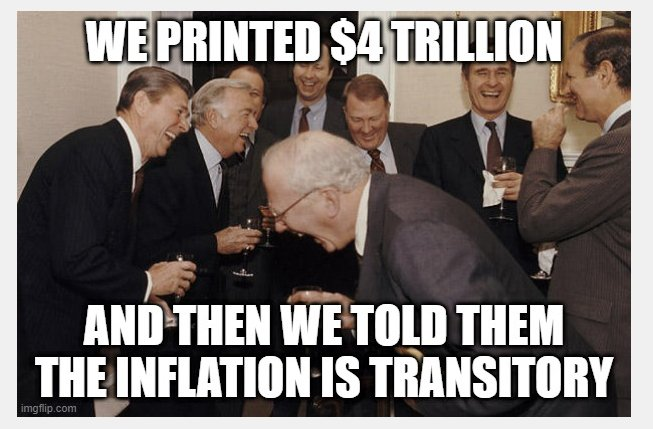
Qualsiasi cosa decidiate di fare in futuro, noi di Recce’d ci sentiamo di indicarvi un obiettivo: come minimo, in futuro cercate di non fare ridere, perché i signori qui sotto hanno già riso a sufficienza.

Mercati oggiValter Buffo
Finanza trash
 

La situazione che tutti vedete oggi, sui mercati finanziari costringe tutti gli investitori, grandi e piccoli, nessuno escluso, a ridefinire le loro priorità.

Obbliga tutti gli investitori, privati e professionali, a ridefinire “che cosa è davvero importante”.

Dopo due anni passati fuori dalla realtà, dopo due anni di vacanza a Disneyland, ecco che tutti gli investitori, quelli investono in modo consapevole e tutti gli altri, quelli che neppure capiscono dove mettono i loro soldi, sono costretti a farsi delle domande.

Sono costretti a chiedersi se, per i rendimenti ed i rischi dei propri investimenti, sono davvero importanti tutti i temi che sono stati “alla moda” e che ogni mattina erano sulle prime pagine dei quotidiani.

Tutti sono davvero obbligati a domandarsi se, per la performance passata e soprattutto futura dei propri soldi, sono davvero importanti i temi di ogni giorno su CNBC.

  1. le dichiarazioni dei banchieri centrali

  2. le previsioni di Goldman Sachs e JP Morgan

  3. le stime di consenso dell’inflazione

  4. le stime dell’inflazione delle Banche Centrali

  5. le stime di consenso per gli utili

  6. le stime di consenso per il PIL

  7. le opinioni di strategisti come Marko Kolanovic (immagine sopra)

  8. il QE delle Banche Centrali

  9. i tassi di interesse ufficiali a zero

  10. Tesla e le auto elettriche

  11. Peloton e le bici elettriche

  12. Palantir e il “big data” e Peter Thiel

  13. TINA

  14. FOMO

  15. la media mobile a 200 giorni

  16. le percentuali di Fibonacci

  17. il Fondo ARK

  18. i titoli Big Tech del Nasdaq

  19. i dati sui flussi di acquisto dei Fondi Comuni

  20. i dati sui flussi dei buybacks delle Società quotate in Borsa

  21. i dati sul ribilanciamento di fine mese dei Fondi CTA

  22. i dati sulle posizioni dei piccoli investitori sulle opzioni call e put, il Gamma ed il Delta

  23. il petrolio a 200$

  24. la Borsa che “nel lungo periodo sale sempre”

  25. il “buy-the-dip”

  26. il Bitcoin

  27. i certificati indicizzati agli indici di Borsa

  28. le polizze UCITS indicizzate alle Borse

  29. le azioni “meme”

  30. … e l’elenco ovviamente potrebbe continuare

Purtroppo, oggi a tutti gli investitori tocca di domandarsi:

“e se tutti questi temi, che dominavano ogni giorno in TV e sui quotidiani, fossero poi soltanto un mucchio di spazzatura mista a cretinate (come qualcuno sosteneva anche due anni fa)?”.

Il paragone che risulta più azzeccato, alla luce dei fatti, è quello della Tv spazzatura: oggi un investitore deve rendersi conto che a fianco della Tv spazzatura (trash) esiste anche la Finanza spazzatura (trash).

Noi di Recce’d, mentre i quotidiani, CNBC e i siti Web del trading-on-line vi instupidivano con quello che è elencato poi sopra, noi invece vi abbiamo regolarmente informato ed aggiornato a proposito di ALTRE cose, di cose molto diverse.

Ad esempio, noi regolarmente vi abbiamo scritto di fare attenzione alla Taylor Rule, proponendovi anche l’immagine qui sotto dello scorso mese di marzo.

Allora, nel mese di marzo, la Taylor Rule ci diceva che il costo del denaro negli Stati Uniti avrebbe dovuto essere del 12%. Allora, stava allo 0,50%.

Dopo tutto, non era poi così difficile, immaginare ciò che sarebbe successo in seguito.

Non pare anche a voi?

Non sono molti, ad averci dato ascolto nel periodo dell’euforia e dell’isteria (e lo abbiamo capito, fino alla parte finale del 2021, seguendo i prezzi dei mercati finanziari).

Ovviamente, oggi però sulla prima pagina di CNBC ci mettono (sono costretti a metterci) proprio John Taylor. Lo vedete sotto, nell’immagine.

Ma chi avrebbe mai potuto immaginare, una cosa simile?

Mettere John Taylor in prima pagina su CNBC, invece di metterci qualcuno che “pompa” le Borse?

E, per di più, ascoltare John Taylor, adesso, con due anni di ritardo, quando (purtroppo) è del tutto inutile?

Sui media, oggi, c’è stato un drammatico e improvviso ribaltamento di temi dominanti: ma nessuno può essere sorpreso. Siamo passati dal boom economico al 2007 in nove mesi.

Ma nessuno di noi, e nessuno di voi, può dirsi sorpreso: si tratta di cose già viste, che sono già successe, come testimoniato dall’articolo che chiude questo Post. Recce’d ve lo aveva anticipato, questo scenario che oggi tutti vedete, già nel 2020.

In questo momento, per gli investitori che invece avevano dato ascolto, e credito, alla Finanza spazzatura, c’è davvero poco che si può fare: soltanto subire.

E girare pagina, e cambiare per il futuro: le perdite passate vanno messe a bilancio, e dimenticate.

Per il futuro, è necessario cambiare tutto: strategie di investimento, interlocutori, strumenti.

By

Chris Anstey

29 settembre 2022 16:37 CEST

Former Treasury Secretary Lawrence Summers likened the array of risks confronting the global economy to the pre-crisis summer of 2007, with the UK’s current troubles just one example of potential breakdowns.

“We’re living through a period of elevated risk,” Summers told Bloomberg Television’s “Wall Street Week” with David Westin. “In the same way that people became anxious in August of 2007, I think this is a moment when there should be increased anxiety.”

The summer of 2007 saw the first signs of strains over a collapsing US housing market, eventually morphing the following year into the worst financial crisis since the Great Depression.

Besides the UK, “I don’t think there’s any sign that I see -- yet -- of other markets being disorderly,” said Summers, a Havard University professor and paid contributor to Bloomberg Television. “But we know that when you have extreme volatility, that’s when these situations are more likely to arise.”

Among the dynamics behind the current fragility are substantial leverage, uncertainty about the economic policy outlook, unease about high rates of underlying inflation, volatility in commodities and geopolitical tensions tied to Russia’s Ukraine invasion and to China, Summers said.

Japan’s Investments

One particular area to monitor is the strains inherent in Japan’s policies right now, the former Treasury chief said.

On the one hand, Japan has been withdrawing liquidity from its markets, through its purchases of yen last week in an effort to support the exchange rate. But on the other hand, it’s injecting liquidity through the Bank of Japan’s continuing monetary easing. It’s an “extraordinary thing” Summers said.

“It will be interesting to see how that plays out,” Summers said. Japanese investors have “vast holdings” of fixed-income securities around the world, and that will be something to keep an eye on, he said.

As for the UK, “we’re in very complex and uncharted territory,” Summers said. While the Bank of England’s intervention in the gilt market stabilized things for a time, that may not prove lasting, he said, noting that the BOE’S plan is for operations to continue until Oct. 14.

No Vacations

The key problem is that markets don’t believe UK macroeconomic policy is sustainable, he said.

“It’s not going to stay stable forever on the basis of two weeks buying -- and it’s probably not even going to stay stable for two weeks, unless there is a sense that this is a bridge to the fundamentals being fixed,” Summers said of UK markets. “And that’s not what we are seeing from the indications we’re getting this morning.”

Prime Minister Liz Truss on Thursday ruled out a U-turn on the biggest set of tax cuts since 1972, saying “this is the right plan.”

Summers, who served at the Treasury during the Clinton administration and was director of the White House National Economic Council under President Barack Obama, said that given the current risks, “this is certainly not a time when very many firefighters should be taking vacations.”

“When a country as major as Britain is going through something like this, that is something that can have consequences that go beyond,” Summers noted. 

He likened financial troubles to tremors before an earthquake. While sometimes the tremors pass, that’s not always the case -- as was true in 2007, he said.

Mercati oggiValter Buffo