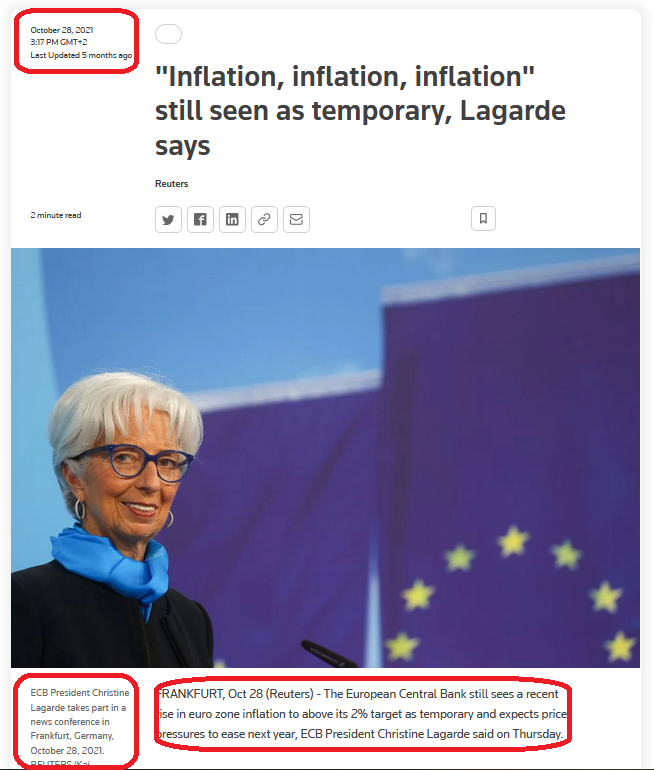

Longform'd. Cronaca di una morte annunciata (già dal 2020)
 

Noi, di Recce’d, lo abbiamo annunciato con anticipo: anni fa.

E’ quindi inevitabile un moto di orgoglio, un aumento dell’autostima.

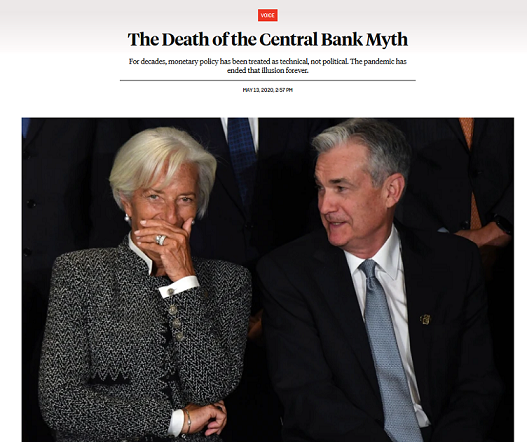
Perché chi segue il nostro sito, del tutto gratuitamente, ha letto con anticipo, anni fa, ciò che poi oggi ritrova sul suo quotidiano di fiducia, oppure in riviste molto autorevoli come Foreign Policy, dalla quale Recce’d ha ricavato sia l’immagine sopra, sia il testo che trovate in questo Longform’d.

Si tratta di un testo di altissima qualità: e di eccezionale lunghezza (almeno per i criteri del nostro Blog).

Se lo riproponiamo per intero, è proprio perché il lavoro di Adam Tooze, che firma questo articolo, è di eccezionale qualità e completezza.

Nulla di ciò che leggerete qui lo trovate sul Sole 24 Ore, oppure sul Corriere della Sera, oppure in TV su CNBC ed al TG Economia.

Nel vostro interesse, c’è dunque di fare uno sforzo, e leggere per intero l’articolo.

Vi offriamo una lettura accompagnata: i commenti di Recce’d vi guideranno nella ricerca dei punti più significativi.

Ripetiamo una cosa che avevamo già scritto, in alcuni precedenti Post: questo tema è un tema della massima attualità, dal punto di vista sociale e politico. Un tema che avrà concrete e rilevanti ricadute, dal punto di vista sociale e politico.

Mentre invece, sul piano della gestione del portafoglio modello, ed in generale della gestione degli investimenti, oggi la sua importanza è pari a ZERO. In termini di strategia di portafoglio, queste sono cose di uno-due-tre anni fa.

Oggi, a metà del 2022, questo argomento non modifica né i futuri rendimenti, né i futuri rischi di asset finanziari e classi di asset finanziari. La medesima cosa ci sentiamo di affermare per ciò che riguarda gli imminenti rialzi dei tassi da parte sia della Fed che della BCE.

I temi che oggi determinano i futuri rendimenti, ed i futuri rischi degli asset finanziari oggi, a metà 2022, sono altri.

Ora vi lasciamo alla lettura, aggiungendo un dettaglio … da niente.

L’articolo è datato 13 maggio 2020: lo avevamo messo da parte, per voi lettori, in modo da pubblicarlo quando ne sarebbe risultata evidente, a tutti, la rilevanza.

E c’è poi un secondo … dettaglio da niente: noi di Recce’d condividiamo l’analisi di Tooze e ne apprezziamo la elevata qualità: allo stesso tempo (lo diciamo per chi arriverà fino in fondo) Recce’d NON condivide le conclusioni proposte (ricordiamolo, nel 2020) da Tooze. Noi NON vediamo le cose nel modo nel quale Tooze le vede.

In particolare: Tooze scrive a favore di un “allargamento” delle funzioni delle Banche Centrali, Recce’d invece è a favore di un (nettissimo) “restringimento” della loro operatività, in modo che essa ritorni ad allinearsi all’originale mandato.

Non le condividiamo, le conclusioni di Tooze: ma per voi investitori, tutti, è rilevante conoscerle. La ragione? Proprio di questo si discuterà, e moltissimo ed in modo acceso ed anche violento, da qui in avanti.

E quindi: arrivateci preparati. Anche con i vostri portafogli in titoli, perché soprattutto loro, i titoli, gli asset finanziari, ne subiranno le conseguenze.

La Storia, in questi anni, viene e verrà riscritta: cercate di farvene un’idea per tempo.


By Adam Tooze, a columnist at Foreign Policy and director of the European Institute at Columbia University.

In Europe, a ruling by the German Constitutional Court that the European Central Bank (ECB) failed to adequately justify a program of asset purchases it began in 2015 is convulsing the political and financial scene. Some suggest it could lead to the unraveling of the euro. It may be difficult at first glance to understand why. Yes, the purchases were huge—more than 2 trillion euros of government debt. But they were made years ago. And the points made by the court are arcane. So how could a matter like this assume such importance?

The legal clash in Europe matters not only because the ECB is the second-most important central bank in the world and not only because global financial stability hinges on the stability of the eurozone. It also brings to the surface what ought to be a basic question of modern government: What is the proper role of central banks? What is the political basis for their actions? Who, if anyone, should oversee central banks?

As the COVID-19 financial shock has reaffirmed, central banks are the first responders of economic policy. They hold the reins of the global economy. But unlike national Treasuries that act from above by way of taxing and government spending, the central banks are in the market. Whereas the Treasuries have budgets limited by parliamentary or congressional vote, the firepower of the central bank is essentially limitless. Money created by central banks only shows up on their balance sheets, not in the debt of the state. Central banks don’t need to raise taxes or find buyers of their debt. This gives them huge power.

Nella prima parte dell’articolo, che prende spunto da una sentenza della Corte Costituzionale tedesca del 2020, Touze spiega con massima chiarezza perché le Banche Centrali hanno agito come hanno agito in reazione alla pandemia: operando in una libertà pressoché assoluta, ed al di fuori di ogni controllo, proprio perché “a tutti faceva comodo”.

Le Bnache Centrali, infatti, “non devono alzare le tasse per finanziare le spese”.

How this power is wielded and under what regime of justification defines the limits of economic policy. The paradigm of modern central banking that is being debated in the spartan court room in the German town of Karlsruhe was set half a century ago amid the turbulence of inflation and political instability of the 1970s. In recent years, it has come under increasing stress. The role of central banks has massively expanded.

In much of the world, notably in the United States, this has engendered remarkably little public debate. Though the litigation in Germany is in many ways obscure, it has the merit of putting a spotlight on this fundamental question of modern governance. Faced with the hubris of the German court, it may be tempting to retreat into a defense of the status quo. That would be a mistake. Though it is flawed in many ways, the court’s judgment does expose a real gap between the reality of 21st-century central banking and the conventional understanding of its mission inherited from the 20th century. What we need is a new monetary constitution.

Central bankers gather for a G-7 meeting in Washington in April 2004, including (from left) David Dodge of the Bank of Canada; Christian Noyer of the Bank of France; Jürgen Stark of the Bundesbank; Jean-Claude Trichet of the European Central Bank; Alan Greenspan of the U.S. Federal Reserve; Toshihiko Fukui of the Bank of Japan; Mervyn King of the Bank of England; and Antonio Fazio of the Bank of Italy. Stephen J. Boitano/LightRocket via Getty Images

The proud badge worn by modern central bankers is that of independence. But what does that mean? As the idea emerged in the 20th century, central bank independence meant above all freedom from direction by the short-term concerns of politicians. Instead, central bankers would be allowed to set monetary policy as they saw fit, usually with a view not only to bringing down inflation but to permanently installing a regime of confidence in monetary stability—what economists call anchoring price expectations.

La seconda parte dell’articolo di Tooze mette all’attenzione del lettore il concetto della “indipendenza” delle Banche Centrali: che poi è il nocciolo della intera questione.

Ciò di cui oggi si discute, e si discuterà per anni, è proprio questo concetto di “indipendenza” che Tooze illustra alla perfezione qui.

The analogy, ironically, was to judges who, in performing the difficult duty of dispensing justice, were given independence from the executive and legislative branches in the classic tripartite division. With money’s value unhooked from gold after the collapse of the Bretton Woods system in the early 1970s, independent central banks became the guardians of the collective good of price stability.

The basic idea was that there was a trade-off between inflation and unemployment. Left to their own devices, voters and politicians would opt for low unemployment at the price of higher inflation. But, as the experience of the 1970s showed, that choice was shortsighted. Inflation would not remain steady. It would progressively accelerate so that what at first looked like a reasonable trade-off would soon deteriorate into dangerous instability and increasing economic dislocation. Financial markets would react by dumping assets. The foreign value of the currency would plunge leading to a spiral of crisis.

Under the looming shadow of this disaster scenario, the idea of central bank independence emerged. The bank was to act as a countermajoritarian institution. It was charged with doing whatever it took to achieve just one objective: hold inflation low. Giving the central bank a quasi-constitutional position would deter reckless politicians from attempting expansive policies. Politicians would know in advance that the central bank would be duty bound to respond with draconian interest rates. At the same time as deterring politicians, this would send a reassuring signal to financial markets. Establishing credibility with that constituency might be painful, but the payoff in due course would be that interest rates could be lower. Price stability could thus be achieved with a less painful level of unemployment. You couldn’t escape the trade-off, but you could improve the terms by reassuring the most powerful investors that their interest in low inflation would be prioritized.

It was a model that rested on a series of assumptions about the economy (there was a trade-off between inflation and unemployment), global financial markets (they had the power to punish), politics (overspending was the preferred vote-getting strategy), and society at large (there were substantial social forces pushing for high employment regardless of inflation). The model was also based on a jaundiced vision of modern history and more or less explicitly at odds with democratic politics: first in the sense that it made cynical assumptions about the motivations of voters and politicians but also in the more general sense that in the place of debate, collective agreement, and choice, it favored technocratic calculation, institutional independence, and nondiscretionary rules.

This conservative vision legitimated itself by reference to moments of historical trauma. The German Bundesbank founded after World War II in the wake of two bouts of hyperinflation—during the Weimar Republic and the aftermath of Germany’s catastrophic defeat in 1945—was the progenitor. The U.S. Federal Reserve made its conversion to anti-inflationary orthodoxy in 1979 under Paul Volcker’s stewardship. The mood music was provided by President Jimmy Carter’s famous speech on the American malaise compounded by global anxiety about the weakness of the dollar after repeated attempts by the Nixon, Ford, and Carter administrations to stabilize prices through government-ordered price regulations and bargains with trade unions and businesses. Democratic politics had failed. It was time for the central bankers to act using sky-high interest rates. That ending inflation in this way would mean abandoning any commitment to full employment, plunging America’s industrial heartland into crisis, and permanently weakening organized labor was not lost on Volcker. There was, in that famous phrase of the era, no alternative.

By the 1990s, an inflation-fighting, independent central bank had become a global model rolled out in post-communist Eastern Europe and what were now dubbed the “emerging markets.” Along with independent constitutional courts and adherence to global human rights law, independent central banks were part of the armature that constrained popular sovereignty in Samuel Huntington’s “third wave of democracy.” If the freedom of capital movement was the belt, then central bank independence was the buckle on the free-market Washington Consensus of the 1990s.

Da qui in avanti, Tooze esamina i cambiamenti intervenuti negli Anni Duemila, quando i poteri delle Banche Centrali si sono ampliati, in una misura che oggi a molti appare eccessiva e dannosa.

For the community of independent central bankers, those were the golden days. But as in so many other respects, that golden age is long gone. In recent decades, central banks have become more powerful than ever. But with the expansion of their role (and their balance sheets) has gone a loss of clarity of purpose. The giant increase in power and responsibility that has accrued to the Fed and its counterparts around the world in reaction to COVID-19 merely confirms this development. Formal mandates have rarely been adjusted, but there has clearly been a huge expansion in reach. In the American case, where the extension has been most dramatic, it amounts to a hidden transformation of the state, indeed of the U.S. Constitution, that has taken place in an ad-hoc way under the pressure of crisis with precious little opportunity for serious debate or argument.

Conservative economists watch in horror as the paradigm of the 1990s has come apart. Won’t a central bank that intervenes as deeply as modern central banks now do distort prices and twist economic incentives? Does it not pursue social redistribution by the back door? Will it not undermine the competitive discipline of credit markets? Will a central bank whose balance sheet is loaded with emergency bond purchases not fall into a vicious circle of dependence on the stressed borrowers whose debts it buys?

These concerns are at the root of the drama in Germany’s constitutional court. But to know how to respond to them, we need to start by doing what neither the German court nor the ECB’s defenders have so far done, namely to account for how the familiar model of central bank independence has come apart since the 1990s.

The assumptions about politics and economics that anchored the model of the independent central bank in 1980s and 1990s were never more than a partial interpretation of the reality of late 20th-century political economy. In truth, the alarmist vision they conjured was not so much a description of reality as a means to advance the push for market discipline, away from both elected politicians and organized labor.

Tooze qui entra nel cuore dell’argomento: i cambiamenti nel terzo decennio del XXI secolo. Un periodo nel quale sono diventate obsolete, in breve tempo, tutte le idee sulla base delle quali il Sistema era fondato.

In the third decade of the 21st century, however, the underlying political and economic assumptions have become entirely obsolete—as much because of the success of the market vision as its failures.

First and foremost, the fight against inflation was won. Indeed, it was won so decisively that economists now ask themselves whether the basic organizing idea of a trade-off between inflation and unemployment any longer obtains. For 30 years, the advanced economies have now been living in a regime of low inflation. Central banks that once steeled themselves for the fight against inflation now struggle to avoid deflation. By convention, the safe minimal level of inflation is 2 percent. The Bank of Japan, the Fed, and the ECB have all systematically failed to hold inflation up to that target. It was the desperate efforts of the ECB to ensure that the eurozone did not slide into deflation in 2015 that led to the drama in the German courtroom last week. The ECB’s giant bond purchases were designed to flush the credit system with liquidity in the hope of stimulating demand.

Long before the lawyers starting arguing, the economics profession has been scratching its head over this situation. The most obvious drivers of so-called lowflation are the spectacular efficiency gains achieved through globalization, the vast reservoir of new workers who were attached to the world economy through the integration of China and other Asian export economies, and the dramatic weakening of trade unions, to which the anti-inflation campaigns, deindustrialization, and high unemployment of the 1970s and 1980s powerfully contributed. The breaking of organized labor has undercut the ability of workers to demand wage increases. This lack of inflationary pressure has left modern central banks unconcerned about even the most gigantic monetary expansion. However much you increase the stock of money, it never seems to show up in price increases.

Nor is it just the economics that are haywire. Whereas the classic model assumed that politicians were fiscally irresponsible and thus needed independent central banks to bring them into line, it turns out that a critical mass of elected officials drank the 1990s Kool-Aid. In recent decades, we have seen not a relentless increase in debt but repeated efforts to balance the books, most notably in the eurozone under German leadership. Contrary to its reputation, Italy has been a devoted follower of austerity, leading the way in fiscal discipline. But so has the United States, at least under Democratic administrations. Politicians campaigned for fiscal consolidation and debt reduction instead of promises of investment and employment. In the agonizingly slow recovery from the 2008 crisis, the problem for the central bankers was not overspending but the failure of governments to provide adequate fiscal stimulus.

E qui Tooze arriva al tema centrale della questione, per noi investitori ma in realtà per tutti i cittadini dei Paesi nei quali le Bnache Centrali hanno svolto questo ruolo “ampliato ed abnorme”.

Il tema è quello dei mercati finanziari, della loro istabilità, e del ruolo dei Titoli di Stato e delle obbligazioni in generale come “meccanismo di esecuzione delle politica delle Banche Centrali”.,

Rather than obstreperous trade unions and feckless politicians, what central bankers have found themselves preoccupied with is financial instability. Again and again, the financial markets that were assumed to be the disciplinarians have demonstrated their irresponsibility (“irrational exuberance”), their tendency to panic, and their inclination to profound instability. They are prone to bubbles, booms, and busts. But rather than seeking to tame those gyrations, central banks, with the Fed leading the way, have taken it on themselves to act as a comprehensive backstop to the financial system—first in 1987 following the global stock market crash, then after the dot-com crash of the 1990s, even more dramatically in 2008, and now on a truly unprecedented scale in response to COVID-19. Liquidity provision is the slogan under which central banks now backstop the entire financial system on a near-permanent basis.

To the horror of conservatives everywhere, the arena in which central banks perform this balancing act is the market for government debt. Government IOUs are not just obligations of the tax payer. For the government’s creditors, they are the safe assets on which pyramids of private credit are built. This Janus-faced quality of debt creates a basic tension. Whereas conservative economists anathematize central banks swapping swap government debt for cash as the slippery slope to hyperinflation, the reality of modern market-based finance is that it is based precisely on this transaction—the exchange of bonds for cash, mediated if necessary by the central bank.

One of the side effects of massive central bank intervention in bond markets is that interest rates are very low, in many cases close to zero, and at times even negative. When central banks take assets off private balance sheets, they drive prices up and yields down. As a result, far from being the fearsome monster it once was, the bond market has become a lap dog. In Japan, once one of the engines of financial speculation, the control of the Bank of Japan is now so absolute that trading of bonds takes place only sporadically at prices effectively set by the central bank. Rather than fearing bond vigilantes, the mantra among bond traders is “Don’t fight the Fed.”

Central bank intervention helps to tame the risks of the financial system, but it does not stem its growth, nor does it create a level playing field. While high-powered fund managers and their favored clients hunt for better returns in stock markets and exotic and exclusive investment channels like private equity and hedge funds, thus taking on more risk, more cautious investors find themselves on the losing side. Low interest rates hurt savers, they hurt pension funds, and they hurt life insurance funds that need to lock in safe long-term returns on their portfolios. It was precisely that constituency that was the mainstay of the litigation in front of the German constitutional court.

The plaintiffs and their lawyers blame the central bank for pushing interest rates down, benefiting feckless borrowers at the expense of thrifty savers. What they ignore are the deeper economic pressures to which the central bank itself is responding. If there is a glut of savings, if rates of investment are low, if governments, notably the German government, are not taking up new loans but repaying debt, this is bound to depress interest rates.

Nella parte dell’articolo che segue, leggete una serie di considerazioni che sono pesantemente condizionate dallo stato delle cose nella prima parte del 2020, e che quindi NON tengono conto dei due anni successivi.

Proprio per questa ragione, risulta utilissimo leggerle oggi.

The result of this combination of economic, political, and financial forces is an economic landscape that, by the standards of the late 20th century, can only seem topsy-turvy. Central bank balance sheets are grotesquely inflated, yet prices (except for financial assets) slide toward deflation. Before the COVID-19 lockdown, record low unemployment no longer translated into wage increases. With long-term interest rates near zero, politicians nonetheless refused to borrow money for public investments. The response of central bankers, desperate to prevent a slide into self-sustaining deflation, is to reach again and again for stimulus.

In the United States, at least in this respect, the election of Donald Trump as president helped restore a degree of normality, if with a perverse edge. Egged on by Republicans in Congress, his administration has shown no inhibition about huge deficits to finance regressive tax cuts. Apart from anti-immigrant rhetoric, Trump’s winning card in 2020 would be an economy running hot. In 2019, the Fed seemed to be headed into the familiar territory of weighing when to raise interest rates to avoid overheating. Chair Jerome Powell certainly did not appreciate the president’s bullying against rate hikes, but at least the Fed was not lost in the crazy house of low growth, low inflation, low interest rates, and low government spending that the Bank of Japan and the ECB had to contend with.

Since the 1990s, the Bank of Japan has engaged in one monetary policy experiment after another. And driven by the profound crisis in the eurozone under the leadership of Mario Draghi, the ECB embarked on its own experiments. These efforts proved effective in delivering a measure of financial stability. They made central bankers into heroes. But they also fundamentally altered the meaning of independence. In the paradigm that emerged from the crises of the 1970s, independence meant restraint and respect for the boundaries of delegated authority. In the new era, it had more to do with independence of action and initiative. More often than not, it meant the central bank single-handedly saving the day.

Whereas in most of the world this was accepted in a pragmatic spirit—it was reassuring to think that someone, at least, was in charge—in the eurozone it was never going to be so easy. The way that Chancellor Helmut Kohl’s government sold German voters on the abandonment of the Deutsche mark was the promise that the ECB would resemble the Bundesbank as closely as possible. It was barred from directly financing deficits, and, in the hope of limiting undue national influence, it had limited political accountability. Its narrow mandate was simply to ensure price stability.

This was always a gamble, which depended on the willingness of the Italians and French, who also had a voice in the euro system, to go along. Their financial elites pushed for a common currency in part because they were looking for a restraint on their own undisciplined political class—but also because they were gambling that as members of the eurozone they would have a better chance of bending European monetary policy in their direction than they would if their national central banks were forced to follow the Bundesbank by the pressure of bond markets. In the early years of the euro, the compromise worked to mutual satisfaction. But it was always fragile. Once the financial crisis of 2008 forced a dramatic expansion of the ECB’s activity, buying both government and corporate bonds, intervening to cap the interest rates paid by the weakest eurozone member states, pushing bank lending by complex manipulation of interest rates, conflict was predictable. This tension exploded in the German Constitutional Court last week.

Da qui in avanti, fino ad arrivare alle conclusione, l’Autore si concentra sul tema BCE ed Unione Europea: è un tema attualissimo, ed ogni cosa che è scritta nell’articolo è rilevante anche per comprendere la attuale situazione (ad esempio: il tema della “frammentazione” e dello spread dei Titoli di Stato italiani.

Ma se siete stanchi, o facili alla pigrizia, potere scendere fino a dove noi di Recce’d commentiamo le conclusioni.

For the majority of financial opinion, the ECB’s growing activism is broadly to be welcomed. It is the one part of the complex European constitution that actually functions with real authority and clout as a federal institution. Though grudging in her public support, Chancellor Angela Merkel has rested her European policy on a tacit agreement to let the ECB do what was necessary. Allowing the ECB to manage spreads—the interest rate margin paid by weaker borrowers—was easier than addressing the question of how to make Italy’s debt-level manageable. But a recalcitrant body of opinion in Germany has never reconciled itself to this reality. For them, the ECB serves as a lightning rod for their grievances about the changing political economy of the last decade. They blame it for victimizing savers with its low interest policy. They blame it for encouraging the debts of their Southern European neighbors. Exponents of the old religion of German free market economics regard cheap credit as subversive of market discipline. All in all, they suspect the ECB of engaging in a policy of redistributive Keynesianism in monetary disguise, everything that Germany’s national model of the social market economy was supposed to have ruled out. For these Germans, the ECB is an opaque technocratic agency arrogating to itself powers that properly belong to national parliaments, barreling down the slippery slope to a European superstate. And, for them, it is anything but accidental of course that it is all the creation of a Machiavellian Italian with trans-Atlantic business connections, Mario Draghi.

For the body of opinion that had always been suspicious of the euro, Draghi’s commitment to do “whatever it takes” in 2012 was the final straw. The Alternative for Germany (AfD) emerged in 2013 not originally as an anti-immigrant party but as a right-wing economic alternative to Berlin’s connivance with the antics of the ECB. As the AfD has consolidated its position as the anti-establishment party of right-wing protest above all in eastern Germany, its agenda has shifted. But Bernd Lucke, one of the founders of the AfD who has since left the party, was among the plaintiffs whose case the German constitutional court decided last week.

Meanwhile, Germany’s influential tabloid Bild pursued a campaign amounting to a vendetta against Draghi, picturing him last September as a vampire sucking the blood of German savers. And even the Bundesbank leadership, both current and emeritus figures, has not been shy about associating itself with public opposition to the expansive course of the ECB. Defending the strength of the euro against the spendthrift, inflationary ways of Southern Europe played well with the patriotic gallery. But so long as Merkel preferred to cooperate with the ECB’s leadership, that opposition remained marginalized. What has thrown a spanner in the works are the well-developed checks and balance of the German Constitution guarded by the Constitutional Court.

The German Constitutional Court, based in modest digs in the sleepy town of Karlsruhe, has an activist understanding of its role within the German polity, presenting itself as “the citizens’ court” unafraid of upending the political agenda on issues from the provision of child care or means-tested welfare benefits to the future development of the European project. Since the 1990s, the court has been a vigilant check on unfettered expansion of European power. It makes the argument on the basis of defending democratic national sovereignty, insisting on its right to constantly review European institutions for their conformity to the basic norms of the German Constitution.

Each progressive expansion of ECB activism has thus stirred a new round of legal activism. Announced in 2012, Draghi’s instrument of Outright Monetary Transactions, an unlimited bond-buying backstop for troubled eurozone sovereign debtors, was challenged by a coalition of both left-wing and right-wing German plaintiffs. It was not until the summer of 2015 that the court finally and grudgingly ruled it acceptable.

When Draghi finally launched the ECB into large-scale bond buying in 2015, of the type that both the Fed and Bank of Japan had embarked on years before, it too immediately triggered a new round of litigation. In 2017, the court gave a preliminary ruling but referred the case to the European Court of Justice (ECJ). In December 2018, the ECJ declared the program to be in conformity of the European treaties. But the German constitutional judges were not satisfied with the reasoning of the ECJ and held hearings in 2019. After months of deliberation, Karlsruhe was supposed to issue its judgment on March 24, but that was postponed a week beforehand due to the coronavirus pandemic.

That turned out to be opportune because financial markets in March were in crisis. Between March 12 and 18, as the ECB failed to calm the waters, the interest paid by Italy for state borrowing surged. Thanks to massive intervention by the ECB, they have since cooled. Christine Lagarde’s ECB has promised to make an additional round of purchases in excess of 700 billion euros, with more to come if necessary. To calm the markets, what was needed was discretion and largesse—precisely what the German critics of the ECB feared most and had criticized so incessantly in the 2015 bond-buying program.

This made the judgment from Karlsruhe on the 2015 program even more significant. What might the ruling on Draghi’s quantitative easing (QE) signal for possible action against Lagarde’s crisis program? How might the court influence the course of debate in Germany? The initial hearings in 2019 had not sounded favorable to the ECB. The selection of expert testimony by the court was conservative and biased. The court had given full vent to the protests of smaller German banks about the low interest rates that ECB policy permitted them to offer savers. It was as though the court had summoned oil companies, and oil companies only, to give evidence on the question of carbon taxes.

For all the anticipation, the judgment has come as a shock. The question that has ultimately proved decisive is a seemingly conceptual one concerning the distinction between monetary policy and economic policy. The German Constitutional Court declared that the ECB, in pursuing its efforts to push inflation up to 2 percent, had overstepped the bounds of its proper domain—monetary policy—and strayed into the area of economic policy, which the European treaties reserve for national governments.

This is by no means an obvious distinction. It was originally built into the treaties both to protect national prerogatives and to ensure that the ECB’s focus on price stability was shielded against any improper meddling by parties that might prioritize concerns like unemployment or growth. Making this distinction is one of the central dogmas of the German school of economics known as ordoliberalism. But once monetary policy reaches any substantial scale, it in fact becomes meaningless.

The ECJ in Luxembourg reasonably took the view that the ECB has fulfilled its obligation to respect the boundary by justifying its policy with regard to the price objective and following a policy mix typical of modern central banks. It is this casual approach on the part of the ECJ to which Karlsruhe objects. The ECJ waived the case through without assessing the proportionality of the underlying trade-off, the German Constitutional Court thundered. In doing so, it had failed in its duty and acted ultra vires—beyond its authority. It was thus up to the German court to adjudicate the issue, and it duly found that the ECB had not to its satisfaction answered the economic concerns raised by the court’s witnesses. The ECB too was therefore found to have overstepped its mandate.

Since the German court does not actually have jurisdiction over the ECB, the ruling was delivered against the German government, which was found to have failed in its duty to protect the plaintiffs against the overreaching policy of the ECB. As Karlsruhe emphasized, its judgment would not come into immediate effect. The ECB would have a three-month grace period in which to provide satisfactory evidence that it had indeed balanced the broader economic impact of its policies against their intended effects. Barring that, the Bundesbank would be required to cease any cooperation with asset purchasing under the 2015 scheme.

The judgment was delivered to a court room observing strict social distancing, though the judges did not wear face masks. Chief Justice Andreas Voßkuhle, whose 12-year term at the court ends this month, noted that the ruling might be interpreted as a challenge to the solidarity necessary to meet the COVID-19 crisis. So he added by way of reassurance that the ruling applied only to the 2015 scheme. There is no need, therefore, for any immediate change of policy. The markets have so far taken the intervention in stride. But the Karlsruhe decision is, nevertheless, shocking.

It is a spectacular challenge to European court hierarchy. Instead of merely assessing the conformity of the ECB’s policies with the German Constitution, the German court arrogated to itself the right to evaluate the conformity of the ECB actions with European treaty law, an area explicitly left to the ECJ. This will surely play into the hands of those in Poland and Hungary who are determined to challenge the common norms of the European Union. It did not take long for Poland’s deputy justice minister to signal his enthusiastic support for the Karlsruhe decision. This may end up being the case’s most lasting effect.

But it is spectacular also for another reason. In challenging the ECB to justify its QE policy, the German court has put in question not just a specific policy but the entire rationale for central bank independence. What is more, it has done so not only formally but substantively. It has exposed the political and material basis that lies behind the norm of independence.

The claim that the ECB overstepped the bound between monetary and economic policy is, as an abstract proposition, not so much a scandal as a tautology. Only in an ordoliberal fantasy world could one imagine monetary policy working purely by way of signaling without it having an impact on the real economy. Indeed, to affect real economic activity by lowering the cost of borrowing is precisely the point of monetary policy. Far from failing to consider the economic impact of its monetary policies, this is precisely what the ECB spends its entire time doing.

Nevertheless, by harping on this seemingly absurd distinction the court has in fact registered a significant historic shift. The shift is not from monetary to economic policy but from a central bank whose job is to restrain inflation to one whose job is to prevent deflation—and from a central bank with a delegated narrow policy objective to one acting as a dealer of last resort to provide a backstop to the entire financial system. The German court is right to detect a sleight of hand when the ECB justifies an entirely new set of policies with regard to the same old mandate of the pursuit of price stability. But what the German court fails to register is that this is not a matter of choice on the part of the ECB but forced on it by historical circumstances.

Cutting through the legalese and abstruse arguments, the complaint brought to the court by the plaintiffs is that the world has changed. Europe’s central bank was supposed to be their friend in upholding an order in which excessive government spending was curbed, wage demands and inflation were disciplined, and thrifty savers were rewarded with solid returns. The reality they have confronted for the last 10 years is very different. They suspect foul play, and they blame the newfangled policies of the ECB and its Italian leadership. Rather than taking the high ground, recognizing the historical significance of this crisis and calling for a general reevaluation of the role of central banks in relation to a radically different economic situation, the German Constitutional Court has made itself into the mouthpiece of the plaintiffs’ specific grievances, linked those to an expression of fundamental democratic rights, and mounted a challenge to the foundation of the European legal order.

Its willingness to assume this role no doubt reflects its resentment at the usurpation of its supremacy by the ECJ. The decision reflects in this sense a concern to defend German national sovereignty. But it also reflects the cognitive shock of failing to come to terms with the role of central banks in a radically changed world. What this starkly reveals is the limits of existing modes of central bank legitimacy—including the narrative of central bank independence—at the precise moment at which we have become more dependent than ever on the decisive actions of central banks.

To see the head-turning effect of this ruling, imagine an alternative history. Imagine a citizen’s court like that in Karlsruhe convening sometime in the mid-1980s in the United States to evaluate whether or not Volcker’s Fed had adequately weighed the economic impact of its savage interest rate hikes on the steelworkers of the Rust Belt. Or, only slightly more plausibly, imagine a hearing in the Spanish or the Italian constitutional court on the question of whether or not their governments were remiss in not demanding to see the reasoning that justified the ECB’s decision in 2008 or 2011 to raise interest rates just as the European economy was sliding into first one and then a second recession. Were German concerns about inflation at those critical moments weighed against the damage that would be done to the employment opportunities of millions of their fellow citizens in the eurozone? Would Karlsruhe have heard a case brought on those grounds by an unfortunate German citizen who lost his or her job as a result of those disastrously misjudged monetary policy moves?

Of course those decisions were criticized at the time. But that kind of criticism was not considered worthy of constitutional consideration. That was merely politics, and it was the duty of the central bank, and a measure of its independence, to override and ignore such objections.

Flags of the European Union and Germany hang in front of the court in Frankfurt on May 5, the day the German Constitutional Court pronounced its judgment on billion-euro purchases of government bonds by the European Central Bank. Sebastian Gollnow/picture alliance via Getty Images

The political impact of the court ruling has been revealing. On the German side, the business council of Merkel’s Christian Democratic Union immediately expressed its support for the court. So too did a spokesperson for the AfD. Friedrich Merz, a possible right-wing successor to Merkel, let it be known that he now considers the German government bound to exercise a precautionary check on any further expansion of the ECB’s range of action.

The reaction of the European Commission and the ECB was no less immediate. They closed ranks around the ECJ. The clear message they sent was that they are bound by Europe’s common law and institutions. After a few days of deliberation, the ECB declared with supreme understatement that it takes note of the judgment from Karlsruhe but intends to ignore it since the ECB answers to the European Parliament and the European court, not the German Constitutional Court. The ECJ ruled in December 2018 on the asset purchase program at the request of the German court. There are no do-overs. The case is closed.

This leaves the German government and the Bundesbank in a tight spot. The German government, for its part, often goes for years without fully implementing the Constitutional Court’s most ambitious judgments. The Social Democrat-led Finance Ministry in Berlin, which cultivates its image as an advocate of pro-European policies, has played down the decision. The neuralgic point will be the Bundesbank. It is both a German agency, answerable to the Constitutional Court, and a member of the euro system—and thus bound by the statutes of the ECB.

An open and irresolvable conflict between the Bundesbank and the Constitutional Court on the one side and the ECB on the other would compound the tensions already being felt within the eurozone over the issue of the funding of the emergency response to the COVID-19 crisis. Resentment in Italy and Spain toward Germany is already at a high pitch. One might take the German court’s call to limit and balance the ECB’s expansion as a call to, instead, expand the reach of European fiscal policy. The ECB has made precisely that argument itself. But unfortunately the same political forces in Germany that brought the case to the Constitutional Court also stand in the way of a major move toward fiscal federalism.

Given the economic conservatism and hubris of the German court and the prospect of a string of challenges from across the EU by even more unfriendly forces, a strong stance from the European side is to be welcomed. But it would be regrettable if the ECB responded to the quixotic German onslaught against the realities of 21st-century central banking by itself retreating into a defensive bunker.

Tooze scrive, in conclusione dell’articolo, che lo shock della pandemia ha portato sotto gli occhi di tutti il fatto che “le circostanze economiche e politiche che ci avevano portato al modello originale di Banca Centrale indipendente sono cambiate, non soltanto in Germania oppure in Europa ma in tutto il Mondo”.

Questa semplice osservazione ha, ed avrà nei prossimi anni, implicazioni non tutte positive ed alcune gravi e pesanti, per tutti gli investitori e per tutti i portafogli titoli.

Ma in particolare per tutti gli investitori che erano stati indotti a credere nel Falso Mito delle “Banche Centrali Onnipotenti”, delle “Banche Centrali che sanno tutto”, delle “Banche Centrali che possono stampare moneta all’infinito”.

Semplicemente: quelle erano sciocchezze, belle e buone.

Nelle sue conclusioni, Toose riassume in modo estremamente efficace lo stato delle cose, uno stato delle cose che era nel 2020 più o meno il medesimo che nel 2022: dice Tooze che

La stabilità finanziaria è essenziale, ma l'attuale relazione incestuosa tra le banche centrali e il sistema finanziario tende, semmai, a sottoscrivere e incoraggiare pericolose speculazioni da parte di un'élite che si arricchisce da sola. Nel frattempo, la crescita lenta, la disuguaglianza e la disoccupazione sono alla base di molti dei nostri mali sociali e, allo stesso modo, del problema dell'onere del debito: la gestione del debito pubblico dipende in modo cruciale dalla velocità di crescita dell'economia.

Noi vi suggeriamo di leggere con la massima attenzione le conclusioni di Tooze che seguono.

If it was not already evident, the COVID-19 shock has made clear beyond a shadow of a doubt that both the political and economic circumstances out of which the original model of central bank independence emerged have changed, not just in Germany or Europe but around the world. This renders the classic paradigm of inflation-fighting independence obsolete and has thrown into doubt models of narrow delegation. To address the new circumstances in which the real problems are the threat of deflation, the stability of the financial system, and the passivity of fiscal policy, the ECB, like all its counterparts, has indeed been pursuing a policy that goes well beyond price stability conventionally understood. In fact, in Europe the ECB is the only agency engaged in economic policy worthy of the name. Given the limitations of its mandate, this does indeed involve a degree of obfuscation. Despite itself groping in the dark, the Karlsruhe decision has helpfully put a spotlight on the ECB charade.

To respond by doubling down on a defense of independence may be inevitable in the short run. But this too will run its course. The more constructive response would be to advocate for a wider mandate to ensure that the central bank does indeed balance price stability with other concerns; the bank’s second objective should surely be employment and not the interests of German savers. But an open debate about the range of the ECB’s mandate would be a step forward for European politics. The politics of treaty adjustment are not easy, of course. It will take political courage. But the demand itself should not be presented and dismissed as outlandish. After all the Fed has a dual mandate. Alongside price stability, it is enjoined by the Humphrey-Hawkins Act to aim for the maximum rate of employment possible. As the history of the Fed attests, this is far from being a binding commitment. But since 2008 it has provided the Fed with the latitude necessary to expand its range of activities.

That expansion of activity has in large part been a matter of technocratic discretion. The point of pushing for a discussion of a widening of the ECB’s mandate should be the opposite. The aim should be to encourage a wide-ranging discussion about the wider purpose of central banks. Again, the U.S. example may be an inspiration. The Fed’s dual mandate is, somewhat surprisingly, a legacy of progressive struggles fought in the 1960s and 1970s—specifically, by the civil rights movement under Coretta Scott King’s leadership—to force social equity to the top of the macroeconomic policy agenda. This may seem far-fetched, but progressives cannot shrink from the challenge. They should not allow themselves to be held prisoner to the 1990s mystique of central bank independence.

Two new issues make this pivotal in the current moment. One is the financial legacy of the COVID-19 crisis, which will burden us with gigantic debts. The balance sheet of the central bank is a pivotal mechanism for managing those debts. The other issue is the green energy transition and the need to make our societies resilient to environmental shocks to come. That will require government spending but also a reorientation of private credit toward sustainable investments. In that process, the central bank also has a key role. The current mandates require those concerns to be shoehorned in by way of arguments about financial stability. It is time for a more direct and openly political approach.

The independence model emerged from the collapse of the Bretton Woods system and the need to anchor inflation during the Great Inflation of the 1970s. The huge range of interventions currently being pursued by global central banks have emerged out of the crises of a globally integrated financial system. They have been enabled by the absence of inflationary risk. They have succeeded in staving off catastrophe for now. But they lack a positive purpose and updated democratic grounding.

We value price stability, but for better and for worse the forces that once made it an urgent problem are no longer pressing. That objective alone is no longer sufficient to define the mandate of the most important economic policymaking agency. Financial stability is essential, but the current incestuous relationship between central banks and the financial system tends, if anything, to underwrite and encourage dangerous speculation by a self-enriching elite. Meanwhile, slow growth, inequality, and unemployment are at the root both of many of our social ills and by the same token the problem of the debt burden—how we manage government debt depends crucially on how rapidly the economy is growing. Finally, we can no longer deny that we confront fundamental environmental issues that pose a dramatic generational challenge for investment.

These are the policy challenges of the third decade of the 21st century. Money and finance must play a key role in addressing all of them. And central banks must therefore be at the heart of policymaking. To pretend otherwise is to deny both the logic of economics and the actual developments in central banking of recent decades. We should also acknowledge however that this expansion stands in tension with the current political construction of central banks and particularly the ECB. Defining their position in terms of independence, strictly delimited mandates, and rules limits their democratic accountability. That was the explicit intention of the conservative reaction to the turmoil of the 1970s.

If Europe wants to escape the impasse created by the German court ruling, in which one countermajoritarian institution checks another at the behest of a resentful and self-interested minority, we need to step out from this historical shadow. Doing so is no doubt hedged with risks. But so too is attempting to patch and mend our anachronistic status quo. Half a century on from the collapse of Bretton Woods and the emergence of a fiat money world, 20 years since the beginning of the euro, it is time to give our financial and monetary system a new constitutional purpose. In so doing, Europe would not only be laying to rest its own inner demons. It would offer a model for the rest of the world.


Adam Tooze is a columnist at Foreign Policy and a history professor and director of the European Institute at Columbia University. His latest book is Crashed: How a Decade of Financial Crises Changed the World, and he is currently working on a history of the climate crisis. Twitter: @adam_tooze
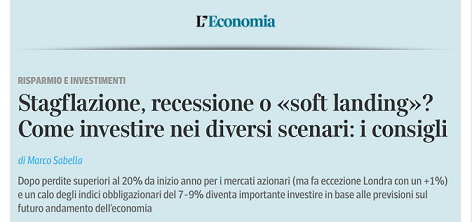
Longform'd. I temi di mercato del secondo semestre 2022: vecchi, e nuovi
 

Come noi, anche molti nostri lettori saranno stanchi e stufi, di leggere e sentire parlare di “inflazione” e di “recessione”.

Sei mesi fa, se si dava ascolto alla Federal Reserve e Goldman Sachs, oppure alla BCE ed UBS, questi due temi (inflazione e recessione) erano “inesistenti” e quindi “irrilevanti”.

Nel corso del primo semestre 2022, sono diventati gli “unici” temi di mercato. Nelle ultime settimane, la “recessione” è il solo tema di mercato.

Per conseguenza, tutte le banche di investimento internazionali, tutte le Reti di promotori finanziari italiane, e anche tutti i media, si sono buttati a capofitto: scopertisi in ritardo, si sono lanciati all’inseguimento.

Oggi un solo titolo si legge su tutti i media di settore, ed è questo: “Come si investe quando arriva la recessione?”.

A noi il tema NON interessa, per nulla. Sul piano della operatività di portafoglio questo è stato un tema rilevante, ma dodici mesi fa e sei mesi fa, quando i pochi che allora comprendevano ciò che stava succedendo anticiparono la “recessione”.

Noi di Recce’d la anticipammo proprio a voi, i lettori di questo Blog, ed anche attraverso i nostri portafogli modello.

Oggi, non ci interessa, sul piano operativo, scrivere di “recessione” o di “inflazione”: sono temi interessanti, certo, ma sul piano culturale e sociale, non sul piano operativo, perché sono già nei prezzi di mercato e quindi temi “passati”.

Noi di Recce’d, già un mese fa, proprio qui nel Blog, anticipammo per i lettori tutti che i temi di investimento sono destinati a cambiare, nel secondo semestre 2022.

Noi dicemmo, in più occasioni, in modo chiarissimo: ci saranno altri cinque NUOVI temi di mercato, dominanti nel secondo semestre.

In questo Longform’d, Recce’d vi anticipa alcuni (non tutti) di questi NUOVI temi di mercato, che ritroverete poi tra qualche mese in prima pagina sul Sole 24 Ore e sul Corriere della Sera.

Il primo di questi temi oggi noi ve lo presentiamo attraverso con un selezionato contributo firmato da Daniel Lacalle, che potete leggere qui di seguito.

Most market participants have been surprised by the last six months. The total return of the US Treasury Index was the worst since 1788 according to Deutsche Bank.

Stocks closed June with one of the largest corrections since 2008. Bonds and equities are falling in unison, driven by rate hikes and normalization of monetary policy.

However, there is no such real normalization.

The balance sheet of the main central banks has barely moved and remains at all-time highs according to Bloomberg. The ECB continues to ignore the highest inflation rate in the eurozone since the early 90s by keeping negative rates. The Federal Reserve rate hikes have been more aggressive, but it is still injecting billions of dollars in the reverse repo market and monetary aggregates remain excessive.

In the United States, money supply growth (M2) is still much higher than in the quantitative easing years. M2 money supply has risen to 21.8 trillion dollars and yearly change shows a rise of 1.3 trillion dollars, which is more than double the annual figure of the expansion phase of 2008-2011. Money supply (M2) annual growth in the United States was 6.5% in May, 6.6% in the eurozone. Global monetary growth in May was 9.9%, all figures according to Yardeni Research. In the eurozone money supply growth is higher than in the middle of the so-called “Draghi bazooka”, the famous “whatever it takes”.

Central banks have gone from “whatever it takes” to “no matter what”.

We already explained in a previous article that commodities do not cause inflation, money printing does, and the monetary aspect of inflation is not being addressed properly. One or two prices may rise due to an external crisis, but the rest would not rise in unison given the same quantity of currency. Between 2012 and 2014 we saw energy commodity prices soar, yet inflation measured as CPI was low because the supply of currency was in line with demand. We did see enormous inflation in asset prices, though, and policy makers did not pay attention to the impact on house prices and markets of enormous liquidity injections. When newly created currency stopped going to risky assets and was targeted at government current spending, inflation shot up.

Central banks seem to fear markets. However, it is better to create a correction in bonds, equities, and risky assets after years of all-time highs than to lead the world to a crisis created by the destruction of purchasing power of salaries and deposits.

Policy makers should be very concerned about the so-called “prudent” normalization because the expansion was far from prudent. The pace at which they bloated their balance sheets and cut rates is what they should have been worried about, not the normalization.

Consumer confidence is plummeting around the world, real wages are negative, and families are consuming the little savings they had just to make ends meet. At the same time, businesses are struggling with weaker margins as input prices soar.

The worst thing that governments and monetary authorities could do is to let the economy slip into a crisis where the productive sector, families, and businesses, collapse just because they did not want to cut deficit spending and truly normalize monetary policy.  By then, the problem will not be inflation, but deflation coming from the asphyxiation of the private sector.

Once consumers and businesses fall, tax revenues will also plummet, taking government debt to new highs. Even Keynesians should be worried about letting inflation run wild because the result would be that governments face an even worse fiscal crisis when the private sector slumps.

Inflation can be addressed by properly reducing central bank balance sheets, raising rates, and cutting deficit spending. If policy makers send the private sector to a crisis due to inaction, the crisis will be far worse than 2008. It is still time. End the perverse incentives of excessive monetary action. It may still create another leg down in markets, but they will eventually recover. The destruction of businesses and families’ disposable income is far more challenging to restore.

Che cosa potete trovare, di interessantissimo, nell’articolo che avete appena letto? L’articolo prende spunto dalla discesa degli indici di mercato, la associa con le recenti scelte e dichiarazioni delle Banche Centrali (tema da noi già ampiamente analizzato) ma arriva alla fine al tema delle scelte dei politici (non quelli delle Banche centrali: quelli che stanno al Governo ed al Parlamento).

Recce’d ha già messo in evidenza il fatto che oggi le Banche Centrali sono (meglio: si sono messe da sole) fuori dai giochi, come già in passato era successo (seconda metà del 2008). I politici sono e saranno costretti a fare scelte, alcune delle quali drastiche, e molte delle quali impopolari.

E quale è dunque il NUOVO tema di mercato che noi avevamo anticipato più in alto? Si tratta di quella che nell’articolo è chiamata la “crisi fiscale”: nessuno sui mercati, almeno fino ad oggi, si è chiesto che cosa succederà alle entrate fiscali, se i fatti che si sono messi in moto nel primo semestre 2022 ci porteranno verso la tanto anticipata “recessione”.

Nessuno, per ora, sui mercati ha operato sulla base di queste considerazioni. Nei prezzi sui mercati finanziari, a tutto oggi, la “crisi fiscale” non esiste. Così come non si vede, ancora, il tema del “credito”.

Queste considerazioni ci portano ad un secondo contributo, che prendiamo a prestito da Rabobank: nel brano che segue, leggete delle misure varate dal Governo tedesco per un “controllo dei prezzi” nel comparto del gas, e del salvataggio (con denaro pubblico) della Società tedesca che si chiama Uniper (settore gas). Due interventi pubblici che il testo che per voi abbiamo selezionato prede ad esempio, allo scopo di spiegare che cosa è la Santissima Trinità.

Nulla a che vedere con la religione, in questo caso: l’espressione “Santissima Trinità” fu scelta da due economisti (Mundell e Fleming) sessanta anni fa, per attribuire una etichetta facile da ricordare ad un loro ragionamento a proposito della politica economica.

Mundell e Fleming spiegarono le ragioni (solide) per ritenere che per un singolo Stato è e sarà sempre impossibile avere:

  1. una politica monetaria indipendente

  2. un tasso di cambio stabile

  3. la libertà nei movimenti di capitale

Ed eccoci arrivati al secondo “NUOVO tema di mercato” a cui vogliamo accennare in questo nostro Longform’d: vogliamo anticiparvi che, nel secondo semestre del 2022, sui mercati finanziari tutti ci ritroveremo ad occuparci molto di più di cambi tra le maggiori valute.

Leggendo con attenzione l’articolo, facilmente arriverete a comprendere le (svariate) ragioni per le quali questa evoluzione, e questo NUOVO tema di mercato, toccheranno in particolare l’euro, e quindi noi europei.

After last week’s recession fear-driven bounce-back in bonds (especially those at the shorter maturity section of the curve), markets took a breather on Monday as the US were closed for Independence Day. The European 2-year swap rate (which declined by a whopping 80bp in the last two weeks of June), recovered by more than 10bp yesterday. Arguably that was also driven by hawkish comments from ECB officials, such as Bank of Slovenia Governor Vasle, who warned that there will “likely be more rate hikes […] after September”. The RBA’s second consecutive 50bp hike this morning – albeit in line with the market’s expectations – served as another reminder that short-term rates are on a (steep) upward slope, globally.

Meanwhile, the US and China are in talks over a roll-back of tariffs imposed by the former Trump administration. It is our understanding that Treasury Secretary Yellen is a proponent of such a reversal, but that there is no unity on this issue in the Biden team. US Trade Representative Katherine Tai, for example, sees the tariffs as useful leverage in broader discussions with China (although sceptics will argue that the tariffs have done little to rebalance the trade relation between the two countries). The downward impact this would have on inflation is likely to be quite modest according to many analysts. Still, if such a decision were to coincide with the start of a downward trajectory in inflation (for entirely different reasons, such as ‘peak’ commodity prices), President Biden –who has also expressed great concern over cost of living issues for US households– may spin it as a vote-winner as the November mid-term elections are drawing closer.

(…)

Germany has already switched to phase 2 of its national gas emergency plan, just one step shy from taking complete control over the allocation of natural gas. Its previously mothballed coal-powered electricity plants are being fired up again and the government is still in talks with Uniper, its biggest gas importer, on what support measures it will provide. According to Germany’s Spiegel magazine, the government is working on legal basis to support gas supply companies with measures that could include the acquisition of shares and/or grant loans or guarantees. The Lufthansa bailout is seen as a blueprint for such measures. Bloomberg reports this morning that the potential bailout package could be as much as EUR 9bn.

But Chancellor Scholz acknowledged yesterday that the country is facing a “historic challenge” and that the rising costs of living could have “explosive” effects on German society, as it also drives a further wedge between the rich and the poor. Arguably, the Chancellor himself is facing one of those Unholy (or Impossible) Trinities: he cannot prevent social unrest, if he wants to have lower inflation and wants to prevent a recession at the same time. One could argue that simultaneously achieving the latter two objectives are already a daunting task in itself, let alone doing so without causing tensions between those in work and those enjoying their pension, or  between the providers of capital and the providers of labour.

So he’d better leave the prevention of inflation in the safe hands of the ECB, right? Oh, hang on, that other institution is actually dealing with an Unholy (or Impossible) Trinity itself. In fact, we would argue, one that is of its own making.

Before you start googling, the “Impossible trinity” concept dates back to the research by international economists Robert Mundell and John Fleming. The central tenet of their reasoning is that it is impossible to have all three of the following at the same time:

  • i) independent monetary policy (i.e. full control of your money supply),

  • ii) a fixed/stable exchange rate and

  • iii) the free movement of capital.

The prime example often used to explain the trinity is the situation where the central bank choses its own monetary policy amidst free capital flows. Under that regime – which basically is the regime under which many developed-markets central banks are currently operating – the central bank cannot control the exchange rate. For if it wants to fix the exchange rate it would have to use its FX reserves to steer the exchange rate. Since these reserves are limited it cannot support its currency indefinitely should it want to maintain an interest rate that is below the ‘global’ interest rate. Should it want to maintain an interest rate that is above the global level, it would likely see considerable capital inflows and the only way to stabilize the exchange rate is to purchase the influx of foreign currency by printing more of its own money, thus raising the money supply and stimulating growth and inflation.

But, we hear you thinking: things are absolutely fine for the ECB, right? Because the “exchange rate is not a policy target”. So no problem there. However, we are actually thinking about yet another Impossible Trinity that is currently playing havoc with the ECB. Over the weekend, the FT reported that the ECB is in discussion over whether and how it could prevent banks from making “multibillion euro” windfall profits from the cheap loans that the ECB has provided them during the pandemic. The basic idea here is that many banks have met their TLTRO targets and therefore borrow at the average deposit facility rate over the entire life of the loan. Since this average rises much more slowly than the actual deposit facility rate when the ECB hikes rates later this month, this effectively offers banks a free lunch.

We asked ourselves: this is not a new issue and the ECB could have seen this coming when it devised the policy. So why and why now? Well, one explanation could be that the ECB has been surprised by the relative low amount of TLTRO repayments by banks so far. But a more interesting explanation – in this regard – is that, in the process of designing its Anti Fragmentation Tool, the ECB may suddenly be realising that it has to give up control of the size of its balance sheet (or better: the monetary base), if it wants to maintain control over interest rates and spreads and prevent fragmentation at the same time.

A thought experiment helps explain the issue. Let’s assume concerns over Italian spreads force the ECB to buy more Italian bonds. And let’s assume that in order to fully sterilize the impact on the monetary base, the ECB decides to sterilize by mopping up liquidity through ‘weekly deposits’ (at a slight premium over de deposit facility rate). This, however, implies that the monetary base would effectively continue to expand, posing long-term risks to inflation. Alternatively, should the ECB decide to raise its reserve requirements by the same amount as it has pumped into Italian bonds, the increase in those requirements would likely pose a problem for those banks already low on excess reserves and who would not see a commensurate increase in their reserves.

As a consequence, the fragmentation issue may not be solved. And if the central bank were to issue securities with a long maturity, this would probably raise long-term interest rates (as they would compete with other core bonds). So while that may contain spreads, it would not be able to contain long-term yield levels.

So the basic conclusion here is that, with so many goals to achieve, the ECB risks becoming all tied up in its own instruments. Failure is almost guaranteed. It just has to choose where it accepts such failure.

Completiamo il nostro Longform’d con un terzo contributo esterno: l’autore questa volta è Mohamed El Erian, che tutti i nostri lettori conoscono bene.

In questo articolo, pubblicato dal Financial Times, El Erian prende come spunto le ampie perdite inflitte a tutti gli investitori nel primo semestre del 2022, e prova a vedere queste perdite in una chiave positiva: dice El Erian che per tutti noi è benefico il fatto che i prezzi degli asset finanziari si siano avvicinati di nuovo alla realtà delle economie e più in generale alla realtà dei fatti, dopo un lungo periodo nel quale “sono stati gonfiati artificialmente da enormi iniezioni di liquidità da parte delle Banche centrali”.

Ci sia consentito un inciso: noi di Recce’d scrivevamo queste medesime parole già due anni fa, e poi in numerose occasioni, da allora ad oggi.

Torniamo ad El Erian: nel suo articolo, scrive che “se il punto di arrivo adesso è quanto meno più sostenibile, la strada per arrivarci è sconnessa e piena di buche e di rischi”. Tra questi rischi, El Erian scrive di “fasi di stress nel funzionamento dei mercati finanziari”.

Noi di Recce’d portiamo alla attenzione dei lettori in questo inizio di luglio 2022 questo tema, in quanto uno dei NUOVI temi di mercato dei quali leggerete, poi, tra qualche mese, sulla prima pagina del vostro quotidiano preferito.

I nostri portafogli modello, già oggi, tengono conto di questi fatti di domani. Di questi NUOVI temi di mercato.

To say that the first half of the year was painful for investors would be a big understatement. They suffered large losses on their holdings of stocks, corporate bonds, emerging markets, crypto and other assets; and, for most of the last six months, they received no protection from government bonds whose traditional risk mitigation attributes gave way to big losses, too.

Indeed, other than oil and some other commodities, it was a dismal picture all around in public markets. It is only a matter of time until valuations in private equity follow suit. 

This is an environment in which it is hard to argue for silver linings, especially when so many analysts are warning that additional losses may be ahead in both public and private markets.

Yet three are already evident.

First, genuine and more sustainable value is being restored after a period in which asset prices were lifted artificially and distorted by huge and predictable injections of liquidity by central banks. Already some prominent individual stocks are in oversold territory, having been technically contaminated by what has been a generalized selloff as liquidity has been receding.

Second, after tracking equities lower and, in the process, experiencing historic losses, government bonds are resuming their role of risk mitigators in diversified investment portfolios. This is better news for investors who, for most of the first half of this year, felt that there was nowhere to hide.

One reason for the return of the traditional inverse correlation between the price of government bonds (the “risk-free asset”) and that of stocks (“risky”) is that the three main risk factors in play have evolved sequentially — the third silver lining. Had they operated simultaneously, the damage to markets and the economy would have been significantly worse.

The market selloff started with surging “interest rate risk” because of inflation and the sluggish policy reaction function of the Federal Reserve. This hit both stocks and bonds hard. It was joined in the last few weeks by higher “credit risk” as investors fretted that a late Fed scrambling to catch up with inflationary realities would push the economy into recession. The more these two risks persist, the greater the threat of unleashing the third, more damaging risk factor: stress to market functioning.

For long-term investors, it will prove beneficial over time that markets are exiting an artificial regime that was maintained for far too long by the Fed and that resulted in frothy valuations, relative price distortions, resource misallocations and investors losing sight of corporate and sovereign fundamentals. The promise now is one of a more sustainable destination. Unfortunately, it comes with an uncomfortably bumpy and unsettling journey.

Valter Buffo
Longform'd (terza parte) Giugno 2022: la crisi di fiducia è arrivata.
 

Il primo semestre del 2022 per la grande parte degli investitori, in Italia e non solo, è stata un vero e proprio incubo.

E questo non soltanto a causa dei risultati, come diremo più avanti.

I risultati, senza dubbio, per la maggioranza degli investitori sono stati disastrosi, ed in una misura che non ha precedenti, come leggete nella tabella che apre il nostro Longform’d.

Disastrosi in particolare di quei portafogli “ad asset allocation” proposti (imposti, per dire meglio) in modo unanime ed uniforme dal cartello delle Reti di vendita di “prodotti finanziari” (le Reti di promotori finanziari, che successivamente sono stati re-brandizzati come “consulenti”, oppure wealth manager, oppure private banker, ma che a tutto oggi devono la loro esistenza unicamente al conflitto di interesse).

I risultati dei citati portafogli, cosiddetti “ad asset allocation” (non è la sola asset allocation possibile: si tratta semplicemente della LORO asset allocation, uguale per tutti) sono in effetti risultati non solo inferiori alle attese di gennaio 2022: sono anche i peggiori risultati semestrali degli ultimi cinquanta anni.

Su questo specifico argomento, ovvero la costruzione del portafoglio titoli e le varie alternative per la asset allocation, noi di Recce’d scriveremo presto in modo ampio ed approfondito, nella pagina del sito che si chiama SCELTE DI PORTAFOGLIO.

Torniamo però all’attualità. Come tutti sapete, le Reti di promotori finanziari, in fasi di mercato come quella attuale, hanno un solo messaggio per il loro Clienti, grandi e piccolo: ovvero “tenete duro, è un brutto momento, ma poi passerà”.

Atteggiamento che non solo non è professionale (non è professionale, in alcuna professione, appellarsi alla “fede” oppure alla “provvidenza di Dio” come nei Promessi Sposi), ma è pure irresponsabile: grandi e piccoli, tutti i promotori finanziari spingono sempre sull’investire, sulla Borsa, persino sui BTP, senza avere la più piccola idea di come in futuro si comporteranno davvero quegli investimenti.

Per la normativa vigente, in Italia ma non solo, la competenza NON è un requisito professionale indispensabile. Spingere su “prodotti finanziari” perché “ad alto margine” (per quelli che li piazzano agli investitori) in conflitto di interesse NON costituisce un problema urgente. E infatti viene tollerato.

Un domani, dice l’immagine qui sotto, le cose potrebbero cambiare: e noi di Recce’d, insieme con tutti gli investitori che hanno consapevolezza ci ciò che fanno dei propri soldi, ce lo auguriamo con tutte le forze.

Proprio per effetto di questa diffusa e profonda incompetenza di cui si è appena detto, e che si può documentare grazie ai dati, quasi tutti gli investitori italiani per due anni sono stati “pompati”, ovvero spinti a mettere in portafoglio “più rischio”, sulla base di argomenti come:

  1. il boom economico

  2. l’inflazione transitoria

  3. le Banche Centrali che hanno il controllo di tutto e prevedono tutto

Erano tutte balle: favole del tutto inventate, al solo scopo di “piazzare la merce”.

Scriverlo oggi è facile: sta scritto su tutti i giornali.

Scriverlo, come noi abbiamo fato, nell’agosto del 2020 e nei mesi successivi, non è stato banale, né facile.

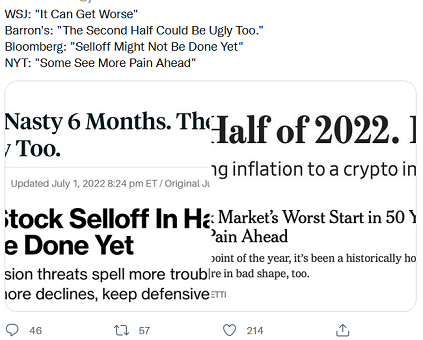
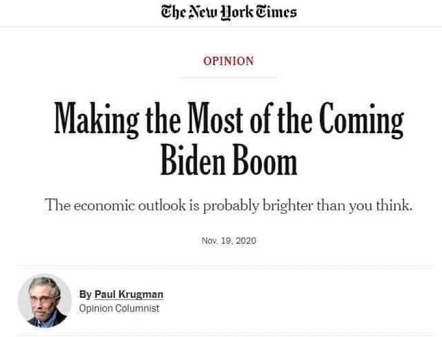
La grande massa degli investitori è stata trattata, dai media e dalle Reti di vendita di Fondi Comuni, come “il gregge dei grulli”, senza che le Autorità preposte ritenessero opportuno proteggerle dalla “infondata euforia” alimentata dai canali di vendita e dai media. E come leggete nell’immagine, anche da alcuni Premi Nobel dell’Economia.

Chi al contrario ha seguito altre e diverse indicazioni, come ad esempio quelle fornite da noi di Recce’d anche attraverso il Blog che state leggendo, oggi NON si trova a soffrire di ansie notturne. Oggi NON soffre di confusione mentale. Ed oggi guarda alle prossime operazioni come fa chi ha “il pallino in mano” e può scegliere.

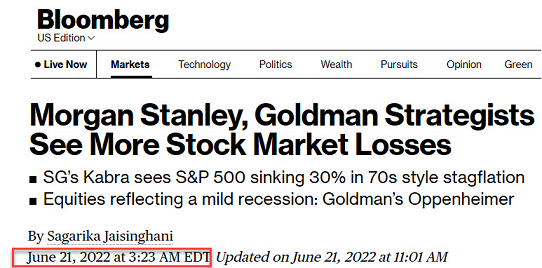
Come scritto poco più sopra, la maggioranza degli investitori italiani soffre a causa di performances che sono state appena definite “miserabili” niente meno che da Goldman Sachs, come leggete qui nell’immagine. Ma non soffre soltanto per quella ragione.

Soffre, lo ripetiamo, anche per uno stato di ansia profonda e di confusione mentale: tutti i riferimenti, tutti gli ancoraggi, tutti i “punti fermi” che agli investitori erano stati proposti (imposto) negli ultimi quindici anni, dopo la Grande Crisi Finanziaria 2007-2009.

Oggi, la massa degli investitori soffre di ansia e confusione perché non riesce più a costruirsi uno “scenario futuro di riferimento”, e quindi non è in grado di operare scelte di investimento consapevoli, perché non è in grado di dire su che cosa tali scelte vanno fondate.

La grande maggioranza degli investitori ha capito (finalmente) che le Banche Centrali sono molto semplicemente Istituzioni pubbliche gestite da funzionari pubblici, soggetti a pressioni politiche, e non “benefattori universali ed infallibili”. In quanto Istituzioni pubbliche, perseguono obbiettivi politici: beneficiano alcuni, a danni di altri. Fanno scelte politiche, appunto.

Sono, in poche parole, semplicemente esseri umani.

Detto delle Banche Centrali, all’investitore quali certezze restano? I politici, forse? Il Fondo Monetario Internazionale? Goldman Sachs e Morgan Stanley e UBS? Mediolanum e Fideuram? FINECO e Allianz? Generali e una qualsiasi di tutte le altre?

Qui i fatti, e la storia delle Istituzioni citate, parlano da sole, e noi non aggiungeremo altro.

La massa degli investitori si sente così: sola ed abbandonata di fronte all’incertezza. Che oggi è 10, 100, 1000 volte più elevata (sembra a quegli investitori: in realtà, è la medesima che c’è sempre stata). Questa è la crisi di fiducia del titolo qui sopra.

L’investitore consapevole, oggi è costretto a fare uno sforzo (finalmente): deve ragionare con la propria testa, deve selezionare e capire, deve evitare di affidarsi ad un nome, ad uno slogan, ad una etichetta.

Deve fare scelte autonome, indipendenti, non condizionate dal brand.

Deve trovare nuovi riferimenti: il nostro suggerimento, come sapete, è quello di uscire dalla trappola costruita dalle Reti di promozione finanziaria, anche grazie ad una normativa a protezione del cartello commerciale, e affidarsi ad operatori indipendenti, e liberi dal conflitto di interesse.

Affidarsi a chi ha competenza professionale specifica, e a chi non è costretto a ripetervi sempre che “tutto va bene” per mettersi in tasca le retrocessioni delle commissioni sui cosiddetti “prodotti finanziari, come UCITS, certificati, Fondi Comuni e così via.

Come sempre, noi di Recce’d offriamo gratuitamente attraverso il Blog a tutti questi investitori “abbandonati” utili elementi di informazione, di analisi e di valutazione, allo scopo di aiutarli prima di tutto a comprendere ciò che accade intorno a loro.

Noi immaginiamo senza difficoltà l’ansia e la confusione della maggioranza degli investitori, investiti da questa ondata di ribassi e di volatilità. L’investitori di massa non può chiaramente comprendere come sia possibile passare, in soli quindici giorni, da un mercato finanziario totalmente dominato dal tema “inflazione”, con i rendimenti in forte rialzo (Treasury USA al 3,45% e BTp Italia al 4,20% sulle scadenze decennali) ad un mercato dominato in tutto e per tutto dal tema “recessione” (e conseguente crollo dei rendimenti.

E’ successo esattamente questo, nelle ultime due settimane di mercato. Ha senso, la cosa? Non ha alcun senso: una testimonianza concreta è offerta sia dai dati visti la settiana scorsa per l’inflazione, sia dal titolo che leggete qui vicino.

Non ha senso: è semplicemente una concreta ed evidente manifestazione di quel disagio, di quella confusione, di quell’ansia che abbiamo citato più sopra. La situazione dei mercati è dominata dall’emotività, dalla paura, ed appunto dalla confusione.

Violenti cambiamenti di umore di questo genere sono tipici di tutte le fasi di crisi dei mercati finanziari: ma una crisi così ampia e profonda come quella in corso non c’è mai stata prima, ed è quindi del tutto impossibile dire quando le violente oscillazioni si calmeranno. La situazione oggi è questa, e rimarrà questa per almeno un certo periodo.

La “asset allocation” delle Reti di promozione finanziaria, da questo punto di vista, lascia l’investitore del tutto “a vento”, del tutto privo di protezione, ed in balia dei mercati finanziari. Il solo argomento di tutti i private bankers, in questo momento, è sempre il solito: “tenete duro, prima o poi passerà”.

Ma passerà, prima o poi? Loro, i private bankers, i wealth managers, non ne hanno idea, e la grande massa degli investitori neppure.

Recce’d è in grado di risolvere questa ansia, di eliminare questa confusione, e di gestire la fase di mercato in corso portando i propri portafogli modello a risultati positivi e dignitosi senza assumere rischio finanziario in misura eccessiva.

A chi deciderà di contattarci, illustreremo le modalità che permettono di raggiungere questi risultati.

Nel Longform’d di oggi invece ci limitiamo come già detto ad offrire contenuti informativi, analisi e valutazioni a supporto delle scelte di investimento dei nostri lettori.

Nell’articolo che segue, pubblicato in settimana dal Wall Street Journal, leggerete l’opinione di John H. Cochrane, uno dei più noti e qualificati economisti in materia di Finanza e Mercati.

L’articolo vi sarà molto utile, e vi invitiamo a leggerlo per intero. Noi per voi abbiamo evidenziato due passaggi, di particolare attualità;

  • un passaggio dove si spiega perché è del tutto sbagliato assumere che “se ci sarà la recessione, calerà anche l’inflazione”; ed anche

  • un secondo passaggio dove si sottolinea quale è la maggiore differenza tra la situazione attuale e quella degli Anni Settanta ed Ottanta.

The current inflation was sparked by fiscal policy—the government printed or borrowed about $5 trillion, and sent checks to people and businesses. The U.S. has borrowed and spent before without causing inflation. People held the extra debt as a good investment. That this stimulus led to inflation thus reflects a broader loss of faith that the U.S. will repay its debt.

The Federal Reserve’s monetary-policy tools to cure this inflation are blunt. By raising interest rates, the Fed pushes the economy toward recession. It hopes to push just enough to offset the stimulus’s fiscal boost. But monetary brakes and a floored fiscal gas pedal mistreat the economic engine.

Raising interest rates can lower stock and bond prices and raise borrowing costs, cutting into home construction, car purchases and corporate investment. The Fed can interrupt the flow of credit. But higher interest rates don’t do much to discourage people from spending government stimulus checks. At best, the economy is unbalanced. The economy needs investment and housing. Today’s demand is tomorrow’s supply.

Slowing the economy isn’t guaranteed to reduce inflation durably anyway. Even in the 2008 recession, with unemployment above 8%, core inflation fell only from 2.4% in December 2007 to 0.6% in October 2010, and then bounced back to 2.3% in December 2011. At this rate, even temporarily curing 6% May 2022 core inflation would take a dismal recession. In 1970 and 1974, the Fed raised interest rates more promptly and more sharply than now, from 4% to 9% in 1970 and from 3.5% to 13% in 1974. Each rise produced a bruising recession. Each reduced inflation. Each time, inflation roared back.

The Phillips curve, by which the Fed believes slowing economic activity reduces inflation, is ephemeral. Some recessions and rate hikes even feature higher inflation, especially in countries with fiscal problems. The Fed will face fiscal headwinds. The Biden administration and Congress will wish to respond to a recession with more stimulus and another financial bailout, which will only lead to more inflation. A recession without the expected stimulus and bailout will be really severe.

Higher interest rates will directly make deficits worse by adding to the interest costs on the debt. Reducing inflation was hard enough in 1980, when federal debt was under 25% of gross domestic product. Now it is over 100%. Each percentage point interest rates are higher means $250 billion more in inflation-inducing deficit.

Many governments, including the U.S. under the Biden administration, want to address inflation by borrowing and printing even more money to help people pay their bills. That will only make matters worse. A witch hunt for “greed,” “monopoly” and “profiteers” will fail to make a dent in inflation, as it has for centuries. Price controls or political pressure to reduce prices will create long lines and exacerbate supply-chain snafus. Endless dog-ate-my-homework excuses, spin about “Putin’s price hike” and transparently silly ideas such as a gas-tax holiday only convince people that the government has no idea what it’s doing.

Monetary policy alone can’t cure a sustained inflation. The government will also have to fix the underlying fiscal problem. Short-run deficit reduction, temporary measures or accounting gimmicks won’t work. Neither will a bout of growth-killing high-tax “austerity.” The U.S. has to persuade people that over the long haul of several decades it will return to its tradition of running small primary surpluses that gradually repay debts. That outcome requires economic growth, which raises long-run taxable income. Raising tax rates alone is like climbing a sand dune, as each rise hurts income growth. The U.S. also needs spending reform, especially on entitlements. And it needs to break the cycle that each crisis will be met by a river of printed or borrowed money, bailouts for big financial firms and stimulus checks for voters.

The good news is that inflation can end quickly, and without a bruising recession, when there is joint fiscal, monetary and economic reform. The inflation targets New Zealand, Israel, Canada and Sweden adopted in the early 1990s are good examples. They included deep fiscal and economic reforms. The sudden end of German and Austrian hyperinflations in the 1920s, when fiscal problems were resolved, are more dramatic examples. In the U.S., tight money in the early 1980s was quickly followed by tax, spending and regulatory reform. Higher economic growth produced large fiscal surpluses by the end of the 1990s. Without those reforms, the monetary tightening might have failed again. If those reforms had come sooner, disinflation might well have been economically painless.

Mr. Cochrane is a senior fellow at the Hoover Institution and author of “The Fiscal Theory of the Price Level,” forthcoming this fall.

Noi di Recce’d giudichiamo l’articolo che avete appena letto in modo molto positivo. per fare le vostre scelte di investimento nel secondo semestre 2022 non potete prescindere da ciò che Cochrane scrive qui sopra.

Dunque, concetti imprescindibili: ma, presi da soli, non sufficienti, a nostro giudizio.

Noi pensiamo che sia indispensabile aggiungere altri elementi, per comporre una vostra valutazione, arrivare alla consapevolezza di ciò che state facendo, e scegliere per il futuro del vostro portafoglio in titoli.

Per questa ragione, completiamo la terza parte del nostro Longform’s con un secondo articolo, tratto in questo caso dal Financial Times.

Nell’articolo che segue, firmato da Mohamed El Erian, ritorniamo al tema della credibilità e della fiducia, che è il tema conduttore dell’intero Longform’s in tre parti pubblicato dal nostro Blog.

Non fatevi cogliere impreparati, e non fatevi distrarre: è questo oggi il tema centrale sui mercati finanziari, il tema sulla base del quale si muoveranno nel secondo semestre 2022 i mercati, e quindi i titoli nel vostro portafoglio.

Da questo tema deriva la accentuata, ed in qualche caso abnorme, volatilità dei mercati di queste ultime settimane, e delle prossime settimane.

Dalla volatilità dovete partire, e tutti devono partire oggi per la gestione dei propri investimenti.

Da questo tema quindi dovete procedere, per le vostre future scelte ed in generale per la gestione di portafoglio.

Leggendo l’articolo che noi vi offriamo qui, sarete informati nel modo migliore sia in merito alle ragioni per le quali la credibilità delle Istituzioni oggi viene messa in discussione dai mercati finanziari, sia in merito ad una situazione di instabilità finanziaria nel prossimo futuro, sia sul rischio di ulteriori, gravi errori nelle scelte di politica monetaria e fiscale.

Non potete avere alcuna consapevolezza delle vostre scelte di investimento, se non vi siete chiariti le idee su questi argomenti: più che mai, oggi per la vostra gestione di portafoglio non è possibile accontentarsi delle frasi imbonitrici del tipo “state calmi, andrà tutto bene, si sistemerà tutto”.


The markets are evolving their minds about US economic prospects just as the Federal Reserve has been scrambling again to catch up to developments on the ground. This risks yet another round of undue economic damage, financial volatility and greater inequality. It also increases the probability of a return to the “stop-go” policymaking of the 1970s and 1980s that exacerbates growth and inflation challenges rather than addressing them. Good central bank policymaking calls for the Fed to lead markets rather than lag behind them, and for good reasons. A well-informed Fed with a credible vision for the future minimises the risk of disruptive financial market overshoots, strengthens the potency of forward guidance on policy and provides an anchor of stability that facilitates productive physical investment and improves the functioning of the real economy.

Coming into the second half of June, the Fed had already lagged behind markets twice in the past 12 months and in a consequential manner. First it stubbornly held on to its “transitory” mischaracterisation of inflation until the end of November, thereby enabling the drivers of inflation to broaden and become more embedded. Second, having belatedly course-corrected on the characterisation, it failed to act in a timely and decisive manner — so much so that it was still injecting exceptional liquidity into the economy in the week in March when the US printed a 7 per cent-plus inflation print. These two missteps have resulted in persistently high inflation that, at 8.6 per cent in May, is hindering economic activity, imposing a particularly heavy burden on the most vulnerable segments of the population, and has contributed to significant market losses on both stocks and government bonds.

Now a third mis-step may be in the making as indicated by developments last week. Having rightly worried about the Fed both underestimating the threat of inflation and failing to evolve its policy stance in a timely manner, markets now feel that a late central bank scrambling to play catch-up risks sending the US economy into recession. This contributed to sharply lower yields on government bonds last week just as the Fed chair, Jay Powell, appeared in Congress with the newly-found conviction that the battle against inflation is “unconditional”.

The markets are right to worry about a higher risk of recession. While the US labour market remains strong, consumer sentiment has been falling. With indicators of business confidence also turning down there is growing doubt about the ability of the private sector to power the US economy through the major uncertainties caused by this phase of high inflation. Other drivers of demand are also under threat. The fiscal policy impetus has shifted from an expansionary to contractionary stance and exports are battling a weakening global economy.

With all this, it is not hard to see why so many worry about another Fed mis-step tipping the economy into a recession. In addition to undermining socio-economic wellbeing and fuelling unsettling financial instability, such a mis-step would erode the institutional credibility that is so crucial for future policy effectiveness. And it is not as if Fed credibility has not been damaged already. In addition to lagging behind economic developments, the central bank has been repeatedly criticised for its forecasts for both inflation and employment — the two components of its dual mandate. A recent illustration of this was the sceptical reaction to the Fed’s update on monetary policy released on June 15.

The scenario that worries the market — the Fed aggressively hiking rates only to be forced to reverse by the end of this year due to the threat of recession — is certainly a possibility, and it is not a comforting one. T

here is another equally possible alternative, if not more likely and more damaging economically and socially: A multi-round flip-flopping Fed. In this scenario, a Fed lacking credibility and sound forecasts would fall in the classic “stop-go” trap that haunted many western central banks in the 1970s and 1980s and remains a problem for some developing countries today lacking policy conviction and commitment. This is a world in which policy measures are whipsawed, seemingly alternating between targeting lower inflation and higher growth, but with little success on either. It is a world in which the US enters 2023 with both problems fuelling more disruption to economic prosperity and higher inequality.

Longform'd (seconda parte). Giugno 2022: la crisi di fiducia è arrivata
 

La settimana, nel Blog, Recce’d ha dedicato un Longform’d al tema della “crisi di fiducia”. Alcune delle cose che avremmo voluto portare all’attenzione del lettore, in quel nostro Longform’d, erano rimaste fuori per ragioni di spazio.

Le riprendiamo questa settimana, allo scopo di completare la nostra analisi di quello che sicuramente è il tema di mercato dominante, in questi ultimi mesi e forse anche da qui a fine 2022.

Premessa: il temi di investimento per la seconda parte del 2022, quelli che fanno da fondamenta alle scelte per i portafogli modello, i temi che porteranno rendimenti a chi investe, a nostro giudizio sono altri, e sono a nostro giudizio cinque. Ne abbiamo accennato anche nel Blog, la prima volta, lo scorso 10 giugno e ve ne accenna anche l’immagine qui vicino.

Ma qui, in questo Blog, noi ci dedichiamo soprattutto al commento dell’attualità, per aiutare i lettori a comprendere ciò che accade intorno a loro e nei loro portafogli titoli. Ai cinque temi fondamentali appena citati dedichiamo altri interventi in sedi diverse.

Torniamo quindi all’attualità: per il grande pubblico degli investitori, oggi, non ci sono dubbi: il tema dominante è “che cosa fare adesso che le Banche Centrali non guidano più i mercati”? Quali scelte di investimento vanno fatte, come conseguenza del cambiamento di una situazione che dominava da quindici anni?

La massa degli investitori è disorientata. I quotidiani e i commentatori nella gran maggioranza non sanno più che storia raccontare. E soprattutto, sono andate totalmente nel panico sia le banche internazionali di investimento (due immagini qui sotto) sia tutte le Reti italiani di promotori finanziari che spingono le famigerate polizze assicurative UCITS sia i Fondi Comuni di Investimento. Tutti i loro Clienti vorrebbero scappare via, ma non sanno come fare.

Noi di Recce’d possiamo aiutarvi, se ci contatterete, con utili indicazioni, analisi e suggerimenti pratici. Noi oggi siamo pro-attivi, concreti e dominiamo la situazione, mentre tutti gli altri, come si legge anche nell’immagine che segue, quasi ogni giorno devono fare una telefonata oppure scrivere una lettera ai loro Clienti per scusarsi delle tante indicazioni sbagliate.

Dice l’immagine: “Forse se Goldman avesse anticipato sei mesi fa ai Clienti quello che sta succedendo oggi, non sarebbe costretta a scrivere ogni 5 minuti un report pieno di mea culpa”.

Ecco, invece noi di Recce’d lo abbiamo anticipato. E non sei mesi fa: due anni fa.

Torniamo però al tema dominante citato più sopra: le Banche Centrali non guidano più i mercati. I mercati finanziari non fanno più quello che dicono le Banche Centrali.

Chi lo dice? Ce lo dicono i fatti, ed in particolare quattro fatti che elenchiamo di seguito:

  1. i mercati finanziari hanno sfiduciato le Banche Centrali qualche mese fa, di fatto obbligando Powell e Lagarde a ritirare (sono parole di Powell) il termine “transitorio”

  2. i mercati finanziari hanno imposto successivamente alla Federal Reserve di passare da rialzi dello 0,50% ad un rialzo dello 0,75%, contraddicendo ciò che la stessa Federal Reserve aveva detto solo un mese prima

  3. i mercati finanziari hanno imposto alla BCE, la settimana scorsa, la prima “riunione di emergenza” sui rendimenti delle obbligazioni, dopo 11 anni

  4. ed anche in questa ultima settimana il ribasso dei rendimenti (rialzo dei prezzi) delle obbligazioni è andato nella direzione opposta a quella che la Fed e la BCE desiderano: non è adesso (questo è certo) che le Banche Centrali vogliono vedere un calo dei rendimenti (che peggiora, e non migliora, i loro problemi di gestione dell’inflazione)

Aggiungete a tutto questo che in Giappone la Banca Centrale ha imposto un “tetto” ai rendimenti del debito pubblico che, fino alla settimana scorsa, il mercato ha superato ogni giorno. Il Giappone è sull’orlo di un cornicione di un grattacielo, da questo punto di vista.

Ma ritorniamo ora a Fed e BCE. la grande maggioranza degli investitori, fino ad oggi, continua a ragionare di mercati finanziari come ha ragionato negli ultimi quindici anni, e rimane convinta che:

  1. se comparissero problemi gravi, le Banche Centrali sono pronte ad intervenire; e anche che

  2. i problemi dell’economia reale sono problemi ciclici, il ciclo economico ha alti e bassi, dopo un basso poi arriva una nuova salita; e soprattutto che

  3. alla fine, i mercati finanziari “recuperano sempre”.

Da molti molti mesi, noi di Recce’d ci impegniamo a mostrare ai lettori gli importanti segnali che ci fanno concludere che:

  1. non è sicuro che le Banche Centrali siano oggi in condizione di intervenire; e non è detto, oggi, che un loro intervento potrebbe migliorare la situazione

  2. non è detto che la crisi nella quale ci troviamo sia di natura “ciclica”: riflettere sul fatto che questa potrebbe NON essesere una “recessione” come tutte le precedenti “recessioni”, ma potrebbe avere uno sviluppo (nel tempo e nei modi) completamente diverso

  3. e non è detto che “i mercati nel lungo termine recuperano sempre (gli esempi? li abete davanti ai vostri occhi: e noi ve li abbiamo già mostrati

Un investitore capace, oggi, deve assolutamente prendere in considerazione questi nostri tre punti, e valutarli: se poi non si trovasse d’accordo con la nostra visione delle cose, l’investitore potrebbe procedere con il suo attuale portafogli di Fondi Comuni ed UCITS, ma nel caso contrario farà bene a dialogare con noi di Recce’d.

Solo qualche mese fa, la nostra posizione e la nostra strategia erano definite (in modo semplicistico) come “contrarian”. la situazione è del tutto cambiata oggi, e persino sui siti più agguerriti di trading on line si leggono critiche violente alle Banche Centrali e si suggeriscono “strategie di investimento alternative”.

Noi non eravamo “contrarian” allora, ed oggi non sentiamo quindi la minima necessità di una “strategia alternativa” a quelle già applicate ai nostri portafogli modello. Che funzionano, in alcuni momento in modo eccellente (ovvero meglio di tutti quanti), e che producono risultati ottimali dato un rigido controllo del rischio di portafoglio.

Sentiamo tuttavia la necessità di insistere sul tema del Longform’s della settimana scorsa proprio perché può essere utilissimo per i nostri lettori riflettere sul fatto che sui maggiori media del Mondo oggi si leggono analisi dei mercati finanziari che somigliano moltissimo a quelle lette in questo Blog fin da due anni fa (estate 2020) come già in precedenza abbiamo ricordato.

Un esempio eccellente, per forma contenuto e qualità, è l’articolo di John Authers, uno dei più affermati e prestigiosi commentatori di mercato al Mondo, pubblicato venerdì 24 giugno sul sito di Bloomberg.

Un articolo che oggi vi proponiamo di rileggere insieme, paragrafo per paragrafo, accompagnando ogni paragrafo con un nostro commento.

Partendo dal primo paragrafo, dove Authers scrive: “I regimi monetari non crollano spesso. Mezzo secolo fa, nell’agosto 1971, Richard Nixon dichiarò la fine del gold standard”.


By John Authers

23 giugno 2022, 06:01 CEST

Monetary regimes don’t fall often. Half a century ago, in 1971, Richard Nixon ended the Age of Gold by formally eliminating the dollar’s peg to the precious metal. Since then, the dollar and other currencies have rested on fiat—they’re worth something because governments say they are. You could call this the Age of Credibility. In place of gold, currency’s anchor is the trust in the central banks that issue them. Now credibility appears to be at an end. With central banks desperately ripping up their playbooks to try to rein in inflation that’s veered far beyond target, they’re admitting they’ve been wrong, and giving up on trying to steer the markets on their plans for the future.

Nel paragrafo qui sopra, Authers definisce “L’epoca della Credibilità” quella che è seguita all’uscita dal gold standard. Un’epoca nella quale il valore delle monete nazionali è stato supportato unicamente dalla credibilità delle Banche Centrali, e da null’altro.

Authers scrive: “Ora quella credibilità sembra arrivata alla fine”

E poi prosegue, nel paragrafo successivo, con un paragone con gli Anni Settanta: un altro tema di cui, nel nostro Blog, leggete da due anni buoni.

That’s alarming, because the precedent of the 1970s is not encouraging. Oil briefly took over from gold as the anchor for currencies, and the world suffered through a period of protracted stagflation. The new Age of Credibility arrived courtesy of Paul Volcker, who as chairman of the Federal Reserve raised rates repeatedly at the turn of the ’80s and managed to squeeze inflation out of the system. For the four decades since, central bankers’ credibility has been the anchor. Provided everyone trusts central bankers to do what it takes to protect the buying power of the money, fiat currencies can work.

Nel paragrafo precedente, Authers spiega come la credibilità di fatto nacque con Paul Volcker (e noi aggiungiamo qui anche la Bundesbank e forse la Signora Thatcher), che non si tirò indietro e provocò una grave recessione alzando il costo del denaro, riuscendo così a stroncare l’inflazione.

Da allora, come dice benissimo qui sotto Authers, le Banche Centrali non hanno più avuto bisogno di agire, di fare qualcosa: da allora è stato sufficiente parlare.

A credible central bank doesn’t even need to act—mere words are usually enough to keep markets in line. In late 1996, Fed Chair Alan Greenspan provoked a stock market correction by musing about the possibility of “irrational exuberance” in a speech; European Central Bank President Mario Draghi halted the euro zone’s sovereign debt crisis in 2012 by promising to do “whatever it takes” to save the currency, and he never needed to do anything more. Draghi’s predecessor, Jean-Claude Trichet, even worked out his own code: If he said he was “extremely vigilant,” everyone knew that was a promise that rates would rise at the next policy meeting.

One notable feature of the Age of Credibility is that inflation stayed quiescent. From 1994 to 2021, central banks’ preferred gauge of consumer prices (excluding food and fuel) never once rose above the 3% top of the target range set in the US and the euro zone. Japanese inflation was far lower.

Come si dice proprio qui sopra, nell’Epoca della Credibilità, un dato di fatto notevole è stato il tasso di inflazione: che sempre e comunque è rimasto basso.

Dopo la pandemia, sui mercati si è però diffusa una domanda, con molta evidenza proprio nel 2022: la bassa inflazione era una conseguenza della credibilità delle Banche Centrali, oppure ne è stata la causa, ovvero il supporto essenziale per la creazione di quella credibilità?

But now it’s time to ask whether low inflation was the result of central banks’ credibility or rather the cause of it. It may just have been a felicitous confluence of factors. Demographics were favorable, with working-age populations growing and saving for the future; globalization—notably China’s insertion into the global market—held down labor costs; commodity prices stayed under control in comparison with the 1970s, with only a brief interruption when a bull market in oil turned into a price spike in the pre-crisis summer of 2008. In such an environment, inflation wasn’t difficult to tame.

Also, crucially, it was almost costless to bail out the markets with lower rates in a crisis. When Draghi promised to do whatever it took, he meant that he was prepared to cut rates, or buy government bonds, or take other actions that would normally stoke inflation. With Europe battling a deflationary slump, he could do this. That no longer holds true.

Ma oggi la situazione è profondamente diversa, come spiega qui sopra Authers: in passato la politica dei “tassi di interesse a zero” aveva anche un “costo zero”, nel senso che non esistevano implicazioni negative. Oggi, non è più così: oggi tutti hanno capito che la politica dei “tassi a zero” ha costi altissimi, ed anche per la vita quotidiana di consumatori ed aziende.

Also absent for decades: aggressive fiscal policy. Expansive Keynesian investment programs went out of favor in the early 1980s, and in the Western world there were increasingly vocal calls for balanced budgets. With elected governments generally trying to avoid what were pejoratively known as “tax-and-spend” policies, all the more weight was placed on central banks and their credibility. That approach has been fraying for years. With the bursting of the dot-com bubble in 2000, the central banking commitment effectively became one of not allowing stock prices to fall too much; and the 2008 financial crisis ushered in a decade when central bank credibility hinged on keeping bond yields low and trying to raise inflation, not lower it.

Il cambiamento di situazione è probabilmente dovuto, come spiega Authers qui sopra, alla parallela esplosione della spesa pubblica e del debito durante la pandemia: ma ciò che per noi investitori rileva, è che oggi a causa di questa situazione le Banche Centrali non sono più in grado di guidare i mercati finanziari.

Gli esempi offerti da Authers qui di seguito sono i medesimi che avete già letto più in alto nella nostra introduzione.

The pandemic-induced surge in prices has laid waste to central bankers’ credibility. The Fed and its peers around the world badly misjudged the path inflation would take, initially dismissing it as “transitory.” After a series of bad calls, they can no longer confidently guide the markets on their next steps. So they’ve given up.

June saw Fed Chair Jerome Powell reverse confident guidance that a 0.75 percentage-point rate increase was “not on the table” and hike them by 0.75 percentage point. Also in June, ECB president Christine Lagarde had to convene an emergency meeting of policymakers less than a week after their regular conclave in response to a speculative attack on Italian government bonds. That selloff had been triggered by the ECB’s failure earlier to address the question of how it would keep different countries’ debt in line once it begins hiking rates in July. Unlike Draghi a decade earlier, she needed to prove she had a plan to stop the region’s debt markets from fragmenting.

Elsewhere, the Bank of England appeared to promise a rate hike in November last year, shocked everyone by not delivering, and then caused just as much surprise by hiking in December. The Swiss National Bank stunned the world on June 16 not only by hiking, for the first time in more than a decade, but also by doing so by half a percentage point.

Avviandosi alla conclusione del suo commento Authers scrive che oggi le parole delle Banche Centrali mancano di credibilità, individua una possibile spiegazione di questa perdita di credibilità (“hanno dovuto occuparsi di troppe cose”) ed implicitamente quindi indica quella che secondo lui, ed anche secondo noi, è la sola via di uscita.

Ovvero: che le Banche Centrali tornino indietro, tornino in un ambito più ristretto, tornino ad occuparsi di ciò che è nel loro mandato.

Lasciando, quindi ai mercati finanziari di determinare, in modo libero, il prezzo di azioni, obbligazioni, valute e materie prime.

E qui Authers ci ricorda che ancora oggi la BCE sta facendo QE, con l’inflazione in Europa allo 8%. Una politica suicida, alla quale seguiranno inevitabilmente altri guai.

What comes next? The implicit plan of the bankers is that after some now unavoidable ’70s-like chaos, central banks will regain their credibility and order will be restored. But that’s going to be difficult to achieve. Trust in all institutions is painfully low as it is. The word of Powell or Lagarde is no longer as good as Volcker’s, and it’s certainly not as good as gold.

Central banks have lost credibility in large part because they’ve had to do too much. With elected governments unwilling or unable to take the measures that might spur growth, or to deal with crises, unelected technocrats had to fill the vacuum. They didn’t do this willingly. The ECB dragged its feet for more than two years during the sovereign debt crisis in an attempt to force politicians to fix the euro’s structural flaws. Ben Bernanke, as Fed chairman, insisted that the Troubled Asset Relief Program bank bailout money should be voted on by Congress and not spirited into being by the central bank. But in both cases, politicians left it to bankers to sort out the mess.

Arguably, the key reason inflation returned last year was that in 2020 governments had at last resorted to stimulative spending to tide businesses and households through the worst of the pandemic—and central banks didn’t grasp that this meant they could desist from buying bonds, a policy known as quantitative easing. The Fed didn’t make its final QE purchase until March of this year, while the ECB is due to make its own final purchases this month.

Le conclusioni di Authers portano alla politica in senso stretto: e qui Recce’d vi ricorda che il nostro suggerimento forte, in questo giugno 2022, è quello di fare grande attenzione a ciò che accade FUORI dai mercati finanziari, per decidere le vostre prossime mosse sui mercati finanziari, con i Fondi Comuni e con le UCITS (disastrose, tra l’altro).

With the cost of living back as a major issue, it’s become a matter for politicians to wrestle with, and not technocrats at the Fed—much as was perceived to be the case throughout the 1970s. For some it may even be a matter of survival: In the US, Republicans are wielding the word “Bidenflation” as a cudgel heading into November’s midterm elections.

Joe Biden’s administration and many other governments are looking for ways to combat inflation other than with monetary policy. And across the world populist pressure is on governments from the left and the right to take a more active role in the economy by, for instance, capping or subsidizing energy costs for households to minimize their pain in the short term.

Thus it appears that the most likely anchor to replace central bank credibility is confidence in governments. Not a comforting thought.

La conclusione di Authers è che la fiducia del pubblico che hanno perso le Banche Centrali la dovranno recuperare, con le loro decisioni, i Governi. Governi che dovrebbero diventare il nuovo ancoraggio per i mercati finanziari, dice Authers. Dunque, un processo che si estende nel lungo, e anche lunghissimo, periodo.

I vecchi ancoraggi, per i mercati e per il vostro portafoglio di Fondi, titoli ed UCITS, in ogni caso non ci sono più.

Se non volete finire alla deriva, come la massa degli investitori, datevi da fare con quella pagaia, che il mare è agitato e sta arrivando all’orizzonte la tempesta.

Recce’d queste medesime cose che avete appena letto le scriveva, anche e non solo qui nel Blog, già nell’agosto di due anni fa, e poi in modo regolare ed esplicito nel 2021, quando a voi il wealth manager, il private banker ed il promotore finanziario che si ripresenta con mille altri nomi vi diceva esattamente l’opposto di questo.

E’ questo un ottimo momento per realizzare che non è l’etichetta che fa il vino buono, ed anche che dovreste spendere decisamente meglio il vostro tempo ed investire decisamente meglio il vostro denaro. Come dice anche il titolo di The Telegraph che chiude il Post.

Valter Buffo
Longform'd. Giugno 2022: la crisi di fiducia è arrivata
 

Ve ne abbiamo scritto per due anni, ed ora tutti avete davanti agli occhi lo scenario che Recce’d aveva anticipato. Chi ci segue con regolarità, e trae indicazioni operative dalle nostre osservazioni, sicuramente ne sta beneficiando.

E chi ce lo dice? Niente di meno che il Governatore della Banca del Giappone, Kuroda, e nel modo più chiaro possibile. Lo vedete nelle prime tre immagini del Post, che risalgono addirittura allo scorso aprile, ma che risultano attualissime dato ciò che abbiamo saputo della riunione della Banca del Giappone di ieri 17 giugno 2022 (della riunione nello specifico scriviamo più in basso in questo Longform’d).

Negli ultimi due mesi e mezzo, il mercato ha spinto Kuroda, e la sua Banca del Giappone, ad un limite. Lo ha testato. Fino al punto che lui già nel mese di aprile era stato costretto ad uscire allo scoperto (cosa molto difficile per un giapponese) e dire “non credo che il mercato abbia perso fiducia nello yen”.

Ma soprattutto (lo leggete nella immagine che segue) Kuroda era stato costretto a dichiarare già due mesi e mezzo fa: “comperiamo Titoli di Stato solo perché vogliamo raggiungere gli obbiettivi di politica monetaria: non è vero che comperiamo i Titoli di Stato per finanziare le spasa pubblica”. Per poi concludere: “se si perde la fiducia nella capacità di controllare la spesa pubblica, poi si perde il controllo dei tassi di interesse”.

Amici lettori, che più chiaro di così non è possibile parlare. Più chiaro di così, non è possibile spiegarvi le cose. E un discorso del tutto simile andrebbe fatto, ad esempio, a proposito dei BTp italiani.

Oggi noi riprendiamo un tema che avevamo già trattato nel nostro Blog, ovvero il tema della fiducia, perché risulta sempre più evidente, anche per i meno attenti ed i meno competenti, che tutti nell’attuale scenario dei mercati gioca un ruolo importantissimo la fiducia nelle istituzioni e la credibilità delle Banche centrali e dei Governi.

Tutti i vari temi di mercato di cui leggete ogni mattina sui quotidiani (dall’inflazione alla recessione, dalle materie prime all’occupazione) si stanno riordinando come satelliti di un solo tema: il pubblico, degli investitori ma pure dei non-investitori, sta perdendo i suoi ancoraggi, i suoi punti di riferimento, ovvero sta perdendo la fiducia. Piano piano (fino ad oggi) la paura ha sostituito la fiducia.

Noi di Recce’d vi diciamo da mesi che sarà questo il principale tema di mercato 2022 - 2025.

Come già specificato, le frasi di Kuroda che leggete qui sopra risalgono al 2 aprile 2022 : e sembrano quasi profetiche. Diceva allora Kuroda: se si perde la fiducia nella politica fiscale (nel debito dello Stato), si perde il controllo dei tassi di interesse. E non soltanto di quelli, aggiunge oggi Recce’d.

Le frasi di Kuroda diventano quindi molto significative rilette oggi, a due mesi di distanza, visto ciò che è successo nel frattempo in Giappone, fino alla riunione di ieri mattina della Banca del Giappone (riunione che commentiamo più in basso in questo Longform’d). E anche vista la volatilità elevata nel comparto dei Titoli di Stato in Eurozona nel mese in corso.

Vi suggeriamo di mettere a confronto la frase di Kuroda (quella dell’immagine) con il clima che si respirava sui mercati finanziari sei mesi fa, a inizio 2022.

Vi suggeriamo in particolare di metterle a confronto con quello che per due anni il vostro wealth manager, il vostro private banker, il vostro robo advisor vi ha ripetuto.

Che cosa vi ripeteva, con tono sicuro, fino a tre-sei mesi fa? Che non c’erano rischi, per i vostri soldi, nei mercati finanziari del dopo-pandemia, perché “le Banche Centrali ci coprono le spalle”, perché “le Banche Centrali stampano moneta e quindi sono onnipotenti”, perché “le Banche Centrali hanno il controllo totale dei mercati finanziari”.

Tutte e tre, questa affermazioni, erano delle barzellette: come i fatti poi ci hanno mostrato.

E naturalmente, c’è chi ha riso molto.

Rilette oggi, a soli tre-sei mesi di distanza, quelle affermazioni, e tutti i suggerimenti e i consigli operativi che ne derivavano (“è questo il momento di investire in Borsa”, “i mercati recuperano sempre”, “è assurdo oggi stare fuori dalla Borsa”) fanno sorridere.

E una bella risata, dicono, allunga la vita.

Purtroppo però non è con una risata che si risolvono i dubbi sui propri investimenti e sul proprio portafoglio in titoli. Per fare le scelte giuste, ci vuole altro.

Ci vuole in primo luogo la capacità di analizzare, in modo analitico ed anche critico, la situazione attuale (dei mercati, delle economie, delle società), unita alla capacità di ricavarne poi indicazioni utili alla stima di rendimenti e rischi sui mercati finanziari di qui a tre, sei, dodici mesi. Ed arrivare in questo modo a fare le giuste scelte per il proprio portafoglio in titoli.

Chi potrebbe aiutarci, in questo difficile compito?

Forse la Banca Centrale Europea?

Madame Lagarde, per tutto il 2022 ed in modo insistito, ci ha informati che “dai dati disponibili oggi non si vede alcun rischio di stagflazione”. In modo particolare il 30 marzo 2022 noi abbiamo archiviato l’immagine qui sopra. La abbiamo archiviata nel nostra database, mettendola con cura a fianco dell’immagine che segue, che è datata 28 ottobre 2021. Esattamente cinque mesi prima. Cinque mesi sono 150 giorni circa.

Questi personaggi oggi sono alla guida delle Istituzioni a cui è stato affidato il potere assoluto sulla politica monetaria: per noi investitori, questo è motivo di preoccupazione. Anzi, questo è la massima ragione di preoccupazione, come vi scriviamo da due anni. E come abbiamo ulteriormente ribadito solo ieri nel nostro ultimo Longform’d.

Per fortuna, non tutti i banchieri centrali sono incompetenti ed irresponsabili: solo la maggior parte di quelli oggi in carica (ma passerà anche questa).

Per completezza, vogliamo evidenziare qui che c’è tra i Banchieri Centrali c’è anche chi preferisce, alla propaganda … da venditori di pentole in TV, il parlare con chiarezza e competenza, come la carica richiede.

Qui sotto, noi vi riportiamo le parole di un esponente della Banca di Inghilterra, pronunciate qualche settimana fa.

Si tratta di parole molto utili, per comprendere il contesto che tutti ci troviamo ad affrontare. Sono utili in particolare per i molti che, ancora oggi, si comportano che se l’inflazione fosse un fenomeno virtuale, come se tutto intorno a loro fosse un videogioco, dove è sufficiente premere il tasto “RESET” e tutto si azzera.

Si tratta di molti investitori, di molti operatori economici e pure di molti semplici consumatori, che si atteggiano come se non fosse successo nulla nella vita reale, che si rifiutano di vedere il cambiamento in atto, a proposito del quale è giustificato utilizzare l’aggettivo “storico” come è stato fatto proprio da questo esponente della Banca di Inghilterra.

A tutti questi soggetti, la lettura dell’articolo che segue risulterà particolarmente utile.

Amici lettori: la realtà, quella nella quale ogni giorno lavorate, vi divertite, respirate e mangiate è quella che viene descritta qui sotto. Aprite gli occhi, e fatelo per tempo.


Britons face a “historic shock” to their incomes this year sparked by surging energy prices that will hit UK economic growth and consumer demand, Bank of England governor Andrew Bailey warned on Monday.

Bailey said Russia’s invasion of Ukraine would fuel the UK cost of living crunch, adding the energy price shock in 2022 would be larger than during any single year in the 1970s.

The BoE governor sounded the alarm on so-called stagflation, suggesting slowing economic growth and soaring inflation posed the biggest challenge to the central bank’s Monetary Policy Committee since its creation in 1997. Surging energy prices are a key factor behind UK consumer price inflation reaching a 30-year high of 6.2 per cent in February, more than three times the BoE’s 2 per cent target. The BoE expects Russia’s war in Ukraine to help push inflation to about 8 per cent in the second quarter of this year.

It said this month inflation could potentially climb even higher in the autumn, when regulated energy prices are due to increase further. The shock from energy prices this year will be larger than any single year in the 1970s. Andrew Bailey Bailey said Britons were facing a “very large shock to aggregate real income and spending” from rising prices of energy and imported goods. He told an event organised by Bruegel, the think-tank, in Brussels: “This is really an historic shock to real incomes.” Bailey said Russia’s invasion of Ukraine had exacerbated the energy supply shock, adding: “The shock from energy prices this year will be larger than any single year in the 1970s. The caveat is that the 1970s had a succession of years and we very much hope that would not be the case now. But as a single year, this is a very, very big shock.”

UK inflation spiralled upwards during the 1970s after Arab members of Opec, the cartel of oil producers, imposed a crude embargo on countries that had supported Israel in the Yom Kippur war. Bailey said the UK and the eurozone were confronting a similar energy shock, because they both relied on the same gas market, adding it was different for the US because of its bigger domestic supply. He also said the US was experiencing a stronger rebound in demand after the worst of the coronavirus pandemic compared with the UK and Europe.

Last week, the Office for Budget Responsibility, Britain’s fiscal watchdog, predicted that UK household real income this year would contract at the sharpest rate since records began in the 1950s. Bailey said: “We expect it to cause growth and demand to slow. We’re beginning to see the evidence of that in both consumer and business surveys.” The OBR has cut its UK growth forecast for 2022 from 6 per cent to 3.8 per cent.

Slower economic growth and higher inflation are often referred to as stagflation: a relatively uncommon situation as prices of goods and services tend to rise most sharply in periods of robust consumer demand and strong expansion of output. Bailey said the BoE had a variety of monetary policy tools to deal with the current situation, but warned of the challenges given growth and inflation were “pulling in different directions”. “This is a big trade-off,” he added. “I think it’s the biggest trade-off the Monetary Policy Committee has faced in its now approaching 25 years life.”

Meanwhile chancellor Rishi Sunak told the House of Commons Treasury select committee he was determined to hold down public borrowing and spending, saying he feared that looser fiscal policy could further fuel inflation. Sunak said a 1 percentage point rise in inflation and interest rates could “wipe out” the headroom he had built into his tax and spending plans in the run-up to the next election.

Dopo avere letto queste utili parole del Governatore della Banca di Inghilterra, ora ritorniamo al Giappone ed a Kuroda, dal quale il nostro Longform’d era partito.

E rivediamo nel dettaglio, con l’articolo che segue, la riunione di ieri: riunione di ieri che resterà, a nostro avviso, nella storia dei mercati finanziari tanto quanto la “riunione di emergenza” della BCE del mercoledì 15 giugno e poi la riunione “dello 0,75%” della Federal Reserve del giorno successivo.

Per quale ragione? Lo leggerete nell’articolo, ed in particolare nella parte dell’articolo che Recce’d ha evdenziato per voi.

Following a week of historic rate hikes and aggressive moves by the Federal Reserve and other major central banks, the Bank of Japan has hardly ever seemed more like a rebel standing athwart the consensus.

And after its two-day policy meeting Friday, the BOJ, as expected, left interest rates at ultraloose levels, despite a plunging Japanese yen.

Unfortunately for some investors, the BOJ’s refusal to accede to the market’s demands has come at a price. And judging by recent market ructions in the dollar-yen currency pair , Japanese stocks (which were sinking in Friday trading) and the market for Japanese government debt — which the BOJ has long backstopped with seemingly bottomless bid — it looks like the central bank has found itself entrenched in a battle with foreign speculators, analysts said.

Despite the central bank ramping up its bond-buying earlier in the week, Japanese government bonds, particularly at durations below the 10-year mark, have seen yields, which move opposite of prices, surge.

The selloff cooled on Thursday as the Bank of Japan’s two-day policy meeting got under way, and yet, the damage has largely been done. Bloomberg reported that the Bank of Japan could face “huge losses” on its $4 trillion trove of government bonds should it abandon its easy money policies.

What’s more, the hope among economists and market participants that the Bank of Japan might make a slightly dovish adjustment to its policy of yield curve control caused markets to whipsaw — the dollar-yen currency pair on Thursday appeared headed for its largest two-day correction since March 2020.

Jens Nordvig, the founder and CEO of Exante Data and a longtime currency market guru, noted via Twitter that the scramble to hedge against a more assertive tone from the Bank of Japan has been quite intense.

As far as what that shift might look like, analysts at Japanese banks have been eerily silent, and economists and market strategists looking on from abroad have ventured to speculate that BOJ Gov. Haruhiko Kuroda and his team might eventually ease up on the acceptable yield ranges for JGBs — although there seems to be wide agreement that any kind of substantial move on the central bank’s part on Friday would be extremely out of character.

When it does arrive, it’s possible that the move could look like a widening of the central bank’s acceptable range for the JGB yields for bonds and bills of the shortest maturity through the 10-year. But even this seems relatively modest when viewed in the context of what the rest of the world’s central banks — with the Federal Reserve front and center — appear to be doing.

The surge in JGB yields appears to have abated (at least, for now), and the dollar has staged a notable reversal, weakening more than 2% against the yen Thursday in what was its biggest two-day drop since March 2020. But analysts say the fact remains that the state of the Japanese 10-year yield curve signals that investors are ready to duke it out with the BoJ, as the bank has been buying trillions of dollars’ worth of bonds just to maintain the status quo. If it persists at the current rate, it will have bought some 10 trillion yen (worth some $75 billion) in June.

“This is a truly extremely level of money printing,” said Deutsche Bank’s George Saravelos.

What’s at stake?

Saravelos warned that if confidence in the BOJ’s ultraloose policy gives way, the result could be chaos in Japanese stocks and equities.

“If it becomes obvious to the market that the clearing level of JGB yields is
above the BoJ’s 25 basis point target, what is the incentive to hold bonds any more?” Saravelos said. “Is the BoJ willing to absorb the entirety of the Japanese government bond stock?”

“Where is the fair value of the yen on this scenario and what happens if the BoJ
changes its mind?” he said.

But it’s not just Japan that will be affected — far from it. Analysts said ripples could spread through stock and equity markets across Asia, and perhaps Europe and the U.S. as well.

Further strength in the U.S. dollar accentuates market sensitivities across the world by making life more difficult for emerging market corporations and governments to service their debt. It’s one reason why the rate hiking cycles can sometimes help provoke problems like the “Tequila Crises” of 1994.

Of course, the Bank of Japan wouldn’t want a replay of that either.

How did we get here?

Fortunately for the Bank of Japan, markets are getting a bit of reprieve on Thursday with the weak U.S. economic data coming just before their big rate decision, according to Steve Englander, FX strategist at Standard Chartered Bank.

U.S. jobless claims lingered near five-month highs last week, and housing starts signaled that trouble could be brewing in the U.S. real-estate market (both of which could be construed as positive developments on the Federal Reserve’s agenda).

Japan and the BOJ fought for years to try to push inflation higher and return the Japanese economy to a state of more dynamic growth. Unfortunately, a slew of factors, including demographic issues, has held it back.

Now, the BOJ needs to find the sweet spot where it can accommodate investors demanding a dramatic policy shift, while also not ceding 100% of the control over the narrative to speculators and bond vigilantes.

“The problem with that is once you let go a little bit, the market anticipates that you will let go a lot,” Englander said. “Until you get to a level where the market says ‘this looks reasonable’ they’re going to be facing that pressure.”