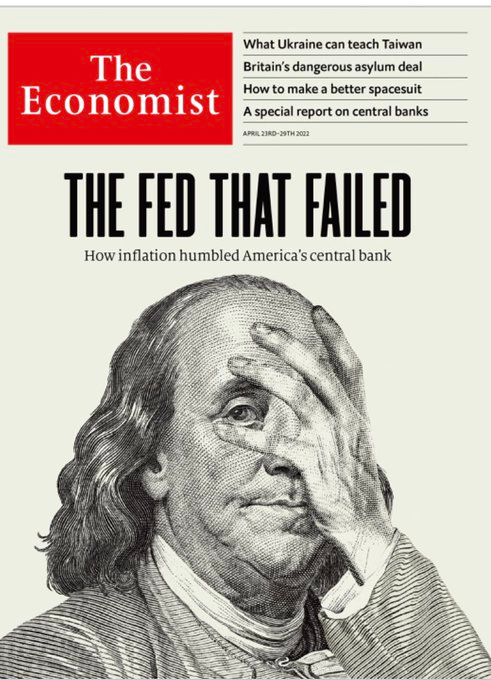
La Federal Reserve del 4 maggio 2022: in quale scenario?

Come abbiamo scritto in più e più occasioni, la Federal Reserve è passata nello spazio di soli due anni da una situazione di (apparente) onnipotenza, ovvero dal potere agire senza alcun limite e al di fuori di qualsiasi controllo, ad una situazione di pressoché totale impotenza, una situazione nella quale la Fed non ha più spazi di manovra e può fare soltanto più ciò che è COSTRETTA a fare.

Costretta da qualcuno? No. E’ costretta dalla realtà. Dalla realtà dei fatti, che intorno a lei, intorno alla Fed, si è trasformata con una tale rapidità che prima la Fed non è riuscita a capire, a comprendere, e poi non è riuscita a seguire.

Per questo, adesso, è costretta: è costretta a rincorrere, può solo rincorrere, ha una sola strada davanti da percorrere.

Oggi, quelli che sono stati (per pochi mesi) gli Onnipotenti vengono trascinati al laccio, come animali da bestiame.

Le scelte che la Fed oggi può fare, e che inevitabilmente farà, sono solo quelle del linguaggio: scelte che hanno ed avranno pochissimo impatto sulla realtà, in futuro, ma che potrebbero averne uno (anche molto grande) sulla psicologia del pubblico, e degli investitori in particolare nell’immediato. Lo abbiamo già messo in evidenza in un Post di sabato 30 aprile qui nel Blog.

Le scelte di linguaggio della Federal Reserve, dopodomani, potrebbero muovere i mercati finanziari: anche se soltanto nel brevissimo termine.

A nostro avviso, molto dipenderà dal tipo di scenario, dal tipo di prospettiva di medio termine che verrà scelta dal Consiglio della Federal Reserve per presentare le proprie scelte in materia di tassi ufficiali di interesse e di riduzione dell’attivo.

Per questa ragione, noi suggeriamo ai nostri lettori di leggere con attenzione l’articolo che noi abbiamo selezionato e che alleghiamo qui per intero.

Vi suggeriamo non soltanto di leggere questo articolo, ma pure di prendere nota con carta e penna dei temi che in questo articolo vengono toccati: si tratta solo in apparenza di tematiche lontane che resto sullo sfondo delle decisioni di investimento.

Al contrario, noi crediamo che mercoledì saranno proprio questi temi a segnare la reazione dei mercati: la Federal Reserve sicuramente li prenderà in esame, e (noi crediamo) li utilizzerà poi per comunicare. la Fed li utilizzerà come “paletti” per delimitare un perimetro, per comunicare al pubblico “noi alziamo il costo del denaro, ma lo facciamo all’interno di un perimetro ben delimitato, per questa e quest’altra ragione”.

Lo scopo? Allontanare dalla mente dell’investitore i dubbi sulla consapevolezza della stessa Fed in questa fase.

Ed in particolare, allontanare il dubbio che gli uomini della Fed abbiamo, molto semplicemente, perso il controllo delle cose.

Passando così da Onnipotenti a Ostaggi della situazione.

While recent shocks have made the current inflationary surge and growth slowdown more acute, they are hardly the global economy’s only problems. Even without them, the medium-term outlook would be darkening, owing to a broad range of economic, political, environmental, and demographic trends.

The new reality with which many advanced economies and emerging markets must reckon is higher inflation and slowing economic growth. And a big reason for the current bout of stagflation is a series of negative aggregate supply shocks that have curtailed production and increased costs.

This should come as no surprise. The COVID-19 pandemic forced many sectors to lock down, disrupted global supply chains, and produced an apparently persistent reduction in labor supply, especially in the United States. Then came Russia’s invasion of Ukraine, which has driven up the price of energy, industrial metals, food, and fertilizers. And now, China has ordered draconian COVID-19 lockdowns in major economic hubs such as Shanghai, causing additional supply-chain disruptions and transport bottlenecks.

But even without these important short-term factors, the medium-term outlook would be darkening.

There are many reasons to worry that today’s stagflationary conditions will continue to characterize the global economy, producing higher inflation, lower growth, and possibly recessions in many economies.

For starters, since the global financial crisis, there has been a retreat from globalization and a return to various forms of protectionism. This reflects geopolitical factors and domestic political motivations in countries where large cohorts of the population feel “left behind.” Rising geopolitical tensions and the supply-chain trauma left by the pandemic are likely to lead to more reshoring of manufacturing from China and emerging markets to advanced economies – or at least near-shoring (or “friend-shoring”) to clusters of politically allied countries. Either way, production will be misallocated to higher-cost regions and countries.

Moreover, demographic aging in advanced economies and some key emerging markets (such as China, Russia, and South Korea) will continue to reduce the supply of labor, causing wage inflation. And because the elderly tend to spend savings without working, the growth of this cohort will add to inflationary pressures while reducing the economy’s growth potential.

The sustained political and economic backlash against immigration in advanced economies will likewise reduce labor supply and apply upward pressure on wages. For decades, large-scale immigration kept a lid on wage growth in advanced economies. But those days appear to be over.

Similarly, the new cold war between the US and China will produce wide-ranging stagflationary effects. Sino-American decoupling implies fragmentation of the global economy, balkanization of supply chains, and tighter restrictions on trade in technology, data, and information – key elements of future trade patterns.

Climate change, too, will be stagflationary. After all, droughts damage crops, ruin harvests, and drive up food prices, just as hurricanes, floods, and rising sea levels destroy capital stocks and disrupt economic activity. Making matters worse, the politics of bashing fossil fuels and demanding aggressive decarbonization has led to underinvestment in carbon-based capacity before renewable energy sources have reached a scale sufficient to compensate for a reduced supply of hydrocarbons. Under these conditions, sharp energy-price spikes are inevitable. And as the price of energy rises, “greenflation” will hit prices for the raw materials used in solar panels, batteries, electric vehicles, and other clean technologies.

Public health is likely to be another factor. Little has been done to avert the next contagious-disease outbreak, and we already know that pandemics disrupt global supply chains and incite protectionist policies as countries rush to hoard critical supplies such as food, pharmaceutical products, and personal protective equipment.

We must also worry about cyberwarfare, which can cause severe disruptions in production, as recent attacks on pipelines and meat processors have shown. Such incidents are expected to become more frequent and severe over time. If firms and governments want to protect themselves, they will need to spend hundreds of billions of dollars on cybersecurity, adding to the costs that will be passed on to consumers.

These factors will add fuel to the political backlash against stark income and wealth inequalities, leading to more fiscal spending to support workers, the unemployed, vulnerable minorities, and the “left behind.” Efforts to boost labor’s income share relative to capital, however well-intentioned, imply more labor strife and a spiral of wage-price inflation.

Then there is Russia’s war on Ukraine, which signals the return of zero-sum great-power politics. For the first time in many decades, we must account for the risk of large-scale military conflicts disrupting global trade and production. Moreover, the sanctions used to deter and punish state aggression are themselves stagflationary. Today, it is Russia against Ukraine and the West. Tomorrow, it could be Iran going nuclear, North Korea engaging in more nuclear brinkmanship, or China attempting to seize Taiwan. Any one of these scenarios could lead to a hot war with the US.

Finally, the weaponization of the US dollar – a central instrument in the enforcement of sanctions – is also stagflationary. Not only does it create severe friction in international trade in goods, services, commodities, and capital; it encourages US rivals to diversify their foreign-exchange reserves away from dollar-denominated assets. Over time, that process could sharply weaken the dollar (thus making US imports more costly and feeding inflation) and lead to the creation of regional monetary systems, further balkanizing global trade and finance.

Optimists may argue that we can still rely on technological innovation to exert disinflationary pressures over time. That may be true, but the technology factor is far outnumbered by the 11 stagflationary factors listed above. Moreover, the impact of technological change on aggregate productivity growth remains unclear in the data, and the Sino-Western decoupling will restrict the adoption of better or cheaper technologies globally, thereby increasing costs. (For example, a Western 5G system is currently much more expensive than one from Huawei.)

In any case, artificial intelligence, automation, and robotics are not an unalloyed good. If they improve to the point where they can create meaningful disinflation, they also would probably disrupt entire occupations and industries, widening already large wealth and income disparities. That would invite an even more powerful political backlash than the one we have already seen – with all the stagflationary policy consequences that are likely to result.
La Federal Reserve del 4 maggio 2022: qual'è la "destinazione finale" di questo viaggio?
 

Come tutti i lettori del Blog sanno, Recce’d ha smesso di scrivere di Federal Reserve un anno e mezzo fa: in questo ultimo anno e mezzo, sarebbe stato inutile.

Questo perché la Federal Reserve, dalla seconda metà del 2020, per tutto il 2021, e in questo inizio di 2022, è rimasta non soltanto senza parole, ma pure senza strumenti, senza leve, senza armi, senza spazio di manovra. (E la BCE sta messa ancora peggio, e di molto).

E quindi, nell’ultimo anno e mezzo, la Federal Reserve non è mai stata protagonista: ha semplicemente fatto ciò che era costretta a fare, data la situazione (assurda, ai limiti del folle) che lei stessa, la Banca Centrale, aveva contribuito a creare.

Recce’d tutto ciò che aveva da dire in proposito lo aveva chiarito nella parte finale del 2020. E prima ancora, nell’agosto 2020.

E ancora molto tempo prima, pensate: nel 2015. E non in una sola occasione: leggete anche qui.

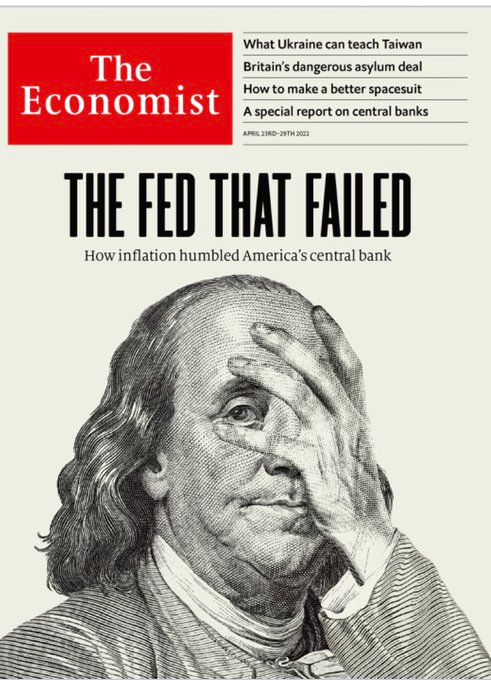
Oggi, quello che Recce’d scriveva anni fa lo trovate sulla prima pagina dei più autorevoli quotidiani e periodici.

Perché allora, proprio oggi, Recce’d torna a scrivere ai suoi lettori della Federal Reserve?

La ragione è molto semplice: perché adesso la Federal Reserve ritorna a contare. Non tanto sul piano pratico, dove le scelte della Federal Reserve potranno incidere ben poco.

Bensì sul piano della psicologia collettiva. Saranno le parole, più che gli atti, della Federal Reserve, ad incidere.

Dopo avere fatto una drammatica (ed ennesima) “svolta ad U” smentendo sé stessa poche settimane fa, quando ha riconosciuto che l’idea stessa di una “inflazione transitoria” era stata una tragica sciocchezza, adesso la Federal Reserve deve scegliere se continuare a mentire oppure se rispondere con chiarezza, concretezza e in modo esplicito alle domande che con sempre maggiore insistenza i mercati finanziari ed il pubblico dei risparmiatori e consumatori le rivolgono.

Le domande sono molte: anzi, sono decisamente troppe. La scelta della BCE e della Federal Reserve di fare per un anno e mezzo la parte del “pesce in barile” ha prodotto questo accumularsi di domande che ad oggi non hanno una risposta.

Dalla settimana prossima, potremmo vedere un cambiamento proprio da questo punto di vista: la Federal Reserve, costretta dall’urgenza dei fatti, costretta dall’evoluzione della realtà (che prevale sempre sulla fantasia delle persone, delle Banche Centrali, delle banche di investimento, e del vostro private banker, wealth manager, promotore finanziario), potrebbe decidere di cambiare modo, tono e contenuto della propria comunicazione.

Potrebbe decidere di smettere l’atteggiamento del tipo “non ho capito bene …” e passare ad una comunicazione più diretta ed esplicita, e più concreta.

Come già detto, le domande rimaste senza risposta, nell’ultimo anno e mezzo, sono moltissime. per questa ragione, Recce’d dedica in questi giorni una serie di nuovi Post a questo argomento.

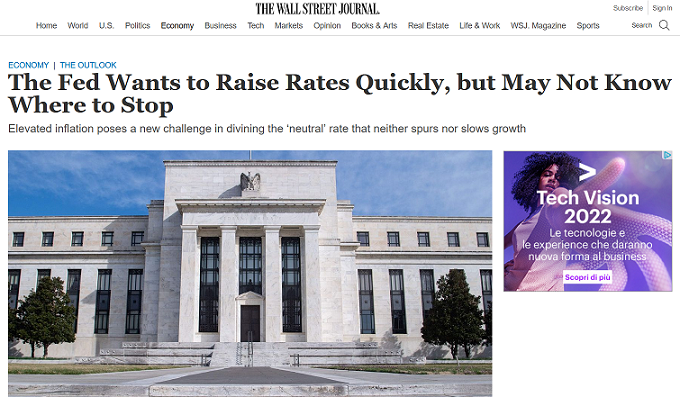
Nel Post che state leggendo, attraverso la lettura di un articolo molto utile della settimana scorsa, pubblicato sul Wall Street Journal, ci occupiamo della seguente domanda: “Di quanto aumenterà il costo del denaro?”.

E’ necessario costruire uno, o più, scenari per rispondere a questa domanda, e in questo articolo ne vengono presentati alcuni.

Noi vogliamo mettere all’attenzione del nostro lettore anche la premessa di questo articolo: “Non sono tempi normali”.

Qualunque valutazione si voglia fare adesso, sia sulla “destinazione finale” dei tassi di interesse, sia sulla “destinazione finale” del vostro portafoglio in titoli, dei vostri asset finanziari, e dei vostri soldi risparmiati, deve necessariamente partire da questa premessa.

Federal Reserve Chairman Jerome Powell is shifting monetary tightening into a higher gear. His goal sounds straightforward—lift interest rates to “neutral,” a setting that neither spurs nor slows growth.

But there’s a catch: Even in normal times, no one knows where this theoretical level is. And these aren’t normal times. There are good reasons to think the ground beneath the central bank’s feet is shifting and that, after accounting for elevated inflation, neutral may be higher than officials’ recent estimates.

At their meeting next month, officials are set to approve plans to shrink their $9 trillion asset portfolio and to raise their benchmark rate by a half percentage point. They are poised to follow with another half-point in June.

“We’re going to be raising rates and getting expeditiously to levels that are more neutral, and then that are actually tightening policy if that turns out to be appropriate, once we get there,” Mr. Powell said during a panel discussion last week.

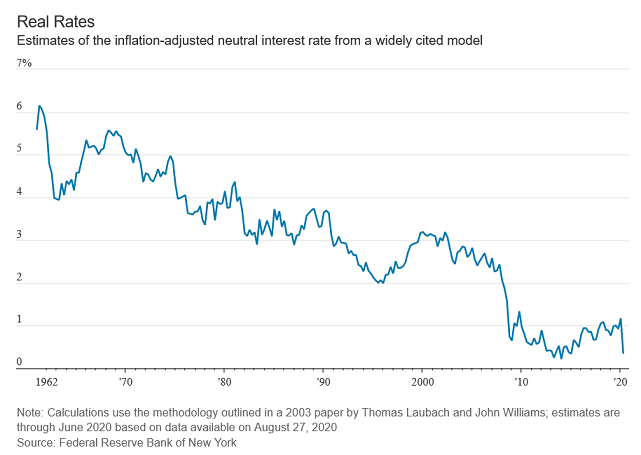
Key to that strategy will be estimates of the neutral interest rate, a monetary nirvana that balances supply and demand when unemployment is low, the economy is growing steadily, and inflation is stable around the Fed’s 2% objective.

“The Fed only knows where neutral is in retrospect,” said Steven Blitz, chief U.S. economist at research firm TS Lombard.

The nominal neutral rate is arrived at by adding inflation to the inflation-adjusted or real neutral rate. It is real, not nominal, rates that matter for monetary policy.

Because inflation reduces the burden of paying back debt, a positive real rate is necessary to create an incentive to save and a disincentive to borrow, such as for a home or business, thereby slowing economic growth and cooling inflation pressure.

Before the 2008 financial crisis, the nominal neutral rate was widely estimated to be near 4%—a real neutral rate of 2% plus inflation of 2%. Over the subsequent decade Fed officials lowered their estimate of neutral to between 2% and 3% because they thought the real neutral rate needed to keep both growth and inflation stable had dropped.

Officials still think the real neutral rate is low; the question is whether inflation will end up higher than 2%, which would mean a higher nominal neutral rate. If inflation settles out closer to 3%, for example, the nominal neutral rate would be closer to 3.5% than 2.5%, and the Fed might need to raise rates to 4% to actually slow the economy down.

A source of uncertainty is where neutral really is. That depends on where inflation settles out, partly based on factors outside the Fed’s control.

This confronts Fed officials with several questions: How fast to get to neutral; do rates need to go above neutral; and where is neutral?

At present, most think neutral is around 2.25% or 2.5% and rates should get there this year, at which point they can see how the economy responds. Some want to go faster, pushing rates into restrictive territory this year. Others are open to that possibility in 2023.

“I’m optimistic that we can get to neutral, look around, and find that we’re not necessarily that far from where we need to go,” said Chicago Fed President Charles Evans on April 7. By last week, though, he was a little more circumspect: “Probably we are going beyond neutral—that’s my expectation.”

A major source of uncertainty in these scenarios centers on where neutral really is. That depends on where inflation settles out, which partly is based on factors outside of the central bank’s control such as supply chain disruptions from the war in Ukraine and Covid lockdowns in China.

Federal Reserve Chairman Jerome Powell indicated on Thursday that the central bank was likely to raise interest rates by a half percentage point at its meeting in May. Photo: Samuel Corum/Getty Images

Mr. Blitz said the Fed today may find itself in a situation similar to 1978, when it was raising rates aggressively but failing to push real rates up enough to slow the economy.

“They kept thinking, ‘This is enough. This is enough.’ It kept turning out it wasn’t enough,” he said. Today, “the Fed has a lot of catching up to do to tighten financial conditions if the world is not going to come to its rescue.”

In projections released in March, most Fed officials mapped out a cheery scenario in which they raised rates to a roughly neutral rate of around 2.75% by next year. They projected growth over the next three years remains above its 1.8% long-run rate while unemployment holds below the 4% rate officials estimate is consistent with stable prices.

But those projections assume inflation, now above 5% based on the Fed’s preferred index, will revert to a long-run underlying trend rate of 2% without higher unemployment, which has historically been rare.

“The odds of doing what they projected in March are small—maybe 25%,” said Donald Kohn, a former Fed vice chairman.

John Roberts, a former Fed economist who retired last year, laid out two other scenarios in a recent analysis. Under one, the Fed raises rates to nearly 2.5% this year and to 4.25% next year, which brings inflation down to 2.5% by 2025. That would push the unemployment rate up by magnitudes that have only occurred during recessions.

In the other, high inflation through 2022 changes underlying consumer psychology, causing underlying inflation to rise, and the Fed fails to raise rates sufficiently to counteract that, leaving inflation persistently above 3% for the rest of the decade.

The bond market has faced a brutal selloff over the last two months, pushing yields sharply higher, as the Fed promises tighter policy. It could be in for another blow if central bank officials publicly conclude that interest rates need to go even higher than currently anticipated in 2023.

Write to Nick Timiraos at nick.timiraos@wsj.com

Appeared in the April 25, 2022, print edition as '‘Neutral’ Fed Rate Is a Moving Target.

Mercati oggiValter Buffo
La Federal Reserve del 4 maggio 2022: poche le opzioni rimaste (e nessuna buona)
 

Come tutti i lettori del Blog sanno, Recce’d ha smesso di scrivere di Federal Reserve un anno e mezzo fa: in questo ultimo anno e mezzo, sarebbe stato inutile.

Questo perché la Federal Reserve, dalla seconda metà del 2020, per tutto il 2021, e in questo inizio di 2022, è rimasta non soltanto senza parole, ma pure senza strumenti, senza leve, senza armi, senza spazio di manovra. (E la BCE sta messa ancora peggio, e di molto).

E quindi, nell’ultimo anno e mezzo, la Federal Reserve non è mai stata protagonista: ha semplicemente fatto ciò che era costretta a fare, data la situazione (assurda, ai limiti del folle) che lei stessa, la Banca Centrale, aveva contribuito a creare.

Recce’d tutto ciò che aveva da dire in proposito lo aveva chiarito nella parte finale del 2020. E prima ancora, nell’agosto 2020.

E ancora molto tempo prima, pensate: nel 2015.

Oggi, quello che Recce’d scriveva anni fa lo trovate sulla prima pagina dei più autorevoli quotidiani e periodici.

Perché allora, proprio oggi, Recce’d torna a scrivere ai suoi lettori della Federal Reserve?

La ragione è molto semplice: perché adesso la Federal Reserve ritorna a contare. Non tanto sul piano pratico, dove le scelte della Federal Reserve potranno incidere ben poco.

Bensì sul piano della psicologia collettiva. Saranno le parole, più che gli atti, della Federal Reserve, ad incidere.

Dopo avere fatto una drammatica (ed ennesima) “svolta ad U” smentendo sé stessa poche settimane fa, quando ha riconosciuto che l’idea stessa di una “inflazione transitoria” era stata una tragica sciocchezza, adesso la Federal Reserve deve scegliere se continuare a mentire oppure se rispondere con chiarezza, concretezza e in modo esplicito alle domande che con sempre maggiore insistenza i mercati finanziari ed il pubblico dei risparmiatori e consumatori le rivolgono.

In questo Post, vi aiutiamo a ragionare sulle possibili risposte alla seguente domanda: “Che cosa potrebbero fare, davvero, per uscire da questa situazione?”. Un tema affrontato nel Blog di Recce’d qualche settimana fa.

In questo articolo, Nuriel Roubini spiega, in modo efficace, perché i margini di manovra oggi sono molto limitati, se non ridotti a zero, a causa delle scelte effettuate negli anni precedenti.

Roubini in conclusione ci spiega quali sono, a suo parere, i due possibili sbocchi di questa situazione: ovvero, ci illustra i due possibili “endgame”, un tema affrontato anche da noi di Recce’d nel Blog qualche mese fa.

Like the COVID-19 pandemic, Russia's war in Ukraine has contributed to the stagflationary pressures in the United States and other advanced economies. While fiscal and monetary authorities currently have the situation under control, they are likely to run up against the limits of their policy options as conditions change.

The global economy has suffered two large negative supply-side shocks, first from the COVID-19 pandemic and now from Russian President Vladimir Putin’s invasion of Ukraine. The war has further disrupted economic activity and resulted in higher inflation, because its short-term effects on supply and commodity prices have combined with the consequences of excessive monetary and fiscal stimulus across advanced economies, especially the United States but also in other advanced economies.

Putting aside the war’s profound long-term geopolitical ramifications, the immediate economic impact has come in the form of higher energy, food, and industrial metal prices. This, together with additional disruptions to global supply chains, has exacerbated the stagflationary conditions that emerged during the pandemic.

A stagflationary negative supply shock poses a dilemma for central bankers. Because they care about anchoring inflation expectations, they need to normalize monetary policy quickly, even though that will lead to a further slowdown and possibly a recession. But because they also care about growth, they need to proceed slowly with policy normalization, even though that risks de-anchoring inflation expectations and triggering a wage-price spiral.

Fiscal policymakers also face a difficult choice. In the presence of a persistent negative supply shock, increasing transfers or reducing taxes is not optimal, because it prevents private demand from falling in response to the reduction in supply.

Fortunately, the European governments that are now pursuing higher spending on defense and decarbonization can count these forms of stimulus as investments – rather than as current spending – that would reduce supply bottlenecks over time. Still, any additional spending will increase debt and come on top of the excessive response to the pandemic, which accompanied a massive fiscal expansion with monetary accommodation and de facto monetization of the debts incurred.

To be sure, as the pandemic has receded (at least in advanced economies), governments have embarked on a very gradual fiscal consolidation, and central banks have begun policy-normalization programs to rein in price inflation and prevent a de-anchoring of inflation expectations. But the war in Ukraine has introduced a new complication as stagflationary pressures are now higher.

Fiscal-monetary coordination was the hallmark of the pandemic response. But now, whereas central banks have stuck with their newly hawkish stance, fiscal authorities have enacted easing policies (such as tax credits and reduction in fuel taxes) to soften the blow from surging energy prices. Thus, coordination seems to have given way to a division of labor, with central banks addressing inflation and legislatures tackling growth and supply issues.

In principle, most governments have three economic objectives:

  1. supporting economic activity,

  2. ensuring price stability, and

  3. keeping long-term interest rates or sovereign spreads in check through persistent monetization of public debt.

An additional goal is geopolitical:

  • Putin’s invasion must be met with a response that both punishes Russia and deters others from considering similar acts of aggression.

The instruments for pursuing these objectives are monetary policy, fiscal policy, and regulatory frameworks.

Each is being used, respectively, to address inflation, support economic activity, and enforce sanctions.

Moreover, until recently, re-investment policies and flight-to-safety capital flows had kept long-term interest rates low by maintaining downward pressure on ten-year Treasury and German bond yields.

Owing to this confluence of factors, the system has reached a temporary equilibrium, with each of the three objectives being partly addressed. But recent market signals – the significant rise in long-term rates and intra-euro spreads – suggest that this policy mix will become inadequate, producing new disequilibria.

Additional fiscal stimulus and sanctions on Russia may feed inflation, thus partly defeating monetary policymakers’ efforts. Moreover, central banks’ drive to tame inflation via higher policy rates will become inconsistent with accommodative balance-sheet policies, and this could result in higher longer-term interest rates and sovereign spreads, which are already drifting sharply upwards.

Central banks will have to continue juggling the incompatible objectives of taming inflation while also keeping long-term rates (or intra-eurozone spreads) low through balance-sheet maintenance policies. And all the while, governments will continue to fuel inflationary pressures with fiscal stimulus and persistent sanctions.

Over time, tighter monetary policies may cause a growth slowdown or outright recession. But another risk is that monetary policy will be constrained by the threat of a debt trap. With private and public debt levels at historic highs as a share of GDP, central bankers can take policy normalization only so far before risking a financial crash in debt and equity markets.

At that point, governments, under pressure from disgruntled citizens, may be tempted to come to the rescue with price and wage caps and administrative controls to tame inflation. These measures have proved unsuccessful in the past (causing, for example, rationing) – not least in the stagflationary 1970s – and there is no reason to think that this time would be different. If anything, some governments would make matters even worse by, say, re-introducing automatic indexation mechanisms for salaries and pensions.

In such a scenario, all policymakers would realize the limitations of their own tools. Central banks would see that their ability to control inflation is circumscribed by the need to continue monetizing public and private debts. And governments would see that their ability to maintain sanctions on Russia is constrained by the negative impacts on their own economies (in terms of both overall activity and inflation).

There are two possible endgames.

  1. Policymakers may abandon one of their objectives, leading to higher inflation, lower growth, higher long-term interest rates, or softer sanctions – accompanied perhaps by lower equity indices.

  2. Alternatively, policymakers may settle for only partly achieving each goal, leading to a suboptimal macro outcome of higher inflation, lower growth, higher long-term rates, and softer sanctions – with lower equity indices and debased fiat currencies then emerging.

Either way, households and consumers will feel the pinch, which will have political implications down the road.

Mercati oggiValter Buffo
La Federal Reserve del 4 maggio 2022: l'inflazione 2021 - 2022 - 2023
 

Come tutti i lettori del Blog sanno, Recce’d ha smesso di scrivere di Federal Reserve un anno e mezzo fa: in questo ultimo anno e mezzo, sarebbe stato inutile.

Questo perché la Federal Reserve, dalla seconda metà del 2020, per tutto il 2021, e in questo inizio di 2022, è rimasta non soltanto senza parole, ma pure senza strumenti, senza leve, senza armi, senza spazio di manovra. (E la BCE sta messa ancora peggio, e di molto).

E quindi, nell’ultimo anno e mezzo, la Federal Reserve non è mai stata protagonista: ha semplicemente fatto ciò che era costretta a fare, data la situazione (assurda, ai limiti del folle) che lei stessa, la Banca Centrale, aveva contribuito a creare.

Recce’d tutto ciò che aveva da dire in proposito lo aveva chiarito nella parte finale del 2020. E prima ancora, nell’agosto 2020.

E ancora molto tempo prima, pensate: nel 2015.

Oggi, quello che Recce’d scriveva anni fa lo trovate sulla prima pagina dei più autorevoli quotidiani e periodici.

Perché allora, proprio oggi, Recce’d torna a scrivere ai suoi lettori della Federal Reserve?

La ragione è molto semplice: perché adesso la Federal Reserve ritorna a contare. Non tanto sul piano pratico, dove le scelte della Federal Reserve potranno incidere ben poco.

Bensì sul piano della psicologia collettiva. Saranno le parole, più che gli atti, della Federal Reserve, ad incidere.

Dopo avere fatto una drammatica (ed ennesima) “svolta ad U” smentendo sé stessa poche settimane fa, quando ha riconosciuto che l’idea stessa di una “inflazione transitoria” era stata una tragica sciocchezza, adesso la Federal Reserve deve scegliere se continuare a mentire oppure se rispondere con chiarezza, concretezza e in modo esplicito alle domande che con sempre maggiore insistenza i mercati finanziari ed il pubblico dei risparmiatori e consumatori le rivolgono.

Le domande sono molte: anzi, sono decisamente troppe. la scelta della BCE e della Federal Reserve di fare per un anno e mezzo la parte del “pesce in barile” ha prodotto questo accumularsi di domande che ad oggi non anno una risposta.

Tra queste, una delle più importanti ed attuali è la seguente: “Quali sono le cause dell’inflazione 2021-2022?”.

Nell’articolo del Wall Street Journal che grazie a Recce’d avete la possibilità di leggere nella versione integrale qui di seguito viene presa una posizione forte: l’articolo è un editoriale firmato dal Board, dal Consiglio direttivo del quotidiano. Quindi, l’articolo esprime la “linea ufficiale” del maggiore quotidiani finanziario degli Stati Uniti.

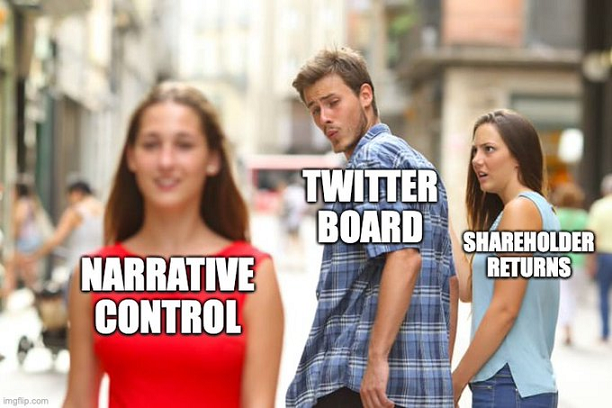
Nell’articolo viene contesta la “versione ufficiale” oggi dominante, la “narrativa” che si vorrebbe imporre al pubblico: la storia che ci dice che la principale causa dell’inflazione è Putin.

E’ anche troppo facile smontare questa recente e nuova “narrativa”: sarà più che sufficiente rivedere i numeri per l’inflazione, negli Stati uniti ed in Europa, nei mesi di dicembre 2021 e di gennaio 2022. Ed il discorso è già chiuso.

Il Wall Street Journal pubblicava questo articolo una decina di giorni fa, a commento del più recente dato USA per l’inflazione nella versione CPI, che aveva fatto scrivere a molti di “peak inflation”, ovvero che negli Stati Uniti l’inflazione aveva toccato proprio con quel dato (riferito al mese di marzo 2022) il suo punto più alto.

Poi proprio ieri, venerdì 29 aprile, a smentire questa ipotesi di “peak inflation” è arrivato il dato per l’inflazione USA nella versione PCE, che nella seduta di quello stesso venerdì 29 aprile ha destabilizzato tutti i comparti del mercato finanziario.

Aggungete a questo dato il dato per l’inflazione tedesca, e per l’inflazione UE, che abbiamo letto sempre il 29 aprile, ed il quadro è completo ed esaustivo.

La lettura attenta di questo articolo, pertanto, è un contributo utilissimo per dare una risposta alla domanda: “Dove andrà l’inflazione nei prossimi mesi?”. Sia negli USA sia nell’Unione Europea. Una domanda alla quale nessun investitore può sottrarsi.

In aggiunta, vi aiuterà a riflettere sulle ricadute dell’inflazione sulla futura evoluzione della politica, sia negli Stati Uniti sia in Europa.

White House aides were out in force on Monday warning that Tuesday’s inflation report would be ugly and blaming it on Vladimir Putin. No doubt that beats blaming your own policies. But inflation didn’t wait to appear until the Ukraine invasion, and by now it will be hard to reduce.

The White House was right about the consumer-price index, which rose 1.2% in March, the highest monthly rise since the current inflation set in. The price rise in the last 12 months hit 8.5%, the fastest rate in 40 years.

Energy prices in the month contributed heavily to the increase, and some of that owes to the ructions in oil markets since the invasion. But so-called core prices, excluding food and energy, rose 6.5% over the last 12 months. Service prices excluding energy, which weren’t supposed to be affected by supply-chain disruptions, were up 0.6% for the month and 4.7% over 12 months.

The nearby chart shows that the inflation trend began in earnest a year ago at the onset of the Biden Presidency. It has accelerated for most of the last 12 months. That’s long before Mr. Putin decided to invade. The timing reflects too much money chasing too few goods, owing mainly to the combination of vast federal spending and easy monetary policy.

President Trump signed onto an unnecessary $900 billion Covid relief bill in December 2020, and Democrats threw kerosene on the kindling with another $1.9 trillion in March 2021. The Federal Reserve continues to support negative real interest rates nearly two years after the pandemic recession ended. This inflation was made in Washington, D.C.

Markets on Tuesday took the bad inflation report in stride, perhaps because they had (like the White House) already discounted the news. Or perhaps investors think the March report represents inflation’s peak. Oil prices may not keep rising, and the report did include some good news on used car and truck prices (down 3.8% in the month).

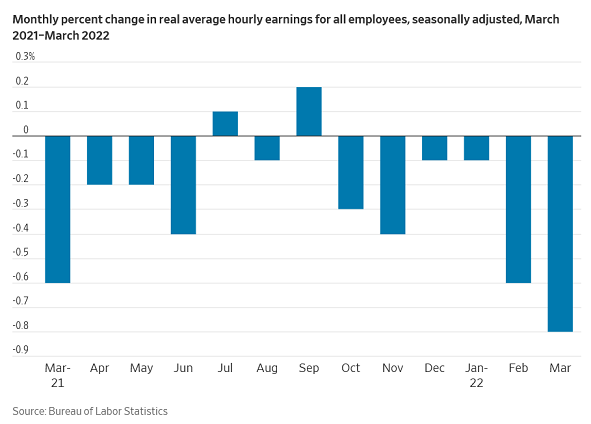
Still, the overall price news is terrible for American workers and consumers. The March surge means that real wages fell 0.8%, or a decline of 2.7% in the last year. (See the nearby chart.) Real average weekly earnings fell a striking $4.26 in March alone, and they’ve fallen nearly $18 during the Biden Presidency. If you want to know why Americans are sour about the economy even as jobs are plentiful, this is it. Their real wages are falling while the prices of everyday goods and services are rising fast. The average worker Democrats invoke when they demand more federal spending is getting crushed by the inflationary consequences of too much federal spending.

The inflation surge calls for a policy shift to tighter money and less spending that fuels excess demand. The Fed is now on the case, raising interest rates and starting to shrink its bloated $9 trillion balance sheet. Its task would be easier had it begun a year ago. Now it will have to move faster in an economy that is still growing, but with less business and consumer confidence.

Even core inflation of 6.5% is more than three times the Fed’s target rate of 2%. The Fed’s consensus target at its March meeting for a fed funds interest-rate peak of 2.8% in 2023 looks inadequate. History suggests that once inflation is this high, interest rates will have to exceed the inflation rate to break it.

That will run the risk of recession. The Fed’s anti-inflation resolve will be tested if growth ebbs and financial troubles erupt. Any central banker can cut interest rates. The Paul Volcker test of monetary mettle is raising rates when the political class is screaming at you.

As for the Biden Administration and Congress, the best anti-inflation policy would be a spending freeze on everything but defense. Cut tariffs, which would be a one-time price cut. Put a moratorium on new regulation that raises costs for business.

***

This advice conflicts with the Democrats’ Build Back Better agenda. But their inflation responses to date of allowing more ethanol fuel (see nearby) and releasing oil from the Strategic Petroleum Reserve are futile gestures. Republicans could pick up the spending freeze and moratorium for their election agenda.

Inflation is a powerful political force because it can’t be explained away. Nearly every voter feels it every day. If the November elections are a referendum on the cost of living, voters won’t blame the Kremlin. They’ll blame the party in power in Washington.

The 8.5% surge in the cost of living in the past year could represent the peak of the worst U.S. inflation in 40 years — but Americans can’t expect much relief from rising prices this year or even next.

The rate of inflation has jumped more than six-fold in the past 14 months from as low as 1.4% at the beginning of 2021. The cost of fuel, food, housing, cars and all sorts of stuff have soared.

Gas prices have jumped 48% from one year ago, for example, and the cost of groceries have climbed 10% to mark the biggest increase in four decades.

“Every time you fill up at the gas station it hurts,” said Robert Frick, corporate economist at Navy Federal Credit Union. “People are going to be paying even more for meat, to which they are very sensitive.”

The sharp and relatively sudden surge caught the Federal Reserve — the nation’s guardian against high inflation — entirely by surprise. Alarmed by the spike in prices, a late-reacting Fed is now speeding up plans to lift low U.S. interest rates quickly to try to put the genie back in the bottle.

Economists predict the increase in inflation will decelerate by year end to 4% to 5%, but they say the central bank waited too long to act. It could take several years, they say, before the Fed’s bitter new medicine pulls inflation closer to its 2% to 2.5% target.

“Clearly they waited too long to get going,” said chief economist Stephen Stanley of Amherst Pierpont Securities, one of the first Wall Street pros to sound the alarm on inflation last year. “It’s going to take them awhile to catch up.”

How the U.S. got here

The roots of today’s inflation run deep.

The Biden and Trump administrations pumped trillions of dollars into the economy during the pandemic to soften the blow. At the same time, the Fed slashed interest rates to record lows and kept them there until just last month.

In short, the economy was flooded with an unprecedented amount of money.

Then as the economy reopened last spring and Americans began to spend freely again, disruptions in global trade tied to the pandemic prevented businesses from being able to obtain enough labor and supplies to meet the demand.

The combination of huge fiscal and monetary stimulus and big shortages has spawned the worst bout of price increases since the late 1970s and early 1980s, when U.S. inflation peaked at almost 15%.

High inflation is also starting to feed into the biggest increase in worker pay in decades, spawning worries about a dreaded wage-price spiral that would make high inflation more long lasting and harder to conquer.

If Americans come to expect high inflation, they’ll ask for more pay. Businesses in turn will charge even higher prices. And on and on the merry-go-round would go — until the economy crashed.

Contrite Fed officials are trying to make amends by more aggressive increases in interest rates, but most still insist that inflation will taper off relatively quickly.

The Fed predicts the rate of inflation will slow to 4.3% by year end using its preferred PCE price barometer. And then drop to 2.3% by the end of 2024.

“This is not the kind of inflation from the 1960s and 70s,” Chicago Fed President Charles Evans said on Monday.

Evans contended the current burst of price pressures is more temporary in nature. He argued inflation will revert back to the low levels that prevailed before the pandemic in a year or two.

Fed officials are likely to take solace from a small 0.3% increase in March in a closely follow inflation barometer known as core consumer prices. It matched the smallest gain in six months.

Yet just as it took time to reduce inflation four decades ago, most economists predict a longer road ahead than the Fed expects.

“The Fed is still largely expecting inflation to self correct and mostly go down on its own,” said chief economist Aneta Markowska of Jefferies, another Wall Street analyst who raised questions about rising prices early on last year.

“I think they are too optimistic on inflation coming down.”

Is the worst over?

So why does the Fed and so many economists — even skeptics like Stanley and Markowska — expect the rate of inflation to slow this year? They think the inflation wave either crested in March or will do so in April. Some like UBS even see the runup in prices mostly reversing by year end.

Fed interest rate hikes this year might restrain inflation a little by making big-ticket items like new houses and autos more expensive, for one thing.

More importantly, the supply-chain bottlenecks that have contributed so much to high inflation are expected to continue to ease.

If businesses can obtain more supplies, the thinking goes, they won’t have to pay as much for materials or charge customers as much for their goods and services.

Finally there’s a statistical mirage of sorts known in economist lingo as “base effects.” As high monthly inflation readings from last year drop out of the 12-month average, it makes headline inflation seem lower.

Take last June, when the consumer price index leaped 0.9%. If several months from now, the CPI rises, say, 0.5% in June, it would make the yearly increase in inflation look smaller.

It wouldn’t necessarily mean that price pressures are easing, though.

A half-point increase in monthly inflation is still historically high, for one thing.

What’s more, the annualized rate of inflation in the first three months of 2022 is still extremely troublesome at 11.3%. That’s how much inflation would rise this year if it increased at the same pace in the final nine months as it did in the first three.

Then there’s the war in Ukraine and Covid lockdowns in China, both of which could exacerbate inflation in the short run.

Russia is a major producer of oil and grains and Ukraine is also a large grain grower. The war has added to the upward pressure on fuel and food prices and the effects could persist well after the conflict is over.

In China, factory closings and the lockdowns affecting millions of people could stanch the flow of goods to the U.S. and put renewed stress on strained supply lines.

The Fed’s big challenge

The real fight to significantly lower inflation is in 2023, economists say. And one of the most “dovish” Feds in history, as Stanley calls it, will only achieve some success if it is aggressive.

That could mean raising a key short-term U.S. interest rate above the central bank’s current goal of 2.8% by the end of 2023 — and possibly slowing the economy to the point of recession.

“Inflation is likely to decelerate, but left on its own, not very rapidly,” said Joel Naroff of Naroff Economic Advisors.

He said there’s still too much demand that businesses can’t meet, a problem that would only be rectified by the Fed icing down a hot economy.

Yet even an aggressive central bank may be limited in what it can achieve quickly. Markowska pointed to a New York Fed study showing consumers think inflation will rise 6.6% in the next year — the highest reading on record.

What do Americans plan to do in response? Keep spending, the survey shows.

Many households have the means to do so.

Wages, for example, have jumped 5.6% in past year to mark the biggest increase in decades and help Americans cope with a higher cost of living. And thanks to unprecedented government stimulus, Americans have an extra $2 trillion-plus of savings in the bank than they did before the pandemic.

“Nobody likes to pay higher prices. The question is, what are consumers going to do about it,” Markowska said. “They are not pushing back at all. They are paying higher prices and moving on.”

If that keeps up, though, Americans will have to use up their savings and eventually find other ways to afford the higher cost of fuel, steak or a beach vacation.

“That’s when you walk in and say to your boss, ‘I need a raise,’ ” Stanley said.

While rising pay would be a good thing for workers, it would give companies even more reason to raise prices and prolong the bout of high inflation.

“I think inflation is going to be around 3% to 4% around the end of the year, but stay stubbornly high relative to the preceding decade,” said Steve Blitz, chief economist of TS Lombard.

Mercati oggiValter Buffo
Longform’d. Twitter e Tesla (e Netflix): mettiamo ordine


SPOILER ALERT: nelle prossime righe che seguono, vi anticipiamo le conclusioni di questo lungo lavoro che abbiamo scelto di regalare ai lettori (in un futuro prossimo, come già anticipato, i nostri Longform’d costituiranno un nuovo servizio di recce’d e quindi non saranno più gratuiti).

E quindi, se preferite sapere soltanto alla fine chi è … l’assassino, allora saltate ora al testo SOTTO la prossima immagine.

Noi oggi con questo Longform’d intendiamo illustrare ai nostri lettori perché questa storia, che ricostruiremo nel Longform’d di oggi, è rilevante per tutti noi investitori.

Ed il perché è il seguente: si tratta di una piccola storia di quartiere, che su molti quotidiani ha occupato tanto spazio quanto il conflitto Ucraina - Russia nelle ultime settimane. Si tratta di una storia piccola, di piccoli interessi e di piccole dimensioni. I furbetti del quartierino, si diceva qualche anno fa.

Ma proprio per questa sua piccolezza, è rilevante per tutti noi investitori: è una misura di quanto sia anomalo, eccezionale, distorto e stravolto il contesto di mercato nel quale tutti noi siamo costretti ad operare da anni, e ancora oggi operiamo.

E forse, dalla lettura di ciò che segue ricaverete l’impressione (che noi abbiamo) che l’anomalia che affligge oggi tutti i mercati finanziari si sia estesa poi anche ai media, alla vita sociale, ed alla vita politica.

Se fosse davvero così, allora tutti noi siamo di fronte ad una nuova fase molto incerta e molto rischiosa (non soltanto per i nostri soldi investititi).

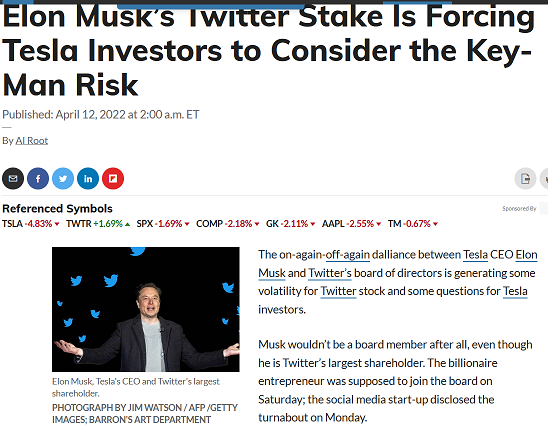
Elon Musk è un genio, secondo numerosi commentatori. Noi di Recce’d non lo sappiamo, se è un genio, ma ci sentiamo di affermare che è sicuramente un Mago. Un mago, un incantatore, un illusionista come David Copperfield.

Come tutti i grandi maghi, anche Elon ha i suoi trucchi preferiti. Uno è quello di “fare scoppiare una bomba mediatica” sempre il lunedì, e sempre prima dell’apertura delle Borse americane.

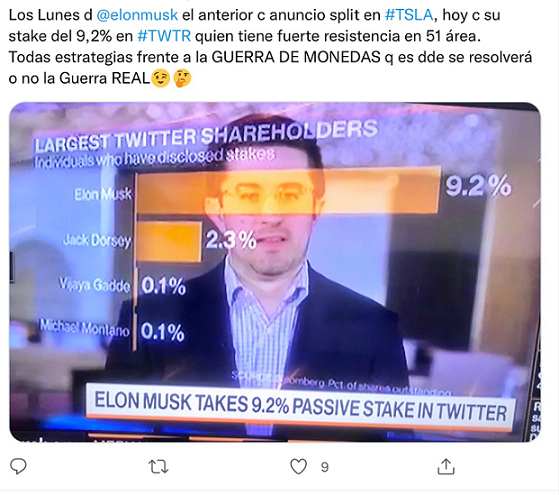
Questo, va detto, è un trucco che ormai hanno capito tutti, in tutto il Mondo, e persino in Argentina (lo leggete nell’immagine qui sopra).

Che cosa ce lo conferma, che tutti se ne sono accorti? Il comportamento del mercato, e dei “suoi” titoli questa settimana.

Perché lui anche lunedì 25 aprile 2022, e prima dell’apertura della Borsa a New York, ha voluto proporci ancora un altro dei suoi tipici “colpi di teatro”, e si è comperato Twitter.

Ma torniamo indietro, a qualche settimana fa. L’acquisizione di Twitter da parte di Musk è stata “coperta” da tutti i media, e non soltanto dai media specializzati, in modo ossessivo.

I due nomi, d’altra pare, sono tali da rendere massimo il numero di click: e per la raccolta pubblicitaria dei media, il numero di click è tutto.

In quanto investitori, in quanto investitori intelligenti, critici, e consapevoli, non possiamo certo permetterci il lusso di misurare le cose a partire dal numero di click.

Chi ha seguito la vicenda ricorderà tutti gli avanti-e-indietro che hanno caratterizzato le ultime settimane, e che noi ricordiamo solo con alcune immagini. Ormai, non hanno più alcuna importanza, e con loro ha perso ogni importanza tutto il tempo che abbiamo ed avete speso a fare tutti quei click.

Noi in questo nostro lavoro vogliamo mettere all’attenzione dell’investitore che ci legge alcuni aspetti della vicenda che non hanno ricevuto, dal nostro punto di vista, la giusta attenzione critica.

Primo fra tutti, il ruolo di Tesla nella vicenda.

Tesla, a leggere dai quotidiani, c’entra un bel nulla. Questa operazione di acquisizione è un “fatto personale” di Elon Musk.

E quindi, Elon Musk e Tesla … in futuro non saranno più la stessa cosa?

E’ vero: Musk ha negli anni gestito anche altri business, ma si è trattato sempre di business di dimensioni chiaramente inferiori. Potremmo dire che si trattava di “business satellite”, usando così un termine che a Musk è molto caro.

In questo caso, la questione viene presentata in modo diverso: Musk si impegna, almeno in pubblico, a “proteggere la libertà di espressione”, e si tratta chiaramente di un impegno che non ammette mezze misure. Non potrà certo, in futuro, dichiarare: “Prima mi occupo del fatturato di Tesla, e poi della libertà di espressione negli Stati Uniti”.

Certo, a noi in Recce’d costa un po’ di fatica ad immaginare Elon Musk nei panni di un sanguigno difensore della libertà di espressione, che spende 50 miliardi per una Società che, in 12 mesi, fattura quanto fattura Google in sette giorni.

Siamo perplessi: ma più di noi, sicuramente lo sono gli azionisti di Tesla.

Ma torniamo più in basso su Tesla ed i suoi azionisti.

Ora seguiteci in una piccola divagazione.

Parliamo, con voi, di Netflix. I lettori del sito hanno già letto alcuni accenni su Netflix, la trimestrale, ed il disastro che ne è seguito, nella nostra pagina dedicata ai tweet che abbiamo chiamato TWIT-TWOO.

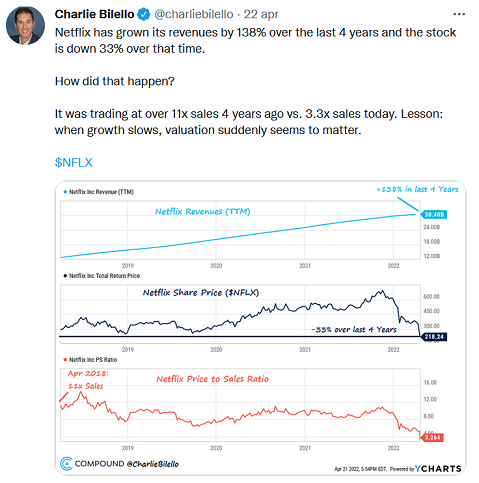
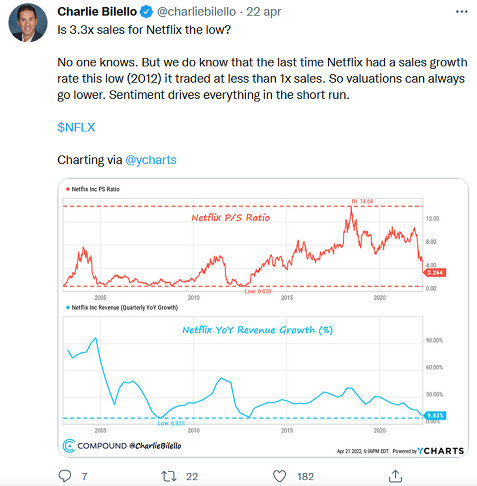
Il crollo del titolo ha suscitato, in molti osservatori, un rinnovato interesse (pensate!) per i dati fondamentali: proprio quelli, quei dati fondamentali che solo in gennaio, solo tre mesi fa, moltissimi credevano fossero … perdite di tempo, oppure roba per gli stupidi (per quelli che “non hanno capito che il mercato è cambiato”).

E’ tornato di attualità persino (pensate!) il vecchio rapporto, per qualche tempo in disuso, tra valore del fatturato e prezzo dell’azione, come leggete qui sotto nelle due immagini.

Forse, allora … il mercato non è cambiato?

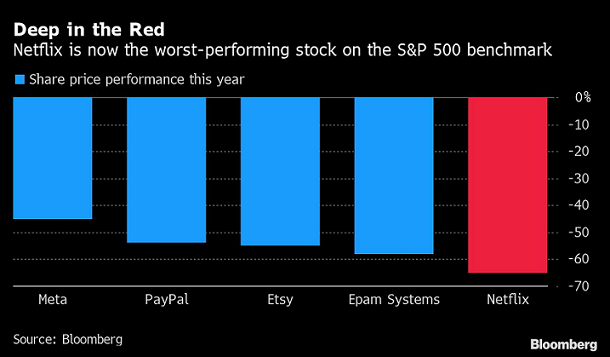
Fatto sta, che il valore di Netflix era di 300 miliardi a gennaio, oggi è di 100 miliardi di dollari USA.

Come vedete qui sotto, oggi Netflix oggi è il titolo con la peggiore performance 2022 dell’intero indice S&P 500 della Borsa di New York (e anche così, vale ancora il doppio di Twitter …).

Tutto molto interessante, ma che c’entra? Qualcuno, tra i nostri lettori, se lo sarà chiesto.

Ve lo facciamo spiegare, proprio qui sotto, niente meno che da John Authers.

John Authers scrive che la vicenda Netflix ci obbliga farci con urgenza una, ed una sola domanda: come è stato possibile per così tanti investitori pensare che fosse una buona idea pagare così caro?

Eccoci, questo è il punto di contatto: possono esserci, oggi, nel mercato, altre Netflix che nessuno ha ancora riconosciuto? Chi ci segue con maggiore attenzione ricorda sicuramente su questo tema un nostro Post del 2021 che fu molto commentato.

Può esserci utile a questo punto riesaminare qualche grafico in merito prezzo dell’azione Twitter.

Insomma: chiediamo direttamente ad Elon “Amico e simpatico Elon, ce lo vuoi spiegare perché hai comperato Twitter? Ma spiegacelo davvero, però!”.

Noi in Recce’d almeno per ora non lo abbiamo capito, ed attendiamo che Elon dopo avere letto il nostro Longform’d ci scriva una risposta (ovviamente, via Twitter …).

Nel frattempo, può succedere che facendoci una risata, o almeno un sorriso, qualche idea ci venga in mente, per risolvere il nostro dubbio.

C’è una seconda immagine, che ci ha aiutato molto: riprende il tema della precedente, ma in modo molto più chiaro.

E noi, in Recce’d, la vediamo proprio in questo modo, nel modo che è scritto nell’immagine qui sotto. Almeno fino a che il simpatico Elon non ci avrà spiegato via Twitter.

Come vedete, il testo qui sopra ci riporta a Tesla, di cui avevamo già scritto sopra. Collega l’operazione Twitter alla vicenda di Tesla. Interessante.

Nel grafico che trovate di seguito, rivediamo insieme l’andamento del titolo Tesla, in Borsa.

Ma dopo avere sorriso e scherzato, ora chiuderemo il Longform’d in modo molto più serio.

Vi facciamo leggere il pensiero di un analista, mettendo avanti le mani: è un analisti critico di Tesla da molti anni. Può essere vittima di pregiudizi. Oppure, potrebbe avere ragione.

Il tempo ce lo dirà: resta interessante leggere alcuni dati, a proposito dei recenti (settimana scorsa) risultati trimestrali di Tesla.

I dati, come noi di Recce’d diciamo sempre, non mentono.

Se leggerete con pazienza ed attenzione questo brano, verrete anche voi incuriositi dal parallelo tra Tesla e Netflix. E avrete compreso, forse, le ragioni autentiche che spingono Musk a comperare Twitter oggi.

Perpetual Tesla critic and proprietor of GLJ Research, Gordon Johnson, was out late last week with a new note to clients explaining why Tesla's numbers, to him, look similar to the growth fall off that Netflix just experienced.

Johnson claims in his latest note that Tesla's $2.87 in GAAP EPS that the company just reported was helped along by $1/share in non-core items. 

"In short, when adjusting for

(a) $288M in one-time regulatory cafe credits "gifted" to TSLA by NHTSA four days prior to quarter end,

(b) $377M in "magical" cost reductions (TSLA's OPEX fell from $2.234B to $1.857B, despite 40yr high inflation, two new plants ramping, and flat unit production - we believe a lot of this had to do with capitalized TX/Berlin costs, as well as lower SBC for E. Musk), and

(c) $497M in incremental non-current other assets (which, based on TSLA's 10-K filing, consists of pure margin benefit long-term government rebates),

TSLA's $2.87/shr in GAAP EPS was helped by ~$1.00/shr in non-core items," Johnson's latest note says.

He continues, explaining that the quality of Tesla's earnings has deteriorated: "This can be further seen in the significant erosion in the quality of TSLA's earnings this quarter, using (EBITDA ÷ Operating Cash Flow) as a 'measuring stick' - this metric advanced to the highest/worst level in 1Q22 since 3Q19."

Johnson says that Tesla's valuation telegraphs "big problems" ahead:

Furthermore, when considering TSLA is trading at ~100x annualized 1Q22 earnings, yet didn't grow units in 1Q22 (and will see unit sales fall in 2Q22), and operates in an auto industry that trades, on avg., at 6.1x forward earnings, we see (big) problems ahead.

He also commented about Shanghai still being shut down, stating that he thinks Elon Musk "likely lied" when he claimed on the conference call that "the most likely vehicle production in Q2 will be similar to Q1, maybe slightly lower, but it's also possible we may pull a rabbit out of the hat and be slightly higher".

Johnson wrote to clients: "In short, we believe E. Musk saw the move in Netflix's stock ex-growth in [last week's] trading session, and wanted to paint a picture that, no matter what, TSLA will not go ex-growth, on a unit sales basis, in 2Q22 (we believe his forecast here will prove [very] wrong)."

Valter Buffo