
Longform’d. Twitter e Tesla (e Netflix): mettiamo ordine


SPOILER ALERT: nelle prossime righe che seguono, vi anticipiamo le conclusioni di questo lungo lavoro che abbiamo scelto di regalare ai lettori (in un futuro prossimo, come già anticipato, i nostri Longform’d costituiranno un nuovo servizio di recce’d e quindi non saranno più gratuiti).

E quindi, se preferite sapere soltanto alla fine chi è … l’assassino, allora saltate ora al testo SOTTO la prossima immagine.

Noi oggi con questo Longform’d intendiamo illustrare ai nostri lettori perché questa storia, che ricostruiremo nel Longform’d di oggi, è rilevante per tutti noi investitori.

Ed il perché è il seguente: si tratta di una piccola storia di quartiere, che su molti quotidiani ha occupato tanto spazio quanto il conflitto Ucraina - Russia nelle ultime settimane. Si tratta di una storia piccola, di piccoli interessi e di piccole dimensioni. I furbetti del quartierino, si diceva qualche anno fa.

Ma proprio per questa sua piccolezza, è rilevante per tutti noi investitori: è una misura di quanto sia anomalo, eccezionale, distorto e stravolto il contesto di mercato nel quale tutti noi siamo costretti ad operare da anni, e ancora oggi operiamo.

E forse, dalla lettura di ciò che segue ricaverete l’impressione (che noi abbiamo) che l’anomalia che affligge oggi tutti i mercati finanziari si sia estesa poi anche ai media, alla vita sociale, ed alla vita politica.

Se fosse davvero così, allora tutti noi siamo di fronte ad una nuova fase molto incerta e molto rischiosa (non soltanto per i nostri soldi investititi).
Elon Musk è un genio, secondo numerosi commentatori. Noi di Recce’d non lo sappiamo, se è un genio, ma ci sentiamo di affermare che è sicuramente un Mago. Un mago, un incantatore, un illusionista come David Copperfield.

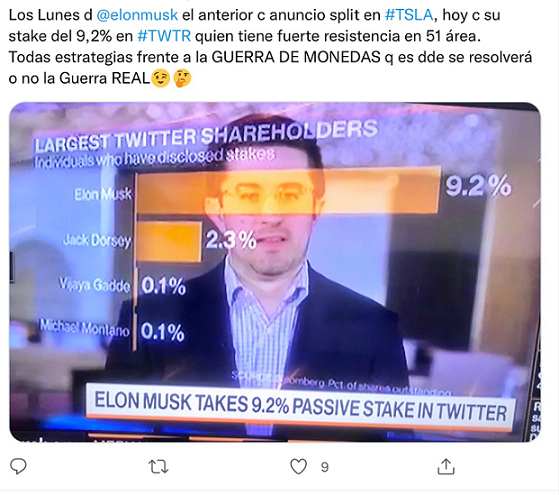
Come tutti i grandi maghi, anche Elon ha i suoi trucchi preferiti. Uno è quello di “fare scoppiare una bomba mediatica” sempre il lunedì, e sempre prima dell’apertura delle Borse americane.

Questo, va detto, è un trucco che ormai hanno capito tutti, in tutto il Mondo, e persino in Argentina (lo leggete nell’immagine qui sopra).

Che cosa ce lo conferma, che tutti se ne sono accorti? Il comportamento del mercato, e dei “suoi” titoli questa settimana.

Perché lui anche lunedì 25 aprile 2022, e prima dell’apertura della Borsa a New York, ha voluto proporci ancora un altro dei suoi tipici “colpi di teatro”, e si è comperato Twitter.

Ma torniamo indietro, a qualche settimana fa. L’acquisizione di Twitter da parte di Musk è stata “coperta” da tutti i media, e non soltanto dai media specializzati, in modo ossessivo.

I due nomi, d’altra pare, sono tali da rendere massimo il numero di click: e per la raccolta pubblicitaria dei media, il numero di click è tutto.

In quanto investitori, in quanto investitori intelligenti, critici, e consapevoli, non possiamo certo permetterci il lusso di misurare le cose a partire dal numero di click.

Chi ha seguito la vicenda ricorderà tutti gli avanti-e-indietro che hanno caratterizzato le ultime settimane, e che noi ricordiamo solo con alcune immagini. Ormai, non hanno più alcuna importanza, e con loro ha perso ogni importanza tutto il tempo che abbiamo ed avete speso a fare tutti quei click.

Noi in questo nostro lavoro vogliamo mettere all’attenzione dell’investitore che ci legge alcuni aspetti della vicenda che non hanno ricevuto, dal nostro punto di vista, la giusta attenzione critica.

Primo fra tutti, il ruolo di Tesla nella vicenda.

Tesla, a leggere dai quotidiani, c’entra un bel nulla. Questa operazione di acquisizione è un “fatto personale” di Elon Musk.

E quindi, Elon Musk e Tesla … in futuro non saranno più la stessa cosa?

E’ vero: Musk ha negli anni gestito anche altri business, ma si è trattato sempre di business di dimensioni chiaramente inferiori. Potremmo dire che si trattava di “business satellite”, usando così un termine che a Musk è molto caro.
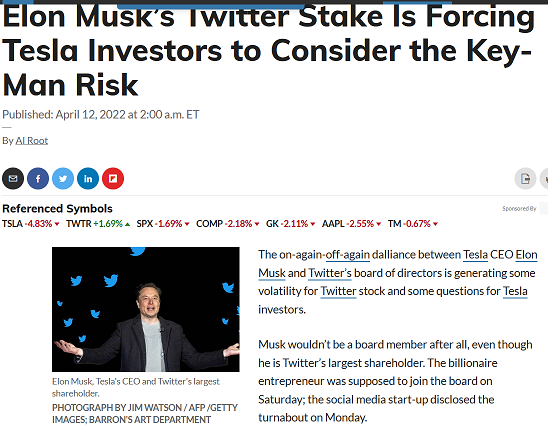
In questo caso, la questione viene presentata in modo diverso: Musk si impegna, almeno in pubblico, a “proteggere la libertà di espressione”, e si tratta chiaramente di un impegno che non ammette mezze misure. Non potrà certo, in futuro, dichiarare: “Prima mi occupo del fatturato di Tesla, e poi della libertà di espressione negli Stati Uniti”.

Certo, a noi in Recce’d costa un po’ di fatica ad immaginare Elon Musk nei panni di un sanguigno difensore della libertà di espressione, che spende 50 miliardi per una Società che, in 12 mesi, fattura quanto fattura Google in sette giorni.

Siamo perplessi: ma più di noi, sicuramente lo sono gli azionisti di Tesla.

Ma torniamo più in basso su Tesla ed i suoi azionisti.

Ora seguiteci in una piccola divagazione.

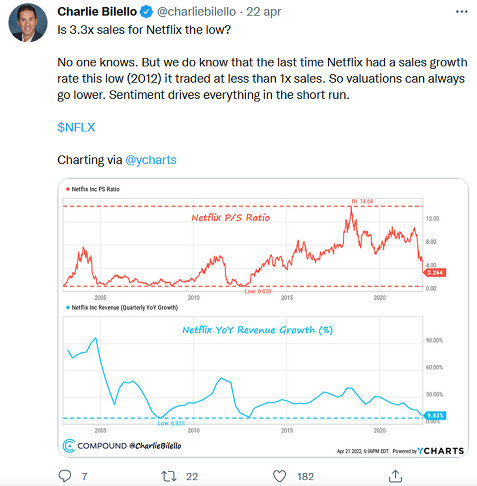
Parliamo, con voi, di Netflix. I lettori del sito hanno già letto alcuni accenni su Netflix, la trimestrale, ed il disastro che ne è seguito, nella nostra pagina dedicata ai tweet che abbiamo chiamato TWIT-TWOO.

Il crollo del titolo ha suscitato, in molti osservatori, un rinnovato interesse (pensate!) per i dati fondamentali: proprio quelli, quei dati fondamentali che solo in gennaio, solo tre mesi fa, moltissimi credevano fossero … perdite di tempo, oppure roba per gli stupidi (per quelli che “non hanno capito che il mercato è cambiato”).

E’ tornato di attualità persino (pensate!) il vecchio rapporto, per qualche tempo in disuso, tra valore del fatturato e prezzo dell’azione, come leggete qui sotto nelle due immagini.

Forse, allora … il mercato non è cambiato?
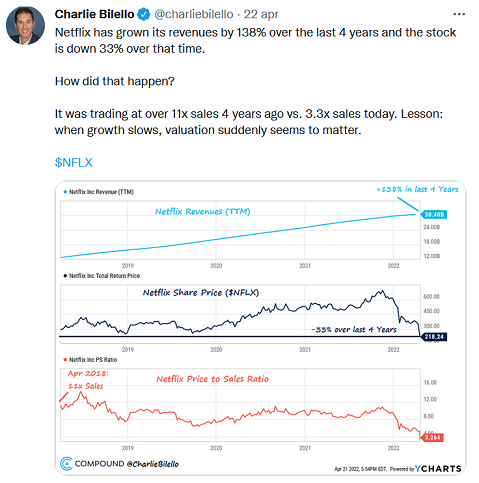
Fatto sta, che il valore di Netflix era di 300 miliardi a gennaio, oggi è di 100 miliardi di dollari USA.

Come vedete qui sotto, oggi Netflix oggi è il titolo con la peggiore performance 2022 dell’intero indice S&P 500 della Borsa di New York (e anche così, vale ancora il doppio di Twitter …).

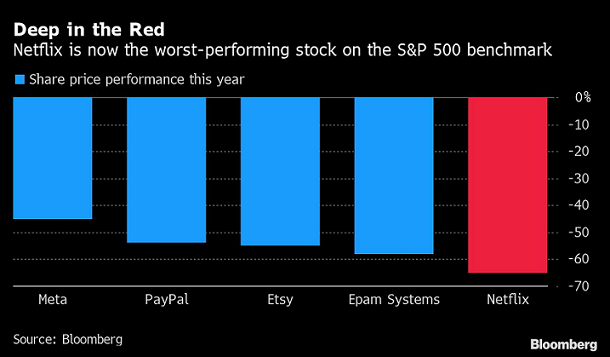
Tutto molto interessante, ma che c’entra? Qualcuno, tra i nostri lettori, se lo sarà chiesto.

Ve lo facciamo spiegare, proprio qui sotto, niente meno che da John Authers.

John Authers scrive che la vicenda Netflix ci obbliga farci con urgenza una, ed una sola domanda: come è stato possibile per così tanti investitori pensare che fosse una buona idea pagare così caro?

Eccoci, questo è il punto di contatto: possono esserci, oggi, nel mercato, altre Netflix che nessuno ha ancora riconosciuto? Chi ci segue con maggiore attenzione ricorda sicuramente su questo tema un nostro Post del 2021 che fu molto commentato.

Può esserci utile a questo punto riesaminare qualche grafico in merito prezzo dell’azione Twitter.

Insomma: chiediamo direttamente ad Elon “Amico e simpatico Elon, ce lo vuoi spiegare perché hai comperato Twitter? Ma spiegacelo davvero, però!”.

Noi in Recce’d almeno per ora non lo abbiamo capito, ed attendiamo che Elon dopo avere letto il nostro Longform’d ci scriva una risposta (ovviamente, via Twitter …).

Nel frattempo, può succedere che facendoci una risata, o almeno un sorriso, qualche idea ci venga in mente, per risolvere il nostro dubbio.
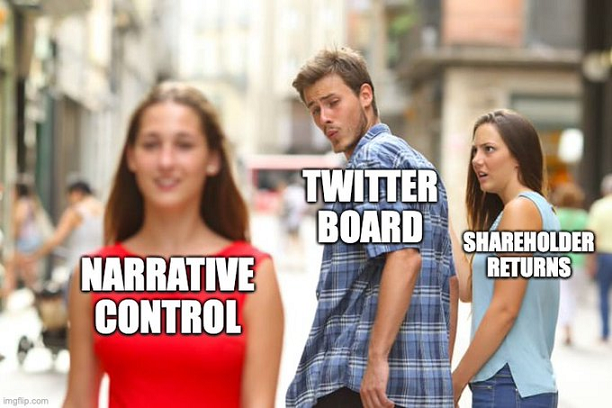
C’è una seconda immagine, che ci ha aiutato molto: riprende il tema della precedente, ma in modo molto più chiaro.

E noi, in Recce’d, la vediamo proprio in questo modo, nel modo che è scritto nell’immagine qui sotto. Almeno fino a che il simpatico Elon non ci avrà spiegato via Twitter.

Come vedete, il testo qui sopra ci riporta a Tesla, di cui avevamo già scritto sopra. Collega l’operazione Twitter alla vicenda di Tesla. Interessante.

Nel grafico che trovate di seguito, rivediamo insieme l’andamento del titolo Tesla, in Borsa.

Ma dopo avere sorriso e scherzato, ora chiuderemo il Longform’d in modo molto più serio.

Vi facciamo leggere il pensiero di un analista, mettendo avanti le mani: è un analisti critico di Tesla da molti anni. Può essere vittima di pregiudizi. Oppure, potrebbe avere ragione.

Il tempo ce lo dirà: resta interessante leggere alcuni dati, a proposito dei recenti (settimana scorsa) risultati trimestrali di Tesla.

I dati, come noi di Recce’d diciamo sempre, non mentono.

Se leggerete con pazienza ed attenzione questo brano, verrete anche voi incuriositi dal parallelo tra Tesla e Netflix. E avrete compreso, forse, le ragioni autentiche che spingono Musk a comperare Twitter oggi.

Perpetual Tesla critic and proprietor of GLJ Research, Gordon Johnson, was out late last week with a new note to clients explaining why Tesla's numbers, to him, look similar to the growth fall off that Netflix just experienced.

Johnson claims in his latest note that Tesla's $2.87 in GAAP EPS that the company just reported was helped along by $1/share in non-core items. 

"In short, when adjusting for

(a) $288M in one-time regulatory cafe credits "gifted" to TSLA by NHTSA four days prior to quarter end,

(b) $377M in "magical" cost reductions (TSLA's OPEX fell from $2.234B to $1.857B, despite 40yr high inflation, two new plants ramping, and flat unit production - we believe a lot of this had to do with capitalized TX/Berlin costs, as well as lower SBC for E. Musk), and

(c) $497M in incremental non-current other assets (which, based on TSLA's 10-K filing, consists of pure margin benefit long-term government rebates),

TSLA's $2.87/shr in GAAP EPS was helped by ~$1.00/shr in non-core items," Johnson's latest note says.

He continues, explaining that the quality of Tesla's earnings has deteriorated: "This can be further seen in the significant erosion in the quality of TSLA's earnings this quarter, using (EBITDA ÷ Operating Cash Flow) as a 'measuring stick' - this metric advanced to the highest/worst level in 1Q22 since 3Q19."

Johnson says that Tesla's valuation telegraphs "big problems" ahead:

Furthermore, when considering TSLA is trading at ~100x annualized 1Q22 earnings, yet didn't grow units in 1Q22 (and will see unit sales fall in 2Q22), and operates in an auto industry that trades, on avg., at 6.1x forward earnings, we see (big) problems ahead.

He also commented about Shanghai still being shut down, stating that he thinks Elon Musk "likely lied" when he claimed on the conference call that "the most likely vehicle production in Q2 will be similar to Q1, maybe slightly lower, but it's also possible we may pull a rabbit out of the hat and be slightly higher".

Johnson wrote to clients: "In short, we believe E. Musk saw the move in Netflix's stock ex-growth in [last week's] trading session, and wanted to paint a picture that, no matter what, TSLA will not go ex-growth, on a unit sales basis, in 2Q22 (we believe his forecast here will prove [very] wrong)."

Valter Buffo
E' solo un pugno: non è il KO

Ci insegna Mike Tyson che ognuno ha un piano, fino a che non prende un pugno in faccia.

Ognuno è un fenomeno, ognuno si sente un genio, fino a che … non lo è più.

Ognuno si sente un toro, quando scrive in chat agli amici “devi assolutamente investire in Borsa”, “Netfix è un guadagno assicurato”, oppure “il petrolio andrà a 200$ entro tre mesi”.

Poi poi poi.

Poi un venerdì sera si siede davanti al suo pc, come quel signore nell’immagine qui sotto, oppure sta sul divano con il tablet, oppure sta in auto con lo smartphone in mano, e si rende conto che qualcosa non funziona.

I dubbi e le paure spingono subito a cercare sul Web, ma le pagine di informazione e persino i siti per il trading-on-line hanno anche loro cambiato tono.

Soltanto in fondo, piccolo piccolo piccolo, c’è ancora scritto il famoso slogan dei venditori: “bisogna guardare al lungo termine”, come vedete sotto nell’immagine.

Questo non è sufficiente: non basta per calmare le ansie e le paure.

Ma come??? Andava tutto bene ancora a gennaio, eravamo tutti felici e tutti ricchi e non c’erano dubbi e non c’erano motivi di preoccupazione. Come dice uno spot televisivo “investire è facile, basta un minuto”, oppure come dice ancora un altro spot televisivo “facciamo social investing”, è facile quanto scrivere i commenti su Facebook o farsi nuove conoscenze su Tik Tok oppure vedere su You Tube il canale dei comici The Jackal (divertentissimi).

Oggi, dove è finita tutta quella sicurezza di tre mesi fa? E perché è finita?

Cerchiamo una spiegazione subito, immediatamente. Ma che sia diretta, semplice, facile e richieda poco tempo: ad esempio, come le righe colorate sui grafici.

Il fatto, è che leggendo questi grafici e questi numeri … nessuno capisce nulla, e soprattutto non si capisce che cosa si deve fare, per tornare tutti felici e tutti ricchi con il “social investing” la sera comodissimi sul divano di casa con il gatto che fa le fusa.

Non può essere finita così, non può: era bellissimo!

Facciamo partire almeno una petizione, una raccolta firme, una iniziativa su Facebook: “Ridateci TINA”.

Ma TINA se ne è andata: sarà forse fuggita con un nuovo amore?

E allora io mi rattristo, mi deprimo, e non mi sento più toro: non sono più Toro Scatenato, ma soltanto un toro sdraiato.

Mercati oggiValter Buffo
Il grande errore da evitare nella gestione di portafoglio oggi
 

Nella nostra nuova pagina che si chiama GESTIONE DI PORTAFOGLIO raccoglieremo una serie di contributi, sia di Recce’d sia di terze parti, in merito alle tecniche, ai criteri, ai metodi che rendono la gestione di portafoglio un esercizio organizzato e produttivo.

Per generare consistenti performances positive sempre tenendo sotto stretto controllo la volatilità (ovvero, l’ampiezza delle minusvalenze del proprio portafoglio considerato nel suo insieme, e non nelle singole posizioni) è indispensabile procedere sempre in modo sistematico, evitare di “andare a braccio” evitare di “basarsi sull’intuizione”, evitare di “affidarsi all’istinto. Noi ve lo possiamo dire, semplicemente perché noi di Recce’d lo abbiamo fatto, per tutti i nostri Clienti.

L’istinto ci vuole, nell’arte dell’investire così come è indispensabile (ad esempio) per guidare una vettura di Formula 1. Ma se mancano la tecnologia, se mancano gli ingegneri, in Formula 1 non solo non si vince, ma si rischia pure di andare a sbattere violentemente.

Faremo un concreto esempio, che riguarda l’attualità dei mercati finanziari. Che è da mettere in pratica oggi stesso.

Recce’d vi dice: oggi, evitate di andare dietro a consigli come quello che leggete qui sotto.

Chiariamo subito: in questo post, Recce’d NON vuole prendere posizione sull’azionario. Le nostre posizioni sull’azionario, per i nostri Clienti, per fortuna (loro e nostra) le abbiamo già prese mesi fa, e bene abbiamo fatto.

Il Post che state leggendo quindi NON riguarda l’azionario, l’andare LONG oppure SHORT. Il Post si concentra sul metodo.

Andare dietro ad indicazioni come quella che leggete qui sopra è sbagliato, perché se ci andate dietro significa che non avete capito PERCHE’ vengono scritte certe cose.

Non abbiamo chiaramente l’intenzione di incolpare in modo specifico gli amici della versione italiana di Invetsing.com (prima immagine) che sono invece più bravi e capaci di molti loro colleghi del comparto (il trading-on-line) e che pubblicano attraverso il loro sito semplicemente quello che viene scritto sulla stampa e sul Web dedicato alla Finanza ed ai Mercati in lingua inglese.

Il loro obbiettivo? E’ chiarissimo. Loro non scrivono certo per informare il lettore di come LORO investono il denaro. Loro scrivono per una ragione diversa: loro scrivono per dire a VOI dove investire il denaro.

Quando scrivono “il rialzo dei tassi sarà moderato” non hanno la più pallida idea di ciò di cui stanno scrivendo.

Lo scopo è un altro. E’ facile capire che, per loro, c’è una bella differenza se voi investite in azioni, in obbligazioni oppure in altri strumenti: le commissioni, che loro percepiscono, sono diverse.

Lo stesso accade nel caso del vostro family banker, del vostro personal banker, del vostro wealth manager: lui vi dice dove investire, ma non pensa al risultato di quell’investimento. Lui pensa al risultato suo e della sua Azienda, Rete,. Banca. Sono due conti economici ben distinti e molto spesso distanti.

Eccovi spiegato perché ogni giorno leggete, e leggerete sempre, che la cosa migliore da fare è “buy the dip”, comperare i ribassi di Borsa.

Ed ecco perché ogni giorno leggete e leggerete che “nel lungo termine in Borsa si guadagna sempre”.

Magari fosse vero …

Chiudiamo quindi tornando alla nostra nuova pagina del sito GESTIONE DI PORTAFOGLIO. Pubblicheremo note e analisi sui metodi e sulle tecniche, sulle domande che bisogna assolutamente farsi, e sugli errori da evitare.

Un dei quali, oggi molto importante, è evitare di seguire consigli che sono motivati, unicamente, dal conflitto di interesse che domina ancora oggi nell’industria del risparmio, in Italia e nel Mondo.

Non fatevi fregare così facilmente.

Mercati oggiValter Buffo
Che cosa fare ora che siamo in stagflazione
 

Abbiamo anticipato il tema “stagflazione” ai lettori del Blog già nell’agosto 2020, ovvero 20 mesi fa.

Da allora ad oggi, abbiamo trattato questo argomento con regolarità, anche qui nel Blog: ma soprattutto, e solo per i nostri Clienti, abbiamo fatto tutto ciò che era necessario per preparare i portafogli modello al momento nel quale la stagflazione sarebbe diventata lo scenario dominante.

Quel momento è oggi.

Oggi, ve ne parlano tutti: il private banker, il wealth manager, il family banker, e persino quel robot che pretende di essere “advisor. Ve ne scrivono sul PLUS di Sole 24 ore, sul Corriere Economia, sui siti web (persino i siti per il trading-online!!!).

Il tema oggi “tira”, oggi “fa scattare i click”, un po’ come fino a sei mesi fa faceva Elon Musk.

Noi ci rendiamo conto che ne parlano e ne scrivono, per la grandissima maggior parte, individui che si muovono a tentoni su questo terreno, che non dispongono delle conoscenze necessarie, che si affidano all’intuizione, che puntano sul “click” e sul creare impatto emotivo.

Come sempre, vogliamo aiutare il nostro lettore, e portarlo fuori da questa “nebbia mediatica”: portare in condizioni di sicurezza lui, ed il suo patrimonio.

Per questa ragione, abbiamo fatto una attenta ed accurata selezione, e qui sotto per voi riportiamo un intero articolo del Financial Times, che ci informa che la stagflazione è già qui. E’ già arrivata.

L’articolo vi è utile perché invece di limitarsi alle chiacchiere generiche dei promotori finanziari, dei quotidiani, e della TV, vi offre qualche punto di riferimento più specifico, più concreto, e quindi più affidabile. Perché basato su una precisa metodologia (invece che sulle semplici chiacchiere che ascoltate ogni giorno).

E voi, amici lettori, avete idea di come si gestisce il vostro portafoglio in titoli, in una fase di stagflazione? sapete che cosa fare? Che cosa vi ha detto il wealth manager, il private banker, il family banker, e che cosa dice adesso il robot? Di chi vi fidate, amici lettodi: di che gente vi fidate?

Se volete un confronto con Recce’d, saremo felici di parlare con voi: contattateci attraverso il sito.


The twin perils of slowing growth and high inflation, or stagflation, will hit the global economy this year as Russia’s war against Ukraine exacerbates a slowdown in the recovery from the coronavirus pandemic, according to Financial Times research.

Mounting price pressures, slipping output expansion and sagging confidence will all pose a drag for most countries, according to the latest Brookings-FT tracking index. As a result, policymakers will be left with “grim quandaries”, said Eswar Prasad, senior fellow at the Brookings Institution.

The IMF is this week expected to downgrade its forecasts for most countries as finance ministers and central bankers convene at the spring meetings of the fund and the World Bank to discuss how to respond to the darkening economic outlook. Policymakers must work out how to address rapidly rising prices and the dangers of raising interest rates when debt levels are already high. Kristalina Georgieva, IMF managing director, on Thursday called the war in Ukraine a “massive setback” for the global economy.

Prasad said there was a risk that 2022 could become “a fraught period of geopolitical realignments, persistent supply disruptions and financial market volatility, all against the background of surging inflationary pressures and limited room for policy manoeuvre”.

The Brookings-FT Tracking Index for the Global Economic Recovery (Tiger) compares indicators of real activity, financial markets and confidence with their historical averages, both for the global economy and individual countries, capturing the extent to which data in the current period is better or worse than normal. In the twice-yearly series, the composite index shows a marked loss of growth momentum since late 2021 in advanced and emerging economies, with confidence levels also dropping from their peaks and financial market performance taking a dip more recently.

Each of the world’s three big economic blocs faces considerable difficulties, Prasad said. While spending remains strong in the US and the labour market has returned to pre-pandemic conditions, inflation poses severe difficulties for the Federal Reserve’s mandate of price stability. The pace of price growth surged to a 40-year high of 8.5 per cent in March. “The Fed is at real risk of losing control of the inflation narrative and could be forced to tighten even more aggressively than it has signalled, raising the risk of a marked slowdown in growth in 2023,” Prasad said.

China’s problems stem from its desire to stick with its zero-Covid strategy after a surge in cases of the more infectious Omicron coronavirus variant. Lockdowns, such as the severe restrictions in Shanghai, threaten consumer spending, investment and production, while the potential to ease monetary policy again will amplify longer-term risks to financial stability. China is set to report first-quarter gross domestic product figures on Monday and they are widely expected to show that Beijing faces a tough challenge in meeting its 5.5 per cent growth target over the course of this year.

For Europe, most exposed to the Ukraine conflict and struggling to reduce reliance on Russian energy imports, confidence levels have declined sharply. Prasad said there were no easy policy solutions and willingness to act appeared in short supply. “Keeping the global economy on a reasonable growth track will require concerted actions to fix the root problems, including measures to limit pandemic-induced disruptions, steps to tamp down geopolitical tensions and targeted measures such as infrastructure spending to boost long-term productivity rather than just fortify short-term demand,” he said.

Valter Buffo
Oggi tutti attaccano la Fed (con 20 mesi di ritardo)
 

Oggi leggete sul settimanale The Economist (immagine sopra) che “la Fed ha fallito ed è stata umiliata”.

Le medesime cose, noi di Recce’d le abbiamo elaborate, e poi scritte, e poi pubblicate, nell’agosto del 2020, ovvero 20 mesi fa.

E poi, nuovamente, le abbiamo approfondite sempre nel 2020, ma in ottobre e novembre. 18 mesi fa.

Questo tipo di competenza è ciò che vi serve, è ciò che è essenziale per la gestione di portafoglio: per gestire i vostri investimenti in modo consapevole ed ottenere una performance positiva, mantenendo però anche il controllo dei vostri rischi.

E non ci vuole un attimo, come dice la pubblicità in TV. Ci vuole tempo, competenza, attenzione ed intelligenza. Come viene dettagliato nella nostra pagina dedicata alla GESTIONE DI PORTAFOGLIO.

I dati PRESENTI E PASSATI dicono che noi di Recce’d lo sappiamo fare, mentre molti altri non lo sanno fare.

In questo Post vogliamo portare all’attenzione del nostro lettore un dato di fatto recentissimo, e di grande rilevanza: in poche settimane, si è formato un “partito della recessione”.

Oggi, scrivere e parlare di “boom economico” … fa sfigato, non è più popolare come sei mesi fa.

Sei mesi fa l’ottimismo era obbligatorio. Se mesi fa, chi non cavalcava l’onda dell’entusiasmo era definito un “contrarian”, o anche uno jettatore, oppure persino lo scemo del villaggio, quello che non riusciva a vedere che “è insensato in un momento come questo, stare fuori dall’azionario”. Ve lo ricordate, vero?

A poche settimane di distanza, abbiamo registrato la comparsa di un atteggiamento altrettanto ottuso, altrettanto semplicistico, altrettanto (permettetecelo) stupido: ma di orientamento opposto. Adesso chi vuole “fare il fenomeno” parla dei “rischi di recessione”. Senza capirci nulla, proprio come sei mesi fa con il “boom economico”.

Noi in Recce’d, come più e più volte abbiamo spiegato, non siamo mai pessimisti e mai ottimisti: non riusciamo, neppure, a capire che cosa significano queste due espressioni, nel mondo degli investimenti.

La realtà, è una sola: ed i mercati finanziari vanno, inevitabilmente, appresso alla realtà.

Non esistono due realtà parallele: quelle, esistono solo nei telefilm. La realtà è una sola: chi la vede nel modo giusto, e con il giusto anticipo, vince, tuti gli altri perdono (i loro soldi, e la loro serenità).

Noi di Recce’d, dal 2007 ad oggi, la abbiamo sempre vista gusta: e questo significa una cosa sola, ovvero che sappiamo fare il nostro mestiere, quello per il quale i nostri Clienti ci riconoscono le commissioni.

Per i nostri lettori, noi utilizziamo questo Post per ricordare che, per un investitore, il pessimismo di maniera, quello semplicistico e retorico, è altrettanto dannoso dell’ottimismo di maniera, quello stupidissimo del 2021 e quello meno esagerato che abbiamo visto dal 2017 al 2019.

Per questo, il nostro suggerimento per i lettori è: tenete alta l’attenzione e usate il senso critico, non seguite mai gli slogan dei media, non seguiteli se sono troppo ottimistici e neppure quando invece sono tutti, e tutti insieme, orientati al pessimismo.

Ragionate, e ragionate bene, ma solo sui fatti.

Un articolo come quello del Wall Street Journal pubblicato pochi giorni fa, e che leggete qui sotto, per che cosa vi è utile? Di che cosa ci informa, tutti quanti?

La risposta più immediata è: “del rischio di recessione”. Ed invece no: ci informa di un’altra cosa: ovvero che il mondo dei media ha mollato al suo destino la Banca Centrale, ne prende le distanze, scende dalla nave prima che sia troppo tardi.

Dopo avere, in modo ottuso ed anche stupido, esaltato le Banche Centrali per un decennio, e strillato la loro grandezza negli ultimi due anni, è arrivato il momento di rivoltare la giacchetta, come fanno tutti quelli che hanno qualche cosa da nascondere.

E’ su questo, che Recce’d vi suggerisce di riflettere a lungo, prima di riprendere in mano il vostro portafoglio titoli, e modificarlo come serve.

Ai suoi lettori, Recce’d raccomanda di leggere con massima attenzione tutto l’articolo, di esaminare i grafici, e poi di rileggere due o tre volte le parole di John Taylor, che sono illustrate anche da un nostro grafico da Bloomberg. Da questa parole, potete capire a che cosa i mercati vanno incontro nell’aprile del 2022.

By Jon Hilsenrath and Nick Timiraos

April 18, 2022 11:07 am ET

The Federal Reserve is setting out to do something it has never accomplished before: reduce inflation a lot without significantly raising unemployment.

Central bank officials think it is possible with calibrated interest-rate increases that slow booming demand just enough to take steam out of an overheated economy. But even one of the Fed’s closest allies, U.S. Treasury Secretary Janet Yellen, sees the risk of failure. “It will require skill and also good luck,” the former Fed chair said in public comments in Washington last week.

During the past 80 years, the Fed has never lowered inflation as much as it is setting out to do now—by 4 percentage points—without causing recession. In this case, the central bank will need a number of factors out of its control to break its way.

Still, Fed officials can find reason for both optimism and caution from history. In seven different episodes during the past 80 years, inflation has fallen as much as the Fed bank wants it to drop now, with varying outcomes. The episodes suggest that the desired scenario is theoretically possible though the risk of failure is high, especially because the bank is chasing inflation that already exists, rather than addressing the problem before it arises as it did in some earlier episodes.

If the Fed is to land the plane safely, the labor market will be key. Typically during a recession joblessness rises sharply. At 3.6% the unemployment rate is now exceptionally low and demand for workers is so intense that companies have listed millions of unfilled job openings.

Fed officials say they can curb that demand, causing employers to eliminate vacancies without laying off existing workers, and tamp down inflation without a recession—what economists would refer to as a “soft landing.”

“No one expects that bringing about a soft landing will be straightforward in the current context—very little is straightforward in the current context,” Fed Chairman Jerome Powell said last month. The central bank, he added, faces a “challenging task.”

Landing Scenarios

During the early 1980s, the U.S. experienced a classic hard landing as economists dub it—falling into a deep recession with double-digit unemployment after the Fed pushed its benchmark interest rate to nearly 20% to tame stubbornly high inflation that had been rising for more than a decade.

The U.S. had less severe, but bumpy landings during the 1950s, characterized by short-lived inflation spikes and recessions. During that period, the unemployment rate rarely got very high even when economic output contracted.

The 1970s delivered aborted landings, when inflation fell and then lurched higher, beset by outside shocks such as OPEC oil embargoes and policy missteps including a central bank that hesitated to raise interest rates aggressively.

The U.S. has had soft landings, too, most recently in 1994. Fed Chairman Alan Greenspan sharply raised rates to 6% in February 1995 from 3% one year earlier, and the unemployment rate kept going down. Unlike 1994, however, the Fed today is trying to reduce inflation that is already too high rather than prevent it from rising, as Mr. Greenspan did back then.

Fed officials have indicated that while they seek a soft landing, they will raise interest rates as much as necessary to lower inflation, even if that results in a downturn.

“My framework for thinking about the Fed right now is, 1994 is the goal, but they are not necessarily petrified of 1980 anymore, or at least not even close to as scared of 1980 as I thought they would have been,” said Jon Turek, founder of policy research firm JST Advisors.

The Fed’s hope

Even before Moscow’s invasion of Ukraine in February, Mr. Powell was laying the groundwork for a more aggressive series of rate increases driven by concerns that labor markets were overheating. The war and new Covid-19 lockdowns in China, which have boosted prices while further disrupting supply chains, have made life harder for the Fed.

Consumer prices rose 6.4% in February from a year earlier, according to the Fed’s preferred gauge, the Commerce Department’s personal-consumption expenditures price index. Core prices, which exclude volatile food and energy price swings, climbed 5.4%. Those readings were the highest in around four decades.

Demand was stoked by low interest rates and $6.4 trillion of government borrowing and spending since Covid struck. Businesses and households spent money faster than a pandemic-strained economy could deliver goods and services, then prices soared.

“We really poured things on in terms of expansionary policy, with good intentions but predictable effects,” said Robert Hall, a Stanford University professor who runs the National Bureau of Economic Research’s committee that dates the beginnings and ends of expansions.

The Fed lifted rates from near zero last month by a quarter percentage point and penciled in a series of rises this year and next. Interest-rate increases are meant to slow demand by restraining consumer and business borrowing.

In the scenario Fed officials mapped out, their benchmark interest rate will rise to around 2.75% by the end of next year, just above estimates of a rate that neither spurs nor slows growth.

They project inflation will drop to slightly above 2% by 2024, a rare 4-percentage-point decline in less than three years. They see economic output growing at a rate between 2% and 3% while unemployment holds below 4%.

“That scenario seems unlikely to me,” said Ellen Meade, who retired from the Fed last August as a senior policy adviser. “The probability of doing this without a hard landing has gone down.”

John Taylor, an economist at Stanford University who is the author of an influential policy-setting rule of thumb called the “Taylor rule,” says his formula calls for the Fed to set interest rates at 5% right now. Because the Fed is unlikely to lift rates so dramatically in one year, he said officials instead ought to raise rates to 3% by December and signal more increases after that unless inflation comes down.

“This is not the only time in history that they’ve been behind, but they are strikingly behind,” said Mr. Taylor. “They need to catch up and do it in a systematic and understandable way.”

Fixing imbalances

The Fed’s success will depend on several factors outside its control. Those include whether global energy supplies recover from the shock of Russia’s invasion of Ukraine, reducing energy prices; whether sidelined U.S. workers rejoin the labor force, easing the labor shortage and wage pressures; whether Chinese plants reopen in the face of more Covid-19 lockdowns, clearing supply bottlenecks; and whether Covid itself recedes for good in the U.S., ending other pandemic-related economic disruptions such as business closures.

The Fed’s job will be easier if these supply constraints ease. If they don’t, the central bank will need to push rates higher to squeeze demand, with a risk of more damage to the economy.

A great deal boils down to the job market.

In February, U.S. companies listed 11.3 million unfilled job openings, four million more than before the pandemic, which even then was a record. Those openings mean firms are competing for scarce workers by bidding up wages, which pressures them to raise prices to keep profits strong.

Some of this gap was driven by a dearth of workers. The U.S. labor-force participation rate, at 62.4% in March, was still a percentage point below prepandemic levels, meaning fewer workers are looking for jobs.

The mismatch was also caused by demand-driven hiring by employers. As of February, the combination of unfilled and filled jobs has exceeded the total number of workers by the largest margin since World War II, according to an analysis by Goldman Sachs.

Goldman analysts estimate the Fed can achieve its goal of bringing down inflation and slowing upward wage pressures by reducing job openings by about 2.5 million.

Monthly job openings

Source: Labor Department

If workforce participation rates return to prepandemic levels, that would add around one million workers, Goldman estimates, making the Fed’s job of easing supply-and-demand imbalances in the labor market somewhat easier.

In recent weeks, Fed officials have zeroed in on this logic.

“There is plenty of room for businesses to reduce the number of job openings,” said Lael Brainard, a Fed governor awaiting Senate confirmation to become Fed vice chairwoman, in an interview with The Wall Street Journal last week. “I see that as being consistent both in bringing inflation down and sustaining the recovery.”

A view from Gilbert

Tad Peelen, co-owner of a restaurant group in Gilbert, Ariz., sees the complexity of these supply and demand mismatches up close. For months he has been struggling to source supplies, such as plastic-foam cups, and couldn’t get them through normal supplier channels. For a while he thought the problem was production disruptions related to Covid. But he thinks the issue has morphed in the past 12 months. Now he thinks many suppliers are simply sold out because there are so many competitors opening around him.

His problem isn’t limited to serving cups.

“We had all come to the assumption there were fewer employees out there for us to choose from, but the pool of employees ready to go to work in restaurants is the same size or larger than before Covid,” he said. “The reason we are struggling so much is because so many restaurants are opening. It has started to make sense to me.”

He said he would welcome a modest slowdown, which could be a chance for him to give his workers a break and also might slow cost increases for supplies.

Parallels to the 1950s

Mr. Hall’s research has found that unemployment followed predictable patterns during and after recessions for several decades—sharp increases in the jobless rate during recession and then slow, steady declines during expansions, a pattern that held from the 1960s right up to 2020.

The pandemic scrambled those patterns, with the slow decline scenario being replaced by astonishingly fast descent. The unemployment rate swung during the pandemic from 3.5% in February 2020 to nearly 15% two months later and then back down, to 3.6% in March.

He said the lurching patterns he sees in unemployment today look more like they did in the 1950s, when he says there was “higher volatility of everything.”

The U.S. bears another economic resemblance to the 1940s and 1950s, which produced bumpy landings; like then, it is going through a cycle of lurching fiscal policy.

Between 2020 and 2021, federal spending rose from 21% of gross domestic product to 31% of gross domestic product, and is projected by the White House Office of Management and Budget to return to 24% of GDP in 2022 and less than 23% of GDP in 2023. These are the largest swings in federal spending since World War II, an era when the Fed also kept interest rates low to support a post-Depression economy and the war effort.

Compared with today, the unemployment rate was less volatile during the 1950s as the Fed worked to stabilize inflation. It averaged 4.5% and exceeded 7% for only two months during the whole decade.

Ms. Brainard said waning fiscal stimulus would help to restrain demand this time around, too.

There is another parallel that gives some hope the Fed can pull off its task without sending joblessness much higher: Japan. By one rule of thumb Japan has experienced seven recessions since the mid-1990s and its unemployment rate never got much over 5%. Its aging workforce meant that even when economic output contracted, it didn’t have an abundance of people who wanted work and couldn’t find it.

For now, Fed officials are in agreement they should seek to raise rates quickly to a level that no longer provides stimulus. They have signaled they are likely to approve a half-percentage-point increase at their meeting next month, and possibly again in June. The Fed hasn’t raised rates in such a large increment since 2000.

Write to Jon Hilsenrath at jon.hilsenrath@wsj.com and Nick Timiraos at nick.timiraos@wsj.com

Valter Buffo