Posts in Mercati oggi
Investire con lo specchietto retrovisore
 
2020_week_04_Feb_039l.png

La gestione del portafoglio titoli, la conosciamo molto bene. E la facciamo, molto bene.

La abbiamo praticata per decenni, sempre con successo.

Sui mercati finanziari le varie fasi si succedono: prima tutti pessimisti (ed allora forse è il caso di comperare) e poi tutti ottimisti (ed è allora, sicuramente, che è il caso di mettersi short, e rimanere short tutto il tempo che necessita, ovvero fino a che la massa rimane in stato di allucinazione).

2020_week_04_Feb_039g.png

L’errore tipico del dilettante è: investire guardando a che cosa è salito l’anno precedente. Ed è esattamente così, che si originano le fasi di euforia come quella del 2019: molti comperano quello che fino a ieri saliva.

Poi quando si piange sui danni fatti e sul latte versato, tutti a ripetere “ma non mi avevano avvisato”.

Quando invece, al contrario, tutti erano stati avvisati, Ogni volta. Ma l’attrazione di “quanto ho guadagnato l’anno scorso”, ogni volta, fa salire tutti sul treno del vincitore di giornata.

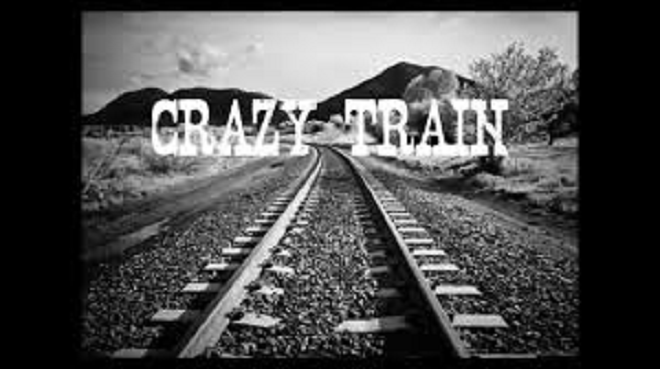
Tale e quale come guidare un treno lanciato a folle velocità guardando soltanto nello specchietto retrovisore.

2020_week_04_Feb_039d.png
Mercati oggiValter Buffo
Coronavirus ed altri virus (parte 5)
2020_week_04_Feb_013.png

Come potete leggere nella nostra pagina settimanale di ricapitolazione, noi di Recce’d abbiamo espresso fino dall’inizio di questa vicenda che la cosa più utile sarebbe stata … lo stare zitti.

Abbiamo ascoltato, e letto, banalità, sciocchezze ed analisi superficiali: ognuno parlava ma parlava per i propri interessi.

Le banche globali di investimento per fare acquistare altre azioni. I Governi per tenere tranquilla la popolazione. I private bankers per costringervi a tenere in portafoglio i loro Fondi Comuni, che a voi costano più del 3% ogni anno, e giorno dopo giorno.

Recce’d ha scelto fin da subito una linea diversa, più cauta e meno rassicurante. Ed abbiamo fatto benissimo.

2020_week_04_Feb_052.png

Oggi, per affrontare questo tema tragico, molto complesso, molto delicato, vi proponiamo di leggere un articolo che Recce’d ha selezionato per voi lettori, pubblicato solo pochi giorni fa dal New York Times.

2020_week_04_Feb_039e.png

A noi è sembrato l’articolo più efficace per illustrare le potenziali implicazioni di medio e di lungo termine di questa vicenda. Economiche certo (ne abbiamo scritto, nella Sezione Analisi, sul nostro The Morning Brief ogni giorno la settimana scorsa) ma pure politiche e sociali. Articolo molto utile, per tutti i nostri lettori che non accettano di farsi intontire dalle parole degli imbonitori.

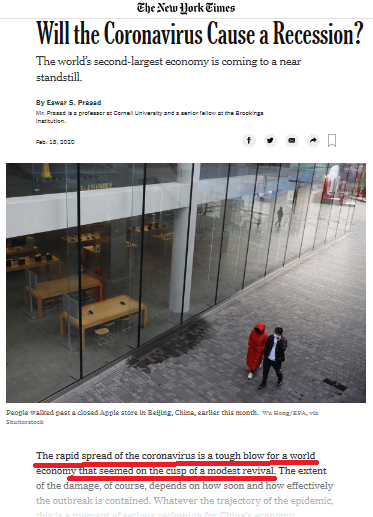
The rapid spread of the coronavirus is a tough blow for a world economy that seemed on the cusp of a modest revival. The extent of the damage, of course, depends on how soon and how effectively the outbreak is contained. Whatever the trajectory of the epidemic, this is a moment of serious reckoning for China’s economy.

Hard as it is to envision, the world’s second-largest economy is coming to a near standstill. Infections and fatalities are mounting. Many of my acquaintances and friends in China tell me they are increasingly concerned about the government’s ability to control the epidemic and its economic fallout. Big urban manufacturing and financial centers remain on at least partial lockdown, migrant laborers are unable to return to work, and factories are unable to get raw materials or ship their goods out reliably.

Consumption has also been cut drastically, as people mostly stay indoors. Service industries such as tourism and restaurants are being hit especially hard. Companies in this sector, as well as small manufacturers, have been driving China’s employment growth, but they tend to have little financial cushion.

Beijing does have room to increase public spending, cut taxes and provide cheap credit to bolster growth. China’s central bank has already taken measures to loosen monetary policy. Flooding the economy with cheap credit will increase risks to the banking system, which the government recognizes, but these are desperate times.

In any event, none of these measures will have much impact until commercial activity picks up. Moreover, China’s traditional banking system has been much better at funneling credit to large, state-owned enterprises rather than to the struggling smaller private companies.

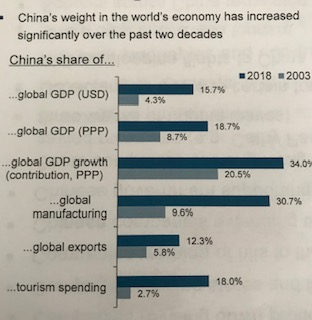
China’s sheer size, along with its roles as an engine of global economic growth and a dominant player in commodity markets, means that a hit to China will have significant ramifications all over the world. Oil prices have tumbled as China’s growth prospects weaken and international travel, particularly to and from China, decreases.

This episode will also add momentum to some changes in global supply chains that were already underway. Along with Chinese workers’ rising wages and the prospects of further U.S.-China trade tensions, the epidemic is likely to cause multinational companies to reassess their supply chains and reduce their production footprints in China.

The coronavirus epidemic might have only a limited immediate impact on the U.S. economy, but by creating further uncertainty and disrupting supply chains in Asia, it will add to the long list of factors likely to hold back U.S. and global growth in 2020. The temporary boost in business sentiment and investment that could have been expected from the U.S.-China trade deal last month is going to be offset by this new cloud of uncertainty over global trade. A worldwide recession is not yet on the cards but, at a minimum, the added uncertainty will restrain investment and productivity, which already looked anemic in all major economies.

Another long-lasting impact is likely to be on Chinese citizens’ confidence in their own government. The state and its people seem to have made an implicit bargain: good economic performance, higher living standards and the semblance of social stability in exchange for constraints on free expression, democratic rights and the free flow of information.

Yet even in an environment where it is accepted that the authorities will control what information is made public, the public grows skeptical about the competence of a government that systematically hides bad news. This issue is especially pertinent in the context of the Chinese government’s initial attempts to play down the outbreak of swine flu last year. By the time the government admitted to the scale of the problem, China’s pig herds had been decimated and pork prices had doubled.

Now, coronavirus is spreading fast in a country that was already experiencing a slowdown from the swine flu and an outbreak of avian flu that could reduce chicken flocks. Trust in information provided by the government and its competence to manage these problems are under question, both domestically and abroad.

The way the coronavirus epidemic is playing out might have lessons not just for China’s government but perhaps for the United States as well. Once trust in the government and a free press are eroded by the government’s desire to manipulate information, the costs can be great — especially in difficult times, when that trust becomes crucial for maintaining confidence and stability.

If history is any guide, the coronavirus will eventually come under control and the Chinese and world economies will get back on track, perhaps after a painful period. It is the effects on how people and businesses perceive their governments that might prove to be longer lasting.

Eswar Prasad is a professor at Cornell University and a senior fellow at the Brookings Institution.

2020_week_04_Feb_039h.png
Mercati oggiValter Buffo
Coronavirus ed altri virus (parte 6)
 
2020_week_04_Feb_036.png

Due sono le cose che, fin dai primi giorni, Recce’d si è sentita di dire (e di fare, per i propri Clienti) in merito alla vicenda del coronavirus e del suo impatto sui mercati finanziari, sui portafogli titoli, ed alla fine sui nostri e vostri soldi.

La prima delle due cose è: non parlare troppo, non fare troppe previsioni, non azzardare, stare un po’ zitti ed osservare, analizzare, ragionare.

La seconda cosa, che la settimana scorsa abbiamo poi sviluppato nella Sezione Analisi del nostro quotidiano The Morning Brief in esclusiva per i nostri Clienti, è che al di là di ogni possibile dubbio l’impatto più significativo di questa vicenda sarà sul sistema bancario cinese che come tutti i lettori sanno era interessato, e già da parecchio tempo, da problemi importanti di stabilità a causa della eccessiva crescita del credito, riconosciuta dalle stesse Autorità monetarie e politiche cinesi.

2020_week_04_Feb_043.png

Crescita del credito che è accelerata nuovamente, dall’inizio del 2020 (grafico sopra), e che potrebbe in futuro PEGGIORARE anziché migliorare lo stato dell’economia cinese, come dice il titolo che trovate sopra in apertura.

Ai nostri Clienti dedicheremo ulteriori approfondimenti nelle prossime settimane. Oggi nel Post proponiamo in lettura un utilissimo articolo che è stato pubblicato da Bloomberg solo pochi giorni fa.

Beijing is throwing all it’s got at the coronavirus. Less visible than the drama of quarantining communities, however, is the new pressure that the outbreak is bringing on China Inc.’s hard-up borrowers.

They face $944 billion of debt maturities onshore and $90 billion offshore this year. Authorities are going back to their old playbook of spewing handouts to get them through. The costs will add billions of dollars of debt and cripple an already-weakened financial system. It may be doing more harm than good.

Workers are stranded and factories remain widely shut. There is no imminent sign of that changing, even if the increase in infections has trended downward in recent days. The resulting economic slowdown will bite into earnings by 10% to 20% for months and hamper the ability of companies to pay their debts. As asset quality deteriorates, Goldman Sachs Group Inc. estimates that Chinese banks’ implied ratio of bad-to-total loans will jump to 8.1% from an earlier prediction of 5.4%.

China has responded with all-too-familiar palliatives. Regulators and local governments have laid out measures that include billions of dollars for tax cuts, borrowings at cheaper rates, and incentives to keep workers employed. Banks are being asked to push off repayments and to roll over debts. They’re allowing companies to add more working capital loans before they have paid down existing ones.

Trouble is, China Inc. was already struggling before the virus hit, especially the private sector. A stimulus campaign to pull manufacturers out of the trade-war doldrums didn’t do much for their balance sheets last year. Private companies’ accounts receivables remain elevated and have been increasing for the likes of large machinery makers. Short-term funding and average average payback periods are also rising. Financing for capital expenditures and working capital slowed into the end of last year. 

A recent survey of 995 small- and medium-size companies showed that a just over a third could survive for a month with their current savings. Another third could hang on for two months, while just under 18% could last three. All this as large banks reported a more than 30% increase in loans to smaller borrowers in the first half of 2019.

Beijing’s latest round of financial forbearance will only worsen the situation. Lending more with looser terms may help tide over some companies and refinance their debt for now, but does little to flush out the ones that just aren’t financially viable. That many cannot support themselves without the state for even three months shows China’s vulnerabilities.

Lenders, the pillars of the financial system, are weaker than the numbers betray. The central bank’s stress tests show as much. Before the virus, they were contending with a bank failure and a deleveraging campaign that unearthed billions of dollars of bad credit assets. Government coffers, meanwhile, are shrinking. All of the state’s largesse has meant fiscal revenue growth slowed to 3.8% last year, well under its 5% target and down almost half from 6.8% in 2018.

In theory, Beijing has the tools and a vast number of financial institutions aside from banks to lean on. In times of crises, financial forbearance isn’t unheard of. But repeated use of banks this way multiplies the dangers to unsustainable levels. Small and medium enterprises facing funding issues have to reach for more shadowy financing. The private sector is cash-starved and debt piles up. That debt, as the deleveraging campaign has shown, clogs the system and makes every yuan of credit even more ineffective. Companies can’t grow and lenders start to fail. The state is left holding the bag.

A more prudent approach this time might be call into service insurance companies with huge balance sheets, and asset management companies, with their experience in dealing with stressed companies. Insurers have been big buyers of bonds, stocks and private equity deals for years. As operators in a marketplace, they understand credit risk better than banks. They could be more effective in managing small and medium companies’ debts.

It’s time to let weak companies that have high operating leverage and short-term debts close down. But that might be too risky for President Xi Jinping, who continues to voice support for them. After all, they account for around 80% of urban employment.

When China dealt with Severe Acute Respiratory Syndrome in 2003, an era of supercharged growth was beginning. It had recently joined the World Trade Organization and even indebted companies had cash flowing in and the prospect of a lot more coming. That’s no longer the case. 

Even if Beijing manages to rein in the coronavirus, debt will keep sickening China Inc.

2020_week_04_Feb_039e.png
Mercati oggiValter Buffo
Coronavirus ed altri virus (parte 7)
 

Fin dai primissimi giorni, avete trovato in Recce’d un punto di riferimento chiaro, trasparente, coerente, e un solido ancoraggio alla realtà, per ciò che riguarda la vicenda coronavirus ed il suo impatto sui nostri portafogli di investimento.

I fatti non ci hanno costretto (almeno fino ad oggi) a fare marcia indietro: il nostro atteggiamento sulla vicenda coronavirus è il più appropriato dal punto di vista di un investitore sui mercati finanziari.

Poi a distanza di ormai cinque settimane abbiamo trovato (e ci ha fatto piacere la circostanza) sul Wall Street Journal un eccellente articolo, che abbiamo deciso di riproporvi per intero, nel quale si suggerisce di adottare esattamente la medesima linea di comportamento e la medesima logica per la valutazione dei fatti presenti e futuri.

2020_week_04_Feb_039a.png

On Monday evening, Apple warned its shareholders about the effects of the new coronavirus outbreak. Production of iPhones has been slowed because of quarantined workers, and the company expects to sell fewer products in China as the country grapples with the problem.

Revenue, Apple said, will take a hit, though it wasn’t ready to estimate just how big. It seemed the kind of warning, from a company worth $1.4 trillion and a mainstay of investors’ portfolios, that might inspire quite a sell-off on Wall Street. After all, if the supply chain wizards at Apple can’t keep things going because of coronavirus, what other problems might emerge that ripple through the global economy?

But Wall Street, in the end, mostly ignored it. The S&P 500 fell a mere 0.3 percent Tuesday, only to recover all of that ground and more Wednesday. By the close of trading Wednesday, even Apple stock recovered to nearly where it had been before the announcement.

It fits a pattern: The stock market has barely reacted despite the idling of countless factories in China as workers are quarantined, and despite fears that the virus could spread more widely and create further economic disruption across Asia and beyond. The S&P 500 is actually up 5.6 percent from its levels at the end of January, when the World Health Organization declared coronavirus a global health emergency.

Even shares of American companies with the most direct exposure to the Chinese economy are holding up fine. The Dow Jones travel and tourism index, which includes airlines and hotel chains that would suffer from a drop in Asian tourism, is down a mere 1.2 percent since mid-January, when the coronavirus fears started to become widespread.

2020_week_04_Feb_039f.png

This buoyant mood in the stock market has continued even as economic forecasters have downgraded their projections for global growth in 2020 and warned that in less likely but more grim scenarios, the world economy could face a major hit as commerce sputters in affected regions.

For example, Moody’s Investors service this week described a baseline scenario in which the virus was contained in the first quarter. If that were the case, the economic damage would probably be limited to temporary disruptions and to supply chains and tourism. But the firm also raised the possibility of something more damaging.

“The toll on the global economy would be severe if the rate of infections does not abate and the death toll continues to rise,” Moody’s analysts wrote. “Extended closures in China would have a global impact given the importance and interconnectedness of China in the global economy. The financial market reaction seems to have been to mostly shrug off the impact, which may underestimate the risks.”

At first glance, it might seem as if there are only two possibilities: Assessments like that one are too gloomy, or the stock market has failed to incorporate a major risk to the outlook. But when you look at the full range of data, there is another way to reconcile things.

Bond markets have appeared markedly more pessimistic than the stock market, with the yield on 10-year Treasury bonds falling to 1.57 percent Wednesday from about 1.8 percent in mid-January. That suggests bond investors envision lower growth, and hence lower interest rates, over years to come.

And two-year Treasuries are yielding a mere 1.43 percent, below the Fed’s current target for overnight interest rates of between 1.5 percent to 1.75 percent. That implies investors think it increasingly likely that the Fed will cut interest rates again this year.

Coronavirus is part of the reason. Minutes of the Fed policy meeting in late January that were released Wednesday said that “the threat of the coronavirus, in addition to its human toll, had emerged as a new risk to the global growth outlook, which participants agreed warranted close watching.”

In effect, stock investors seem to be betting that the Fed will bail them out of any damage that the virus might to do to corporate profits and the world economy. A Fed rate cut or two would make money cheaper, and therefore support high stock valuations even in an environment in which major companies that do business in China or other affected countries had to shutter production or absorb lost sales.

It’s a plausible story. But it also points to one of the big worries about the valuations of all sorts of financial markets in the 11th year of the economic expansion.

The stock market keeps hitting new highs, but it has required repeated shifts toward easier money by the Fed to make it happen — most recently, last summer and fall. Back then, the trade wars and other global factors seemed at risking of tipping the United States economy into a slowdown, and the Fed cut its key interest rate three times.

The rate cuts did their job, financial markets rebounded after some summer turbulence, and now the United States economy seems to be cruising.

But the Fed is also facing the very real problem that interest rates are so exceptionally low even in good times that it has little room to maneuver if the economy takes a significant turn for the worse.

Its target interest rates are barely above 1.5 percent, and if the Fed has to cut further to protect the United States economy against a shock from a virus that emerged in Wuhan, China, it has less capacity to deal with some potentially larger disruption closer to home.

Using the power of monetary policy to combat a potential pandemic, in other words, would leave the central bank with less capacity to fight some future, unknown challenge.

So stock investors who remain bullish despite the coronavirus risks are in effect making two big bets rather than one.

First, they are betting that the Fed can and will act if necessary should the virus start to do real damage to the economy. Second, if that were to happen, they are betting that the Fed’s diminished capacity to deal with future shocks won’t be a problem.

2020_week_04_Feb_039i.png

If you think the world is full of risks in the years ahead, the economic disruptions from coronavirus ought to be only the beginning of your worries.

Neil Irwin is a senior economics correspondent for The Upshot. He is the author of “How to Win in a Winner-Take-All-World,” a guide to navigating a career in the modern economy. @Neil_Irwin 

Mercati oggiValter Buffo
Come si fanno i soldi nel 2020. E nel 2021, 2022, 2023 (parte 2)
2020_week_02_Feb_75d.png

Come scriviamo anche oggi nella nostra pagina di ricapitolazione settimanale, in questo momento la nostra strategia di investimento è chiara come in poche altre fasi di mercato.

Anche i dati che sono stati pubblicati negli ultimi giorni, inclusa la produzione industriale in Eurozona che vedete sotto con la linea di colore rosso) contribuiscono a chiarire la situazione, anche se per ora i mercati (la linea di colore blu del grafico) sono vittime di una fase di euforia che è stata alimentata dai mezzi di informazione.

2020_week_02_Feb_48c.png

Non ci faremo di certo mandare in confusione da queste oscillazioni di brevissimo termine di pochi indici di mercato: ci siamo già passati, ci siamo già stati, ed abbiamo già vinto in passato, e non una sola volta.

Non siamo ingenui, non siamo sognatori, e non siamo più bambini: abbiamo smesso da tempo di credere alle favole a lieto fine, ai supereroi del cinema di Hollywood, ed alle pillole della salute che fanno vivere 120 anni.

Ed anche a quella felicità “garantita dalla liquidità delle Banche Centrali”.

Liquidità che, come tutti sanno, garantisce benefici solo di breve termine. E’ un palliativo. E’ un placebo.

Come già abbiamo scritto in altre occasioni, però, le fasi di mercato in cui tutto sale fanno sentire anche il più piccolo investitore come un Dio dei mercati, che è capace di dominare le onde dell’Oceano facendo surf sulla propria piccola tavola.

Come vedete nell’immagine qui sotto, tutto dipende poi da come si scende, da quella tavola.

2020_week_02_Feb_74.png

Ma oggi una buona parte degli investitori si è fatta mandare in confusione dal miraggio di una “eterna felicità ed illimitata ricchezza”. Questi investitori non sono più lucidi, e prendono decisioni affrettate sotto la pressione della psicologia di massa, e commettono quindi errori che pagheranno a breve.

Allo scopo di rendere utile il nostro lavoro anche per chi crede … nelle pillole dei 120 anni, ci pare utile proporre in lettura i seguenti due commenti della settimana scorsa, che arrivano da due esperti operatori di mercato, che hanno la capacità di mettere in evidenza sia gli eccessi della attuale situazione di mercato, sia gli eccessi che dominano oggi nella psicologia di massa.

From my perch we’re in the midst of a giant Fed induced asset bubble and I’ve written extensively about it. In my view the Fed is reckless, irresponsible, and unaccountable and their liquidity actions are setting up investors for a disaster to come.

Each bubble has its voices and in hindsight in particular they offer testimony to how dangerous markets really were at the time, how obvious the risks ignored were, yet so ignored by participants as momentum kept rolling on before the rug gets pulled.

Hence I thought it might be of interest to document some of these voices:

Guggenheim’s Minerd, a $275B money manager:

“Guggenheim Partners Global CIO Scott Minerd said in a letter to clients that the elevated prices in financial markets show a “cognitive dissonance” from economic reality that has created a dangerous bubble among debt assets.

Liquidity from the Federal Reserve and other central banks and increased demand for bonds from ETFs are masking the problems in the market, Minerd said, and the coronavirus outbreak is an example of an economic shock that could prick the bubble. The money manager said GDP growth in China in the first quarter could be as bad as negative 6%.

“This will eventually end badly. I have never in my career seen anything as crazy as what’s going on right now,”

“In the markets today, yields are low, spreads are tight, and risk assets are priced to perfection, but everywhere you look there are red flags,”

“We are either moving into a completely new paradigm, or the speculative energy in the market is incredibly out of control. I think it is the latter. I have said before that we have entered the silly season, but I stand corrected,” Minerd said at the end of his letter. “We are in the ludicrous season.”

Then from Mark Spitznagel, the founder of Universa Investments:

Right now, stocks, with the Federal Reserve winds blowing at their backs, are “distorted” and “no longer tethered to fundamentals,” Spitznagel warns, and that makes for those chasing returns extremely vulnerable.

“These monetary distortions lead to this reckless reach for yields that we are all seeing,” he said. “Randomly go look at a screen and it’s pretty crazy. Big caps, small-caps, credit markets, volatility; it’s crazy. Reach for yield is everywhere.”

Mercati oggiValter Buffo