
Le ragioni per mentirvi e il soft landing
 

Ad un mese dall’invasione dell’Ucraina, se guardiamo ai mercati finanziari internazionali i dati forti che richiedono attenzione sono due:

  1. il generale rialzo dei rendimenti obbligazionari, ancora più ampio sulle scadenze a breve termine (2 anni) rispetto a quello che ha interessato le scadenze lunghe (10 anni e 30 anni)

  2. il rafforzamento del dollaro USA, che ha rotto la soglia psicologica di 1,1000 contro euro

Nella nostra strategia di portafoglio, e quindi nei nostri portafogli modello, queste due posizioni sono ben rappresentate, sia per varietà sia per percentuale.

Nel mese di guerra in Ucraina, invece, per quello che riguarda le Borse c’è ben poco di rilevante da segnalare: elevata volatilità, fortissimo aumento dei rischi, ma alla fine i livelli sono solo di poco più bassi di quelli di un mese fa. Ma ci sarà tempo, ovviamente.

Come abbiamo spiegato in settimana, nel nostro The Morning Brief, oggi le Borse hanno perso ogni importanza, nel quadro dei mercati finanziari internazionali: non possono più muovere in modo autonomo, e devono semplicemente riflettere quello che accade in altri comparti del mercato internazionale. E quindi, almeno in questa fase, non perdiamoci altro tempo.

Ritornando ai tassi ed alle valute, è inevitabile scrivere di Banche Centrali: anche le Banche Centrali, come le Borse, hanno perso ogni autonomia di movimento. Non possono più decidere nulla.

Possono soltanto parlare: ed infatti parlano, e parlano moltissimo. Parlano per persuadere, convincere, fare vedere quello che non esiste. Esattamente come fecero, fino a sei mesi fa, con la “inflazione transitoria”.

Oggi che cosa ha preso il posto della “inflazione transitoria”? Il tema di oggi si chiama “soft landing”, ed è quindi un “atterraggio morbido”, da intendersi come atterraggio morbido di una economia che (lo dice l’espressione medesima) soffre di un grave guasto.

L’economia che ancora nell’autunno scorso volava, quella che tutti (o quasi) descrivevano come “in grande salute”, e “protetta da ogni rischio” grazie alle “manovre di stimolo delle Banche Centrali”, oggi è costretta (ce lo dicono i banchieri centrali) ad atterrare. Un atterraggio forzato: la sola cosa che i banchieri centrali possono augurarsi, è che sia “soft”, ovvero “il meno doloroso possibile”.

Anche questa volta, finirà come per l’inflazione “transitoria”. Anche questa volta, i banchieri centrali stanno mentendo al pubblico?

Il Wall Street Journal, questa settimana, con i grafici che seguono e con il testo che leggete qui sotto, ha illustrato le grandi incertezze che pesano sullo scenario di “soft landing” che le Banche Centrali oggi promettono.
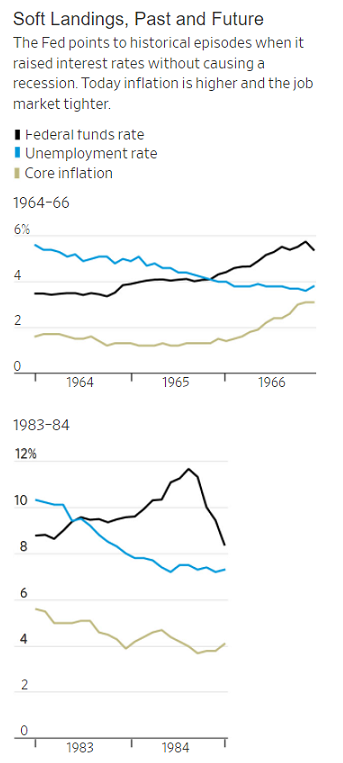
Soft Landings, Past and Future: The Fed points to historical episodes when it raised interest rates without causing a recession. Today inflation is higher and the job market tighter.

Federal Reserve Chairman Jerome Powell explained this week what he and his colleagues hoped to accomplish with the interest-rate increases they initiated last week. “The economy achieves a soft landing, with inflation coming down and unemployment holding steady,” he told a conference of economists.

In 1965, 1984 and 1994, the Fed raised interest rates enough to cool an overheating economy without precipitating recession, he noted, adding it may have done the same in 2019 but for the Covid-19 pandemic.

Unfortunately, history isn’t on his side. Inflation is much further from the Fed’s objective and the labor market, by many measures, tighter than in previous soft landings, yet the Fed starts with real interest rates—nominal rates adjusted for inflation—much lower, in fact deeply negative. In other words, not only is the economy already traveling above the speed limit, the Fed has the gas pedal pressed to the floor. The odds are that getting inflation back to the Fed’s 2% target will require much higher interest rates and greater risk of recession than the Fed or markets now anticipate.

The biggest contrast with prior soft landings was that in the past, the Fed sought only to keep inflation from going up—not to actually push it down. Today, though, it starts with core inflation, which excludes food and energy, above 5% using the Fed’s preferred price index, more than 3 percentage points above target.

History and the Fed’s own models are pretty clear: When inflation is too high, pushing it down requires damping demand and pushing up unemployment so that workers and firms must settle for lower pay and prices. Yet the median projections released by Fed officials show no such thing: They anticipate core inflation falling to 4.1% at the end of this year, 2.6% next year, and 2.3% in 2024 while unemployment stays near a 50-year low of 3.5% to 3.6% for the entire period.

Questo nostro Post ha lo scopo di mettervi in guardia dal credere alla storia del “soft landing”: già oggi è possibile leggere, nei dati e nelle notizie, quale sarà lo sviluppo degli eventi nelle prossime settimane e mesi.

E lo sanno anche alla Federal Reserve, ed alla BCE, ovviamente: a differenza di Recce’d, però, la Federal Reserve e la BCE soffrono di un (grave) conflitto di interessi.

In teoria, Federal Reserve e BCE dovrebbero servire “gli interessi del pubblico”, ma nella realtà, come ci dimostrò Mario Draghi alla BCE e come ci dimostrano oggi Lagarde e Powell, le banche centrali sono istituzioni (oggi più che in passato) politiche, che fanno scelte politiche e quindi avvantaggiano e privilegiano alcune parti della società e dell’economia su altre parti.

Questa è la sola spiegazione che vi serve, per capire “come è possibile” che nel 2021 TUTTI i banchieri centrali si siano sbagliati sulla “inflazione transitoria”. Ed allo stesso tempo, per comprendere perché, oggi, vi vogliono “vendere” la storia del soft landing. Una storia che non poggia su alcun elemento concreto: è solo un sogno, una aspirazione.

E noi, investitori consapevoli, dobbiamo sempre ricordare: “hope is not a strategy”.

Il conflitto di interessi, del quale abbiamo fatto cenno solo poche righe qui sopra, è spiegato alla perfezione dall’articolo che vi offriamo qui sotto: nel quale si sottolinea che la Federal Reserve oggi NON FA neppure quello che lei stessa, la Federal Reserve, dice che bisognerebbe fare (e la medesima cosa deve essere detta della BCE). Come è possibile? Mentire sapendo di mentire?

Clive Crook

21 marzo 2022, 12:00 CET

Clive Crook is a Bloomberg Opinion columnist and member of the editorial board covering economics, finance and politics. A former chief Washington commentator for the Financial Times, he has been an editor for the Economist and the Atlantic. @clive_crook


The Federal Reserve embarked last week on its long-advertised monetary tightening: a quarter-point increase in interest rates, with the suggestion of six more by the end of the year, and a plan to run down its stock of government debt (details to follow). This was widely expected and essentially a non-event.

Much more interesting was the way Fed Chair Jerome Powell explained what the central bank was doing. This was downright puzzling, and it raises some questions about what comes next.

Inflation stands at a 40-year high and keeps exceeding the Fed’s projections. Its new forecasts show inflation at 4.3% at the end of this year, 1.7 percentage points higher than it projected three months ago. Yet the policy interest rate is projected to be only 1.9% at year’s end — an increase of just one percentage point over the previous projection, and still significantly below what most economists see as the “neutral rate” (neither adding to nor subtracting from demand) of 2.5%.

Powell therefore needed to say why policy was shifting so slowly, bearing in mind that inflation has already risen further and more persistently than the Fed expected and that the Russia sanctions shock will make things worse.

Here’s a good rationale: The interest-rate plan splits the difference between economists who want to keep rates close to zero to avoid tipping a fragile recovery into recession, and those who think the Fed has let inflation run out of control and want more forceful corrective action.

There’s much to be said for this middle course. The outlook is uncertain and the Fed has to contend with upside and downside risks. In addition, if the Russia shock is mostly on the supply side, as seems likely, monetary policy should mostly ignore it, for the same reason it was right to ignore the rise in inflation due to the supply-side part of the Covid shock. Central banks, according to the standard view, should “look through” temporary fluctuations in supply.

So the message might have been: Yes, demand is trending a little high, so tightening shouldn’t wait any longer. But let’s be careful not to overdo it.

Powell didn’t strike this balance. Asked about the downside risk, he said this:

[T]he probability of a recession within the next year is not particularly elevated. And why do I say that? Aggregate demand is currently strong, and most forecasters expect it to remain so. If you look at the labor market, also very strong. Conditions are tight, and payroll job growth is continuing at very high levels. Household and business balance sheets are strong. And so all signs are that this is a strong economy and, indeed, one that will be able to flourish, not to say withstand but certainly flourish, as well, in the face of less accommodative monetary policy.

Does this kind of economy really need another year of (admittedly diminishing) monetary stimulus — or “accommodation,” as Powell calls it? In effect, he is arguing against postponing tightening yet again, as though the view that it’s already been delayed too long isn’t worth mentioning. But this view is both widely held and increasingly plausible.

Powell was directly asked whether he believed the Fed had fallen “behind the curve.” The questioner reminded him that he’d told a Senate committee earlier this month that if the Fed had known earlier what it knows now about the path of the economy, it would have begun to tighten sooner. Powell answered that perfect hindsight isn’t much help in setting forward-looking policy. That’s true, but beside the point. If the Fed, knowing what it now knows, would have tightened sooner, then it has ground to make up, and it should be raising rates by half a percentage point or more, not a quarter of a point.

Economists who think the Fed has a lot of catching up to do are entitled to be puzzled. They heard the central bank say it agrees with their analysis but for some reason isn’t going to do what that analysis demands.

One wonders whether the Fed might have acted differently last week if it hadn’t spent so much time coaching markets to expect the gentlest possible start. That seems quite likely. And the possibility draws attention to a persistent problem with the Fed’s communications.

Its commentary and projections set policy expectations too firmly — expectations that the Fed then seems reluctant to disappoint. Reading the Fed’s so-called dot-plot of future interest rates, investors penciled in six more quarter-point rises by year’s end before Powell had stopped talking. What the dot-plot projections actually say is that the Fed’s policy makers are all over the place on what should happen to interest rates. The spread of estimates for the fourth-quarter policy rate ranges from 1.4% to 3.1%, and none of these numbers, I’m willing to bet, was offered with much conviction. It’s a huge mistake to let the median estimate — 1.9%, implying six more increases of 25 basis points — guide expectations as much as it does.

When the future is uncertain — and it’s rarely been as uncertain as now — why invite investors to make false assumptions, especially when that might limit the flexibility you’re likely to need? The Fed should take a good hard look at how it talks to the markets.

Durante la settimana, nel nostro The Morning Brief che è riservato ai Clienti, abbiamo in dettaglio esaminato le ricadute sulla strategia di investimento di questo stato di cose, molto complesso, ed estremamente incerto: in estrema sintesi, si tratta di sapere distinguere tra la verità e le menzogne. Non c’è qui lo spazio per una analisi di dettaglio, sulle singole posizioni dei nostri portafogli modello oppure sui singoli mercati finanziari. E tuttavia, abbiamo selezionato per voi un ottimo articolo, che segue qui sotto, nel quale si mettono in evidenza le principali implicazioni per i mercati finanziari, e per noi investitori. Più in basso, vi regaliamo alcune delle nostre conclusioni.

In Congressional testimony on March 2, Federal Reserve Chair Jerome Powell said that “it is more likely than not” that the central bank “can achieve what we call a soft landing” in the economy. In other words, he believes that the Fed can raise interest rates enough to get raging inflation under control without forcing the economy into a recession. The odds that Powell can pull that off are getting longer by the day. 

History shows that when the central bank increases rates, a recession is almost assured. The Fed’s 12 rate-raising campaigns since the early 1950s resulted in 11 recessions, with the only exception coming in the early 1990s. What makes the Fed’s job extra hard now is that the inflation rate is so high. “To the extent that inflation comes in higher or is more persistently high than that, we would be prepared to move more aggressively by raising the federal funds rate by more than 25 basis points at a meeting or meetings,” Powell told lawmakers.

Increasing the odds of a recession this time is the Fed’s plan to reduce the almost $9 trillion of assets on its balance sheet after it stops buying U.S. Treasury and mortgage-backed securities this month. Those assets have risen $4.8 trillion since the pandemic commenced in early 2020. Powell said the reduction will be conducted “in a predictable manner,” largely through letting obligations it owns mature rather than outright sales. Nevertheless, this is a big reversal from the $140 billion in asset purchases it had been making each month to support the economy through the pandemic.

Another sure sign of a recession is an inversion of the so-called yield curve, which happens when the interest rate on the 2-year Treasury note rises above that on the 10-year note. An inversion makes it unprofitable for banks and other financial institutions that borrow through deposits and other short-term markets while lending at longer maturities. That restrains lending and thereby depresses business activity. At present, the 2-year yield is 1.53%, still lower than 1.84% 10-year note yield, but the spread has narrowed from 1.07 percentage points on Dec. 31 to just spx0.27 point.

The Fed is between a rock and a hard place. If it backs off tightening monetary policy, it risks persistent inflation, spurring buyers of goods to expect more of the same, so they buy ahead of need. The result is pressure on inventories and production capacity, leading to further price hikes. That confirms expectations and induces more pre-buying, generating a self-feeding inflationary spiral. Such was the case in the late 1960s and 1970s.

Major stock indexes are down anywhere from 8% to 15% this year. In recessions following significant credit restraint and yield curve inversions, the average drop in the S&P 500 Index has been 36% in recent decades. A similar plunge or greater is likely, given the extremely high level of equity prices as well as rampant speculation. It would take a 55% drop in the S&P 500 from here to bring the cyclically-adjusted price-to-earnings ratio back to 17, which is its average over the very long term. And bear markets usually overshoot on the downside just as bull markets tend to exceed rational extremes. That’s especially true when the previous bull market was saturated with speculation – just like the latest one.  

Robinhood Markets Inc., the darling of aggressive but green investors, plunged in the last half of 2021, and another 12% in January after reporting a $423 million loss in the fourth quarter. Bitcoin continues to be very volatile along with the overall stock market, typical of the opening stages of major bear markets. SPACs, with no sales or earnings and only the hope of merging with viable companies, are reminiscent of the dot-com companies of the late 1990s, which was followed by a Nasdaq plunge of 78%. Almost half of all startups with less than $10 million in annual revenue that went public last year through SPACs have failed or are expected to fall short of the 2021 revenue and earnings targets they provided to investors, according to a survey by The Wall Street Journal.

In this environment, investors should be extremely cautious. Stocks are still overpriced and vulnerable. Bond investors are worried about inflation. We may be entering a time when cash is king.

Dal punto di vista pratico, ed operativo, e quindi con riferimento alla gestione del portafoglio titoli, a nostro giudizio lo spunto più interessante sul tema di questo Post lo ha offerto in settimana l’articolo che segue, e che chiude il nostro Post.

In questo articolo, Mohamed El Erian spiega le ragioni (forti) per le quali le economie ed i mercati finanziari occidentali sono stati precipitati, dopo il 2020, in una situazione che per numerosi aspetti somiglia alla situazione nella quale si trovarono molti Paesi Emergenti nei decenni precedenti.

Vi suggeriamo di rifletterci: noi lo abbiamo già fatto (già nel 2020, e anche nel Blog) ed abbiamo quindi adeguato la nostra strategia di investimento, che appunto è basata sul fatto che il comportamento dei mercati finanziari, in Occidente, avrà sicuramente alcune somiglianze con quello dei Mercati Emergenti nei decenni precedenti.

Per moltissimi, sarà una enorme sorpresa. Non per i Clienti di Recce’d.

Mohamed A. El-Erian

22 marzo 2022, 10:30 CET

Judging from price movements on Monday, the Federal Reserve risks slipping further into a no-win interaction with markets that is more familiar to developing countries that lack policy credibility than to a systemically important central bank — let alone the world’s most powerful one. Absent a quick reestablishment of its inflation credential, something that the markets doubted again on Monday, the Fed would face even more of a no-win policy paradigm that would cause what, only a few months ago, was avoidable harm to livelihoods in the U.S. and beyond.

This unfortunate sequence is painfully familiar to some developing countries:

  • First, through a misdiagnosis of the economic situation or policy inertia or both, the central bank falls behind inflation realities and erodes its inflation-fighting credibility.

  • Second, swallowing its pride, the central bank acknowledges that inflation is too high, toughens up its policy narrative and embarks on the needed measures.

  • Third, rather than be reassured by this (albeit late) change, markets run further away from the central bank and signal the need for even more aggressive policy measures.

  • Fourth, the central bank finds itself in the dilemma of either risking a recession by validating the ever-more hawkish market pricing or seeking to minimize such damage, often unsuccessfully, by enabling high and potentially more destabilizing inflation to persist even longer.

With this sequence in mind, consider what happened on Monday, less than a week after the Fed’s top policy-making committee raised interest rates by 25 basis points and signaled further increases.

In a presentation to the National Association for Business Economics, Chair Jerome Powell tried to restore the Fed’s eroded inflation-fighting credibility by signaling that the central bank is willing to increase interest rates by 50 basis points in May, repeat that at other meetings and continue raising past the neutral level in a bid to meet its inflation objective. Yet nominal market yields, the yield curve and inflation breakevens were far from reassured. Instead, they moved further away from the Fed.

While Russia’s invasion of Ukraine has amplified the Fed’s policy challenges, the hole it is in is of its own making, and that was illustrated by Monday’s developments.

Despite ample evidence to the contrary starting almost a year ago, the Fed stuck to its “transitory” characterization of inflation until the end of November — what I called months earlier one of the worse inflation calls in the history of the Fed. Even after it belatedly “retired” the word from its vocabulary, the Fed kept its foot on the accelerator of policy stimulus. To illustrate the extent to which its policies remained misaligned, it was still injecting liquidity through its asset purchases earlier this month, including the week in which the February reading for U.S. inflation came at 7.9%.

For many months, I have been arguing that the Fed should come clean on why it got the inflation call so wrong, explain how it has improved its understanding and forecasting of the current inflation dynamics, immediately stop its liquidity injections and start its interest rate hiking cycle. The idea was to ease off the accelerator and start tapping the brakes softly instead of having to do what the market is asking for now and Chair Powell acknowledged on Monday: Having to hit the brakes a lot harder.

That was then. What about now? Is there still an optimal policy response for the Fed?

I worry that, being so late and having lost so much credibility, the Fed is far away from the policy world of “first bests.” Rather than having a way to contain inflationary expectations, cause no undue damage to the economy and meet its dual objective, the Fed is increasingly being forced to consider what is the least bad policy mistake it wishes to be remembered for: meeting its inflation target by causing a recession, or allowing high and potentially destabilizing inflation to persist well into 2023.

This awful trade-off is familiar to too many developing countries. And one of their typical reactions may also shed light on what may be tempting for the Fed: simply hope for an immaculate recovery — that is, some mix of consequential productivity gains, quick-healing supply chains, surging labor force participation and continued financial market resilience to pull the central bank out of the deep hole it has dug for itself.

Mercati oggiValter Buffo
I mercati finanziari ritornano sempre alla realtà
 

Si tratta di una delle nostre linee guida irrinunciabili.

Una delle linee guida seguendo le quali sviluppiamo la nostra strategia di investimento per i nostri Clienti: tra realtà e fantasie, noi scegliamo sempre di guardare alla realtà, per quanto fastidiosa, dolorosa, sporca, e confusa.

Sarà sempre meglio, anche per i vostri soldi e per i vostri investimenti, dei disegnetti a colori che trovate sulle slides del promotore finanziario, del wealth manager, del private banker, ed anche della grande banca internazionale di investimento.

Perché sarà sempre lì, alla brutta, sporca e confusa realtà, che i mercati finanziari alla fine dovranno ritornare.

Ne scriviamo nuovamente oggi perché proprio in questo momento, mentre sui mercati finanziari si scrive e si parla di “crisi energetica” e prezzo del petrolio, di “soft landing” e di “cessate il fuoco”, nella realtà intorno ai mercati finanziari si sono messe in moto dinamiche ben più importanti.

Anche per noi investitori, è ben più importante seguire queste dinamiche, ed anticipare l’impatto di questi fattori, piuttosto che perdere tempo a vedere “dove ha chiuso ieri sera la Borsa”.

Per fornire ai lettori un esempio concreto, abbiamo scelto questa settimana un articolo del Wall Street Journal, articolo nel quale si riferisce dello stato delle cose per quello che riguarda i prodotti dell’agricoltura, le scorte alimentari e la produzione di fertilizzanti.

Il nostro suggerimento a tutti gli investitori, in questo momento, è di non illudersi guardando le figurine a colori sullo schermo dello smartphone oppure del pc: la realtà ha colori meno brillanti, ha contorni meno definiti, soffre di imperfezioni ed ha odori a volte sgradevoli, ma prevale sempre.

Come spiega benissimo questo articolo, la crisi alimentare del 2022 non si risolverà presto, e non è detto che si risolva per il meglio: in ogni caso, condizionerà le nostre vite (anche quelle di noi che viviamo nei Paesi Occidentali) e senza alcun dubbio condizionerà anche il comportamento dei mercati finanziari.


The symbolism of Ireland’s government telling its farmers to grow more crops because of wartime shortages should be lost on no one: it recalls Irish ministers in the 1940s ordering growers to plant more grain during the second world war.

This time round the programme, designed to replace imports from Russia and Ukraine, relies on cash rather than coercion. The rush across the EU to get more crops in the ground goes against the decades-long direction of European agricultural policy and subsidies.

Warnings of a global food crisis are not a drill. It’s not Covid-related general interruptions to trade that are causing soaring food prices and shortages. There was a false alarm along those lines early in the pandemic, when governments worried about shortages and export restrictions similar to those on personal protective equipment. In fact, the supply chains held up quite well.

The current episode looks more like the global food crisis in 2007 to 2008. Shocks didn’t emanate from the trading system but ended up there, with countries slamming on export controls to keep produce at home. Food prices have been rising sharply since the middle of last year, chased higher by energy costs — not mainly the diversion of crops to biofuels but the fossil-fuel intensity of modern agriculture, including the use of synthetic nitrogen fertiliser.

The Ukraine war has disrupted output and exports of grain and fertiliser from two of the world’s biggest producers. There’s a historical irony here: Stalin’s insistence that Ukraine keep exporting grain in the early 1930s to pay for imports of machinery to industrialise the Soviet Union worsened the Holodomor famine, in which more than 3mn Ukrainians starved to death.

The world has had 15 years since the previous food crisis to prepare its emergency response, including agreements to minimise export controls. It hasn’t done very well. The Global Trade Alert monitoring service reports food export curbs more or less doubling since the middle of 2021. By now there’s another story every few days of governments restricting food sales abroad.

It’s a global prisoners’ dilemma: it’s in everyone’s interest to keep exports flowing, but no one wants to run short by being the only country that does. During the crisis of 2007 to 2008, India and other countries panicked and banned exports of rice despite no evidence of global shortages, resulting in huge price rises. In response, governments created the Agricultural Market Information System (Amis) to promote transparency in production. That’s fine when there are no shortfalls, but doesn’t guarantee co-operative policy reactions if there are.

Despite discussions at the World Trade Organization, there are no binding agreements between governments to eschew food export restrictions. Export bans are illegal under WTO law, but cases would almost certainly fail under the exception for temporary restrictions “to prevent or relieve critical shortages of foodstuffs or other products”, a loophole you could drive a fleet of combine harvesters through.

Governments can try stimulating output in the short term, as Ireland and the EU are doing. The US will do the same, though it’s already pumping out huge production-distorting handouts to compensate farmers for retaliation from Donald Trump’s absurd trade war with China, and US wheat is often already too expensive to compete globally.

One-off support schemes to turn unused land back to growing basic crops are worth trying if they don’t get baked into permanent production-distorting subsidies. But they should represent only a temporary reversal of the sensible longer-term direction of encouraging farmers to go up the value chain. (The EU is actually a net exporter of food, including selling wheat abroad, but it’s disproportionately high-end stuff: Brussels could put on export restrictions to keep its food at home, but even Europeans can’t live on Gorgonzola and champagne alone.)

In any case, the increase in supply is not likely to be dramatic. It’s not generally high-quality productive land that farmers have allowed to go fallow. And time is short: Ireland’s farmers had better get a move on before the barley planting season ends in a few weeks. Digging for victory isn’t a major short-term solution. More helpful would be cutting tariffs to ensure that what grain there is ends up where it’s needed, backed up with rapid aid disbursements to developing countries to give them more purchasing power. Australia, where the government is handing out export credits to wheat exporters, has surpluses to sell, as does India. For both substantive and signalling reasons, the EU should quickly push through the preferential trade deals with Australia and New Zealand once the French presidential election is done and Emmanuel Macron doesn’t have to strike agricultural protectionist poses any more. As well as Australia’s wheat, New Zealand’s fruit and vegetables, grown in the southern hemisphere summer, will be welcome when the northern winter comes.

Even during food crises there’s generally enough to eat in the world as a whole, but it’s in the wrong places. You can try producing more, or you can move it to the right ones. In the short term, the second of those may be politically harder but it’s more likely to be effective. alan.beattie@ft.com

Mercati oggiValter Buffo
Questi sono i vostri soldi (al marzo 2022)
 

Lo ripetiamo spesso, ai nostri Clienti, di non ossessionarsi, nel breve termine, con le performances del proprio portafoglio di investimenti. Non è sano, e non è utile: in modo particolare, è del tutto inutile nelle fasi di elevata volatilità.

Ed è proprio questa la ragione per la quale Recce’d ha rinviato, di settimana in settimana, la pubblicazione del Post che leggete oggi: abbiamo atteso (sapevamo che sarebbe arrivato) l’ampio e generale rimbalzo delle Borse della scorsa settimana, per fare insieme ai nostri lettori qualche conto.

Nel grafico che vedete qui sotto, vi viene raccontato quello che hanno fatto i vostri soldi dal 2015 al 2022, in sette anni.

Fate bene attenzione alle date: abbiamo pubblicato un dato aggiornato a PRIMA: la data a cui il grafico è stato aggiornato è PRECEDENTE allo scoppio della guerra in Ucraina.

Questa scelta è coerente con ciò che vi abbiamo scritto, più di una volta, in questo Blog: noi non consideriamo (a meno di sviluppi clamorosi) la guerra in Ucraina come un fattore decisivo per i rischi ed i rendimenti delle diverse asset class e sei singoli asset finanziari nel 2022.

A tutto oggi, ed ancora per oggi (domani, poi, si vedrà quello che succede) la maggiori parte degli italiani investitori affidano il loro risparmio a Reti di vendita di Fondi Comuni, a reti di promotori finanziari (che anche se si fanno chiamare “consulenti” restano sempre promotori di prodotti finanziari): i nomi, li conoscete tutti, e si va da Mediolanum a FINECO, da Fideuram ad Allianz, da Generali a Azimut, e altri nomi molto conosciuti, specie grazie a martellanti spot pubblicitari.

Tutte queste reti di promotori finanziari propongo al Cliente lo STESSO portafoglio di Fondi: non ci sono differenze sostanziali, tra Rete e Rete, e meno ancora tra promotore finanziario e promotore finanziario. Anche se si fanno chiamare wealth manager, oppure familiy banker, personal banker oppure robo advisor, tutti fanno le medesime cose, perché la sola cosa importante è restare ben nascosti nel gruppo, rimanere allineati nel gregge. Così, quando si perdono soldi si può sempre dire “eh, ma hanno perso tutti”.

Quindi tutti voi lettori, se siete Clienti di queste Reti, avete il medesimo portafoglio: un po’ di azionario (20-30-40%), un po’ di obbligazionario (40-50-60%) e poi … un po’ di pasticcio, confusione, per dare una pennellata di colore, suggestione, emozione (senza alcun impatto sulla vostra performance).

Per questo, nel grafico trovate la performance dei vostri investimenti negli ultimi sette anni: come vedete, il rendimento complessivo è positivo, ma ci sono almeno due cose che meritano di essere sottolineate:

  1. avete guadagnato in sette anni circa il 11%, che fa circa lo 1,5% medio annuo; e questo, con i mercati azionari vicini ai livelli massimi assoluti di ogni tempo, ed i mercati obbligazionari con i prezzi delle obbligazioni vicini ai livelli massimi assoluti di ogni tempo

  2. solo due anni fa, e quindi dopo 5 anni, il vostro rendimento era sceso sotto zero

Fatevi una domanda: che cosa ci ha salvati, due anni fa? Che cosa ha riportato a galla i rendimenti, ripescandoli da sotto zero?

E più in generale, fatevi questa domanda: si tratta di buoni risultati? Dei quali essere soddisfatti? Oppure sono risultati mediocri? O peggio ancora, sono risultati da giudicare negativamente?

Insomma, visto che lo scopo di questo gioco è “guadagnare soldi”, potete affermare che avete fatto “dei bei guadagni”?

Come abbiamo già scritto, proprio in questo Blog, e solo qualche settimana fa, circolano voci di “favolosi guadagni” del 2021, si sentono racconti di nuove auto, nuove case, nuove ricchezze accumulate in Borsa, nel 2021: noi, però, pur avendo cercato prove concrete di questi “favolosi guadagni”, non ne abbiamo trovata alcuna traccia.

Come già abbiamo scritto, forse i guadagni che ci sono stati sono da attribuire a falsi e truffe, e non agli investimenti in Borsa.

Non troviamo traccia di “favolosi guadagni di Borsa”, e non c’è traccia neppure nel grafico qui sopra.

Come giudichiamo noi i risultati raccontati dal grafico qui sopra? Semplice: questo grafico descrive il nulla.

Questi investitori sono stati piazzati, dal loro promotore finanziario, in modo tale che “se il mercato sale, tu guadagni, se invece il mercato scende, tu perdi i tuoi soldi”. Non è un lavoro, non è nulla: purtroppo per il Cliente di queste Reti di promotori è un nulla pagato molto caro.

Tornando all’esordio del nostro Post, ripetiamo che questo momento (19 marzo 2022) è un ottimo momento per riflettere sulle scelte che avete fatto per i vostri soldi investiti, e quindi per i vostri risparmi: c’è stato il rimbalzo delle borse, i quotidiani scrivono di un “cessate il fuoco” tra Russia ed Ucraina, e le reti di promotori finanziari spendono ogni possibile energia per convincere il pubblico che “tutto continuerà come prima, nulla è cambiato, e soprattutto non disinvestite mai dai nostri Fondi Comuni che a noi fanno guadagnare ogni anno il 3%, mentre voi guadagnate lo 1,5% quando tutto (ma proprio tutto tutto) va bene”.

Ecco: questo è un buon momento: i soldi sono i vostri, e le scelte sono le vostre. Se siete rassicurati dalle parole dei promotori finanziari, se siete convinti che tutto andrà avanti come sempre, e se vi convince la strategia di investimento di Massimo Doris, che dice che “i mercati prima o poi si riprendono”, allora restate come siete oggi. Restate ben allineati e coperti dentro al gregge.

Se no, questa è la vostra occasione: rifletteteci bene, e poi scriveteci. Ci sono occasioni nelle quali è decisivo ascoltare anche opinioni diverse da quelle che (oggi) risultano prevalenti.

Per completezza e correttezza verso il lettore, qui sotto vedete la pagina Web dove invece potete ascoltare le opinioni delle quali si scrive nelle due immagini di questo Post.

Mercati oggiValter Buffo
Il gregge che procede senza sollevare lo sguardo
 

Abbiamo più e più volte spiegato, con dettaglio, anche qui nel Blog, che esporre il proprio portafoglio, e quindi i propri soldi ed il proprio di risparmio, al rischio di mercato, comperando tutto ad occhi chiusi, senza rendersi conto del rischio di un ribasso dei mercati, non è una strategia di investimento, ma è invece una pericolosa ingenuità.

Guidati dai promotori finanziari delle Reti di vendita, che si fanno chiamare wealth managers ma non sono managers (sono solo venditori, non decidono nulla) una buona percentuale di investitori italiano oggi si trova proprio in questa situazione: “se i mercati salgono, tu guadagni e noi guadagniamo; se i mercati invece scendono, tu perdi i tuoi soldi, e non guadagniamo esattamente lo stesso”.

Questa situazione spiega perché la maggioranza degli investitori finali ha accolto con soddisfazione il recupero delle Borse dell’ultima settimana: e non fa nulla che la guerra in Ucraina è ancora in corso, e non fa nulla che salgono i tassi ufficiali di interesse, e non fa nulla che l’epidemia di COVID sta risalendo. Per questa categoria di investitori, la realtà non conta (più), l’importante è solo che la Borsa salga (anche se manca un motivo).

Cosa spiega questo atteggiamento, che è ai limiti della isteria collettiva? Prova a spiegarlo qui sotto un articolo del Financial Times, che vi proponiamo di leggere.

In particolare, vi segnaliamo la frase dove si parla di “agganciarsi ad un indice di mercato e poi auto-proclamarsi un genio”: è una frase che spiega più di molte altre, e che poi però prosegue dicendo “è una fase in via di esaurimento, il gioco sta cambiando”.

Per questa ragione, è utile leggere questo articolo, ed è utile riflettere su questo fenomeno proprio oggi. Il momento, per i mercati e quindi per tutti noi investitori, era e rimane delicatissimo: sicuramente per gli investitori la situazione è cambiata, rispetto agli anni 2020 e 2021, e sicuramente non è una buona idea “aspettare e vedere quello che succede”.

Per ogni investitore, era e rimane decisivo decidere PRIMA.

Three horsemen of the apocalypse have arrived: war in Europe, pestilence in Asia and interest rate rises in the US.

The market response: shrug and keep on buying the risky stuff. Almost unbelievably, European stocks have now fully recovered from the shock of Russia’s invasion of Ukraine. The Stoxx 600 index dropped more than 10 per cent from immediately before the invasion in late February to the low point on March 7. It is now right back where it started, after the biggest weekly rally since late 2020. Roughly the same goes for Germany’s Dax, which dropped even more heavily and is now close to the starting point again.

This is despite an overwhelming consensus that the EU economy will suffer, possibly greatly, from the war next door, largely through the impact of painfully high energy prices. Goldman Sachs, for one, has chopped its growth forecast for the year from close to 4 per cent before the war, to 2.5 per cent now. But it seems the developing narrative that the Ukraine war will foster greater EU cohesion and, crucially, heavier government spending on defence, is winning the day.

In Asia, this week brought a rather depressing reminder that Covid-19 is not over. On Monday, Chinese stocks in Hong Kong had their worst day since the global financial crisis, with a more than 7 per cent drop after authorities announced a six-day lockdown in Shenzhen to counter another coronavirus outbreak. Analysts at ANZ calculated that just a one-week shutdown of the region could lop as much as 0.8 percentage points off growth for the year. Clearly, the path back to well-functioning global supply chains will not be smooth.

Making matters worse, investors are fretting that at some point soon, China will have to pick a side more clearly over the conflict in Ukraine. “There’s a worry that China will somehow get itself embroiled in sanctions,” says Ron Temple, head of US equities and co-head of multi-asset at Lazard Asset Management. Again, though, fast-forward to the end of the week and China’s stock markets are back in business after Liu He, the Chinese president’s closest economic adviser, promised measures to boost the economy, along with unspecified “policies that are favourable to the market”. Details were not immediately forthcoming, but it does not matter — investors can spot a good dollop of extra monetary or fiscal stimulus from 50 paces.

And, of course, the US Federal Reserve finally did it. It raised interest rates for the first time since 2018, with a quarter-point increase that is likely to be just the first of several through the course of this year. The dreaded end of the monetary stimulus has hung over riskier assets for months. In the end, though, the S&P 500 index shot more than 2 per cent higher on Fed day and just kept on going from there. The Nasdaq Composite, stuffed with precisely the high-tech stocks that are considered most vulnerable to tighter monetary policy, has had its best week in a year. Sure, it is down by nearly 13 per cent so far in 2022, and Goldman Sachs’ index of unprofitable tech stocks is still down around 60 per cent this year. But a 6.5 per cent gain in the Nasdaq in a week is not to be sniffed at. “I still think some of the speculative tech stocks in the US are overvalued,” says Lazard’s Temple. “But there’s still a strong case for US equities. Maybe for the next few years, we grow the earnings into the valuations.”

The game has changed; tracking indices higher and calling yourself a genius is a trick that has worn thin. Investors “overdosed” on clinging to broad stock market indices in recent years, says Michael Kelly, global head of multi-asset at PineBridge Investments. Putting blunt rate rises to one side, the Fed’s process of chopping back the $9tn balance sheet it has run up to provide stimulus to the financial system will be tricky for investors to navigate, he notes. “It’s very hard for the markets to front run it,” he says. “I don’t believe the ‘priced in’ story. I don’t believe it can be priced in.” Exploiting niches rather than following the herd will be important from here, he says. Still, investors clearly are determined to pick out the positives. In a note this week, Credit Suisse’s investment committee said that following an ad hoc meeting, it had decided to flip to an overweight position in equities. The benign reaction to the Fed rate rise suggests “markets have had enough time to digest the changed economic outlook”, it said. “Glimmers of hope” over a ceasefire in Ukraine have emerged, it added. And a pullback in commodity prices suggests the Russian shock could “allow the global economy, including Europe, to stay on a solid growth path”.

Analysts at UBS Global Wealth Management said the pick-up in US stocks since the Fed’s meeting shows “how rapidly markets can turn if investor perception of geopolitical risks changes”. “It also reinforces our view that simply selling risk assets is not the best response to the war in Ukraine,” they said. In short: markets are all about how fears match up to reality, and everything could have been worse. We should hope that is not tempting fate.

Nell’articolo qui sopra, si legge che secondo la grande banca internazionale UBS “è sbagliato reagire alla crisi dell’Ucraina vendendo gli asset rischiosi in portafoglio”: si tratta di una frase che, ad un esame superficiale, sembra semplicemente una frase di buon senso, e che invece ad una lettura più attenta si rivela per ciò che è, ovvero un ennesimo tentativo di manipolare l’investitore finale, portandolo ad agire contro i propri interessi.

Questo perché, con quella frase (che poi ritrovate anche nelle frasi dei promotori finanziari in Italia, come leggete qui sotto) si vuole fare intendere all’investitore che i mercati sono volatili a causa di un unico fattore di incertezza, che sarebbe secondo questa lettura il conflitto in Ucraina.

Le cose non stanno assolutamente in questo modo. Recce’d ne ha scritto ogni mattina ai propri Clienti in The Morning Brief, e poi ne ha scritto anche in questo Blog, e più di una volta, nelle ultime quattro settimane.

A differenza di chi vende UCITS e Fondi Comuni, Recce’d non ha alcun interesse nel “tenervi investiti sui prodotti finanziari”, se questi prodotti finanziari per voi non hanno alcuna prospettiva di guadagno nei prossimi anni.

Il nostro lavoro è del tutto diverso: noi non dobbiamo piazzare nei portafogli degli investitori Fondi Comuni di investimento e polizze assicurative, bensì dobbiamo dire ai Clienti su che cosa investire per guadagnare ragionevolmente rischiando in modo ragionevole, quando esistono opportunità per farlo sui mercati.

Come detto, a proposito dell’attualità dei mercati, e a proposito del fatto che l’Ucraina oggi NON è il fattore principale, NON è il fattore determinante per le performances dei mercati finanziari internazionali, noi di Recce’d abbiamo scritto, e più di una volta, in questo Blog nel 2022.

Per questo, e quindi per non ripeterci, abbiamo selezionato il migliore tra i commenti apparsi nell’ultima settimana, che vi mettiamo a disposizione qui di seguito. la lettura dell’articolo vi potrà essere utili a comprendere quali sono le tre principali implicazioni per l’economia internazionale dei fatti di febbraio e marzo 2022.

Una analisi un po’ meno semplicistica, un po’ meno grossolana, ed un po’ più utile di quelle che ascoltate oggi dai promotori Finanziari e dai capi delle Reti che li arruolano.

Una analisi che quindi vi può essere utile, per non ragionare come la massa e di non fare la medesima fine che farà tutto il grande gregge che si marcia a testa bassa verso il proprio destino seguendo il bastone del pastore, anziché alzare la testa e guardare all’orizzonte.

The writer is president of Queens’ College, Cambridge, and an adviser to Allianz and Gramercy

Due to the invasion of Ukraine, Russia is being disconnected from the global system, one economic and financial wire after another. This will devastate the economy, once the world’s 11th largest and still a G20 member. Together with a crippled financial system, it will result in a depression undermining the wellbeing of generations of Russians.

What’s happening economically and financially in Russia and Ukraine won’t stay there. In addition to the tragic forced migration of millions of Ukrainians, there are consequences for the global economy and markets, both immediately and in the longer term. By the time the spillovers and spillbacks have made their way through the world, we will have faced some of the toughest economic and financial challenges of the 1970s, 1980s, and 1990s.

But there is one important difference: they will all have materialised at the same time. Russia’s vulnerability to the west’s sanctions is visible in the collapse of its currency, queues outside banks, goods shortages, multiplying financial restrictions and so on. The resulting sharp contraction in gross domestic product will take years to reverse and will necessitate a costly transformation of how the economy operates internally and interacts externally.

The major implications for the rest of the world, while uneven across and within countries, are a combination of challenges we’ve seen before.

Due to disruptions in the availability of commodities from both Ukraine and Russia, as well as renewed supply chain breakdowns, the world faces big inflation in costs reminiscent of the oil shock of the 1970s. Also similar to the 1970s, the US Federal Reserve, the world’s most powerful central bank, is already dealing with self-inflicted damage to its inflation-fighting credibility. With that comes the likelihood of de-anchored inflationary expectations, the absence of good monetary policy options, and a stark choice for the Fed between enabling above-target inflation well into 2023 or pushing the economy into recession.

Like the 1980s, mounting payments arrears will be a feature of emerging markets. This will start with Russia and Ukraine, albeit for different reasons. Increasingly, Russia will be both unwilling and unable to pay western bond creditors, banks and suppliers. In sharp contrast, Ukraine will attract considerable international financial assistance — but this will increasingly be conditional on the private sector sharing some of the funding burden by agreeing to a reduction in contractual claims on the country’s public sector. This mix of default and restructuring is likely to spread to other emerging economies, including some particularly fragile commodity importers in Africa, Asia, and Latin America. Already, they are feeling the pain of elevated import prices, a stronger dollar, and higher borrowing costs.

Like the 1990s, when a surge in market yields caught many by surprise, we should also expect more financial market volatility. Investors are slowly recognising that the “buy-the-dip” strategy for investing has been undermined. That approach had proved very profitable when supported by massive and predictable injections of liquidity by central banks. But it is now facing headwinds, with US monetary policymakers having no good policy alternatives. This comes when the price of many assets is significantly decoupled from fundamentals by the many years of central bank interventions.

Unlike the 1990s, however, investors should not expect a quick normalisation of Russia’s relationship with international capital markets and, with that, a recovery in its debt securities. This time will be messier and lengthier.

All this has three main implications for the global economy. Stagflation has gone from being a risk scenario to a baseline one. Recession is now the risk scenario. And there will be significant dispersion in individual baseline outcomes, ranging from a depression in Russia to a recession in the eurozone and stagflation in the US. While differentiation will also be visible in market performance, this will come after a period of contagion for some as global financial conditions tighten.

The major risk scenario for markets has changed, too — potentially with unsettling volatility and market malfunction. It is a risk that, unlike in 2008-09, is of less relevance to banks and, therefore, the payments and settlement system. That’s the good news. But its morphing and migration to the non-bank sector still poses blowback risks for the real economy.

Mercati oggiValter Buffo
Chi lo poteva immaginare? (parte 4)
 

Il titolo di questo Post ci riallaccia ad una serie di tre Post, pubblicati nel maggio del 2021.

Il titolo è un richiamo ad un argomento che ci capita di ascoltare spesso: e molti di recente, anche a proposito dell’Ucraina.

Il nostro suggerimento al lettore, oggi, è di riflettere su questa pagina de La Stampa: dove come vedete è scritto “BCE incubo recessione”.

Non c’è dubbio: c’è proprio scritto do un “incubo recessione”, a soli 18 mesi di distanza dalla più grande manovra fiscale e monetaria mai approvata nell’intera storia dell’umanità, coordinata tra Fed, BCE, Banca di Inghilterra e Banca del Giappone. La manovra di “stimolo” che avrebbe dovuto addirittura eleminare, dal nostro futuro, ogni rischio di “recessione”, proteggendo le economie da ogni futuro rischio.

E’ evidente, da questa immagine e dalle altre immagini di questo Post, che quella manovra ha fallito.

Chi lo poteva immaginare? Solo 12 mesi fa, tutti i quotidiani in Italia e nel mondo ci raccontavano del “boom economico”, ed oggi invece un investitore si trova a leggere che c’è davanti a noi ed ai mercati finanziari un “incubo recessione”. E come vi dimostriamo con l’immagine più sopra, e con quella che segue, non è soltanto la BCE a sollevare l’argomento.

Pe moltissimi investitori, si tratta di sorpresa, anzi è meglio dire che è uno shock: un cambiamento drammatico di prospettiva, e in uno spazio di tempo molto ristretto.

E non è l’unico: 12 mesi fa, ma pure 6 mesi fa, sui medesimi quotidiani, italiani ed internazionali, si leggeva la storia della “inflazione transitoria”, una storia che oggi “è andata in bancarotta”, come ci ha detto la stessa BCE soltanto la settimana scorsa.

Il punto che Recce’d vuole fare con grande forza, in questo Post, è che in realtà NON si tratta di una sorpresa. Noi affermiamo che dice IL FALSO chi afferma che si tratta di una sorpresa.

Anche voi lettori, come noi di Recce’d, dovreste esservi stancati, di sentire ripetere frasi come “del resto, chi lo poteva prevedere?”.

Il lavoro, questo lavoro, è prevedere: chi vuole presentarsi come consulente, deve prevedere. A che altro serve, se non prevede, la sua consulenza? Che cosa offre, al suo Cliente? Che cosa ci sta a fare, a fianco del Cliente?

Dovrebbe solo vendere, sempre vendere, e poi … vada come vada?

Questo lavoro, è prevedere: è prevedere che la storia della “inflazione transitoria” era una storia stupida, e che il “boom economico 2021” in realtà era unicamente un argomento utilizzato per fare marketing, una balla di fumo.

Lo deve prevedere, il consulente. Se non lo prevede, allora i casi che restano sono solo due: è incompetente, e non deve fare il consulente, oppure è un truffatore, nel senso che inganna il Cliente raccontando cose che non esistono né mai sono esistite, e solo per “piazzare la merce” che la Rete gli ha detto di piazzare, ovvero polizze assicurative e Fondi Comuni.

Un investitore che nel 2022 si affida ancora alle Reti di promotori, ai wealth managers ed ai Private bankers, è lasciato solo di fronte agli improvvisi “cambi della narrativa dominante”, cambiamenti radicali di prospettiva, e quindi anche di rendimenti futuri degli asset finanziari, come quello che documentiamo qui nel Post.

Il Cliente delle Reti oggi è totalmente abbandonato, e si sente dire soltanto di “non farsi prendere dal panico” dal proprio promotore finanziario, per il quale la sola cosa che conta è che il Cliente non disinvesta mai e rimanga investito in quei Fondi Comuni che rendono, al promotore finanziario, il 3% ogni anno in media.

Noi suggeriamo, a questi investitori, di riflettere attentamente e velocemente, e ci proponiamo per una autentica consulenza, non viziata dal conflitto di interesse. Noi di Recce’d non siamo costretti a “piazzarvi” né Fondi, né polizze, né alcun altro “prodotto finanziario”. Perché i prodotti finanziari, per voi investitori finali, sono solo costi, e costi inutili oppure dannosi.

Mercati oggiValter Buffo