
Non sono "dietro la curva": la curva, quella non la vedono proprio!
 

Forse non lo sapete, amici lettori: ma la prossima settimana (il prossimo 10 febbario 2022) negli Stati Uniti verrà pubblicato il nuovo dato per l’inflazione, il dato aggiornato allo scorso gennaio.

Ne sentirete parlare in TV. Ne leggerete anche sul vostro quotidiano.

Come sapete, se seguite con attenzione il nostro lavoro, Recce’d da mesi e mesi insiste sul fatto che l’inflazione non è oggi, e non sarà nel 2022, il principale problema, il tema che determinerà il rendimento (ed il rischio) delle diverse classi di asset finanziari.

E tuttavia, noi in Recce’d ne scriviamo e ne parliamo per mettere ordine nel flusso, ogni giorno più caotico, di commenti ed analisi che investono tutti noi investitori.

A proposito di questo vero e proprio panico, a causa del quale oggi tutti si buttano a scrivere e parlare di inflazione, si tuffano nel mare delle previsioni cercando di “beccare” quella giusta, e si agitano come galline impazzite quando nel pollaio si presenta la volpe, la sola cosa che a noi sembra davvero importante, per tutti gli investitori e per la gestione degli investimenti, è che … è decisamente troppo, troppo tardi per parlarne.

Era necessario parlarne, e scriverne, 12 mesi fa: cosa che Recce’d ha fatto, prima di tutto con i propri Clienti, e poi anche nelle varie sedi pubbliche, come è ad esempio il nostro Blog oppure sempre a titolo di esempio Soldionline.it.

Parlarne oggi, è inutile: i fatti sono già lì da vedere, tutti davanti ai vostri occhi. Come investitori, tutti noi, e quindi anche voi, dobbiamo chiederci: che cosa verrà DOPO, nella fase successiva?

Di questo scrive Stephen Roach, un veterano dei mercati finanziari che è già stato da noi presentato in precedenza ai lettori del Blog, in questo articolo che di seguito vi proponiamo in lettura.

L’articolo dice una cosa che condividiamo al 100%: dice che è passé (ovvero: vecchio come una moda passata di moda) oggi lanciare allarmi sul fatto che le Banche Centrali (anche la BCE, ovviamente) sono rimaste indietro, che sono “dietro la curva” come si dice in genere.

Questo è un dato di fatto, un’evidenza. non è (più) un tema di discussione, di analisi, di valutazione. E quindi, non serve più a nulla, per la gestione degli investimenti finanziari. Serve a zero.

Quello che serve, oggi, a noi investitori, è capire che cosa verrà dopo. E leggendo l’articolo di Stephen Roach, voi stessi potete farvi una vostra idea in proposito.


Jan 24, 2022STEPHEN S. ROACH

By now, it is passé to warn that the US Federal Reserve is “behind the curve” in fighting inflation. In fact, the Fed is so far behind that it can’t even see the curve and may have to slam on the policy brakes to regain control before it is too late.


NEW HAVEN – The US Federal Reserve has turned on a dime, an uncharacteristic about-face for an institution long noted for slow and deliberate shifts in monetary policy. While the Fed’s recent messaging (it hasn’t really done anything yet) is not as creative as I had hoped, at least it has recognized that it has a serious problem.

That problem, of course, is inflation. Like the Fed I worked at in the early 1970s under Arthur Burns, today’s policymakers once again misdiagnosed the initial outbreak. The current upsurge in inflation is not transitory or to be dismissed as an outgrowth of idiosyncratic COVID-19-related developments. It is widespread, persistent, and reinforced by wage pressures stemming from an unprecedentedly sharp tightening of the US labor market. Under these circumstances, the Fed’s continued refusal to change course would have been an epic policy blunder.

But recognizing the problem is only the first step toward solving it. And solving it will not be easy.

Consider the math: The inflation rate as measured by the Consumer Price Index reached 7% in December 2021. With the nominal federal funds rate effectively at zero, that translates into a real funds rate (the preferred metric for assessing the efficacy of monetary policy) of -7%.

That is a record low.

Only twice before in modern history, in early 1975 and again in mid-1980, did the Fed allow the real funds rate to plunge to -5%. Those two instances bookended the Great Inflation, when, over a five-year-plus period, the CPI rose at an 8.6% average annual rate.

Of course, no one thinks we are facing a sequel. I have been worried about inflation for longer than most, but even I don’t entertain that possibility. Most forecasters expect inflation to moderate over the course of this year. As supply-chain bottlenecks ease and markets become more balanced, that is a reasonable presumption.

But only to a point. The forward-looking Fed still faces a critical tactical question: What federal funds rate should it target to address the most likely inflation rate 12-18 months from now?

No one has a clue, including the Fed and the financial markets. But one thing is certain: With a -7% real federal funds rate putting the Fed in a deep hole, even a swift deceleration in inflation does not rule out an aggressive monetary tightening to re-position the real funds rate such that it is well-aligned with the Fed’s price-stability mandate.

To figure this out, the Fed must hazard an estimate of when the inflation rate will peak and head lower. It is always tough to guess the date – and even harder to figure out what “lower” really means. But the US economy is still running hot, and the labor market, at least as measured by the plunging unemployment rate, is tighter than at any point since January 1970 (on, gulp, the brink of the Great Inflation). Under these circumstances, I would argue that a responsible policymaker would want to err on the side of caution and not bet on a quick, miraculous roundtrip of inflation back to its sub-2% pre-COVID-19 trend.

Again, consider the math: Let’s say the Fed’s projected policy path, as conveyed through its latest “dot plot,” is correct and the central bank takes the nominal federal funds rate from zero to around 1% by the end of 2022. Couple that with a judicious assessment of the disinflation trajectory – not too slow, not too fast – that foresees year-end CPI inflation moving back into the 3-4% zone. That would still leave the real federal funds rate in negative territory at -2% to -3% at the end of this year.

That’s the catch in all this. In the current easing cycle, the Fed first pushed the real federal funds rate below zero in November 2019. That means a likely -2% to -3% rate in December 2022 would mark a 38-month period of extraordinary monetary accommodation, during which the real federal funds rate averaged -3.1%.

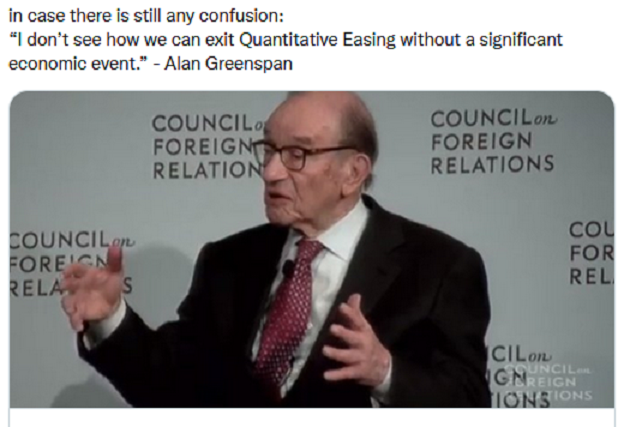
Historical perspective is important here. There have been three earlier periods of extraordinary monetary accommodation worth noting: In the aftermath of the dot-com bubble a generation ago, the Fed under Alan Greenspan ran a negative real funds rate averaging -1.1% for 31 consecutive months. Following the 2008 global financial crisis, Ben Bernanke and Janet Yellen teamed up to sustain a -1.9% average real funds rate for a whopping 62 months. And then, as post-crisis sluggishness persisted, Yellen partnered with Jerome Powell for 37 straight months to hold the real funds rate at -0.9%.

Today’s Fed is playing with fire. The -3.1% real federal funds rate of the current über-accommodation is more than double the -1.4% average of those three earlier periods. And yet today’s inflation problem is far more serious, with CPI increases likely to average 5% from March 2021 through December 2022, compared with the 2.1% average that prevailed under the earlier regimes of negative real funds rates.

All this underscores what could well be the riskiest policy bet the Fed has ever made. It has injected record stimulus into the economy during a period when inflation is running at well over twice the pace it did during its three previous experiments with negative real funds rates. I deliberately left out a fourth comparison: the -1.7% real federal funds rate under Burns in the early 1970s. We know how that ended. And I also left out any mention of the Fed’s equally aggressive balance-sheet expansion.

By now, it is passé to warn that the Fed is “behind the curve.” In fact, the Fed is so far behind that it can’t even see the curve. Its dot plots, not only for this year but also for 2023 and 2024, don’t do justice to the extent of monetary tightening that most likely will be required as the Fed scrambles to bring inflation back under control. In the meantime, financial markets are in for a very rude awakening.
Mercati oggiValter Buffo
Meno probabile di una luna fatta di formaggio verde.
 

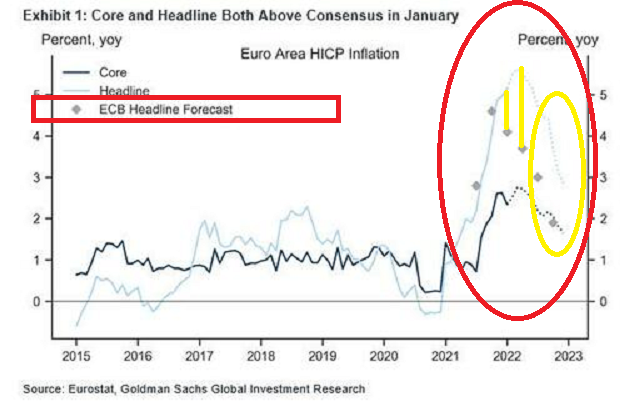
La performane di Christine Lagarde alla riunione della scorsa settimana della BCE è stata … incommentabile, come è stato poi dimostrato dalle reazioni dei mercati. Il 3 febbraio 2022 verrà ricordato, dai mercati e sui mercati.

Abbiamo immediatamente segnalato la cosa, che è di grande importanza e che eserciterà i suoi effetti per settimane e mesi a venire, ai nostri Clienti attraverso il nostro bollettino quotidiano The Morning Brief.

E’ escluso che il vostro promotore finanziario (che si chiami private banker, wealth manager o familiy banker) vi abbia segnalato e spiegato la cosa.

Ma vi siete comunque resi conto che qualche cosa di importante è successo, dai prezzi delle vostre posizioni in portafoglio (i Fondi Comuni e le polizze UCITS) e ciò che avete visto è soltanto una prima reazione, una piccola parte del tutto. Siamo soltanto all’inizio.

La signora Lagarde si è presentata in conferenza stampa con il medesimo atteggiamento di arroganza che fino a qualche mese fa aveva tenuto la Federal Reserve, negando l’evidenza e parlando come parla chi si rivolge ad una platea di individui poco intelligenti ed incapace di comprendere quello che succede nel Mondo intorno a loro.

La reazione dei mercati ci ha detto che il pubblico degli operatori e degli investitori non è fatto di persone poco intelligenti e poco informate (come Lagarde evidentemente sperava). dai mercati è arrivata una prima reazione brutale, e altre reazioni seguiranno nelle prossime settimane.

Allo scopo di non ripetere cose che Recce’d scriveva già nel 2020, sul destino delle Banche Centrali e sul futuro di politiche monetare che non sono “non convenzionali” bensì sono spregiudicate, mal calcolate e semplicemente sbagliate, oggi vi proponiamo di leggere qui di seguito ciò che ne ha scritto, la settimana scorsa, l’autorevole e conosciutissimo giornalista Martin Wolf sul Financial Times.

Abbiamo preso in prestito, da Martin Wolf, il titolo di questo Post: laddove scrive che è possibile che si esca da questa fase di politica monetaria, avviata durante la pandemia, senza frenare la crescita delle economie e senza destabilizzare i mercati finanziari. E’ possibile, scrive Wolf, ma quanto è probabile? E’ meno improbabile … di una luna fatta di formaggio verde, ci scrive Martin Wolf.

Nell’articolo, che è scritto nel modo più chiaro possibile, troverete una serie di considerazioni su ciò che di recente è accaduto negli Stati Uniti, fatti che vengono presentati e trattati in un modo che è applicabile in modo perfetto a ciò che è successo a Lagarde giovedì scorso.

In aggiunta, la lettura di questo articolo vi aiuterà anche a collocare nel modo più opportuno, nel quadro attuale i dati per l’occupazione USA che avete letto venerdì 4 febbraio 2022.

Insomma, l’articolo che vi proponiamo vi regala un completo, ed utile aggiornamento della situazione, per guardare al futuro con occhi aperti.


On November 22, US president Joe Biden renominated Jay Powell as chairman of the Federal Reserve. Eight days later, Powell told Congress that it was “probably a good time to retire that word and try to explain more clearly what we mean”. The magic word he was about to retire was “transitory”. That incantation had permitted the Fed to persist with an extremely expansionary monetary policy during a strong recovery accompanied by soaring inflation. A cynic might think there was something more than accidental about the timing of the word’s retirement. I could not possibly comment. Let us hope instead that the shift is not too late. US consumption is back on the pre-Covid trend unlike last time.

In 1955, chairman William McChesney Martin remarked that the Fed “is in the position of the chaperone who has ordered the punch bowl removed just when the party was really warming up”. It was sound advice, as the monetary turmoil of some two decades later demonstrated. Losing control over inflation is politically and economically damaging: restoring control usually requires a deep recession. Yet the Fed has been running this risk lately, because it has not even started to remove a highly alcoholic punch bowl. Whether inflation is indeed transitory is not mainly determined by what is going on in markets for specific products. It depends more on the environment in which such shocks emerge. The risk is that in a highly supportive policy environment, such as today’s, a price shock can too easily ripple across the economy as workers and other producers struggle to recoup their losses. The recovery of fixed investment has been particularly strong.

The Institute for International Finance notes that US real consumption has by now fully returned to its pre-pandemic trend. This never happened after the 2008 financial crisis. Business and residential investment is also extremely robust. The recovery is stronger than in the other big high-income countries. The main reason for this rude health, argues the IIF, has been fiscal stimulus.

The labour market has also substantially healed and, on some measures, is hot. In a recent piece for the Peterson Institute for International Economics, Jason Furman and Wilson Powell show that the prime-age non-employment rate, unemployment rate, number of unemployed people per vacancy and quit rate are all stronger than the 2001-2018 average. The last two are at record levels. As Jay Powell himself noted in his press conference last week, “labour market conditions are consistent with maximum employment in the sense of the highest level of employment that is consistent with price stability”. In other words, the Fed has already fulfilled its jobs mandate. Data on US labour markets are confusing but show tightness.

The strong labour market is also showing up in a rapid rise in nominal earnings, with total compensation for civilian workers above the pre-pandemic trend. Yet real compensation was 3.6 per cent below trend in December 2021. This was because annual consumer price inflation reached 7 per cent, the highest rate for four decades. Even core inflation (with volatile items such as energy and food stripped out) reached 5.5 per cent. Moreover, contrary to the belief that this is due to just a few items, the IIF shows that inflation is running at over 2 per cent on over 70 per cent of the weighted index.

This price surge is no limited phenomenon. US nominal employment costs are rising strongly. Chart showing US nominal employment cost index, total compensation for all civilian workers (Dec 2019=100) The rate of price increases on the scarcest items will slow and many prices will even fall. But that will not be enough. One reason is that affected businesses and workers will seek to recoup their losses, risking an inflationary spiral. Another is that policy is still aggressively loose, given the ongoing asset purchases and a Fed funds rate of 0.25 per cent. Whatever the supply disruptions, a central bank still has to calibrate policy to demand.

Yet the Fed continues to ladle out the punch, even though the party is turning into an orgy. Given, in addition, the “long and variable lags” in the relationship between monetary policy, the economy and inflation, described by Milton Friedman, it is hard to believe the Fed is anywhere near where it needs to be today. The Fed itself agrees: tightening is on the way.

But the question is whether it can still contain an inflationary spiral and keep expectations stable without having to inflict a recession. That is going to be extremely hard to pull off. Policymakers just do not know enough about the post-pandemic economy to calibrate the needed policy changes, especially as they are clearly too late. Meanwhile high inflation is lowering real employment costs.

In this context, the Fed board’s December forecasts are bewildering. The median view is that core consumer price inflation will fall to 2.7 per cent this year and 2.3 per cent in 2023, as the unemployment rate stabilises at 3.5 per cent. Meanwhile, the forecast is for the Fed funds rate to be between 0.6 and 0.9 per cent this year, and 1.4 per cent and 1.9 per cent in 2023 (if we leave out the three highest and lowest). These forecasts are, we must note, below the Fed’s own estimate of the neutral rate of interest, which is 2.5 per cent. Moreover, the assumed real interest rates are also negative.

Perhaps board members believe that aggressive asset sales will deliver the needed tightening via higher long-term rates. Alternatively, they have to believe that the economy and inflation will stabilise smoothly even though monetary policy stays expansionary throughout. Inflation is over 2 per cent on 70 per cent of the indices by weight.

This would be immaculate stabilisation. It is conceivable that the policy settings chosen during the worst of the Covid crisis still make sense today. It is conceivable too that the forecast tightening will deliver robust growth and smooth disinflation. Both are less unlikely than that the moon is made of green cheese.

Mercati oggiValter Buffo
La asset allocation va buttata nell'indifferenziata
 

Nell’immagine qui sopra, Mohamed El Erian riassume, come sempre con massima efficacia, lo stato d’animo di tutti voi investitori a fine gennaio 2022.

El Erian presenta nel modo migliore il problema della gestione del portafoglio dei propri investimenti in questo preciso momento dei mercati:

  • forse le azioni non ci piacciono più

  • l’inflazione si mangia il denaro tenuto in cash

  • e i tassi reali negativi di rendimento delle obbligazioni scoraggiano

  • mentre la volatilità delle criptovalute è esplosa e mette preoccupazione

E quindi. oggi, che cosa faccio?

C’è molto, molto, molto da riflettere, su queste poche parole di El Erian.

Più ancora che per la performance degli indici di mercato, proprio da questo punto di vista si profila, almeno a giudicare dalle prime battute, un 2022 che resterà nella storia, ben più (pensate!) dei rialzi di Borsa del 2020-2021.

L’anno 2022 sarà un anno nel quale verranno riscritte molte regole, convenzioni e convinzioni per ciò che riguarda la gestione degli investimenti e del risparmio.

Per gli investitori, in modo particolare, e per la truppa dei venditori che facendosi chiamare wealth manager o private banker oppure robot advisor da sempre ingannano il risparmiatore finale facendogli credere che la sola cosa che si può fare con i propri soldi è distribuirli secondo le regole della cosiddetta “asset allocation”.

Recce’d ne scrive da anni nel Blog, ed ogni giorno poi ne parla con i propri Clienti: quella “asset allocation”, quella ispirata a principi come media e varianza, quella che vi impone di mettere il 30% in azioni, il 60% in obbligazioni ed il rimanente 10% in “altro”, è niente altro che una strategia commerciale che adatta (molto malamente) una teoria economica per vendere a voi i Fondi Comuni e le polizze UCITS.

Una “mano benedetta dall’alto” negli ultimi anni ha permesso ai mercati di lievitare allontanandosi sempre più dalla realtà, ed ha quindi permesso a questo tipo di “asset allocation” di sopravvivere.

Ma è finita: la inevitabili riconciliazione tra realtà e mercati finanziari porterà via, come fanno tutte le alluvioni, i detriti del passato e gli edifici pericolanti. Come è appunto quel tipo di “asset allocation”

Un primo segnale, tra i tanti che vedrete, di questa progressiva rimozione della vecchia “asset allocation” dalle pratiche di investimento di massa lo abbiamo colto nell’articolo che vi riportiamo qui sotto.

Nell’articolo, si scrive che è finito il “mercato del Beta” e che il prossimo mercato sarà il “mercato dell’Alfa”

Si tratta solo di un primo passo: il secondo passo, sarà capire che neppure l’Alfa esiste, e che è arrivato il momento di buttare sia Alfa sia Beta nel cestino dei rifiuti. Come Recce’d scriveva qualche anno fa sul Financial Times. E come diremo successivamente, in altre pubblicazioni più approfondite.

L’articolo che abbiamo citato e che riproduciamo qui sotto contiene una massima di Ben Graham, che sta benissimo incorniciata anche nel vostro studio (oltre che nel nostro).

By Ven Ram, Bloomberg Markets Live analyst and commentator

In the past few years, you could have closed your eyes and gone long beta.

Preferably even higher beta if you felt a bit more adventurous. And the markets would have rewarded you with returns far, far higher than even your rose-tinted marketing material could have possibly projected.

Fast forward three weeks into the new year, and those portfolios and closet-index trades have taken it on their knuckles.

Given Monday’s stock rebound, the mood may have turned again for now, though traders may prefer to revive their best bets -- short or long -- after the Fed has spoken on Wednesday. However, whatever the color of their trade, it’s clear that the coming months and years will belong to those who have done their homework, back that up with conviction, have the guts to drown the incessant noise thereafter and hold their poise.

If you rewound life back to say, 2019 -- or any other year before the pandemic for that matter -- you had little by way of (officially recorded) inflation, no tensions surrounding Russia and Ukraine and certainly no uncertainty to the broader macroeconomy stemming from possible variants. Now, each one of those has to be accounted for: will inflation in the U.S., already running at 7%, head even higher as crude prices threaten to push toward $100 a barrel, or will the numbers go mellow from the second half? Will geopolitical tensions spill over into a full-fledged confrontation, cause even more supply bottlenecks and send commodity prices a-soaring as colleague Jake Lloyd-Smith notes?

You could possibly solve for all those variables and arrive at a Grand Theory of where the Fed will be a couple of years down the line and what that means for asset prices -- though you would run the very real risk of supplanting simplicity with complexity and false precision.

As Benjamin Graham counseled Warren Buffett, “You are neither right nor wrong because the crowd disagrees with you. You are right because your data and reasoning are right.”

And if your conviction is high that your reasoning is right, sit tight and let your alpha do the work for you -- chances are, you will stand out from the crowd and come out smiling.

Mercati oggiValter Buffo
Fed Put 2022
 

Che cosa sia la Fed Put, nessuno lo sa spiegare con precisione: c’è però da anni una convinzione diffusa (supportata dall’esperienza) che la Banca centrale USA sia pronta sempre a fare “whatever it takes” per fare salire le Borse, così come in Europa è stato fatto per i Titoli di Stato.

Abbiamo sempre scritto e detto, e lo ripetiamo oggi, che semplicemente è folle andare dietro ad una storiella così semplicistica e persino stupida.

E’ follia pensare che la Federal Reserve possa permettersi un comportamento come questo: la Fed come la BCE è un organismo politico che fa politica. Agisce sulla base ed in funzione degli scopi della politica prevalente al momento.

Si è trattato di un incidente, di una casualità: per anni è risultato politicamente conveniente “tirare su” i prezzi dei Titoli di Stato e delle Borse, gonfiare in modo artificiale i mercati finanziari.

Oggi, nel 2022, le cose stanno in modo diverso.

L’isteria delle Borse nell’ultima settimana del gennaio 2022 si spiega anche (non solo) per questo: manca un ancoraggio nel quale gli operatori e gli investitori hanno creduto per anni (anche se, forse, non è mai esistito davvero).

Da qui deriva la confusione e la paura: perché “non sappiamo dove stiamo andando”, come si dice qui sotto nell’immagine che segue (la parte in basso). Di sicuro, però, stiamo andando … da un’altra parte.

La cosa non ci coglie di sorpresa: noi di Recce’d abbiamo predisposto i nostri portafogli modello in favore di vento (il vento di oggi, che è il solo vento che conta davvero) già molti mesi fa.

Mesi fa, noi di Recce’d eravamo i soli a scrivere ed affermare alcune cose, che al contrario oggi si trovano su tutti i media del Pianeta, sostenuti da voci autorevoli.

Ogni volta che cambia il vento, infatti, si fanno avanti un grande numero di “esperti” che vogliono cavalcare la nuova ondata di emozione: ondata di emozione che successivamente coinvolge la massa degli investitori.

Come già ampiamente illustrato, Recce’d NON ritiene che il maggiore problema che i mercati devono affrontare in questi mesi sia la Federal Reserve, o i tassi di interesse. Al tempo stesso, ne scriviamo per segnalare ai lettori un tema che influisce sulla psicologia della massa degli investitori.

Noi, che ne scriviamo da almeno due anni, seguendo questo dibattito sulla Fed Put a volte ci mettiamo a ridere: la situazione a noi sembra ben rappresentata dalla immagine che vedete qui sotto, con la quale chiudiamo il Post.

Immagine che spiega bene la ragione per la quale, nell’agosto 2020, noi vi avevamo avvisati del fatto che “La Fed è il principale nemico della vostra stabilità finanziaria”.

Mercati oggiValter Buffo
Alla deriva: una totale mancanza di prospettiva.
 

Molti tra di voi lettori ricorderanno il January Effect: certamente il vostro private banker, il vostro wealth manager, il vostro robot advisor e quindi il vostro promotore finanziario ve ne ha parlato, più di una volta, più o meno dicendovi che “esiste una statistica inattaccabile secondo la quale in gennaio le Borse salgono sempre”.

Nel mondo degli investimenti però la statistica è una branca della scienza che serve soltanto a ricordarci come sono andate le cose in passato. Estrapolare, ovvero proiettare sul futuro i comportamenti passati dei mercati finanziari, è un errore, tanto grave quanto sarebbe grave oggi prepararsi ad una guerra studiando le tattiche utilizzate per vincere a Waterloo.

Lo scorso anno, avete letto sul vostro quotidiano, oppure ascoltato alla vostra TV preferita, dei mille e mille record di Wall Street: ed oggi potete aggiungerne un altro, di record. Come vedete qui sopra, al 28 di gennaio questo inizio di anno è stato il peggiore in assoluto, per la Borsa di New York, dal 1939.

Come spiega sopra l’immagine, a seconda di come andrà la seduta di lunedì, potrebbe essere il peggiore di sempre.

“Dopo così grandi guadagni, ci sta”: è questo che vi sta dicendo il vostro promotore finanziario.

Può darsi. E’ vero che anche in questo caso, come in ogni altro, guardare al futuro nello specchietto retrovisore non serve a nulla, e produce danno.

Ed infatti noi in Recce’d non utilizziamo MAI il passato come indicazione per il futuro: siamo consapevoli, e con noi i nostri Clienti, che per investire in modo fruttuoso e produttivo è necessario costruirsi uno scenario, fatto di rendimenti attesi e di rischi da sopportare, che sia basato sulla realtà.

La grandissima parte degli investitori, ed il 100% dei promotori/private bankers, oggi non ha più uno scenario a cui affidarsi per effettuare le scelte di investimento.

Quello di sei mesi fa è stato distrutto. Quello di sei mesi fa era fatto più o meno così:

  • la crescita delle economie resterà forte per anni

  • l’inflazione verrà tenuta sotto controllo

  • le Banche centrali sono onnipotenti e hanno sempre tutto sotto controllo

  • una crisi finanziaria non è neppure da tenere in considerazione

In un mese (anzi, 28 giorni), tutto questo è scomparso, ed infatti sui mercati finanziari di tutto il Mondo si è manifestata una reazione caotica.

Il numero eccezionale di “reversal”, ovvero di cambi di segno (aperture in rialzo, e chiusure in ribasso) osservato nel 2022 sulle Borse di tutto il mondo è un segnale chiarissimo. Ci segnala soprattutto la enorme confusione nella testa sia degli investitori sia dei “traders” delle piattaforme online, quelli del “buy-the-dip”, ovvero “compera ogni ribasso”.

La confusione tocca persino i mezzi di comunicazione: nell’immagine qui sotto, che non è stata ritoccata, un sito autorevole di finanza ci dice, nel medesimo istante, di una chiusura in ribasso dell’indice Dow Jones e di un Dow Jones in rialzo di 400 punti.

Poveri i lettori che cercano di capirci qualcosa …

I mercati finanziari, nell’ultima settimana di gennaio, sono apparsi in preda a spasmi degni di un episodio di epilessia, come vedete più sopra nel grafico dell’indice Nasdaq.

Ed il margine di oscillazione intra-day (ovvero la differenza percentuale tra valore massimo e valore minimo toccati) è raddoppiato, come vedete nel grafico qui sotto.

Come vanno interpretate queste oscillazioni “selvagge”, questo attacco epilettico dei prezzi? Davvero, come dicono i venditori di Fondi Comuni, si tratta solo di una “crisi passeggera”? Oppure, come dice il titolo qui sotto, c’è dell’altro?

Secondo gli amanti delle statistiche, e per quelli che guardano al futuro usando lo specchietto retrovisore, i numerosi “reversal” dell’ultima settimana non promettono nulla di buono per gli indici: ce lo dice qui sotto il sito del canale TV CNBC.

Noi non guardiamo mai al passato come indicazione per il futuro: e questa regola è di particolare validità proprio con i mercati del 2020-2021.

Ma se non si guarda al passato, a che cosa affidarsi? A quale visione del futuro? Il difficile, adesso, in questo preciso momento dei mercati, è sapere che cosa fare con i propri soldi.

La “narrativa dell’ottimismo” è andata distrutta, schiacciata come sotto lo schiacciasassi.

Ma un’altra narrativa non c’è: ed infatti (come sicuramente avete notato) il vostro wealth manager/promotore finanziario a voi non sa più che storia raccontare.

Lui oggi rimane un unico argomento da spendere: l’estrapolazione del passato: “non vendete nulla, perché nel lungo periodo …”.

E poi, diciamolo chiaramente: il vostro wealth manager/promotore finanziario fa il “copia ed incolla” con quello che a lui viene mandato da Goldman Sachs, e purtroppo per lui (e per voi) Goldman Sachs oggi … sta messa anche peggio del vostro promotore, come potete leggere qui sotto. Facendovi anche nell’occasione una bella risata, naturalmente.

Per chiarezza: pur facendo molta, molta, molta confusione Goldman Sachs oggi con i propri Clienti spinge ancora sull’azionario, come leggete nel brano che segue. Peccato che, proprio la settimana scorsa, i dati trimestrali della stessa banca di investimento ci avevano raccontato che la banca nel 2021 è stata venditore netto di azioni dai suoi conti per 16 miliardi di dollari USA.

Equities are still the best game in town, despite this week’s market decline, according to Goldman Sachs Group Inc. 

That’s because stock valuations are “nowhere near” where they were at the height of the dotcom bubble two decades ago, says Sharmin Mossavar-Rahmani, head of the bank’s investment strategy group. Unlike in the late-90s, the U.S. equity market today has broad-based returns and its corporate earnings are fundamentally strong, she said.  

She said that holds true even after this week’s selloff. 

“This kind of volatility is to be expected when you’re at these valuations,” Mossavar-Rahmani said in an interview. “The worst thing a client could do in terms of preserving wealth is to sell meaningfully in a downdraft.”

It’s an expanded version of a message that Goldman delivered earlier this month. That was before this week’s tech-led market selloff, but the bank’s investment strategy unit, which focuses on wealthy clients, hasn’t changed its view on the long-term prospects for U.S. equities. 

Just five companies, including Apple Inc. and Amazon.com Inc., account for about a quarter of the market capitalization of the S&P 500, close to the highest level in 40 years.

Yet market concentration doesn’t necessarily indicate a bubble, according to the firm’s research. Unlike during the dotcom mania where the biggest companies were responsible for the lion’s share of the gains, the recent positive returns have been more widespread. 

Then there’s the general mood of investors. The bank noted that sentiment-based indicators, like the American Association of Individual Investors Sentiment Survey, currently give “depressed” readings, in contrast to the exuberance typically displayed by traders in a market about to peak. Such bearishness has historically been followed by favorable equity returns. 

“​​The hurdle to underweight U.S. equities should be high,” Mossavar-Rahmani said. 

Ma voi, che siete più attenti e più critici del vostro promotore finanziario (perché i soldi sono vostri, e perché voi non siete costretti a vendere polizze UCITS e Fondi Comuni per vivere) volete approfondire, capire meglio, ed allora vi fate qualche domanda.

Ad esempio, visto che lo avete letto su ogni possibile quotidiano e lo avete ascoltato da ogni possibile televisione) vi domandate se è proprio vero che tutta la colpa delle turbolenze è della Federal Reserve e dei tassi di interesse.

Noi di Recce’d abbiamo scritto di Federal Reserve martedì scorso, 25 gennaio, in tre Post che trovate senza difficoltà proprio qui nel Blog.

Ovviamente non ripetiamo qui quello che è scritto nei tre Post citati: ma vogliamo utilizzare un’immagine già presente in uno di quei Post.

Dice bene El Erian: il mercato non sa dove sta oggi la Fed e dove vuole andare (non parliamo poi della BCE …): sono istituzioni in balia delle onde, proprio come Recce’d aveva anticipato nell’agosto di due anni fa.

Ma anche oggi cogliamo l’occasione per chiarire che nostro parere la Fed, i tassi di interesse e l’inflaizone NON sono il maggiore problema con il quale i mercati finanziari dovranno confrontarsi. Certamente sono un problema (laddove limitano lo spazio di manovra) ma NON sono il problema maggiore.

Molto lentamente (come del resto fu anche per l’inflazione) anche l’opinione di massa sta allinenandosi a questo nostro modo di vedere le cose.

Il nostro suggerimento operativo di oggi, ai nostri lettori (che ancora sono sotto shock dopo che hanno scoperto in dicembre che l’inflazione non è più transitoria) è di riflettere con massima attenzione su questo punto: e se credete, potete anche parlarne con noi direttamente, utilizzando la chat che trovate sul sito oppure la e-mail come sempre.

Il Mondo, e per conseguenza i mercati, stanno cambiando con grandissima rapidità: il nostro suggerimenti e di non chiudere gli occhi davanti a questi profondissimi cambiamenti in corso.

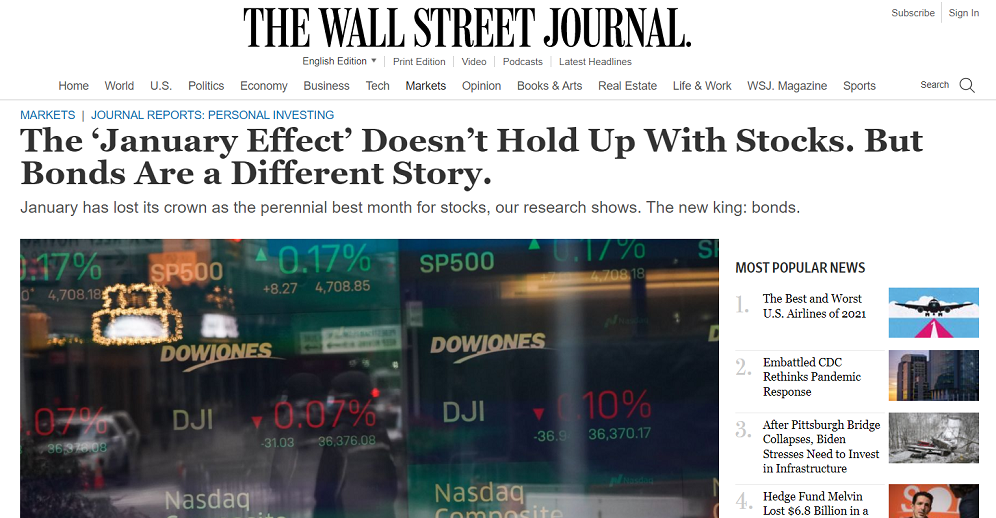
Più in basso, vi invitiamo a leggere il testo dell’articolo pubblicato la settimana scorsa dal wall Street Journal proprio sul January Effect dal quale siamo partiti in questo Post.

By Derek Horstmeyer

Jan. 8, 2022 1:00 pm ET

The January effect is a theory in financial markets that has existed for 50-plus years. It states that stocks and other assets seem to go up the most in the first month of a year.

But a closer look shows that, for stocks at least, the reverse has been true for the past 20 years. Since January 2000, on average, if you bought U.S. or international stocks at the beginning of the month and sold at the end, you have actually lost a considerable amount of money.

Surprisingly, however, the January effect continues to hold true for fixed-income securities. Since 2000, if an investor had been buying bonds in January, the return for that one-month period on average was 0.20 percentage point greater than the average return for any other month of the year. This may not seem like much, but in the bond market, where it is a game of inches, this is a significant amount.

Data back to 1950

To implement this study, my research assistant Kevin Mocknick and I gathered return data for all mutual funds going back to 1950. We then separated all funds by their investment strategy and allocation: U.S. large-cap, U.S. small-cap, U.S. value stocks, U.S. growth stocks, international equity and fixed income (bonds). With these partitions, we then looked at the average return in each grouping during the month of January and the average return in all other months (February through December).

The first finding is that from 1950 to 1999, the January effect was considerable. For instance, if you were to buy large-cap stocks in January, you averaged a 1.89% return in this one month. If you held for the rest of the year, you averaged only a 1.02% return each month after January. This amounts to a 0.87 percentage-point difference. For small-cap equities this difference jumps all the way up to 1.82 percentage points.

Buying stocks at the start of January thus was a hugely profitable strategy. Another way to benefit from the January effect during that period would have been to use leverage (or buy on margin) to overweight your portfolio to stocks the first month of the year.

Theories as to the causes of the January effect, when it was still a boost to stock returns, include such phenomena as portfolio rebalancing due to taxes, or investors putting their end-of-year bonuses to work in the stock market to start the year.

The reversal

Yet starting in 2000, the January effect for stocks has reversed. If you were to buy large-cap equities at the start of January over the past 20 years, your average return at the end of the month was a negative 0.53%. And compared with average returns for the other months of the year during this period, the return on equities for January lagged behind by an average of 1.39 percentage points. For all classes of equity, January on average has become a losing month. And this January looks to be starting on the same path; as of Friday, the S&P 500 is down 1.9% to start the year.

The one holdout is fixed income. Bond-fund investments during January over the past 20 years averaged a one-month return of 0.53%. If you held for the rest of the year (February through December) you would have averaged a monthly return of 0.33%. This amounts to a difference of 0.20 percentage point.

If you are looking to get ahead of other investors in the bond market, it appears that buying early in the year is a strategy that pays off.

Dr. Horstmeyer is a professor of finance at George Mason University’s Business School in Fairfax, Va. He can be reached at reports@wsj.com.

Mercati oggiValter Buffo