
Facciamoci due risate (ovvero: in difesa di Mario Draghi)
 

Siamo stati, noi di Recce’d, sempre molto critici verso la persona, e la figura di Mario Draghi.

Nel 2015, al tempo del “bazooka” fummo tra i pochissimi a scrivere che quel “bazooka” non esisteva, e che la mossa del 2015 aveva finalità molto diverse da quelle dichiarate. I fatti ci diedero ragione: è stato così.

Nelle settimane del suo insediamento a Capo del Governo, scrivemmo più volte che Draghi era semplicemente una operazione di Palazzo, o se preferite del Sistema, per salvaguardare sé stesso, operazione che non avrebbe mantenuto le tante (davvero troppe) promesse diffuse e vendute al pubblico.

Eravamo soli, allora: e le nostre prese di posizione furono trattate come una sorta di “tradimento della Patria”.

I fatti anche in questo caso ci hanno dato ragione.

Oggi, con questo Post, intendiamo prendere la posizione opposta: vogliamo prendere le parti di Mario Draghi.

Questo perché siamo irritati dal vero e proprio diluvio di commenti caustici e sarcastici che si leggono sui social e che attaccano la persona di Mario Draghi dopo che lo spread tra Titoli di Stato italiani e tedeschi è ritornata ai livelli del 2019 e dopo che la Borsa italiana è ritornata a scendere del 5% in un solo giorno.

Sui social spopolano, in questo weekend, immagini come quella qui sopra, ed altre immagini come quella qui sotto, che sembrano attribuire proprio a Mario Draghi l’innalzamento dello spread.

Ma si tratta di una atteggiamento polemico, superficiale, e anche un po’ stupido.

Che cosa ne può, Mario Draghi? Non ne può nulla.

E’ importante chiarire subito: Recce’d in questo post afferma che Draghi non ha responsabilità dirette, nel rialzo dello spread.

Certo, non si può negare, è a capo del Governo. E non si può negare che il suo Governo, a proposito di questo problema, ha fatto ben poco. Diciamolo pure: ha fatto nulla.

Il problema, che tutti conoscono, è sempre il medesimo problema: è il problema di un anno fa, di due anni fa, di cinque anni fa, di undici anni fa.

Non è, quindi, e non può essere, un problema di Mario Draghi: è il problema di tutti i Governi che si sono succeduti negli ultimi decenni, di centro sinistra, di centro destra, giallo-verdi, e pure dei Governi tecnici.

Nessuno, di questi Governi, e dei personaggi che hanno guidato questi Governi, ha fatto nulla. Solo, e sempre, operazioni di facciata, di abbellimento: nessuno di questi signori ha mai chiamato il problema con il suo nome, con la sola esclusione, almeno nei primi mesi, di Mario Monti.

Tutti invece impegnatissimi a girarci intorno.

E quindi, a tutti gli spiritosi e a tutte le belve da tastiera che si accaniscono sui social, chiediamo: chi avreste messo, voi, al posto di Mario Draghi, allo scopo di evitare questo rialzo dello spread?

Oppure: credete davvero che il rialzo dello spread sia la conseguenza di un “complotto plutocratico internazionale” che ha lo scopo di danneggiare proprio noi italiani? Per rendere gli italiani il popolo schiavo delle Potenze straniere?

Ma di quali potenze? Ma schiavi per fare cosa? Per raggiungere quali obbiettivi? Siete davvero convinti che ci sia la fila di gente che non vede l’ora di assumersi la responsabilità di mettere energie, attenzione, ed impegno in questo nostro Paese così come è oggi? Noi siamo sicuri di no: siamo sicuri che preferirebbero, giusto per dire, la Grecia o la Turchia. C’è meno … casino, sarebbe più facile.

Noi adesso ritorniamo a scrivere di Mario Draghi: che non merita tutto l’astio di cui è fatto oggetto sul piano personale.

Ha fatto poco, da Capo del Governo, e forse nulla a proposito di questo problema. Ma resta il fatto che quando è stato portato a Capo del Governo era la migliore delle alternative possibili, o sarebbe meglio dire la meno peggiore. Ci hanno messo lui, perché non c’era proprio nessun altro. Rendetevene conto.

Oggi Draghi subisce questo diluvio di attacchi astiosi soprattutto a causa delle aspettative che erano state create: da questo punto di vista, i suoi “presunti amici” sono stati i suoi peggiori nemici.

Spieghiamoci con un esempio, che vedete nell’immagine qui sotto.

C’è ancora oggi chi tenta di confondere le idee al pubblico, e pretende che i lettori dei quotidiani siano degli autentici imbecilli: come chi oggi scrive che il rialzo del tassi ufficiali annunciato giovedì 9 giugno dalla BCE sia la conseguenza di un “complotto di Putin”.

E’ una sciocchezza così grande, che sarebbe da riprendere in un programma comico alla TV, del tipo Zelig.

Eppure, viene ripresa anche da altri quotidiani, come leggete nell’immagine che segue.

La decenza professionale vorrebbe che quotidiani nazionali, come sono Il Corriere della Sera e La Stampa, per rispetto dei propri lettori accompagnassero gli articoli di commento che abbiamo appena riportato con il grafico che trovate qui sotto.

Non solo: il grafico dovrebbe essere spiegato ai lettori dei quotidiani citati, allo scopo di aiutarli a comprendere ciò che accade oggi, e ad anticipare quello che accadrà domani.

Questo si dovrebbe fare, se si avesse rispetto dei propri lettori. Invece di inventare favolette a scopo consolatorio, inventarle allo scopo di prolungare per il maggiore tempo possibile gli attuali (fragilissimi) equilibri del potere politico.

Lo scopo di proteggere l’equilibrio in essere nel mondo della politica va però in contrasto con i titoli, inevitabilmente allarmistici, che raccontano la realtà dei mercati finanziari.

I prezzi che si leggono sui mercati finanziari non forniscono alcun appiglio, ed anzi appaiono in totale contrasto, con la buffa teoria del “complotto di Putin”.

Il Corriere della Sera si spinge persino a scrivere, come leggete sotto nell’immagine, che “ora per l’Italia cambia tutto”.

Qui l’artificio e l’inganno sono ancora più evidenti: perché “ora” per l’Italia non cambia nulla, perché “ora” non c’è stato alcun aumento dei tassi. Arriverà poi. Ma soprattutto, perché la realtà in questo modo viene capovolta: il problema è che “ora”, ma pure 12 mesi fa, e 24 mesi fa, e 36 mesi fa, per l’Italia non cambia mai nulla.

Si tira avanti, fingendo che i problemi semplicemente non esistano e si punta tutto sul prendere tempo. Si sta lì fermi a fare niente, magari sfogliando in poltrona il Corriere della Sera. Così ha fatto anche Mario Draghi, e tutti gli altri che lo hanno preceduto.

Non cambia mai nulla: ed infatti riappaiono gli articoli del 2011 che raccontano del Governo Berlusconi e della “Lettera da Bruxelles” che ne determinò la caduta rovinosa.

Quello fu senza dubbio un episodio che vide la BCE coinvolta in dinamiche di tipo squisitamente politico: non fu il primo, non sarà l’ultimo. Accade in Europa, accade negli Stati Uniti.

Un Governo valido e capace riesce a non fare precipitare il proprio Paese in trappole di questo tipo.

Ecco spiegato perché, ancora oggi, i “presunti amici e fiancheggiatori” di Mario Draghi sono in realtà i suoi peggiori nemici. Che alimentano l’odio da tastiera, ma alimentano soprattutto gli argomenti dell’opposizione politica interna ed internazionale.

Non c’è motivo di scandalo, se si parla di manovre di palazzo e di manovre internazionali: il Mondo funziona in questo modo.

Nello specifico di Draghi, anche il suo arrivo a Capo del Governo italiano fu chiaramente il risultato di una manovra che vide coinvolti sia i partiti politici sia il mondo dell’economia. Anche questo, accade in Italia, in Europa, negli Stati Uniti. Nulla di cui scandalizzarsi, nulla di cui indignarsi.

Ciò che invece suscitava e suscita indignazione, allora ed oggi, è il tono elogiativo, spesso trionfalistico, adottato dai mezzi di comunicazione italiani nei confronti di Mario Draghi: quel tono che, come dicevamo più in alto, oggi rende ancora più aspro l’astio nei confronti della persona, e ne mina anche la solidità e la credibilità come Capo del Governo.

Difficile dire in che misura le sciocchezze che siamo stati costretti a leggere sui quotidiani, e ad ascoltare al TG5, al TG1, al TG7, sciocchezze che (del tutto a campione) vi ricordiamo con due immagini (qui sopra e qui sotto) siano state “approvate”, o quanto meno “assecondate” dal Presidente del Consiglio, o meglio dal suo staff addetto alla comunicazione. Nostro parere: avrebbe dovuto cercare di limitare, se non evitare del tutto, queste forme di “culto della persona”.

Ciò che rimane, a distanza di pochi mesi, è che questo tipo di celebrazioni personali fanno sorridere, in qualche caso anche ridere, e risultano piuttosto grossolane.
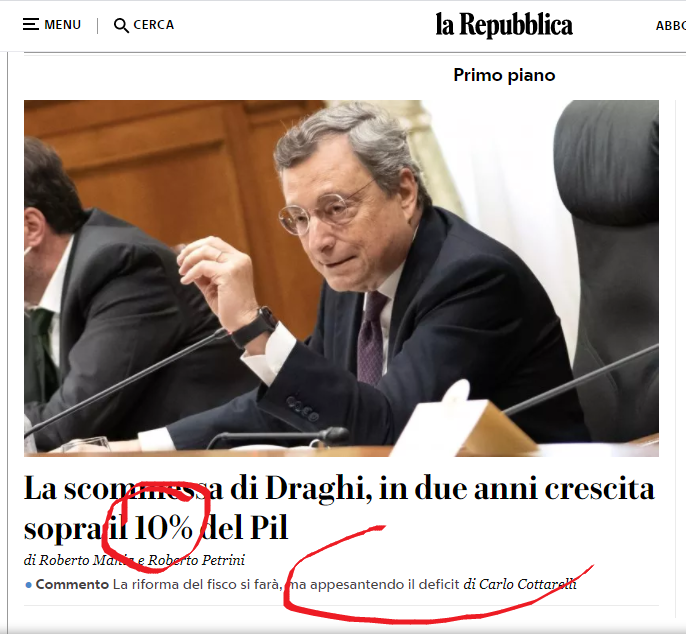
I titoli trionfalistici, a volte a tutta prima pagina, generano aspettative molto elevate nel pubblico: questi titoli dei quotidiani giustificano un rilassamento nell’opinione pubblica, che si sente autorizzata (dalla lettura dei quotidiani stessi) a credere che “tutto è risolto”, o meglio che “tutto è stato risolto da Mario Draghi”.

La pagina che vedete qui sotto, in particolare, a noi fa ancora, e sempre, ridere di gusto.
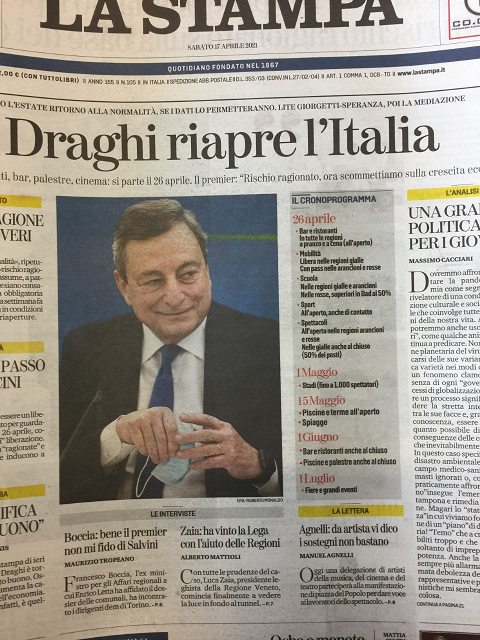
Lo stesso discorso vale per i mercati finanziari, ma soprattutto per gli investitori: indotti a scelte azzardate, e ad oggi sbagliate, da quei media che amano espressioni come “la Borsa vola” (nell’immagine qui sotto), decisamente più adatte alla pubblicità in Tv degli elettrodomestici.

Gli errori e le perdite degli investitori, però, meritano un approfondimento finale: da mesi noi ci chiediamo a che cosa stavano pensando quegli investitori che avevano in portafoglio i BTp nove mesi fa, quando il decennale del BTp a scadenza rendeva lo 0,50%.

Erano tutti convinti che sarebbe andata avanti così per sempre? Erano davvero convinti che “gli asini possono volare”? Possibile essere così tanto ingenui? E’ davvero credibile che decine di migliaia di investitori adulti e razionali abbiamo scelto di credere alle favole?

Possibile che, leggendo un titolo come quello che segue qui sotto, tutti gli investitori che avevano allo BTP in portafoglio a rendimenti vicini a zero abbiamo pensato: “Va tutto bene così, è normale, siamo a posto”?

Nel titolo c’è scritto: “la soluzione è: facciamo ancora più debito!”

E’ credibile che una persona razionale e di buon senso, dotata di un intelletto normale, leggendo un titolo come quello che trovate qui sopra e anche quello che segue qui sotto, non si sia fatto qualche domanda sui BTp fino al mese di maggio 2022?

Nel titolo che segue, potete leggere tutti: “stop austerità, più debito e meno paletti dall’Europa”. Parole semplici, comprensibili, non facili da equivocare: parole dirette, del tipo “facciamo un po’ quello che ci pare a noi”.

Volete dire che c’è qualcuno che non ha capito, neppure così? A noi sembra incredibile.

Ciò che vogliamo dire ai lettori, in questo Post, è che anziché insultare Mario Draghi sui social, la gran parte degli investitori italiani dovrebbe … insultare sé stessa.

“Siamo stati un po’ distratti, ed un po’ fessi: stava tutto scritto sul giornale, e in modo molto chiari, anche con dei titoloni".

Per poi concludere: “La prossima volta, faremo più attenzione. Oppure, ci affideremo a qualcuno capace, che ci metta in guardia dai pericoli.”

Parliamone, se volete.

Longform’d. Perché oggi nessuno ne parla?
 

Le prime pagine dei quotidiani, sia in Italia sia nel Mondo, oggi sono pieni di titoli che citano la “recessione”, la “stagflazione”, la “crisi dello spread”, la “inflazione”. E poi BCE, Federal Reserve, tassi ufficiali di interesse: ovviamente.

Si tratta di temi di investimento sui quali Recce’d scriveva nella seconda parte del 2020, e poi nel 2021. Allora, un anno fa e più, erano rilevanti. Oggi, i nostri portafogli modello devono semplicemente raccogliere i frutti delle scelte compiute allora.

Noi, in quanto gestori di quei portafogli, oggi ci occupiamo di altri temi, di temi dei quali oggi NON si legge sulle prime pagine dei quotidiani.

Sono almeno cinque, i nuovi temi di investimento per la seconda parte del 2022 e per il 2023. E nessuno di questi, oggi, lo trovate sulle prime pagine dei quotidiani.

Con il nostro Blog, noi vogliamo offrire in modo gratuito, e quindi regalare, ai nostri lettori alcuni elementi di informazione, di giudizio, e di valutazione, che non trovano né sulle pagine dei quotidiani, né in Tv nei programmi specializzati in Finanza, né nelle pubblicazioni delle Reti dei promotori finanziari, quali sono ad esempio Fideuram, FINECO, Allianz, Generali e Mediolanum insieme a molti altri operatori autorizzati alla “vendita di prodotti finanziari”.

Vendita alla quale, come sapete, Recce’d non è interessata: non è quello il nostro mestiere, nel passato, nel presente e nel futuro: Recce’d costituisce una brillante eccezione, nel panorama italiano, perché agisce al di fuori di ogni conflitto di interesse, la principale piaga che da sempre infesta il settore del risparmio in Italia e che le Autorità preposte fino ad oggi hanno limitato senza mai debellare, lasciando procedere attività che a norma di regolamento di settore non potrebbero essere svolte.

Torniamo al tema del nostro Longform’d: vogliamo fornirvi concreti supporti per comprendere come si arriverà, tra qualche mese, a leggere di questo argomento anche sulla prima pagina del vostro quotidiano, ed al TG economia.

Vi sarete chiesti, leggendo delle recenti revisioni al ribasso di tutte le più autorevoli, ed “ufficiali”, stime per la crescita economica (dal Fondo Monetario Internazionale in aprile alla OCSE ed alla Banca Mondiale la scorsa settimana, fino alla BCE giovedì 9 giugno) che cosa potrà succedere per conseguenza agli utili che saranno realizzati dalle Società quotate in Borsa. Si tratta di una domanda che sorge spontaneamente, leggendo di un rallentamento dell’economia, ed ancora di più quando si legge la parola “recessione” oppure “stagflazione”.

Alla data di oggi, 11 giugno 2022, la risposta è la seguente: “non succederà assolutamente nulla, almeno se diamo credito alle stime degli analisti che formulano le previsioni sugli utili per conto delle grandi banche di investimento internazionali (ad esempio JP Morga, UBS, Goldman Sachs, Deutsche Bank, Morgan Stanley, Citigroup, BNP Paribas).

Il grafico che vedete qui sopra, e che è il primo del nostro Longform’d, conferma ciò che abbiamo appena scritto.

Per fare il punto della situazione, con riferimento proprio al tema delle previsioni per gli utili delle Società quotate, ci affidiamo ad un recente articolo della nota rivista Barron’s.

Leggete l’articolo che segue, e poi ritrovateci per proseguire con noi nell’analisi.

Despite warnings from multiple high-profile companies that profits would disappoint in the coming months, Wall Street analysts have continued to raise their expectations for corporate earnings. But that might not last long. Historically, analysts often begin lowering their earnings estimates a few months after stocks tumble. Once they do revise their estimates, it might trigger another round of selloff, according to Wolfe Research strategist Chris Senyek.

At the end of last year, analysts expected S&P 1500 components—which include companies that make up 90% of the U.S. stock market’s valuation—to deliver average earnings per share of $5.87 for the fiscal year of 2022, according to FactSet data analyzed by Barron’s. By the end of May, the number has grown to $6.15.

The jump in estimates came despite various economic uncertainties that could pose challenges to corporate earnings, such as high inflation, labor shortage, lockdowns in China, and rising interest rates.

Energy stocks contributed to most of the growth in 2022’s earnings projections, jumping from $3.41 at the end of 2021 to $5.59 this week. While most other sectors also saw estimates increase to various degrees, analysts have slightly trimmed their expectations for communication services, healthcare, and financial stocks.

The higher estimates can be partly attributed to record-setting inflation that has propped up companies’ revenue and earnings in nominal terms, wrote Senyek in a note last week. He believes analysts will start to adjust their earnings estimates lower in the months ahead as concerns about a recession mount.

“The pattern is not uncommon in the run-up to a recession,” wrote Senyek. During the dot-com bubble burst, he noted, equity markets started to price in an earnings downturn four to five months before analysts started to meaningfully reduce numbers.

If history is any indication, the recent market selloff could be a harbinger of downward earnings revisions in the second half of the year, which will drive the next leg down in the stock market, Senyek said.

Some companies are already sounding alarms. Last month, social media app Snap warned that revenue and profit would come in lower than expected in the second quarter, sending shares plunging. Nvidia , Cisco, Gap (GPS), and Groupon (GRPN) have also issued similar warnings in their latest earnings calls.

So far this year, 67 companies in the S&P 500 have signaled that their second-quarter earnings would come lower than what analysts expected. Around the same time last year, only 33 companies did so.

Analysts are already turning more cautious about what stocks might be worth in the next 12 to 18 months. Since the end of last year, more than 60% of S&P 1500 components have seen their average target prices adjusted lower.

Consumer discretionary, communication services, technology, and healthcare sectors have seen the biggest downward adjustments, while price targets for energy, utility, and material stocks have gone up thanks to their recent rallies. The average target price for all S&P 1500 stocks has come down from $136 to $126.

Still, that number is well above the current average price of S&P 1500 components, at $101. (This is different from the index itself, which is weighted by market capitalization.) That means analysts expect stocks to climb higher a year from now. 

This might come as a surprise given prevailing concerns about a possible recession––and a deep bear market––as the Federal Reserve moves to curb inflation through aggressive rate hikes. A few factors might have contributed to this disconnect.

Many stocks, especially smaller ones, have very few analysts covering them and even fewer that follow the firm close enough to give timely updates on their earnings estimates or price outlook. That means the numbers can often be skewed by the opinion of a few.

Of all the S&P 1500 companies, 386 have fewer than five analysts covering them, defined as the number of target prices tracked by FactSet. About 430 have between five to nine analysts covering them. Only 162 companies in the index have more than 20 analysts.  

Even if a stock is heavily covered, opinions can vary a lot, which makes the average less meaningful. Take Tesla, for example. The stock is notoriously volatile and analysts have a wide range of views about how to price the business. The stock currently trades at around $747 per share, but its 36 price targets range from $250 to $1,620—a six times difference.

Tesla is hardly an exception when it comes to a lack of analyst consensus. Among the nearly 700 stocks in S&P 1500 with at least 10 target prices, the difference between the highest and lowest target is more than 50% for half of the names. Opinions vary the most for consumer discretionary and communication services stocks, and are more in sync for defensive sectors like utilities and financials.

The discrepancy between target prices seems to have grown wider since the end of last year, which means analysts are becoming even more divided about what to expect. Even for the most seasoned analyst, a price target is still a calculated guess. Studies have found that, historically, the overall accuracy rate is around 30% for price targets with 12- to 18-month horizons.

One thing is for certain: This much uncertainty is a recipe for volatility. Hang tight to your seat.

Potete leggere nel testo dell’articolo qui sopra, ma soprattutto attraverso i quattro grafici che lo completano, una serie di dati utilissimi: nel nostro Longform’d non possiamo analizzare per voi ognuno di questi dati, per ragioni sia di tempo sia di spazio, e quindi riserviamo gli approfondimenti ai nostri Clienti attraverso il nostro quotidiano The Morning Brief.

In questo Post in forma estesa, vi regaliamo invece come già detto una serie di informazioni e supporti all’analisi, che poi il lettore può utilizzare per formare una propria valutazione, oppure per discuterne con chi si qualifica come “consulente”, magari con la etichetta di wealth manager, oppure di private banker, oppure di robo-advisor (avendo poi tutti loro, come scopo, quello di “piazzare la merce”, ovvero i cosiddetti “prodotti finanziari ad alto margine” che a voi costano almeno il 3% ogni anno, a prescindere dai risultati che ottenete.

Entriamo quindi nel merito, e vediamo insieme qualche dato utile per capire come potrebbero cambiare, nelle prossime settimane e mesi, i dati per le stime degli utili, i dati che avete già visto in alto, nel primo degli articoli del nostro Longform’d.

Il grafico che trovate qui sotto (di Deutsche Bank) a noi serve per mettere in evidenza il rapporto tra crescita economica e margini di profitto delle Aziende. Il grafico in particolare come si comportano gli utili societari nelle fasi di recessione.

Sono disponibili anche altri dati, come vedete nel grafico sotto, che confermano la rilevanza dei dati macroeconomici per la comprensione dei movimenti degli utili aziendali. proprio quei dati fondamentali che solo 12 mesi fa sembravano diventati del tutto inutili (“la Borsa sale sempre”) oggi sono tornati ad occupare il loro posto: al centro delle scelte di investimento.

Il tema è di grande attualità poiché oggi trovate il termine “recessione” oppure il termine “stagflazione” scritto sulle prime pagine dei quotidiani nazionali ed internazionali. Non mancheranno (adesso, che sono del tutto inutili) anche i talk show e le analisi delle banche di investimento sui dati macroeconomici.

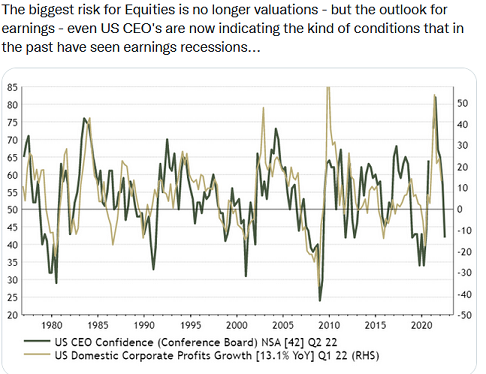
E non sono soltanto i dati fondamentali, a fornirci indicazioni sul futuro degli utili aziendali: nel grafico qui sotto, viene associato il risultato di un sondaggio tra gli Amministratori Delegati degli Stati Uniti e gli utili aziendali.

Oltre alla (possibile, probabile, eventuale) recessione, c’è un secondo motivo per farsi delle domande sull’andamento futuro degli utili, ed è il livello dei rendimenti delle obbligazioni: nel grafico che trovate qui sotto, si vede che, almeno in parte, l’andamento degli utili è associato all’andamento dei tassi di interesse di mercato.

Per quale ragione vi è utile riflettere, proprio in questo momento, sull’andamento degli utili? Più precisamente: perché Recce’d vi suggerisce di non perdere altro tempo con l’inflazione ed i tassi di interesse e le Banche Centrali, e concentrarvi su questo argomento (e su altri quattro cinque, che vedremo nel corso dell’estate)?

La ragione è spiegata dal grafico che trovate qui sotto.

Il grafico attribuisce la variazione dell’indice della Borsa di New York a quattro fattori: il rapporto P/E tra prezzo ed utile, la stima degli utili futuri (dei prossimi 12 mesi) e i dividendi.

Come vedete, la parte in azzurro della colonna che misura il risultato finale dell’indice ha spesso un peso importante: in modo particolare nei due anni 2018 e 2021.

Oggi, a metà 2022, noi riteniamo che per i vostri investimenti in Borsa sia decisivo immaginare come si comporterà quella parte in azzurro della barra del rendimento, nei prossimi sei mesi e poi nel 2023.

Senza trascurare, ovviamente, la componente di colore rosso mattone, ovvero il P/E, che (vedi il grafico sotto) anche dopo i recenti ribassi dei prezzi rimangono ancora tutti su livelli molto elevati.

Abbiamo passato in rassegna (alcuni) indicatori macroeconomici e sondaggi di opinione, per spostare poi l’attenzione sui parametri di valutazione con i precedenti due grafici.

Per completare il giro di orizzonte, investire in modo consapevole e guadagnare dai propri investimenti finanziari , ora dobbiamo prendere in esame l’atteggiamento degli intermediari, di chi svolge in questo mercato finanziario globale il ruolo del “grossista”, ed indirizza, ovvero tenta di indirizzare, i flussi di acquisto e di vendita.

Abbiamo selezionato per il lettore, tra migliaia di esempi, un articolo che vi descriverà come vengono utilizzati i dati per gli utili aziendali allo scopo di fornire ai Clienti ed al mercato i “target”, ovvero gli obbiettivi per gli indici dei mercati di Borsa.

La lettura di questo articolo è molto utile, perché vi avvicinerà al metodo, ai criteri di utilizzo dei dati, ed in definitiva al modo nel quale viene motivato il “target” per l’indice della Borsa.

The S&P 500 just got a new lower price target. But that doesn’t mean investors need to panic—at least not right away.

Strategists at RBC Capital Markets now sees the S&P 500 rising to 4700 by year’s end, down from the bank’s prior call for 4860. That still implies a gain of 17% from the index’s current level around 4100.

The lowered forecast doesn’t necessarily mean the stock market outlook is worsening, however. One key driver of RBC’s lowered forecast is that consensus for real gross domestic growth in 2022 is down to below 3%, from almost 4% near the start of this year. Real GDP is total output adjusted for inflation, so when the pace of real GDP growth declines, it means there’s more inflation and less total output. Economists expect price increases in the economy to dent overall demand this year and beyond.

That’s just one part of RBC’s model, which encapsulates many economic and market factors. Another important factor is valuations, which RBC says could drop from here. Looking at steep sell-offs in 1994, 2001, 2018, and 2020, the forward price-to-earnings multiple on the S&P 500 fell by 17.5% at the median. Using that drop in the multiple for the 2022 sell-off would lower the index’s multiple to 17 times from a little under 17.3 times currently. 

Overall, the strategists use a fairly unusual model to forecast the index. Their real GDP indicator implies a certain annual gain for the index—given historical trends—while their valuation indicator suggests a different annual gain. The bank uses other indicators, too, like ones seen in the bond market. So RBC takes the average S&P 500 annual gain from all of its indictors to arrive at its price target. 

But none of this necessarily means people should become any less confident in the stock market. First off, RBC is simply adjusting its market expectation lower, given the recently worsened economic and market environment. But stock prices have already begun to reflect those changes. The index has already slumped 14% this year. Meanwhile, its earnings multiple has dropped because confidence in earnings growth has waned, as inflation and interest rates have gone up. 

Assuming certain factors remain largely unchanged, the stock market would rise from its current level. Most importantly, keeping the index’s current multiple in place would bring the index to 4346 by the end of the year, for an 8% gain from the current level (though still a drop pf 16% for the full calendar year.)

That gain in full, though, seems unlikely. For one, analyst’s profit forecasts likely need to come down from here. Economic growth projections are lower and the Fed is trying to reduce demand by lifting interest rates. Meanwhile, the aggregate 2022 earnings-per-share estimate has risen 3% for the year so far to $228, meaning projections have nowhere to go but down. The S&P 500’s aggregate expected earnings per share for 2023, meanwhile, is $249.79, according to FactSet.

Plus, the multiple placed on the next year of earnings, at 17.3, could easily drop from here, as RBC points out. That’s because the 10-year Treasury yield has soared this year to around 3%, a level last seen in 2018. Higher long-dated bond yields make future profits less valuable. An earnings multiple on the S&P consistent with yields where they are now often starts with a “16 handle,” historically. 

With so many moving parts, investors have plenty of things to keep an eye on. For now, the factors to monitor are analysts’ revisions to earnings and where valuations should land.

A questo utile articolo, Recce’d gratuitamente aggiunge altri elementi di informazione: lo scopo è quello di regalare ai lettori un quadro completo, dettagliato e selezionato. In una parola, della massima qualità, come sempre abbiamo fatto.

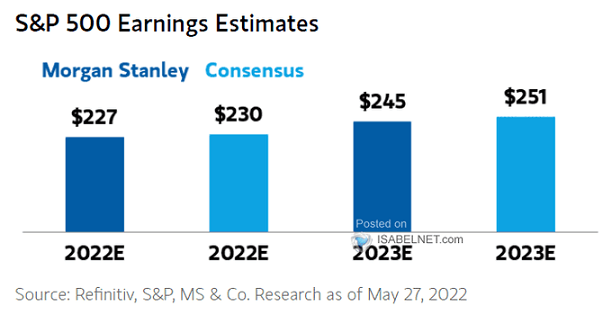
Procediamo con le previsioni di consenso per il mercato di Borsa di New York, che leggete qui sotto nel grafico 8affiancate a quelle di Morgan Stanley).

Queste previsioni, va sottolineato ancora una volta, sono le medesime, in sostanza, che venivano comunicate lo scorso 1 gennaio 2022 dalle banche di investimento.

Il fatto è degno di grandissima attenzione: perché tra gennaio e maggio, intorno a questi numeri, è cambiato tutto. Ma proprio tutto: le stime per la crescita, l’inflazione, i tassi di interesse, i cambi, i prezzi delle materie prime.

Effetto sulle stime degli utili prodotte dagli analisti delle banche di investimento? Zero.

Almeno, fino al 10 giugno 2022.

Questo implica che cosa? implica che i prezzi che oggi vedete sui mercati finanziari sono “basati” su valutazioni elaborate (nel modo che avete letto più sopra nel secondo articolo del Longform’d) partendo da previsioni che sono, a tutto oggi, molto favorevoli, molto positive, molto ottimistiche. Come leggete grazie al grafico che segue, ad oggi la previsione per i margini di profitto delle Società quotate negli Stati Uniti rimane ai massimi di ogni tempo.

Il solo cambiamento visibile, per ciò che riguarda le stime degli analisti? E’ che non crescono più, si sono fermate.

Come dice il grafico che segue, il numero di revisioni al rialzo ed il numero di revisioni al ribasso, oggi, è uguale. Per essere più chiari: il numero di revisioni al rialzo oggi è pari al numero di revisioni al ribasso.

Anche l’indicatore che viene calcolato da Bank of America (“sell-side indicator") ci racconta che da parte degli analisti delle banche di investimento oggi viene espresso minore ottimismo rispetto al passato, nelle loro raccomandazioni di “buy”, “sell” e “hold”.

Tutti i dati che via abbiamo presentato, e i testi che abbiamo scelto per voi e che vi abbiamo messo a disposizione in questo Longform’d, ci portano ad una sola, semplice domanda: che è quella che leggete sotto, nel grafico di Ed Yardeni che chiude il Longform’d.

Ovvero: oggi le previsioni per gli utili sono troppo ottimistiche?

Recce’d vuole sottolineare, con questo Longform’d che ogni investitore in azioni non può rimandare la risposta nel tempo: è oggi, che dovete darvi una risposta, ed è oggi che dovete intervenire sui vostri portafogli titoli.

Se volete confrontarvi con noi, i recapiti sono quelli che conoscete, attraverso il sito.

Valter Buffo
DYOR
 

Il 2021 è stato l’anno dei “fenomeni”: in un contesto di mercato dove “tutto sale”, ognuno è autorizzato a sentirsi un genio.

Non succede soltanto nell’ambito della finanza e degli investimenti: ci sono evidenti segnali di abuso che arrivano anche da altri ambiti, come la medicina.

Oggi sono in molti ad affidarsi ai social, ai “canali non convenzionali” per prendere le proprie decisioni in materia di medicinali. Il recente caso del vaccino COVID è diventato un argomento da prima pagina per quotidiani e TG.

Recce’d non si fida, di questi “canali non convenzionali”: non raccoglie opinioni di investimento di un po’ di qua ed un po’ di là sul Web. lo fanno però, ancora oggi, numerosi investitori.

Nelle ultime settimane il tema è ritornato di massima attualità, a causa dei crolli del comparto delle crypto-valute. Che hanno lascito un numero elevato di persone in una situazione disperata.

Proprio in quel comparto, quello delle crypto, il ruolo della comunicazione social è stato determinante negli utili anni. La frase ricorrente è “mi sono cercato da solo le informazioni sul Web”, ovvero “mi sono fatto una mia ricerca”, ovvero “do your own research” ovvero DYOR del titolo.

Il New York Times, pochi giorni fa ha dedicato a questo tema, e quindi ai rischi che si corrono “facendo una propria ricerca sul Web”, un utile articolo che Recce’d vi propone in lettura di seguito.

Se siete tra quelli che fanno da soli, che seguono i suggerimenti sul Web, che passano ore sul tablet oppure sullo smartphone, se siete abituati a decidere sugli investimenti sulla base delle cosiddette “meme”, se siete appassionati dei Forum On Line tra investitori, vi sarà utile leggere con attenzione.

By John Herrman

May 29, 2022

A couple of weeks ago, the crash of two linked cryptocurrencies caused tens of billions of dollars in value to evaporate from digital wallets around the world.

Cryptocurrencies are notoriously volatile, but this wasn’t your average down day: People who thought they knew what they were getting into had, in the space of 24 hours, lost nearly everything. Messages of desperation flooded a Reddit forum for traders of one of the currencies, a coin called Luna, prompting moderators to share phone numbers for international crisis hotlines. Some posters (or “Lunatics,” as the currency’s creator, Do Kwon, has referred to them) shared hope for a turnaround or bailout; most were panicking, mourning and seeking advice.

“My friends who I recommended Luna to all hate me now,” one user wrote. “We all lost our life savings and they have kids. What do I do?” Among the consolations and scolding about mixing friends and business was a rather harsh reply: “DYOR before investing in ANYTHING! No one to blame but themselves.”

“DYOR” is shorthand for “do your own research,” a phrase that, on its face, amounts to excellent if obvious advice — a reminder to stay informed and vigilant against groupthink.

But in the context of a broad collapse of trust in institutions and the experts who speak for them, it has come to mean something more specific. A common refrain in battles about Covid-19 and vaccination, politics and conspiracy theories, parenting, drugs, food, stock trading and media, it signals not just a rejection of authority but often trust in another kind.

DYOR is an attitude, if not quite a practice, that has been adopted by some athletes, musicians, pundits and even politicians to build a sort of outsider credibility. “Do your own research” is an idea central to Joe Rogan’s interview podcast, the most listened to program on Spotify, where external claims of expertise are synonymous with admissions of malice. In its current usage, DYOR is often an appeal to join in, rendered in the language of opting out.

Nowhere are the contradictions of DYOR on such vivid display as in the world of crypto, where the phrase is a rallying cry, a disclaimer, a meme and a joke — an invitation to a community as well as a reminder of its harsh limits.

Against Consensus

Melissa Carrion, a professor at the University of Nevada, Las Vegas, who studies the rhetoric of health and medicine, spoke to 50 mothers who had refused one or more vaccines for their children for a study published in 2017.

“Across the board, every single one of them gave some variation of the advice that a mother ‘should do her own research,’” she said in a phone interview. “It was this kind of worldview that was less about the result of the research than the individual process of doing it themselves.”

“There’s this idea that the goal of science is consensus,” Professor Carrion said. “The model they brought to it was that we didn’t need consensus.” She noted that the women she surveyed often used singular rather than plural pronouns. “It was ‘she needs to do her own research,” Professor Carrion said, rather than we need to do ours. Unlike some critical health movements in the past, this was an individualist endeavor.

Anti-vaccine rhetoric is DYOR in a pure anti-expert form. Medicine is a highly credentialed field addressing life-or-death matters which, as practiced, expects a great deal of trust from patients. For a medical expert to warn of the perils of “doing your own research” on vaccines, for example, is to either preach to the converted or to demand trust where it has already been lost.

One of the enticing aspects of cryptocurrencies, which pose an alternative to traditional financial institutions, is that expertise is available to anyone who wants to claim it. There are people who’ve gotten rich, people who know a lot about blockchains and people who believe in the liberating power of digital currencies. There is some recent institutional interest. But nobody’s been around very long, which makes the idea of “researching” your way to prosperity feel more credible.

Earlier this year, in a New York Times guest essay about DYOR and medicine, Nathan Ballantyne and David Dunning cited research suggesting that people new to subject areas are, like some experts, “vulnerable to hubris.” They caution that newcomers can “quickly become unreasonably confident after just a small amount of exposure to the subject,” a phenomenon known as the “beginner’s bubble.”

Expand Your Cryptocurrency Vocabulary

Card 1 of 9

A glossary. Cryptocurrencies have gone from a curiosity to a viable investment, making them almost impossible to ignore. If you are struggling with the terminology, let us help:

Bitcoin. A Bitcoin is a digital token that can be sent electronically from one user to another, anywhere in the world. Bitcoin is also the name of the payment network on which this form of digital currency is stored and moved.

Blockchain. A blockchain is a database maintained communally and that reliably stores digital information. The original blockchain was the database on which all Bitcoin transactions were stored, but non-currency-based companies and governments are also trying to use blockchain technology to store their data.

Cryptocurrencies. Since Bitcoin was first conceived in 2008, thousands of other virtual currencies, known as cryptocurrencies, have been developed. Among them are Ether, Dogecoin and Tether.

Coinbase. The first major cryptocurrency company to list its shares on a U.S. stock exchange, Coinbase is a platform that allows people and companies to buy and sell various digital currencies, including Bitcoin, for a transaction fee.

DeFi. The development of cryptocurrencies spawned a parallel universe of alternative financial services, known as Decentralized Finance, or DeFi, allowing crypto businesses to move into traditional banking territory, including lending and borrowing.

NFTs. A “nonfungible token,” or NFT, is an asset verified using blockchain technology, in which a network of computers records transactions and gives buyers proof of authenticity and ownership. NFTs make digital artworks unique, and therefore sellable.

Web3. The name “web3” is what some technologists call the idea of a new kind of internet service that is built using blockchain-based tokens, replacing centralized, corporate platforms with open protocols and decentralized, community-run networks.

DAOs. A decentralized autonomous organization, or DAO, is an organizational structure built with blockchain technology that is often described as a crypto co-op. DAOs form for a common purpose, like investing in start-ups, managing a stablecoin or buying NFTs.

Cryptocurrency trading, in contrast to medicine, might represent DYOR in pure no-expert form. Virtually everyone is operating in a beginners’ bubble, whether they’re worried about it or not, betting with and against one another, in hopes of making money.

Just DYOR

In crypto, the uses of DYOR are various and contradictory, earnest and ironic sometimes within the same discussion. Breathless investment pitches for new coins are punctuated with “NFA/DYOR” (not financial advice), or admonitions not to invest more than you can afford to lose, which many people are obviously ignoring; stories about getting rich are prefaced with DYOR; requests for advice about which coins to hold are answered with DYOR. It is the siren song of crypto investing.

Here, so-called research materials are often limited to a white paper, marketing materials and testimonials, the “due diligence” posts of others, the reputations of a currency’s creators and the general sentiment of other possible buyers. Will they buy-in, too? Will we take this coin to the moon?

In that way — the momentum of a group — crypto investing isn’t altogether distinct from how people have invested in the stock market for decades. Though here it is tinged with a rebellious, anti-authoritarian streak: We’re outsiders, in this together; we’re doing something sort of ridiculous, but also sort of cool. Though DYOR may be used to foster a sense of community, what it actually describes is participation in a market.

A year ago, Luna boosters (and a few skeptics) in online forums offered the same advice to gathered audiences of potential buyers reading their posts, looking for tips: just DYOR. Thousands invested in both Luna and TerraUSD. The price of Luna climbed from around $5 to over $100. After the crash, at least one Reddit user suggested that the situation highlighted the “limit” of DYOR; the coin’s price had fallen to nearly zero.

“Now it seems like DYOR can only do so much,” the user wrote. Eventually, the user said, you end up relying on “trust.”

For another user, however, DYOR had in fact done a different kind of “so much”: “I did my research,” they wrote, “and I stayed away.”

Valter Buffo
Perché si deve andare "contro" (quando è necessario)
 

Vi sarete stancati anche voi: noi che lo facciamo per dovere professionale siamo esasperati dal numero di analisi che TV, Web e stampa quotidiano ci sottopongono sui futuri rialzi dei tassi da parte della Federal Reserve e delle Banche Centrali in generale. Rialzi dei tassi che oggi sono necessari per rimediare agli errori che le Banche Centrali hanno fatto negli ultimi 18 mesi.

Utili, questi commenti non lo sono di certo: sarebbe stato utile, per noi ma soprattutto per gli investitori, leggere questo tipo di analisi e valutazioni un anno e mezzo fa. Oggi, suscitano soltanto irritazione.

Il Mondo intero, e il suo cane, oggi ha capito che i Signori delle Banche Centrali hanno sbagliato. Parlarne adesso a che cosa serve? A pulirsi la coscienza forse? Affermare che le Banche Centrali si stavano sbagliando, nella seconda metà del 2020, e poi nel 2021, suscitava al contrario di oggi reazioni di sdegno ed irritazione.

Gli attacchi che abbiamo ricevuto erano insistenti: sei un “contrarian”, è inutile andare “contro le Banche Centrali”, sei un “anti-sistema”, ti collochi “fuori dalla massa per cercare visibilità”.

Qualcuno sosteneva un anno fa che “è folle essere SHORT sulle Borse”; altri dicevano un anno fa “non è possibile perdersi il più grande rialzo di Borsa della Storia”.

Tutta quella montagna di chiacchiere è stata semplicemente cancellata nello spazio di tre mesi: e tutto quel “rialzo storico della Borsa”, semplicemente, non esiste più.

Non esiste più neppure l’infallibilità delle Banche Centrali: e chi 18 mesi fa aveva messo in guardia, aveva anticipato, aveva criticato, oggi ha tutte le ragioni per provare orgoglio e fierezza sul piano professionale. E’ questo, che si definisce un “buon lavoro”.

Non è stato buono al contrario il lavoro di Janet Yellen, prima a Capo della Federal Reserve e successivamente messa da Biden a Capo del Tesoro USA.

Proprio ieri, in televisione, lei lo ha detto: “Mi sono sbagliata sull’inflazione … c’erano cose che io non ho completamente capito”. Lo leggete sopra nell’immagine.

Un buon investitore professionale, ma pure un investitore privato, davanti a una dichiarazione come questa deve riflettere (almeno) su tre cose:

  1. l’ammissione arriva, ma arriva soltanto dopo che, su tutti i quotidiani e in tutti i TG del Mondo, si dice già da settimane e forse mesi che “hanno fatto un errore”

  2. Yellen non ci ha detto nulla, ieri, sui possibili, probabili errori che si stanno facendo ancora oggi

  3. e soprattutto: davvero l’errore ha riguardato l’inflazione? davvero l’errore più grande commesso dal Tesoro e dalla Banca Centrale, negli Stati Uniti come in Europa, è stato quello di sottovalutare l’inflazione?

Il gestore professionale, ma pure il gestore privato che fa da solo, oggi deve chiarirsi le idee soprattutto su questo: l’errore è stato quello di sottostimare l’inflazione, oppure allora come oggi si sta commettendo un altro, più grave errore, che poi a sua volta ha provocato l’impennata senza precedenti dell’inflazione nel Mondo?

Come leggete nell’immagine qui sopra, lo scorso 20 maggio è stato un anniversario importante: di un celebre intervento di Janet Yellen al G7.

Recce’d da allora, ma già nei mesi precedenti a quel maggio 2021, ha scritto sia in sede pubblica sia ai propri Clienti: “Attenzione che l’inflazione non sarà il vostro maggiore problema”. Oggi lo vedete tutti: l’inflazione ed i tassi sono in effetti temi di grande attualità, ma come tutti avete capito ormai da almeno un mese ci siamo avviati verso una “nuova fase” dei mercati finanziari, una fase nella quale non saranno più i tassi e l’inflazione al centro delle dinamiche dei mercati finanziari.

Da qui a fine 2022, non saranno i tassi e l’inflazione a fare pendere la bilancia dei mercati finanziari da una parte oppure dall’altra.

L’investitore, professionale oppure privato, che non coglie questo radicale cambiamento rischia di rimanere indietro, rischia di non fare le scelte appropriate e necessarie, oppure di farle con grande ritardo.

Perché le cose (e lo avete visto tutti) cambiano rapidamente, nel 2022: sono già cambiate nel profondo nei primi cinque mesi dell’anno, ma cambieranno ancora più profondamente nei mesi tra giugno e dicembre.

In quale direzione? Con questo Longform’d vi aiutiamo a cercare una risposta, con una serie di elementi di giudizio.

Ricordando al lettore, ancora una volta, che il ruolo di un gestore, il ruolo autentico di un consulente autentico (non quelli dell’Albo, quindi) non è, e non può essere, quello di dirvi “compra” quando gli indici di mercato salgono, e poi “tieni duro” quando i mercati scendono. A che cosa vi serve, un “consulente” fatto così? Se è tutto quello che avete a portata di mano, fate da soli che è meglio.

Un gestore professionale a voi serve soltanto se quel gestore ha le capacità professionali e di carattere per “andare contro”: non sempre, ma di sicuro quando è necessario.

Deve aiutarvi a navigare i mercati, ricordandovi (se necessario, anche con insistenza al limite della testardaggine) che sui mercati non esistono figure onnipotenti, neppure le Banche Centrali lo sono. E poi ricordandovi che il ruolo delle grandi banche di intermediazione (e delle Reti di vendita che seguono le banche di investimento) è quello di spingere gli investitori verso gli strumento PER LORO più redditizi, e NON verso gli investimenti più redditizi per l’investitore finale.

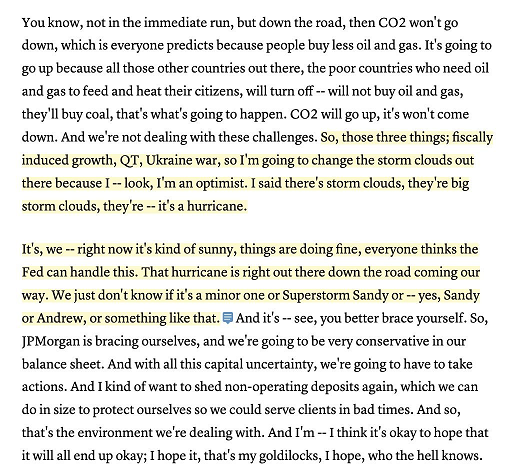
Un esempio concreto: la banca JP Morgan ha spinto per due anni, forse più di ogni altra banca, sul tema del “buy-the-dip” in Borsa, sulla base del fatto che “tutto va bene, come meglio non potrebbe”. Poi accade che nel primo giorno del mese di giugno il Grande Capo di quella banca colossale, Jamie Dimon, in pubblico annuncia che “sta arrivando un uragano”. Così, come se niente fosse.

Ovviamente, oggi, anche dalle banche come JP Morgan piovono critiche sulle Banche Centrali: “hanno sbagliato”, “hanno esagerato”. Lo leggete nell’immagine che segue qui sotto.

Per voi investitori, il punto è avere prima, molto prima che parli Jamie Dimon, un professionista capace di anticiparvi, 6 mesi fa oppure 12 mesi fa, che ciò che allora veniva detto da JP Morgan era soltanto un contenuto di tipo pubblicitario, il cui scopo era “spingere i Fondi Comuni a più alto margine” prospettando un futuro roseo, del tutto privo di volatilità, caratterizzato da alta crescita e bassa inflazione. Insomma, una favola: ed era, appunto, una favoletta commerciale. Ce lo dice, oggi, la stessa JP Morgan per bocca del suo stesso Numero Uno.

E’ utile, per tutti i lettori e gli investitori, leggere con attenzione queste parole di Dimon: in particolare dove dice “noi in JP Morgan stiamo allacciando le cinture e saremo molto prudenti nella gestione del nostro attivo di bilancio, evitando o riducendo gli investimenti rischiosi”.

Possono sembrare dichiarazioni banali, ma non lo sono, e per due ragioni:

  1. ancora in gennaio, l’atteggiamento era opposto: non c’era traccia di questa avversione al rischio, né in JP Morgan, né in alcuna altra grande banca di investimento; e

  2. ancora in queste settimane, da altre parti di JP Morga, sono arrivati ai Clienti e sul mercato inviti ad operare nel modo che si chiama “buy-the-dip”: “altro che avversione al rischio, qui è ora di comperare tutti i ribassi”

Dovreste subito chiedervi: se Jamie Dimon riduce gli investimenti rischio, lo dovrei fare anche io, e subito?

Noi vi suggeriamo di leggere ancora con maggiore attenzione un secondo passaggio di Dimon, che è quello che segue qui sotto.

Dice Dimon: “QE backfired”. Ovvero, la politica di acquisto di Titoli di Stato ha avuto un contraccolpo negativo. In altre parole Dimon ci dice che la politica centrata sul gonfiare i prezzi delle obbligazioni e poi delle azioni è stata un errore.

E se lui lo dice, significa che sono in tanti a pensarlo: anche alla Federal Reserve.

Sono in molti, tra gli investitori (in Italia e nel Mondo) a non avere ancora ben compreso questo punto: i medesimi soggetti (Governi e Banche Centrali) che dodici mesi fa celebravano i rialzi di Borsa come “un segno che la gente ha fiducia nelle nostre politiche” oggi hanno deciso che i prezzi devono scendere. I prezzi in Borsa ed i prezzi delle obbligazioni.

In questo senso, il dato di domani per gli occupati negli Stati uniti potrebbe giocare un ruolo importante, come viene spiegato nell’immagine che segue.

Il nostro suggerimento al Cliente è quello già anticipato nel titolo.

A voi serve un gestore di portafoglio, eventualmente in remoto, che vi aiuti a non farvi sballottare come pupazzi di stoffa, prima su e poi giù, da figure e personaggi che, a posteriori, poi vengono a spiegarvi che “non avevamo capito bene”.

Perché è dei vostri soldi, che qui si parla e si scrive. Prima si dice “dobbiamo farli salire”, e poi si dice “dobbiamo farli scendere”. In spregio a qualsiasi Legge o regolamento di settore: una “manipolazione dei mercati finanziari” alla luce del sole, sotto gli occhi di tutti, sulla quale nessuno ha il coraggio di intervenire.

Il quanto investitori, farete bene a cercarvi qualcuno in grado di proteggere il vostro patrimonio da manipolazioni di questi tipo, in grado di anticipare fatti come questi con le mosse più appropriate nel portafoglio titoli, magari in anticipo di 12 oppure 18 mesi.

Perché adesso, quelle mosse sono molto meno utili, e molto meno redditizi. Un buon gestore oggi, non pensa più ai rialzi dei tassi della Federal Reserve, ed invece pensa già al dopo, a quello che verrà dopo che la fase dei mercati si è chiusa, nell’interesse suo e soprattutto dei suoi Clienti.

In questa chiave, il suggerimento operativo di questo nostro Post è il seguente: evitate di perdere tempo su argomento come “rimbalzo” e “pausa di settembre”. Lo abbiamo fatto in centinaia di occasioni precedenti, e lo rifacciamo di nuovo oggi: vi mettiamo in guardia contro gli “argomenti del marketing”, argomenti utilizzati ad arte per stimolare interesse, movimentazione e commenti dove … in realtà non c’è nulla.

Un esempio concreto: la settimana scorsa è stata dominata da una sola dichiarazione, di un membro della Federal Reserve (Bostic), che disse “potrebbe esserci una pausa nel ciclo dei rialzi dei tassi già a settembre”.

Dietro le quinte, deve esserci stata una forte irritazione politica: tanto che solo 48 ore fa il medesimo personaggio è stato costretto a rilasciare una intervista al solo scopo di ritrattare tutto. L’intervista è quella che vedete qui sotto.

E quindi: lasciate perdere questi “pettegolezzi di mercato”, e concentratevi invece su quello che c’è al di fuori del mercato finanziario; lasciate da parte il tablet e lo smartphone e guardate fuori dalla finestra; concentratevi sul quadro, cercate di comprendere come si modificherà l’insieme delle cose (politica, economia e finanza) e poi fate le vostre mosse.

Magari, confrontandovi con noi di Recce’d.

Tra le cose sulle quali vi suggeriamo di riflettere, a proposito della strategia di investimento e della gestione di portafoglio, c’è sicuramente il tema “recessione”: se ne parla molto, ma per ora se ne parla soprattutto in modo generico, e con toni allarmistici.

Visto che l’argomento rimarrà con noi investitori per parecchio tempo, è nel vostro interesse iniziare da subito a lavorarci, per andare nel dettaglio e comprendere il nocciolo della questione.

Vi può essere molto utile leggere per intero un articolo del The Economist, pubblicato proprio oggi, che tenta di anticipare le principali caratteristiche di una “eventuale” recessione negli Stati Uniti. A voi, lettori ed investitori, resta poi di decidere se sposate, o meno, questa visione delle cose. Potete parlarne con il vostro private banker, con il wealth manager, oppure con noi di Recce’d attraverso i canali che conoscete.

L’articolo andrebbe letto per intero, dedicandoci il tempo necessario, perché è davvero utile come strumento per analizzare il possibile futuro scenario nel quale i mercati finanziari dovranno muoversi.

Noi di Recce’d abbiamo in ogni caso voluto evidenziare quattro passaggi:

  1. laddove si dice che oggi ad ogni angolo si parla di recessione

  2. l’analisi della fragilità del sistema finanziario nel suo insieme (banche e non-banche)

  3. l’analisi dei risvolti nel mondo della politica

  4. il commento finale sul fatto che nei prossimi mesi l’inflazione potrebbe non essere più il tema dominante, come lo è stato fino ad oggi

Noi aggiungiamo un quinto spunto, su cui riflette dopo avere letto questo articolo: perché oggi, in Europa, ancora non c’è un simile dibattito sul tema “recessione”? Perché The Economist sceglie di parlare solo di Stati Uniti?

Il rischi recessione c’è anche in Europa, e forse è anche più elevato che negli USA, oggi.

These days it is hard to turn a corner without bumping into predictions of an American recession. Big banks, prominent economists and former officials are all saying that a downturn is a near certainty as the Federal Reserve wrestles inflation under control. Three-quarters of chief executives of Fortune 500 companies are braced for growth to go negative before the end of 2023. Bond yields and consumer surveys are flashing red. Google searches for “recession” are soaring.

The track record is certainly ominous. As Larry Summers, a former treasury secretary, has observed, whenever inflation has risen above 4% and unemployment has dipped below 4%—two thresholds that, when breached, indicate economic overheating—America has suffered a recession within two years. It is well across both thresholds now.

For much of last year the Fed and investors alike believed that inflation would fade as the pandemic subsided. No one believes that now. There is broad agreement that, supply snarls and energy-price surges notwithstanding, demand is also excessive, and that tighter monetary policy is needed to return it to a normal level. The question is how tight, and therefore how much the economy could suffer: the higher the Fed has to raise rates, the more punishing the downturn will be. Investors are pricing in pain, as indicated by the fall in stocks since the start of the year.

If America does slip into a recession, how might it play out? One way of trying to divine the path of a downturn is to consult history. America has suffered 12 recessions since 1945. Many observers point to similarities between today’s predicament and the early 1980s, when Paul Volcker’s Fed crushed inflation, causing a deep recession in the process. Others look at the downturn that followed the energy crises of the 1970s, echoed by the surge in oil and food prices today. Still others point to the dotcom bust in 2000, mirrored by the collapse in tech stocks this year.

But these parallels have serious flaws. Inflation is nowhere near as entrenched as at the start of Mr Volcker’s era. Growth is far less energy-intensive than in the 1970s. And the economy faces more complex crosswinds now than it did after the bust of 2000. The unusual nature of the deep covid-induced downturn in 2020, and the roaring recovery in 2021, when fiscal and monetary stimulus flooded the economy, limits the relevance of past episodes.

A better way to think about a recession, if it comes, is to look at America as it is today. Consider three different facets: the real economy, the financial system and the central bank. All three, working in concert, suggest that a recession would be relatively mild. Households and businesses’ balance-sheets are mostly strong. Risks in the financial system appear to be manageable. The Fed, for its part, has been too slow to respond to inflation, but the credibility it has built up over the past few decades means it can still fight an effective rearguard action. There is, however, a sting in the tail: when the recession ultimately ends, the consequences of the past few years of living dangerously with inflation may make for a sluggish recovery.

Start with the resilience of the real economy, which may well be the most important line of defence in a downturn. The general population is on a sound financial footing, a welcome change from the overextended consumers of the past. Household debt is about 75% of gdp, down from 100% on the eve of the global financial crisis of 2007-09. Even more striking is how much less Americans pay annually to service their debts. Because so many have shifted to cheaper mortgages as interest rates have fallen in recent years, their annual debt payments now add up to about 9% of disposable income, about the lowest since data were first collected in 1980.

Moreover, many households have larger-than-normal cash buffers thanks to the stimulus payments of the past two years, plus their reduced spending on travel, restaurants and the like at the height of the pandemic. Overall, Americans have excess savings of about $2trn (9% of gdp) compared with before covid. They have started to use some of this cash as living costs rise, but still retain a useful cushion.

In any recession one big concern is how many people will lose their jobs. Unemployment tends to rise during recessions: the average post-1945 downturn in America, excluding the brief covid recession, pushed up the jobless rate by three percentage points (see chart 1). A rise in unemployment seems all the more economically necessary today, as a way to relieve some of the upward pressure on wages and dampen inflation.

Could things play out differently, though? The labour market has, by some measures, never been so tight: a record 1.9 jobs are available for every unemployed person. This has fuelled optimism that companies could, in effect, cancel their job ads without firing people. Jerome Powell, chairman of the Fed, has expressed this hope. “There’s a path by which we would be able to moderate demand in the labour market and have vacancies go down without having unemployment going up,” he said on May 4th.

In practice, though, the labour market is unlikely to adjust so smoothly. Mr Summers has drawn attention to the concept of the Beveridge Curve, which portrays a basic relationship: the more vacancies there are, the lower the unemployment rate. Since the onset of the pandemic the curve has shifted outwards (see chart 2). In other words, it now seems to require more vacancies to get to the same unemployment rates as in the past—an indication of faltering efficiency in the economy’s ability to match the right people with the right jobs. One possible explanation is that some people are still reluctant to work because of the health risks from covid. Another is regional variation: some states, like Utah and Nebraska, have giant needs for workers but not enough people are willing to move to them.

Whatever the precise reason, the implication is that it is too optimistic to think that the Fed’s tightening can reduce vacancies without also reducing employment. Yet that does not mean that Mr Powell is all wrong. The Beveridge Curve could also move back as the recovery progresses and more people re-enter the workforce. Say the unemployment rate increases by two percentage points instead of the average three during recessions. That would take the rate to about 5.5%, lower than the average of the past three decades. Though painful for those who end up on the dole, it would be a good outcome as far as recessions go. By contrast, 11% of Americans were out of work by the time Mr Volcker was done with his tightening.

Hurting me softly

Even if most people are fairly well insulated from a recession, they are still likely to curtail their spending as the economy goes south. Belt-tightening would, in turn, translate into less revenue for businesses. A key question is how those lower earnings will interact with high debt levels: unlike households, companies have ramped up their borrowing over the past decade. Non-financial business debt stands at about 75% of gdp, not far from a record high.

Reassuringly, many companies sought to lock in rock-bottom rates during the pandemic. In 2021 companies reduced debt coming due this year by about 27%, or $250bn, mainly by refinancing their existing debt at lower rates and for longer durations. That makes them less sensitive to an increase in interest rates.

Less reassuringly, riskier companies also took advantage of easy money. Bonds that are rated bbb, the lowest rung of investment-grade debt, now account for a record 57% of the investment-grade bond market, up from 40% in 2007. When a recession strikes, the ratings on many of these bonds could slip a notch or two. And when bonds go from investment-grade to speculative, or junk, status, they become far less appealing for a universe of investors such as pension funds and insurance firms. That increases the chances of a flight to safety when the mood sours.

Even so, thanks to the starting point of low funding costs, there are limits to how bad things might get. In a pessimistic scenario—where a recession collides with higher input costs and rising interest rates—s&p, a rating agency, forecasts that about 6% of speculative-grade corporate bonds will go into default next year. That would be well up from the 1.5% rate now, but half the 12% rate hit in 2009. Intriguingly, the sector today holding the most low-quality debt is media and entertainment, featuring many leisure companies such as cruise lines. A recession would sap demand for their services. But as worries about covid recede, there is also a pent-up desire to get out and have fun again. The paradoxical result is that a swathe of low-rated companies may be positioned to fare better than most during a downturn.

How well fortified is the financial system? Headlines in recent years about Basel 3 capital-adequacy standards for banks may have caused more than a few pairs of eyes to glaze over. But these rules have served a purpose, forcing large financial firms to hold more capital and more liquid assets. Banks went into 2007 with core loss-absorbing equity worth about 8% of their risk-weighted assets. Today, it is more like 13%, a much plumper margin of safety. “A recession would not look like it did after the financial crisis. The system is just not levered like it was back then,” says Jay Bryson of Wells Fargo, a bank.

New threats have, inevitably, emerged. Prudential regulations have pushed risky activities into darker corners of the financial system. Non-bank lenders, for instance, issued about 70% of all mortgages last year, up from 30% a decade ago. Ideally, that would spread risks away from banks. But bank lending to these non-banks has also boomed, creating a web of opaque linkages. Insurers, hedge funds and family offices—in effect investment firms for the ultra-rich—have also taken on additional risks. They carry more debt than 15 years ago and are among the biggest investors in lower-rated corporate bonds.

Emblematic of the new kind of danger are collateralised loan obligations (clos). These are typically created by syndicating loans, pooling them and then dividing them into securities with different ratings depending on their payment profiles. The value of outstanding clos has reached about $850bn, making it the biggest securitised credit sector in America. And high-risk leveraged loans form a growing share of clos, which are partly converted into investment-grade assets through the alchemy of securitisation. The parallels with the dodgy mortgage-backed securities of the 2000s are obvious. Yet the similarities can also be overstated. The clo market is about half the size of the riskiest mortgage-securities market in the early 2000s. clos connect investors to a wide range of sectors, not just property. They also tend to be longer-term investments, more resistant to market ups and downs.

Moreover, an important stabiliser for the financial system will be the relative solidity of America’s most important asset market: property. An exuberant surge in house prices over the past two years means a decline in sales and values may be on the cards. But property is also dramatically undersupplied. Sam Khater of Freddie Mac, a government-backed mortgage firm, estimates that America has a shortage of nearly 4m homes because of a slowdown in building over the past 15 years. It is far better for the financial system to enter a recession with a giant under-investment backlog than with an over-investment hangover, as was the case in 2007.

The final factor in assessing the impact of a recession is monetary policy. As of March the median forecast by members of the Fed’s rate-setting committee was that inflation would fall to close to 2% in 2024 without interest rates having to exceed 3%.

It seems a fair bet that rates will go quite a bit higher than that. James Bullard, the relatively hawkish president of the St Louis Fed, reckons that the central bank will need to increase rates to 3.5% by the end of this year. A simple rule of thumb, which combines the real neutral rate of interest (the rate, adjusted for inflation, that neither stimulates nor restrains growth) and expected inflation, suggests higher nominal rates may be needed. If the real neutral rate is 0.5%, then the Fed would probably want to hit a real rate of about 1.5% to rein in inflation. Add on short-term inflation expectations of about 4% per year, as indicated by consumer surveys at present, and that suggests that the Fed may need to lift the nominal rate to 5.5%. “There is a substantially greater probability that we’ll need higher rates than the Fed now envisions or the market now predicts,” says Mr Summers.

Put differently, the Fed is embarking on a journey with a clear destination (low inflation), an obvious vehicle (interest rates) but hazy guesses about how to get there (how high rates must go). It will know the correct path only by moving forward and seeing how the economy reacts.

It has barely taken its first steps, raising rates by three-quarters of a percentage point over the past three months and setting out a plan for shrinking its assets. But it may be pleased with the results so far, clearly visible as financial markets rush to price in future tightening. For all the Fed’s missteps of the past year, investors still have respect for it, a precious legacy of the past four decades, starting with Mr Volcker’s leadership, in which it kept a lid on inflation. Equities, which were looking bubbly, have tumbled in value. The impact on mortgages has been dramatic: 30-year fixed rates have risen above 5%, the highest in more than a decade. Yet credit spreads have widened only somewhat, an indication that lending markets are not too stressed. Taken together, this looks like an orderly sell-off and an early success for the Fed. Although inflation expectations, as measured by bond pricing, still point to annual inflation of 3% over the next five years, they have come down by about half a percentage point since March.

Mr Bullard’s case for optimism is that much of the work of taming inflation can be done by resetting expectations at a lower level. The real economy would then not need to bear the weight of the adjustment. The key objective for the Fed is therefore to prove to investors that its vows to quash inflation are credible. “It is more game theory and less econometrics,” he says. The Fed’s record over the past couple of months, since belatedly training its sights on inflation, opens up the possibility that it may be able to tame prices without a punishingly high increase in rates. That, in turn, would make for a lighter recession.

Why worry, then? For one thing, even a mild recession hurts. Imagine the unemployment rate does rise by two percentage points, as in our relatively hopeful scenario. That would imply job losses for about 3m Americans. The political consequences may be even more dramatic. The recession in 1990 shows up as a mere blip in economic trends, but it helped pave the way for Bill Clinton’s victory over George H.W. Bush. A mild recession in 2023 could put paid to Joe Biden’s beleaguered presidency, perhaps helping usher Donald Trump back into the White House.

This will make the policy response to a looming recession much more controversial. If, as expected, the Republicans seize control of Congress from the Democrats in mid-term elections this November, there would be little chance of a muscular fiscal stimulus as growth slows. Republicans would see little reason to bail out Mr Biden, especially if the financial system holds up.

The task of easing would fall squarely on the Fed. But having just fought to contain an overheating economy and bring inflation to heel, the central bank would be queasy about revving up demand too much. And if the current cycle of rate increases stops at a low level, the Fed would not have much room to cut rates anyway. The next step would be once again to unleash quantitative easing (ie, purchasing assets such as government bonds in order to lower longer-term interest rates). It would, however, be fearful of the optics of “printing money” so soon after whipping inflation and just as a contentious election campaign gets under way.

The upshot is that policymakers are likely to have a limited arsenal if the next recession is just round the corner. Given the strengths of the economy today—flush consumers, solid businesses and safe banks—the next downturn ought to be mild. But even a mild recession must be followed by an upturn for the economy to return to full health. And with fiscal policy on the sidelines and monetary policy badly hobbled, the chances are that America would face a painfully slow recovery. After two years of focusing on high inflation, low growth may move back to centre-stage as the economy’s principal problem.

Valter Buffo
Longform’d. Analisi di un rimbalzo: è anche lui “transitorio”?
 

Dopo ben otto settimane, la Borsa a New York ha chiuso in rialzo venerdì 27 maggio 2022. Il rialzo settimanale supera il 6%.

Si tratta del fatto del giorno, ed è un argomento inevitabile.

Ma si tratta di un argomento importante, nella logica della gestione di portafoglio? Si tratta di un fatto rilevante? Ci porta a comperare oppure a vendere? Modifica le nostre aspettative per il futuro?

La risposta di Recce’d è NO: a tutte le domande lette qui sopra.

Che cosa fare, lo diremo poi la settimana prossima ai nostri Clienti, nella Sezione Operatività del nostro quotidiano The Morning Brief.

Ma ugualmente, per i lettori del Blog, intendiamo (come sempre facciamo) produrre gratuitamente elementi di valutazione e di giudizio: un contributo concreto ed applicabile per decidere che cosa fare.

Il rimbalzo, come leggete qui sopra, è stato annunciato più volte: qui si torna addirittura al mese di ottobre del 2021, ovvero si ritorna indietro di ben sette mesi. Leggete nel titolo: “buy-the-dip” è l’indicazione operativa. La motivazione che fu fornita, allora, da Goldman Sachs e JP Morgan, fu questa: “L’inflazione è transitoria”.

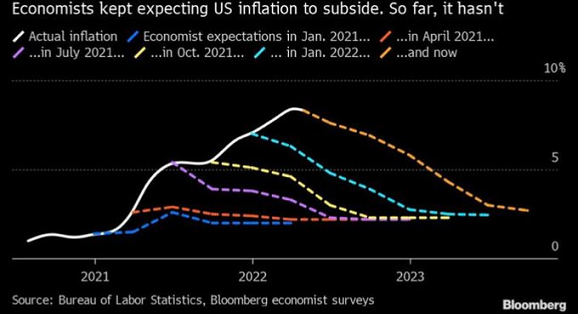
Le cose poi non andarono esattamente in quel modo: lo documentiamo con il grafico che segue.

L’inflazione non era “transitoria”, e comperare il tema “buy-the-dip” da Goldman e JP Morgan fu un errore nell’ottobre 2021.

Fu un errore anche in novembre, dicembre, gennaio, febbraio, e marzo e aprile e maggio 2022.

Il tema è rilevante per il semplice fatto che proprio la scorsa settimana … ci hanno riprovato. Il tema però si è trasformato: il suggerimento operativo è sempre “buy-the-dip” ma la scorsa settimana c’era una nuova motivazione, e precisamente quella che “la Federal Reserve farà una pausa il prossimo settembre” . Interromperà il ciclo di rialzi dei tassi di interesse.

Sui mercati finanziari, in questo maggio del 2022, sono in moltissimi quelli che hanno “nostalgia”: vorrebbero tornare ai bei tempi andati, quando le Banche Centrali facevano semplicemente “tutto quello che volevano”.

Quei tempi però sono andati per sempre: non torneranno mai più. Le Banche centrali oggi fanno ciò che sono costrette a fare. Costrette dalla realtà. Oggi, la realtà le ha costrette ad alzare i tassi. Se faranno una pausa, in settembre, non dipende da una loro scelta, ma da ciò che faranno i dati.

Come investitori, quindi, siete costretti a rispondere ad una semplicissima domanda: ci saranno segnali di una inflazione sotto controllo, da qui a settembre?

La risposta di Recce’d verrà consegnata ai nostri Clienti ogni mattina, la settimana prossima, nel The Morning Brief. Oggi nel Longform’d ci limitiamo a ragionare con i lettori di dati e di movimenti di mercato, come il calo dei rendimento sui Titoli di Stato che avete visto la settimana scorsa (e che ha sostenuto il rimbalzo delle Borse).

Un movimento come quello che vi documentiamo qui sopra, nell’immagine, giustifica una previsione di “peak rates”, ovvero che i tassi di interesse abbiamo già raggiunto il loro massimo del 2022 (almeno, per le scadenze lunghe come i 10 anni)?

Ovviamente, la domanda è complessa, e la risposta richiede competenza e capacità di analisi. I numeri sono essenziali, in analisi di questo tipo: è importante evitare le trappole emotive, è importante evitare di affidarsi a “sensazioni” ed “emozioni”, è importante guardare invece con attenzione ai numeri.

Un veterano di Wall Street come Stephen Roach lo ha fatto, e poi ha pubblicato l’articolo che segue, dove si esprimono opinioni molti vicine a quelle di Recce’d. Roach indica la misura dei rialzi dei tassi che oggi è necessaria per incidere sull’epidemia di inflazione: ci dice in altre parole di quanti punti percentuali Powell dovrà alzare i tassi se vuole vedere “peak inflation” e “peak rates”.

Da una analisi di questo tipo, si può ricavare una risposta alla domanda di cui dicevamo sopra: i rendimenti delle obbligazioni hanno già raggiunto il loro massimo per il 2022?

NEW YORK, May 26 (Reuters) - The Federal Reserve could pause its monetary policy tightening in September if there is an economic deterioration and inflation subsides, BofA strategists said on Thursday, a day after the U.S. central bank released the minutes from its May policy meeting.

All of the Fed's policymakers agreed to hike interest rates by half a percentage point at the May 3-4 policy meeting to counter rampant inflation and most participants said further hikes of that magnitude in June and July could be appropriate.

But the minutes also showed the Fed grappling with how best to reduce inflation without causing a recession or pushing the unemployment rate substantially higher - a task that several participants said would prove challenging. read more

The central bank would likely pause its tightening in September, leaving its benchmark overnight interest rate in a range of 1.75% to 2% if financial conditions worsened, BofA strategists said in a note.

"We have recently seen a tenuous but remarkable change in Fed communications, where some Fed officials suggest the option of downshifting or pausing later in the year as they reach 2% given the challenging macro backdrop, tightening of financial conditions, and potentially softening inflation," they said.

Inflation, by the Fed's preferred measure, is currently running at more than three times the central bank's 2% target.

Fed funds futures traders on Thursday were pricing in 50-basis-point rate hikes at each of the central bank's June and July meetings and another 25-basis-point hike in September. FEDWATCH

While noting that it was not its base case scenario, BofA said the central bank may see a federal funds rate at 1.75%-2% as providing "a normalization of policy which then offers an opportunity to pause and assess the impact on jobs and inflation."

A pause in tightening could lead to lower rates across the U.S. Treasury yield curve, the strategists said.

The benchmark 10-year U.S. government bond yield hit its lowest level since April on Thursday. It has fallen from 3.2% on May 9, as the bond market sees the economy slowing and expects inflation to lose momentum.

Other analysts, however, do not see the Fed as having shifted to a more dovish stance.

Strategists at TD Securities said they expected the central bank to hike rates above the neutral rate, the level which neither stimulates nor constricts economic growth, but at a more gradual pace after the June and July policy meetings. Fed policymakers estimate the neutral rate to be roughly between 2% and 3%.

"The views expressed in the minutes are about all they could say at the start of an aggressive tightening cycle where no one really knows how far rates have to go," investment bank Brown Brothers Harriman said in a note.

"The Fed is facing a very complicated situation and so is trying to burnish its hawkish credentials while trying not to pre-commit to any rate path", it said.

If the US Federal Reserve wishes to avoid a return to stagflation, it must recognize the huge gulf between the level of real interest rates under former Fed Chair Paul Volcker and the current incumbent. It is delusional to think that today’s wildly accommodative monetary policy can solve the worst inflation problem in a generation.

Poor Jerome Powell. With US inflation close to a 40-year high, the Federal Reserve chair knows what he needs to do. He has professed great admiration for Paul Volcker, his 1980s-era predecessor, as a role model.

But, to paraphrase US Senator Lloyd Bentsen’s famous 1988 quip about his vice-presidential rival, Senator Dan Quayle, I knew Paul Volcker very well, and Powell is no Paul Volcker.

Volcker was the quintessential US public servant. He smoked cheap cigars, wore rumpled off-the-rack suits, and had a strong distaste for the glitz of Washington power circles. His legacy was a single-minded discipline in attacking a pernicious Great Inflation.

Unlike the modern Fed, which under Ben Bernanke’s intellectual stewardship created a new arsenal of tools – balance-sheet adjustments, special lending facilities, and the “forward guidance” of outcome-dependent policy signals – the Volcker approach was simple, blunt, and direct. Monetary policy, in Volcker’s view, started and ended with interest rates. He once said to me, “If you are not prepared to act on interest rates, you may as well get out of town.”

Volcker, of course, raised US interest rates to unheard-of levels in 1980-81, and there were many who did want him to get out of town. But howls of protest from builders, farmers, citizens’ groups, and members of Congress demanding his impeachment did not dissuade him from an unprecedented tightening in monetary policy.

It was long overdue. Under Volcker’s predecessor, Arthur Burns, the Fed had become convinced that inflation was part of the US economy’s institutional fabric. The price level was thought to have less to do with monetary policy than with the power of labor unions, cost-of-living wage indexation, and regulatory pressures on costs stemming from environmental protection, occupational safety, and pension benefits. Burns argued that oil and food-price shocks reinforced the institutional biases of an inflation-prone US economy. In other words, blame the system, not the Fed. The Fed’s research staff, which at the time included me, squirmed but raised no objections.

Volcker did more than squirm when he took over as Fed chair in August 1979. At the time, the consumer price index was surging by 11.8% year on year, on its way to 14.6% in March 1980. Volcker was determined to find the interest-rate threshold that would break the back of US inflation. Using the political cover provided by the 1978 Humphrey-Hawkins Act, which formalized the Fed’s price-stability mandate, and drawing operational support from a shift to targeting the money supply, Volcker went into action.

The Fed increased its benchmark federal funds rate from 10.5% in July 1979 to 17.6% in April 1980. Volcker then reversed course during an ill-advised but short-lived experiment with credit controls in the spring of 1980, before resuming a monetary-policy tightening that eventually pushed the funds rate to a monthly peak of 19.1% in June 1981. Only then did the fever of double-digit inflation break.

By late 1982, with the US in deep recession, annual headline CPI inflation had slipped below 4%, and the Fed started to reduce the benchmark policy rate. Mindful of the deeply entrenched inflationary psychology still gripping America, the Fed moved slowly and cautiously. Volcker, having broken the back of inflation, was not about to “leave town” until the Fed’s mission was complete.

Fast-forward 40 years, and Powell’s problem is glaringly apparent. Yes, the world today is certainly different than it was back then. But the modern Fed apparently has no institutional memory of the mistakes that it made in the Burns era. In 2021, there was a striking sense of déjà vu when US central bankers treated the initial surge in inflation as transitory and squandered the credibility of well-anchored expectations of low inflation.

The Fed viewed the COVID-19 shock in the same way it viewed the global financial crisis of 2008-09, and injected massive monetary stimulus to address what it was convinced would be a protracted shortfall in aggregate demand. In retrospect, that was an epic policy blunder. As pandemic-related lockdowns quickly gave way to a reopening of the economy, aggregate demand, aided by massive fiscal stimulus, snapped back with a vengeance. And in the face of now seemingly chronic supply-chain disruptions, this post-lockdown takeoff spawned the great inflation of our generation.

Powell’s problem is all the more evident when viewed through the inflation-adjusted lens of real interest rates. Over the 51 months of his leadership of the Fed (through April 2022), the real federal funds rate has averaged -1.95% (with a stress on the minus sign). This extraordinary monetary accommodation is unmatched in modern times. The real funds rate averaged -0.05% for eight years under Burns, -0.7% during Bernanke’s eight-year tenure, and -0.9% for four years under his successor, Janet Yellen.

Under Volcker, by comparison, the real federal funds rate averaged 4.4% for eight years (with a stress on the positive sign). Moreover, notwithstanding the Powell Fed’s newfound determination to move swiftly to counter what it belatedly views as a serious inflation problem, I suspect that the federal funds rate will remain below the US inflation rate well into 2023. That would push the Powell average down to -2.25% over the 59 months ending in December 2022.

No, I am not arguing that Powell needs to replicate Volcker’s tightening campaign. But if the Fed wishes to avoid a replay of the stagflation of the late 1970s and early 1980s, it needs to recognize the extraordinary gulf between Volcker’s 4.4% real interest rate and Powell’s -2.25%. It is delusional to believe that such a wildly accommodative policy trajectory can solve America’s worst inflation problem in a generation.

Like Volcker, Powell takes his mission of public service very seriously. Unfortunately, as Bentsen might have said, that is where the comparison ends

L’analisi di Stephen Roach che avete appena letto è completa ed esaustiva, per ciò che riguarda il tema del costo ufficiale del denaro e dei tassi di interesse. Noi gestori di portafoglio però dobbiamo ogni giorno guardare all’insieme del portafoglio titoli, ovvero a tutte le sue componenti: azioni, obbligazioni, materie prime e valute.

Il tema dei tassi di interesse, da solo, non ci permette di guidare con consapevolezza la strategia di investimento: lo dobbiamo unire ad altri temi, sui quali è necessario un quotidiano aggiornamento. Forniremo, ai nostri lettori, alcuni esempi.

Il tema dei tassi e dell’inflazione si interseca, prima di tutto, con il tema della crescita economica: nel grafico che trovate di seguito, si vede che i dati economici pubblicati nel 2022 per l’economia degli Stati Uniti sono stati, regolarmente, inferiori alle previsioni, ed in una misura crescente con il passare delle settimane.

I dati macroeconomici in arrivo dalla Cina e dall’Europa, nel 2022, sono stati anch’essi regolarmente inferiori alle previsioni. Questo ha determinato nel corso del 2022 una ampia revisione delle previsioni anche per i prossimi mesi.

Lo scenario che ci viene prospettato, oggi, è quindi uno scenario di bassa crescita delle economie, e di elevata inflazione: si chiama STAGFLAZIONE ed è proprio lo scenario sul quale noi di Recce’d avevamo chiamato la vostra attenzione dall’estate del 2020 e per tutto il periodo successivo.

I banchieri centrali, fino ad oggi, hanno tenuto una linea che, di fatto, nega la possibilità di stagflazione e si concentra sulla eventualità del “soft landing”, pur essendo costretti a riconoscere che “ci saranno ricadute negative”, come fece la settimana scorsa Jerome Powell e come ci spiega James Bullard nell’intervento che riportiamo sotto..

Retailers who endlessly raise their prices and don’t understand that consumers are stretched thin because of inflation are going to lose market share, said St. Louis Fed President James Bullard on Friday.

“A lot of CEOs have come on TV and said ‘oh I have lots of pricing power and I can do whatever I want and make a lot of money’,” Bullard said Friday, in an interview on the Fox Business Network.

“But I think some of them are going to get punched in the face here with the fact that consumers have to react” to higher inflation, he said.

Households only have so many dollars coming into their bank accounts and they have to decide what to buy. They are going to choose the basic necessity rather than the luxury good, Bullard added.

This dynamic will help inflation moderate, Bullard said.

In the interview, Bullard gave no indication that the stock market selloff this month had caused him to waver in his support for half-a-percentage point rate hikes at the Fed’s next two meetings in June and July.

Those two moves would lift the Fed’s benchmark fed funds rate up to a range of 1.75-2% by August.

“50 basis points is a good plan for now,” he said.

“We have to get inflation under control and I think we have a good plan to do so,” Bullard said.

Some of the repricing in the equity market might be due to the Fed, but other factors were also at play, he said.

Bullard said he still would like to see the Fed raise its benchmark interest rate up to 3.5% by the end of the year. That’s a more aggressive path than most of his colleagues are sketched out.

The St. Louis Fed president said getting up to a 3.5% rate might possibly allow the central bank to lower rates in 2023 or 2024.

Bullard downplayed fear of a recession or stagflation.

Stagflation means a recession with inflation continuing to move higher, he said.

“I don’t see that as a scenario right here,” Bullard said. In fact, he predicted U.S. economic growth will be stronger after June than it was in the first six months of the year.

And Bullard said it would take a “big shock” to push the U.S. into a recession and he doesn’t see that on the horizon.

Le parole di Bullard che abbiamo riportato qui sono di una particolare rilevanza, a giudizio di Recce’d, nella parte dove si parla delle politiche di prezzo delle aziende: dice Bullard che “prenderanno un pugno in faccia quelle aziende della distribuzione che non capiscono che i consumatori spendono meno”.

In pratica, Bullard afferma che le Aziende devono capire di non avere tutto quello spazio per alzare i prezzi, e che devono “tenersi in casa” una parte delle ricadute degli aumenti di prezzo.

Ciò che ci porta immediatamente ad un altro dei temi che oggi vogliamo segnalare: il rema degli utili.

Se le Aziende sceglieranno di non scaricare l’inflazione per intero sul Cliente, gli utili delle Società ne soffriranno.

Per noi investitori, questo significa una di queste due conseguenze: prezzi più bassi per le azioni, oppure valutazioni più elevate sulla base di utili più bassi.

Le grandi banche di investimento si sono già mosse, nel modo che vedete sopra nel grafico: hanno abbassato le stime per il valore della Borsa a fine 2022, ma hanno mantenuto ferme le stime per gli utili delle Società (le stime che nel grafico vengono chiamate EPS, ovvero utile-per-azione).

Il grafico qui sopra, che è di una decina di giorni fa, è interessante per almeno due ragioni:

  1. il nuovo target di Goldman Sachs, per dicembre, è di 4300 punti per l’indice S&P 500; ma se per effetto del rimbalzo dell’ultima settimana siamo ritornati a 4150 punti circa. Questo allora significa che da qui ai prossimi sette mesi tutto si ferma?

  2. e poi: gli utili per azione rimangono, come vedete, ai massimi di sempre secondo Goldman, anche nel 2022: e quindi, le cose di cui parlava Bullard più sopra semplicemente … non esistono?

Ecco uno dei fattori che devono orientare le vostre scelte di investimento.

Con questi pochi, e selezionati esempi, Recce’d vuole aiutarvi a capire che il rimbalzo di una settimana, basato sul tema “pausa di settembre e peak rates”, è soltanto un dettaglio in una storia che è molto più ampia e molto più complessa.

Per questo, più in alto abbiamo risposto NO alla domanda se questo rimbalzo è rilevante, per la nostra strategia di investimento e per la gestione di portafoglio. Un buon gestore di portafoglio guarda anche ad altri fattori, e li esamina tutti insieme per costruire uno scenario coerente per i propri investimenti.

Alcuni fattori ve li abbiamo già esposti: per chiudere, ne citiamo un altro, che è la storia dei mercati finanziari: e più nello specifico, la storia dei rimbalzi. Ad esempio dei rimbalzi tra il 2000 ed il 2003, che vi raccontiamo con il grafico qui sotto

La storia non si ripete, ma spesso fa rima, come disse lo scrittore Mark Twain.

La conclusione di questo nostro Longform’d è un suggerimento al lettore: per gestire in modo attivo e produttivo i propri investimenti, è un errore affidarsi agli slogan ed alle dichiarazioni. Lo è sempre, ma in modo particolare lo sarà in questo 2022, un anno che già oggi è molto diverso da quello che tutti immaginavano ad inizio anno, e che a fine 2022 sarà ancora più distante dalle previsioni della massa.

Molte sorprese sono già arrivate, ed altre sono in arrivo: il nostro suggerimento è di preparare i vostri portafogli.

Reagiste alle parole, come sempre rassicuranti e zuccherose, dei banchieri centrali e del vostro promotore finanziari: non ci sarà nessun “soft landing”, ed accadranno invece cose che voi, e loro, neppure immaginate, in questo 2022.

Nell’articolo che chiude il Longform’d, si spiega in modo chiarissimo perché lo scenario di “soft landing” oggi è esattamente la medesima cosa che sei mesi fa era “l’inflazione transitoria” di cui abbiamo scritto più sopra.

Fermatevi a fare due conti: che cosa sarebbe cambiato per i vostri soldi, sei mesi fa, se sei mesi fa voi aveste dato ascolto ai suggerimenti di questo Blog e modificato il vostro portafoglio di investimenti?

Oggi si ripete proprio quella situazione.

After more than a decade of chained stimulus packages and extremely low rates, with trillions of dollars of monetary stimulus fuelling elevated asset valuations and incentivising an enormous leveraged bet on risk, the idea of a controlled explosion or a “soft landing” is impossible.

In an interview with Marketplace, Federal Reserve chairman admitted that “a soft landing is really just getting back to 2% inflation while keeping the labor market strong. And it’s quite challenging to accomplish that right now”. He went on to say that “nonetheless, we think there are pathways … for us to get there.”

The first problem of a soft landing is the evidence of the weak economic data. While headline unemployment rate appears robust, both the labor participation and employment rate show a different picture, as they have been stagnant for almost a year. Both the labor force participation rate, at 62.2 percent, and the employment-population ratio, at 60.0 percent remain each 1.2 percentage points below their February 2020 values, as the April Jobs Report shows. Real wages are down, as inflation completely eats away the nominal wage increase. According to the Bureau of Labor Statistics, real average hourly earnings decreased 2.6 percent, seasonally adjusted, from April 2021 to April 2022. The change in real average hourly earnings combined with a decrease of 0.9 percent in the average workweek resulted in a 3.4-percent decrease in real average weekly earnings over this period.

The University of Michigan consumer confidence in early May fell to an 11-year low of 59.1, from 65.2, deep into recessionary territory. The current conditions index fell to 63.6, from 69.4, but the expectations index plummeted to 56.3, from 62.5.

The second problem of believing in a soft landing is underestimating the chain reaction impact of even allegedly small corrections in markets. With global debt at all-time highs and margin debt in the US alone at $773 billion, expectations of a controlled explosion where markets and the indebted sectors will absorb the rate hikes without a significant damage to the economy are simply too optimistic. Margin debt remains more than $170 billion above the 2019 level, which was an all-time high at the time.

However, the biggest problem is that the Federal Reserve wants to curb inflation while at the same time the Federal government is unwilling to reduce spending. Ultimately, inflation is reduced by cutting the amount of broad money in the economy, and if government spending remains the same, the efforts to reduce inflation will only come from obliterating the private sector through higher cost of debt and a collapse in consumption. You know that the economy is in trouble when the fiscal deficit is only reduced to $360 billion in the first seven months of fiscal year 2022 despite record receipts and the tailwind of a strong recovery in GDP.  Now, with GDP growth likely to be flat in the first six months but mandatory and discretional spending still virtually intact, government consumption of monetary reserves is likely to keep core inflation elevated even if oil and gas prices moderate.

The Federal Reserve cannot expect a soft landing when the economy did not even take off, it was bloated with a chain of newly printed stimulus packages that have made the debt soar and created the perverse incentive to monetize all that the Federal government overspends.

The idea of a gradual cooling down of the economy is also negated by the reality of emerging markets and European banks. The relative strength of the US dollar is already creating enormous financial holes in the assets of a financial system that has built the largest carry trade against the dollar in decades. It is almost impossible to calculate the nominal and real losses in pension funds and the negative result of financial institutions in the most aggressively priced assets, from socially responsible investment and technology to infrastructure and private equity. We can see that markets have lost more than $7 trillion in capitalization in the year so far with a very modest move from the Federal Reserve. The impact of these losses is not evident yet in financial institutions, but the write-downs are likely to be significant into the second half of 2022, leading to a credit crunch exacerbated by rate hikes.

Central banks always underestimate how quickly the core capital of a financial institution can dissolve into nonexistence. Even the financial system itself is unable to really understand the complexity of the cross-asset impact of a widespread slump in extremely generous valuations throughout all kinds of assets. That is why stress tests always fail. And financial institutions all over the world have abandoned the healthy process of provisioning expecting a lengthy and solid recovery.

The Federal Reserve tries to convince the world that rates will remain negative in real terms for a long time, but borrowing costs globally are surging while the US dollar is strengthening, creating an enormous vacuum effect that can create significant negative effects on the real economy before the Federal Reserve even realizes that the market is weaker than they anticipated, and liquidity is significantly lower than they calculated.

There is no easy solution. There is no possible painless normalization path. After a massive monetary binge there is no soft hangover. The only thing that the Federal Reserve should have learnt is that the enormous stimulus plans of 2020 created the worst outcome: stubbornly high core inflation with weakening economic growth. There are only two possibilities: To truly tackle inflation and risk a financial crisis led by the US dollar vacuum effect or to forget about inflation, make citizens poorer and maintain the so-called bubble of everything. None is good but they wanted a decisive and unprecedented response to the pandemic lockdowns and created a decisive and unprecedented global financial risk. They thought money creation was not an issue and now the accumulated risk is so high it is hard to see how to tackle it.

One day someone may finally understand that supply shocks are addressed with supply-side policies, not with demand ones. Now it is too late. Powell will have to choose between the risk of a global financial meltdown or prolonged inflation.

Valter Buffo