Perché si deve andare "contro" (quando è necessario)
 

Vi sarete stancati anche voi: noi che lo facciamo per dovere professionale siamo esasperati dal numero di analisi che TV, Web e stampa quotidiano ci sottopongono sui futuri rialzi dei tassi da parte della Federal Reserve e delle Banche Centrali in generale. Rialzi dei tassi che oggi sono necessari per rimediare agli errori che le Banche Centrali hanno fatto negli ultimi 18 mesi.

Utili, questi commenti non lo sono di certo: sarebbe stato utile, per noi ma soprattutto per gli investitori, leggere questo tipo di analisi e valutazioni un anno e mezzo fa. Oggi, suscitano soltanto irritazione.

Il Mondo intero, e il suo cane, oggi ha capito che i Signori delle Banche Centrali hanno sbagliato. Parlarne adesso a che cosa serve? A pulirsi la coscienza forse? Affermare che le Banche Centrali si stavano sbagliando, nella seconda metà del 2020, e poi nel 2021, suscitava al contrario di oggi reazioni di sdegno ed irritazione.

Gli attacchi che abbiamo ricevuto erano insistenti: sei un “contrarian”, è inutile andare “contro le Banche Centrali”, sei un “anti-sistema”, ti collochi “fuori dalla massa per cercare visibilità”.

Qualcuno sosteneva un anno fa che “è folle essere SHORT sulle Borse”; altri dicevano un anno fa “non è possibile perdersi il più grande rialzo di Borsa della Storia”.

Tutta quella montagna di chiacchiere è stata semplicemente cancellata nello spazio di tre mesi: e tutto quel “rialzo storico della Borsa”, semplicemente, non esiste più.

Non esiste più neppure l’infallibilità delle Banche Centrali: e chi 18 mesi fa aveva messo in guardia, aveva anticipato, aveva criticato, oggi ha tutte le ragioni per provare orgoglio e fierezza sul piano professionale. E’ questo, che si definisce un “buon lavoro”.

Non è stato buono al contrario il lavoro di Janet Yellen, prima a Capo della Federal Reserve e successivamente messa da Biden a Capo del Tesoro USA.

Proprio ieri, in televisione, lei lo ha detto: “Mi sono sbagliata sull’inflazione … c’erano cose che io non ho completamente capito”. Lo leggete sopra nell’immagine.

Un buon investitore professionale, ma pure un investitore privato, davanti a una dichiarazione come questa deve riflettere (almeno) su tre cose:

  1. l’ammissione arriva, ma arriva soltanto dopo che, su tutti i quotidiani e in tutti i TG del Mondo, si dice già da settimane e forse mesi che “hanno fatto un errore”

  2. Yellen non ci ha detto nulla, ieri, sui possibili, probabili errori che si stanno facendo ancora oggi

  3. e soprattutto: davvero l’errore ha riguardato l’inflazione? davvero l’errore più grande commesso dal Tesoro e dalla Banca Centrale, negli Stati Uniti come in Europa, è stato quello di sottovalutare l’inflazione?

Il gestore professionale, ma pure il gestore privato che fa da solo, oggi deve chiarirsi le idee soprattutto su questo: l’errore è stato quello di sottostimare l’inflazione, oppure allora come oggi si sta commettendo un altro, più grave errore, che poi a sua volta ha provocato l’impennata senza precedenti dell’inflazione nel Mondo?

Come leggete nell’immagine qui sopra, lo scorso 20 maggio è stato un anniversario importante: di un celebre intervento di Janet Yellen al G7.

Recce’d da allora, ma già nei mesi precedenti a quel maggio 2021, ha scritto sia in sede pubblica sia ai propri Clienti: “Attenzione che l’inflazione non sarà il vostro maggiore problema”. Oggi lo vedete tutti: l’inflazione ed i tassi sono in effetti temi di grande attualità, ma come tutti avete capito ormai da almeno un mese ci siamo avviati verso una “nuova fase” dei mercati finanziari, una fase nella quale non saranno più i tassi e l’inflazione al centro delle dinamiche dei mercati finanziari.

Da qui a fine 2022, non saranno i tassi e l’inflazione a fare pendere la bilancia dei mercati finanziari da una parte oppure dall’altra.

L’investitore, professionale oppure privato, che non coglie questo radicale cambiamento rischia di rimanere indietro, rischia di non fare le scelte appropriate e necessarie, oppure di farle con grande ritardo.

Perché le cose (e lo avete visto tutti) cambiano rapidamente, nel 2022: sono già cambiate nel profondo nei primi cinque mesi dell’anno, ma cambieranno ancora più profondamente nei mesi tra giugno e dicembre.

In quale direzione? Con questo Longform’d vi aiutiamo a cercare una risposta, con una serie di elementi di giudizio.

Ricordando al lettore, ancora una volta, che il ruolo di un gestore, il ruolo autentico di un consulente autentico (non quelli dell’Albo, quindi) non è, e non può essere, quello di dirvi “compra” quando gli indici di mercato salgono, e poi “tieni duro” quando i mercati scendono. A che cosa vi serve, un “consulente” fatto così? Se è tutto quello che avete a portata di mano, fate da soli che è meglio.

Un gestore professionale a voi serve soltanto se quel gestore ha le capacità professionali e di carattere per “andare contro”: non sempre, ma di sicuro quando è necessario.

Deve aiutarvi a navigare i mercati, ricordandovi (se necessario, anche con insistenza al limite della testardaggine) che sui mercati non esistono figure onnipotenti, neppure le Banche Centrali lo sono. E poi ricordandovi che il ruolo delle grandi banche di intermediazione (e delle Reti di vendita che seguono le banche di investimento) è quello di spingere gli investitori verso gli strumento PER LORO più redditizi, e NON verso gli investimenti più redditizi per l’investitore finale.

Un esempio concreto: la banca JP Morgan ha spinto per due anni, forse più di ogni altra banca, sul tema del “buy-the-dip” in Borsa, sulla base del fatto che “tutto va bene, come meglio non potrebbe”. Poi accade che nel primo giorno del mese di giugno il Grande Capo di quella banca colossale, Jamie Dimon, in pubblico annuncia che “sta arrivando un uragano”. Così, come se niente fosse.

Ovviamente, oggi, anche dalle banche come JP Morgan piovono critiche sulle Banche Centrali: “hanno sbagliato”, “hanno esagerato”. Lo leggete nell’immagine che segue qui sotto.

Per voi investitori, il punto è avere prima, molto prima che parli Jamie Dimon, un professionista capace di anticiparvi, 6 mesi fa oppure 12 mesi fa, che ciò che allora veniva detto da JP Morgan era soltanto un contenuto di tipo pubblicitario, il cui scopo era “spingere i Fondi Comuni a più alto margine” prospettando un futuro roseo, del tutto privo di volatilità, caratterizzato da alta crescita e bassa inflazione. Insomma, una favola: ed era, appunto, una favoletta commerciale. Ce lo dice, oggi, la stessa JP Morgan per bocca del suo stesso Numero Uno.
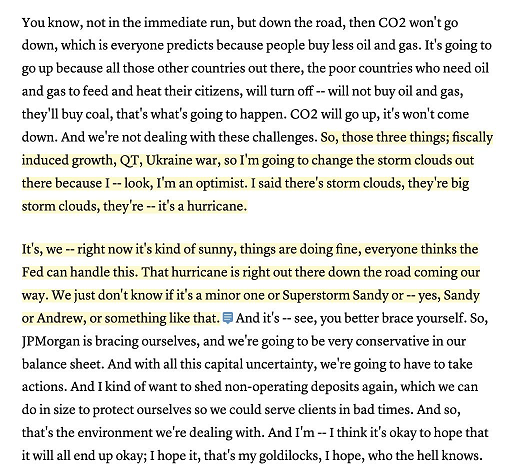
E’ utile, per tutti i lettori e gli investitori, leggere con attenzione queste parole di Dimon: in particolare dove dice “noi in JP Morgan stiamo allacciando le cinture e saremo molto prudenti nella gestione del nostro attivo di bilancio, evitando o riducendo gli investimenti rischiosi”.

Possono sembrare dichiarazioni banali, ma non lo sono, e per due ragioni:

  1. ancora in gennaio, l’atteggiamento era opposto: non c’era traccia di questa avversione al rischio, né in JP Morgan, né in alcuna altra grande banca di investimento; e

  2. ancora in queste settimane, da altre parti di JP Morga, sono arrivati ai Clienti e sul mercato inviti ad operare nel modo che si chiama “buy-the-dip”: “altro che avversione al rischio, qui è ora di comperare tutti i ribassi”

Dovreste subito chiedervi: se Jamie Dimon riduce gli investimenti rischio, lo dovrei fare anche io, e subito?

Noi vi suggeriamo di leggere ancora con maggiore attenzione un secondo passaggio di Dimon, che è quello che segue qui sotto.

Dice Dimon: “QE backfired”. Ovvero, la politica di acquisto di Titoli di Stato ha avuto un contraccolpo negativo. In altre parole Dimon ci dice che la politica centrata sul gonfiare i prezzi delle obbligazioni e poi delle azioni è stata un errore.

E se lui lo dice, significa che sono in tanti a pensarlo: anche alla Federal Reserve.

Sono in molti, tra gli investitori (in Italia e nel Mondo) a non avere ancora ben compreso questo punto: i medesimi soggetti (Governi e Banche Centrali) che dodici mesi fa celebravano i rialzi di Borsa come “un segno che la gente ha fiducia nelle nostre politiche” oggi hanno deciso che i prezzi devono scendere. I prezzi in Borsa ed i prezzi delle obbligazioni.

In questo senso, il dato di domani per gli occupati negli Stati uniti potrebbe giocare un ruolo importante, come viene spiegato nell’immagine che segue.

Il nostro suggerimento al Cliente è quello già anticipato nel titolo.

A voi serve un gestore di portafoglio, eventualmente in remoto, che vi aiuti a non farvi sballottare come pupazzi di stoffa, prima su e poi giù, da figure e personaggi che, a posteriori, poi vengono a spiegarvi che “non avevamo capito bene”.

Perché è dei vostri soldi, che qui si parla e si scrive. Prima si dice “dobbiamo farli salire”, e poi si dice “dobbiamo farli scendere”. In spregio a qualsiasi Legge o regolamento di settore: una “manipolazione dei mercati finanziari” alla luce del sole, sotto gli occhi di tutti, sulla quale nessuno ha il coraggio di intervenire.

Il quanto investitori, farete bene a cercarvi qualcuno in grado di proteggere il vostro patrimonio da manipolazioni di questi tipo, in grado di anticipare fatti come questi con le mosse più appropriate nel portafoglio titoli, magari in anticipo di 12 oppure 18 mesi.

Perché adesso, quelle mosse sono molto meno utili, e molto meno redditizi. Un buon gestore oggi, non pensa più ai rialzi dei tassi della Federal Reserve, ed invece pensa già al dopo, a quello che verrà dopo che la fase dei mercati si è chiusa, nell’interesse suo e soprattutto dei suoi Clienti.

In questa chiave, il suggerimento operativo di questo nostro Post è il seguente: evitate di perdere tempo su argomento come “rimbalzo” e “pausa di settembre”. Lo abbiamo fatto in centinaia di occasioni precedenti, e lo rifacciamo di nuovo oggi: vi mettiamo in guardia contro gli “argomenti del marketing”, argomenti utilizzati ad arte per stimolare interesse, movimentazione e commenti dove … in realtà non c’è nulla.

Un esempio concreto: la settimana scorsa è stata dominata da una sola dichiarazione, di un membro della Federal Reserve (Bostic), che disse “potrebbe esserci una pausa nel ciclo dei rialzi dei tassi già a settembre”.

Dietro le quinte, deve esserci stata una forte irritazione politica: tanto che solo 48 ore fa il medesimo personaggio è stato costretto a rilasciare una intervista al solo scopo di ritrattare tutto. L’intervista è quella che vedete qui sotto.

E quindi: lasciate perdere questi “pettegolezzi di mercato”, e concentratevi invece su quello che c’è al di fuori del mercato finanziario; lasciate da parte il tablet e lo smartphone e guardate fuori dalla finestra; concentratevi sul quadro, cercate di comprendere come si modificherà l’insieme delle cose (politica, economia e finanza) e poi fate le vostre mosse.

Magari, confrontandovi con noi di Recce’d.

Tra le cose sulle quali vi suggeriamo di riflettere, a proposito della strategia di investimento e della gestione di portafoglio, c’è sicuramente il tema “recessione”: se ne parla molto, ma per ora se ne parla soprattutto in modo generico, e con toni allarmistici.

Visto che l’argomento rimarrà con noi investitori per parecchio tempo, è nel vostro interesse iniziare da subito a lavorarci, per andare nel dettaglio e comprendere il nocciolo della questione.

Vi può essere molto utile leggere per intero un articolo del The Economist, pubblicato proprio oggi, che tenta di anticipare le principali caratteristiche di una “eventuale” recessione negli Stati Uniti. A voi, lettori ed investitori, resta poi di decidere se sposate, o meno, questa visione delle cose. Potete parlarne con il vostro private banker, con il wealth manager, oppure con noi di Recce’d attraverso i canali che conoscete.

L’articolo andrebbe letto per intero, dedicandoci il tempo necessario, perché è davvero utile come strumento per analizzare il possibile futuro scenario nel quale i mercati finanziari dovranno muoversi.

Noi di Recce’d abbiamo in ogni caso voluto evidenziare quattro passaggi:

  1. laddove si dice che oggi ad ogni angolo si parla di recessione

  2. l’analisi della fragilità del sistema finanziario nel suo insieme (banche e non-banche)

  3. l’analisi dei risvolti nel mondo della politica

  4. il commento finale sul fatto che nei prossimi mesi l’inflazione potrebbe non essere più il tema dominante, come lo è stato fino ad oggi

Noi aggiungiamo un quinto spunto, su cui riflette dopo avere letto questo articolo: perché oggi, in Europa, ancora non c’è un simile dibattito sul tema “recessione”? Perché The Economist sceglie di parlare solo di Stati Uniti?

Il rischi recessione c’è anche in Europa, e forse è anche più elevato che negli USA, oggi.

These days it is hard to turn a corner without bumping into predictions of an American recession. Big banks, prominent economists and former officials are all saying that a downturn is a near certainty as the Federal Reserve wrestles inflation under control. Three-quarters of chief executives of Fortune 500 companies are braced for growth to go negative before the end of 2023. Bond yields and consumer surveys are flashing red. Google searches for “recession” are soaring.

The track record is certainly ominous. As Larry Summers, a former treasury secretary, has observed, whenever inflation has risen above 4% and unemployment has dipped below 4%—two thresholds that, when breached, indicate economic overheating—America has suffered a recession within two years. It is well across both thresholds now.

For much of last year the Fed and investors alike believed that inflation would fade as the pandemic subsided. No one believes that now. There is broad agreement that, supply snarls and energy-price surges notwithstanding, demand is also excessive, and that tighter monetary policy is needed to return it to a normal level. The question is how tight, and therefore how much the economy could suffer: the higher the Fed has to raise rates, the more punishing the downturn will be. Investors are pricing in pain, as indicated by the fall in stocks since the start of the year.

If America does slip into a recession, how might it play out? One way of trying to divine the path of a downturn is to consult history. America has suffered 12 recessions since 1945. Many observers point to similarities between today’s predicament and the early 1980s, when Paul Volcker’s Fed crushed inflation, causing a deep recession in the process. Others look at the downturn that followed the energy crises of the 1970s, echoed by the surge in oil and food prices today. Still others point to the dotcom bust in 2000, mirrored by the collapse in tech stocks this year.

But these parallels have serious flaws. Inflation is nowhere near as entrenched as at the start of Mr Volcker’s era. Growth is far less energy-intensive than in the 1970s. And the economy faces more complex crosswinds now than it did after the bust of 2000. The unusual nature of the deep covid-induced downturn in 2020, and the roaring recovery in 2021, when fiscal and monetary stimulus flooded the economy, limits the relevance of past episodes.

A better way to think about a recession, if it comes, is to look at America as it is today. Consider three different facets: the real economy, the financial system and the central bank. All three, working in concert, suggest that a recession would be relatively mild. Households and businesses’ balance-sheets are mostly strong. Risks in the financial system appear to be manageable. The Fed, for its part, has been too slow to respond to inflation, but the credibility it has built up over the past few decades means it can still fight an effective rearguard action. There is, however, a sting in the tail: when the recession ultimately ends, the consequences of the past few years of living dangerously with inflation may make for a sluggish recovery.

Start with the resilience of the real economy, which may well be the most important line of defence in a downturn. The general population is on a sound financial footing, a welcome change from the overextended consumers of the past. Household debt is about 75% of gdp, down from 100% on the eve of the global financial crisis of 2007-09. Even more striking is how much less Americans pay annually to service their debts. Because so many have shifted to cheaper mortgages as interest rates have fallen in recent years, their annual debt payments now add up to about 9% of disposable income, about the lowest since data were first collected in 1980.

Moreover, many households have larger-than-normal cash buffers thanks to the stimulus payments of the past two years, plus their reduced spending on travel, restaurants and the like at the height of the pandemic. Overall, Americans have excess savings of about $2trn (9% of gdp) compared with before covid. They have started to use some of this cash as living costs rise, but still retain a useful cushion.

In any recession one big concern is how many people will lose their jobs. Unemployment tends to rise during recessions: the average post-1945 downturn in America, excluding the brief covid recession, pushed up the jobless rate by three percentage points (see chart 1). A rise in unemployment seems all the more economically necessary today, as a way to relieve some of the upward pressure on wages and dampen inflation.

Could things play out differently, though? The labour market has, by some measures, never been so tight: a record 1.9 jobs are available for every unemployed person. This has fuelled optimism that companies could, in effect, cancel their job ads without firing people. Jerome Powell, chairman of the Fed, has expressed this hope. “There’s a path by which we would be able to moderate demand in the labour market and have vacancies go down without having unemployment going up,” he said on May 4th.

In practice, though, the labour market is unlikely to adjust so smoothly. Mr Summers has drawn attention to the concept of the Beveridge Curve, which portrays a basic relationship: the more vacancies there are, the lower the unemployment rate. Since the onset of the pandemic the curve has shifted outwards (see chart 2). In other words, it now seems to require more vacancies to get to the same unemployment rates as in the past—an indication of faltering efficiency in the economy’s ability to match the right people with the right jobs. One possible explanation is that some people are still reluctant to work because of the health risks from covid. Another is regional variation: some states, like Utah and Nebraska, have giant needs for workers but not enough people are willing to move to them.

Whatever the precise reason, the implication is that it is too optimistic to think that the Fed’s tightening can reduce vacancies without also reducing employment. Yet that does not mean that Mr Powell is all wrong. The Beveridge Curve could also move back as the recovery progresses and more people re-enter the workforce. Say the unemployment rate increases by two percentage points instead of the average three during recessions. That would take the rate to about 5.5%, lower than the average of the past three decades. Though painful for those who end up on the dole, it would be a good outcome as far as recessions go. By contrast, 11% of Americans were out of work by the time Mr Volcker was done with his tightening.

Hurting me softly

Even if most people are fairly well insulated from a recession, they are still likely to curtail their spending as the economy goes south. Belt-tightening would, in turn, translate into less revenue for businesses. A key question is how those lower earnings will interact with high debt levels: unlike households, companies have ramped up their borrowing over the past decade. Non-financial business debt stands at about 75% of gdp, not far from a record high.

Reassuringly, many companies sought to lock in rock-bottom rates during the pandemic. In 2021 companies reduced debt coming due this year by about 27%, or $250bn, mainly by refinancing their existing debt at lower rates and for longer durations. That makes them less sensitive to an increase in interest rates.

Less reassuringly, riskier companies also took advantage of easy money. Bonds that are rated bbb, the lowest rung of investment-grade debt, now account for a record 57% of the investment-grade bond market, up from 40% in 2007. When a recession strikes, the ratings on many of these bonds could slip a notch or two. And when bonds go from investment-grade to speculative, or junk, status, they become far less appealing for a universe of investors such as pension funds and insurance firms. That increases the chances of a flight to safety when the mood sours.

Even so, thanks to the starting point of low funding costs, there are limits to how bad things might get. In a pessimistic scenario—where a recession collides with higher input costs and rising interest rates—s&p, a rating agency, forecasts that about 6% of speculative-grade corporate bonds will go into default next year. That would be well up from the 1.5% rate now, but half the 12% rate hit in 2009. Intriguingly, the sector today holding the most low-quality debt is media and entertainment, featuring many leisure companies such as cruise lines. A recession would sap demand for their services. But as worries about covid recede, there is also a pent-up desire to get out and have fun again. The paradoxical result is that a swathe of low-rated companies may be positioned to fare better than most during a downturn.

How well fortified is the financial system? Headlines in recent years about Basel 3 capital-adequacy standards for banks may have caused more than a few pairs of eyes to glaze over. But these rules have served a purpose, forcing large financial firms to hold more capital and more liquid assets. Banks went into 2007 with core loss-absorbing equity worth about 8% of their risk-weighted assets. Today, it is more like 13%, a much plumper margin of safety. “A recession would not look like it did after the financial crisis. The system is just not levered like it was back then,” says Jay Bryson of Wells Fargo, a bank.

New threats have, inevitably, emerged. Prudential regulations have pushed risky activities into darker corners of the financial system. Non-bank lenders, for instance, issued about 70% of all mortgages last year, up from 30% a decade ago. Ideally, that would spread risks away from banks. But bank lending to these non-banks has also boomed, creating a web of opaque linkages. Insurers, hedge funds and family offices—in effect investment firms for the ultra-rich—have also taken on additional risks. They carry more debt than 15 years ago and are among the biggest investors in lower-rated corporate bonds.

Emblematic of the new kind of danger are collateralised loan obligations (clos). These are typically created by syndicating loans, pooling them and then dividing them into securities with different ratings depending on their payment profiles. The value of outstanding clos has reached about $850bn, making it the biggest securitised credit sector in America. And high-risk leveraged loans form a growing share of clos, which are partly converted into investment-grade assets through the alchemy of securitisation. The parallels with the dodgy mortgage-backed securities of the 2000s are obvious. Yet the similarities can also be overstated. The clo market is about half the size of the riskiest mortgage-securities market in the early 2000s. clos connect investors to a wide range of sectors, not just property. They also tend to be longer-term investments, more resistant to market ups and downs.

Moreover, an important stabiliser for the financial system will be the relative solidity of America’s most important asset market: property. An exuberant surge in house prices over the past two years means a decline in sales and values may be on the cards. But property is also dramatically undersupplied. Sam Khater of Freddie Mac, a government-backed mortgage firm, estimates that America has a shortage of nearly 4m homes because of a slowdown in building over the past 15 years. It is far better for the financial system to enter a recession with a giant under-investment backlog than with an over-investment hangover, as was the case in 2007.

The final factor in assessing the impact of a recession is monetary policy. As of March the median forecast by members of the Fed’s rate-setting committee was that inflation would fall to close to 2% in 2024 without interest rates having to exceed 3%.

It seems a fair bet that rates will go quite a bit higher than that. James Bullard, the relatively hawkish president of the St Louis Fed, reckons that the central bank will need to increase rates to 3.5% by the end of this year. A simple rule of thumb, which combines the real neutral rate of interest (the rate, adjusted for inflation, that neither stimulates nor restrains growth) and expected inflation, suggests higher nominal rates may be needed. If the real neutral rate is 0.5%, then the Fed would probably want to hit a real rate of about 1.5% to rein in inflation. Add on short-term inflation expectations of about 4% per year, as indicated by consumer surveys at present, and that suggests that the Fed may need to lift the nominal rate to 5.5%. “There is a substantially greater probability that we’ll need higher rates than the Fed now envisions or the market now predicts,” says Mr Summers.

Put differently, the Fed is embarking on a journey with a clear destination (low inflation), an obvious vehicle (interest rates) but hazy guesses about how to get there (how high rates must go). It will know the correct path only by moving forward and seeing how the economy reacts.

It has barely taken its first steps, raising rates by three-quarters of a percentage point over the past three months and setting out a plan for shrinking its assets. But it may be pleased with the results so far, clearly visible as financial markets rush to price in future tightening. For all the Fed’s missteps of the past year, investors still have respect for it, a precious legacy of the past four decades, starting with Mr Volcker’s leadership, in which it kept a lid on inflation. Equities, which were looking bubbly, have tumbled in value. The impact on mortgages has been dramatic: 30-year fixed rates have risen above 5%, the highest in more than a decade. Yet credit spreads have widened only somewhat, an indication that lending markets are not too stressed. Taken together, this looks like an orderly sell-off and an early success for the Fed. Although inflation expectations, as measured by bond pricing, still point to annual inflation of 3% over the next five years, they have come down by about half a percentage point since March.

Mr Bullard’s case for optimism is that much of the work of taming inflation can be done by resetting expectations at a lower level. The real economy would then not need to bear the weight of the adjustment. The key objective for the Fed is therefore to prove to investors that its vows to quash inflation are credible. “It is more game theory and less econometrics,” he says. The Fed’s record over the past couple of months, since belatedly training its sights on inflation, opens up the possibility that it may be able to tame prices without a punishingly high increase in rates. That, in turn, would make for a lighter recession.

Why worry, then? For one thing, even a mild recession hurts. Imagine the unemployment rate does rise by two percentage points, as in our relatively hopeful scenario. That would imply job losses for about 3m Americans. The political consequences may be even more dramatic. The recession in 1990 shows up as a mere blip in economic trends, but it helped pave the way for Bill Clinton’s victory over George H.W. Bush. A mild recession in 2023 could put paid to Joe Biden’s beleaguered presidency, perhaps helping usher Donald Trump back into the White House.

This will make the policy response to a looming recession much more controversial. If, as expected, the Republicans seize control of Congress from the Democrats in mid-term elections this November, there would be little chance of a muscular fiscal stimulus as growth slows. Republicans would see little reason to bail out Mr Biden, especially if the financial system holds up.

The task of easing would fall squarely on the Fed. But having just fought to contain an overheating economy and bring inflation to heel, the central bank would be queasy about revving up demand too much. And if the current cycle of rate increases stops at a low level, the Fed would not have much room to cut rates anyway. The next step would be once again to unleash quantitative easing (ie, purchasing assets such as government bonds in order to lower longer-term interest rates). It would, however, be fearful of the optics of “printing money” so soon after whipping inflation and just as a contentious election campaign gets under way.

The upshot is that policymakers are likely to have a limited arsenal if the next recession is just round the corner. Given the strengths of the economy today—flush consumers, solid businesses and safe banks—the next downturn ought to be mild. But even a mild recession must be followed by an upturn for the economy to return to full health. And with fiscal policy on the sidelines and monetary policy badly hobbled, the chances are that America would face a painfully slow recovery. After two years of focusing on high inflation, low growth may move back to centre-stage as the economy’s principal problem.

Valter Buffo
Longform’d. Analisi di un rimbalzo: è anche lui “transitorio”?
 

Dopo ben otto settimane, la Borsa a New York ha chiuso in rialzo venerdì 27 maggio 2022. Il rialzo settimanale supera il 6%.

Si tratta del fatto del giorno, ed è un argomento inevitabile.

Ma si tratta di un argomento importante, nella logica della gestione di portafoglio? Si tratta di un fatto rilevante? Ci porta a comperare oppure a vendere? Modifica le nostre aspettative per il futuro?

La risposta di Recce’d è NO: a tutte le domande lette qui sopra.

Che cosa fare, lo diremo poi la settimana prossima ai nostri Clienti, nella Sezione Operatività del nostro quotidiano The Morning Brief.

Ma ugualmente, per i lettori del Blog, intendiamo (come sempre facciamo) produrre gratuitamente elementi di valutazione e di giudizio: un contributo concreto ed applicabile per decidere che cosa fare.

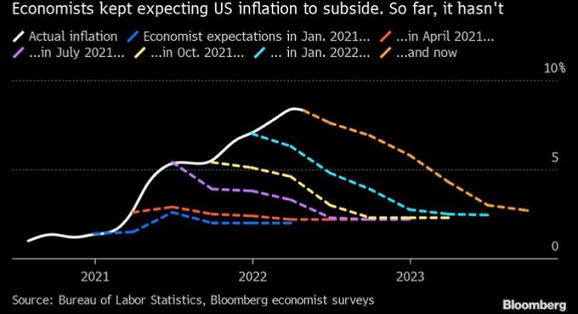
Il rimbalzo, come leggete qui sopra, è stato annunciato più volte: qui si torna addirittura al mese di ottobre del 2021, ovvero si ritorna indietro di ben sette mesi. Leggete nel titolo: “buy-the-dip” è l’indicazione operativa. La motivazione che fu fornita, allora, da Goldman Sachs e JP Morgan, fu questa: “L’inflazione è transitoria”.

Le cose poi non andarono esattamente in quel modo: lo documentiamo con il grafico che segue.

L’inflazione non era “transitoria”, e comperare il tema “buy-the-dip” da Goldman e JP Morgan fu un errore nell’ottobre 2021.

Fu un errore anche in novembre, dicembre, gennaio, febbraio, e marzo e aprile e maggio 2022.

Il tema è rilevante per il semplice fatto che proprio la scorsa settimana … ci hanno riprovato. Il tema però si è trasformato: il suggerimento operativo è sempre “buy-the-dip” ma la scorsa settimana c’era una nuova motivazione, e precisamente quella che “la Federal Reserve farà una pausa il prossimo settembre” . Interromperà il ciclo di rialzi dei tassi di interesse.

Sui mercati finanziari, in questo maggio del 2022, sono in moltissimi quelli che hanno “nostalgia”: vorrebbero tornare ai bei tempi andati, quando le Banche Centrali facevano semplicemente “tutto quello che volevano”.

Quei tempi però sono andati per sempre: non torneranno mai più. Le Banche centrali oggi fanno ciò che sono costrette a fare. Costrette dalla realtà. Oggi, la realtà le ha costrette ad alzare i tassi. Se faranno una pausa, in settembre, non dipende da una loro scelta, ma da ciò che faranno i dati.

Come investitori, quindi, siete costretti a rispondere ad una semplicissima domanda: ci saranno segnali di una inflazione sotto controllo, da qui a settembre?

La risposta di Recce’d verrà consegnata ai nostri Clienti ogni mattina, la settimana prossima, nel The Morning Brief. Oggi nel Longform’d ci limitiamo a ragionare con i lettori di dati e di movimenti di mercato, come il calo dei rendimento sui Titoli di Stato che avete visto la settimana scorsa (e che ha sostenuto il rimbalzo delle Borse).

Un movimento come quello che vi documentiamo qui sopra, nell’immagine, giustifica una previsione di “peak rates”, ovvero che i tassi di interesse abbiamo già raggiunto il loro massimo del 2022 (almeno, per le scadenze lunghe come i 10 anni)?

Ovviamente, la domanda è complessa, e la risposta richiede competenza e capacità di analisi. I numeri sono essenziali, in analisi di questo tipo: è importante evitare le trappole emotive, è importante evitare di affidarsi a “sensazioni” ed “emozioni”, è importante guardare invece con attenzione ai numeri.

Un veterano di Wall Street come Stephen Roach lo ha fatto, e poi ha pubblicato l’articolo che segue, dove si esprimono opinioni molti vicine a quelle di Recce’d. Roach indica la misura dei rialzi dei tassi che oggi è necessaria per incidere sull’epidemia di inflazione: ci dice in altre parole di quanti punti percentuali Powell dovrà alzare i tassi se vuole vedere “peak inflation” e “peak rates”.

Da una analisi di questo tipo, si può ricavare una risposta alla domanda di cui dicevamo sopra: i rendimenti delle obbligazioni hanno già raggiunto il loro massimo per il 2022?

NEW YORK, May 26 (Reuters) - The Federal Reserve could pause its monetary policy tightening in September if there is an economic deterioration and inflation subsides, BofA strategists said on Thursday, a day after the U.S. central bank released the minutes from its May policy meeting.

All of the Fed's policymakers agreed to hike interest rates by half a percentage point at the May 3-4 policy meeting to counter rampant inflation and most participants said further hikes of that magnitude in June and July could be appropriate.

But the minutes also showed the Fed grappling with how best to reduce inflation without causing a recession or pushing the unemployment rate substantially higher - a task that several participants said would prove challenging. read more

The central bank would likely pause its tightening in September, leaving its benchmark overnight interest rate in a range of 1.75% to 2% if financial conditions worsened, BofA strategists said in a note.

"We have recently seen a tenuous but remarkable change in Fed communications, where some Fed officials suggest the option of downshifting or pausing later in the year as they reach 2% given the challenging macro backdrop, tightening of financial conditions, and potentially softening inflation," they said.

Inflation, by the Fed's preferred measure, is currently running at more than three times the central bank's 2% target.

Fed funds futures traders on Thursday were pricing in 50-basis-point rate hikes at each of the central bank's June and July meetings and another 25-basis-point hike in September. FEDWATCH

While noting that it was not its base case scenario, BofA said the central bank may see a federal funds rate at 1.75%-2% as providing "a normalization of policy which then offers an opportunity to pause and assess the impact on jobs and inflation."

A pause in tightening could lead to lower rates across the U.S. Treasury yield curve, the strategists said.

The benchmark 10-year U.S. government bond yield hit its lowest level since April on Thursday. It has fallen from 3.2% on May 9, as the bond market sees the economy slowing and expects inflation to lose momentum.

Other analysts, however, do not see the Fed as having shifted to a more dovish stance.

Strategists at TD Securities said they expected the central bank to hike rates above the neutral rate, the level which neither stimulates nor constricts economic growth, but at a more gradual pace after the June and July policy meetings. Fed policymakers estimate the neutral rate to be roughly between 2% and 3%.

"The views expressed in the minutes are about all they could say at the start of an aggressive tightening cycle where no one really knows how far rates have to go," investment bank Brown Brothers Harriman said in a note.

"The Fed is facing a very complicated situation and so is trying to burnish its hawkish credentials while trying not to pre-commit to any rate path", it said.

If the US Federal Reserve wishes to avoid a return to stagflation, it must recognize the huge gulf between the level of real interest rates under former Fed Chair Paul Volcker and the current incumbent. It is delusional to think that today’s wildly accommodative monetary policy can solve the worst inflation problem in a generation.

Poor Jerome Powell. With US inflation close to a 40-year high, the Federal Reserve chair knows what he needs to do. He has professed great admiration for Paul Volcker, his 1980s-era predecessor, as a role model.

But, to paraphrase US Senator Lloyd Bentsen’s famous 1988 quip about his vice-presidential rival, Senator Dan Quayle, I knew Paul Volcker very well, and Powell is no Paul Volcker.

Volcker was the quintessential US public servant. He smoked cheap cigars, wore rumpled off-the-rack suits, and had a strong distaste for the glitz of Washington power circles. His legacy was a single-minded discipline in attacking a pernicious Great Inflation.

Unlike the modern Fed, which under Ben Bernanke’s intellectual stewardship created a new arsenal of tools – balance-sheet adjustments, special lending facilities, and the “forward guidance” of outcome-dependent policy signals – the Volcker approach was simple, blunt, and direct. Monetary policy, in Volcker’s view, started and ended with interest rates. He once said to me, “If you are not prepared to act on interest rates, you may as well get out of town.”

Volcker, of course, raised US interest rates to unheard-of levels in 1980-81, and there were many who did want him to get out of town. But howls of protest from builders, farmers, citizens’ groups, and members of Congress demanding his impeachment did not dissuade him from an unprecedented tightening in monetary policy.

It was long overdue. Under Volcker’s predecessor, Arthur Burns, the Fed had become convinced that inflation was part of the US economy’s institutional fabric. The price level was thought to have less to do with monetary policy than with the power of labor unions, cost-of-living wage indexation, and regulatory pressures on costs stemming from environmental protection, occupational safety, and pension benefits. Burns argued that oil and food-price shocks reinforced the institutional biases of an inflation-prone US economy. In other words, blame the system, not the Fed. The Fed’s research staff, which at the time included me, squirmed but raised no objections.

Volcker did more than squirm when he took over as Fed chair in August 1979. At the time, the consumer price index was surging by 11.8% year on year, on its way to 14.6% in March 1980. Volcker was determined to find the interest-rate threshold that would break the back of US inflation. Using the political cover provided by the 1978 Humphrey-Hawkins Act, which formalized the Fed’s price-stability mandate, and drawing operational support from a shift to targeting the money supply, Volcker went into action.

The Fed increased its benchmark federal funds rate from 10.5% in July 1979 to 17.6% in April 1980. Volcker then reversed course during an ill-advised but short-lived experiment with credit controls in the spring of 1980, before resuming a monetary-policy tightening that eventually pushed the funds rate to a monthly peak of 19.1% in June 1981. Only then did the fever of double-digit inflation break.

By late 1982, with the US in deep recession, annual headline CPI inflation had slipped below 4%, and the Fed started to reduce the benchmark policy rate. Mindful of the deeply entrenched inflationary psychology still gripping America, the Fed moved slowly and cautiously. Volcker, having broken the back of inflation, was not about to “leave town” until the Fed’s mission was complete.

Fast-forward 40 years, and Powell’s problem is glaringly apparent. Yes, the world today is certainly different than it was back then. But the modern Fed apparently has no institutional memory of the mistakes that it made in the Burns era. In 2021, there was a striking sense of déjà vu when US central bankers treated the initial surge in inflation as transitory and squandered the credibility of well-anchored expectations of low inflation.

The Fed viewed the COVID-19 shock in the same way it viewed the global financial crisis of 2008-09, and injected massive monetary stimulus to address what it was convinced would be a protracted shortfall in aggregate demand. In retrospect, that was an epic policy blunder. As pandemic-related lockdowns quickly gave way to a reopening of the economy, aggregate demand, aided by massive fiscal stimulus, snapped back with a vengeance. And in the face of now seemingly chronic supply-chain disruptions, this post-lockdown takeoff spawned the great inflation of our generation.

Powell’s problem is all the more evident when viewed through the inflation-adjusted lens of real interest rates. Over the 51 months of his leadership of the Fed (through April 2022), the real federal funds rate has averaged -1.95% (with a stress on the minus sign). This extraordinary monetary accommodation is unmatched in modern times. The real funds rate averaged -0.05% for eight years under Burns, -0.7% during Bernanke’s eight-year tenure, and -0.9% for four years under his successor, Janet Yellen.

Under Volcker, by comparison, the real federal funds rate averaged 4.4% for eight years (with a stress on the positive sign). Moreover, notwithstanding the Powell Fed’s newfound determination to move swiftly to counter what it belatedly views as a serious inflation problem, I suspect that the federal funds rate will remain below the US inflation rate well into 2023. That would push the Powell average down to -2.25% over the 59 months ending in December 2022.

No, I am not arguing that Powell needs to replicate Volcker’s tightening campaign. But if the Fed wishes to avoid a replay of the stagflation of the late 1970s and early 1980s, it needs to recognize the extraordinary gulf between Volcker’s 4.4% real interest rate and Powell’s -2.25%. It is delusional to believe that such a wildly accommodative policy trajectory can solve America’s worst inflation problem in a generation.

Like Volcker, Powell takes his mission of public service very seriously. Unfortunately, as Bentsen might have said, that is where the comparison ends

L’analisi di Stephen Roach che avete appena letto è completa ed esaustiva, per ciò che riguarda il tema del costo ufficiale del denaro e dei tassi di interesse. Noi gestori di portafoglio però dobbiamo ogni giorno guardare all’insieme del portafoglio titoli, ovvero a tutte le sue componenti: azioni, obbligazioni, materie prime e valute.

Il tema dei tassi di interesse, da solo, non ci permette di guidare con consapevolezza la strategia di investimento: lo dobbiamo unire ad altri temi, sui quali è necessario un quotidiano aggiornamento. Forniremo, ai nostri lettori, alcuni esempi.

Il tema dei tassi e dell’inflazione si interseca, prima di tutto, con il tema della crescita economica: nel grafico che trovate di seguito, si vede che i dati economici pubblicati nel 2022 per l’economia degli Stati Uniti sono stati, regolarmente, inferiori alle previsioni, ed in una misura crescente con il passare delle settimane.

I dati macroeconomici in arrivo dalla Cina e dall’Europa, nel 2022, sono stati anch’essi regolarmente inferiori alle previsioni. Questo ha determinato nel corso del 2022 una ampia revisione delle previsioni anche per i prossimi mesi.

Lo scenario che ci viene prospettato, oggi, è quindi uno scenario di bassa crescita delle economie, e di elevata inflazione: si chiama STAGFLAZIONE ed è proprio lo scenario sul quale noi di Recce’d avevamo chiamato la vostra attenzione dall’estate del 2020 e per tutto il periodo successivo.

I banchieri centrali, fino ad oggi, hanno tenuto una linea che, di fatto, nega la possibilità di stagflazione e si concentra sulla eventualità del “soft landing”, pur essendo costretti a riconoscere che “ci saranno ricadute negative”, come fece la settimana scorsa Jerome Powell e come ci spiega James Bullard nell’intervento che riportiamo sotto..

Retailers who endlessly raise their prices and don’t understand that consumers are stretched thin because of inflation are going to lose market share, said St. Louis Fed President James Bullard on Friday.

“A lot of CEOs have come on TV and said ‘oh I have lots of pricing power and I can do whatever I want and make a lot of money’,” Bullard said Friday, in an interview on the Fox Business Network.

“But I think some of them are going to get punched in the face here with the fact that consumers have to react” to higher inflation, he said.

Households only have so many dollars coming into their bank accounts and they have to decide what to buy. They are going to choose the basic necessity rather than the luxury good, Bullard added.

This dynamic will help inflation moderate, Bullard said.

In the interview, Bullard gave no indication that the stock market selloff this month had caused him to waver in his support for half-a-percentage point rate hikes at the Fed’s next two meetings in June and July.

Those two moves would lift the Fed’s benchmark fed funds rate up to a range of 1.75-2% by August.

“50 basis points is a good plan for now,” he said.

“We have to get inflation under control and I think we have a good plan to do so,” Bullard said.

Some of the repricing in the equity market might be due to the Fed, but other factors were also at play, he said.

Bullard said he still would like to see the Fed raise its benchmark interest rate up to 3.5% by the end of the year. That’s a more aggressive path than most of his colleagues are sketched out.

The St. Louis Fed president said getting up to a 3.5% rate might possibly allow the central bank to lower rates in 2023 or 2024.

Bullard downplayed fear of a recession or stagflation.

Stagflation means a recession with inflation continuing to move higher, he said.

“I don’t see that as a scenario right here,” Bullard said. In fact, he predicted U.S. economic growth will be stronger after June than it was in the first six months of the year.

And Bullard said it would take a “big shock” to push the U.S. into a recession and he doesn’t see that on the horizon.

Le parole di Bullard che abbiamo riportato qui sono di una particolare rilevanza, a giudizio di Recce’d, nella parte dove si parla delle politiche di prezzo delle aziende: dice Bullard che “prenderanno un pugno in faccia quelle aziende della distribuzione che non capiscono che i consumatori spendono meno”.

In pratica, Bullard afferma che le Aziende devono capire di non avere tutto quello spazio per alzare i prezzi, e che devono “tenersi in casa” una parte delle ricadute degli aumenti di prezzo.

Ciò che ci porta immediatamente ad un altro dei temi che oggi vogliamo segnalare: il rema degli utili.

Se le Aziende sceglieranno di non scaricare l’inflazione per intero sul Cliente, gli utili delle Società ne soffriranno.

Per noi investitori, questo significa una di queste due conseguenze: prezzi più bassi per le azioni, oppure valutazioni più elevate sulla base di utili più bassi.

Le grandi banche di investimento si sono già mosse, nel modo che vedete sopra nel grafico: hanno abbassato le stime per il valore della Borsa a fine 2022, ma hanno mantenuto ferme le stime per gli utili delle Società (le stime che nel grafico vengono chiamate EPS, ovvero utile-per-azione).

Il grafico qui sopra, che è di una decina di giorni fa, è interessante per almeno due ragioni:

  1. il nuovo target di Goldman Sachs, per dicembre, è di 4300 punti per l’indice S&P 500; ma se per effetto del rimbalzo dell’ultima settimana siamo ritornati a 4150 punti circa. Questo allora significa che da qui ai prossimi sette mesi tutto si ferma?

  2. e poi: gli utili per azione rimangono, come vedete, ai massimi di sempre secondo Goldman, anche nel 2022: e quindi, le cose di cui parlava Bullard più sopra semplicemente … non esistono?

Ecco uno dei fattori che devono orientare le vostre scelte di investimento.

Con questi pochi, e selezionati esempi, Recce’d vuole aiutarvi a capire che il rimbalzo di una settimana, basato sul tema “pausa di settembre e peak rates”, è soltanto un dettaglio in una storia che è molto più ampia e molto più complessa.

Per questo, più in alto abbiamo risposto NO alla domanda se questo rimbalzo è rilevante, per la nostra strategia di investimento e per la gestione di portafoglio. Un buon gestore di portafoglio guarda anche ad altri fattori, e li esamina tutti insieme per costruire uno scenario coerente per i propri investimenti.

Alcuni fattori ve li abbiamo già esposti: per chiudere, ne citiamo un altro, che è la storia dei mercati finanziari: e più nello specifico, la storia dei rimbalzi. Ad esempio dei rimbalzi tra il 2000 ed il 2003, che vi raccontiamo con il grafico qui sotto

La storia non si ripete, ma spesso fa rima, come disse lo scrittore Mark Twain.

La conclusione di questo nostro Longform’d è un suggerimento al lettore: per gestire in modo attivo e produttivo i propri investimenti, è un errore affidarsi agli slogan ed alle dichiarazioni. Lo è sempre, ma in modo particolare lo sarà in questo 2022, un anno che già oggi è molto diverso da quello che tutti immaginavano ad inizio anno, e che a fine 2022 sarà ancora più distante dalle previsioni della massa.

Molte sorprese sono già arrivate, ed altre sono in arrivo: il nostro suggerimento è di preparare i vostri portafogli.

Reagiste alle parole, come sempre rassicuranti e zuccherose, dei banchieri centrali e del vostro promotore finanziari: non ci sarà nessun “soft landing”, ed accadranno invece cose che voi, e loro, neppure immaginate, in questo 2022.

Nell’articolo che chiude il Longform’d, si spiega in modo chiarissimo perché lo scenario di “soft landing” oggi è esattamente la medesima cosa che sei mesi fa era “l’inflazione transitoria” di cui abbiamo scritto più sopra.

Fermatevi a fare due conti: che cosa sarebbe cambiato per i vostri soldi, sei mesi fa, se sei mesi fa voi aveste dato ascolto ai suggerimenti di questo Blog e modificato il vostro portafoglio di investimenti?

Oggi si ripete proprio quella situazione.

After more than a decade of chained stimulus packages and extremely low rates, with trillions of dollars of monetary stimulus fuelling elevated asset valuations and incentivising an enormous leveraged bet on risk, the idea of a controlled explosion or a “soft landing” is impossible.

In an interview with Marketplace, Federal Reserve chairman admitted that “a soft landing is really just getting back to 2% inflation while keeping the labor market strong. And it’s quite challenging to accomplish that right now”. He went on to say that “nonetheless, we think there are pathways … for us to get there.”

The first problem of a soft landing is the evidence of the weak economic data. While headline unemployment rate appears robust, both the labor participation and employment rate show a different picture, as they have been stagnant for almost a year. Both the labor force participation rate, at 62.2 percent, and the employment-population ratio, at 60.0 percent remain each 1.2 percentage points below their February 2020 values, as the April Jobs Report shows. Real wages are down, as inflation completely eats away the nominal wage increase. According to the Bureau of Labor Statistics, real average hourly earnings decreased 2.6 percent, seasonally adjusted, from April 2021 to April 2022. The change in real average hourly earnings combined with a decrease of 0.9 percent in the average workweek resulted in a 3.4-percent decrease in real average weekly earnings over this period.

The University of Michigan consumer confidence in early May fell to an 11-year low of 59.1, from 65.2, deep into recessionary territory. The current conditions index fell to 63.6, from 69.4, but the expectations index plummeted to 56.3, from 62.5.

The second problem of believing in a soft landing is underestimating the chain reaction impact of even allegedly small corrections in markets. With global debt at all-time highs and margin debt in the US alone at $773 billion, expectations of a controlled explosion where markets and the indebted sectors will absorb the rate hikes without a significant damage to the economy are simply too optimistic. Margin debt remains more than $170 billion above the 2019 level, which was an all-time high at the time.

However, the biggest problem is that the Federal Reserve wants to curb inflation while at the same time the Federal government is unwilling to reduce spending. Ultimately, inflation is reduced by cutting the amount of broad money in the economy, and if government spending remains the same, the efforts to reduce inflation will only come from obliterating the private sector through higher cost of debt and a collapse in consumption. You know that the economy is in trouble when the fiscal deficit is only reduced to $360 billion in the first seven months of fiscal year 2022 despite record receipts and the tailwind of a strong recovery in GDP.  Now, with GDP growth likely to be flat in the first six months but mandatory and discretional spending still virtually intact, government consumption of monetary reserves is likely to keep core inflation elevated even if oil and gas prices moderate.

The Federal Reserve cannot expect a soft landing when the economy did not even take off, it was bloated with a chain of newly printed stimulus packages that have made the debt soar and created the perverse incentive to monetize all that the Federal government overspends.

The idea of a gradual cooling down of the economy is also negated by the reality of emerging markets and European banks. The relative strength of the US dollar is already creating enormous financial holes in the assets of a financial system that has built the largest carry trade against the dollar in decades. It is almost impossible to calculate the nominal and real losses in pension funds and the negative result of financial institutions in the most aggressively priced assets, from socially responsible investment and technology to infrastructure and private equity. We can see that markets have lost more than $7 trillion in capitalization in the year so far with a very modest move from the Federal Reserve. The impact of these losses is not evident yet in financial institutions, but the write-downs are likely to be significant into the second half of 2022, leading to a credit crunch exacerbated by rate hikes.

Central banks always underestimate how quickly the core capital of a financial institution can dissolve into nonexistence. Even the financial system itself is unable to really understand the complexity of the cross-asset impact of a widespread slump in extremely generous valuations throughout all kinds of assets. That is why stress tests always fail. And financial institutions all over the world have abandoned the healthy process of provisioning expecting a lengthy and solid recovery.

The Federal Reserve tries to convince the world that rates will remain negative in real terms for a long time, but borrowing costs globally are surging while the US dollar is strengthening, creating an enormous vacuum effect that can create significant negative effects on the real economy before the Federal Reserve even realizes that the market is weaker than they anticipated, and liquidity is significantly lower than they calculated.

There is no easy solution. There is no possible painless normalization path. After a massive monetary binge there is no soft hangover. The only thing that the Federal Reserve should have learnt is that the enormous stimulus plans of 2020 created the worst outcome: stubbornly high core inflation with weakening economic growth. There are only two possibilities: To truly tackle inflation and risk a financial crisis led by the US dollar vacuum effect or to forget about inflation, make citizens poorer and maintain the so-called bubble of everything. None is good but they wanted a decisive and unprecedented response to the pandemic lockdowns and created a decisive and unprecedented global financial risk. They thought money creation was not an issue and now the accumulated risk is so high it is hard to see how to tackle it.

One day someone may finally understand that supply shocks are addressed with supply-side policies, not with demand ones. Now it is too late. Powell will have to choose between the risk of a global financial meltdown or prolonged inflation.

Valter Buffo
Longform'd. Benvenuto Orso
 

La salita alla cima del Monviso, 3841 metri, è una delle gite di montagna più gratificanti che l’Italia offre. E’ impagabile la salita, ed è impagabile il panorama che si offre da quella cima.

Gita che va effettuata ovviamente sotto la scorta di una valida guida di montagna: senza una guida esperta, la soddisfazione della salita e del panorama viene sovrastata dal pericolo, dall’incertezza e dalla paura. Mettere un piede in fallo è cosa di un attimo, e può essere fatale.

Sono 3841 i metri alla vetta del Monviso, e sono 3856 i punti dell’indice S&P 500 che sono stati superati (al ribasso) in chiusura della settimana, venerdì 20 maggio 2022.

In quel momento, l’indice della Borsa più grande al Mondo è stato in “bear market”.

Il primo commento che sale alla mente, leggendo questa notizia, è la rapidità: la rapidità con la quale le cose si evolvono e cambiano sui mercati finanziari.

Un concetto sul quale noi di Recce’d abbiamo più e più volte insistito, in particolare con i nostri Clienti: per un investitore è tempo del tutto buttato quello impiegato ossessionarsi sui “prezzi di oggi” come se fossero “prezzi per sempre”. Perché possono modificarsi con grandissima rapidità: i conti dei profitti e delle perdite sono utili solo se si fanno alla fine.

Lo scenario si è completamente ribaltato tra febbraio e maggio, in soli tre mesi, ovvero 90 giorni. Qualcuno sarà stupito, altri si spiegheranno la cosa dicendo a sé stessi che “è colpa di Putin”: Recce’d ed i suoi Clienti, al contrario, non sono stupiti e non attribuiscono alcuna colpa a Putin.

Già due anni fa, e poi un anno fa, e poi sei mesi fa, Recce’d ed i suoi Clienti avevano preso una posizione chiara: abbiamo detto che tutto quel compiacimento, tutta quella euforia, erano niente altro che una bolla d’aria.

Abbiamo detto e scritto che si trattava di una isteria collettiva, di una stupidaggine: che come ogni altra stupidaggine poteva essere spazzata via in un attimo.

Non è ancora stata spazzata via del tutto: il processo è in corso, ci saranno bassi e poi alti e poi ancora alti e bassi.

Questo però non modifica i criteri di valutazione, non modifica i criteri di allocazione del portafoglio, non modifica la nostra strategia: che è una strategia vincente, sempre ed in ogni condizione dei mercati finanziari.

Una chiara strategia di investimento è la sola risposta possibile ad un mercato, e ad un contesto intorno al mercato, nel quale (come avete visto) si passa da uno scenario di “boom economico” ad uno scenario di “recessione” in soli tre mesi, ovvero 90 giorni.

Dicevamo sopra: i conti si fanno alla fine.

Questo non significa, ovviamente, che il momento nel quale si possono e devono tirare le somme non arrivi mai: significa però che è sensato tirare le somme quando si arriva alla fine, al completamento di una fase del mercato finanziario, e non a metà.

Se si tirano le somme a metà, si rischia di arrivare a conclusioni sbagliate, e di fare affermazioni che, a breve distanza di tempo, si rivelano per quello che sono, ovvero delle sciocchezze.

Ripetiamolo: noi di Recce’d non consideriamo già chiusa l’attuale fase dei mercati: e spiegheremo più sotto il perché. E tuttavia, scriviamo in questo Post che il momento che stiamo attraversando non è un momento qualunque. E’ un momento di particolare significato.

In Borsa, scrivono i media, “è arrivato l’orso”, e questo per noi è significativo.

Il significato della cosa, a nostro modo di vedere le cose, è il seguente: anche se da lunedì arrivasse quel rimbalzo più e più volte annunciato e mai visto sino ad oggi, anche se dovessimo assistere ad un rapido reversal degli indici di Borsa, anche in quel caso è stato certificato che tutte le cose dette e scritte per spingere al rialzo i mercati finanziari nel 2020 e nel 2021 erano sciocchezze senza senso.

Ed è stato, al tempo stesso, certificato che è stata una sciocchezza investire andando dietro a quelle sciocchezze, tra le quali ricordiamo oggi: “le Banche Centrali hanno il controllo”; “le Banche Centrali possono stampare moneta all’infinito”; “il rischio sui mercati finanziari non esiste più”; “non ci sarà più una recessione”; “le azioni possono solo salire”. E soprattutto, che “non bisogna investire contro”.

Contro chi, poi, non si è mai saputo, è mancato il tempo.

Di questo chiarimento definitivo, tutti gli investitori debbono rallegrarsi: sia chi come noi ci guadagna, sia i tanti che ci perdono i soldi.

Certificato quindi il fallimento di quell’ottimismo a buon mercato, grossolano, facilone, o peggio ancora interessato (nel caso dei private bankers e wealth managers e robo-advisors) che aveva dominato nel 2020 e nel 2021, ora ovviamente si tratta di capire che cosa viene dopo.

Come già detto, noi in Recce’d giudichiamo prematuro oggi il tirare le somme definitive: la nostra valutazione è che la fase di mercato in corso non si è ancora completata.

E’ il caso tuttavia di iniziare oggi ad affrontare l’argomento, anche per prepararsi in modo tempestivo alla fase successiva.

Noi di Recce’d non siamo tra quelli che attribuiscono una grande importanza ai “livelli” statistici, ai “livelli degli indici” (come il -20% che segnala il bear market) oppure all’analisi tecnica: ne teniamo ovviamente conto, ma più come elementi di “colore” che influenzano la pubblica psicologia. Sicuramente, non sul piano dell’operatività.

Il parere di Recce’d è che occorre individuare altri elementi, più soldi e concreti, per cogliere il passaggio da una vecchia ad una nuova fase dei mercati.

In questo senso, ci è parso di cogliere alcuni segnali significativi nel corso delle ultime settimane: da qui la decisione di scrivere questo Post e raccogliere quei segnali in un’unica analisi.

Sono stati numerosi i commenti, autorevoli, che hanno messo in evidenza un cambiamento in particolare: il cambiamento del segno della correlazione tra indici azionari ed indici obbligazionari. Un esempio lo avete visto qui sopra nell’immagine, un secondo lo vedete nell’immagine successiva.

E’ stato (giustamente) evidenziato da molti che dopo una serie di settimane durante le quali abbiamo visto i tassi di interesse salire e le Borse scendere, da un paio di settimane le Borse scendono anche se i tassi non salgono.

Vi proponiamo questa tesi, e vi suggeriamo di approfondire, perché tra gli operatori dei mercati finanziari se ne è parlato molto: è stato forse proprio questo il tema dominante nelle ultime due settimane.

Il nostro giudizio è che, da solo, questo argomento non è sufficiente a convincerci che siamo già in una nuova fase.

Il nostro giudizio è che siamo ancora nella fase di chiusura del mercato precedente: il ciclo iniziato nel 2020 non si è ancora chiuso. Ci vuole altro: bisogna prestare attenzione ad altri fattori.

Recce’d vi anticipa con questo Post che, nelle prossime settimane, vedrete altri elementi entrare in gioco, e quindi anche prendere nuovo spazio sulle prime pagine dei giornali e nei media che seguire abitualmente.

Uno di questi temi sarà il tema degli utili aziendali, fino ad oggi quasi del tutto assente nella comunicazione dei media: ha iniziato ad affiorare proprio nell’ultima settimana.

Le banche globali di investimento, quelle che producono le stime per gli utili aziendali, hanno fatto una scelta (di marketing) ed hanno mantenuto fino ad oggi invariate le stime per gli utili 2022. E’ stata una scelta unicamente commerciale, che va spiegata così:

  • io abbasso le previsioni per il valore dell’indice di mercato a fine 2022; ma

  • lo spiego semplicemente come riduzione del rapporto P/E, che a inizio 2022 stava a livelli di delirio (lo sapevano tutti anche allora, ovviamente)

  • in questo modo, costringo l’investitore retail a tenere le sue quote di Fondi Comuni, per la ragione che “adesso le valutazioni sono più interessanti”

  • se in parallelo fossero scese anche le previsioni per gli utili (lo “E” in “P/E”) l’investitore si accorgerebbe che le valutazioni oggi sono le medesime valutazioni di gennaio

Il grafico qui sopra meriterebbe un ampio commento: sia con riferimento agli utili trimestrali di Wal-Mart e Target della settimana scorsa, sia con riferimento al testo che lo accompagna (abbiamo aggiunto noi la frase in blu)..

Non abbiamo lo spazio in questo Post: non vogliamo che un Longform’d diventi “too Long”-form’d, non vogliamo stancare il lettore.

Giorno per giorno, ci lavoreremo la settimana prossima per i nostri Clienti in The Morning Brief.

I dati delle immagini precedenti sono comunque almeno sufficienti, anche se non esaustivi, per chiarire quale è il problema.

Questa è una delle ragioni che ci fanno dire che, almeno ad oggi, i mercati non sono ancora “nella nuova fase”.

Non è questa la sola ragione.

L’immagine qui sopra a noi serve per ricordare al nostro lettore di prestare attenzione e se possibile approfondire almeno tre altri argomenti, e precisamente:

  1. l’indice delle condizioni finanziarie

  2. la crescita economica

  3. le condizioni di vita, il costo della vita, il caro-vita

Si tratta di tre temi della massima attualità, che eserciteranno sui mercati finanziari una grande influenza da qui a fine 2022, e poi anche nel 2023.

Non appena ne avremo il tempo e l’energia, dedicheremo ad ognuno dei tre temi un approfondimento anche nel nostro Blog.

La nuova fase dei mercati si definirà probabilmente proprio intorno

  1. al tema degli utili citato in precedenza, ed anche

  2. ai tre temi appena elencati per voi.

Manca però ancora il tema più importante: o almeno, quello che noi in Recce’d riteniamo sia il più importante per il passaggio ad una “nuova fase” dei mercati.

Il funzionamento dei mercati finanziari non è una cosa garantita.

Non lo può garantire neppure la Banca Centrale: il funzionamento dei mercati finanziari è garantito unicamente dalla fiducia tra gli operatori dei mercati finanziari. Se viene a mancare quella fiducia, il mercato chiude.

Lo abbiamo visto, tutti, nel 2008.

Oggi esiste un rischio di questo tipo? Un buon gestore di portafoglio, un gestore di portafoglio competente, un gestire di portafoglio responsabile, oggi non può escluderlo del tutto dai suoi calcoli.

Un portafoglio titoli che abbia tra i suoi obbiettivi anche la preservazione del capitale dai rischi, oltre che il raggiungimento di un obbiettivo di performance, oggi deve attribuire a questa eventualità una probabilità che non è pari a zero, come viene detto qui sopra (autorevolmente) nell’immagine.

Però allo stesso tempo (l’attività di gestione di portafoglio è davvero complessa e richiede una grande pazienza) un gestire non può escludere che tutto si risolva, magicamente, in un ritorno alle favole, come ci promette l’immagine che segue.

Anche questo tipo di scenario va tenuto in conto: una efficiente ed efficace gestione di portafoglio richiede all’investitore di mettere a confronto più scenari.

Un gestire di successo pesa i diversi scenari alternativi con diverse probabilità, senza escluderne a priori nessuno, e poi è capace di costruire un portafoglio titoli che in ogni tipo di scenario, anche quello più eccessivo (come è stato il 2020-2021) protegge il patrimonio (con minusvalenze sempre controllate), per poi produrre un rendimento positivo e regolare una volta che gli eccessi sono rientrati.

Nessuno sui mercati finanziari può vincere ogni giorno: ma c’è chi è sempre vincente quando si tirano le somme, ovvero alla chiusura di una fase di mercato, chiusura alla quale oggi ci stiamo avvicinando.

E questo è ciò che Recce’d ha dimostrato di saper fare per i suoi Clienti dal 2007. Ed è quello che farà nella PROSSIMA fse dei mercati finanziari internazionali.

Chiudiamo con un contributo esterno, che noi giudichiamo utile per completare la nostra rassegna dei fattori che entreranno in gioco nel passaggio dalla fase dei mercati che sta chiudendosi alla nuova fase.

Il tema è quello del credito: un tema che al quale Recce’d già qualche giorno fa aveva dedicato un utile Post.

L’articolo che potete leggere più in basso lega il tema del credito ad un altro tema del quale si discute moltissimo: quali sono le condizioni dei mercati finanziari che possono fare scattare una (ennesima) marcia indietro delle Banche Centrali?

Come si dice nell’immagine qui sopra, nello spazio di poche settimane le Banche Centrali di tutto il Mondo hanno completamente ribaltato le loro priorità: adesso la sola priorità è “la lotta all’inflazione” e da questo punto di vista il ribasso delle Borse “va bene” (e lo affermano pubblicamente).

Ma questo atteggiamento potrà essere mantenuto anche nel caso di ulteriori, ed ampi, ribassi dei mercati finanziari?

Leggiamo insieme questo utile articolo sull’argomento.

Avrete così a vostra disposizione l’elenco completo dei fattori che vi aiuteranno a rispondere alla domanda: “A questo livello di mercato, io dovrei comperare oppure vendere tutto?”.

Federal Reserve officials don't seem particularly concerned that stock valuations have plunged. They are, however, sensitive to significant movements in credit markets. The central bank would probably pull back on its plan to aggressively tighten monetary policy if corporate America showed signs of having trouble raising debt financing.

But despite some historic losses in credit markets this year, we're not anywhere close to that point. Corporate balance sheets are in some of the strongest positions in 20 years, and defaults are expected to stay “comfortably below” the long-term average of 4% this year, Goldman Sachs Group Inc. analysts wrote in a note last week. Bank of America Corp. credit analyst Eric Yu concurs. "Even if we are headed into a recessionary scenario, we think that high-yield defaults will peak at under 6%,” he wrote in a research note last week. “We suggest taking materially more risk here."

Even the Fed's quarterly senior loan officer survey of banks shows a willingness to lend. No banks reported significantly tightening lending standards in the latest survey, even with higher interest rates and concerns about higher inflation and a slowing economy. Lenders have confidence because companies aren’t desperate to borrow right now to stay afloat. They mostly took advantage of historically low rates to refinance a significant amount of their obligations, pushing out maturities years into the future. 

Sources: Federal Reserve, Bloomberg


It's not like there hasn’t been any pain or cause for concern. US investment-grade bonds are down 13.4% this year, and high-yield, high-risk, or junk, bonds have fallen 10.4%, according to Bloomberg indexes. But the losses are mostly due to a broad repricing linked to higher rates on US Treasury securities rather than worries about deteriorating credit quality and potential defaults. Stripping out the government-debt component from the returns, junk bonds are up 0.7% and investment-grade bonds are down just 0.5%. 

Source: Bloomberg

BPS = basis points

Normally, these signals would be supportive for equities and other riskier assets, since credit is a bellwether of corporate health and tends to lead other markets. But in this case, the mostly resilient credit market has become a liability for equity investors. It means that the bar is that much higher for the Fed to back down from its plans to aggressively raise interest rates and withdraw liquidity from the financial system by shrinking its almost $9 trillion balance sheet. 

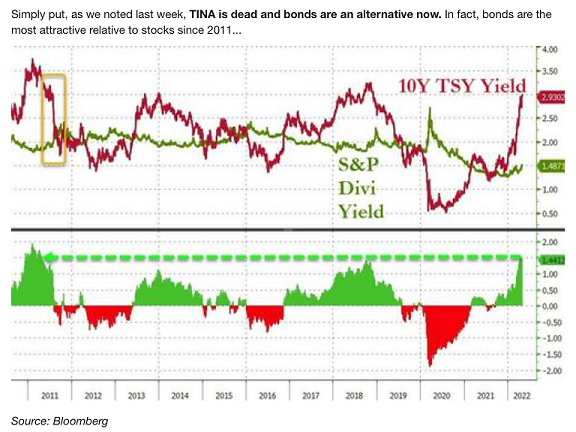
As is, stocks are getting buffeted by yields on inflation-adjusted Treasury rising above zero for the first time since before the start of the pandemic, making equities less valuable on a risk-adjusted basis. For example, the S&P 500 Index's dividend yield is near the lowest since May 2019 relative to real 10-year Treasury yields, which have climbed to 0.18% from as low as negative 1.08% in March. 

Stocks are also getting slammed by the prospect of slower economic growth, higher costs for labor and raw commodities, and prolonged-supply chain disruptions. Some one-time havens, namely the US technology giants, have seen disproportionate declines in their share prices, with the Nasdaq Composite Index firmly in a bear market, dropping 26.5% from its high in November. 

On the other hand, borrowers in the corporate bond market may have an easier time repaying their debts given the boost to nominal revenues and gross domestic product from inflation. Investors may be flipping to a period when credit provides a better hedge than equities to slower economic growth and faster inflation. After all, high-yield bonds actually provide the income so many investors have been clamoring for, offering average yields of 7.6%, near the highest since May 2020. Investment-grade bonds pay the most yield since March 2020, at 4.4%.

There is no credit crisis, and it would take an unforeseen event for it to become one anytime soon. Corporate bond investors are finally earning the income they've been craving for and they have little risk of not being paid in full and on time. This is positive for them, but for stock investors, the picture has shifted in the opposite direction. Without more pain in credit, equity markets can't count on the Fed to back away from its monetary-tightening plans simply to avoid further losses. 

To contact the author of this story:
Lisa Abramowicz at
labramowicz@bloomberg.net

Valter Buffo
Longform'd. TINA se ne è andata e non ritorna più?
 

Il mercato azionario internazionale è destinato a rimbalzare da qui a fine maggio? Si chiuderà così una fase di ribasso? Si può chiamare “correzione” la fase di ribasso dei primi mesi del 2022?

Le risposte a queste domande, Recce’d le darà ai suoi Clienti attraverso i tanti canali di comunicazione attivi ogni giorno con loro.

Ma soprattutto le darà con le nostre prossime mosse sui portafogli modello.

In questo Post, tuttavia, intendiamo regalare ai lettori del Blog qualche utile, concreto e specifico elemento di conoscenza, allo scopo di aiutarli a formare, loro stessi, una propria opinione.

C’è poi un secondo scopo: difendersi e proteggere il patrimonio dai luoghi comuni, dalle frasi fatte, dalle favole che vengono ogni giorno appioppate ai poveri investitori italiani che si affidano alle Reti di vendita di Fondi Comuni ed alle banche.

Per rispondere alle domande che aprono questo nostro Longfrom’d, è utile guardare ai tanti temi che ogni giorno sono presenti sulle prime pagine dei quotidiani: dall’inflazione alla crescita, dai tassi di interesse agli utili aziendali. E’ sicuramente utile, ma non è sufficiente. Noi in Recce’d guardiamo anche ad altri temi, che in questo Post vi esponiamo.

Tutti noi investitori usciamo da una fase di mercato che non ha alcun precedente nella storia: una fase di mercato estrema ed eccessiva, nella quale hanno dominato l’irrazionalità ed anche la follia (2020-2021). I mercati nel 2022 hanno (prevedibilmente) cominciato a fare i conti con questa follia. facciamo bene ad aspettarci che, nella fase di discesa, i maggiori indici di mercato si comportino come si erano comportati nelle precedenti fasi di ribasso? Se la fase di rialzo è stata diversa da ogni altra, esagerata ed eccessiva, la cosa può riflettersi anche sulla fase di ribasso?

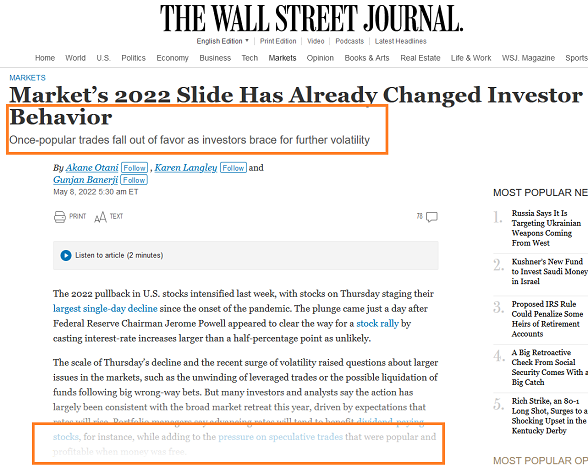
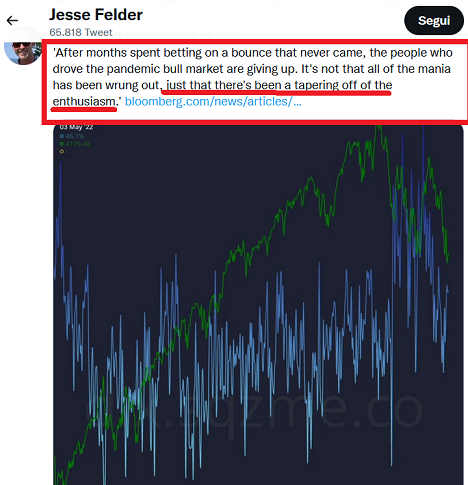
E quindi, ritorniamo alla domanda iniziale: stiamo davvero nel coso di una “correzione”? Oppure si tratta di qualche cosa di diverso? A voi lettori regaliamo, qui di seguito, in lettura un articolo del Wall Street Journal della scorsa settimana, nel quale si afferma che “il mercato è cambiato”. L’articolo spiega che non sono soltanto i prezzi, ad essere cambiati: sono cambiati gli operatori di mercato, la loro psicologia, i loro atteggiamenti.

L’articolo, che è della settimana scorsa, si riferisce in modo particolare all’esercito degli investitori fai-da-te, ovvero ai “retail”, ovvero agli investitori al dettaglio: quelli che, solo 12 mesi fa, si erano autoconvinti di essere in grado di “dominare il mercato” soltanto scrivendosi in chat con quattro amici, come spiega ancora oggi una pubblicità in TV (che promette di “trasportarvi sulla Luna”, e che vedete sotto nella nostra immagine).

Oggi per queste “sollecitazioni del pubblico risparmio” le Autorità nazionali ed internazionali non hanno previsto alcun tipo di sanzione o regolamentazione, e preferiscono investire il loro tempo e le loro risorse in altre attività. Ed è un problema, perché anche a causa di questo tipo di “manie collettive” sui mercati si propagano eccessi ed enormità come quelle che tutti hanno visto negli anni 2020 e 2021. Eccessi ed enormità da cui successivamente seguono i danni, non solo per chi ha messo in moto la cosa.

Torniamo quindi al tema del “rimbalzo” e al tema associato della “correzione”: per valutare se è arrivato quel momento in cui ci si deve “buttare a pesce”, oltre all’inflazione, oltre alla crescita, ed oltre agli utili aziendali, dovete necessariamente chiedervi se il mercato “è cambiato” anche in fase di discesa. Leggiamo che cosa ne scrive il Wall Street Journal la settimana scorsa.

By Akane Otani , Karen Langley and Gunjan Banerji

May 8, 2022 5:30 am ET

The 2022 pullback in U.S. stocks intensified last week, with stocks on Thursday staging their largest single-day decline since the onset of the pandemic. The plunge came just a day after Federal Reserve Chairman Jerome Powell appeared to clear the way for a stock rally by casting interest-rate increases larger than a half-percentage point as unlikely.

The scale of Thursday’s decline and the recent surge of volatility raised questions about larger issues in the markets, such as the unwinding of leveraged trades or the possible liquidation of funds following big wrong-way bets. But many investors and analysts say the action has largely been consistent with the broad market retreat this year, driven by expectations that rates will rise. Portfolio managers say advancing rates will tend to benefit dividend-paying stocks, for instance, while adding to the pressure on speculative trades that were popular and profitable when money was free.

For stocks, that trend has meant pain for the shares of firms that ran up during the pandemic years and carry large valuations.Netflix Inc., one of the hottest tech stocks of recent years, is down 70% this year. Amazon.com Inc.is down 31%, lagging behind even the slumping major stock indexes. Below we consider a few signs of the unrest in markets when buying the dip no longer pays immediate, predictable benefits.

The breadth of the market’s selloff has been striking. Few stocks have been spared.

Just 35% of stocks in the S&P 500 were trading above their 200-day moving averages Thursday, according to FactSet. That was down from 74% in January. Within the Nasdaq Composite, just 20% of stocks traded above their 200-day moving averages that day, down from 38% in January.

“There’s a lot of weakness that’s taking place beneath the surface,” said Willie Delwiche, investment strategist at All Star Charts.

The rout has dragged stock-market valuations lower.

Even after recent drawdowns, though, the S&P 500 still looks expensive relative to its valuations over the past decade. The S&P 500 traded last week at 17.7 times its projected earnings over the next 12 months, according to FactSet, above its 10-year average of 17.1 times earnings. With the Fed poised to continue tightening monetary conditions, many investors say stocks still don’t look cheap.

As stocks have tumbled, investors have tempered their enthusiasm for risky bets in the options market.

For much of the past two years, individual investors had rushed to the options market to place ultrabullish bets on stocks. Options bets became synonymous with the frenzy surrounding meme stocks, as shares of companies such as GameStop Corp. and AMC Entertainment Holdings Inc. soared.

Now, much of that speculation appears to be winding down. Net call option volumes in single stocks recently hit the lowest level since April 2020, according to Deutsche Bank.

The price of bullish options on stocks has also started to come down relative to bearish options, according to Credit Suisse. That is a reversal from much of the past few years, when investors looking to amp up bets on particular stocks rising supercharged demand for bullish options.

Other risky markets have taken a hit. Bitcoin prices peaked this year in March and have generally fallen since then to trade around $36,000.

The cryptocurrency’s descent has likely had a bruising effect on not just individual investors, but also a growing crowd of institutional investors. While cryptocurrencies in their early days were primarily bought and sold by retail traders, hedge funds and registered investment advisers have become a bigger presence in the markets in recent years.

As the rout has left money managers with few places to hide, surveys have shown individual investors becoming increasingly pessimistic about the stock market.

The share of investors who believe the stock market will fall over the next six months ended April at its highest level since March 5, 2009, according to the American Association of Individual Investors.

Widespread pessimism isn’t necessarily bad news. Some analysts view the AAII survey as a contrarian indicator, betting that when sentiment appears to have soured to an extreme level, markets are poised for a rebound. (Back in 2009, the S&P 500 hit its financial-crisis closing low just four days after the AAII reading.)

“Sentiment data can do a good job of saying, if we’re not exactly at the market bottom, we’re probably in the ballpark,” said Ross Mayfield, investment strategy analyst at Baird. “So if you’re being very tactical, those are the good times to put money to work.”

One reason some investors are looking at markets with hesitation these days: inflation. After factoring in price increases, the S&P 500’s earnings yield has fallen dramatically. That has made it harder for investors to justify paying a premium to own stocks over other investments, Morgan Stanley Wealth Management said.

Some investors bracing for further turmoil are turning to inverse funds, which offer buyers the chance to bet on declines in stocks or indexes. By one measure, activity in such funds recently hit the highest level of the past decade, according to Jason Goepfert, founder of Sundial Capital Research.

“Retail investors are betting against stocks,” Mr. Goepfert said. “They’re hedging their portfolios”-

L’articolo del Wall Street Journal, come avete visto, non fornisce alcuna risposta definitiva: via aiuta però a capire, e a valutare, fornendo utili elementi di informazione.

Tra le cose che voi lettori siete chiamati a valutare, una è la seguente: per quale ragione, in TV al TG economia oppure sul vostro giornale preferito non leggete più quelle sigle che soltanto sei mesi fa andavano per la maggiore.

Elenchiamole:

  • BTD

  • FOMO

  • TINA

Per qualche tempo, hanno dominato sui media: tanto che è superfluo spiegarne di nuovo il significato.

Se in particolare ci occupiamo di TINA, la ragione per la quale oggi non leggiamo più di TINA nei titoli degli articoli di giornale è semplice: adesso, una alternativa alle azioni esiste, come ci racconta il grafico qui sotto.

Il grafico qui sopra, ed il grafico qui sotto, ci servono per mettere in evidenza che l’aumento dei rendimenti delle obbligazioni oggi rende meno conveniente, rispetto al recente passato, l’investimento in azioni: almeno da questo punto di vista, ovvero se mettiamo a confronto il rendimento delle obbligazioni ed il rendimento delle azioni in termini di dividendi distribuiti.

Ovviamente, questo elemento di valutazione non è sufficiente, da solo, a spiegare i recenti cali degli indici azionari, né può da solo spiegare il cambiamento nell’atteggiamento e nella psicologia degli investitori retail che aveva messo in evidenza, poco più sopra, l’articolo del Wall Street Journal.

Secondo un certo numero di commentatori, come leggete nell’immagine sotto, quei soggetti che avevano alimentato la mania del 2020-2021 hanno semplicemente … mollato la presa, si sono arresi all’evidenza, ed hanno ridotto il loro entusiasmo, dopo avere aspettato per mesi un rimbalzo che non arriva..

Ma questo è solo un “si dice”, è una cosa che circola tra gli operatori di mercato, è semplicemente uno dei tanti aneddoti a proposito del comportamento degli investitori.

Trattandosi di aneddoti, di cose raccontate e non di dati certi, sarà utile ricordare che soltanto qualche settimana fa, ovvero tra fine marzo ed inizio aprile, si registrò un rimbalzo molto ampio degli indici delle Borse, in coincidenza con la fine della prima fase della guerra in Ucraina.

E proprio in quel periodo si parlava ancora di BTD, di “buy-the-dip”, ovvero di “compera il ribasso” (della Borsa) come atteggiamento prevalente tra i piccoli investitori al dettaglio. Lo leggete qui sotto nell’immagine, che (ripetiamo) è solo di qualche settimana fa.

Su questo argomento, noi riteniamo che vi sarà utile rileggere un commento che fu scritto allora, quando sui mercati di Borsa si registrò quel rimbalzo di fine marzo: abbiamo selezionato per voi lettori l’articolo che segue, articolo che allora (ripetiamo, a fine marzo: ma è utile leggerlo oggi) ci spiegava “le ragioni del rimbalzo”.

L’articolo è molto significativo, perché ci riporta le osservazioni di chi, dall’interno di Goldman Sachs, osserva in modo diretto i flussi di acquisto, ed i flussi di vendita: da dove vengono i soldi, e dove se ne vanno i soldi.

Goldman Sachs solo un mese e dieci giorni fa osservava (come potete leggere) che nelle chat tra investitori retail in quel momento ai temi macroeconomici come inflazione e i tassi di interesse non era attribuita grande rilevanza, mettendo in evidenza che gli investitori individuali negli Stati Uniti sono ancora la categoria che detiene in portafoglio la quota più importante del totale delle azioni in circolazione, e che (secondo Goldman Sachs) sono pronti a ritornare “investitori aggressivi” come prima.

Ne usciva, da questa analisi fatta un mese fa, che l’investimento in azioni avrebbe goduto in quel momento di prospettive favorevoli.

Over the weekend, when looking at the latest JPMorgan Prime Brokerage data, we noted that the "pain trade" remains higher as unlike retail, hedge funds have been selling every rally aggressively with the largest US bank seeing "net selling in 8 of the past 9 days," during which stocks have staged a torrid rally.

At the same time, we also observed that the bulk of the recent market meltup has been on the back of a massive short squeeze and covering of puts (creating a delta and gamma squeeze) which makes it especially difficult to predict what happens next as most if not all of the recent market meltup has been due to technicals and positioning, not fundamentals.

Still, one can conclude that either hedge funds will reverse their selling soon and jump on board the retail buying bandwagon (at which point it will again be time to short), or retail will run out of buying power amid the hedge fund-to-retail "distribution", and stocks will tumble once again.

The outcome of that tensions is, according to Goldman's flow trader Scott Rubner, the $64 trillion question: as he writes in his latest Tactical Flow of Funds note - in which he says that the top institutional investor question has been "who is buying the market +500 points in the last two weeks?" - do retail traders force institutional investors to re-leverage back into the equity market above (the prior ceiling of $4600).

Here are Rubner's 5 main (bullish, of course) observations:

  1. The S&P 500 has closed up more than >1% in 6 out of the last 8 trading days. In the last 80 years, that’s only happened 2 other times.

  2. US bonds are down -6.3% so far this year, on pace for their worst year on record (record is - 2.9% in 1994).

  3. If the month closed today, US bonds would have the worst monthly performance in 42 years.

  4. "I expect a MASSIVE rotation into equities in Q2. When do we start talking about new all-time highs for US Equities? Great Rotation / Great Migration type of stuff."

  5. Global PWM’s are making the calls today for next week. “hey, so we have these bonds, and we are sitting on cash”..... but inflation, yadda yadda yadda. new Q = new inflows.

Going back to the divergence between retail and institutional investors, here is why Rubner is "tracking the message boards again":

  1. US Households own 39% of the $80 Trillion US Equity Market. ($31 Trillion)

  2. Hedge Funds own 2% of the US Equity Market. Households own 20x more market cap than Hedge Funds (ZH: this, however, is a grossly inaccurate at best, since household ownership is a plug in the Fed's Flow of Funds report, and if anything, represents how little the Fed actually knows where the money ends up).

  3. Goldman's analysis shows that the largest owner of the equity market, has scope to become the largest trader of the equity market yet again.

  4. This is the biggest swing factor in the market today, and also the largest source of aggressive trading demand (at a time when liquidity and value traded has decreased).

  5. You have to remember, despite the bearish macro backdrop and investor sentiment, this is not true for message board traders. Open the apps’s today to get the vibe.

Rubner then takes a look at the bigger tactical flow of funds checklist, and gives the lists the following 12 reasons why the S&P rallied ~500 handles in 11 trading days, and why he expects it will keep rallying?

  1. April is a strong seasonal month. Over the last decade the average return for April is 2.34%, the second best month after November.

  2. Great Rotation - Investors are reducing money in bonds, 11 straight weeks of outflows, and huge redemptions from cash funds losing to inflation by -7%. Households have $15 Trillion in cash holding.

  3. Retail is back. Retail participation has dramatically increased and retail are buying weekly calls again. (+50% moves in GME, and huge gains in core retail favorites, TSLA/NVDA). Watch TSLA stock split news. They have fully paid their April 18th tax bill.

  4. Great Repatriation Migration “I’m coming home”. This was the largest monthly move back into the USA on record (out of rest of world). Lot of $ is parked in low quality overseas. Foreigners also coming back to the US.

  5. Systematic. We have +$46B worth of equities to buy from CTAs. This will take us through the end of the quarter.

  6. Corporates are still the largest buyer in market, in a modest blackout window. Net demand (buybacks ex-issuance) is expected to be a record $700 Billion.

  7. $3.5 Trillion worth of option notional rolled off two weeks ago. Gamma is short. The street is very short gamma around ATM strike.

  8. PWM Model portfolios are aggressively selling bonds / credit, and moving back into US quality / tech / dividends.

  9. Our PB team, showed a further capitulation of gross and net HF exposure.

  10. HF’s generally are under exposed to a rally, and want not lag indices before statements go out on quarter-end.

  11. Sentiment remains below COVID, March 2020 lows. (-1.8%)

  12. Liquidity remains challenged. You can trade $5M on the screens of ESA (E-mini futures), this ranks in the 4th percentile in the last decade. This has had the most impact on the shorts trying to cover.

Goldman's bottom line: "flow of funds are still positive for the next two weeks, and there is a lack of supply."

La lettura dell’articolo per voi è interessante, perché vi chiarisce in che modo ragiona ed in che modo “legge i dati dei mercati” chi lavora sui mercati stessi in una posizione che è analoga al grossista che lavora ai Mercati Generali per l’ortofrutta: non decide, ma osserva chi compera e chi vende e in quale quantità.

Le cose poi, per la Borsa USA e per le altre Borse del Mondo, non sono andate nel modo previsto da Goldman Sachs nell’articolo appena letto, e questo per voi è utile perché vi conferma che non è sufficiente guardare ai flussi di ieri per immaginare i flussi di domani.

Ad esempio: leggete l’intervista che segue, in cui ci parla il creatore di una APP per il trading-on-line che fa concorrenza a Robinhood: questo inventore di APP ripete la ben nota storiella che “i giovano hanno molta fiducia in sé stessi e nelle loro risorse, voglio investire su sé stessi e quindi in azioni, e guardano al futuro con fiducia e quindi sono sempre bullish”.

Ammettiamo per un attimo (ma solo per un attimo) che queste frasi abbiano un senso compiuto, ma leggiamo anche il resto: ovvero che “i giovano stanno facendo la punta alle loro matite per capire che cosa fare durante una fase di ribasso”.

Ci pare interessante che questo imprenditore di APP dica queste cose, ovvero che i suoi clienti

  1. stanno cercando di capire che cosa sia una fase di ribasso; e che

  2. non abbiano ancora deciso che cosa fare in una fase di ribasso.

Tra i possibili sviluppi, c’è anche la possibilità che … tutti diventino meno “bullish”?

Vi lasciamo alla lettura dell’intervista e riprendiamo più sotto.

Our call of the day, from the founder and chief executive officer of competitive stock trading app Zingeroo, says institutional traders would be wise to keep paying attention to an increasingly sophisticated retail investor.

Prepandemic, notes Zingeroo’s chief Zoë Barry, the retail crowd represented 10% of the volume that was traded and didn’t share trading ideas — often seen in the Gen. X and older crowd. That figure then hit a high of 25%, and with it came much chattier investors.

“[Wall Street] completely underestimated what it would be like if 25% of the volume turned in a certain direction and turned away from institutional,” Barry told MarketWatch in a recent interview.

“…Gen. Z has actually started sharpening their pencils and doing the research as to what to do in a bear market.”

— Zoë Barry, CEO of Zingeroo

“And now Wall Street is all over sentiment data and they’re looking at what people are seeing, but they also want the core trading numbers because there’s a gap between what people chatter about and say online, versus what they actually trade,” she said.

As a former analyst at Dawson Capital, Barry said she wants to know what traders are saying versus what they’re trading, and why there are inflows on certain stocks. “If I were an institutional, I would be very, very wary of shorting a stock that has the potential to be a heartthrob of retail investors,” she said.

Barry’s app, which launched last autumn, is a rival to Robinhood, but features “bullpens” — chat groups to discuss investing topics — and “zones,” where performances can be benchmarked against others, while trades can be verified by “trading cards.”

The serial entrepreneur said 80% of Zingeroo’s users are millennials and Gen. Z, with the rest Gen. X plus. The younger crowd, she said, views trading activity as their so-called “M.B.A.” — investing in themselves and their own financial diversity.

“I think young retail investors are beginning to have a longer-term outlook than just you know, what is happening this week in the markets. I think that’s an overall positive for them,” she said. “They’re investing in the stock market and they’re investing in themselves and increasing their financial literacy and that’s positive.”

And in the first part of the quarter, there was lots of chatter about young investors being lost in the wilderness of a bear market. “And what we saw was Gen. Z has actually started sharpening their pencils and doing the research as to what to do in a bear market,” said Barry.

As for differences between generations, she said the Gen. X plus category will auto liquidate via stop losses, millennials tend to buy the dip, while Gen. Z is even more sophisticated. For example, she noted recent action on the SQQQ, a three-times leveraged inverse exchange-traded fund that tracks the Nasdaq-100, and called that “definitely unusual behavior for a retail investor.

“They basically said we’re not sure which of the growth stocks are going to be impacted most, so I’m not smart enough as a retail investor to pick exactly what stock will pull back,” said Barry. They are also not worried about catching the exact bottom of a market, but instead are looking at stocks they think will have a greater chance of being a future fundamental success.”

And this crowd “understands the future tools that are happening right now,” and are overall more bullish on themselves, their future potential and the economy overall, despite the geopolitical meltdown and rising inflation, said Barry.

La lettura che avete appena fatto è molto interessante, perché oggi sui mercati giocano un ruolo importante (più importante che in passato) anche questo tipo di intermediari e per conseguenza anche questo tipo di investitori.

Al punto di vista che avete appena letto noi vi suggeriamo di contrapporre quelli che leggerete nell’articolo che segue.

In questo articolo di Bloomberg, datato 9 marzo 2022 (due mesi fa), Mohamed El Erian anticipava che “il buy-the-dip” non costituisce più un guadagno assicurato per gli investitori, dopo essere stato l’atteggiamento dominante per quasi due anni.

Per il momento, quello che El erian aveva previsto si è verificato. Ma domani, che cosa succederà?

Ritornando alle nostre domande di apertura, potrebbe essere proprio questo l’elemento-chiave per rispondere alla domanda sul “rimbalzo” e sulla “correzione”: tutti noi lettori oggi siamo chiamati a rispondere alla domanda del titolo, de “TINA se ne è andata e non ritorna più”, come accadeva in quella nota canzone della musica leggera italiana, cantata dalla presentatrice dell’Eurovision Contest in questi giorni in TV.

Ci auguriamo di avere aiutato, come sempre in modo puntuale, qualificato e articolato, tutti i nostri lettori chiamati a decidere dei loro soldi in questo complicato momento di mercato.

By

Mohamed A. El-Erian

9 marzo 2022, 11:30 CET

Mohamed A. El-Erian is a Bloomberg Opinion columnist. He is president of Queens’ College, Cambridge; chief economic adviser at Allianz SE, the parent company of Pimco where he served as CEO and co-CIO; and chair of Gramercy Fund Management. His books include "The Only Game in Town" and "When Markets Collide." @elerianm

Whether it was friends or total strangers, everyone seemed to have the same question for me on a recent trip. Is it time to buy the dip in stocks? After all, U.S. stock markets have already had a few encouraging bounces in the past two weeks of trading, though they proved both temporary and more than fully reversible.

Few have liked my answer because it contends that economics, finance and related policies have been relegated to the back seat when it comes to the drivers of price action. At this stage, their market question is closely related to a political and national security calculation associated with Russia’s invasion of Ukraine: Is there an offramp for Vladimir Putin anytime soon? If there is, the occasional bounce could translate into a sustainable longer-term rally. Absent that, more unsettling financial market volatility is in the cards.

The war aggravated what was already an unpleasant start to 2022 for stock investors. The top U.S. stock indexes are now down 10% to 18% this year, while widely followed indexes for Europe and emerging markets have fallen 15% and 12%, respectively.

Until recently, BTD was a profitable strategy — so much so that the investor conditioning that came with it made the dips less pronounced and shorter, especially as “fear of missing out” and “there is no alternative” to stocks joined the fray. What made BTD particularly successful is that markets were consistently supported by huge and predictable injections of liquidity from central banks as well as interest rates pinned near zero.

Data suggest that, during the first week of the war, retail investors were inclined to maintain this approach. But their purchases collided with sales from institutional investors, rendering the strategy less effective in maintaining and building on a short-term bounce. Behind this apparent change is a weakening of the central bank shield that, for too many years, decoupled ever-higher asset prices from fundamentals.

With raging inflation threatening to worsen in the next few months, the Federal Reserve has little choice but to ease its foot off the stimulus accelerator — a necessity that is amplified by the extent to which the central bank’s prolonged mischaracterization of inflation as transitory has damaged its credibility and caused it to lose control of its policy narrative. With that, markets are now a lot more exposed to the four-level economic impact of the war: direct repercussions on Russia and Ukraine, spillbacks to advanced countries, spillovers to developing countries, and changes in the functioning of the multilateral system. 
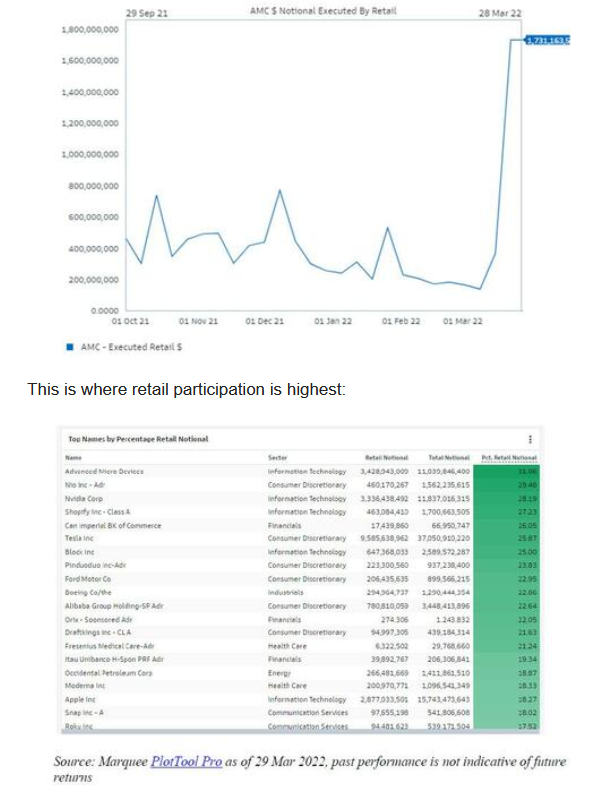
The longer the war continues, the greater the magnitude of these four effects and the larger the scope for their adverse interactions. With that comes a simple but critical question: Can Putin find his way out anytime soon?

Without an orderly end to the war, the disruptions to commodity markets and supply chains will intensify, as will “self-sanctioning” by the corporate world; Europe will be pushed into an inflationary recession; China and the U.S. economies will slow notably; some commodity-importing developing countries will risk foreign-exchange and debt crises; and the new stagflationary baseline for the global economy as a whole will be associated with a growing risk of an outright global recession.

Neither economic and financial policies nor markets are well positioned to deal with this combination, let alone overcome it.

Traditionally, stagflation has been one of the hardest challenges for policy making. It is compounded because the war in Ukraine came when the Fed had already fallen behind inflation realities and failed to build the much-needed flexibility for its policy responses.

Meanwhile, energy policy is stymied by the extent to which the world has been losing the fight against climate change. Fiscal and debt balances have yet to reset after their aggressive deployment to fight Covid-19. And financial supervision and regulation are lagging behind the significant morphing and migration of risk from banks to nonbanks.

Markets have similarly been caught offsides. And it’s not just positioning. Already, market liquidity has proved patchy at times, including for U.S. Treasuries and, of course, individual stocks and commodities. In what fortunately remains a rarity for now, market malfunction has also reared its ugly head: Witness the London Metal Exchange’s suspension of chaotic nickel trading this week.

Without a halt to the atrocities against Ukraine and its people, the global economy and financial markets will face more disruption. 

This is not a comforting context for the continued success of BTD. Unless investors can identify the so-far elusive Putin offramp, their heavily exposed equity positions would be better served by rationalizing them during the bounces rather than buying the current dip outright and hoping for the immediate initiation of a long rally. They should use this opportunity to focus more on selecting individual stocks while positioning for a future of greater dispersion in global economic performance.

Vi ricordate Riccioli d'oro? Non è stato facile.
 

Non è stato facile.

Non è stato facile mantenere la lucidità, in quei mesi infiammati. Durante l’anno 2021.

A pollice alzato, come nella foto qui sopra. Si andava così.

Ognuno si sentiva un genio. Il private banker, il wealth manager, il robo-advisor, il family banker: ognuno di loro aveva capito, e poteva spiegare a voi come diventare ricchi subito.

Era lo scenario Goldilocks: Riccioli d’oro.

Appunto, come nelle favole.

Il merito? Della Federal Reserve e della BCE.

A voi, che cosa raccontava in quelle settimane, il wealth manager? Il personal banker? Il vostro promotore finanziario?

FINECO, Mediolanum, Fideuram, Allianz, Generali e tutti gli altri: a voi, che cosa dicevano di fare allora, un anno fa?

E noi? Noi di Recce’d ai nostri Clienti che cosa abbiamo detto, un anno fa?

Facile: quello che c’è ancora oggi scritto, come testimonianza, in questo Blog.

In sintesi abbiamo detto, e ripetuto: Goldilocks è una favola, ed alle favole è giusto che credano i bambini.

Un adulto che crede alle favole è un ingenuo.

Investire il proprio denaro su una favola, è una stupidaggine.

Chi vi ha spinto a farlo, non pagherà il conto. Il conto lo pagate voi lettori.

Come leggete nell’articolo del Financial Times che segue: dove si riassume la situazione. Leggete fino al fondo, dove si scrive di Anni Settanta, che è un tema di investimento di Recce’d da due anni.


Remember Goldilocks? We are unlikely to be hearing much about that fairy tale character in the near future. For Jay Powell, the US Federal Reserve chair, the odds are that the American economy will either run too hot or too cold, or go from one to the other.

Unlike in the 1990s, or indeed for most of the last generation, it would be rash to bet on a soft landing for the US economy. The era of easy money was also one of relatively easy central banking. That job is getting much tougher.

Goldilocks has left the building. Some of the Fed’s woes are self-created. Its chief sin has been wishful thinking — a trait that was also shared by the markets. The Fed has not yet explained why it got inflation so wrong in the last year. For most of 2021, the Fed insisted higher inflation was “transitory” even as evidence accumulated that it was not.

Then in November the Fed switched to admitting the problem was stickier than it thought. But it did not act as though it meant it. It took another four months to end its monthly injection of $40bn into a housing market that was already booming. Even after proclaiming a turn in the interest rate cycle, the Fed signalled the shift would be modest. Its first interest rate increase of 25 basis points came in March — months after inflation began to overshoot its 2 per cent target. Real monetary conditions have in fact got easier since then.

Inflation has risen by more than the Fed funds rate, which makes America’s real interest rate even more negative than it was before. It is as though Powell, reappointed Fed chair, cannot bring himself to let go of Goldilocks’ hand. It is hard to blame him. For decades, the markets have thrived on the one-way bet that when conditions got rough the Fed would prop up asset prices with steep rate cuts and quantitative easing. It thus always made sense for investors to “buy on the dip”.
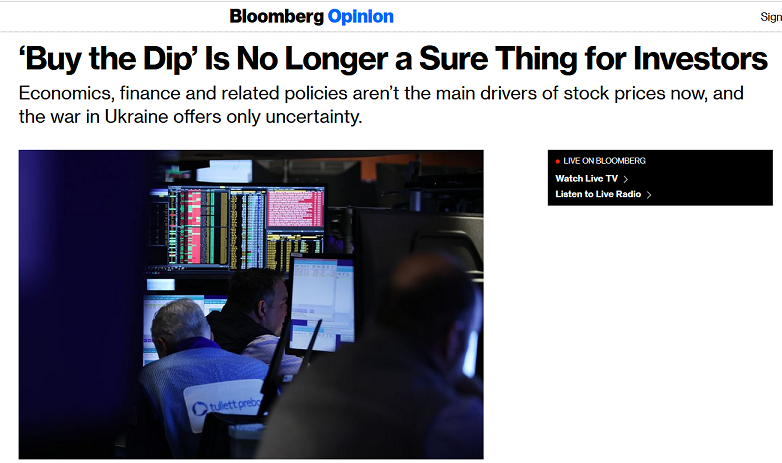
Even when the Fed complained that it was the only game in town — in frustration with the fiscal gridlock that disabled Washington for most of the years after the financial crisis — it carried on playing. Not to have done so would have been far worse for everybody. But the super-rich have been the overwhelming beneficiaries, which has not been healthy for democracy.

On the one occasion the Fed did try to alter the rules, it was quickly whipped into line. Ben Bernanke’s attempt to end quantitative easing in 2013 was shut down by the market’s “taper tantrum”. The pandemic returned the Fed to the 2008 mindset of “whatever it takes” — only this time with the fortunes of the non-rich explicitly in mind.

A few months after Covid-19 struck, the Fed replaced its strict 2 per cent inflation target with far more fungible language. Almost everybody, not just the Fed, converted to the view that the US economy could be run far hotter than theory dictated for the sake of full employment. That stance has now sadly been discredited.

Inflation, it turns out, is still a death eater of income gains. In addition to fast wage growth, China’s addiction to “zero Covid” lockdowns and the war in Ukraine are likely to sustain inflation across a broad range of products for months. Though the Fed can do nothing to ease global supply chain problems, the risk is that it will have to overcompensate for its failure to tackle inflation sooner.

On Wednesday, Powell is likely to announce the first 50 basis-point increase in years. That is already priced in. But with headline inflation at 8.6 per cent, a doubling of the Fed funds rate to 1 per cent is hardly disinflationary.

This underlines two growing threats to the Fed. The first is that it might be forced to induce a US recession with far higher interest rate increases than it now anticipates. The Fed’s last dot plot predicts a 1.9 per cent rate by the end of this year.

Last week Deutsche Bank predicted the Fed would have to lift that rate to 5 or 6 per cent to tame inflation. For similar reasons, Morgan Stanley warned that the US was entering a bear market. Both views are a minority.

But consensus forecasts, including the Fed’s, have been so badly off that it would be unwise to take the majority literally. The middle class wage renaissance may turn out to be fleeting. The second worry is about the harm to the Fed’s credibility. Powell did not acknowledge that inflation was non-transitory until after President Joe Biden reappointed him. Doubtless this was a coincidence.

Either way, the institution that was until recently seen as Washington’s most effective may be forced to relearn the lessons of the 1970s and early 1980s — even if today’s woes are not as great. Credibility is bought at great expense over a period of years. Alas, it can also be risked with remarkable ease.

edward.luce@ft.com