
Vi ricordate Riccioli d'oro? Non è stato facile.
 

Non è stato facile.

Non è stato facile mantenere la lucidità, in quei mesi infiammati. Durante l’anno 2021.

A pollice alzato, come nella foto qui sopra. Si andava così.

Ognuno si sentiva un genio. Il private banker, il wealth manager, il robo-advisor, il family banker: ognuno di loro aveva capito, e poteva spiegare a voi come diventare ricchi subito.

Era lo scenario Goldilocks: Riccioli d’oro.

Appunto, come nelle favole.

Il merito? Della Federal Reserve e della BCE.

A voi, che cosa raccontava in quelle settimane, il wealth manager? Il personal banker? Il vostro promotore finanziario?

FINECO, Mediolanum, Fideuram, Allianz, Generali e tutti gli altri: a voi, che cosa dicevano di fare allora, un anno fa?

E noi? Noi di Recce’d ai nostri Clienti che cosa abbiamo detto, un anno fa?

Facile: quello che c’è ancora oggi scritto, come testimonianza, in questo Blog.

In sintesi abbiamo detto, e ripetuto: Goldilocks è una favola, ed alle favole è giusto che credano i bambini.

Un adulto che crede alle favole è un ingenuo.

Investire il proprio denaro su una favola, è una stupidaggine.

Chi vi ha spinto a farlo, non pagherà il conto. Il conto lo pagate voi lettori.

Come leggete nell’articolo del Financial Times che segue: dove si riassume la situazione. Leggete fino al fondo, dove si scrive di Anni Settanta, che è un tema di investimento di Recce’d da due anni.


Remember Goldilocks? We are unlikely to be hearing much about that fairy tale character in the near future. For Jay Powell, the US Federal Reserve chair, the odds are that the American economy will either run too hot or too cold, or go from one to the other.

Unlike in the 1990s, or indeed for most of the last generation, it would be rash to bet on a soft landing for the US economy. The era of easy money was also one of relatively easy central banking. That job is getting much tougher.

Goldilocks has left the building. Some of the Fed’s woes are self-created. Its chief sin has been wishful thinking — a trait that was also shared by the markets. The Fed has not yet explained why it got inflation so wrong in the last year. For most of 2021, the Fed insisted higher inflation was “transitory” even as evidence accumulated that it was not.

Then in November the Fed switched to admitting the problem was stickier than it thought. But it did not act as though it meant it. It took another four months to end its monthly injection of $40bn into a housing market that was already booming. Even after proclaiming a turn in the interest rate cycle, the Fed signalled the shift would be modest. Its first interest rate increase of 25 basis points came in March — months after inflation began to overshoot its 2 per cent target. Real monetary conditions have in fact got easier since then.

Inflation has risen by more than the Fed funds rate, which makes America’s real interest rate even more negative than it was before. It is as though Powell, reappointed Fed chair, cannot bring himself to let go of Goldilocks’ hand. It is hard to blame him. For decades, the markets have thrived on the one-way bet that when conditions got rough the Fed would prop up asset prices with steep rate cuts and quantitative easing. It thus always made sense for investors to “buy on the dip”.

Even when the Fed complained that it was the only game in town — in frustration with the fiscal gridlock that disabled Washington for most of the years after the financial crisis — it carried on playing. Not to have done so would have been far worse for everybody. But the super-rich have been the overwhelming beneficiaries, which has not been healthy for democracy.

On the one occasion the Fed did try to alter the rules, it was quickly whipped into line. Ben Bernanke’s attempt to end quantitative easing in 2013 was shut down by the market’s “taper tantrum”. The pandemic returned the Fed to the 2008 mindset of “whatever it takes” — only this time with the fortunes of the non-rich explicitly in mind.

A few months after Covid-19 struck, the Fed replaced its strict 2 per cent inflation target with far more fungible language. Almost everybody, not just the Fed, converted to the view that the US economy could be run far hotter than theory dictated for the sake of full employment. That stance has now sadly been discredited.

Inflation, it turns out, is still a death eater of income gains. In addition to fast wage growth, China’s addiction to “zero Covid” lockdowns and the war in Ukraine are likely to sustain inflation across a broad range of products for months. Though the Fed can do nothing to ease global supply chain problems, the risk is that it will have to overcompensate for its failure to tackle inflation sooner.

On Wednesday, Powell is likely to announce the first 50 basis-point increase in years. That is already priced in. But with headline inflation at 8.6 per cent, a doubling of the Fed funds rate to 1 per cent is hardly disinflationary.

This underlines two growing threats to the Fed. The first is that it might be forced to induce a US recession with far higher interest rate increases than it now anticipates. The Fed’s last dot plot predicts a 1.9 per cent rate by the end of this year.

Last week Deutsche Bank predicted the Fed would have to lift that rate to 5 or 6 per cent to tame inflation. For similar reasons, Morgan Stanley warned that the US was entering a bear market. Both views are a minority.

But consensus forecasts, including the Fed’s, have been so badly off that it would be unwise to take the majority literally. The middle class wage renaissance may turn out to be fleeting. The second worry is about the harm to the Fed’s credibility. Powell did not acknowledge that inflation was non-transitory until after President Joe Biden reappointed him. Doubtless this was a coincidence.

Either way, the institution that was until recently seen as Washington’s most effective may be forced to relearn the lessons of the 1970s and early 1980s — even if today’s woes are not as great. Credibility is bought at great expense over a period of years. Alas, it can also be risked with remarkable ease.

edward.luce@ft.com

Il 9 maggio e la guerra di logoramento
 

Come abbiamo scritto già nelle due settimane precedenti, in Recce’d seguiamo con particolare attenzione l’Europa in questo momento.

Ciò che vediamo negli Stati Uniti, per noi rientra nel prevedibile: non ci stupisce e quindi non ci colpisce. Non dobbiamo spiegare nulla ai nostri Clienti, che erano (da tempo) preparati.

In Europa, a noi sembra che la situazione sia diversa, e da più di un punto di vista.

Spieghiamo: le ricadute di ciò che vedete succede sui mercati finanziari, per l’Europa e per la zona Euro in modo particolare sono più ampie, rispetto alla situazione degli Stati Uniti.

Anche negli Stati Uniti vedremo ricadute sulla vita sociale e politica. Ma in Europa potrebbero essere più profonde.

Ne scriviamo da una settimana, ogni mattina nel The Morning Brief per i nostri Clienti.

Con questo Post, noi vogliamo mettere all’attenzione dei nostri lettori soltanto uno, dei tanti aspetti che a noi fanno ritenere particolarmente delicata la situazione dell’Europa e dell’Area Euro in questo momento.

Si tratta del conflitto in Ucraina.

Già nel mese in febbraio, ed anche in forma pubblica attraverso questo Blog, Recce’d scriveva che questa guerra tra Ucraina e Russia è “una cosa per il lungo periodo”.

Oggi, ritrovate il medesimo concetto scritto sulla stampa nazionale ed internazionale (immagine qui sopra.

I mercati finanziari, e noi investitori, siamo chiamati a fare i conti daccapo, a rivedere tutte le stime, non solo epr il 2022 ma per il medio termine.

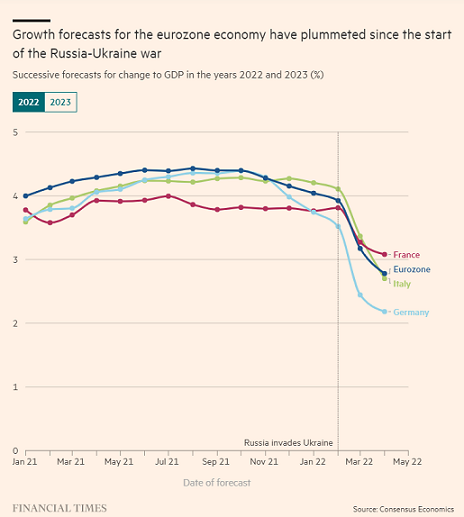
Allo scopo di fare proprio questo, Recce’d ha selezionato per i suoi lettori un recente articolo del Financial Times, che vi aiuterà a capire in che modo siamo tuti costretti a modificare i numeri, le stime e le previsioni per le economie europee, e quindi per conseguenza anche per i mercati finanziari europei.

Nell’articolo scritto da Martin Wolf potrete leggere in particolare le ragioni per le quali, per l’Europa, le conseguenze della guerra in Ucraina sono economiche ma anche politiche e morali.


How should the EU manage the economic costs of Vladimir Putin’s war? That is not the same as minimising those costs. This is a war, one on which the future of Europe, perhaps of democracy itself, will depend. In such times, the aim of economic policy is to support the war effort. Policy should seek to maximise costs to the aggressor relative to those to the EU, particularly to its most vulnerable citizens. How should this be done? If we are to think about this question, we need an analytical framework. Olivier Blanchard, former chief economist of the IMF, and Jean Pisani-Ferry provide that in a recent paper.

They list three challenges: first, “How best to use sanctions to deter Russia, while limiting adverse effects on the EU economy”; second, how to deal with cuts to real incomes that result from the rise in the cost of energy imports; and, third, how to manage the increased inflation caused by higher energy and food prices, which has come on top of the post-Covid surge in inflation. Needless to say, any such analysis is provisional. In times of war, the future is even more uncertain than usual. (See charts.)

On the impact of sanctions on Russia, consider a recent comment by Rystad Energy: “Despite the severe oil production cuts expected in Russia this year, tax revenue will increase significantly to more than $180bn due to the spike in oil prices . . . This is 45 per cent and 181 per cent higher than in 2021 and 2020, respectively.”

This is not to deny the damage done by sanctions: the IMF forecasts that Russia’s economy will shrink by 8.5 per cent this year. But it means that higher prices are more than offsetting reductions in volumes. Consumers are suffering, but they are also financing the invasion of Ukraine.

This is bad policy. The aim must at the least be to lower the revenue Russia receives from its exports, not increase it. A number of economists have considered what this might require.

Seven points emerge from their analyses.

  1. First, the EU’s vulnerability to Russia, but also power over it, is greater in gas than oil, because gas depends more on a fixed infrastructure. That makes diversification of sales by Russia (though also of purchases by the EU) more difficult.

  2. Second, the most effective way to lower revenue to Russia is not an embargo but a punitive tax or tariff, which should shift Putin’s “energy rent” to consumers.

  3. Third, imposing tariffs would generate revenue that can be used to help those suffering losses in real incomes at present.

  4. Fourth, a tax imposed by the EU alone on Russian exports would achieve more in gas than in oil, because of the greater difficulty of diversifying gas exports.

  5. Fifth, trade sanctions would be more effective the greater the number of participating countries.

  6. Sixth, one might extend sanctions on oil by placing sanctions on shipping. Finally, the cost of such measures to Russia would be a large multiple of their costs to the EU and allies. Reaching consensus on effective measures is hard, but crucial.

A way has to be found to shift more of the revenue of Russian exports to consuming countries. Yet, whatever is done on that, there will be significant costs to wealthy importing countries from the war: increased spending on defence; greater spending on energy infrastructure; assistance to refugees; and, not least, substantial support for hard-hit developing countries. Inevitably, the salient political issue will be how to cushion the blow to domestic consumers.

Should this be done via subsidies on energy, transfer payments or price controls? A big part of the answer depends on the sanctions regime that is adopted. But the general point is that subsidies will tend to offset sanctions by increasing consumption rather than reducing it. It would be better to increase transfers of purchasing power to vulnerable households, leaving them to decide how to spend it.

Price controls on oil were a disaster in the 1970s. I can see no good reason why they would do any better now. If one wants to limit windfall profits, it would be better to tax them. How, also ask Blanchard and Pisani-Ferry, should transfers or other spending measures be financed? Since a war is a short-term emergency, the case for additional government borrowing is strong.

Moreover, at current long-term interest rates (still very low) and prospective increases in nominal gross domestic product (boosted by inflation), extra debt would be affordable.

This then raises the issue of monetary policy. The impact of the war is to strengthen upward pricing pressures, risking an inflationary wage-price spiral, while simultaneously weakening demand as real incomes are squeezed. Blanchard and Pisani-Ferry suggest these two effects offset each other. In that case, they argue, monetary policy should remain on the tightening path laid out before the Russian invasion. But they also suggest fiscal measures might be targeted at lowering price inflation, so reducing the risks of the wage-price spiral. They also suggest that such fiscal measures could be brought into the wage-bargaining process directly. I am sceptical. Yet it just might work in northern Europe.

The conclusion I draw from these analyses is that the war is a significant economic shock, but it is very much more a political and moral one. A brutal conflict has come to Europe of a kind not seen since the second world war, and even where some of its worst atrocities occurred. For Germany in particular, it is a moment of challenge and opportunity. The challenge is to defend Europe’s liberal civilisation. The opportunity is for historic redemption. Russia must not prevail. This is what matters most. There will indeed be pain. But it must be borne for a far greater cause.

martin.wolf@ft.com Follow Martin Wolf with myFT and on Twitter

Perché c'è una tigre nella piscina?
 

Nella nostra Lettera al Cliente di oggi, abbiamo analizzato i fatti dell’ultima, confusa e persino caotica, settimana dei mercati finanziari.

In modo particolare, abbiamo messo in evidenza i cambiamenti, significativi, che noi abbiamo rilevato, nel comportamento dei mercati finanziari, e quindi degli investitori, nelle ultime cinque sedute.

Cambiamenti che, come abbiamo illustrato nella Lettera, determineranno presto un cambiamento, probabilmente molto ampio, dei nostri portafogli modello.

In questo Post, noi portiamo all’attenzione di tutti i lettori un tema di mercato che, fino ad oggi, non abbiamo ancora letto sulle prime pagine dei quotidiani, e non abbiamo ancora ascoltato a CNBC.

Noi siamo però del parere che, nei mesi restanti del 2022, e nel 2023, questo argomento acquisterà progressivamente importanza, fino a diventare centrale.

Recce’d ne aveva già scritto, e solo pochi giorni fa (prima della riunione della Federal Reserve) anche qui, nel nostro Blog. Potete leggere quel Post cliccando qui.

Di questo argomento, Recce’d scrive in modo più specifico in un altro Post pubblicato oggi. In questo Post che state leggendo, invece, richiamiamo la vostra attenzione su un fatto concreto dell’ultima settimana che a molti di voi è sfuggito e che funziona come spunto.

Come dice il titolo di questo Post, c’è una tigre sott’acqua in piscina: fuori di metafora, questo significa che uno dei più grandi Fondi Hedge del Pianeta è in (forte) difficoltà, come potete leggere nell’immagine che trovate qui sopra.

Nei primi 4 mesi del 2021, il valore di questo Fondo è sceso di oltre il 50%.

C’è un grande numero di temi, che si dovrebbero affrontare prendendo spunto da questa notizia, notizia che, lo ripetiamo, riguarda uno dei più acclamati, e grandi, Fondi Hedge del Mondo.

Molti di questi argomenti (dalla gestione del rischio alla composizione del portafoglio all’utilizzo della leva) noi li affronteremo anche nella nuova pagina del sito che si chiama GESTIONE DI PORTAFOGLIO).

Oggi nel Post ci fermiamo al caso specifico. e chiediamo, ai nostri lettori, se ricordano LTCM. Oppure, se ricordano il Fondo di Goldman Sachs che si chiamava Global Alpha.

Sono vicende del 1998, e poi del 2006, che influenzarono l’intero mercato finanziario globale: azioni, obbligazioni, valute e materie prime.

I nostri lettori che non ricordano questi episodi, farebbero bene a fare un’indagine al proposito sul Web, e poi ad informarsi di altri episodi analoghi.

Perché diamo al lettore questa indicazione oggi? Lo leggete sotto, nell’immagine che chiude il Post.

Per ottenere la pace è necessaria la resa incondizionata
 

Nella nostra Lettera al Cliente di oggi, abbiamo analizzato i fatti dell’ultima, confusa e persino caotica, settimana dei mercati finanziari.

In modo particolare, abbiamo messo in evidenza i cambiamenti, significativi, che noi abbiamo rilevato, nel comportamento dei mercati finanziari, e quindi degli investitori, nelle ultime cinque sedute.

Cambiamenti che, come abbiamo illustrato nella Lettera, determineranno presto un cambiamento, probabilmente molto ampio, dei nostri portafogli modello.

In questo Post, ripercorriamo per voi i fatti principali dell’ultima settimana.

L’immagine qui sopra ci ricorda che, nella serata italiana del mercoledì 4 maggio 2022, la Federal Reserve si è presentata in pubblico sostenendo che “un aumento di 0,50% oggi è sufficiente”.

Quella scelta ha provocato una reazione dei mercati molto significativa. non subito, ma nella seduta seguente.

Ve lo raccontiamo con l’immagine qui sotto.

Che cosa ci trovate, di notevole, in questi fatti? Noi (insieme con Bloomberg, da cui abbiamo preso a prestito l’immagine che segue) ci abbiamo visto una situazione di conflitto tra i mercati finanziari e la Banca Centrale americana.

E questa è una novità, dopo 15 anni di “amore corrisposto”.

Da quel momento, sui mercati finanziari i temi dominanti sono cambiati: come ci aiuta a sintetizzare l’immagine che segue, i temi dominanti tra gli operatori di mercato sono diventati:

  • la liquidità; e

  • le situazioni di stress.

E questa è la seconda novità, che dovete aggiungere alla precedente.

Il contesto, per chi investe e per chi opera sui mercati finanziari, è quindi cambiato.

Il che non dovrebbe sorprendere, visto che erano trascorsi 22 anni dall’ultimo aumento dello 0,50% dei tassi ufficiali di interesse negli Stati Uniti. Noi di Recce’d condividiamo il parere che leggete qui sotto, nell’immagine: sotto i vostri ed i nostri occhi, si sta facendo la Storia. Forse, non soltanto la Storia dei mercati finanziari.

Non dimenticatelo, quando pensate ai vostri attuali investimenti di portafoglio: questo, non è “normale”.

Come abbiamo messo in evidenza poco sopra, la Federal Reserve oggi si trova sotto attacco: da parte dei mercati finanziari, ma pure da parte di chi, solo pochi giorni fa, ne era il Vice-Presidente. Lo leggete nell’immagine qui sotto.

Noi avevamo anticipato proprio questa situazione, di cui tutti oggi leggete sui giornali (e di cui tutti, ma proprio tutti gli investitori subiscono le conseguenze, nel 2020 ed in più di una occasione.

A questo punto, vi diamo il nostro parere: come possono BCE e Federal Reserve togliersi da questa scomodissima situazione di impotenza e replicare agli attacchi che ormai ricevono da ogni parte?

A nostro giudizio, c’è un solo modo: devono arrendersi.

Devono arrendersi, senza condizioni, all’evidenza dei fatti.

Il che significa due cose:

  1. ammettere di avere sbagliato: ammettere che le loro scelte di politica economica hanno danneggiato le economie; e poi

  2. (la parte che a noi interessa più da vicino) ammettere di avere pompato i prezzi degli asset finanziari a livelli ingiustificati, ed insostenibili.

Fino a che non leggerete queste ammissioni, la situazione di tensione e tumulto sui mercati finanziari continuerà. Lo scriveva anche, in settimana, il Financial Times, come leggete nell’immagine sotto.

Esempi concreti a disposizione, per la BCE e per la Federal Reserve, ce ne sono pochi. Ma esistono: ce lo ricorda qui sotto l’immagine, e anche noi vi invitiamo ad andare a leggere il testo segnalato qui (dal sito della Banca di Inghilterra).

Quel testo è un punto di riferimento, oggi, per noi investitori: e ce ne sono pochi in giro. nel tono, nel contenuto e nella franchezza.

Come si dice qui sotto, nell’immagine che chiude questo Post: “I mercati finanziari usciranno dal panico quando le Banche Centrali entreranno nel panico”.

A giudizio di Recce’d, quel momento potrebbe non essere lontano.

A giudizio di Recce’d, la conseguente uscita dei mercati finanziari dal panico potrebbe farsi aspettare, questa volta, un po’ più che nei più recenti episodi.

Per immaginare che cosa potrebbe succede, noi di Recce’d pensiamo che è necessario trovare riferimenti in un passato un po’ più lontano da noi.

Come vi avevamo scritto già mese di agosto del 2020.

Di-stress credit
 

Nella nostra Lettera al Cliente di oggi, abbiamo analizzato i fatti dell’ultima, confusa e persino caotica, settimana dei mercati finanziari.

In modo particolare, abbiamo messo in evidenza i cambiamenti, significativi, che noi abbiamo rilevato, nel comportamento dei mercati finanziari, e quindi degli investitori, nelle ultime cinque sedute.

Cambiamenti che, come abbiamo illustrato nella Lettera, determineranno presto un cambiamento, probabilmente molto ampio, dei nostri portafogli modello.

In questo Post, noi portiamo all’attenzione di tutti i lettori un tema di mercato che, fino ad oggi, non abbiamo ancora letto sulle prime pagine dei quotidiani, e non abbiamo ancora ascoltato a CNBC.

Noi siamo però del parere che, nei mesi restanti del 2022, e nel 2023, questo argomento acquisterà progressivamente importanza, fino a diventare centrale.

Recce’d ne aveva già scritto, e solo pochi giorni fa (prima della riunione della Federal Reserve) anche qui, nel nostro Blog. Potete leggere quel Post cliccando qui.

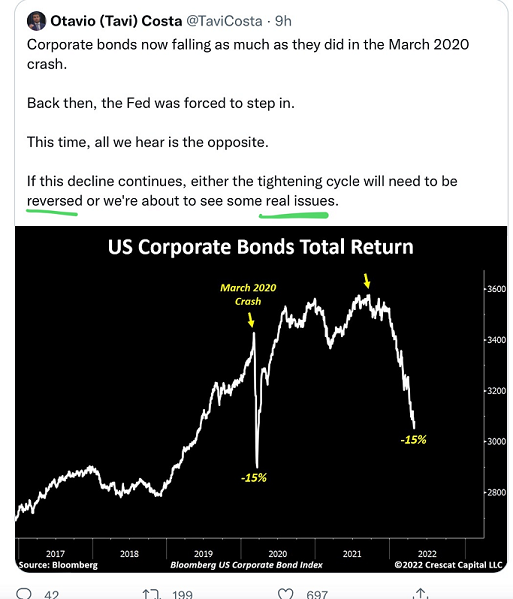
Oggi, Recce’d vi suggerisce di leggere con attenzione questo articolo che noi per voi abbiamo selezionato dal Financial Times, e i dati che trovate nell’articolo e nel grafico che segue.


Investors have started backing away from the riskiest corporate bonds in the US, with the amount of debt that trades at distressed levels doubling since the start of the year. The value of junk bonds trading for 70 cents on the dollar or less, considered a sign of distress and a warning that a company may struggle to repay debts, has climbed to $27bn from about $14bn at the end of 2021, according to FT calculations based on a widely watched index run by Ice Data Services.

The increase reflects a more hawkish Federal Reserve, which first lifted interest rates in March and is expected to do so again on Wednesday, the beginning of a forecast string of rate rises meant to combat US inflation. The central bank’s pivot also comes alongside the war in Ukraine and slowing global growth, clouding the picture for more indebted companies that may struggle to refinance their borrowings at higher interest rates.

Marty Fridson, chief investment officer of Lehmann Livian Fridson Advisors, said that while the amount of debt trading at distressed levels remained low, “it’s starting to move up, and I would expect it to continue to rise. That’s significant.” Further monetary tightening by the Fed will push more debt into the distressed zone, he added.

The accumulation of distressed debt outstanding comes after the worst month for the US high-yield bond market since the coronavirus pandemic-triggered sell-off in March 2020, with an Ice Data Services index down 3.6 per cent in April.

Another measure of distress — the share of debt trading with a yield of 10 percentage points or more above equivalent US government bonds — has also risen, led by consumer and communications companies, according to data from UBS. Retail technology company Diebold Nixdorf’s bonds maturing in 2024 slid sharply in April, pushing up its yield from about 10 per cent at the start of that month to 27 per cent on Tuesday. The yield on pharmacy chain Rite Aid’s $850mn bond maturing in 2026 has been rising all year, reaching close to 13 per cent on Tuesday, up from about 7.3 per cent at the end of 2021.

Some investors remain sanguine about the risks ahead, noting that many lower-rated companies have taken the opportunity to raise cash, extending the maturity of their debt and making them less reliant on new money. However, UBS analyst Matt Mish noted the number of companies that face elevated borrowing costs increases sharply for bonds trading above an all-in yield of 10 per cent. More than 8 per cent of the US high-yield bond market is now above this level. “The weakness is broadening out,” he said. “It tells you that at the margin, this is not just a rates issue, it’s also a credit issue. There are not many companies that can finance at north of 10 per cent for a sustained period of time.”