
Per ottenere la pace è necessaria la resa incondizionata
 

Nella nostra Lettera al Cliente di oggi, abbiamo analizzato i fatti dell’ultima, confusa e persino caotica, settimana dei mercati finanziari.

In modo particolare, abbiamo messo in evidenza i cambiamenti, significativi, che noi abbiamo rilevato, nel comportamento dei mercati finanziari, e quindi degli investitori, nelle ultime cinque sedute.

Cambiamenti che, come abbiamo illustrato nella Lettera, determineranno presto un cambiamento, probabilmente molto ampio, dei nostri portafogli modello.

In questo Post, ripercorriamo per voi i fatti principali dell’ultima settimana.

L’immagine qui sopra ci ricorda che, nella serata italiana del mercoledì 4 maggio 2022, la Federal Reserve si è presentata in pubblico sostenendo che “un aumento di 0,50% oggi è sufficiente”.

Quella scelta ha provocato una reazione dei mercati molto significativa. non subito, ma nella seduta seguente.

Ve lo raccontiamo con l’immagine qui sotto.

Che cosa ci trovate, di notevole, in questi fatti? Noi (insieme con Bloomberg, da cui abbiamo preso a prestito l’immagine che segue) ci abbiamo visto una situazione di conflitto tra i mercati finanziari e la Banca Centrale americana.

E questa è una novità, dopo 15 anni di “amore corrisposto”.

Da quel momento, sui mercati finanziari i temi dominanti sono cambiati: come ci aiuta a sintetizzare l’immagine che segue, i temi dominanti tra gli operatori di mercato sono diventati:

  • la liquidità; e

  • le situazioni di stress.

E questa è la seconda novità, che dovete aggiungere alla precedente.

Il contesto, per chi investe e per chi opera sui mercati finanziari, è quindi cambiato.

Il che non dovrebbe sorprendere, visto che erano trascorsi 22 anni dall’ultimo aumento dello 0,50% dei tassi ufficiali di interesse negli Stati Uniti. Noi di Recce’d condividiamo il parere che leggete qui sotto, nell’immagine: sotto i vostri ed i nostri occhi, si sta facendo la Storia. Forse, non soltanto la Storia dei mercati finanziari.

Non dimenticatelo, quando pensate ai vostri attuali investimenti di portafoglio: questo, non è “normale”.

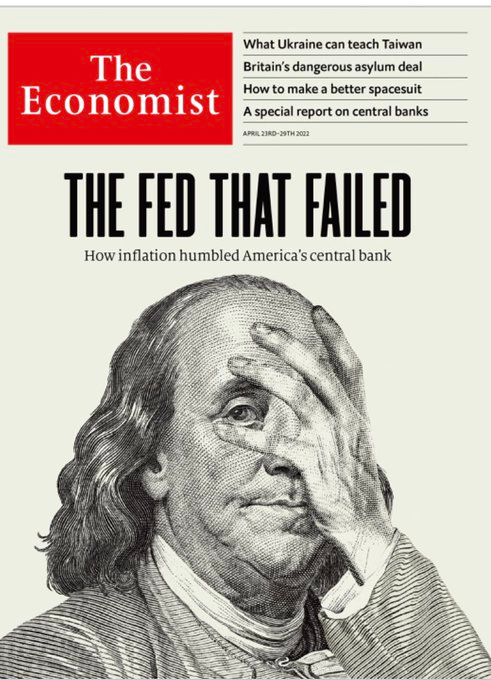
Come abbiamo messo in evidenza poco sopra, la Federal Reserve oggi si trova sotto attacco: da parte dei mercati finanziari, ma pure da parte di chi, solo pochi giorni fa, ne era il Vice-Presidente. Lo leggete nell’immagine qui sotto.

Noi avevamo anticipato proprio questa situazione, di cui tutti oggi leggete sui giornali (e di cui tutti, ma proprio tutti gli investitori subiscono le conseguenze, nel 2020 ed in più di una occasione.

A questo punto, vi diamo il nostro parere: come possono BCE e Federal Reserve togliersi da questa scomodissima situazione di impotenza e replicare agli attacchi che ormai ricevono da ogni parte?

A nostro giudizio, c’è un solo modo: devono arrendersi.

Devono arrendersi, senza condizioni, all’evidenza dei fatti.

Il che significa due cose:

  1. ammettere di avere sbagliato: ammettere che le loro scelte di politica economica hanno danneggiato le economie; e poi

  2. (la parte che a noi interessa più da vicino) ammettere di avere pompato i prezzi degli asset finanziari a livelli ingiustificati, ed insostenibili.

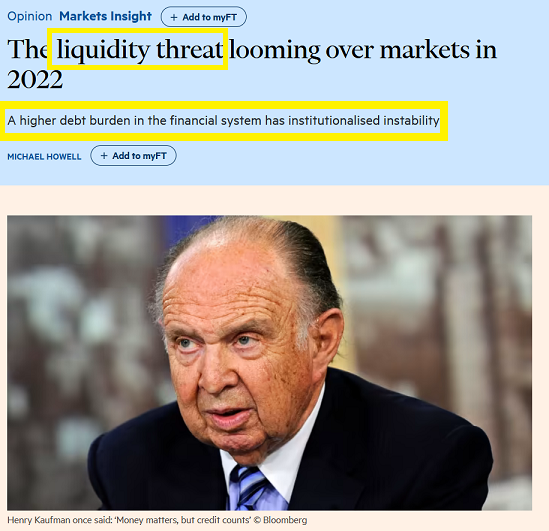
Fino a che non leggerete queste ammissioni, la situazione di tensione e tumulto sui mercati finanziari continuerà. Lo scriveva anche, in settimana, il Financial Times, come leggete nell’immagine sotto.

Esempi concreti a disposizione, per la BCE e per la Federal Reserve, ce ne sono pochi. Ma esistono: ce lo ricorda qui sotto l’immagine, e anche noi vi invitiamo ad andare a leggere il testo segnalato qui (dal sito della Banca di Inghilterra).

Quel testo è un punto di riferimento, oggi, per noi investitori: e ce ne sono pochi in giro. nel tono, nel contenuto e nella franchezza.

Come si dice qui sotto, nell’immagine che chiude questo Post: “I mercati finanziari usciranno dal panico quando le Banche Centrali entreranno nel panico”.

A giudizio di Recce’d, quel momento potrebbe non essere lontano.

A giudizio di Recce’d, la conseguente uscita dei mercati finanziari dal panico potrebbe farsi aspettare, questa volta, un po’ più che nei più recenti episodi.

Per immaginare che cosa potrebbe succede, noi di Recce’d pensiamo che è necessario trovare riferimenti in un passato un po’ più lontano da noi.

Come vi avevamo scritto già mese di agosto del 2020.

Di-stress credit
 

Nella nostra Lettera al Cliente di oggi, abbiamo analizzato i fatti dell’ultima, confusa e persino caotica, settimana dei mercati finanziari.

In modo particolare, abbiamo messo in evidenza i cambiamenti, significativi, che noi abbiamo rilevato, nel comportamento dei mercati finanziari, e quindi degli investitori, nelle ultime cinque sedute.

Cambiamenti che, come abbiamo illustrato nella Lettera, determineranno presto un cambiamento, probabilmente molto ampio, dei nostri portafogli modello.

In questo Post, noi portiamo all’attenzione di tutti i lettori un tema di mercato che, fino ad oggi, non abbiamo ancora letto sulle prime pagine dei quotidiani, e non abbiamo ancora ascoltato a CNBC.

Noi siamo però del parere che, nei mesi restanti del 2022, e nel 2023, questo argomento acquisterà progressivamente importanza, fino a diventare centrale.

Recce’d ne aveva già scritto, e solo pochi giorni fa (prima della riunione della Federal Reserve) anche qui, nel nostro Blog. Potete leggere quel Post cliccando qui.

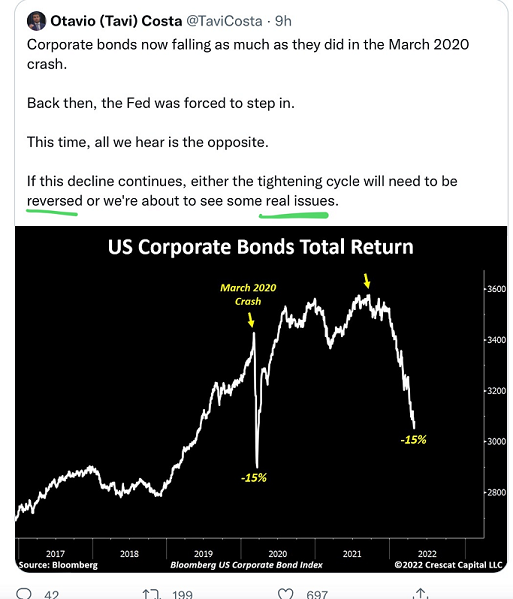
Oggi, Recce’d vi suggerisce di leggere con attenzione questo articolo che noi per voi abbiamo selezionato dal Financial Times, e i dati che trovate nell’articolo e nel grafico che segue.


Investors have started backing away from the riskiest corporate bonds in the US, with the amount of debt that trades at distressed levels doubling since the start of the year. The value of junk bonds trading for 70 cents on the dollar or less, considered a sign of distress and a warning that a company may struggle to repay debts, has climbed to $27bn from about $14bn at the end of 2021, according to FT calculations based on a widely watched index run by Ice Data Services.

The increase reflects a more hawkish Federal Reserve, which first lifted interest rates in March and is expected to do so again on Wednesday, the beginning of a forecast string of rate rises meant to combat US inflation. The central bank’s pivot also comes alongside the war in Ukraine and slowing global growth, clouding the picture for more indebted companies that may struggle to refinance their borrowings at higher interest rates.

Marty Fridson, chief investment officer of Lehmann Livian Fridson Advisors, said that while the amount of debt trading at distressed levels remained low, “it’s starting to move up, and I would expect it to continue to rise. That’s significant.” Further monetary tightening by the Fed will push more debt into the distressed zone, he added.

The accumulation of distressed debt outstanding comes after the worst month for the US high-yield bond market since the coronavirus pandemic-triggered sell-off in March 2020, with an Ice Data Services index down 3.6 per cent in April.

Another measure of distress — the share of debt trading with a yield of 10 percentage points or more above equivalent US government bonds — has also risen, led by consumer and communications companies, according to data from UBS. Retail technology company Diebold Nixdorf’s bonds maturing in 2024 slid sharply in April, pushing up its yield from about 10 per cent at the start of that month to 27 per cent on Tuesday. The yield on pharmacy chain Rite Aid’s $850mn bond maturing in 2026 has been rising all year, reaching close to 13 per cent on Tuesday, up from about 7.3 per cent at the end of 2021.

Some investors remain sanguine about the risks ahead, noting that many lower-rated companies have taken the opportunity to raise cash, extending the maturity of their debt and making them less reliant on new money. However, UBS analyst Matt Mish noted the number of companies that face elevated borrowing costs increases sharply for bonds trading above an all-in yield of 10 per cent. More than 8 per cent of the US high-yield bond market is now above this level. “The weakness is broadening out,” he said. “It tells you that at the margin, this is not just a rates issue, it’s also a credit issue. There are not many companies that can finance at north of 10 per cent for a sustained period of time.”

La Federal Reserve del 4 maggio 2022: la parola chiave è "credito"
 

Saremo sintetici, in questo Post.

Non possiamo, ed al tempo stesso non intendiamo, fornire troppi dettagli.

Qui Recce’d vi parla dell’elemento chiave per l’evoluzione dei mercati finanziari nel 2022, e quindi inevitabilmente vi parla della nostra strategia di investimento, di come sono costruiti oggi i portafogli dei Clienti di Recce’d, e di quali mosse di portafoglio stiamo per fare, forse già questa settimana.

Alcune di queste cose, è giusto riservarle ai nostri Clienti, alle persone che con le loro commissioni contribuiscono a sostenere i nostri sforzi e fare crescere le nostre attività.

Al tempo stesso, come sempre abbiamo fatto, vogliamo regalare ai nostri lettori utili elementi di informazione, valutazione giudizio.

I lettori, poi ne faranno l’uso migliore per il loro interesse. mentre per i nostri Clienti noi, successivamente, metteremo in pratica quelle mosse di portafoglio che ci consentiranno di beneficiare di ciò che qui viene chiaramente illustrato.

Oggi 2 maggio 2022, la forte convinzione del team di gestione di Recce’d è che la parole chiave sia “credito”: una parola, un termine, che oggi 2 maggio 2022, non è ancora comparso, sulle prime pagine dei quotidiani, al TG Economia, e su CNBC.

La nostra forte convinzione è che con il passare delle settimane l’utilizzo del termine “credito” diventerà via via più frequente, da parte dei media.

In quel momento, sapremo, e saprete anche voi, che la attuale fase di mercato è entrata nella sua fase finale.

Allo scopo di spiegare al lettore perché noi la vediamo in questo modo, abbiamo selezionato un articolo che lo spiega in modo chiaro, che per tutti è leggibile qui di seguito.

La cosa più interessante di questo articolo? Che fu pubblicato il 16 dicembre 2021, ovvero quattro mesi e messo fa.

E noi di Recce’d lo abbiamo, intenzionalmente, riservato per pubblicarlo al momento giusto. Che è questo.


The writer is managing director at Crossborder Capital and author of ‘Capital Wars: The Rise of Global Liquidity’

After nearly two years of solid gains across stock markets, will the feared roller-coaster return? The answer is yes, due to higher debt levels, the tapering of central banks’ liquidity support for markets and the growth of indexation.

Only two things really matter in investment: how much money there is in the system and how it is deployed. Recently surging equity prices once again confirm that both are highly elastic concepts. Some may argue this has always been the case. Fine, but we should ask whether we have reached the point where this elasticity is becoming a far bigger and more institutionalised problem. I think it has.

We calculate that global liquidity — the volume of cash and credit shifting around world financial markets — is testing $172tn. This figure is a stock of all sources of liquidity, including from central banks, traditional commercial banks and the so-called shadow banks that supply short-term debt and currency derivatives.

It echoes the words of Henry Kaufman, Salomon Brothers’ former economist: “Money matters, but credit counts.”

Since the financial crisis, the US and China have been the two dominant liquidity providers, but because China’s international financial footprint is small, America’s actions matter far more for global markets, particularly during crises. Consider the importance of the dollar funding worldwide and the extension of lines of support between central banks to provide access to facilities backed by the US currency during the Covid-19 emergency.

According to our calculations, these actions, together with a near-60 per cent jump in the size of central bank balance sheets to more than $30tn, have fuelled the 30 per cent rise in global liquidity since early 2020. Yet these figures are still overshadowed by a huge debt pile that we now estimate exceeds $300tn — an eye-watering three times GDP — that burdens the world economy. The problem is that debt ultimately has to be repaid or, more likely, rolled over. Taking an average debt maturity of five years implies a $60tn annual refinancing problem that requires balance sheet capacity, or, in other words, liquidity.

This means the modern financial cycle gyrates with the tempo of debt maturities. More liquidity requires more debt as collateral, and more debt needs more liquidity for refinancing. Policymakers seem stuck in this cycle. They keep policy interest rates low and, thereby, encourage still more borrowing, but, often in the same breath, they threaten to withdraw liquidity through so-called quantitative tightening or tapering measures. Several of the world’s key central banks, including the US Federal Reserve, the linchpin of the global monetary system, plan to reduce their quantitative easing programmes next year. Some have already started.

Less liquidity makes it more difficult to roll over existing debts. Meanwhile, capital markets have lately turned into large-scale debt refinancing mechanisms, easily eclipsing their textbook role of funding new capital projects. The result is a dizzying spiral of debt, with central banks forced to respond by quickly restarting their quantitative easing programmes to support markets with asset buying whenever financial instability threatens. Consider the policy responses to the 2008, 2010, 2019 and 2020 market sell-offs, and the support given through the colourfully dubbed “Greenspan, Bernanke and Yellen Puts”, after successive Fed chairs.

A renewed dose of QE, or a “Powell Put”, seems the inevitable remedy for the next stock market sell-off. In short, future growth of global liquidity has seemingly become institutionalised by these debt burdens. The irony is that when the Fed’s cash flows through the system, it often gets forced into a narrow list of often-illiquid securities and has an outsized effect on prices. It drives indices across asset classes substantially higher and compels other investors to chase prices upwards, which magnifies its impact. Many of the largest investment managers now track these indices across both bonds and equities.

About half the assets under management in US equity funds passively track indices such as the S&P 500, according to Bloomberg Intelligence. Traditional valuation metrics play no role in their decisions. Unless the spiral is broken by higher interest rates, global liquidity will ultimately bound higher. At the same time, asset allocation has been put on a potentially self-destructive autopilot that ignores sensible investment criteria, so that money is focused on the largest stocks, driving their valuations and sometimes even their owners towards the moon.

La Federal Reserve del 4 maggio 2022: in quale scenario?

Come abbiamo scritto in più e più occasioni, la Federal Reserve è passata nello spazio di soli due anni da una situazione di (apparente) onnipotenza, ovvero dal potere agire senza alcun limite e al di fuori di qualsiasi controllo, ad una situazione di pressoché totale impotenza, una situazione nella quale la Fed non ha più spazi di manovra e può fare soltanto più ciò che è COSTRETTA a fare.

Costretta da qualcuno? No. E’ costretta dalla realtà. Dalla realtà dei fatti, che intorno a lei, intorno alla Fed, si è trasformata con una tale rapidità che prima la Fed non è riuscita a capire, a comprendere, e poi non è riuscita a seguire.

Per questo, adesso, è costretta: è costretta a rincorrere, può solo rincorrere, ha una sola strada davanti da percorrere.

Oggi, quelli che sono stati (per pochi mesi) gli Onnipotenti vengono trascinati al laccio, come animali da bestiame.

Le scelte che la Fed oggi può fare, e che inevitabilmente farà, sono solo quelle del linguaggio: scelte che hanno ed avranno pochissimo impatto sulla realtà, in futuro, ma che potrebbero averne uno (anche molto grande) sulla psicologia del pubblico, e degli investitori in particolare nell’immediato. Lo abbiamo già messo in evidenza in un Post di sabato 30 aprile qui nel Blog.

Le scelte di linguaggio della Federal Reserve, dopodomani, potrebbero muovere i mercati finanziari: anche se soltanto nel brevissimo termine.

A nostro avviso, molto dipenderà dal tipo di scenario, dal tipo di prospettiva di medio termine che verrà scelta dal Consiglio della Federal Reserve per presentare le proprie scelte in materia di tassi ufficiali di interesse e di riduzione dell’attivo.

Per questa ragione, noi suggeriamo ai nostri lettori di leggere con attenzione l’articolo che noi abbiamo selezionato e che alleghiamo qui per intero.

Vi suggeriamo non soltanto di leggere questo articolo, ma pure di prendere nota con carta e penna dei temi che in questo articolo vengono toccati: si tratta solo in apparenza di tematiche lontane che resto sullo sfondo delle decisioni di investimento.

Al contrario, noi crediamo che mercoledì saranno proprio questi temi a segnare la reazione dei mercati: la Federal Reserve sicuramente li prenderà in esame, e (noi crediamo) li utilizzerà poi per comunicare. la Fed li utilizzerà come “paletti” per delimitare un perimetro, per comunicare al pubblico “noi alziamo il costo del denaro, ma lo facciamo all’interno di un perimetro ben delimitato, per questa e quest’altra ragione”.

Lo scopo? Allontanare dalla mente dell’investitore i dubbi sulla consapevolezza della stessa Fed in questa fase.

Ed in particolare, allontanare il dubbio che gli uomini della Fed abbiamo, molto semplicemente, perso il controllo delle cose.

Passando così da Onnipotenti a Ostaggi della situazione.

While recent shocks have made the current inflationary surge and growth slowdown more acute, they are hardly the global economy’s only problems. Even without them, the medium-term outlook would be darkening, owing to a broad range of economic, political, environmental, and demographic trends.

The new reality with which many advanced economies and emerging markets must reckon is higher inflation and slowing economic growth. And a big reason for the current bout of stagflation is a series of negative aggregate supply shocks that have curtailed production and increased costs.

This should come as no surprise. The COVID-19 pandemic forced many sectors to lock down, disrupted global supply chains, and produced an apparently persistent reduction in labor supply, especially in the United States. Then came Russia’s invasion of Ukraine, which has driven up the price of energy, industrial metals, food, and fertilizers. And now, China has ordered draconian COVID-19 lockdowns in major economic hubs such as Shanghai, causing additional supply-chain disruptions and transport bottlenecks.

But even without these important short-term factors, the medium-term outlook would be darkening.

There are many reasons to worry that today’s stagflationary conditions will continue to characterize the global economy, producing higher inflation, lower growth, and possibly recessions in many economies.

For starters, since the global financial crisis, there has been a retreat from globalization and a return to various forms of protectionism. This reflects geopolitical factors and domestic political motivations in countries where large cohorts of the population feel “left behind.” Rising geopolitical tensions and the supply-chain trauma left by the pandemic are likely to lead to more reshoring of manufacturing from China and emerging markets to advanced economies – or at least near-shoring (or “friend-shoring”) to clusters of politically allied countries. Either way, production will be misallocated to higher-cost regions and countries.

Moreover, demographic aging in advanced economies and some key emerging markets (such as China, Russia, and South Korea) will continue to reduce the supply of labor, causing wage inflation. And because the elderly tend to spend savings without working, the growth of this cohort will add to inflationary pressures while reducing the economy’s growth potential.

The sustained political and economic backlash against immigration in advanced economies will likewise reduce labor supply and apply upward pressure on wages. For decades, large-scale immigration kept a lid on wage growth in advanced economies. But those days appear to be over.

Similarly, the new cold war between the US and China will produce wide-ranging stagflationary effects. Sino-American decoupling implies fragmentation of the global economy, balkanization of supply chains, and tighter restrictions on trade in technology, data, and information – key elements of future trade patterns.

Climate change, too, will be stagflationary. After all, droughts damage crops, ruin harvests, and drive up food prices, just as hurricanes, floods, and rising sea levels destroy capital stocks and disrupt economic activity. Making matters worse, the politics of bashing fossil fuels and demanding aggressive decarbonization has led to underinvestment in carbon-based capacity before renewable energy sources have reached a scale sufficient to compensate for a reduced supply of hydrocarbons. Under these conditions, sharp energy-price spikes are inevitable. And as the price of energy rises, “greenflation” will hit prices for the raw materials used in solar panels, batteries, electric vehicles, and other clean technologies.

Public health is likely to be another factor. Little has been done to avert the next contagious-disease outbreak, and we already know that pandemics disrupt global supply chains and incite protectionist policies as countries rush to hoard critical supplies such as food, pharmaceutical products, and personal protective equipment.

We must also worry about cyberwarfare, which can cause severe disruptions in production, as recent attacks on pipelines and meat processors have shown. Such incidents are expected to become more frequent and severe over time. If firms and governments want to protect themselves, they will need to spend hundreds of billions of dollars on cybersecurity, adding to the costs that will be passed on to consumers.

These factors will add fuel to the political backlash against stark income and wealth inequalities, leading to more fiscal spending to support workers, the unemployed, vulnerable minorities, and the “left behind.” Efforts to boost labor’s income share relative to capital, however well-intentioned, imply more labor strife and a spiral of wage-price inflation.

Then there is Russia’s war on Ukraine, which signals the return of zero-sum great-power politics. For the first time in many decades, we must account for the risk of large-scale military conflicts disrupting global trade and production. Moreover, the sanctions used to deter and punish state aggression are themselves stagflationary. Today, it is Russia against Ukraine and the West. Tomorrow, it could be Iran going nuclear, North Korea engaging in more nuclear brinkmanship, or China attempting to seize Taiwan. Any one of these scenarios could lead to a hot war with the US.

Finally, the weaponization of the US dollar – a central instrument in the enforcement of sanctions – is also stagflationary. Not only does it create severe friction in international trade in goods, services, commodities, and capital; it encourages US rivals to diversify their foreign-exchange reserves away from dollar-denominated assets. Over time, that process could sharply weaken the dollar (thus making US imports more costly and feeding inflation) and lead to the creation of regional monetary systems, further balkanizing global trade and finance.

Optimists may argue that we can still rely on technological innovation to exert disinflationary pressures over time. That may be true, but the technology factor is far outnumbered by the 11 stagflationary factors listed above. Moreover, the impact of technological change on aggregate productivity growth remains unclear in the data, and the Sino-Western decoupling will restrict the adoption of better or cheaper technologies globally, thereby increasing costs. (For example, a Western 5G system is currently much more expensive than one from Huawei.)

In any case, artificial intelligence, automation, and robotics are not an unalloyed good. If they improve to the point where they can create meaningful disinflation, they also would probably disrupt entire occupations and industries, widening already large wealth and income disparities. That would invite an even more powerful political backlash than the one we have already seen – with all the stagflationary policy consequences that are likely to result.

La Federal Reserve del 4 maggio 2022: qual'è la "destinazione finale" di questo viaggio?
 

Come tutti i lettori del Blog sanno, Recce’d ha smesso di scrivere di Federal Reserve un anno e mezzo fa: in questo ultimo anno e mezzo, sarebbe stato inutile.

Questo perché la Federal Reserve, dalla seconda metà del 2020, per tutto il 2021, e in questo inizio di 2022, è rimasta non soltanto senza parole, ma pure senza strumenti, senza leve, senza armi, senza spazio di manovra. (E la BCE sta messa ancora peggio, e di molto).

E quindi, nell’ultimo anno e mezzo, la Federal Reserve non è mai stata protagonista: ha semplicemente fatto ciò che era costretta a fare, data la situazione (assurda, ai limiti del folle) che lei stessa, la Banca Centrale, aveva contribuito a creare.

Recce’d tutto ciò che aveva da dire in proposito lo aveva chiarito nella parte finale del 2020. E prima ancora, nell’agosto 2020.

E ancora molto tempo prima, pensate: nel 2015. E non in una sola occasione: leggete anche qui.

Oggi, quello che Recce’d scriveva anni fa lo trovate sulla prima pagina dei più autorevoli quotidiani e periodici.

Perché allora, proprio oggi, Recce’d torna a scrivere ai suoi lettori della Federal Reserve?

La ragione è molto semplice: perché adesso la Federal Reserve ritorna a contare. Non tanto sul piano pratico, dove le scelte della Federal Reserve potranno incidere ben poco.

Bensì sul piano della psicologia collettiva. Saranno le parole, più che gli atti, della Federal Reserve, ad incidere.

Dopo avere fatto una drammatica (ed ennesima) “svolta ad U” smentendo sé stessa poche settimane fa, quando ha riconosciuto che l’idea stessa di una “inflazione transitoria” era stata una tragica sciocchezza, adesso la Federal Reserve deve scegliere se continuare a mentire oppure se rispondere con chiarezza, concretezza e in modo esplicito alle domande che con sempre maggiore insistenza i mercati finanziari ed il pubblico dei risparmiatori e consumatori le rivolgono.

Le domande sono molte: anzi, sono decisamente troppe. La scelta della BCE e della Federal Reserve di fare per un anno e mezzo la parte del “pesce in barile” ha prodotto questo accumularsi di domande che ad oggi non hanno una risposta.

Dalla settimana prossima, potremmo vedere un cambiamento proprio da questo punto di vista: la Federal Reserve, costretta dall’urgenza dei fatti, costretta dall’evoluzione della realtà (che prevale sempre sulla fantasia delle persone, delle Banche Centrali, delle banche di investimento, e del vostro private banker, wealth manager, promotore finanziario), potrebbe decidere di cambiare modo, tono e contenuto della propria comunicazione.

Potrebbe decidere di smettere l’atteggiamento del tipo “non ho capito bene …” e passare ad una comunicazione più diretta ed esplicita, e più concreta.

Come già detto, le domande rimaste senza risposta, nell’ultimo anno e mezzo, sono moltissime. per questa ragione, Recce’d dedica in questi giorni una serie di nuovi Post a questo argomento.

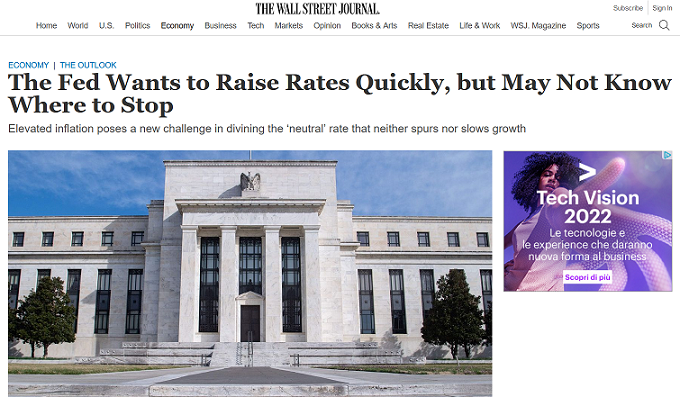
Nel Post che state leggendo, attraverso la lettura di un articolo molto utile della settimana scorsa, pubblicato sul Wall Street Journal, ci occupiamo della seguente domanda: “Di quanto aumenterà il costo del denaro?”.

E’ necessario costruire uno, o più, scenari per rispondere a questa domanda, e in questo articolo ne vengono presentati alcuni.

Noi vogliamo mettere all’attenzione del nostro lettore anche la premessa di questo articolo: “Non sono tempi normali”.

Qualunque valutazione si voglia fare adesso, sia sulla “destinazione finale” dei tassi di interesse, sia sulla “destinazione finale” del vostro portafoglio in titoli, dei vostri asset finanziari, e dei vostri soldi risparmiati, deve necessariamente partire da questa premessa.

Federal Reserve Chairman Jerome Powell is shifting monetary tightening into a higher gear. His goal sounds straightforward—lift interest rates to “neutral,” a setting that neither spurs nor slows growth.

But there’s a catch: Even in normal times, no one knows where this theoretical level is. And these aren’t normal times. There are good reasons to think the ground beneath the central bank’s feet is shifting and that, after accounting for elevated inflation, neutral may be higher than officials’ recent estimates.

At their meeting next month, officials are set to approve plans to shrink their $9 trillion asset portfolio and to raise their benchmark rate by a half percentage point. They are poised to follow with another half-point in June.

“We’re going to be raising rates and getting expeditiously to levels that are more neutral, and then that are actually tightening policy if that turns out to be appropriate, once we get there,” Mr. Powell said during a panel discussion last week.

Key to that strategy will be estimates of the neutral interest rate, a monetary nirvana that balances supply and demand when unemployment is low, the economy is growing steadily, and inflation is stable around the Fed’s 2% objective.

“The Fed only knows where neutral is in retrospect,” said Steven Blitz, chief U.S. economist at research firm TS Lombard.

The nominal neutral rate is arrived at by adding inflation to the inflation-adjusted or real neutral rate. It is real, not nominal, rates that matter for monetary policy.

Because inflation reduces the burden of paying back debt, a positive real rate is necessary to create an incentive to save and a disincentive to borrow, such as for a home or business, thereby slowing economic growth and cooling inflation pressure.

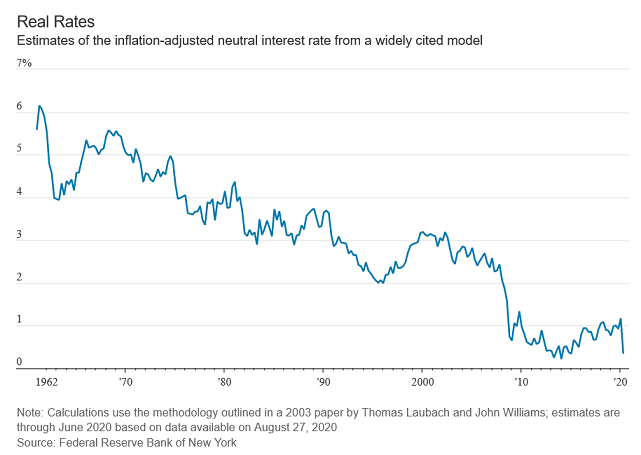
Before the 2008 financial crisis, the nominal neutral rate was widely estimated to be near 4%—a real neutral rate of 2% plus inflation of 2%. Over the subsequent decade Fed officials lowered their estimate of neutral to between 2% and 3% because they thought the real neutral rate needed to keep both growth and inflation stable had dropped.

Officials still think the real neutral rate is low; the question is whether inflation will end up higher than 2%, which would mean a higher nominal neutral rate. If inflation settles out closer to 3%, for example, the nominal neutral rate would be closer to 3.5% than 2.5%, and the Fed might need to raise rates to 4% to actually slow the economy down.

A source of uncertainty is where neutral really is. That depends on where inflation settles out, partly based on factors outside the Fed’s control.

This confronts Fed officials with several questions: How fast to get to neutral; do rates need to go above neutral; and where is neutral?

At present, most think neutral is around 2.25% or 2.5% and rates should get there this year, at which point they can see how the economy responds. Some want to go faster, pushing rates into restrictive territory this year. Others are open to that possibility in 2023.

“I’m optimistic that we can get to neutral, look around, and find that we’re not necessarily that far from where we need to go,” said Chicago Fed President Charles Evans on April 7. By last week, though, he was a little more circumspect: “Probably we are going beyond neutral—that’s my expectation.”

A major source of uncertainty in these scenarios centers on where neutral really is. That depends on where inflation settles out, which partly is based on factors outside of the central bank’s control such as supply chain disruptions from the war in Ukraine and Covid lockdowns in China.

Federal Reserve Chairman Jerome Powell indicated on Thursday that the central bank was likely to raise interest rates by a half percentage point at its meeting in May. Photo: Samuel Corum/Getty Images

Mr. Blitz said the Fed today may find itself in a situation similar to 1978, when it was raising rates aggressively but failing to push real rates up enough to slow the economy.

“They kept thinking, ‘This is enough. This is enough.’ It kept turning out it wasn’t enough,” he said. Today, “the Fed has a lot of catching up to do to tighten financial conditions if the world is not going to come to its rescue.”

In projections released in March, most Fed officials mapped out a cheery scenario in which they raised rates to a roughly neutral rate of around 2.75% by next year. They projected growth over the next three years remains above its 1.8% long-run rate while unemployment holds below the 4% rate officials estimate is consistent with stable prices.

But those projections assume inflation, now above 5% based on the Fed’s preferred index, will revert to a long-run underlying trend rate of 2% without higher unemployment, which has historically been rare.

“The odds of doing what they projected in March are small—maybe 25%,” said Donald Kohn, a former Fed vice chairman.

John Roberts, a former Fed economist who retired last year, laid out two other scenarios in a recent analysis. Under one, the Fed raises rates to nearly 2.5% this year and to 4.25% next year, which brings inflation down to 2.5% by 2025. That would push the unemployment rate up by magnitudes that have only occurred during recessions.

In the other, high inflation through 2022 changes underlying consumer psychology, causing underlying inflation to rise, and the Fed fails to raise rates sufficiently to counteract that, leaving inflation persistently above 3% for the rest of the decade.

The bond market has faced a brutal selloff over the last two months, pushing yields sharply higher, as the Fed promises tighter policy. It could be in for another blow if central bank officials publicly conclude that interest rates need to go even higher than currently anticipated in 2023.

Write to Nick Timiraos at nick.timiraos@wsj.com

Appeared in the April 25, 2022, print edition as '‘Neutral’ Fed Rate Is a Moving Target.

Mercati oggiValter Buffo