
Fight the Fed: per ora siamo 1-1
 

Bond market one, central banks zero. That’s the headline score after a bruising week in global markets forced a policy change in Australia that’s sent ripples across the globe.

Inizia proprio così l’articolo di Bloomberg del quale presentiamo qui sotto il titolo. Banche Centrali zero, mercati delle obbligazioni uno.

Quello era il punteggio di questo match che è appena iniziato fino a mercoledì 3 novembre. Poi, negli ultimi due giorni della settimana, le Banche Centrali hanno pareggiato.

Prima di concentrarci sul pareggio, leggiamo però insieme in che modo i mercati obbligazionari avevano attaccato e messo in difficoltà le Banche Centrali, portandosi in questo modo in vantaggio per uno a zero.

Tutto parte dal fatto che la Banca Centrale australiana ha rinunciato a una politica che fissava i rendimenti delle obbligazioni a breve termine, una scelta che ha fatto salire questi stessi rendimenti di otto volte, rispetto al “tetto” che la Banca Centrale aveva mantenuto in precedenza.

I mercati hanno mandato così, in Australia ma pure in tutto il Mondo, un segnale chiari e forte: chiedono alle Banche Centrali di agire subito, perché non hanno fiducia nella loro capacità di mantenere la promessa di una “inflazione transitoria”.

E qui, eravamo uno a zero mercoledì 3 a metà giornata. E tutto sarebbe potuto succedere nei due giorni successivi.

Bond market one, central banks zero. 

That’s the headline score after a bruising week in global markets forced a policy change in Australia that’s sent ripples across the globe. But market moves in the wake of the decision suggest traders are unsure about just how far they can push the world’s central banks.

Spiraling inflation set the ball rolling for Australia, sparking a selloff in local debt markets that boosted yields more than eight times higher than the central banks’s target. Reserve Bank of Australia Governor Philip Lowe ditched his 0.1% cap on Tuesday, as central bankers worldwide struggle to convince traders and households that they won’t let inflation get out of control. 

The RBA’s climb down in the face of the biggest yield spikes since the 1990s shows how policy makers may struggle to stave off investor demands for action. The Federal Reserve, Bank of England and European Central Bank are among those confronting accelerating bets for tighter monetary policy as they battle to unwind unconventional settings while persuading markets that conventional tools -- benchmark borrowing costs -- will remain near the lower bound for as long as necessary. 

In a statement accompanying the RBA’s decision to end its 20-month experiment with yield control, Lowe acknowledged he was effectively bowing to the market forces. 

“Given that other market interest rates have moved in response to the increased likelihood of higher inflation and lower unemployment, the effectiveness of the yield target in holding down the general structure of interest rates in Australia has diminished,” Lowe said.

Global Waves 

The speed of change in the narrative is remarkable given the RBA just last month reiterated that conditions for a rate increase were unlikely to be met before 2024. 

Still, while Lowe conceded that there is now potential for higher rates in 2023, his insistence on remaining patient led Australian markets to pare back some of the most aggressive bets for early hikes, and spurred some global flattening trades to be wound back also.

Money markets pared bets on an ECB deposit rate hike to 13 basis points by the end of next year, compared with 20 basis points previously. Italian debt, which had led Europe’s recent bond declines, rallied to narrow its premium over German peers by eight basis points, the biggest tightening since February. Traders also shaved 10 basis points from their expectations for BOE tightening by the end of 2022. 

The Fed is expected on Wednesday to announce plans to roll back its stimulus, while the BOE meets Thursday.

When it comes to the central bank tool kit though, Australia’s scrapping of the yield target means the hurdle is much higher for another central bank to adopt the policy in the future. 

‘Important Lessons’

The RBA experience also shows that combining a bond yield target with outcome-based guidance isn’t ideal, because the policy becomes vulnerable to rapid shifts in expectations.  

“The RBA was a pioneer in front-end yield targeting, and the apparent demise of this experiment has important lessons for other central banks,” Krishna Guha, head of central bank strategy at Evercore ISI in Washington, wrote in a note to clients before the meeting.

The central bank’s shift has come amid a faster-than-expected vaccination take up in recent weeks, which allowed Australia’s biggest cities to reopen from their rigid coronavirus lockdowns. Meantime, government support stopped unemployment from climbing to levels the RBA had feared, setting the scene for a robust recovery late this year and into 2022. 

At the same time, short-end yields have been spiking around the globe over the past month, with investors rushing for the exits after deciding that the acceleration in inflation is going to last. Any hint that central banks might still regard the surge in cost pressures as transitory simply fed the fire by igniting fears that policy makers were going to lose control of their economies.  

Benchmark yields at the short end -- those most sensitive to policy rates -- jumped by the most in years for key developed markets. Japan’s were held down as the BOJ maintained its curve control, while Australia’s were the extreme outlier with the biggest increase since 1994 as the RBA’s grip loosened. 

The following table shows the moves in key markets in October, using three-year bonds in Australia where that is the key short-dated security, and two-year notes for the others.

The RBA’s ditching of yield control leaves the Bank of Japan alone among major central banks in still using the policy, after others including the Fed considered it and decided it wasn’t for them. The RBA’s abrupt end is perhaps the only way for a YCC exit, given any signal of such a change would see bond markets rapidly price in the departure.  

“For other central banks that watched the RBA experiment with interest, the takeaway is not encouraging,” Evercore’s Guha added. “Skeptics will see in the RBA experience proof that a yield target is like an FX peg and will always be vulnerable to breaking when the expected rate path shifts in a way that is not consistent with the stated target.”

— With assistance by James Hirai

Il clima sui mercati è poi cambiato, in modo profondo, tra la sera del mercoledì 3 novembre e la sera del venerdì 5 novembre.

In parte, questo cambiamento è derivato dal tono scelto da Jay Powell dopo la conferenza stampa della Federal Reserve, mercoledì nella serata europea.

A questo si è aggiunta il giorno successivo la decisione della Banca di Inghilterra di NON alzare il costo ufficiale del denaro: una decisione che era stata data quasi per certa dai mercati finanziari (sulla base delle anticipazioni filtrate proprio dall’interno della Banca di Inghilterra).

Questa decisione, questo mancato rialzo, ha suscitato un clamore enorme, in tutto il Mondo, perché è apparsa a molti come una inversione di marcia, come una svolta ad U, e qualcuno ha scritto (immagine qui sotto) persino di un amante infedele. Il mercato in questo caso sarebbe invece l’amante tradito.
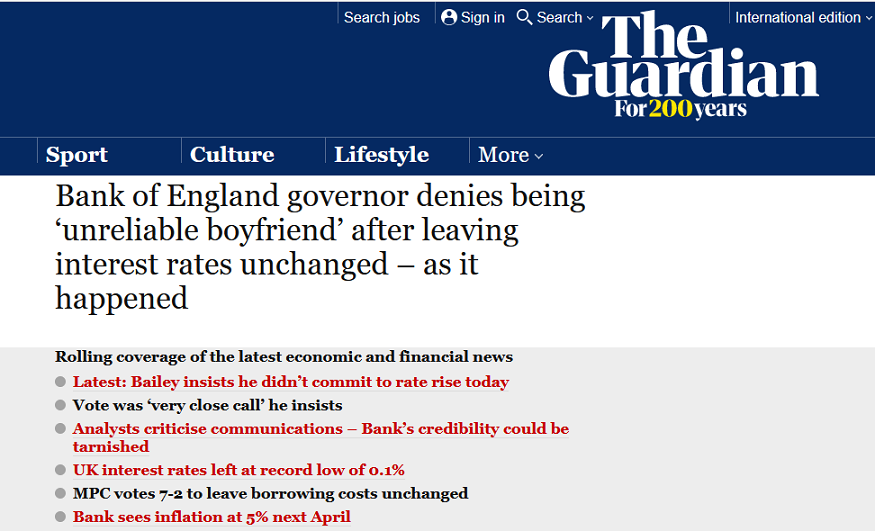
Ci appoggiamo a Reuters per ricostruire nel dettaglio queste ore convulse, con l’articolo che segue qui sotto.

LONDON, Nov 4 (Reuters) - The Bank of England kept interest rates on hold on Thursday, wrong-footing investors who had been convinced that it would be the first of the world's big central banks to raise borrowing costs after the COVID-19 pandemic.

The BoE kept alive the prospect of a move soon, saying it would probably have to raise Bank Rate from its all-time low of 0.1% "over coming months" if the economy performed as expected.

But seven of its nine policymakers voted to leave rates unchanged for now - even as they forecast inflation would reach almost 5% in April - so they can see how many people lose their jobs after the recent end of the government's furlough scheme.

The announcement sent shockwaves through markets, sending sterling towards its biggest fall since the early days of the COVID-19 pandemic in March 2020.

The yield on two-year British government bonds fell by the most since the day after the Brexit vote in 2016.

Governor Andrew Bailey rejected a suggestion by a reporter that he was "unreliable boyfriend number two," a nickname first used by a lawmaker to describe former governor Mark Carney, whose signals on rate moves failed to translate into action.

"We are in a situation where the calls are close, they are quite hard but that's just a reflection of the position that we are in," Bailey said. "It's not 'unreliable boyfriend'. We didn't say we were going to act at any particular meeting."

He spoke last month of the need to act to contain inflation expectations.

Bailey said two scheduled labour market data releases between now and the BoE's next rate decision on Dec. 16 could clear up the uncertainty about the labour market but that was not "a strong clue" about when a hike might come.

Investors responded to the BoE's announcement by putting a roughly two-thirds chance on a rate hike in December, much less than the 100% chance they had seen for a hike at November's meeting.

By contrast, a Reuters poll of economists last week showed the average expectation was for the BoE to keep rates on hold.

Only two Monetary Policy Committee members - Deputy Governor Dave Ramsden and Michael Saunders - voted for an immediate 15 basis-point rate hike.

"Pathetic communication from the BoE," Peter Kinsella, head of FX strategy at Swiss bank Union Bancaire Privée, said. "Bailey basically marched us up the hill, and then voted to keep rates steady."

The BoE's cautious approach came a day after the U.S. Federal Reserve said it would start scaling back its bond-buying programme this month, a precursor to its first rate increase which investors expect in mid-2022. read more

The European Central Bank has been more explicit about its determination to keep the stimulus flowing. Its President Christine Lagarde said the ECB was very unlikely to raise rates next year. read more

On Thursday, the BoE said the MPC voted 6-3 to let its government bond-buying programme reach its full size of 875 billion pounds ($1.18 trillion). Catherine Mann joined Ramsden and Saunders to vote to scale back that part of the bank's stimulus programme.

Including its 20 billion pounds of corporate bond holdings - which this month will start to be reinvested in greener debt - the total asset purchase target remained at 895 billion pounds.

"VALUE IN WAITING"

The BoE said most MPC members still thought "there was value in waiting" for data on the labour market.

Earlier on Thursday, survey data showed most furloughed workers had returned to their employers on their regular hours after the government programme ended at the end of September. read more

A recent slowdown in consumer demand also stayed the hand of most MPC members.

The BoE's new forecasts predicted slower economic growth due to continued bottlenecks in global supply chains. Output was seen regaining its pre-pandemic size in the first quarter of 2022, three months later than previously thought.

Growth in 2021 was trimmed to 7% and the forecast for 2022 was cut to 5% from a previous 6% before slowing sharply to 1.5% in 2023 and 1% in 2024.

Inflation was seen jumping to around 5% in April, driven mostly by surging global energy prices, before falling back to just below the BoE's 2% target in three years' time.

That projection was based on the BoE's usual practice of assuming energy prices follow futures for the next six months and then stay unchanged for the rest of its three-year forecast.

However, an alternative scenario, including a drop-off in energy prices in the second half of 2022 which markets expect, showed inflation would be "materially lower" than the BoE's 2% target in 2023 and 2024.

That scenario also factored in previous market expectations that interest rates would hit 1% by the end of next year.

Bailey told investors that the inflation undershoot meant investors should not count on interest rates rising as high as expected if energy prices fell as the futures market predicted.

I mercati finanziari di tutto il Mondo, ed in particolare i mercati delle obbligazioni, hanno subito reagito all’inversione di marcia della BoE, facendo calare i rendimenti delle obbligazioni in tutto il Mondo giovedì 4 e venerdì 5 ottobre.

Nell’immediato, le Borse invece hanno reagito salendo (l’effetto TINA di cui oggi noi di Recce’d scriviamo nel Blog), ma si tratta unicamente di un effetto di brevissimo periodo.

L’inversione ad U della Banca di Inghilterra era forse inevitabile, dato il clima di pre-crisi che si respirava da giorni sui mercati obbligazionari. Ne scriviamo oggi in un altro Post.

Ma questa marcia indietro non risolve il problema, ed al contrario lo rende ancora più grande. Le Banche Centrali non sanno come gestire il rialzo dell’inflazione, che da un lato rallenta le economie (facendo calare il potere di acquisto) e dall’altro lato impone un aumento dei tassi.

La situazione è resa ancora più seria dalla guerra tra mercati e Banche Centrali che è diventata di pubblico dominio proprio in queste settimane. Ne scriviamo oggi anche in un altro Post.

Dichiarazioni come quelle del Capo della Banca di Inghilterra che potete leggere qui sotto non fanno altro che confermare che lo scontro è in corso.

Bank of England Governor Andrew Bailey said it wasn’t his job to guide financial markets on interest rates, hitting back against criticism that he misled investors in the weeks leading to Thursday’s policy decision.

Speaking after officials defied markets’ expectations by keeping borrowing costs unchanged on Thursday, Bailey told Bloomberg TV’s Francine Lacqua that his remarks on the need to curb inflation before the meeting were “conditional.”

“I don’t think it’s our job to steer markets day by day and week by week,” he said.

The comments will do little to ease criticism that Bailey’s decision not to push back against aggressive bets of tightening would undermine the central bank’s credibility. 

Traders had expected the BOE to raise borrowing costs from 0.1% to 0.25% on Thursday. Some of the country’s commercial banks including Barclays Plc increased, NatWest Plc and Lloyds Banking Group Plc pulled their cheapest mortgage deals before the decision, hitting households directly.

BOE Pushback

“Communications and policy feed off each other. What the Bank does is very dependent on credibility,” said Andrew Sentance, a former BOE policy maker now at Cambridge Econometrics. 

“What senior members of the Bank say can help to build confidence in the broader economy. When markets don’t have confidence in those statements, that can feed through to a lack of confidence in the economy.”

Only two of the nine rate-setters voted for an increase, with the governor himself voting to hold, despite the new forecasts showing inflation will hit 5%, more than double its target.

Traders responded by slashing rate-hike bets, and sent the pound tumbling 1.4% against the dollar. U.K. government bonds advanced, with the yield on five-year debt set for the biggest decline since the Brexit vote.

“Forward misguidance,” was how Rabobank described the BOE’s messaging after the decision, while Bob Stoutjesdik, a fund manager at Robeco Institutional Asset Management in Rotterdam said Bailey “has a serious credibility problem.”

“When look you look at how markets respond today and how they have responded to the hawkish messages you can easily conclude that the BOE have seriously lost credibility which I think is difficult to repair,” he said.

Bailey’s apparent U-turn invited comparisons with an “unreliable boyfriend”, a tag first applied to former Governor Mark Carney after he signalled rate rises and changed his mind later. “It’s not compulsory for a BOE governor to be an unreliable boyfriend,” Bailey said.

He told Bloomberg TV that his pre-meeting comments were prompted by concern that falling bond yields could lead to a rise in inflationary pressures. He said the bets following his remarks were “in the right direction, overdone.”

Jamie Rush, chief European economist at Bloomberg Economics, said it’s “absolutely Governor Bailey’s job to guide markets to a rates path that helps the Bank hit its inflation target.”

“What markets expect interest rates to be in the future affects the cost of borrowing now,” he said.

James Rossiter, head of macro strategy at TD and a former BOE economist, said it will be even harder to gauge the central bank’s future moves. 

“We knew that a November hike was a coin toss, but messaging from the BOE up to now suggested that a 2021 hike was a done deal,” he said. 

“After today’s communications, I don’t think we can take that for granted anymore.”

Siamo quindi uno ad uno, nel match tra Banche Centrali e mercati delle obbligazioni: i mercati sanno che le Banche Centrali stanno provando … a fregarli, e non vogliono farsi fregare (almeno non più di tanto)

Dopo una settimana convulsa ed emozionante, ne stanno per arrivare altre ancora più emozionanti.

Per collocare le cose nella giusta prospettiva, il nostro suggerimento in questo Post è rileggere l’articolo che segue di Bloomberg: ci ritroverete, raccolti ordinati e sintetizzati, tutti i temi più importanti di questo difficile momento dei mercati finanziari internazionali.

L’articolo è di sette giorni fa: ma dopo questo uno a uno iniziale, la palla torna al centro: proprio dove stava sette giorni fa. Sola differenza la maggiore sfiducia tra le due squadre in campo.

Taper Tantrum 2.0 has arrived just as the Federal Reserve plans to start scaling back its asset purchases. This time is different from the original edition in 2013 in a few important ways — raising the stakes for Chair Jerome Powell and the central bank, which will issue its latest decision at the conclusion of its meeting on Wednesday.

First, unlike eight years ago, traders in the $21.9 trillion U.S. Treasury market clearly understand the playbook: a combination of tapering and a potentially accelerated pace of interest-rate increases means a sharply flatter yield curve. From May 22 through July 3 in 2013, the curve from five to 30 years flattened by about 25 basis points. Last month, in a shorter time frame, the same curve flattened by roughly 40 basis points. Other curves steepened during the previous episode. Regardless of maturity, the flattening trend has been unmistakable this time around. 

Taper Tantrum Playbook

Crucially, this latest bout of bond-market upheaval is a distinctly global phenomenon. That’s a problem for the Fed. Even if it’s the world’s most influential central bank, there’s only so much it can do to dictate policy decisions in other large developed nations, which have their own domestic considerations. Here’s a snapshot of what has happened lately across sovereign debt:

  • Canada: Two-year yields more than doubled in October to 1.04%, including a spike of more than 20 basis points in one day as the Bank of Canada ended its bond-buying program and moved forward the potential timing of future rate increases.

  • U.K.: Two-year yields have been rising for 10 consecutive weeks, the longest stretch in at least three decades. Markets expect that the Bank of England will increase its benchmark rate to 0.25% from 0.1% the day after the Fed’s decision.

  • Australia: Two-year yields increased more than 50 basis points in two days, ending Friday at 0.775% from just 0.115% a week earlier. The Reserve Bank of Australia opted not to defend its short-term target level through yield-curve control.

  • New Zealand, Norway, South Korea: The central banks in these countries have already raised interest rates.

  • Spain, Portugal, Italy, Greece: Shorter-term rates as well as 10-year yields are surging in these so-called peripheral countries within the euro zone. European Central Bank President Christine Lagarde’s remarks last Thursday were taken to be not-so-dovish, and by Friday, “that caution mushroomed overnight into a mini taper tantrum,” FHN Financial’s Jim Vogel wrote.

Dragged Higher

Taken in its entirety, the global bond market looks like a powder keg, even if stocks and credit are largely shaking it off for now. That raises the all-important question: Does the Fed have the tools to prevent a blowup? 

Wall Street strategists aren’t necessarily convinced. Citigroup Inc.’s Matt King sees the Fed and its peers caught between a rock and a hard place. “Expect tantrums in risk if central banks respond to inflation — and tantrums in bonds if they don’t,” he wrote in an Oct. 29 report. At Jefferies, Aneta Markowska and Thomas Simons pondered whether Powell will look to dial back the market’s current bets on two interest-rate increases next year. He “will have to walk a very fine line, since pushing back too hard could unhinge inflation expectations, but not pushing back at all could unsettle the front end of the curve,” they wrote.

Here’s what we know for certain: The Fed doesn’t like to surprise markets. Just about everyone expects the central bank to say it will start scaling back its $120 billion of monthly bond purchases ($80 billion in Treasuries, $40 billion in mortgage-backed securities) by $15 billion a month ($10 billion in Treasuries, $5 billion in MBS) starting in mid-November and ending by June. That’s what should happen come Wednesday. It gives Powell and his colleagues eight months to ever-so-slightly pare back accommodative policy and hope in the meantime that inflation comes down and validates their long-held position that price pressures are transitory.

Ideally, the Fed would have a better strategy than hope. But it has boxed itself into a difficult situation with its new policy framework, which was designed with the post-2008 economy in mind. That period was characterized by a gradually improving labor market without much wage pressure or inflation broadly. It suggested that reaching the nebulous level of “full employment” doesn’t mean price growth will reach or exceed the central bank’s 2% target.

The framework wasn’t meant to address the current situation: persistently elevated inflation when the number of working Americans is still well below its February 2020 levels. Yes, it’s good to see that the employment cost index, a broad gauge of wages and benefits, rose 1.3% in the three months through September from the prior quarter, the biggest jump on record. But if consumer prices are rising more quickly — and especially if individuals and companies expect they’ll only go up faster in the future — then the Fed is violating the price-stability part of its mandate by staying the course, to say nothing of its supposed data dependency.

The best way for Powell to defuse the situation is by first acknowledging that the pace of tapering isn’t on autopilot and that the central bank reserves the right to speed it up or slow it down based on incoming data. It would take a severe shock for that to happen, of course, but just hinting at that optionality would show that it hasn’t abandoned its commitment to keep inflation well-anchored. Second, he would be wise to steer clear of directly trying to influence the market pricing of short-term rates, only saying that officials were split about increasing the fed funds rate in 2022 as of September, and that they will update their forecasts next month based on the latest information. As it stands, I’d expect December’s dot plot to reflect a median expectation of one rate increase within a year, meeting current market pricing halfway. 

Suffice it to say, it’s a delicate balancing act. It’s made a bit easier by the fact that the bond market’s tantrum hasn’t yet spilled over into credit spreads or equity prices, and made more difficult because Powell isn’t even sure he’ll be Fed chair in a few months. Will there be a hard policy pivot, or is this just bond traders getting ahead of themselves about inherently uncertain actions months down the line?

It’s up to Powell to navigate this treacherous path. Announcing the start of tapering will be the easy part.

Mercati oggiValter Buffo
Borse: resta solo e soltanto TINA
 

Leggendo i quotidiani, ascoltando i TG Economia, e scorrendo quello che viene scritto sul Web, spesso ci si imbatte nel termine “euforia”.

Il termine “euforia” viene utilizzato in associazione con i “nuovi record delle Borse”. I nuovi record delle Borse, ed in particolare della Borsa di New York, sarebbero il riflesso di un clima di “euforia tra gli investitori”.

Ci sembra utile, per i nostri lettori, mettere in evidenza almeno due punti, a questo proposito:

  1. il clima sui mercati, ed in Borsa in particolare, oggi è molto diverso da quello prevalente nella prima parte del 2021: qualche mese fa, dominava una visione del futuro tutta improntata all’ottimismo; pochi mesi fa sui mercati si registrava un ampio consenso sul boom economico in arrivo, ed uguale consenso dominava in materia di inflazione, che a fine 2021 avrebbe dovuto ritornare al 2% (e che in ogni caso non sarebbe stato un problema); oggi, a novembre 2021, entrambe queste due previsioni sono state smentite, in modo brutale, dai fatti e dalla realtà; ma le Borse sono salite ancora: come si spiega? ne scriviamo poco più in basso; prima mettiamo in evidenza un secondo punto

  2. il clima forse è di “euforia” in Borsa, ma sicuramente non è di euforia negli altri comparti del mercato finanziario internazionale: e noi oggi ne scriviamo, in modo ampio, in altri Post

Nel grafico qui sopra, mettiamo alla vostra attenzione un dato che poi viene ripreso anche in altri Post pubblicati oggi: la linea di colore rosso è l’indice della volatilità del mercato delle obbligazioni, mentre quella di colore verde è la volatilità della Borsa di New York. Come tutti vedete, da una parte c’è un’impennata, dall’altra parte (la linea di colore verde) il dato rimane stabile.

Dell’impennata che vedete qui sopra, scriviamo oggi in altri Post. In questo Post, ci dedichiamo alla linea di colore verde.

Che nel grafico sotto vedete di nuovo, nel grafico del Financial Times che racconta proprio la medesima storia.

Bloomberg scrive qui sotto: “I problemi delle obbligazioni non hanno coinvolto le azioni”. Il grafico che vedete nell’immagine qui sotto è di particolare interesse per noi investitori, perché segnala un valore estremo nella statistica che si chiama “Z”, statistica che da sempre ha un buon potere previsivo sull’evoluzione dei mercati finanziari.

In questo Post, tenteremo di aiutare chi ci legge a comprendere la ragione per la quale abbiamo tutti visto, nell’ultimo mese, una nuova fase di rialzo dei prezzi di Borsa, e quali sono le motivazioni sottostanti a questo movimento verso l’alto. Motivazioni che, non c’è dubbio, hanno nulla a che vedere con il “boom economico” ed hanno nulla a che vedere con la “inflazione transitoria”.

E allora?
E allora, Recce’d vi propone la spiegazione offerta pochi giorni fa dal settimanale The Economist: che nel suo titolo qui sotto dice “TINA tiene azioni ed obbligazioni su due strade opposte”.

Che cosa è TINA?. TINA sta per “there is no alternative”, e significa che “è giusto comperare azioni perché le obbligazioni rendono nulla”.

Questo argomento ha funzionato, e funziona ancora, perché si è volutamente lasciato credere alla massa degli investitori che non esiste (più) il rischio di ribasso delle azioni, quel rischio di ribasso che negli ultimi 20 anni si è chiaramente manifestato, e concretizzato, in (almeno) tre macroscopiche fasi di ribasso.

Le Autorità vogliono però che il grande pubblico rimanga all’oscuro, e continui a mantenere la convinzione che le azioni “non possono scendere”, perché “ci pensa la Federal Reserve”.

Restiamo del parere che già conoscete: questa è una sciocchezza enorme, e lo dimostriamo proprio oggi negli altri Post.

In questo Post, però, vogliamo completare l’esame dei recenti rialzi degli indici di Borsa, offrendovi in lettura proprio qui sotto l’integrale riproduzione dell’articolo di The Economist che abbiamo già citato.

Notate che abbiamo messo in evidenza il passaggio nel quale The Economist accenna al “parametro K di Marshall”: non c’è in questo Post lo spazio per un approfondimento, ma vi invitiamo a indagare su questo parametro e sulle sue implicazioni. Come sempre se ci contatterete saremo felici di integrare con ulteriori informazioni.

LONDON, Oct 29 (Reuters) - The readout from this week's brutal selloff in government bond markets seems clear: rising inflation will hustle central banks into panicky interest rate rises, quashing economic growth.

Yet stocks, currencies and corporate bonds are sending a different picture: keep calm. Maybe even buy more.

Time will tell who has it right. What's for sure is many bond investors were caught out by fears that central banks, despite their inflation-is-transitory mantra, may end up tightening policy sooner than signalled.

A timid message from the European Central Bank, a hawkish one in Canada and the Reserve Bank of Australia's reluctance to defend its 0.1% T-bill yield target all helped light a fire under short-dated debt yields. Those in Germany and the United States zipped to their highest since last March while Australian bill yields saw their biggest three-day surge since 1996.

Ordinarily, such moves would cause significant disruption across asset classes.

But instead they have barely registered, with the S&P 500 equity index hitting a record high on Thursday. While stocks fell on Friday, losses are relatively muted and Lipper data shows that in the week to Wednesday, investors purchased equities at the fastest pace since March.

Currency and equity volatility (.DBCVIX) remain subdued, with Wall Street's "fear gauge", the VIX index (.VIX), just off 2021 lows. In Europe, rates volatility has rocketed, while stocks have remained calm.

Some attribute the sanguine reaction to falling yields on longer-dated bonds, which has flattened yield curves and appears to signal that swift central bank action will in time quash inflationary pressures.

And "real" bond yields, adjusted for inflation, remain deeply negative: despite a surge on Friday they remain around -1% and -2% in the United States and Germany respectively , .

"It's surprising that stocks have not responded more but with real yields so negative, markets are not too worried," said Charles Diebel, head of fixed income at Mediolanum International Funds.

"If you decompose the forward curve on inflation it's about the near-term pressure on inflation ... so breakevens are moving up but central banks are starting to respond, which means slower activity and meaning inflation will not be a problem in the longer-term."

Breakevens refer to the difference between nominal and inflation-linked bond yields and are often used as a market gauge of inflation expectations.

Nor do riskier corporate debt markets seem spooked. The risk premiums they pay on top of government bonds remain historically low. ,

"(Low real rates), I think that is having an effect on markets in the sense that it's creating the 'TINA' effect: There Is No Alternative to buy higher-yielding securities," said Barnaby Martin, head of credit strategy at BofA in London.

TYPICAL MID-CYCLE

The short-dated bond moves are also partly down to positioning. Traders caught out by the yield rise had to dump their positions, exacerbating the selloff and making some pricing look far-fetched.

Traders now expect the United Kingdom and Canada to raise interest rates by more than 100 basis points over the next 12 months. Even the ultra-dovish European Central Bank is seen hiking twice by October 2022.

Chris Iggo at AXA Investment Managers expects higher rates to tighten financial conditions a little but said it would be akin to "normalisation, in a sense because we're going to pre-COVID conditions".

"It's typical mid-cycle type of economic conditions, where inflation has gone up a bit, rates have gone up, growth starts to slow, but it's not a recession yet."

And if serious growth concerns do emerge, many remain confident of the central bank "put".

"The real widening (in stocks and corporate spreads) would come on a recession, not so much rates risk, just because we've seen time and time again that if markets begin struggling because of interest rate fears, central banks try to push back dovishly again," Martin of BofA said.

But bond repricing should eventually ripple out more broadly, meaning some pain is inevitable.

"Expect tantrums in risk if central banks respond to inflation - and tantrums in bonds if they don't," Citi strategist Matt King told clients.

Reporting by Yoruk Bahceli, Tommy Wilkes, Sujata Rao and Saikat Chatterjee; Editing by Sujata Rao and Catherine Evans

A measure of U.S. financial liquidity whose declines foreshadowed two of the decade’s worst equity routs is flashing alarms even before the Federal Reserve embarks on its planned winding down of asset purchases.

The signal is obscure, but has sent meaningful signs in the past. Roughly speaking, it’s the gap between the rates of growth in money supply and gross domestic product, an indicator known to eco-geeks as Marshallian K. It just turned negative for the first time since 2018, meaning GDP is rising faster than the government’s M2 account.

The shortfall comes from an expanding economy that’s quickly depleting the nation’s available money. The deficit could become a problem for markets at a time when excess liquidity is seen as underpinning rallies in everything from Bitcoin to meme stocks.

“Put another way, the recovering economy is now drinking from a punch bowl that the stock market once had all to itself,” Doug Ramsey, Leuthold Group’s chief investment officer, wrote in a note last week.

How big a threat is this? While stocks kept rising during frequent negative Marshallian K readings in the 1990s, the pattern since the 2008 global financial crisis -- a period when the central bank was in what Ramsey calls a “perpetual crisis mode” -- begs for caution.

The Marshallian K fell below zero in 2010, a year when the S&P 500 Index suffered a 16% correction. A similar dip in 2018 portended a selloff that almost killed that bull market.

The Leuthold study is the latest attempt to handicap the market’s outlook from the perspective of liquidity. But not everyone is worried. Ed Yardeni, the president and founder of Yardeni Research Inc., says he prefers to plot not the growth rates but the absolute level of M2 against GDP to measure liquidity. Based on that, liquidity stood near a record high.

“Some people start to freak out about the M2 growth rate,” he said in an interview on Bloomberg TV and Radio. “What they don’t really appreciate is M2 today is $5 trillion higher than it was before the pandemic. There is just a tremendous liquidity sitting there.”

Others see limited impact from Fed tapering on the equity market. In June, research from UBS Group AG showed that should the Fed turn off the spigot on its annual $1.4 trillion in quantitative-easing spending, the hit to the S&P 500 would be a paltry 3% decline in prices.

In 2013, when the Fed’s announcement on a reduction in stimulus sparked a taper tantrum that sent 10-year Treasury yields skyward, the S&P 500 pulled back almost 6% from its May peak that year. But stocks staged a full recovery within weeks and went on with a rally that eventually lifted the index 30% for the whole year.

Skeptics, however, are quick to point out one big difference: equity valuations.

“Back then, the stock market was trading at 15 times earnings. Now it’s 22 times earnings,” Matt Maley, chief market strategist for Miller Tabak + Co., said in an interview on Bloomberg TV with Caroline Hyde. “It will be hard for the market to ignore it this time around.”

For now, a liquidity drain suggested by the Marshallian K data has done little damage to the market, at least on the index level. The S&P 500 is poised for a seventh straight monthly gain, reaching all-time highs almost every week.

But Ramsey warns investors shouldn’t let their guard down. While the broad market has been strong -- the S&P 500 closed Wednesday at a record for the 46th time this year -- fewer stocks are participating in the latest leg up. This could be blamed on falling liquidity, he says, and the days of abundant cash floating all stocks are likely gone.

The Marshallian K indicator just slumped into negative territory faster than ever. During the second quarter, M2 money expanded 12.7% from a year ago, trailing the nominal GDP growth rate of 16.7%. That came after four quarters of excessive liquidity where the spread stayed above 20 percentage points.

The Marshallian K now shows liquidity not only deteriorating but actually contracting -- and at a time when hopes (as embedded in valuations) have never been higher,” Ramsey said. “If the Fed can drawdown QE in the next year without triggering a decline of those levels, it will truly have achieved something remarkable. But we’d rather invest based on the probable.”

(Updates with Yardeni’s comment starting in seventh paragraph.)

Mercati oggiValter Buffo
Il tempo è dalla nostra parte
 

Il tempo è dalla nostra parte: ed anzi, per essere precisi, sta dalla parte di ogni investitore.

Di ogni investitore che scelga il ragionamento sull’emozione e la consapevolezza sull’euforia.

Il tempo ripaga, sempre, questi investitori: e punisce gli altri.

Spesso noi per i Post del nostro Blog abbiamo utilizzato il nostro archivio, molto ampio, molto ordinato e molto selezionato: spesso lo abbiamo fatti riportando alla mente dei nostri lettori fatti che i nostri lettori avevano dimenticato, rimosso e messo da parte.

Autorevoli scienziati hanno dimostrato che la mente umana ricorda in modo selettivo: ricorda più facilmente le cose piacevoli, e tende a rimuovere quelle meno piacevoli.

Quando si parla di investimenti, la cosa risulta molto più evidente che in altri ambiti. Molto più evidente, persino clamorosa.

Fatti di uno, due, tre anni fa vengono del tutto rimossi: l’investitore retail, ma pure una buona fetta di investitori professionali, preferisce pensare che “sì, è vero, è successo: ma oggi non potrebbe più accadere”.

Perché? Nessuno lo sa spiegare. E’ semplicemente così: si preferisce pensare che il futuro è semplice, che tutto è facile, che “per investire basta un minuto”. Come ripete una pubblicità TV martellante.

Ovvio che la realtà è lontana un milione di miglia da questa rappresentazione, zuccherosa ed anche un po’ ridicola.

Cosa ci ha suscitato questa serie di riflessioni?

Prenderemo come spunto iniziale un lavoro, che loro chiamano “ricerca” ma che noi invece chiamiamo “materiale di marketing”, di Generali Investments.

La scelta di Generali Investments va spiegata: nella produzione di materiali “di ricerca” Generali è in Italia uno dei campioni, uno dei nomi più qualificati. la nostra scelta riflette quindi la considerazione che Recce’d ha per i lavori “di ricerca” di Generali Investments.

Dobbiamo altresì chiarire subito che ciò che dice Generali Investments si scosta molto poco, e molto raramente, dal cosiddetto “consenso”.

Oggi, tra gli operatori del settore del risparmio, sono pochissimi quelli in grado di sostenere il rischio di una visione indipendente e non allineata al cosiddetto “consenso”. Tutti la devono vedere allo stesso modo: tutti devono ripetere, sempre quello che dicono le grandi banche di investimento. Le quali, a loro volta, devono obbligatoriamente sposare la visione di quelli che oggi sono i loro maggiori Clienti ed alleati. Ovvero, la Federal Reserve e la BCE.

Fatte queste due premesse, torniamo indietro al dicembre 2020, e rileggiamo una piccola parte di un documento di Generali Investiments.

Tra poche settimane inizieranno ad arrivare sulle scrivanie dei gestori di Fondi Comuni, ma anche e forse soprattutto sulle scrivanie delle redazioni di quotidiani i documenti che si chiamano “Outlook 2022”, ovvero i documenti riassuntivi delle previsioni per il nuovo anno. Non c’è una sola banca globale di investimento, e neppure una sola Casa di gestione di Fondi Comuni, che rinuncia a questo esercizio. Quasi come se stampare un documento con le previsioni a novembre sia più importante, rispetto ad un documento datato magari marzo o luglio.

Noi per anticipare questa ondata di “Outlook” oggi abbiamo appunto scelto di ritornare a quelli di dieci mesi fa, e tra i cento che abbiamo in archivio (tutti che dicono, come anticipato, le medesime cose: lo possiamo dimostrare) abbiamo scelto, per le ragioni già citate, Generali Investments.

Perché abbiamo scelto un Istituto italiano, e non le più famose Goldman Sachs, Morgan Stanley, UBS oppure BNP Paribas oppure un’altra di quelle?

Perché eravamo alla ricerca di una cosa in particolare.

Siamo andati alla ricerca di quello che vedete nella casella di colore rosso.

Che sono le previsioni di Generali Investments, e di tutti quanti, al dicembre 2020, per i rendimenti dei BTp decennali a fine 2021: ovvero, ad oggi.

Come vedete, si scrive di rendimenti tra 0,50% e 0,65%. Non è andata così.

Ovviamente, su questo specifico dato ha pesato l’andamento dell’inflazione: nella tabella che segue, potete leggere le previsioni di marzo 2021, ovvero di sei mesi fa, della BCE per l’inflazione in Eurozona.

Se la BCE, sei mesi fa, dice al Mondo che a fine anno l’inflazione in Europa sarà allo 1,6%, nessuna Istituzione bancaria, e ancora meno Generali Investments, può osare contraddirla.

Nessuno quindi potrà affermare che è prevedibile un aumento dei rendimenti dei BTP, se no … la BCE si arrabbia e poi si vendica con la Generali di turno che avesse osato, molto semplicemente, di ragionarci un po’ sopra.

Lasciateci sottolineare, in questo contesto, il ruolo della stampa quotidiana e delle TV: che è il ruolo della cinghia di trasmissione. Anche qui ci è di grande aiuto il nostro archivio, dove siamo andati a ritrovare un titolo del Corriere della Sera, il maggiore quotidiano d’Italia, che risale alle settimane successive all’insediamento del Governo Draghi. Lo vedete qui sopra nell’immagine.

E poi anche in un secondo titolo, sempre del Corriere della Sera, molto più recente (ed anche in questo caso, precisiamo subito che il Corriere della Sera, in fatto di stampa quotidiana, è “il meglio che c’è”, figuratevi il resto). Lo leggete qui sotto nell’immagine.

Oggi l’inflazione in Europa non sta allo 1,6% e neppure allo 2,6%, bensì sta al 3,6%. Ma soprattutto (quello che è importante per tutti noi investitori) il rendimento del BTp a 10 anni non sta allo 0,50%.

Venerdì 29 ottobre 2021, il rendimento del BTp decennale ha toccato, per la seconda volta nel 2021, il livello massimo appunto del 2021, a 1,35%, per poi chiudere la seduta a 1,18%.

In termini di analisi di mercato, scriviamo qui molto sinteticamente ciò che con dettaglio molto maggiore abbiamo chiarito al Cliente nel corso dell’ultima settimana. Ovvero che il dato forte, di questo rialzo, è che non avviene in un momento in cui salgono i rendimenti dei Treasury negli Stati Uniti (fermi al 1,6% circa), né in un momento in cui salgono i rendimenti sui Bund della Germania.

E quindi … ragionateci.

Ma lo scopo di questo Post è un altro. E lo abbiamo chiarito in apertura.

Il tempo è il migliore alleato di un investitore che sia consapevole di ciò che sta facendo e di ciò che accade nella realtà: perché arriva sempre il momento in cui la realtà prevale, su tutto.

Noi non abbiamo idea di ciò che si muove dietro le quinte, con una violenza tale da determinare il rialzo che vedete nel grafico qui sopra.

Sappiamo però, con certezza, che per dire al tuo Cliente che i rendimenti dei BTp resteranno fermi per 12 mesi allo 0,50% devi essere in alternativa molto scarso come analista (e certamente non è il caso degli amici di Generali Investments) oppure pesantemente condizionato tanto da essere obbligato ad un tono “fiducioso ed ottimista” che neppure prende in esame le difficoltà che potrebbero presentarsi.

Rifletteteci, quando leggerete degli “Outlook 2022”, e rifletteteci guardando il vostro attuale portafoglio.

E’ nella vostra convenienza, rifletterci: dallo 0,50% di rendimento allo 1,30% di rendimento, una obbligazione a 10 anni perde sul prezzo ben 8 punti. Quel titolo obbligazionario che vale 100 lire quando siamo allo 0,50% di rendimento, ne vale poi solo 92 se il rendimento sale a 1,30%.

E adesso, chiedetevi dove potrà andare nei prossimi 12 mesi.

(Inciso finale: nella tabella di Generali Investments che avete visto più sopra, ci sono anche altre due caselle, una di colore blu ed una verde. Molto interessanti. Fate le vostre valutazioni. Noi, se i mercati ce ne daranno il tempo, torneremo su quella tabella nelle prossime settimane: tanto, come ormai sapete, Recce’d a fine anno non produce alcun Outlook, risparmiando così le proprie risorse ed anche il tempo dei nostri amici lettori).

Mercati oggiValter Buffo
Quelle crepe nel muro
 

La pandemia è stata sfruttata, con grande abilità, dai Governi in carica e dalle altre Autorità politiche, incluse le Banche Centrali, per lasciarsi tutto alle spalle.

Si è trattato di una imperdibile occasione per tirare una riga su tutto: la situazione è stata azzerata, e si è ripartiti da zero. Per loro fortuna, la pandemia è arrivata proprio nel momento nel quale stavano diffondendosi, con crescente rapidità, i dubbi sull’efficacia delle loro scelte.

Esattamente per questa ragione, la scelta è stata: GO BIG: che vuole dire, mettiamo in atto un insieme di misure e di interventi come mai prima nella storia economica del Mondo, regaliamo denaro a tutti e tutto, e stimoliamo l’ottimismo, con la attiva collaborazione di quotidiani, TV, e soprattutto di tutte le banche e di tutte le Reti di promotori.

Come zelanti muratori, i private bankers, i wealth managers, i personal bankers, i promotori finanziari in generale si sono prestati come manovalanza per la costruzione di un altissimo muro.

Il muro serve ad impedire al pubblico dei risparmiatori di vedere la realtà. Deve mantenere il pubblico dei risparmiatori nell’illusione, deve sostenere la convinzione che tutte le misure “di stimolo” varate nel 2020 e nel 2021 erano, effettivamente, misure nel loro interesse, nell’interesse del pubblico, finalizzate a “stimolare la crescita delle economie.

Come leggete qui sopra, il Fondo Monetario Internazionale in effetti dice che c’è la crescita.

Le Banche Centrali dicono che c’è la crescita.

I Governi, anche loro dicono che c’è la crescita.

Le banche di investimento? Anche loro, dicono che c’è la crescita.

E il private banker? Che cosa volete che dica?

Ed il vostro wealth manager, che cosa potrebbe mai dire?

Naturalmente, anche il robot con l’algoritmo dice che c’è la crescita.

Tutti d’accordo, e tutto a posto, quindi.

Con una sola eccezione. Fanno eccezione i dati. I dati NON dicono che c’è la crescita.

Qui sopra e poi qui sotto vedete quale drammatico cambiamento è intervenuto, in particolare nei mesi estivi appena conclusi, per le previsioni della crescita nelle due maggiori economie Occidentali.

Della Cina, abbiamo scritto ampiamente anche nel Blog, in una serie di Post precedenti, e molto è stato scritto anche sui quotidiani.

Poi giovedì 28 ottobre abbiamo visto il dato per il PIL degli Stati Uniti tra luglio e settembre, che è cresciuto del 2%. Ma questo è il dato annualizzato, mentre in valore assoluto è cresciuto dello 0,4%.

Un dato buono? Cattivo? Dipende.

In tempi normali, sarebbe un dato che si potrebbe definire discreto. Ma dopo soli sei mesi, 180 giorni, dal varo della più grande “manovra di stimolo” nella storia degli Stati Uniti … beh, qualche domanda è obbligatorio farsela.

E se il vostro private banker, il vostro wealth manager, il vostro promotore finanziaria non ve ne ha ancora parlato, i casi sono due: o è molto, molto in ritardo, oppure è poco, ma poco, competente.

Il punto dove sta? Sta tutto in questo: le previsioni che oggi vengono fate dalle Autorità e dalle Banche centrali (e quindi, poi, dalle varie Goldman Sachs) sono credibili tanto quanto erano credibili, 6 mesi fa, ovvero 180 giorni fa, le “previsioni ufficiali” per l’inflazione? Tipo quelle di Goldman Sachs che leggete nell’immagine qui sotto (attenzione alle date)?

Ci permettiamo di suggerire ai nostri lettori di riflettere: sei mesi fa, avrebbero fatto bene ad ascoltare ciò che diceva Recce’d, a proposito dell’inflazione. E a non dare importanza, invece alle previsioni della BCE e di Goldman Sachs: quelle che ogni volta vi racconta il wealth manager, il promotore finanziario e persino il robot.

Oggi, noi crediamo, fareste bene a stare a sentire ciò che Recce’d ha da dirvi sulla crescita delle economie.

E quindi, sulla crescita, oppure de-crescita, del valore del vostro portafoglio in titoli.

Contattarci attraverso il sito è molto semplice, e noi restiamo a vostra disposizione. E’ nel vostro interesse.

Mercati oggiValter Buffo
Documento riservato
 

La Banca Centrale USA, ovvero la Federal Reserve, di tanto in tanto riceve pareri da operatori di mercato, che fanno parte di un apposito Advisory Commiteee, un Comitato di Consulenza.

La settimana scorsa, uno dei partecipanti di questo Comitato, un gestore molto noto e di fama mondiale di nome William Ackman, ha fornito alla Federal Reserve un proprio parere scritto, che noi siamo in grado di mettervi a disposizione qui.

Il documento non contiene dal punto di vista di Recce’d elementi di particolare novità. Si tratta di dati e valutazioni che abbiamo già affrontato negli ultimi mesi, e che in una buona parte noi condividiamo.

Detto questo, noi vi suggeriamo di leggerlo con attenzione: contiene concetti e valutazioni molti diverse da quelle che vi vengono proposte, a tutto oggi, dal wealth manager, dal private banker, dal robo-advisor, dal promotore finanziario. Le conclusioni sono molto distanti da quelle a cui arrivano, a tutto oggi, UBS, Goldman Sachs, BNP Paribas e Morgan Stanley. Non troverete argomenti come questi leggendo Il Sole 24 Ore oppure il Corriere Economia.

Insomma, una ventata di aria fresca tra i vostri pensieri, ed insieme un valido supporto ad una analisi della situazione attuale che non sia del tutto schiacciata sulla “prevalente opinione della massa”.

Un esempio? Ackman mostra in una tabella i dati per l’inflazione USA che tutti voi conoscete: ma nella tabella vengono “riletti” in una chiave che sicuramente sarà utile anche a voi lettori, una chiave molto, molto distante da quella “ufficiale” che ancora oggi viene proposta dalla Federal Reserve e dalla BCE. Una chiave più vicina alla realtà,

In una seconda tabella, Ackman racconta poi delle precedenti fasi di “stretta monetaria”, e fornisce una comparazione tra i dati che potrebbe esservi utile, soprattutto anche in questo caso per rendervi conto di quale è la realtà delle cose oggi.

Infine Ackman sottolinea alcune delle più recenti prese di posizione, su questi temi della Banca di Inghilterra: le medesime cose che noi di Recce’d scrivevamo alcuni mesi fa, suscitando in alcuni scetticismo e perplessità, quasi come se noi di Recce’d si volesse sempre vedere le cose in chiave negativa, con uno spirito catastrofista.

Mentre al contrario, già alcuni mesi fa, Recce’d era semplicemente realista, e gli altri semplicemente dicevano cose sbagliate.

Proprio come fanno anche oggi.

Mercati oggiValter Buffo