
Unknown unknown: le 5 aree di buio totale
 

Chi ci segue con maggiore attenzione avrà letto, nei Post della settimana scorsa, una nostra forte presa di posizione sullo scontro tra mercati finanziari e Federal Reserve, scontro che è appena iniziato e che terrà occupatissimi noi gestori e voi investitori per molti mesi.

Il tema viene ripreso questa settimana, attraverso l’articolo che segue: un articolo che prende spunto proprio da quello scontro, ed in particolare alle reazioni immediate dei mercati obbligazionari alle più recenti decisioni annunciate dalle Banche Centrali.

Ma nell’articolo c’è anche dell’altro: il centro di questo articolo è un elenco di cinque “unknown unknowns”, che vuole dire quelle cinque variabili che avranno una influenza dominante sul rendimento degli asset finanziari ma a proposito delle quali oggi tutti, incluso Recce’d, oggi sanno ben poco.

Ormai è chiaro che Recce’d ci ha visto giusto, quando diciotto mesi fa vi scrisse qui nel Blog che il COVID lascerà sull’economia e sui mercati finanziari effetti e conseguenze NON transitorie ma permanenti. Allora nessuno era di questo parere: oggi, quel parere è un’evidenza nei fatti.

Da qui deriva il fatto che tutti sono colti di sorpresa, impreparati, e che la grande parte degli attori (Istituzioni, investitori istituzionali e individuali) oggi non sa che cosa fare.

Le Banche Centrali, in particolare, continuano a raccontare la storia del “transitorio”: e questo perché … non ne hanno ancora capito proprio nulla di nulla.

Scorrendo questo elenco, voi lettori fare bene a chiedervi: “io, che cosa ne so, davvero?”. Ed il mio consulente, il mio wealth manager, il mio personal banker, il mio robo advisor, loro che cosa ne sapranno? Oppure a loro non importa nulla, perché tanto a loro hanno detto di vendermi qual tale portafoglio, senza stare a ragionarci troppo?

Chiedetelo, a voi stessi ed anche a loro: è nel vostro interesse,

Covid has thrown traditional macroeconomics out of its comfort zone.

Last week’s policy pronouncements from the Federal Reserve, the Bank of England, the Reserve Bank of Australia and even the European Central Bank revealed the latest surprise — a wide disconnect between markets’ rate expectations and central banks’ guidance across major currencies. The real “taper shock” came not with the ending of the biggest concerted monetary expansion in history, but with a “tapering” of market confidence in what the future may look like.

Now markets are struggling with two fundamental issues: the sense that economies can’t get back to where they were before the pandemic and an inability to forecast what lies ahead.

This echoes the message that central banks shared last week — that there is sizable uncertainty about future output, employment and inflation, and that these “unknowables” will be consequential for both economic trajectories and for market rates and returns. The result, as the Chinese proverb goes, is a shared policy desire to “cross the river by feeling the stones.”

There are no less than five major areas of “unknowable uncertainty” that remarks from Fed Chair Jerome Powell, BOE Governor Andrew Bailey, ECB President Christine Lagarde and RBA Governor Philip Lowe have identified. These are:

When the pandemic will end. Waves of Covid variants have upended central banks’ ability to predict the duration of supply-demand imbalances. At the same time, there’s increased anxiety that the longer these imbalances persist, the greater the risk of secondary wage-price inflation, which would necessitate policy intervention in the shape of faster stimulus withdrawal and inverted yield curves in 2022. The more-tempered-than-tapered signaling on future rate rises shows this is an outcome policy makers are keen to avoid.  

Future growth. The structural legacy of the pandemic raises questions about future trend growth and economies’ capacity for sustained, non-inflationary expansion. Although higher-than-anticipated labor costs are still in line with past productivity gains, the net effects of pandemic-induced advances in digital business models and global supply infrastructure will take years to assess. In other words, there’s still a long way to go before we see where the new normal for economic productivity lies, and whether wage gains through the pandemic are, indeed, inflationary.

The energy price shock. The surge in energy prices has highlighted the tension between the international transition to low-carbon economic models and the resilience of traditional supply networks. The potential for structurally higher future energy costs poses risks to both future growth and inflation, by lowering the real purchasing power of consumers and future demand while pushing up production costs. It has also reminded economists and markets of the limitations of monetary policy to address short-term supply-demand imbalances, especially when these are triggered by global structural disruptions.

Inflation is transitory but not short-lived. Central bank chiefs have been at pains to address market inflation anxiety by qualifying what “transitory” means in analyses of elevated inflation readings. Policy makers expect that widespread port congestion, shipping delays and supply bottlenecks — all of which have marred economies’ capacity to satisfy consumer demand for goods — cannot last indefinitely. But they admit that there’s no quick logistical fix to the disruptions either.

What’s more, market pressures on companies to address supply chain resilience — from on-shoring capacity to abandoning just-in-time inventory models — mean that some of the historic benefits from globalization that have kept consumer costs low may be permanently lost after the pandemic. This creates considerable uncertainty about the future balance between growth and inflation, and therefore also about the distribution of welfare gains between employers and workers, consumers and producers, and creditors and borrowers in the post-Covid recovery.

The clear message of the last week is that central banks are not keen to play arbiter of the long-term social legacy of Covid at this stage.

Labor supply. The single biggest unknowable variable concerning central banks is the evolution of labor markets after Covid. The long-term supply of labor holds the key to policy makers’ thinking about the degree of capacity in economies and the risk of a prolonged period of high consumer prices affecting worker pricing power and company wage- and price-setting behavior.

This uncertainty has united the Fed, the BOE, the ECB and the RBA in making a future policy rates lift-off conditional not on top-line consumer price readings, but on behavior — on wages moving higher in markets where demand for workers and skills continuously outstrips supply, as that would lead to stickier future inflation.

Where does this leave us? For now, central banks’ willingness to put up a wall of cash will help insulate markets from the unpleasant arithmetic of trying to predict the unpredictable.

By keeping market rates below the rate of inflation but also moving higher — i.e., by sustaining negative real rates in an ongoing expansion driven by excess demand — central banks hope to thread the needle around labor supply uncertainty while hedging market anxiety about inflation and keeping the pandemic legacy of elevated fiscal debt sustainable.

Yet, none of these issues are in the hands of monetary policy to resolve or predict. This makes the calm among markets all the more fascinating. Here’s hoping that the ample central bank liquidity doesn’t wear off too soon. 

Mercati oggiValter Buffo
Bubble Melt Up
 

Nelle ultime sei settimane, da ottobre in avanti, è stato fatto ogni sforzo da parte degli operatori di mercato che operano come grossisti (le banche globali di investimento come Goldman Sachs ad esempio) per riportare almeno un po’ di “euforia” del primo semestre sui mercati finanziari.

La cosa è riuscita, ma solo in parte: l’indice di Borsa più importante del Mondo oggi si trova al di sopra dei precedenti massimi assoluto (settembre 2021), ma soltanto di una manciata di punti. Nulla. Nulla che abbia significato in una razionale e lucida gestione degli investimenti finanziari.

Il clima in realtà è cambiato soprattutto sui media: gli organi di informazione impegnati ogni giorno a scrivere dei “nuovi massimi assoluti degli indici di Borsa”, senza neppure specificare che si tratta di mini-rialzi, nell’ordine dello 0,09%.

Detto questo, per conseguenza sui quotidiani e in TV è ritornato il tema della bolla: siamo, o non siamo in una bolla?

L’argomento NON ci appassiona, ed infatti in questo nostro Blog avete letto pochi Post dedicati alla “bolla finanziaria”. La definizione è giornalistica, di effetto, generica, mentre noi ci occupiamo, scriviamo e raccontiamo per voi di cose molto più specifiche, e concrete.

Tuttavia, ci pare corretto segnalare ai nostri lettori il ritorno di questo tema sui media, e prendiamo qui ad esempio un titolo di Bloomberg (sotto) che associa da un lato la “paura” (della bolla finanziaria) e poi dall’altro lato il “boom” (dei mercati finanziari), boom che sarebbe possibile grazie alle “condizioni finanziarie” particolarmente accomodanti.

Ritorneremo poi, in altri Post, sul tema delle “condizioni finanziarie”, un tema che è più concreto e specifico: ora vi lasciamo alla lettura dell’articolo che segue, che vi farà da utile supporto per orientarvi in questo dibattito sulla bolla.

In particolare, il nostro suggerimento è di riflettere con grande attenzione sulla frase conclusiva, e sulle implicazioni di quella prospettiva per gli investimenti che oggi avete nel vostro portafoglio.

Bubble warnings are ringing louder after a week of dovish central bank bombshells fueled the easiest financial conditions in nearly four decades. 

BlackRock Inc.’s Rick Rieder and Allianz SE’s Mohamed El-Erian are among those warning that systemic risks will only multiply, unless monetary officials take more decisive measures to pare extraordinary pandemic stimulus. While policy makers are acutely aware of the dangers in the easy-money era, their accommodative stances are encouraging ever-increasing flows to the riskiest markets.

The crypto industry just hit over $3 trillion in value, the biggest junk bond exchange-traded fund is booming after getting the most cash since March, and major stock indexes are sitting near records. No wonder a cross-asset gauge shows the easy U.S. investing climate is one for the history books. 

The risk binge is intensifying worries over market froth and lax central bank watchdogs. The world’s biggest, the Federal Reserve, signaled last week a delay in interest-rate increases until the labor market is in better shape after it announced a widely expected reduction in asset purchases.

“The risk is you’re creating overheating prices,” Rieder, BlackRock’s CIO of global fixed income, told Bloomberg TV on Friday. “The risk to the system is you get too much liquidity in the system creating excess.” 

Last week the Bank of England shocked markets with a decision not to raise rates. Meanwhile European Central Bank President Christine Lagarde pushed back against wagers on a rate hike in 2022.

With supply-side pressures threatening growth, central bankers risk either acting too fast and derailing recoveries or being too slow and letting inflation get out of control. Officials are therefore taking a measured approach, despite some investors pressing for a more decisive end to pandemic stimulus. 

“It’s not clear to me why we need to continue to run monetary policy so hot,” El-Erian, a Bloomberg Opinion columnist, said on Bloomberg TV on Friday. “The economy is doing just fine. But the collateral damage it’s creating, the unintended consequences that are resulting, are spreading. This is a Fed that’s going to wait and I fear is going to fall behind and we risk a pretty big policy mistake.”

Catherine Mann, one of the Bank of England policy makers who voted to keep rates on hold, sounded a cautious note in minutes of the meeting. The ex-Citigroup Inc. economist was seen urging an early end to asset purchases, saying it was fueling an “elevated level of risky asset prices.”

Investors may be doubling down on risk, but at least they’re building a protective cushion. 

According to the latest Bank of America Corp. monthly fund manager survey, cash allocations rose to a net 27% overweight, the highest since July 2020, while institutional traders are hedging in the stock-derivatives market. And with corporate earnings beating expectations, there are good reasons for credit and equity rallies in America and Europe.

At the same time while policy makers have been slow to turn off the liquidity hose, they’re at least making a start, said Rieder.

“Could they do it a bit faster? Yeah I think so,” he said. “But at least the door is open and we’re moving in the right direction.”

Kristina Hooper is among those downplaying a market rout scenario from any moderation in growth and tighter monetary policy, though she sees a cap in the rally for risky stocks like cyclicals and small caps.

“We are in a transition to a more normal economy,” Invesco’s chief global market strategist told Bloomberg Radio. “That, to me, is the theme for 2022. And that suggests that we’re going to see growth moderate, and defensive and large-caps perform better.”

Mercati oggiValter Buffo
Fight the Fed: adesso lo scontro è aperto
 

Come sempre molto efficace nella scelta dei titoli, il settimanale The Economist ci ha appena informato che lo scontro tra i mercati (obbligazionari) e la Federal Reserve (e tutte le altre Banche Centrali) è iniziato. Adesso, e da qui in poi, sarà “Mercato delle obbligazioni contro Federal Reserve”, proprio come dice il titolo qui sopra.

Ricorderete che noi ne scrivemmo ormai un anno fa, ed anche prima, per la precisione fino dal 2015. Ci siamo ritornati poi anche un mese fa.

Il tema diventa di massima attualità oggi, nel momento in cui sui mercati delle obbligazioni si registrano una serie di reazioni, negative,

Per ricostruire con voi questo tema, e comprenderne le implicazioni per i nostri e vostri portafogli titoli. facciamo un passo indietro e ritorniamo al 3 novembre scorso, prima dell’ultima riunione della Federal Reserve. Leggiamo che cosa ne scriveva il New York Times.

By Jeanna Smialek and Eshe Nelson

  • Nov. 3, 2021Updated 10:20 a.m. ET

Tangled supply chains, rising costs for raw goods and soaring consumer demand have combined to push prices rapidly higher in many wealthy countries, prodding central banks around the world to start dialing back some of the extraordinary economic support measures they put in place during the pandemic.

In the United States, the Federal Reserve is expected to on Wednesday announce a plan to slow its large-scale asset purchases, a process its officials want to complete before lifting interest rates down the line. Increasingly, markets expect the Fed to start to lift interest rates from near-zero in the second half of 2022.

The Bank of England is even further along: Investors expect it could raise its main interest rate as soon as Thursday. And in Canada, Australia, Norway and elsewhere, monetary authorities have also begun to dial back support or lay the groundwork for a step away from policy help.

The shift away from full-blast economic stimulus comes amid a burst in inflation that has no 21st century precedent. Price gains had been chronically weak for decades, but this year, they have rocketed above the 2 percent rate that most advanced economy central banks target, partly as government relief helped families to spend on everything from houses to furniture.

At the same time, supply has been limited after factories shut down to contain the spread of the coronavirus and shipping routes struggled to respond to rapidly changing consumption patterns. The combination has caused prices to move higher in many places. In the United States, inflation came in at 4.4 percent in the year through September.

Britain’s annual rate of inflation was 3.1 percent in September, and is expected to peak above 4 percent in the coming months. Supply bottlenecks have been exacerbated by Brexit, which has raised trade barriers and contributed to European Union workers leaving the country throughout the pandemic. And in the eurozone, inflation came in at 4.1 percent in October, matching the highest-ever rate of inflation for the bloc.

The Bank of England might become the first major central bank to raise interest rates if it meets investor expectations on Thursday. Andrew Bailey, the central bank’s top official, said the rate of inflation was concerning and that policymakers needed to prevent high inflation from becoming permanent, but the decision on Thursday is likely to split the nine-person monetary policy committee as some members haven’t expressed as much certainty that rates need to rise.

The path forward for the European Central Bank isn’t as clear cut. Last week, Christine Lagarde, the president of the bank, said higher inflation and supply chain bottlenecks would last longer than expected in the region, but would eventually ease over the course of 2022. Financial markets were wrong to expect an increase in interest rates next year, she added, because longer-term inflation expectations remain below the E.C.B.’s target.

European policymakers have taken a small step to prepare for the end of emergency-levels of support. Last month, they slowed their pandemic-era bond buying program, attributing the change to an improved outlook for the economy and higher inflation expectations.

Other central banks have been more blunt about their concerns. The Bank of Canada abruptly ended its bond-buying program last week and signaled that it could raise interest rates sooner than expected, as the forces pushing prices higher proved to be stronger and more persistent than anticipated.

Understand the Supply Chain Crisis

Card 1 of 5

Covid’s impact on the supply chain continues. The pandemic has disrupted nearly every aspect of the global supply chain and made all kinds of products harder to find. In turn, scarcity has caused the prices of many things to go higher as inflation remains stubbornly high.

Almost anything manufactured is in short supply. That includes everything from toilet paper to new cars. The disruptions go back to the beginning of the pandemic, when factories in Asia and Europe were forced to shut down and shipping companies cut their schedules.

First, demand for home goods spiked. Money that Americans once spent on experiences were redirected to things for their homes. The surge clogged the system for transporting goods to the factories that needed them — like computer chips — and finished products piled up because of a shortage of shipping containers.

Now, ports are struggling to keep up. In North America and Europe, where containers are arriving, the heavy influx of ships is overwhelming ports. With warehouses full, containers are piling up at ports. The chaos in global shipping is likely to persist as a result of the massive traffic jam.

No one really knows when the crisis will end. Shortages and delays are likely to affect this year’s Christmas and holiday shopping season, but what happens after that is unclear. Jerome Powell, the Federal Reserve chair, said he expects supply chain problems to persist “likely well into next year.”

Norway’s central bank has already lifted interest rates and is expected to raise them again in December. The Reserve Bank of Australia announced this week that it was ending its program to cap rates on certain types of debt, citing “earlier than expected progress” toward its inflation target.

U.S. policymakers are preparing to dial back their own bond-buying program in part because doing so will leave their policy in a more nimble position: Officials still expect inflation to fade substantially with time. If it does not, some policymakers want to be done with the bond purchases and in a position to raise interest rates to counteract heady price gains.

The inflationary moment confronting global central banks comes as a surprise. Many had spent years battling tepid inflation, trying to figure out how to coax price gains back to the levels that lay the groundwork for dynamic economies. That situation has rapidly reversed — many still expect the burst of pandemic price pressure to fade, but how quickly and how completely that will happen is perhaps the biggest question in global economics.

“The risks are clearly, now, to longer and more persistent bottlenecks and thus to higher inflation,” Jerome H. Powell, the Fed chair, said recently, adding that the Fed was “in a risk management business, not one of absolute certainty.”

Jeanna Smialek writes about the Federal Reserve and the economy for The New York Times. She previously covered economics at Bloomberg News

L’articolo qui sopra ci aiuta a ricostruire lo stato delle cose sette giorni fa, all’inizio della settimana scorsa. Una settimana che, come vedremo insieme, è risultata per numerosi aspetti una settimana decisiva.

Con il titolo che vedete qui sotto (che risale addirittura allo scorso mese di agosto), facciamo nel Post un accenno al tema della liquidità dei mercati finanziari: un tema al quale noi la settimana scorsa abbiamo dedicato ogni giorno la Sezione Operatività, per mettere i nostri Clienti sull’avviso dei cambiamenti in corso.

Cambiamenti che, ovviamente sui quotidiani ed a CNBC non vengono neppure presi in considerazione.

La riunione della Federal Reserve della settimana scorsa era molto attesa: ai mercati era stato anticipato che Powell avrebbe annunciato la riduzione degli acquisti di obbligazioni sui mercati (ovvero il “tapering”: si temeva ala reazione dei mercati obbligazionari, al punto che, proprio nelle ore immediatamente precedenti la conferenza stampa di Powell, il Tesoro degli Stati Uniti ha annunciato ai mercati che nei prossimi mesi emetterà un quantitativo INFERIORE di obbligazioni a medio e lungo termine.

Una (ennesima) prova concreta della totale politicizzazione della Federal Reserve, ormai parte integrante del governo politico e per nulla “Autorità indipendente”.

Come vedete qui sotto, la settimana scorsa l’indice che misura la volatilità dei prezzi delle obbligazioni USA ha toccato un livello “da piena pandemia”.

Il grafico che vedete qui sotto ci offre una lettura del medesimo dato su un periodo di tempo più lungo: come vedete, l’attuale livello di volatilità (75, nel grafico qui sopra) è molto significativo, se messo a confronto con i livelli toccati in precedenti periodi di tensione.

Se siete interessati a comprendere i dati che presentiamo in questi grafici, e più in generale che cosa sta accadendo intorno a voi, e quello che accadrà nelle prossime settimane, vi sarà quindi utile, e forse indispensabile, approfondire: potete farlo leggendo l’articolo che segue, che è appunto l’articolo di The Economist a cui abbiamo fatto cenno in apertura.

L’articolo si apre con l’affermazione che “Le Banche Centrali negli ultimi due anni hanno fatto da “secondo violino” alle scelte dei Governi”, come noi abbiamo scritto poco più sopra, e poi spiega perché nella seconda parte del 2021 sono invece finite in prima fila, e quindi esposte come dicevamo allo scontro con i mercati finanziari che è iniziato in queste ultime settimane.

In un altro Post, sempre datato oggi, ci soffermiamo poi sui primi episodi di questo scontro.

For much of the past two years, central bankers have found themselves playing second fiddle to governments. With interest rates in the rich world near or below zero even before the pandemic, surges in public spending were needed to see economies through lockdowns. Now central bankers are firmly in the limelight. During the past month, as inflation has soared, investors have rapidly brought forward their expectations for the date at which interest rates will rise, testing policymakers’ promises to keep rates low.

The expected date of lift-off in some countries is now years earlier. In the last days of October Australia’s two-year government-bond yield jumped from around 0.1% to nearly 0.8%, roughly the level at which five-year bonds had traded as recently as September, prompting the central bank to throw in the towel on its pledge to keep three-year yields ultra-low. The bank formally ditched its policy of yield-curve control on November 2nd, though it said it would wait for sustained inflation to emerge before raising interest rates.

On October 27th the Bank of Canada announced the end of its bond-buying scheme (though it will still reinvest the proceeds of maturing securities). The bond market had already reached the same conclusion before the announcement, and is pricing in a small interest-rate increase over the next year. Investors’ expectations for rate rises in Britain have ratcheted up dramatically (see chart). As we wrote this, the Bank of England was due to decide whether to raise its policy rate.

Such moves have been mirrored in America and the euro area, albeit on a smaller scale. The Federal Reserve announced a tapering of its asset purchases on November 3rd. That had been widely expected, but the move index, which tracks the volatility of American interest rates, has this month hit its highest level since the early days of the pandemic. On October 28th Christine Lagarde, the head of the European Central Bank, pressed back against market expectations that interest-rate increases could begin as soon as the second half of 2022, noting that an early rise would be inconsistent with the bank’s guidance. That failed to stop two-year German bond yields inching up the day after, to their highest level since January 2020.

The movements so far are not large enough to constitute a bond-market tantrum on the scale of that seen in 2013, when the Fed also announced a taper. But the fact that the mood is much more febrile than it has been for most of this year reflects the uncertainty over the economic outlook, particularly that for inflation.

Whether the markets prove to be right on the timing of interest-rate rises or whether central bankers instead keep their original promises will depend on how persistent inflation looks likely to be. Central bankers have said that price rises so far are transient, reflecting an intense supply crunch. But some onlookers believe that a new inflationary era may be on the way, in which more powerful workers and faster wage growth place sustained pressure on prices. “Instead of decades in which labour has been coming out of people’s ears it’s going to be quite hard to find it, and that’s going to raise bargaining power,” says Charles Goodhart, a former rate-setter at the Bank of England.

Recent moves also highlight the sometimes-complex relationship between financial markets and monetary policy. In normal times central bankers set short-term interest rates, and markets try to forecast where those rates could go. But bond markets might also contain information on investors’ expectations about the economy and inflation, which central bankers, for their part, try to parse. Ben Bernanke, a former chairman of the Fed, once referred to the risk of a “hall of mirrors” dynamic, in which policymakers feel the need to respond to rising bond yields, while yields in turn respond to central banks’ actions.

All this makes central bankers’ lives even harder as they try to penetrate a fog of economic uncertainty. Yet there is some small relief to be had, too. If investors thought inflation had become sustained, instead of being driven largely by commodity prices and supply-chain snarls, yields on long-dated government bonds would have begun to move significantly. So far, however, investors have dragged interest-rate increases forward rather than baking in the expectation of permanently tighter monetary policy. The ten-year American Treasury yield, for instance, is still not back to its recent highs in March.

Furthermore, some bond markets are still calm. In Japan, consumer prices were just 0.2% higher in September than a year ago, and are still in deflationary territory once energy and fresh food are stripped out. The Bank of Japan’s yield-curve-control policy remains in place, contrasting with the collapse in Australia. Setting policy is a little easier when investors are more certain of the outlook. That, sadly, is not a luxury many central bankers have. ■

For more expert analysis of the biggest stories in economics, business and markets, sign up to Money Talks, our weekly newsletter.

Mercati oggiValter Buffo
Fight the Fed: per ora siamo 1-1
 

Bond market one, central banks zero. That’s the headline score after a bruising week in global markets forced a policy change in Australia that’s sent ripples across the globe.

Inizia proprio così l’articolo di Bloomberg del quale presentiamo qui sotto il titolo. Banche Centrali zero, mercati delle obbligazioni uno.

Quello era il punteggio di questo match che è appena iniziato fino a mercoledì 3 novembre. Poi, negli ultimi due giorni della settimana, le Banche Centrali hanno pareggiato.

Prima di concentrarci sul pareggio, leggiamo però insieme in che modo i mercati obbligazionari avevano attaccato e messo in difficoltà le Banche Centrali, portandosi in questo modo in vantaggio per uno a zero.

Tutto parte dal fatto che la Banca Centrale australiana ha rinunciato a una politica che fissava i rendimenti delle obbligazioni a breve termine, una scelta che ha fatto salire questi stessi rendimenti di otto volte, rispetto al “tetto” che la Banca Centrale aveva mantenuto in precedenza.

I mercati hanno mandato così, in Australia ma pure in tutto il Mondo, un segnale chiari e forte: chiedono alle Banche Centrali di agire subito, perché non hanno fiducia nella loro capacità di mantenere la promessa di una “inflazione transitoria”.

E qui, eravamo uno a zero mercoledì 3 a metà giornata. E tutto sarebbe potuto succedere nei due giorni successivi.

Bond market one, central banks zero. 

That’s the headline score after a bruising week in global markets forced a policy change in Australia that’s sent ripples across the globe. But market moves in the wake of the decision suggest traders are unsure about just how far they can push the world’s central banks.

Spiraling inflation set the ball rolling for Australia, sparking a selloff in local debt markets that boosted yields more than eight times higher than the central banks’s target. Reserve Bank of Australia Governor Philip Lowe ditched his 0.1% cap on Tuesday, as central bankers worldwide struggle to convince traders and households that they won’t let inflation get out of control. 

The RBA’s climb down in the face of the biggest yield spikes since the 1990s shows how policy makers may struggle to stave off investor demands for action. The Federal Reserve, Bank of England and European Central Bank are among those confronting accelerating bets for tighter monetary policy as they battle to unwind unconventional settings while persuading markets that conventional tools -- benchmark borrowing costs -- will remain near the lower bound for as long as necessary. 

In a statement accompanying the RBA’s decision to end its 20-month experiment with yield control, Lowe acknowledged he was effectively bowing to the market forces. 

“Given that other market interest rates have moved in response to the increased likelihood of higher inflation and lower unemployment, the effectiveness of the yield target in holding down the general structure of interest rates in Australia has diminished,” Lowe said.

Global Waves 

The speed of change in the narrative is remarkable given the RBA just last month reiterated that conditions for a rate increase were unlikely to be met before 2024. 

Still, while Lowe conceded that there is now potential for higher rates in 2023, his insistence on remaining patient led Australian markets to pare back some of the most aggressive bets for early hikes, and spurred some global flattening trades to be wound back also.

Money markets pared bets on an ECB deposit rate hike to 13 basis points by the end of next year, compared with 20 basis points previously. Italian debt, which had led Europe’s recent bond declines, rallied to narrow its premium over German peers by eight basis points, the biggest tightening since February. Traders also shaved 10 basis points from their expectations for BOE tightening by the end of 2022. 

The Fed is expected on Wednesday to announce plans to roll back its stimulus, while the BOE meets Thursday.

When it comes to the central bank tool kit though, Australia’s scrapping of the yield target means the hurdle is much higher for another central bank to adopt the policy in the future. 

‘Important Lessons’

The RBA experience also shows that combining a bond yield target with outcome-based guidance isn’t ideal, because the policy becomes vulnerable to rapid shifts in expectations.  

“The RBA was a pioneer in front-end yield targeting, and the apparent demise of this experiment has important lessons for other central banks,” Krishna Guha, head of central bank strategy at Evercore ISI in Washington, wrote in a note to clients before the meeting.

The central bank’s shift has come amid a faster-than-expected vaccination take up in recent weeks, which allowed Australia’s biggest cities to reopen from their rigid coronavirus lockdowns. Meantime, government support stopped unemployment from climbing to levels the RBA had feared, setting the scene for a robust recovery late this year and into 2022. 

At the same time, short-end yields have been spiking around the globe over the past month, with investors rushing for the exits after deciding that the acceleration in inflation is going to last. Any hint that central banks might still regard the surge in cost pressures as transitory simply fed the fire by igniting fears that policy makers were going to lose control of their economies.  

Benchmark yields at the short end -- those most sensitive to policy rates -- jumped by the most in years for key developed markets. Japan’s were held down as the BOJ maintained its curve control, while Australia’s were the extreme outlier with the biggest increase since 1994 as the RBA’s grip loosened. 

The following table shows the moves in key markets in October, using three-year bonds in Australia where that is the key short-dated security, and two-year notes for the others.

The RBA’s ditching of yield control leaves the Bank of Japan alone among major central banks in still using the policy, after others including the Fed considered it and decided it wasn’t for them. The RBA’s abrupt end is perhaps the only way for a YCC exit, given any signal of such a change would see bond markets rapidly price in the departure.  

“For other central banks that watched the RBA experiment with interest, the takeaway is not encouraging,” Evercore’s Guha added. “Skeptics will see in the RBA experience proof that a yield target is like an FX peg and will always be vulnerable to breaking when the expected rate path shifts in a way that is not consistent with the stated target.”

— With assistance by James Hirai

Il clima sui mercati è poi cambiato, in modo profondo, tra la sera del mercoledì 3 novembre e la sera del venerdì 5 novembre.

In parte, questo cambiamento è derivato dal tono scelto da Jay Powell dopo la conferenza stampa della Federal Reserve, mercoledì nella serata europea.

A questo si è aggiunta il giorno successivo la decisione della Banca di Inghilterra di NON alzare il costo ufficiale del denaro: una decisione che era stata data quasi per certa dai mercati finanziari (sulla base delle anticipazioni filtrate proprio dall’interno della Banca di Inghilterra).

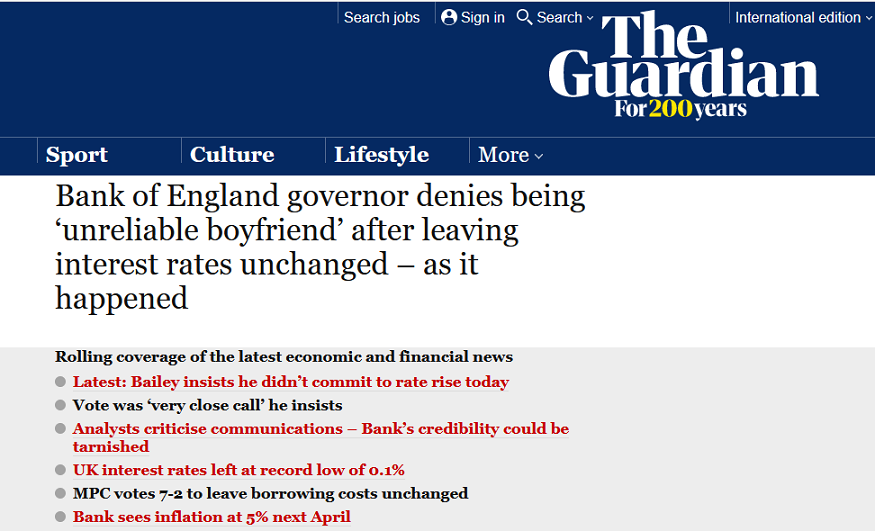
Questa decisione, questo mancato rialzo, ha suscitato un clamore enorme, in tutto il Mondo, perché è apparsa a molti come una inversione di marcia, come una svolta ad U, e qualcuno ha scritto (immagine qui sotto) persino di un amante infedele. Il mercato in questo caso sarebbe invece l’amante tradito.

Ci appoggiamo a Reuters per ricostruire nel dettaglio queste ore convulse, con l’articolo che segue qui sotto.

LONDON, Nov 4 (Reuters) - The Bank of England kept interest rates on hold on Thursday, wrong-footing investors who had been convinced that it would be the first of the world's big central banks to raise borrowing costs after the COVID-19 pandemic.

The BoE kept alive the prospect of a move soon, saying it would probably have to raise Bank Rate from its all-time low of 0.1% "over coming months" if the economy performed as expected.

But seven of its nine policymakers voted to leave rates unchanged for now - even as they forecast inflation would reach almost 5% in April - so they can see how many people lose their jobs after the recent end of the government's furlough scheme.

The announcement sent shockwaves through markets, sending sterling towards its biggest fall since the early days of the COVID-19 pandemic in March 2020.

The yield on two-year British government bonds fell by the most since the day after the Brexit vote in 2016.

Governor Andrew Bailey rejected a suggestion by a reporter that he was "unreliable boyfriend number two," a nickname first used by a lawmaker to describe former governor Mark Carney, whose signals on rate moves failed to translate into action.

"We are in a situation where the calls are close, they are quite hard but that's just a reflection of the position that we are in," Bailey said. "It's not 'unreliable boyfriend'. We didn't say we were going to act at any particular meeting."

He spoke last month of the need to act to contain inflation expectations.

Bailey said two scheduled labour market data releases between now and the BoE's next rate decision on Dec. 16 could clear up the uncertainty about the labour market but that was not "a strong clue" about when a hike might come.

Investors responded to the BoE's announcement by putting a roughly two-thirds chance on a rate hike in December, much less than the 100% chance they had seen for a hike at November's meeting.

By contrast, a Reuters poll of economists last week showed the average expectation was for the BoE to keep rates on hold.

Only two Monetary Policy Committee members - Deputy Governor Dave Ramsden and Michael Saunders - voted for an immediate 15 basis-point rate hike.

"Pathetic communication from the BoE," Peter Kinsella, head of FX strategy at Swiss bank Union Bancaire Privée, said. "Bailey basically marched us up the hill, and then voted to keep rates steady."

The BoE's cautious approach came a day after the U.S. Federal Reserve said it would start scaling back its bond-buying programme this month, a precursor to its first rate increase which investors expect in mid-2022. read more

The European Central Bank has been more explicit about its determination to keep the stimulus flowing. Its President Christine Lagarde said the ECB was very unlikely to raise rates next year. read more

On Thursday, the BoE said the MPC voted 6-3 to let its government bond-buying programme reach its full size of 875 billion pounds ($1.18 trillion). Catherine Mann joined Ramsden and Saunders to vote to scale back that part of the bank's stimulus programme.

Including its 20 billion pounds of corporate bond holdings - which this month will start to be reinvested in greener debt - the total asset purchase target remained at 895 billion pounds.

"VALUE IN WAITING"

The BoE said most MPC members still thought "there was value in waiting" for data on the labour market.

Earlier on Thursday, survey data showed most furloughed workers had returned to their employers on their regular hours after the government programme ended at the end of September. read more

A recent slowdown in consumer demand also stayed the hand of most MPC members.

The BoE's new forecasts predicted slower economic growth due to continued bottlenecks in global supply chains. Output was seen regaining its pre-pandemic size in the first quarter of 2022, three months later than previously thought.

Growth in 2021 was trimmed to 7% and the forecast for 2022 was cut to 5% from a previous 6% before slowing sharply to 1.5% in 2023 and 1% in 2024.

Inflation was seen jumping to around 5% in April, driven mostly by surging global energy prices, before falling back to just below the BoE's 2% target in three years' time.

That projection was based on the BoE's usual practice of assuming energy prices follow futures for the next six months and then stay unchanged for the rest of its three-year forecast.

However, an alternative scenario, including a drop-off in energy prices in the second half of 2022 which markets expect, showed inflation would be "materially lower" than the BoE's 2% target in 2023 and 2024.

That scenario also factored in previous market expectations that interest rates would hit 1% by the end of next year.

Bailey told investors that the inflation undershoot meant investors should not count on interest rates rising as high as expected if energy prices fell as the futures market predicted.

I mercati finanziari di tutto il Mondo, ed in particolare i mercati delle obbligazioni, hanno subito reagito all’inversione di marcia della BoE, facendo calare i rendimenti delle obbligazioni in tutto il Mondo giovedì 4 e venerdì 5 ottobre.

Nell’immediato, le Borse invece hanno reagito salendo (l’effetto TINA di cui oggi noi di Recce’d scriviamo nel Blog), ma si tratta unicamente di un effetto di brevissimo periodo.

L’inversione ad U della Banca di Inghilterra era forse inevitabile, dato il clima di pre-crisi che si respirava da giorni sui mercati obbligazionari. Ne scriviamo oggi in un altro Post.

Ma questa marcia indietro non risolve il problema, ed al contrario lo rende ancora più grande. Le Banche Centrali non sanno come gestire il rialzo dell’inflazione, che da un lato rallenta le economie (facendo calare il potere di acquisto) e dall’altro lato impone un aumento dei tassi.

La situazione è resa ancora più seria dalla guerra tra mercati e Banche Centrali che è diventata di pubblico dominio proprio in queste settimane. Ne scriviamo oggi anche in un altro Post.

Dichiarazioni come quelle del Capo della Banca di Inghilterra che potete leggere qui sotto non fanno altro che confermare che lo scontro è in corso.

Bank of England Governor Andrew Bailey said it wasn’t his job to guide financial markets on interest rates, hitting back against criticism that he misled investors in the weeks leading to Thursday’s policy decision.

Speaking after officials defied markets’ expectations by keeping borrowing costs unchanged on Thursday, Bailey told Bloomberg TV’s Francine Lacqua that his remarks on the need to curb inflation before the meeting were “conditional.”

“I don’t think it’s our job to steer markets day by day and week by week,” he said.

The comments will do little to ease criticism that Bailey’s decision not to push back against aggressive bets of tightening would undermine the central bank’s credibility. 

Traders had expected the BOE to raise borrowing costs from 0.1% to 0.25% on Thursday. Some of the country’s commercial banks including Barclays Plc increased, NatWest Plc and Lloyds Banking Group Plc pulled their cheapest mortgage deals before the decision, hitting households directly.

BOE Pushback

“Communications and policy feed off each other. What the Bank does is very dependent on credibility,” said Andrew Sentance, a former BOE policy maker now at Cambridge Econometrics. 

“What senior members of the Bank say can help to build confidence in the broader economy. When markets don’t have confidence in those statements, that can feed through to a lack of confidence in the economy.”

Only two of the nine rate-setters voted for an increase, with the governor himself voting to hold, despite the new forecasts showing inflation will hit 5%, more than double its target.

Traders responded by slashing rate-hike bets, and sent the pound tumbling 1.4% against the dollar. U.K. government bonds advanced, with the yield on five-year debt set for the biggest decline since the Brexit vote.

“Forward misguidance,” was how Rabobank described the BOE’s messaging after the decision, while Bob Stoutjesdik, a fund manager at Robeco Institutional Asset Management in Rotterdam said Bailey “has a serious credibility problem.”

“When look you look at how markets respond today and how they have responded to the hawkish messages you can easily conclude that the BOE have seriously lost credibility which I think is difficult to repair,” he said.

Bailey’s apparent U-turn invited comparisons with an “unreliable boyfriend”, a tag first applied to former Governor Mark Carney after he signalled rate rises and changed his mind later. “It’s not compulsory for a BOE governor to be an unreliable boyfriend,” Bailey said.

He told Bloomberg TV that his pre-meeting comments were prompted by concern that falling bond yields could lead to a rise in inflationary pressures. He said the bets following his remarks were “in the right direction, overdone.”

Jamie Rush, chief European economist at Bloomberg Economics, said it’s “absolutely Governor Bailey’s job to guide markets to a rates path that helps the Bank hit its inflation target.”

“What markets expect interest rates to be in the future affects the cost of borrowing now,” he said.

James Rossiter, head of macro strategy at TD and a former BOE economist, said it will be even harder to gauge the central bank’s future moves. 

“We knew that a November hike was a coin toss, but messaging from the BOE up to now suggested that a 2021 hike was a done deal,” he said. 

“After today’s communications, I don’t think we can take that for granted anymore.”

Siamo quindi uno ad uno, nel match tra Banche Centrali e mercati delle obbligazioni: i mercati sanno che le Banche Centrali stanno provando … a fregarli, e non vogliono farsi fregare (almeno non più di tanto)

Dopo una settimana convulsa ed emozionante, ne stanno per arrivare altre ancora più emozionanti.

Per collocare le cose nella giusta prospettiva, il nostro suggerimento in questo Post è rileggere l’articolo che segue di Bloomberg: ci ritroverete, raccolti ordinati e sintetizzati, tutti i temi più importanti di questo difficile momento dei mercati finanziari internazionali.

L’articolo è di sette giorni fa: ma dopo questo uno a uno iniziale, la palla torna al centro: proprio dove stava sette giorni fa. Sola differenza la maggiore sfiducia tra le due squadre in campo.

Taper Tantrum 2.0 has arrived just as the Federal Reserve plans to start scaling back its asset purchases. This time is different from the original edition in 2013 in a few important ways — raising the stakes for Chair Jerome Powell and the central bank, which will issue its latest decision at the conclusion of its meeting on Wednesday.

First, unlike eight years ago, traders in the $21.9 trillion U.S. Treasury market clearly understand the playbook: a combination of tapering and a potentially accelerated pace of interest-rate increases means a sharply flatter yield curve. From May 22 through July 3 in 2013, the curve from five to 30 years flattened by about 25 basis points. Last month, in a shorter time frame, the same curve flattened by roughly 40 basis points. Other curves steepened during the previous episode. Regardless of maturity, the flattening trend has been unmistakable this time around. 

Taper Tantrum Playbook

Crucially, this latest bout of bond-market upheaval is a distinctly global phenomenon. That’s a problem for the Fed. Even if it’s the world’s most influential central bank, there’s only so much it can do to dictate policy decisions in other large developed nations, which have their own domestic considerations. Here’s a snapshot of what has happened lately across sovereign debt:

  • Canada: Two-year yields more than doubled in October to 1.04%, including a spike of more than 20 basis points in one day as the Bank of Canada ended its bond-buying program and moved forward the potential timing of future rate increases.

  • U.K.: Two-year yields have been rising for 10 consecutive weeks, the longest stretch in at least three decades. Markets expect that the Bank of England will increase its benchmark rate to 0.25% from 0.1% the day after the Fed’s decision.

  • Australia: Two-year yields increased more than 50 basis points in two days, ending Friday at 0.775% from just 0.115% a week earlier. The Reserve Bank of Australia opted not to defend its short-term target level through yield-curve control.

  • New Zealand, Norway, South Korea: The central banks in these countries have already raised interest rates.

  • Spain, Portugal, Italy, Greece: Shorter-term rates as well as 10-year yields are surging in these so-called peripheral countries within the euro zone. European Central Bank President Christine Lagarde’s remarks last Thursday were taken to be not-so-dovish, and by Friday, “that caution mushroomed overnight into a mini taper tantrum,” FHN Financial’s Jim Vogel wrote.

Dragged Higher

Taken in its entirety, the global bond market looks like a powder keg, even if stocks and credit are largely shaking it off for now. That raises the all-important question: Does the Fed have the tools to prevent a blowup? 

Wall Street strategists aren’t necessarily convinced. Citigroup Inc.’s Matt King sees the Fed and its peers caught between a rock and a hard place. “Expect tantrums in risk if central banks respond to inflation — and tantrums in bonds if they don’t,” he wrote in an Oct. 29 report. At Jefferies, Aneta Markowska and Thomas Simons pondered whether Powell will look to dial back the market’s current bets on two interest-rate increases next year. He “will have to walk a very fine line, since pushing back too hard could unhinge inflation expectations, but not pushing back at all could unsettle the front end of the curve,” they wrote.

Here’s what we know for certain: The Fed doesn’t like to surprise markets. Just about everyone expects the central bank to say it will start scaling back its $120 billion of monthly bond purchases ($80 billion in Treasuries, $40 billion in mortgage-backed securities) by $15 billion a month ($10 billion in Treasuries, $5 billion in MBS) starting in mid-November and ending by June. That’s what should happen come Wednesday. It gives Powell and his colleagues eight months to ever-so-slightly pare back accommodative policy and hope in the meantime that inflation comes down and validates their long-held position that price pressures are transitory.

Ideally, the Fed would have a better strategy than hope. But it has boxed itself into a difficult situation with its new policy framework, which was designed with the post-2008 economy in mind. That period was characterized by a gradually improving labor market without much wage pressure or inflation broadly. It suggested that reaching the nebulous level of “full employment” doesn’t mean price growth will reach or exceed the central bank’s 2% target.

The framework wasn’t meant to address the current situation: persistently elevated inflation when the number of working Americans is still well below its February 2020 levels. Yes, it’s good to see that the employment cost index, a broad gauge of wages and benefits, rose 1.3% in the three months through September from the prior quarter, the biggest jump on record. But if consumer prices are rising more quickly — and especially if individuals and companies expect they’ll only go up faster in the future — then the Fed is violating the price-stability part of its mandate by staying the course, to say nothing of its supposed data dependency.

The best way for Powell to defuse the situation is by first acknowledging that the pace of tapering isn’t on autopilot and that the central bank reserves the right to speed it up or slow it down based on incoming data. It would take a severe shock for that to happen, of course, but just hinting at that optionality would show that it hasn’t abandoned its commitment to keep inflation well-anchored. Second, he would be wise to steer clear of directly trying to influence the market pricing of short-term rates, only saying that officials were split about increasing the fed funds rate in 2022 as of September, and that they will update their forecasts next month based on the latest information. As it stands, I’d expect December’s dot plot to reflect a median expectation of one rate increase within a year, meeting current market pricing halfway. 

Suffice it to say, it’s a delicate balancing act. It’s made a bit easier by the fact that the bond market’s tantrum hasn’t yet spilled over into credit spreads or equity prices, and made more difficult because Powell isn’t even sure he’ll be Fed chair in a few months. Will there be a hard policy pivot, or is this just bond traders getting ahead of themselves about inherently uncertain actions months down the line?

It’s up to Powell to navigate this treacherous path. Announcing the start of tapering will be the easy part.

Mercati oggiValter Buffo
Borse: resta solo e soltanto TINA
 

Leggendo i quotidiani, ascoltando i TG Economia, e scorrendo quello che viene scritto sul Web, spesso ci si imbatte nel termine “euforia”.

Il termine “euforia” viene utilizzato in associazione con i “nuovi record delle Borse”. I nuovi record delle Borse, ed in particolare della Borsa di New York, sarebbero il riflesso di un clima di “euforia tra gli investitori”.

Ci sembra utile, per i nostri lettori, mettere in evidenza almeno due punti, a questo proposito:

  1. il clima sui mercati, ed in Borsa in particolare, oggi è molto diverso da quello prevalente nella prima parte del 2021: qualche mese fa, dominava una visione del futuro tutta improntata all’ottimismo; pochi mesi fa sui mercati si registrava un ampio consenso sul boom economico in arrivo, ed uguale consenso dominava in materia di inflazione, che a fine 2021 avrebbe dovuto ritornare al 2% (e che in ogni caso non sarebbe stato un problema); oggi, a novembre 2021, entrambe queste due previsioni sono state smentite, in modo brutale, dai fatti e dalla realtà; ma le Borse sono salite ancora: come si spiega? ne scriviamo poco più in basso; prima mettiamo in evidenza un secondo punto

  2. il clima forse è di “euforia” in Borsa, ma sicuramente non è di euforia negli altri comparti del mercato finanziario internazionale: e noi oggi ne scriviamo, in modo ampio, in altri Post

Nel grafico qui sopra, mettiamo alla vostra attenzione un dato che poi viene ripreso anche in altri Post pubblicati oggi: la linea di colore rosso è l’indice della volatilità del mercato delle obbligazioni, mentre quella di colore verde è la volatilità della Borsa di New York. Come tutti vedete, da una parte c’è un’impennata, dall’altra parte (la linea di colore verde) il dato rimane stabile.

Dell’impennata che vedete qui sopra, scriviamo oggi in altri Post. In questo Post, ci dedichiamo alla linea di colore verde.

Che nel grafico sotto vedete di nuovo, nel grafico del Financial Times che racconta proprio la medesima storia.

Bloomberg scrive qui sotto: “I problemi delle obbligazioni non hanno coinvolto le azioni”. Il grafico che vedete nell’immagine qui sotto è di particolare interesse per noi investitori, perché segnala un valore estremo nella statistica che si chiama “Z”, statistica che da sempre ha un buon potere previsivo sull’evoluzione dei mercati finanziari.

In questo Post, tenteremo di aiutare chi ci legge a comprendere la ragione per la quale abbiamo tutti visto, nell’ultimo mese, una nuova fase di rialzo dei prezzi di Borsa, e quali sono le motivazioni sottostanti a questo movimento verso l’alto. Motivazioni che, non c’è dubbio, hanno nulla a che vedere con il “boom economico” ed hanno nulla a che vedere con la “inflazione transitoria”.

E allora?
E allora, Recce’d vi propone la spiegazione offerta pochi giorni fa dal settimanale The Economist: che nel suo titolo qui sotto dice “TINA tiene azioni ed obbligazioni su due strade opposte”.

Che cosa è TINA?. TINA sta per “there is no alternative”, e significa che “è giusto comperare azioni perché le obbligazioni rendono nulla”.

Questo argomento ha funzionato, e funziona ancora, perché si è volutamente lasciato credere alla massa degli investitori che non esiste (più) il rischio di ribasso delle azioni, quel rischio di ribasso che negli ultimi 20 anni si è chiaramente manifestato, e concretizzato, in (almeno) tre macroscopiche fasi di ribasso.

Le Autorità vogliono però che il grande pubblico rimanga all’oscuro, e continui a mantenere la convinzione che le azioni “non possono scendere”, perché “ci pensa la Federal Reserve”.

Restiamo del parere che già conoscete: questa è una sciocchezza enorme, e lo dimostriamo proprio oggi negli altri Post.

In questo Post, però, vogliamo completare l’esame dei recenti rialzi degli indici di Borsa, offrendovi in lettura proprio qui sotto l’integrale riproduzione dell’articolo di The Economist che abbiamo già citato.

Notate che abbiamo messo in evidenza il passaggio nel quale The Economist accenna al “parametro K di Marshall”: non c’è in questo Post lo spazio per un approfondimento, ma vi invitiamo a indagare su questo parametro e sulle sue implicazioni. Come sempre se ci contatterete saremo felici di integrare con ulteriori informazioni.

LONDON, Oct 29 (Reuters) - The readout from this week's brutal selloff in government bond markets seems clear: rising inflation will hustle central banks into panicky interest rate rises, quashing economic growth.

Yet stocks, currencies and corporate bonds are sending a different picture: keep calm. Maybe even buy more.

Time will tell who has it right. What's for sure is many bond investors were caught out by fears that central banks, despite their inflation-is-transitory mantra, may end up tightening policy sooner than signalled.

A timid message from the European Central Bank, a hawkish one in Canada and the Reserve Bank of Australia's reluctance to defend its 0.1% T-bill yield target all helped light a fire under short-dated debt yields. Those in Germany and the United States zipped to their highest since last March while Australian bill yields saw their biggest three-day surge since 1996.

Ordinarily, such moves would cause significant disruption across asset classes.

But instead they have barely registered, with the S&P 500 equity index hitting a record high on Thursday. While stocks fell on Friday, losses are relatively muted and Lipper data shows that in the week to Wednesday, investors purchased equities at the fastest pace since March.

Currency and equity volatility (.DBCVIX) remain subdued, with Wall Street's "fear gauge", the VIX index (.VIX), just off 2021 lows. In Europe, rates volatility has rocketed, while stocks have remained calm.

Some attribute the sanguine reaction to falling yields on longer-dated bonds, which has flattened yield curves and appears to signal that swift central bank action will in time quash inflationary pressures.

And "real" bond yields, adjusted for inflation, remain deeply negative: despite a surge on Friday they remain around -1% and -2% in the United States and Germany respectively , .

"It's surprising that stocks have not responded more but with real yields so negative, markets are not too worried," said Charles Diebel, head of fixed income at Mediolanum International Funds.

"If you decompose the forward curve on inflation it's about the near-term pressure on inflation ... so breakevens are moving up but central banks are starting to respond, which means slower activity and meaning inflation will not be a problem in the longer-term."

Breakevens refer to the difference between nominal and inflation-linked bond yields and are often used as a market gauge of inflation expectations.

Nor do riskier corporate debt markets seem spooked. The risk premiums they pay on top of government bonds remain historically low. ,

"(Low real rates), I think that is having an effect on markets in the sense that it's creating the 'TINA' effect: There Is No Alternative to buy higher-yielding securities," said Barnaby Martin, head of credit strategy at BofA in London.

TYPICAL MID-CYCLE

The short-dated bond moves are also partly down to positioning. Traders caught out by the yield rise had to dump their positions, exacerbating the selloff and making some pricing look far-fetched.

Traders now expect the United Kingdom and Canada to raise interest rates by more than 100 basis points over the next 12 months. Even the ultra-dovish European Central Bank is seen hiking twice by October 2022.

Chris Iggo at AXA Investment Managers expects higher rates to tighten financial conditions a little but said it would be akin to "normalisation, in a sense because we're going to pre-COVID conditions".

"It's typical mid-cycle type of economic conditions, where inflation has gone up a bit, rates have gone up, growth starts to slow, but it's not a recession yet."

And if serious growth concerns do emerge, many remain confident of the central bank "put".

"The real widening (in stocks and corporate spreads) would come on a recession, not so much rates risk, just because we've seen time and time again that if markets begin struggling because of interest rate fears, central banks try to push back dovishly again," Martin of BofA said.

But bond repricing should eventually ripple out more broadly, meaning some pain is inevitable.

"Expect tantrums in risk if central banks respond to inflation - and tantrums in bonds if they don't," Citi strategist Matt King told clients.

Reporting by Yoruk Bahceli, Tommy Wilkes, Sujata Rao and Saikat Chatterjee; Editing by Sujata Rao and Catherine Evans

A measure of U.S. financial liquidity whose declines foreshadowed two of the decade’s worst equity routs is flashing alarms even before the Federal Reserve embarks on its planned winding down of asset purchases.

The signal is obscure, but has sent meaningful signs in the past. Roughly speaking, it’s the gap between the rates of growth in money supply and gross domestic product, an indicator known to eco-geeks as Marshallian K. It just turned negative for the first time since 2018, meaning GDP is rising faster than the government’s M2 account.

The shortfall comes from an expanding economy that’s quickly depleting the nation’s available money. The deficit could become a problem for markets at a time when excess liquidity is seen as underpinning rallies in everything from Bitcoin to meme stocks.

“Put another way, the recovering economy is now drinking from a punch bowl that the stock market once had all to itself,” Doug Ramsey, Leuthold Group’s chief investment officer, wrote in a note last week.

How big a threat is this? While stocks kept rising during frequent negative Marshallian K readings in the 1990s, the pattern since the 2008 global financial crisis -- a period when the central bank was in what Ramsey calls a “perpetual crisis mode” -- begs for caution.

The Marshallian K fell below zero in 2010, a year when the S&P 500 Index suffered a 16% correction. A similar dip in 2018 portended a selloff that almost killed that bull market.

The Leuthold study is the latest attempt to handicap the market’s outlook from the perspective of liquidity. But not everyone is worried. Ed Yardeni, the president and founder of Yardeni Research Inc., says he prefers to plot not the growth rates but the absolute level of M2 against GDP to measure liquidity. Based on that, liquidity stood near a record high.

“Some people start to freak out about the M2 growth rate,” he said in an interview on Bloomberg TV and Radio. “What they don’t really appreciate is M2 today is $5 trillion higher than it was before the pandemic. There is just a tremendous liquidity sitting there.”

Others see limited impact from Fed tapering on the equity market. In June, research from UBS Group AG showed that should the Fed turn off the spigot on its annual $1.4 trillion in quantitative-easing spending, the hit to the S&P 500 would be a paltry 3% decline in prices.

In 2013, when the Fed’s announcement on a reduction in stimulus sparked a taper tantrum that sent 10-year Treasury yields skyward, the S&P 500 pulled back almost 6% from its May peak that year. But stocks staged a full recovery within weeks and went on with a rally that eventually lifted the index 30% for the whole year.

Skeptics, however, are quick to point out one big difference: equity valuations.

“Back then, the stock market was trading at 15 times earnings. Now it’s 22 times earnings,” Matt Maley, chief market strategist for Miller Tabak + Co., said in an interview on Bloomberg TV with Caroline Hyde. “It will be hard for the market to ignore it this time around.”

For now, a liquidity drain suggested by the Marshallian K data has done little damage to the market, at least on the index level. The S&P 500 is poised for a seventh straight monthly gain, reaching all-time highs almost every week.

But Ramsey warns investors shouldn’t let their guard down. While the broad market has been strong -- the S&P 500 closed Wednesday at a record for the 46th time this year -- fewer stocks are participating in the latest leg up. This could be blamed on falling liquidity, he says, and the days of abundant cash floating all stocks are likely gone.

The Marshallian K indicator just slumped into negative territory faster than ever. During the second quarter, M2 money expanded 12.7% from a year ago, trailing the nominal GDP growth rate of 16.7%. That came after four quarters of excessive liquidity where the spread stayed above 20 percentage points.

The Marshallian K now shows liquidity not only deteriorating but actually contracting -- and at a time when hopes (as embedded in valuations) have never been higher,” Ramsey said. “If the Fed can drawdown QE in the next year without triggering a decline of those levels, it will truly have achieved something remarkable. But we’d rather invest based on the probable.”

(Updates with Yardeni’s comment starting in seventh paragraph.)

Mercati oggiValter Buffo