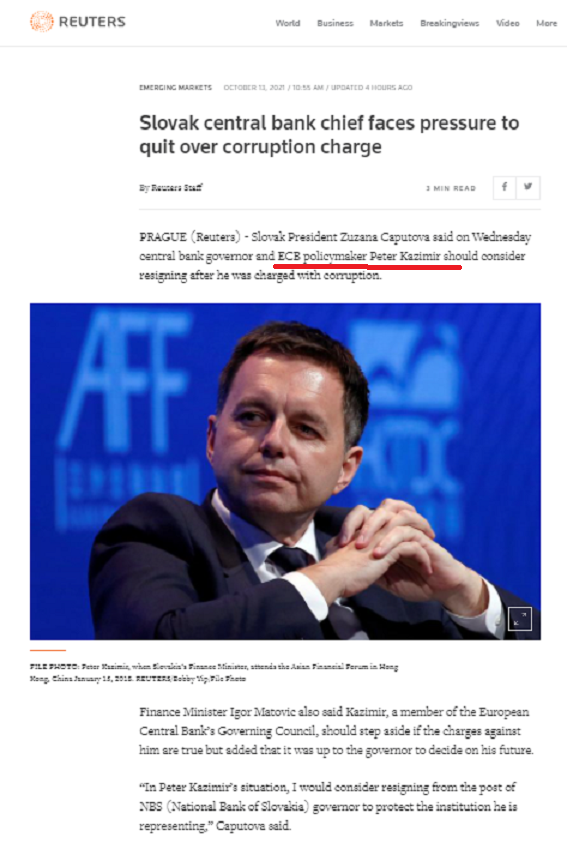
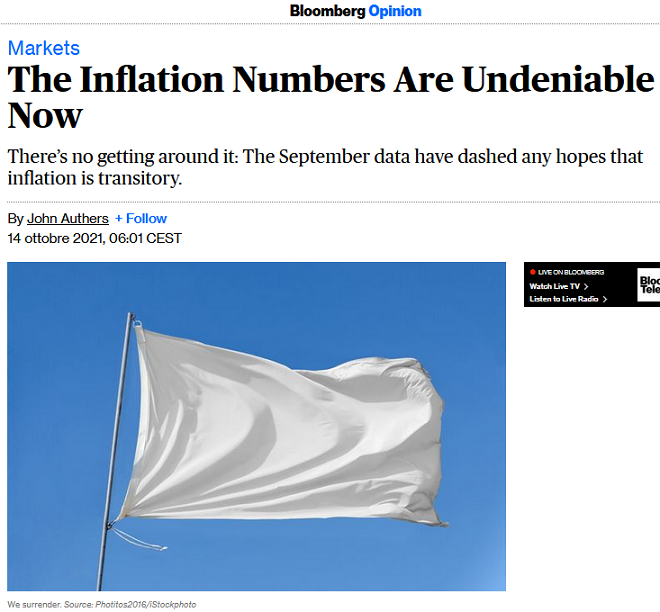
Come sempre è successo, e come sempre sarà, è la realtà a prevalere sulla fantasia. I dati non possono essere smentiti.
Ma soprattutto, questo fatto recentissimo dovrebbe ricordarvi una cosa: è assolutamente sbagliato affermare che “un po’ tutti hanno ragione, a turno ora questo ora quello”.
No, è falso: uno solo ha ragione, e chi invece affermava l’opposto ha torto, e questo perché la realtà è una sola, non ce ne sono due.
E dunque: chi diceva a inizio anno che l’inflazione NON era transitoria ha ragione, gli altri hanno sbagliato. Molti non consapevolmente, altri scegliendo di … fare i fessi in commedia.
Sarà così anche per quello che riguarda i mercati finanziari, non c’è dubbio: solo uno, ha ragione, sui mercati finanziari.
Ed anche se i tempi sono sempre incerti (“quando arriverà la svolta sui mercati?”: risposta, quando vuole arrivare, ma questa volta più di altre volte in modo improvviso e rapissimo) non esiste modo per i mercati finanziari di aggirare la realtà, che prima o dopo passa e chiede il conto.
Per arricchire e completare questo nuovissimo Longform’d, vi proponiamo in lettura un altro articolo che è stato pubblicato in settimana dal New York Times. Un articolo che viene seguito più in basso da un nostro commento. E che si apre con un episodio che riguarda proprio uno dei nostri amici wealth managers, ovvero private bankers, ovvero promotori finanziari, ovvero consulenti addetti alla vendita (di Fondi Comuni).
Oct. 15, 2021
Terrell McCallum, a private wealth adviser in Dallas, spends a lot of time thinking about markets and interest rates. He knows that the Federal Reserve targets 2 percent annual price increases on average, so it was a shock when he learned that his rent would increase a whopping 10 percent this year.
“I can afford it, but it gets to the brink of financial burden,” said Mr. McCallum, 33. He and his wife have been saving up for their first home, but now that they are paying $1,830 for their apartment and fees, that will become more difficult. He tried to push back on the increase, but the company he rents from wouldn’t budge.
“They said: ‘This is what the market is doing.’”
Mr. McCallum’s experience is echoing across America, as rents shoot higher after a brief pandemic slump, burdening households and fueling overall inflation. That is bad news for the Federal Reserve, because it could make today’s uncomfortably rapid price gains last longer. It’s also problematic for the White House because it hits households right in their pocketbooks, diminishing well-being and fueling unhappiness among voters.
The jump in rents stemmed from a frenzy in the market for owned homes. People tried to buy as the pandemic took hold in the United States, often searching for extra space, but found that houses were in short supply after years of under-building following the housing crisis. That dearth of properties has been exacerbated by work stoppages, supply shortages and labor constraints during the coronavirus era, all of which have kept developers from ramping up production to meet demand.
As buyers bid up prices on single-family homes and condominiums, many people who would have otherwise moved toward homeownership found themselves unable to afford it, increasing demand for apartments and home leases. Rents have been further boosted by the large number of people searching for places with more space and home offices during the pandemic, and as millennials in their late 20s and early to mid-30s look for more autonomy.
“People might be looking to move out and on their own after being stuck with roommates during the pandemic,” said Adam Ozimek, the chief economist at Upwork, an online freelancing marketplace. “There’s also a possibility that remote work is playing a role here.”
Government stimulus checks and expanded unemployment benefits also helped people amass savings over the course of the pandemic, so they can afford to move. Personal savings as a share of disposable income popped during the crisis, and while the share has come down toward normal levels, it remains slightly elevated at 9.4 percent, compared with about 8 percent just before the pandemic.
The combination of factors seems to have created a perfect storm that pushed the Consumer Price Index measure of rent up 0.5 percent just between August and September, the fastest pace in about 20 years.
That’s a concern for the Fed, because housing prices tend to move slowly and once they go up, they tend to stay up for a while. Rent data also feed into what is called “owners’ equivalent rent” — which tries to put a price on how much owners would pay for housing if they hadn’t bought a home. Together, housing measures make up about a third of the overall Consumer Price Index.
Overall consumer prices have jumped sharply in 2021, climbing 5.4 percent in September from the prior year. Fed officials have been hoping and betting that the move is temporary, but they are watching housing measures carefully as a risk to that outlook.
“Many participants pointed out that the owners’ equivalent rent component of price indexes should be monitored carefully, as rising home prices could lead to upward pressure on rents,” minutes from the Fed’s September meeting, released Wednesday, said.
Rent is less critical to the Fed’s preferred inflation gauge, the one it officially targets when it shoots for 2 percent annual inflation on average, than it is to the C.P.I. But it is a big part of people’s experience with prices, so it could help shape their expectations about future cost increases.
Those expectations matter a lot to the Fed. If consumers come to anticipate faster inflation, they may begin to demand higher wages to cover their rising expenses. As businesses lift prices to cover rising costs, they could set off an upward spiral. Already, some key measures of inflation outlooks — notably the New York Fed’s Survey of Consumer Expectations — have jumped higher.
The Fed is already preparing to start slowing the large bond purchases it has been making during the pandemic to keep longer-term interest rates low and money flowing around the economy. If inflation stays high, the Fed may also come under pressure to raise its policy interest rate, its more traditional and more powerful tool. That might slow mortgage lending, cool the housing market and weigh down inflation.
But doing that would come at a big cost, slowing the labor market when there are 5 million fewer jobs than before the pandemic. So for now, Fed officials are getting themselves into a position where they can be nimble without signaling that they’re poised to raise rates.
White House officials are also wrestling with their options for easing housing price pressures. President Biden’s economic agenda includes measures that would build more houses and discourage zoning rules that keep new construction at bay.
Such an intervention would take time — homes are not built overnight. And in the meantime, rents will almost certainly continue moving in the inflation data, which reflect rising housing costs at a long delay. More up-to-date measures of rental pricing pressure produced by Apartment List and Zillow have shown costs climbing in recent months, though many measures of rent and new leases have calmed down somewhat after a red-hot summer.
The national median rent has increased 16.4 percent since January, Apartment List said in its September rental report, with monthly growth slowing slightly from its July peak.
U.S. Inflation & Supply Chain Problems
Covid’s impact on supply continues. Price increases that grew out of pandemic-related shutdowns and supply chain disruptions have continued. Here are some of its effects:
Prices jumped more than expected in September. The Consumer Price Index climbed 5.4 percent in September when compared with the prior year, raising the stakes for the Fed and the White House, which are now facing a much longer period of rapid inflation than they had anticipated.
Social Security benefits will rise 5.9 percent in 2022. The increase, which is tied to the Consumer Price Index and is known as a cost of living adjustment, is the largest in 40 years.
Rents have shot higher. The increase is burdening households and fueling overall inflation. That’s bad news for the Fed, because it could make uncomfortably rapid price gains last longer.
The Port of Los Angeles will operate 24/7. The expansion of the port’s hours comes as the Biden administration struggles to relieve backlogs in global supply chains, which are contributing to inflation. Walmart, UPS and FedEx will also increase operations.
Wall Street is concerned about stagflation. The toxic mix of sluggish growth and high inflation is driving fears about the possible return of an economic specter from the 1970s: stagflation.
“This is still very strong by historical standards — we’re in off season,” said Igor Popov, chief economist at Apartment List. “It’s a racecar slowing down ahead of a turn, but it’s still going faster than we ever have in our lives.”
Whether rent growth speeds up or slows next year may hinge on whether the government support that has given households the financial ability to afford housing gives way to a strong job market.
“There’s room to run, for sure,” based on demographics alone, Mr. Ozimek said. “The question is whether the economy is going to go into full employment, or whether there’s a slowdown.”
Rents could heat up as big cities including New York and Los Angeles rebound from the pandemic, said Daryl Fairweather, chief economist of Redfin. While smaller cities’ rental markets have been hot for months, the median rent in Manhattan climbed for the first time since the start of the pandemic in September, data from Miller Samuel and Douglas Elliman showed.
The recovery in the New York area as a whole has been uneven as some families have moved to the city, bidding up prices, while others are struggling to pay, said Jay Martin, executive director of the Community Housing Improvement Program, which represents landlords of mostly rent-stabilized housing.
“You have bidding wars for one unit, and then a renter who can’t pay,” he said. “A tale of two cities is happening within the same building.”
Drew Hamrick, the senior vice president of the Colorado Apartment Association, a landlord group, said the rise in rents is not driven by landlords but by market factors.
“Landlords don’t really set the price, consumers set the price,” he said. “It’s musical chairs.”
Even if there is a pullback in rents next year, today’s suddenly higher housing costs could make for a painful adjustment period. Higher rent costs can reverberate through people’s lives and force tough decisions.
Luke Martinez, a 27-year-old in Greenville, a town in East Texas, is contemplating buying a trailer and setting his family up on an R.V. lot after learning that he is losing the three-bedroom house he has been renting for about $1,000 per month since 2016.
“It’s insane the amount of rent, even in this little podunk town,” Mr. Martinez said.
He’s looking at paying up to $1,500 per month for a new place, which will be tough. After getting laid off at the start of the pandemic, he had been living partly on savings — padded by an insurance payout after his car was stolen and totaled. He returned to working in automotive repair only this week. His wife had been working the front desk at a hotel until two months ago, but she is now home-schooling their 8-year-old.
If they end up renting at the higher price, they will most likely afford it by forgoing a new car.
“It’s pretty much just scraping by,” he said of his lifestyle.
Jeanna Smialek writes about the Federal Reserve and the economy for The New York Times. She previously covered economics at Bloomberg News. @jeannasmialek
Questo articolo a noi serve nell’ambito del Longform’d come esempio. Esempio che serve a ricordare a voi, lettori del Blog, che se vi hanno detto che ‘inflazione non è un problema di cui tenere conto, perché non si vede nella vita quotidiana, vi hanno appena raccontato l’ennesima favoletta, come è facile dimostrare andando alla pompa per fare il pieno di carburante per l’auto, oppure quando si riempie il serbatoio per il riscaldamento della casa, anche qui in Italia.
Una seconda cosa che ci è molto utile, dell’articolo che avete letto sopra, è il richiamo agli Anni Settanta, richiamo che chi segue il Blog ricorderà, fin dall’agosto del 2020, ovvero 15 mesi addietro, come il nostro tema forte.
Il lavoro di ogni gestore di portafoglio sta prima di tutto in questo: nell’essere efficace nella costruzione di scenari credibili (e non ridicoli come quelli della “inflazione transitoria”).
Scenari che sono INDISPENSABILI per poi formulare in modo razionale fondato aspettative di rischio e rendimento per azioni, obbligazioni, valute, oro, petrolio e persino Bitcoin.
Non si riesce proprio a comprendere come in tanti abbiamo la pretesa di affermare che “le azioni faranno così” oppure le obbligazioni faranno cosà” oppure “il petrolio può solo salire” quando neppure capiscono (neppure alla lontana) che cosa sta accadendo nella realtà intorno a loro. Eppure, moltissimi insistono, a sparare bolle di sapone in aria, e c’è poi sempre qualcuno che le scambia per il sole.
Oggi, il tema di mercato, in tutto il Mondo, è per tutti la stagflazione, come dice anche l’immagine più sotto. Come già detto, vi sarà utile riflettere sul fatto che nell’agosto 2020 Recce’d vi scriveva e vi parlava di stagflazione, mentre tutti gli altri vi scrivevano e parlavano di “boom economico” e di “inflazione transitoria”.
Non lo abbiamo soltanto detto: abbiamo anche operato, a favore e nell’esclusivo interesse del Cliente, in questa direzione. per questo, mentre voi lettori oggi siete divorati da ansie assortite per il vostro portafoglio, i nostri Clienti guardano al loro futuro cone legittime aspettative di guadagno. Quelle che voi, oggi, non avete più.
Ovviamente, voi amici lettori del Blog siete liberi di stare a sentire chi vi pare, e di parlare di chicchessia: ma la competenza, nel mondo degli investimenti, conta, e conta moltissimo. La differenza tra un gestore competente e un chiacchierone impreparato la vedete nei risultati dei vostri investimenti, come sempre a fine corsa. E quindi, … occhio!