Secondo semestre 2021: come investiranno gli altri?
 
2021_Jan_956.png

Della prima metà del 2021 sui mercati finanziari, il fatto memorabile è uno, ed uno solo, Lo vedete qui sotto nei due grafici.

2021_Jan_969.png

Il secondo dei due grafici qui sopra vi informa che la quantità di denaro che è affluito vero i Fondi Comuni azionari, nella prima metà del 2021, è superiore al totale dei 20 anni precedenti.

Per conseguenza, i Clienti individuali oggi, nella loro asset allocation, hanno una quantità eccezionale di azioni ed investimenti azionari (attraverso Fondi Comuni ed Unit linked) Lo vedete sotto nel grafico.

Il dato è clamoroso, storico persino, per la ragione che le Borse, nel primo semestre, di fatto non si sono mosse: i rialzi che sono stati registrati dai maggiori indici fanno ridere, se messi a confronto con questi dati.

E quindi: chi ha venduto, nel primo semestre?

2021_Jan_974.png

Ma c’è una seconda ragione, che rende storico ed indimenticabile questo periodo: tutti questi piccoli e medi investitori hanno investito in Borsa convinti di guadagnare. Non sanno nulla, di Borsa, e di sicuro non sanno nulla dei dati qui sotto.

2021_Jan_970.png

Questi piccoli e medi investitori sono stati convinti da personaggi privi di professionalità e spregiudicati che le loro posizioni azionarie avrebbero portato all’investitore dei grandi guadagni: ma non succederà, e per capirlo è sufficiente dare uno sguardo al grafico qui sotto.

2021_Jan_979.png

La storia stessa dei mercati finanziari ci dice che il rendimento di questi investimenti in Borsa sarà pari a zero, ma solo se tutto di tutto filerà liscio. In tutti gli altri casi sarà sotto zero.

2021_Jan_980.png

A questi investitori sarebbe molto utile riflettere sul fatto che un modestissimo ribasso dello 1,5% degli indici di Borsa, giovedì 8 luglio 2021, ha immediatamente fatto comparire, su tutti i siti e sulle prime pagine dei quotidiani, titoli “da panico” come quello che vedete qui sotto.

2021_Jan_977.png

A questi investitori noi suggeriamo di riflettere con attenzione sul fatto che un piccolissimo ribasso degli indici di Borsa ha trovato tutte le banche globali di investimento immediatamente pronte a rovesciare la giacchetta, tirando fuori dai cassetti (dove erano già preparate) le ricerche che mettono in evidenza le “anomalie” e le “analogie con la bolla dot.com”., come vedete sotto.

2021_Jan_978.png

A questi investitori, che si aspettano l’impossibile dai propri recenti investimenti, consigliamo di cambiare al più presto strada, e portafoglio.

A tutti questi investitori noi consigliamo di leggere con attenzione le analisi di chi ha da tempo messo in evidenza “la fragilità dello scenario di boom economico con bassa inflazione”. Tre mesi fa, c’era soltanto Recce’d, adesso c’è una buona percentuale degli analisti.

2021_Jan_945.png
Secondo semestre 2021: l'inflazione
 
2021_Jan_988.png

La settimana che si apre con lunedì 12 luglio sarà caldissima, per tutti i mercati finanziari, per almeno tre buone ragioni:

  1. arrivano i dati per l’inflazione dagli Stati uniti e dall'Europa

  2. si apre la stagione degli utili trimestrali negli Stati Uniti

  3. Jerome Powell testimonia al Congresso USA

Il quadro che Recce’d propone ai propri Clienti (ed i conseguenti portafogli in titoli) è definito ormai da mesi, e non cambierà certamente per conseguenza degli effetti della settimana prossima.

Per i mercati, e per il “gregge” dei piccoli e medi investitori, però, è molto diverso.

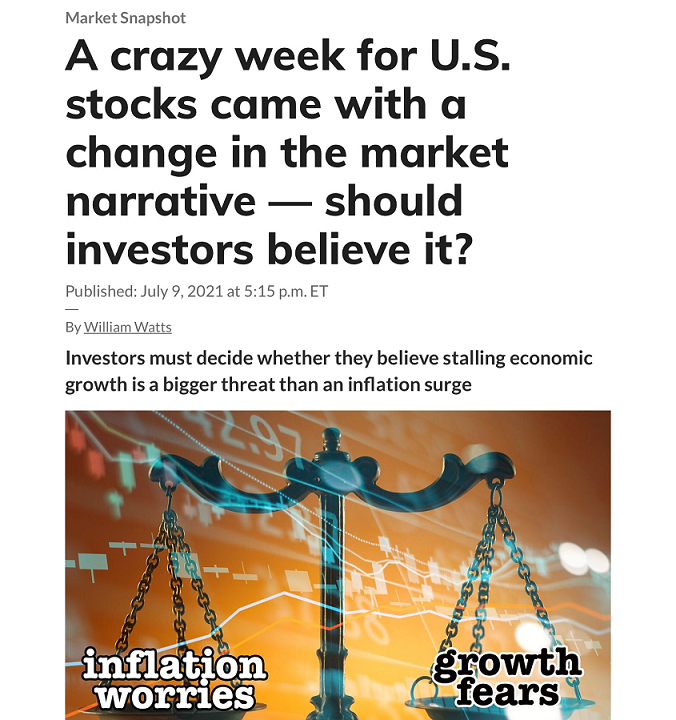
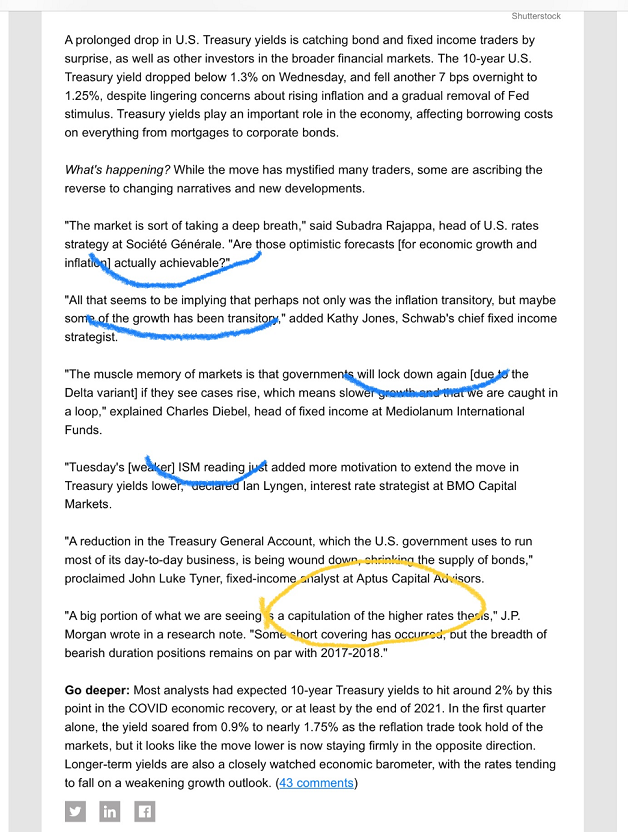
Già nella settimana appena conclusa, tutti avete visto un test della solidità della “narrativa” dominante, quella fatta di “boom economico e bassa inflazione”. Entrambe le due cose, oggi, sono state messe in discussione. Lo leggete ad esempio qui sotto nell’immagine.

2021_Jan_989.png

Per voi investitori, serve (è indispensabile) una quotidiana analisi dei dati in uscita, delle dichiarazioni, e delle notizie rilevanti, se volete fare investimenti redditizi, oppure come minimo comprendere ciò che state facendo dei vostri risparmi.

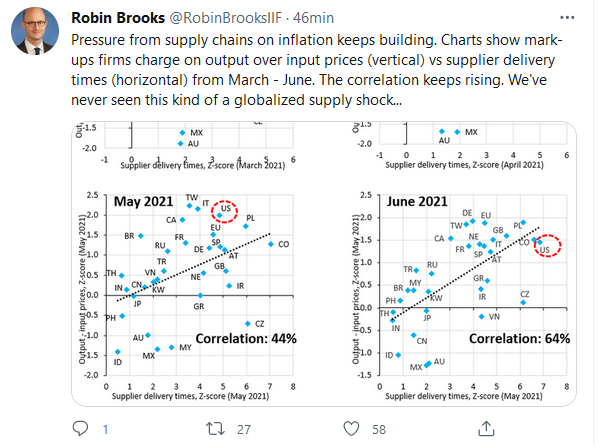
In particolare, i dati per l’inflazione che vedrete la settimana prossima, se volete renderli utili per voi, li dovrete collocare nel contesto che viene descritto, in modo semplice ma eccellente, nell’immagine qui sotto.

2021_Jan_967.png

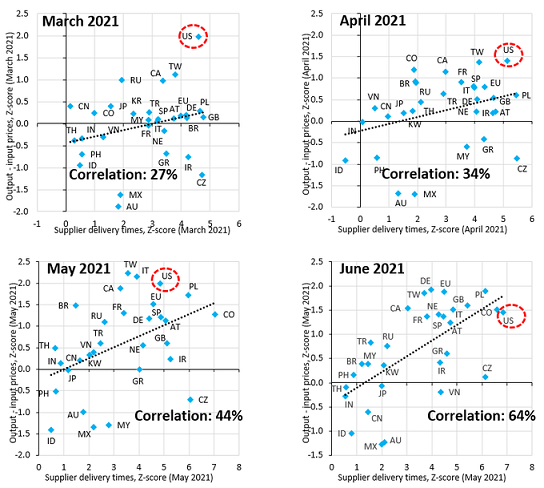
La correlazione, crescente di mese in mese, tra i ritardi nelle consegne delle merci ed i prezzi delle merci stesse è uno degli indicatori seguiti da Recce’d, che non si fida (per nulla) di facili dichiarazioni sulla “inflazione transitoria” e si preoccupa invece dei denari dei propri Clienti con quotidiane analisi ed approfondimenti, per capire se questa inflazione è davvero “transitoria” oppure se tra due mesi di nuovo ci sarà una giravolta nelle previsioni delle Banche Centrali (come quella che tutti voi avete visto nel mese di giugno 2021).

2021_Jan_968.png

Il nostro suggerimento ai lettori è di seguire con attenzione i dati che usciranno tra luglio ed agosto 2021, ed in aggiunta di analizzarli nel modo più utile per gli investitori (oppure di rivolgersi a qualcuno che abbia la capacità e la competenza per fare questo lavoro di analisi).

In aggiunta, consigliamo ai nostri lettori di non affidarsi (mai) a certi commenti che circolano sul Web, di diffidare delle chat dei siti di trading, di evitare di leggere le analisi frettolose e semplicistiche di alcuni quotidiani e settimanali, di non cadere nella trappola dei social media.

Sui social media, solo 90 giorni fa, tutti voi avete letto che “i rendimenti delle obbligazioni non salgono per paura dell’inflazione ma per la ragione giusta, che è la forza dell’economia reale”.

Noi avevamo detto allora, con molta chiarezza, che questa semplicistica spiegazione era poco sostenibile (in qualche caso ridicola).

Chissà cosa dicono oggi quei social media, che l’inflazione è in rialzo, l’economia non cresce più, ed i rendimenti delle obbligazioni scendono? Non abbiamo tempo di controllare.

Meglio affidarsi a persone serie, come noi di Recce’d facciamo: e qui vi proponiamo per conseguenza di leggere un estratto da qualificato articolo, che contiene alcuni numeri che possono essere molto utili per interpretare i dati in uscita questa settimana.

2021_Jan_976.png

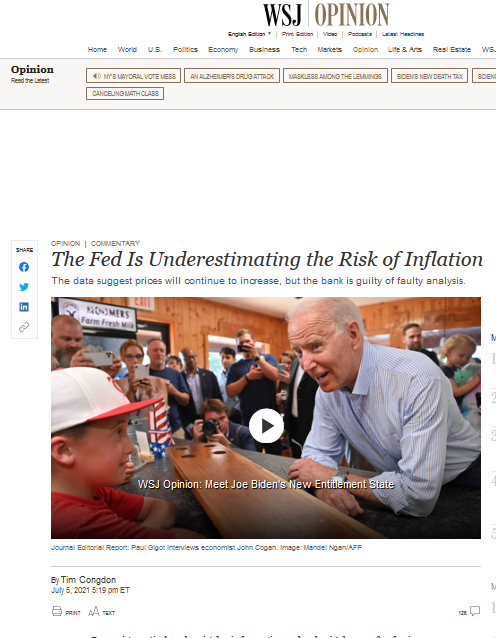
By Tim Congdon

July 5, 2021 5:19 pm ET

Economists routinely make mistakes in forecasting, and such mistakes are often forgiven. But recent errors by the Federal Reserve are deeper analytical blunders. As with any activity that claims to have professional status, economics must respect elementary arithmetic.

From May 2020 to May 2021 the price index for personal-consumption expenditures, or PCE, rose 3.9%, while the consumer-price index jumped 5%. The inflation outbreak has come as a shock to many economists. The latest numbers have undoubtedly required top officials and researchers at the Federal Reserve to revise their thinking.

The Fed considers the PCE index the most reliable indicator of price trends. The Federal Open Market Committee predicted in June 2020 that the increase in the PCE in the year to fourth quarter 2021 would be between 1.4% and 1.7%. At its June 2021 meeting the band was increased to between 3.1% and 3.5%, still too low. The 200-basis-point adjustment is the largest since the instability of the Great Recession more than a decade ago.

Now the Fed is saying that consumer inflation will be less than 3.5% by the end of the year, even as the underlying data tell a different story. Between the fourth quarter of 2020 (taking the average of three months) and May 2021, the PCE index increased 2.5%. In other words, the bulk of the 3.9% price increase has happened in 2021. So far in 2021 the typical monthly increase has been between 0.4% and 0.5%. If that trend continues unabated, the end-year numbers would be on the order of 5% or 6%.

The FOMC might still be right, but it’s clearly assuming that upward pressure on prices will weaken. Have such pressures been weakening or intensifying so far in 2021? What is the reality facing American business and finance? One way to assess the evidence is to check the results of business surveys. Among the most widely cited and well-regarded is the purchasing managers index from the Institute of Supply Management.

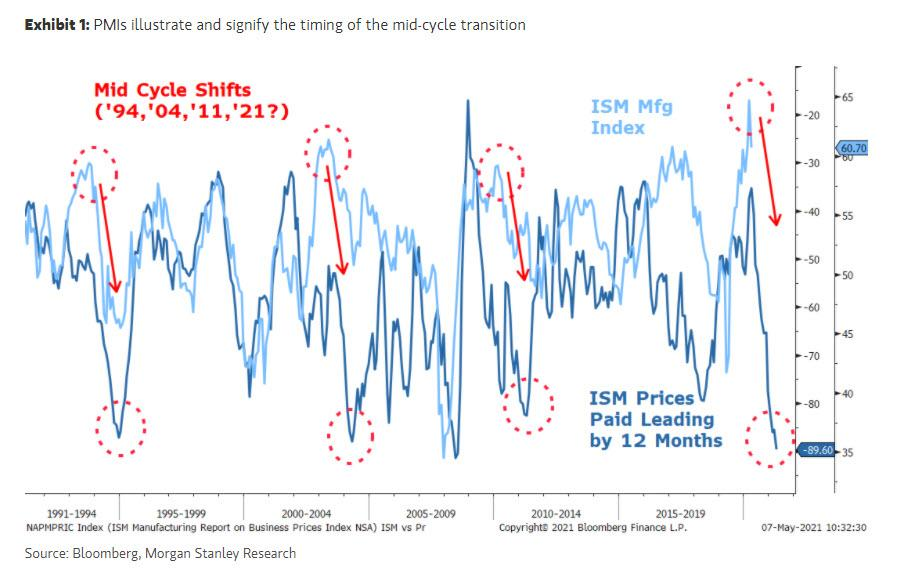
Come vedete, nell’articolo si fa riferimento alla componente prezzi dell’indice ISM americano, un dato del quale noi di Recce’d abbiamo scritto nel Blog già settimane fa, e che qui richiamiamo velocemente con l’immagine che segue. Non c’è bisogno di aggiungere altro.

(Nota: nel grafico sotto la linea di colore blu scuro ha la scala a destra ma invertita: se la linea scende significa che il dato sale)

2021_Jan_991.png
Secondo semestre 2021: le Borse
 
2021_Jan_956.png

Articoli come quello che segue qui sotto, anche voi lettori ne avrete letti in grande quantità. Si celebra l’indice della Borsa più grande al Mondo, in questo caso con riferimento alla chiusura a livello record del venerdì 2 luglio, si paragona questo indici dei Borsa a Superman, si scrive che “è inarrestabile”, sulla scia di quelli (ed erano tanti) che scrivevano nel 2020 che “la Borsa può soltanto salire”.

Nel contesto attuale, più che in ogni altra epoca precedente dell’economia, la stampa (specializzata e non) si è presa il compito di fare da megafono, di amplificare il messaggio dell'o “ottimismo obbligatorio” al di là di qualsiasi ragione”, messaggio diffuso a piene mani da Banche Centrali e Governi, attraverso i loro canali “di servizio”, che sono le banche e i quotidiani.

Giustamente, molti tra gli investitori vanno in confusione e si emozionano, sottoposti ad un bombardamento massiccio e quotidiano, Un esempio: l’articolo che abbiamo scelto di portare alla vostra attenzione celebra la “nuova chiusura record di venerdì 2 luglio”, e non tutti i lettori che sono anche investitori hanno la forza mentale di ricordare. Di ricordare che l’indice S&P 500 vale oggi 4350 punti, e valeva 4200 punti a metà aprile, due mesi e mezzo per fare il 3%.

2021_Jan_965.png

Piuttosto che Superman, questo rialzo di Borsa ha la forza di Superpaperino.

L’articolo che leggete qui sotto invece celebra la forza dello S&P 500 citando la serie di rialzi trimestrali, e utilizza questa serie di dati per supportare l’argomento che questo mercato “ha una grande forza”: quindici mesi fa, però, la forza era svanita, l’indice valeva 2200 punti, e questo articolo nessuno avrebbe potuto scriverlo.

E qui l’investitore che non ha smesso di ragionare si deve chiedere, per forza, cosa spiega il passaggio da 2200 punti a 4350 in quindici mesi. Quali fattori hanno messo in moto questo rapido cambiamento? E’ un cambiamento destinato a resistere nel tempo? Ha senso scrivere a parlare di “forza del mercato”?

L’articolo che leggete qui sotto, nel seguito, ritrova un po’ di equilibrio, e cita almeno un paio di fattori che potrebbero mettere in crisi lo scenario centrato sulla “forza del mercato”: l’articolista cita l’indice ISM (una dato della cui importanza abbiamo scritto in modo ampio la settimana scorsa, nel nostro The Morning Brief) e la Variante Delta, alla quale noi oggi dedichiamo un altro Post in questo Blog.

Vi lasciamo alla lettura, e più sotto riprendiamo.

Like Superman, the S&P 500 appears unstoppable. Nothing—not the Federal Reserve, not the Delta variant, not even old-fashioned fear and greed—has been able to slow its rise. Of course, it just hasn’t found its Kryptonite yet.

It’s not just that the stock market had a good week: The Dow Jones Industrial Average advanced 352.51 points, or 1%, to 34,786.35, while the Nasdaq Composite rose 1.9%, to 14639.33, and the S&P 500 gained 1.7%, to 4352.34. All three ended the week at record highs.

For the S&P 500, Friday’s close was its seventh high in row, the longest streak since 1997. The index, with a gain in June, rose for a fifth consecutive month, the longest streak since August 2020. It also gained 8.2% during the second quarter of 2021, its fifth consecutive quarterly gain, which is the longest streak since the fourth quarter of 2017. Its first-half gain of 14.4% was the best since 2019 and the second-best since 1998. There’s clearly strength in those numbers.

The quarterly streak, in particular, is impressive. The S&P 500 hasn’t just gained for five quarters in a row. It has gained more than 5% for five quarters in a row, only the second time since 1945 that the index has been able to pull off that feat.

The previous occasion was in 1954, according to Bespoke Investment Group founder Paul Hickey, a time when the Fed was also trying to emerge from a period of ultralow interest rates. While the streak ended, it didn’t end with a bust. Yes, Time magazine put the bull market on the cover dated Jan. 10, 1955, which was followed by a quick 6% decline in the S&P 500. The index, however, still finished the quarter up 1.7% and went on to gain 26% over the next 12 months.

Five-month winning streaks happen a little more often but this one was special because the index finished the fifth month at an all-time high. That’s occurred 17 times since the start of 1961, and the index was higher one year later all 17 times, according to Sundial Capital Research data. That doesn’t mean there weren’t painful drops along the way. The most recent streaks, in 2020 and 2018, were followed by declines of 6.5% and 5.4%, respectively, over the following two months. But the streaks look to be sending a positive sign for longer-term investors. “Momentum is a strong force and doesn’t usually roll over easily,” writes Jason Goepfert, founder of Sundial Capital Research.

It’s not as if the market is risk-free, however. The June Institute for Supply Management manufacturing survey, which dipped, did nothing to alter the narrative that economic growth, while still strong, is slowing, and that inflation lingers in the background. Next week will bring the release of the minutes from June’s FOMC meeting that could provide more evidence on the timing of tapering. And then there’s the more infectious Delta variant of Covid-19, which research shows could become the dominant strain in the U.S. in two to three weeks.

New cases are already starting to rise again—they hit 16,517 on July 1, up 5% over a two-week period—and Fundstrat founder Tom Lee warns that the increase could turn “parabolic” in 10 to 15 states with low vaccine rates, causing a brief selloff in stocks. “Our central case is ‘transitory panic’ of Delta causes July to be ‘flat,’” Lee writes.

But the long-term impact might not be enough to seriously damage financial markets. While the Delta variant has sometimes led to an increase in cases, the rise in deaths has been relatively small, particularly in developed markets where vaccination rates are high, writes JPMorgan strategist Marko Kolanovic. “[Positioning] in markets should not be driven by this or any other subsequent variant of Covid-19 for which current vaccines are effective,” he writes.

So what will it be? We thought the Fed’s hawkish stance at its June meeting might start a correction. We were wrong. Maybe it’s something we haven’t thought of yet? Or maybe it’s something sitting in plain sight.

Whatever it is, the market is still looking for its Kryptonite.

Write to Ben Levisohn at Ben.Levisohn@barrons.com

Il migliore commento all’articolo qui sopra lo offre, come sempre, la realtà: la realtà dei dati, la realtà dei fatti, la realtà della storia.

Proprio per questa ragione, vi sarà molto utile leggere il secondo articolo sulla Borsa USA che abbiamo scelto per voi e che trovate qui sotto.

Precisiamo che si tratta di un articolo ad ampio respiro: lo scrivente si interroga sulle cause che spiegano il rialzo di Borsa dal 1980 ad oggi, e prende in esami temi che sicuramente prenderanno spazio nelle prime pagine dei quotidiani nella seconda parte del 2021, come il cambiamento tecnologico, la concentrazione, il potere di controllo del mercato, il potere di fissare i prezzi, la disuguaglianza sociale.

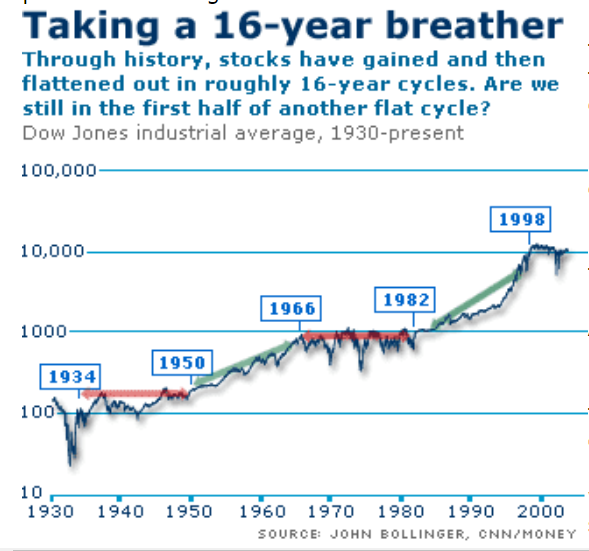
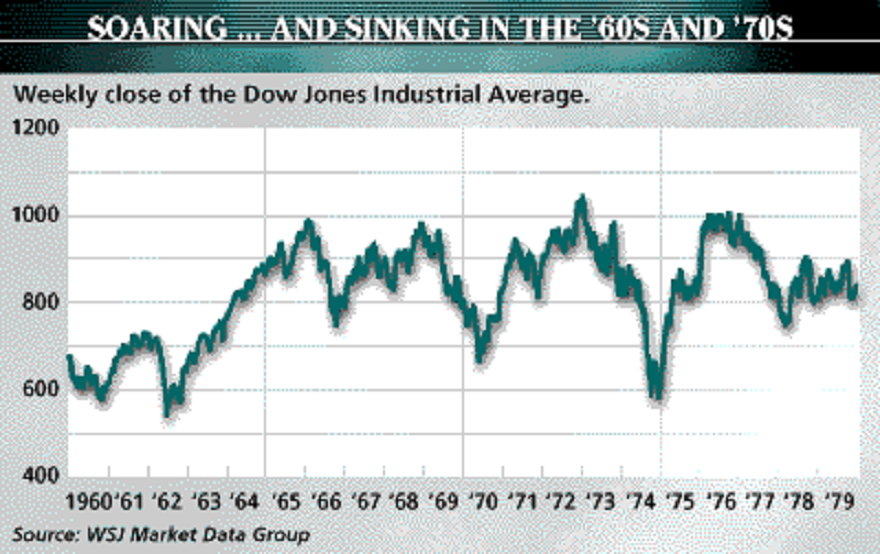
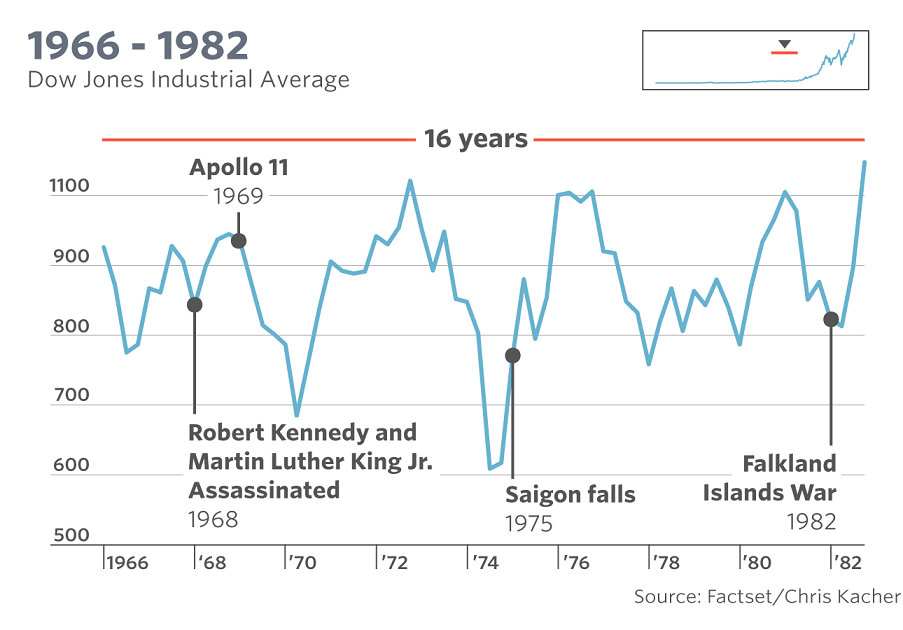
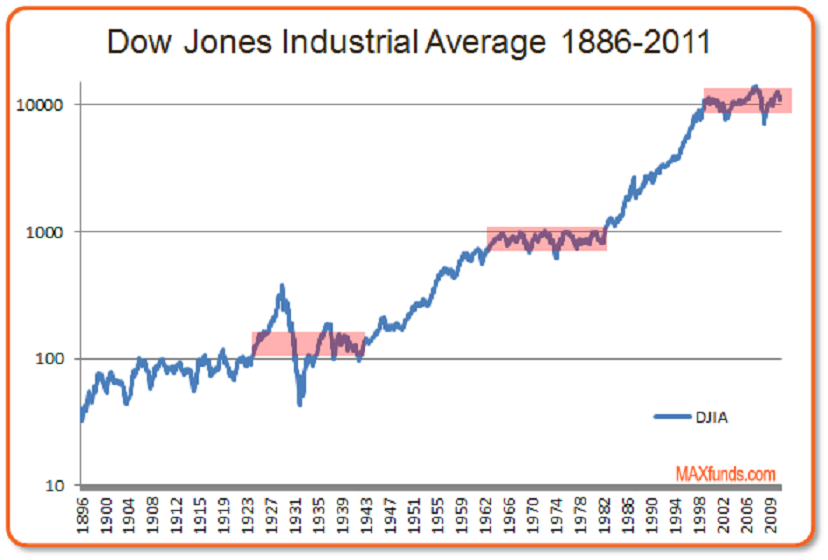
Noi ve lo proponiamo in lettura per due ragioni: la prima ragione, come detto, è che qui trovate le tematiche di mercato emergenti, che saranno dominanti nel prossimi 12-24 mesi; la seconda ragione è che subito nel secondo capoverso l’articolista ricorda che nei 35 anni tra il 1946 ed il 1981, al metto dell’inflazione, la Borsa di New York ha reso ZERO all’investitore.

I grafici che noi abbiamo scelto ed inserito nel testo dell’articolo offrono altri dati, altre evidenze, altre realtà con le quali noi giudichiamo utile che l’investitore si confronti. Per l’investitore, risulta sicuramente più utile questo confronto, rispetto alla lettura dell’articolo che avete letto più in alto,


2021_Jan_960.png

BARCELONA – Since the 1980s, the Dow Jones Industrial Average, adjusted for inflation, has grown at an average rate of about 6.7% per year, reaching new highs of 30,000 in November 2020 and 34,000 in April 2021. But the Dow has not always followed this growth pattern. If one takes the long view – focusing on the evolution of stocks since World War II and not letting sharp short-term fluctuations obfuscate matters – a very different picture emerges.

In 1981, the Dow (inflation-adjusted) was at the same level that it stood at in 1946, suggesting that there was zero growth over that 35-year period.

2021_Jan_964.png

But that does not mean the unprecedented rise in stock-market valuations since the early 1980s is a bubble. Bubbles are whimsical, short-lived phenomena. They are not driven by fundamental changes in the economy, nor are they backed up by firms achieving results that justify their seemingly outlandish valuations.1

The most valuable firms today are genuinely thriving, turning huge profits that justify their high valuations. Apple, Visa, Johnson & Johnson, Facebook, and most other major companies that everyone knows and loves (in some cases) have enjoyed unprecedented success in recent years. The question, then, is what has happened since the 1980s to account for this massive, sustained stock-market boom.

TECHNOLOGICAL SPEED KILLS

The new technologies of the digital age have brought enormous improvements to our quality of life. These gains are widely reflected in better goods and services with lower production costs. No other company currently can manage logistics at as low a cost as Amazon can.

But that’s the problem: increasingly powerful cost-saving technologies are helping incumbents keep competitors out, by enabling enormous economies of scale and creating network effects that reward size. Who wants to sell on an auction platform that has far fewer potential buyers than are available on eBay?

2021_Jan_963.png

These trends – rapid technological change and the emergence of huge economies of scale – have created a winner-take-all contest in more and more industries. As the Netscape co-founder turned venture capitalist Marc Andreessen put it in 2011, software was “eating the world.” Those who were in a market early (the eBays and Facebooks) grabbed it all, while most new platforms couldn’t even get a foot in the door. In this world, companies initially compete for a market, but once a winner is crowned, competition in the market essentially ceases to exist.

Fast technological change is not new, of course. There were similar developments during the Second Industrial Revolution from the end of the nineteenth century until the onset of World War I. With the advent of railroads, oil, electricity, the telegraph, and telephone communication, first movers gained a dominant share in the market, often after stiff competition. Once a firm had achieved its position on top, it could keep out competitors through enormous economies of scale.

In this earlier episode, costs dropped enormously but prices did not, which helps to explain why it became known as the Gilded Age. With the expansion of railroads, the cost of traveling from the East Coast to the West Coast of the United States fell by as much as a factor of ten compared to travel in horse-drawn carriage, yet the price paid by the customer fell only marginally.

The profits that dominant Gilded Age firms generated are functionally comparable to the high stock-market valuations we see today. The names have changed – instead of Rockefellers, Morgans, and Carnegies, we have the likes of Jeff Bezos, Mark Zuckerberg, Sergey Brin, and Bill Gates – but the basic story is the same: a firm discovers and exploits new technologies to lower costs dramatically while keeping prices only slightly below where they were. The same technologies that drive material progress also stifle competition and reinforce firms’ dominant positions, ushering in a near-universal, decades-long concentration of market power.

A CONCENTRATED HIGH

My own research shows that since the 1980s, there has been a steady increase in market power, understood as a firm’s ability to set prices higher than the cost of producing what it sells. For obvious reasons, savvy investors bet on firms with significant prospects for expanding their market power. The key to Warren Buffett’s success over the past few decades is his ability to pick out these castles with “wide and long-lasting moats.”

When the pharmaceutical company Mylan jacks up the price of an EpiPen by almost 550%, its stock price rises because investors believe that this exercise of market power will increase its profits. As you would expect, the firms with the most market power are those with the highest stock valuations. With fewer market participants, each firm commands a larger market share and can leverage its position to extract ever-higher profits.

2021_Jan_961.png

This practice shows up clearly in the data. My colleagues and I measure a firm’s stock-market performance as the ratio of its stock-market valuation to its sales. We have found that across all listed firms, the average of this ratio has risen by a factor of three since 1980, from less than 0.5 to over 1.5. This enormous increase reflects investors’ expectations of an increase in future dividends (because a firm’s valuation is an indicator of its future profitability).

Never has the problem of market concentration been more manifest than during the COVID-19 crisis. Although US unemployment soared above 14%, and GDP dropped by nearly 10% when the pandemic arrived, the stock market rebounded quickly. Three months after the start of lockdowns, listed firms’ share prices had fallen 15%, on average, but their profits had recovered, because they had managed to reduce costs commensurately.

Moreover, because these companies don’t face competition, their profits are expected to rise even further despite a reduction in sales. For the dominant firms on the stock market, competition may continue to weaken as smaller firms are forced to declare bankruptcy. And far from being limited to the Silicon Valley giants, the effects of market concentration show up across all industries, from tech to textiles. Though most of these firms are not selling tech, they can use new technologies to innovate and reduce their costs. As a result, consumers are now paying too much for too many things, from beer to pacemakers.

A SICK ECONOMY

Viewed in context, the stock-market high of the last four decades is not a sign of economic health. In a competitive economy, markets where firms are making huge profits will attract new entrants who see an opportunity to capture a share of those gains. Even if a leading firm improves its products or technologies to stay ahead, its competitors will follow suit and innovate, too.

It is this competition that keeps market power in check and prices low. But with today’s enormous economies of scale and network effects, first movers can and do use their disproportionate market power to keep competition at bay. And because market power is endemic, it has profound implications across the entire economy. While stock prices have grown robustly, the economy has been slowly getting sicker, as the higher prices that market power creates ripple through all economic sectors.

It is no coincidence that business dynamism has been stalling, even in Silicon Valley. This may come as a surprise, but the number of start-ups created each year, on average, has been falling steadily, to half that of the 1990s. By allowing just a few giant dominant firms to crush most innovators and start-ups, market power stifles innovation.

While we are blinded by the apparent stellar performance of several hundred dominant firms – or fewer, as there are only 30 firms in the Dow Jones Index, their share prices all propped up by market power – we lose sight of the six million firms in the US. Today, most small and medium-size firms generate lower profits and face harsher business conditions than ever.

It also lowers wages. With higher prices, fewer quantities are sold and produced, which lowers demand for labor and hence wages. The typical worker is hit twice: her wages fall as a result of lower labor demand, and what she consumes is sold at monopolistic prices, further reducing her purchasing power. As if this was not bad enough, most workers are hit a third time because they hold no stocks and therefore forgo the financial gains of market power.

Moreover, households that don’t hold stocks are numerous and growing in quantity, which increasingly skews the distribution of both income and wealth. At the same time, many of those who have little wealth and are bearing the brunt of a sick economy’s symptoms are in the dark about what is really going on. If current trends continue, many of our children will be among the losers. Young people today already have lower-paying jobs and substantially less wealth than their parents’ generation, which is why they marry and buy homes at later ages than their parents did.

Meanwhile, others are enjoying the stock-market high and barely suffering. The fact that you are reading this means there is a good chance that you are a beneficiary of market power. You may be feeling the costs only in the form of higher insurance premiums (perhaps for an overpriced EpiPen for your child). And yet, even if you are a net winner, your capital gains do not outweigh all the losses of those around you and to society. The losses of a sick economy vastly outweigh the gains from high stock prices.

And the massive policy interventions to resuscitate the economy after shocks like the 2008 financial crisis and the pandemic will make a sick economy sicker, because they tend to favor disproportionately the shareholders of large companies. Why should taxpayers bail out large companies and thereby guarantee a huge payout to shareholders who decided to take a risk? They should not, of course. With bailouts, there is only ever an upside risk, financed by taxes mainly on workers.

WE NEED AN INTERVENTION

The continuing rise of stock-market indices suggests that there is no end in sight to the concentration of market power. But we, as a society, can do something about it. If we are serious about achieving a meaningful recovery for an economy that is suffering from a stagnating labor market and weak new-business creation, we will need to increase competition.

That doesn’t necessarily mean we should break up large firms. Some mergers and acquisitions – such as Facebook’s purchases of Instagram and WhatsApp – should not have happened and should still be undone. But in the case of Amazon, for example, it would be just as unproductive to split up the company as it would have been to dig up nineteenth-century railway lines. We should embrace the economies of scale and the large network effects that today’s innovations engender. But we need regulation that fosters competition on the efficient networks that new technologies have created.

While every market is different, and every technology has its own needs, there are plenty of simple regulatory interventions that could boost competition. One of these concerns “interoperability.” For example, prices for mobile services are 2-3 times higher in the US than in Europe, even though the markets are comparable in size and the technology is identical. That huge difference reflects a small but crucial difference in antitrust regulation between the two jurisdictions.

The difference is that, unlike the US, Europe requires interoperability: the owners of a cell-tower network must allow competitors to use that network at a rate of compensation set by the regulator. If a Peruvian operator wants to offer mobile services in Germany and France, it doesn’t have to build its own (largely redundant) infrastructure to do so.

The results of this policy have been astounding. Europe has more than 100 mobile competitors, compared to just three major ones in the US. Such interventions lead to more competition and lower prices, and if they are implemented across all sectors, they can revitalize the entire economy, increasing innovation and output, encouraging start-ups, and fostering wage growth.

The stakes are high. In my research with economists Jan De Loecker and Simon Mongey, we estimate that the annual cost of dominant firms not facing competition in the US amounts to 9% of GDP. That is far too high a price to pay to get high on stocks. As output growth slows, even Buffett will eventually feel it in his portfolio.

More important, the longer we keep the anti-competitive stock-market boom going, the greater the economic polarization that will follow – that is, until we reach a tipping point. Eventually, the vast majority of people who are drawing the short end of the economic stick will no longer be willing to play by the rules, especially when they see those rules being bent in favor of profits and rents.

BREAKING POINT

The underlying economic tension has already begun to translate into political conflict, and it is only a matter of time before it spirals toward severe social strife. Even if the stock-market high is not a bubble – even if the fundamentals based on profits are real – euphoria is never permanent. And when the come-down happens, the consequences will be far worse and longer lasting than a recession. The last century’s decades-long boom, also driven by market power, culminated in two world wars and the Great Depression.

It is important to remember that “pro-business” is not “pro-market,” especially when there are enormous economies of scale involved. A lack of regulation has tilted the balance in favor of a small number of large businesses and those with wealth in the form of stocks, and away from what is needed to sustain a dynamic, competitive market economy.

Looking ahead, we must raise output with lower prices, higher wages, and – yes – lower returns on stocks of those few hundred dominant firms. We can do so by reining in market power and restoring competition throughout the economy for all six million firms. Curing the sickness would mean returning to the competitive markets as we knew them prior to the 1980s. A Dow below 10,000, rather than above 34,000, would be a sign of good economic health.

But in the current political environment, with the winners high on stocks and the losers distracted by ginned-up culture wars and sedated by endless streaming entertainment, your pension fund is in no imminent danger – for now.

Secondo semestre 2021: i tassi e le obbligazioni
 

Gli economisti sono bravissimi nello spiegare quello che è già successo

Gli economisti hanno previsto 20 delle ultime 5 recessioni.

Queste insieme a molte altre sono le battute che circolano con maggiore frequenza a proposito della categoria degli economisti accademici, ai quali il pubblico da sempre guarda con grande scetticismo: salvo poi ricorrere proprio agli economisti per rimediare agli errori di chi ha fatto danni ed eventualmente gettato un Paese nella disperazione, come accadde in Italia con Mario Monti anni fa, e come succede proprio oggi in Italia con Mario Draghi.

In questo Post, non intendiamo prendere una posizione sul valore della categoria degli economisti: l’atteggiamento di Recce’d è laico, nel senso che seguiamo con attenzione le loro opinioni, tenendoci però stretta la nostra esperienza di professionisti dei mercati finanziari, e quindi le nostre differenze di vedute.

Noi seguiamo attentamente, in modo particolare, quegli economisti che hanno dimostrato nel corso dei decenni di avere una grande capacità di interpretare la realtà, ed una grande (massima) competenza nelle cose dell’economia.

Non ci sono dubbi che John B. Taylor sia uno dei massi economisti oggi attivi, una figura capace di vedere con grande chiarezza quali sono le implicazioni delle scelte fatte oggi per il nostro futuro di investitori. In particolare, per le scelte di politica economica e monetaria, alle quali è dedicato l’articolo che noi in questo Post vi proponiamo di leggere.

Ci fa molto piacere farvi osservare che anche questo intervento di Taylor, come centinaia di altri in questa prima parte del 2021, fa riferimento alle esperienze degli anni Settanta, esperienze sulle quali Recce’d aveva indirizzato la vostra attenzione di lettori ma soprattutto di investitori già un anno fa.

Sempre un anno fa, Recce’d nel Blog vi aveva spiegato perché adesso la Federal Reserve è “il più grande nemico della vostra stabilità finanziaria”, cosa che trovate pienamente confermata dalle analisi di John B. Taylor in questo articolo.

In termini operativi e di breve-medio termine, questo articolo vi sarà utile per comprendere ciò che succede nel mondo dei tassi e delle obbligazioni. Nel secondo semestre del 2021, vedrete cose ben più sorprendenti di quelle che avete visto nel primo (già sorprendente di suo, almeno per tutte le banche di investimento e tutte le reti di private bankers).

La Federal Reserve ha operato in modo nascosto (attraverso operatori di mercato compiacenti) tra aprile e giugno per tenere il rendimento del Titolo di Stato USA sotto lo 1,50% di rendimento a scadenza, senza però dichiararlo al pubblico oppure al Congresso. Questo tappo artificiale salterà nel secondo semestre, mano a mano che dati dati per l’inflazione arriverà la conferma che l’inflazione non è “transitoria” (e questo vale non soltanto per gli Stati Uniti).

La pubblicazione di questi dati dirà anche al pubblico ed ai mercati che la Federal Reserve (come la BCE) non sa ciò che sta facendo, e che ha perso il controllo della situazione. Il resto, lo potete leggere nell’articolo di John B. Taylor.

Come conclude Taylor, anche noi vi mettiamo in guardia: le lancette dell’orologio girano molto velocemente.

2021_Jan_954.png

As in the stagflationary 1970s, the US Federal Reserve is once again denying that its own policies are the reason for a recent surge of inflation, even though there is good reason to think that they are. It is not too late to learn from past mistakes and reverse course – but the clock is quickly ticking down.

Fifty years ago, on June 22, 1971, US Federal Reserve Chair Arthur Burns wrote a memorandum to President Richard Nixon that will long live in infamy.

Inflation was picking up, and Burns wanted the White House to understand that the price surge was not due to monetary policy or to any action that the Fed had taken under his leadership. The issue, rather, was that “the structure of the economy [had] changed profoundly.” Accordingly, Burns was writing to recommend “a strong wage and price policy”:

“I have already outlined to you a possible path for such a policy – emphatic and pointed jawboning, followed by a wage and price review board (preferably through the instrumentality of the Cabinet Committee on Economic Policy); and in the event of insufficient success (which is now more probable than it would have been a year or two ago), followed – perhaps no later than next January – by a six-month wage and price freeze.”

Perhaps owing to Burns’s reputation as a renowned scholar (he was Milton Friedman’s teacher) and his long experience as a policymaker, the memo convinced Nixon to proceed with a wage and price freeze, and to follow that up with a policy of wage and price controls and guidelines for the entire economy.

For a time after the freeze was implemented, the controls and guidelines seemed to be working. They were even politically popular for a brief period. Inflation inched down, and the freeze was followed by more compulsory controls requiring firms to get permission from a commission to change wages and prices.

But the intrusive nature of the system began to wear on people and the economy because every price increase had to be approved by a federal government bureaucracy.

Moreover, it soon became obvious that the government controls and interventions were making matters worse.

Ignoring its responsibility to keep inflation low, the Fed had started letting the money supply increase faster, with the annual growth rate of M2 (a measure of cash, deposits, and highly liquid assets) averaging 10% in the 1970s, up from 7% in the 1960s. This compounded the impact of the decade’s oil shocks on the price level, and the inflation rate shot into double digits – rising above 12% three times (first in 1974 and then again in 1979 and 1980) – while the unemployment rate rose from 5.9% in June 1971 to 9% in 1975.

As we know now, the US economy’s performance in the 1970s was very poor owing at least partly to that era’s monetary policies. This was when the word “stagflation” was coined to describe a strange mix of rising inflation and stagnant economic growth. As James A. Dorn of the Cato Institute recently recounted, Nixon’s “price controls went on to distort market prices” and are rightly remembered as a cautionary tale. “We should not forget that the loss of economic freedom is a high price to pay for a false promise to end inflation by suppressing market forces” (emphasis mine).

As it happens, Choose Economic Freedomis the title of a book that I published last year with George P. Shultz, who passed away in February at the age of 100. Schultz had gained decades of wisdom and experience as both a diplomat and economic policymaker, serving as the Nixon administration’s budget director when Burns wrote his audacious memo. In an appendix to our book, we included the full text of that document, because it had only recently been discovered in the Hoover Institution archives. It should now be recognized as required reading for anyone seeking to understand the recent history of US economic policymaking.

The Burns memo is a perfect example of how bad ideas lead to bad policies, which in turn lead to bad economic outcomes. Despite Burns’s extraordinary reputation, his memo conveyed a set of terrible policy recommendations. By blaming everything on putative structural defects supposedly afflicting the entire economy, the memo’s worst effect was to shun the Fed’s responsibility for controlling inflation, even though it was clearly responsible for the rising price level.

By the same token, good ideas lead to good policy and good economic performance. As Schultz and I showed, this was certainly the case in the 1980s. The Fed reasserted itself as part of a broader economic reform, and the economy duly boomed.

The message from this historical experience – and many other examples in the United States and elsewhere – should be abundantly clear. And while history never repeats itself, it often rhymes, so consider where we are midway through 2021: inflation is picking up, and the Fed is once again claiming that it is not responsible for that development. Instead, Fed officials argue that today’s surge in prices merely reflects the bounce back from the low inflation of the last year.

Worse, the Fed’s policy is even more interventionist now than it was in Burns’s day. Its balance sheet has exploded from massive purchases of Treasury bonds and mortgage-backed securities, and the growth rate of M2 has risen sharply over the past year. The federal funds interest rate is now lower than virtually any tested monetary policy rule or strategy suggests it should be, including those listed on page 48 of the Fed’s own February 2021 Monetary Policy Report.

It is not too late to learn from past mistakes and turn monetary policy into the handmaiden of a sustained recovery from the pandemic. But time is running out.

Secondo semestre 2021: la gestione del rischio
 
2021_Jan_939.png

Come i nostri Clienti sanno benissimo, noi in Recce’d gestiamo i portafogli in titoli ANCHE tenendo ben presente il rischio: noi giudichiamo che sia del tutto NON professionale commentare fatti come l’esplosione dell’epidemia del marzo 2020 con parole come “del resto, chi poteva prevederlo?”.

A chi dice cose del genere, ci sentiamo di rispondere che se non sei in grado di impostare il portafoglio tenendo conto ANCHE di fatti del genere, beh … secondo noi (e tanti altri) devi proprio cambiare mestiere.

Oggi, nel giugno 2021, chi (e sono tanti) fa finta di non vedere i dati relativi alla Variante Delta a nostro giudizio è uno che rischia coi soldi degli altri, un incosciente. Oppure, e sarebbe peggio, è molto poco intelligente.

Questi che in questo Post commentiamo sono fatti importanti sia per il breve termine, sia per le prospettive di medio e lungo termine dei nostri e vostri soldi, alle quali Recce’d ha dedicato la scorsa settimana nel Blog un nuovo Longform’d, che vi invitiamo a leggere

Per i lettori interessati, abbiamo disponibili su richiesta una serie di papers (documenti di ricerca) che completano la nostra analisi del prossimo decennio

A proposito della Variante Delta, si sono già espressi numerosi commentatori, e tra questi anche alcune vere e proprie “superstar” delle banche di investimento: ad esempio, Marko Kolanovic di JP Morgan, che si è affrettato a garantire che la Variante Delta non avrà alcuna influenza sui mercati finanziari.

Quando parla Marko Kolanovic, oppure Goldman Sachs oppure Morgan Stanley, o qualsiasi altra banca di investimento, noi in Recce’d consultiamo regolarmente il nostro ordinatissimo archivio, per vedere quello che dicevano e scrivevano le medesime persone in passato: ad esempio, nel mese di aprile del 2020.

2021_Jan_953.png

Come leggete qui sopra, agli inizi di aprile 2020 Marko Kolanovic aveva annunciato al Mondo “il picco delle morti per COVID”. Perché lo aveva fatto? Lui forse è un epidemiologo? No, non lo è. Allora, perché lanciarsi in affermazioni anto nette da apparire, a distanza di 15 mesi, ridicole?

La nostra riposta è che quello che conta, per Marko, ma pure per Goldman Sachs, per Morgan Stanley, per UBS e per Credit Suisse (non le citiamo tutte, ma le conoscete) è quello che noi abbiamo sottolineato con il colore blu nell’immagine sopra. Quello: non l’epidemia, e soprattutto non i risultati dei Clienti.

Per questa ragione, noi in Recce’d non ci fidiamo di quello che dice Marko Kolanovic né ci fidiamo di quello che scrivono le altre banche di investimento, Molto più utili, a nostro giudizio, le analisi e le considerazioni di altri analisti e commentatori: un esempio di queste si sull’influenza della Variante Delta sui mercati finanziari ve lo regaliamo qui di seguito, invitandovi a farvi poi anche una domanda.

La domanda è la seguente: è ragionevole pensare alla comparsa di una “Variante Delta” anche sui mercati finanziari nel secondo semestre 2021? La gestione del rischio, nell’ambito della gestione del portafoglio titoli, impone di rispondere prima di tutto a questa domanda.

Over the weekend, Sydney was put under a mandatory stay-at-home order for two weeks in response to the risk posed by the Delta variant of Covid-19. This came as a surprise to many, especially those who rightly view Australia as having been among the best in managing Covid, with its very low infections, hospitalizations and deaths.

Australia was not the only recent Covid surprise in advanced countries. Israel, long a vaccination leader, reimposed an indoor-mask requirement last Friday. Once again, the catalyst was the Delta variant. Then there was the U.K., which, other than India, has been battling longest against Delta. According to government reports, the number of Delta infections rose 46% in just one week. Indeed, whether it is the evidence from there or the reactions of Australia and Israel, four issues should be front and center for many more countries, including the U.S., which need to realize that new Covid risks are likely  and do not respect borders.

The ability of the Delta variant to spread fast and deep has surprised many. It is the most infectious variant so far, especially among the nonvaccinated segments of the population. But it also hits the vaccinated, including the doubled-jabbed who, according to U.K. data, made up as much as 20% of those infected with Delta.

Health Consequences

Fortunately, the health consequences of the Delta variant in advanced countries appear less severe so far. This is due in part to a better understanding of Covid-19 some 18 months into the pandemic. But most important is vaccination: While it has not totally broken the link between infections on the one hand and hospitalizations and deaths on the other, it has significantly weakened it. So far, a lot fewer of those testing positive have ended up in hospital or worse because they were vaccinated. Uncertainty remains, however, about the risks of “long Covid” effects.

Policy Reactions

Government policy reactions have varied significantly, and not just because of different vaccination rates. Important behavioral judgments appear to be in play as well as issues about policy acceptance and effectiveness.

Sydney, with a relatively low vaccination rate, took strong measures despite a very low absolute number of infections. Israel and the U.K. have high vaccination rates but have differed in their reactions, with Israel tightening guidelines but the U.K. maintaining its reopening narrative. (England did delay by a month the final stage of the reopening roadmap, with similar actions by Northern Ireland, Scotland and Wales; importantly, it has also stepped up in the already-impressive vaccination effort there, with pop-up vaccination centers that don’t require a reservation appearing nationwide.)

Economic circumstances

As of now, the incremental economic damage associated with the Delta variant in advanced countries appears limited, especially when compared with India, where it originated and has been causing widespread human tragedies.

Though there are recent examples around the world of significant disruptions because of new waves of Covid (Bangladesh being this weekend’s most striking example), there is little to suggest as of now that Delta in itself is particularly damaging economically and financially in the advanced world. While it is still early when it comes to the potential global spread, and it will spread unfortunately, many countries have become much better at managing through these waves.

No matter how the four factors evolve, it is hard to deny two general but important conclusions.

First, Delta is yet another illustration that the terrible Covid pandemic will not end suddenly. Instead, the world will need to continue to adapt to the reality of living with an endemic for a while — that is, a virus that is proving hard to fully eradicate. With improved private and public health practices and guidelines, living in this age of an endemic virus can be a lot less threatening to lives and livelihoods.

Governments must reinforce their efforts to win all three races in this historical pushback against Covid. Winning just one or two is simply not sufficient. Specifically, victory is needed in crushing infections, minimizing variants and accelerating full vaccination. It is not just a government responsibility, as important as this is. It also places an important obligation on individuals to adhere consistently and fully to what the U.K. government has labeled “hand, face, space” health practices.

Second, there is no sure way for one country to protect itself from Covid threats coming from outside. Think of this weekend’s Sydney news. Along with New Zealand, Australia has taken the most restrictive approach to cross-border human interactions among the advanced economies, imposing quite a range of inconveniences on citizens. It has enforced strict limits on inward and outward travel, subjected those traveling to Australia to quotas, as well as harsh quarantine rules and practices, and has a population that has been impressively understanding, supportive and compliant. Yet Sydney was again shut down, and not as a quick circuit breaker but for a longer period.

The only way to ensure well-being is to go back to the mantra that “no one is safe until everyone is safe.” Further vigilance in advanced countries needs to be accompanied with greater assistance to poorer and less-well-organized countries to improve everyone’s durable protection against Covid.-Bloomberg