

Ultimi quattro mesi del 2018: portafoglio e performance (parte 2)

Durante questo weekend, viene spedita ai nostri Clienti la nostra più recente Lettera, che oltre a fare il punto sulle strategie verso la fine del 2018, offre pure un consuntivo dei primi 8 mesi.

Avrete tutti letto, seguendo le vostre abituali fonti, quali sono i risultati delle gestioni GPM e dei Fondi Comuni nella prima parte del 2018: proprio su questo argomento, abbiamo fornito al Cliente nella Lettera a lui dedicata i dati più aggiornati e più significativi.

In questa sede però offriamo ai lettori un commento di carattere più generale e rivolto al futuro: cosa ci si deve aspettare, in termini di performances, da qui a fine 2018, dato che il contesto internazionale è fortemente caratterizzato da caratteristiche come divergenza e compiacenza?.

Un notissimo commentatore di Bloomberg, il trader Richard Brinslow, scrive che ...nessuno lo sa (nella sua rubrica che è riservata a chi sottoscrive).

Abbiamo selezionato per voi lettori alcuni brani, che descrivono alla perfezione lo stato di agitazione, isteria, confusione ed anche caos che si osserva ogni giorno sui mercati globali in questi ultimi mesi.

Ci piace in particolare la citazione di Cooleridge, e l'espressione di "willing suspension of disbelief". L'espressione "suspension of disbelief" in inglese ha un significato forte, che in italiano potrebbe essere reso come sognare ad occhi aperti, oppure volerci credere a tutti i costi, oppure negare l'evidenza.


With Nasdaq now set for its best Augusts since the year 2000 (the dead cat bounce peak right before the 74% plunge to 2002) and stocks soaring in the face of dismal macro data, slumping housing, a collapsing yield curve, lower bond yields, and now a rising VIX, one wonders - aside from the ubiquitous corporate buybacks - is driving this hysteria at the vinegar strokes of the longest bull run ever.

(...) 

I was sent a technical piece yesterday from someone who doesn’t believe news should figure at all into the analysis. It’s an approach I have an enormous amount of sympathy with. This is a rare time that it’s questionable to stick with that view. As I read it, all I could think of was Samuel Taylor Coleridge. Because the only way to navigate these markets is to engage in a conscious willing suspension of disbelief. You read the news and have to accept the surreal to have any hope of understanding what is going on.

Even the news-oblivious charts have figured out that normal rules don’t apply. And that’s why they have been working so well.

The gist of the piece was that just about every asset it looked at was doing one of two things. Approaching resistance where it was expected to fail or had failed at resistance and was headed the other way where it would do the same. The world is in a state of flux and the last word that should be found in any piece of market analysis is "definitive."

Beware the person telling you something has bottomed or peaked unless it includes the “for now” tag line. 

(...)

My working theory is that the confusion sown by the ebullient stock market has every other asset uncertain and conflicted. That’s a danger. Sometimes certain sectors just have to go their own way. And while models take a long time to figure this out, we carbon entities can sometimes out-think them. We should take advantage of it while it lasts.


(...)

That old game where you play which of these don’t belong with the others is a lot of fun. Sometimes, however, being able to choose correctly is a very valuable tool. Spoiler alert: it’s the stocks.

Aside from them we are in a risk-off environment. And must play things from that perspective. We all just get repeatedly confused because we’ve been trained to think the world lives or dies based on how much trickle down we are led to expect from a rising S&P

  

Mercati oggiValter Buffo
Ultimi quattro mesi del 2018: portafoglio e performance (parte 1)

L'obbiettivo di questa nuova serie di Post è fornire a chi ci legge indicazioni concrete sui prossimi quattro mesi di mercato.

Che fare? Con quali obbiettivi?

Per decidere al meglio, è indispensabile comprendere bene dove stiamo oggi. Il Mondo oggi è quello di Trump, oppure quello della Turchia? Il Mondo è quello che si vede guardando alla Cina, oppure ai titoli del settore Tech? Il Mondo è quello che ci raccontano i rendimenti delle obbligazioni, oppure è quello che ci raccontano le stime per gli utili (ma soltanto negli Stati Uniti? Il Mondo è quello che leggiamo, ogni mattina, nei dati macroeconomici, oppure è quello che leggiamo nei titoli sui "nuovi record" della Borsa di New York?

Allo scopo di fare chiarezza, vi chiediamo di leggere con attenzione la frase che segue (che noi di Recce'd abbiamo editato):


Prince told the Financial Times that global liquidity was enormous and only a significant disruptive event could create difficulty in the (...) market. “As long as the music is playing, you’ve got to get up and dance,” he said. “We’re still dancing".


Quante volte avete letto questa frase, oppure frasi di significato equivalente, negli ultimi mesi ed anni. Centinaia, e forse migliaia.

Ora però vi chiederemo di leggerla di nuovo. Questa volta NON editata da Recce'd. E nel suo originale contesto.


Charles “Chuck” Prince’s infamous comment that his bank was “still dancing” even as the the subprime crisis worsened came back to haunt him on Thursday.

The former Citigroup Inc chief executive’s explanation seemed to boil down to: it was a race to keep up with competitors who kept loosening lending standards and Citi couldn’t afford to drop out.

In July 2007, Prince told the Financial Times that global liquidity was enormous and only a significant disruptive event could create difficulty in the leveraged buyout market. “As long as the music is playing, you’ve got to get up and dance,” he said. “We’re still dancing".

The U.S. congressional panel investigating the origins of the worst U.S. financial crisis since the Great Depression pressed Prince about his comment, which has become emblematic of banks’ failure to come to grips with the gravity of the crisis.


Come capire dal testo qui sopra, quella frase era vecchia di ben 11 anni, e come leggete sempre qui sopra lo stesso prince fu poi costretto a difendersi, proprio per quella frase, al Congresso degli Stati Uniti.

Eppure, anche oggi nel 2018 quella frase è della massima attualità, come potete leggere nel testo che segue, che abbiamo tratto dal Wall Street Journal. Si tratta di una efficace descrizione dello stato delle cose il 31 agosto 2018, sui mercati finanziari del Globo. Ci ha colpito, perché anche noi in Recce'd riteniamo indispensabile investire ... come se la musica potesse fermarsi in un qualsiasi secondo di ogni giorno. Qualcuno, al contrario, ritiene di essere più bravo: ritiene che, quando la musica si fermerà, sarà capace di "cogliere i segnali" e di trovare sempre una sedia sulla quale sedersi. La storia, però, ci insegna che non funziona così.


Today’s global investment environment is a game of musical chairs. Investors are up and marching along because the music is playing, hoping they’ll be able to grab a chair when the music stops (few will do so). Accordingly, I am investing as if the music might stop any second.

Over the past 10 years it has not paid to be cautious. Low interest rates drove prices of almost all assets higher. Pricier assets made people feel wealthier and thus magically created economic growth. Low interest rates also pushed people into riskier assets, thus creating a mismatch between the assets people hold and their true risk affordability and appetite.

So far, none of this has mattered — the more risk you took, the more money you made. It will matter when risk gets ugly, because investor reaction to it will be more irrational than usual. This is why my firm hedges our portfolios through put options.

The problem with an economy being propped up by artificially appreciated assets is that this pendulum swings both ways. At some point, prices will decline. No one knows what will cause the decline — maybe higher interest rates, maybe a presidential tweet, maybe the implosion of the Chinese economy, or maybe just because stock markets and real estate prices don’t grow to the sky. Or it could be triggered by something completely unseen today.

What is clear is that since interest rates are low and global economies are highly leveraged, central banks and governments will not have as much power to help.

Mercati oggiValter Buffo
I fatti che determinano i rendimenti (parte 12)

Ben poco, di ciò che avete visto venerdì 24 sui mercati, corrisponde alle parole di Jay Powell a Jackson Hole, lo stesso venerdì.

Proprio quelle parole offrono, anche a noi, una sintesi molto efficace dei FATTI che oggi noi investitori abbiamo a disposizione, per valutare tutti gli asset finanziari, e per prendere decisioni conseguenti, e coerenti, per il nostro portafoglio di titoli.

la settimana prossima, per i nostri Clienti, ogni giorno in The Morning Brief rivedremo, con dettaglio, quali sono le reazioni dei mercati alle parole di Powell.

Oggi, in questo Post, sfruttiamo una parte di un articolo del Financial Times, che ha fatto una sintesi molto efficace delle parole di Powell.

The moves in the yield curve, as investors remain convinced of imminent rate rises while money pours into longer-dated Treasuries, is more important. An inverted yield curve, in which short yields are higher than longer-dated yields, indicates a future recession. A flat curve implies a lack of enthusiasm about economic prospects (hence rates need not rise in future), and a fear that the Fed will raise rates imminently, then be forced to desist.

Further, the evidence of a need for higher rates to combat inflation is weakening. The bond market’s implicit prediction for inflation over the next 10 years had risen from 1.2 per cent in early 2016 to 2.2 per cent earlier this year — but it has since settled closer to 2.1 per cent, barely above the Fed’s 2 per cent target.

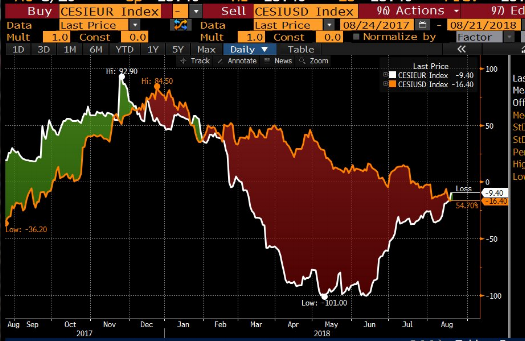
Finally, US economic data have begun to disappoint, at least compared to reasonable expectations from a few months ago. Citi’s economic surprise indices, which measure how data compare to forecasts, show the US in negative territory, and below the eurozone.

Faced with all of this, Mr Powell deliberately said he was avoiding all foreign and political questions, admitting that these were risk factors that “could demand a different policy response, but today I will step back from them”.

But he could have given a clear signal that the Fed needed to keep tightening, and did not. “We have seen no clear sign of an acceleration above 2 per cent” in inflation, he said, and “there does not seem too be an elevated risk of overheating”. So no desperation to tighten there. His predictions for future tightening were strictly conditional. With my emphases added, he said: “If the strong growth in income and jobs continues, further gradual increases in [the target rate] will likely be appropriate.”

Mercati oggiValter Buffo
I fatti che determinano i rendimenti (parte 11)

Recce'd vi ha segnalato più e più volte le anomalie che dominano per il momento sui mercati finanziari. le pericolose distorsioni. Le rischiose stranezze.

Come i lettori più attenti ricordano, in Recce'd giudichiamo l'anomalia più grande, la più pericolosa, e la più influente sul futuro dei mercati, il prezzo (e quindi il rendimento) delle  obbligazioni di bassa e bassissima qualità che è del tutto fuori mercato oggi.

Per questo, va segnalato, seguito ed analizzato il fatto che questa anomalia sta in questi mesi riducendosi (grafico qui sotto) in particolare in Eurozona.

wk5_aug_2018_003.png

Sarebbe da definire "normale" questa reazione, se non si partisse da livelli infimi (e per questo pericolosissimi). Normale perché? Perché le economie rallentano (grafico qui sotto)

wk5_aug_2018_001.png

E rallentano sulla base dei dati già pubblicati: manca ancora, in questi dati, l'impatto della crisi degli Emergenti, che oggi pesano per una metà del PIL globale, come vedete sotto.

wk5_aug_2018_005.png

Notate bene che il mercato si sta aggiustando alla nuova realtà anche in assenza di alcuna iniziativa concreta in chiave restrittiva (minore liquidità) da parte della BCE.

wk5_aug_2018_007.png

L'aspettativa dei mercati, al contrario, è per un atteggiamento più accomodante della BCE, che vedete nel grafico qui sopra e che si riflette nel ribasso dell'euro che vedete nel grafico qui sotto.

wk5_aug_2018_012.png

Fatto che a sua volta si spiega con le previsioni di minore crescita dell'economia, come dicono anche gli indici PMI come vedete sotto nel grafico.

Un processo che arriverà ad impattare sugli spread obbligazionari di cui abbiamo scritto in apertura in modo MOLTO AMPIO nei prossimi mesi.

wk5_aug_2018_013.png
Valter Buffo
I fatti che determinano i rendimenti (parte 10)

I giornali, in Italia, martellano, anche durante questo weekend finale di agosto.

I giornali, nel Mondo, riprendono e scrivono anche loro.

Ma che cosa significa? Noi, in Recce'd, non lo capiamo.

wk5_aug_2018_009.png

Perché tutto ciò che dicono i giornali è vero, come ad esempio ciò che dice il grafico del Financial Times qui sopra. Ma è tutto ... così ovvio, scontato, banale. NON c'è la notizia.

E allora ci sembra che rimangano solo due possibilità:

  • che sia lo stesso Governo italiano, a volere in qualche modo "anticipare i tempi", in modo da "mettere le mani avanti" (vedi ad esempio ciò che disse Giorgetti); oppure
  • che sia in corso una manovra più ampia e nascosta, questa volta ai danno del Governo in carica

Non abbiamo, a tutto oggi, una risposta: al lettori diciamo di guardare ai fatti e non ai titoli dei giornali. Ai Clienti, diciamo invece che siamo già posizionati al meglio, almeno su questo tema.

wk5_aug_2018_010.png
Valter Buffo