
Posts in Mercati oggi
Facciamoci due risate (ovvero: in difesa di Mario Draghi)
 

Siamo stati, noi di Recce’d, sempre molto critici verso la persona, e la figura di Mario Draghi.

Nel 2015, al tempo del “bazooka” fummo tra i pochissimi a scrivere che quel “bazooka” non esisteva, e che la mossa del 2015 aveva finalità molto diverse da quelle dichiarate. I fatti ci diedero ragione: è stato così.

Nelle settimane del suo insediamento a Capo del Governo, scrivemmo più volte che Draghi era semplicemente una operazione di Palazzo, o se preferite del Sistema, per salvaguardare sé stesso, operazione che non avrebbe mantenuto le tante (davvero troppe) promesse diffuse e vendute al pubblico.

Eravamo soli, allora: e le nostre prese di posizione furono trattate come una sorta di “tradimento della Patria”.

I fatti anche in questo caso ci hanno dato ragione.

Oggi, con questo Post, intendiamo prendere la posizione opposta: vogliamo prendere le parti di Mario Draghi.

Questo perché siamo irritati dal vero e proprio diluvio di commenti caustici e sarcastici che si leggono sui social e che attaccano la persona di Mario Draghi dopo che lo spread tra Titoli di Stato italiani e tedeschi è ritornata ai livelli del 2019 e dopo che la Borsa italiana è ritornata a scendere del 5% in un solo giorno.

Sui social spopolano, in questo weekend, immagini come quella qui sopra, ed altre immagini come quella qui sotto, che sembrano attribuire proprio a Mario Draghi l’innalzamento dello spread.

Ma si tratta di una atteggiamento polemico, superficiale, e anche un po’ stupido.

Che cosa ne può, Mario Draghi? Non ne può nulla.

E’ importante chiarire subito: Recce’d in questo post afferma che Draghi non ha responsabilità dirette, nel rialzo dello spread.

Certo, non si può negare, è a capo del Governo. E non si può negare che il suo Governo, a proposito di questo problema, ha fatto ben poco. Diciamolo pure: ha fatto nulla.

Il problema, che tutti conoscono, è sempre il medesimo problema: è il problema di un anno fa, di due anni fa, di cinque anni fa, di undici anni fa.

Non è, quindi, e non può essere, un problema di Mario Draghi: è il problema di tutti i Governi che si sono succeduti negli ultimi decenni, di centro sinistra, di centro destra, giallo-verdi, e pure dei Governi tecnici.

Nessuno, di questi Governi, e dei personaggi che hanno guidato questi Governi, ha fatto nulla. Solo, e sempre, operazioni di facciata, di abbellimento: nessuno di questi signori ha mai chiamato il problema con il suo nome, con la sola esclusione, almeno nei primi mesi, di Mario Monti.

Tutti invece impegnatissimi a girarci intorno.

E quindi, a tutti gli spiritosi e a tutte le belve da tastiera che si accaniscono sui social, chiediamo: chi avreste messo, voi, al posto di Mario Draghi, allo scopo di evitare questo rialzo dello spread?

Oppure: credete davvero che il rialzo dello spread sia la conseguenza di un “complotto plutocratico internazionale” che ha lo scopo di danneggiare proprio noi italiani? Per rendere gli italiani il popolo schiavo delle Potenze straniere?

Ma di quali potenze? Ma schiavi per fare cosa? Per raggiungere quali obbiettivi? Siete davvero convinti che ci sia la fila di gente che non vede l’ora di assumersi la responsabilità di mettere energie, attenzione, ed impegno in questo nostro Paese così come è oggi? Noi siamo sicuri di no: siamo sicuri che preferirebbero, giusto per dire, la Grecia o la Turchia. C’è meno … casino, sarebbe più facile.

Noi adesso ritorniamo a scrivere di Mario Draghi: che non merita tutto l’astio di cui è fatto oggetto sul piano personale.

Ha fatto poco, da Capo del Governo, e forse nulla a proposito di questo problema. Ma resta il fatto che quando è stato portato a Capo del Governo era la migliore delle alternative possibili, o sarebbe meglio dire la meno peggiore. Ci hanno messo lui, perché non c’era proprio nessun altro. Rendetevene conto.

Oggi Draghi subisce questo diluvio di attacchi astiosi soprattutto a causa delle aspettative che erano state create: da questo punto di vista, i suoi “presunti amici” sono stati i suoi peggiori nemici.

Spieghiamoci con un esempio, che vedete nell’immagine qui sotto.

C’è ancora oggi chi tenta di confondere le idee al pubblico, e pretende che i lettori dei quotidiani siano degli autentici imbecilli: come chi oggi scrive che il rialzo del tassi ufficiali annunciato giovedì 9 giugno dalla BCE sia la conseguenza di un “complotto di Putin”.

E’ una sciocchezza così grande, che sarebbe da riprendere in un programma comico alla TV, del tipo Zelig.

Eppure, viene ripresa anche da altri quotidiani, come leggete nell’immagine che segue.

La decenza professionale vorrebbe che quotidiani nazionali, come sono Il Corriere della Sera e La Stampa, per rispetto dei propri lettori accompagnassero gli articoli di commento che abbiamo appena riportato con il grafico che trovate qui sotto.

Non solo: il grafico dovrebbe essere spiegato ai lettori dei quotidiani citati, allo scopo di aiutarli a comprendere ciò che accade oggi, e ad anticipare quello che accadrà domani.

Questo si dovrebbe fare, se si avesse rispetto dei propri lettori. Invece di inventare favolette a scopo consolatorio, inventarle allo scopo di prolungare per il maggiore tempo possibile gli attuali (fragilissimi) equilibri del potere politico.

Lo scopo di proteggere l’equilibrio in essere nel mondo della politica va però in contrasto con i titoli, inevitabilmente allarmistici, che raccontano la realtà dei mercati finanziari.

I prezzi che si leggono sui mercati finanziari non forniscono alcun appiglio, ed anzi appaiono in totale contrasto, con la buffa teoria del “complotto di Putin”.

Il Corriere della Sera si spinge persino a scrivere, come leggete sotto nell’immagine, che “ora per l’Italia cambia tutto”.

Qui l’artificio e l’inganno sono ancora più evidenti: perché “ora” per l’Italia non cambia nulla, perché “ora” non c’è stato alcun aumento dei tassi. Arriverà poi. Ma soprattutto, perché la realtà in questo modo viene capovolta: il problema è che “ora”, ma pure 12 mesi fa, e 24 mesi fa, e 36 mesi fa, per l’Italia non cambia mai nulla.

Si tira avanti, fingendo che i problemi semplicemente non esistano e si punta tutto sul prendere tempo. Si sta lì fermi a fare niente, magari sfogliando in poltrona il Corriere della Sera. Così ha fatto anche Mario Draghi, e tutti gli altri che lo hanno preceduto.

Non cambia mai nulla: ed infatti riappaiono gli articoli del 2011 che raccontano del Governo Berlusconi e della “Lettera da Bruxelles” che ne determinò la caduta rovinosa.

Quello fu senza dubbio un episodio che vide la BCE coinvolta in dinamiche di tipo squisitamente politico: non fu il primo, non sarà l’ultimo. Accade in Europa, accade negli Stati Uniti.

Un Governo valido e capace riesce a non fare precipitare il proprio Paese in trappole di questo tipo.

Ecco spiegato perché, ancora oggi, i “presunti amici e fiancheggiatori” di Mario Draghi sono in realtà i suoi peggiori nemici. Che alimentano l’odio da tastiera, ma alimentano soprattutto gli argomenti dell’opposizione politica interna ed internazionale.

Non c’è motivo di scandalo, se si parla di manovre di palazzo e di manovre internazionali: il Mondo funziona in questo modo.

Nello specifico di Draghi, anche il suo arrivo a Capo del Governo italiano fu chiaramente il risultato di una manovra che vide coinvolti sia i partiti politici sia il mondo dell’economia. Anche questo, accade in Italia, in Europa, negli Stati Uniti. Nulla di cui scandalizzarsi, nulla di cui indignarsi.

Ciò che invece suscitava e suscita indignazione, allora ed oggi, è il tono elogiativo, spesso trionfalistico, adottato dai mezzi di comunicazione italiani nei confronti di Mario Draghi: quel tono che, come dicevamo più in alto, oggi rende ancora più aspro l’astio nei confronti della persona, e ne mina anche la solidità e la credibilità come Capo del Governo.

Difficile dire in che misura le sciocchezze che siamo stati costretti a leggere sui quotidiani, e ad ascoltare al TG5, al TG1, al TG7, sciocchezze che (del tutto a campione) vi ricordiamo con due immagini (qui sopra e qui sotto) siano state “approvate”, o quanto meno “assecondate” dal Presidente del Consiglio, o meglio dal suo staff addetto alla comunicazione. Nostro parere: avrebbe dovuto cercare di limitare, se non evitare del tutto, queste forme di “culto della persona”.

Ciò che rimane, a distanza di pochi mesi, è che questo tipo di celebrazioni personali fanno sorridere, in qualche caso anche ridere, e risultano piuttosto grossolane.
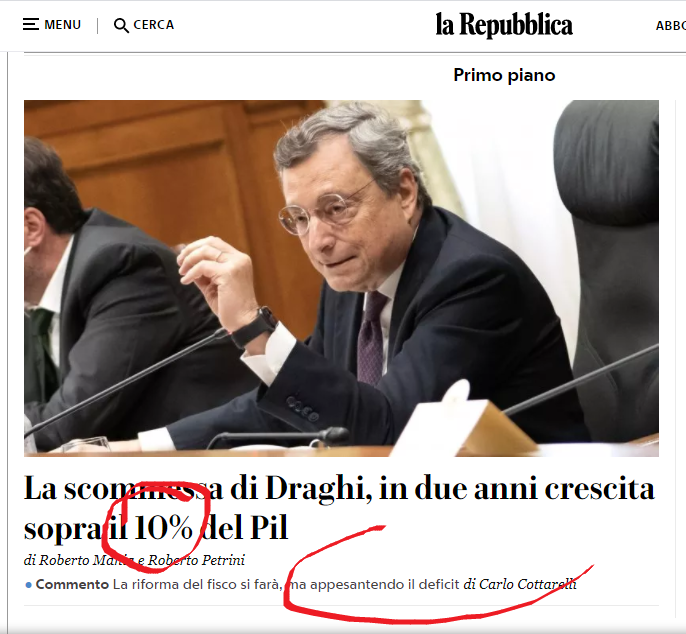
I titoli trionfalistici, a volte a tutta prima pagina, generano aspettative molto elevate nel pubblico: questi titoli dei quotidiani giustificano un rilassamento nell’opinione pubblica, che si sente autorizzata (dalla lettura dei quotidiani stessi) a credere che “tutto è risolto”, o meglio che “tutto è stato risolto da Mario Draghi”.

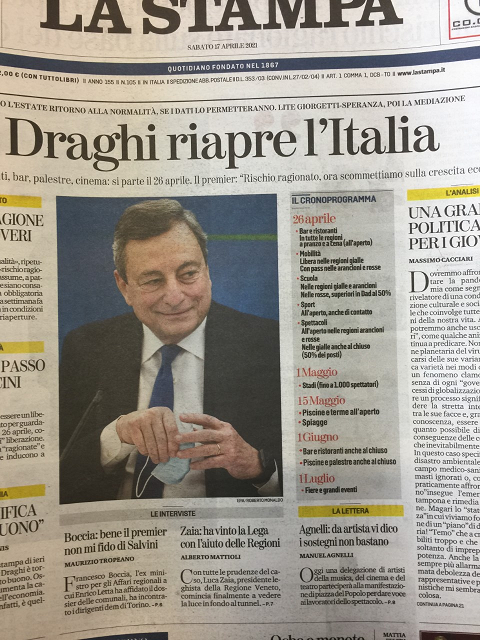
La pagina che vedete qui sotto, in particolare, a noi fa ancora, e sempre, ridere di gusto.
Lo stesso discorso vale per i mercati finanziari, ma soprattutto per gli investitori: indotti a scelte azzardate, e ad oggi sbagliate, da quei media che amano espressioni come “la Borsa vola” (nell’immagine qui sotto), decisamente più adatte alla pubblicità in Tv degli elettrodomestici.

Gli errori e le perdite degli investitori, però, meritano un approfondimento finale: da mesi noi ci chiediamo a che cosa stavano pensando quegli investitori che avevano in portafoglio i BTp nove mesi fa, quando il decennale del BTp a scadenza rendeva lo 0,50%.

Erano tutti convinti che sarebbe andata avanti così per sempre? Erano davvero convinti che “gli asini possono volare”? Possibile essere così tanto ingenui? E’ davvero credibile che decine di migliaia di investitori adulti e razionali abbiamo scelto di credere alle favole?

Possibile che, leggendo un titolo come quello che segue qui sotto, tutti gli investitori che avevano allo BTP in portafoglio a rendimenti vicini a zero abbiamo pensato: “Va tutto bene così, è normale, siamo a posto”?

Nel titolo c’è scritto: “la soluzione è: facciamo ancora più debito!”

E’ credibile che una persona razionale e di buon senso, dotata di un intelletto normale, leggendo un titolo come quello che trovate qui sopra e anche quello che segue qui sotto, non si sia fatto qualche domanda sui BTp fino al mese di maggio 2022?

Nel titolo che segue, potete leggere tutti: “stop austerità, più debito e meno paletti dall’Europa”. Parole semplici, comprensibili, non facili da equivocare: parole dirette, del tipo “facciamo un po’ quello che ci pare a noi”.

Volete dire che c’è qualcuno che non ha capito, neppure così? A noi sembra incredibile.

Ciò che vogliamo dire ai lettori, in questo Post, è che anziché insultare Mario Draghi sui social, la gran parte degli investitori italiani dovrebbe … insultare sé stessa.

“Siamo stati un po’ distratti, ed un po’ fessi: stava tutto scritto sul giornale, e in modo molto chiari, anche con dei titoloni".

Per poi concludere: “La prossima volta, faremo più attenzione. Oppure, ci affideremo a qualcuno capace, che ci metta in guardia dai pericoli.”

Parliamone, se volete.

Longform'd. TINA se ne è andata e non ritorna più?
 

Il mercato azionario internazionale è destinato a rimbalzare da qui a fine maggio? Si chiuderà così una fase di ribasso? Si può chiamare “correzione” la fase di ribasso dei primi mesi del 2022?

Le risposte a queste domande, Recce’d le darà ai suoi Clienti attraverso i tanti canali di comunicazione attivi ogni giorno con loro.

Ma soprattutto le darà con le nostre prossime mosse sui portafogli modello.

In questo Post, tuttavia, intendiamo regalare ai lettori del Blog qualche utile, concreto e specifico elemento di conoscenza, allo scopo di aiutarli a formare, loro stessi, una propria opinione.

C’è poi un secondo scopo: difendersi e proteggere il patrimonio dai luoghi comuni, dalle frasi fatte, dalle favole che vengono ogni giorno appioppate ai poveri investitori italiani che si affidano alle Reti di vendita di Fondi Comuni ed alle banche.

Per rispondere alle domande che aprono questo nostro Longfrom’d, è utile guardare ai tanti temi che ogni giorno sono presenti sulle prime pagine dei quotidiani: dall’inflazione alla crescita, dai tassi di interesse agli utili aziendali. E’ sicuramente utile, ma non è sufficiente. Noi in Recce’d guardiamo anche ad altri temi, che in questo Post vi esponiamo.

Tutti noi investitori usciamo da una fase di mercato che non ha alcun precedente nella storia: una fase di mercato estrema ed eccessiva, nella quale hanno dominato l’irrazionalità ed anche la follia (2020-2021). I mercati nel 2022 hanno (prevedibilmente) cominciato a fare i conti con questa follia. facciamo bene ad aspettarci che, nella fase di discesa, i maggiori indici di mercato si comportino come si erano comportati nelle precedenti fasi di ribasso? Se la fase di rialzo è stata diversa da ogni altra, esagerata ed eccessiva, la cosa può riflettersi anche sulla fase di ribasso?

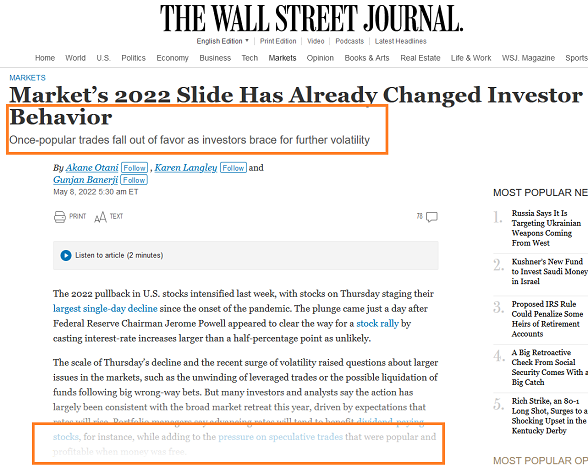
E quindi, ritorniamo alla domanda iniziale: stiamo davvero nel coso di una “correzione”? Oppure si tratta di qualche cosa di diverso? A voi lettori regaliamo, qui di seguito, in lettura un articolo del Wall Street Journal della scorsa settimana, nel quale si afferma che “il mercato è cambiato”. L’articolo spiega che non sono soltanto i prezzi, ad essere cambiati: sono cambiati gli operatori di mercato, la loro psicologia, i loro atteggiamenti.

L’articolo, che è della settimana scorsa, si riferisce in modo particolare all’esercito degli investitori fai-da-te, ovvero ai “retail”, ovvero agli investitori al dettaglio: quelli che, solo 12 mesi fa, si erano autoconvinti di essere in grado di “dominare il mercato” soltanto scrivendosi in chat con quattro amici, come spiega ancora oggi una pubblicità in TV (che promette di “trasportarvi sulla Luna”, e che vedete sotto nella nostra immagine).

Oggi per queste “sollecitazioni del pubblico risparmio” le Autorità nazionali ed internazionali non hanno previsto alcun tipo di sanzione o regolamentazione, e preferiscono investire il loro tempo e le loro risorse in altre attività. Ed è un problema, perché anche a causa di questo tipo di “manie collettive” sui mercati si propagano eccessi ed enormità come quelle che tutti hanno visto negli anni 2020 e 2021. Eccessi ed enormità da cui successivamente seguono i danni, non solo per chi ha messo in moto la cosa.

Torniamo quindi al tema del “rimbalzo” e al tema associato della “correzione”: per valutare se è arrivato quel momento in cui ci si deve “buttare a pesce”, oltre all’inflazione, oltre alla crescita, ed oltre agli utili aziendali, dovete necessariamente chiedervi se il mercato “è cambiato” anche in fase di discesa. Leggiamo che cosa ne scrive il Wall Street Journal la settimana scorsa.

By Akane Otani , Karen Langley and Gunjan Banerji

May 8, 2022 5:30 am ET

The 2022 pullback in U.S. stocks intensified last week, with stocks on Thursday staging their largest single-day decline since the onset of the pandemic. The plunge came just a day after Federal Reserve Chairman Jerome Powell appeared to clear the way for a stock rally by casting interest-rate increases larger than a half-percentage point as unlikely.

The scale of Thursday’s decline and the recent surge of volatility raised questions about larger issues in the markets, such as the unwinding of leveraged trades or the possible liquidation of funds following big wrong-way bets. But many investors and analysts say the action has largely been consistent with the broad market retreat this year, driven by expectations that rates will rise. Portfolio managers say advancing rates will tend to benefit dividend-paying stocks, for instance, while adding to the pressure on speculative trades that were popular and profitable when money was free.

For stocks, that trend has meant pain for the shares of firms that ran up during the pandemic years and carry large valuations.Netflix Inc., one of the hottest tech stocks of recent years, is down 70% this year. Amazon.com Inc.is down 31%, lagging behind even the slumping major stock indexes. Below we consider a few signs of the unrest in markets when buying the dip no longer pays immediate, predictable benefits.

The breadth of the market’s selloff has been striking. Few stocks have been spared.

Just 35% of stocks in the S&P 500 were trading above their 200-day moving averages Thursday, according to FactSet. That was down from 74% in January. Within the Nasdaq Composite, just 20% of stocks traded above their 200-day moving averages that day, down from 38% in January.

“There’s a lot of weakness that’s taking place beneath the surface,” said Willie Delwiche, investment strategist at All Star Charts.

The rout has dragged stock-market valuations lower.

Even after recent drawdowns, though, the S&P 500 still looks expensive relative to its valuations over the past decade. The S&P 500 traded last week at 17.7 times its projected earnings over the next 12 months, according to FactSet, above its 10-year average of 17.1 times earnings. With the Fed poised to continue tightening monetary conditions, many investors say stocks still don’t look cheap.

As stocks have tumbled, investors have tempered their enthusiasm for risky bets in the options market.

For much of the past two years, individual investors had rushed to the options market to place ultrabullish bets on stocks. Options bets became synonymous with the frenzy surrounding meme stocks, as shares of companies such as GameStop Corp. and AMC Entertainment Holdings Inc. soared.

Now, much of that speculation appears to be winding down. Net call option volumes in single stocks recently hit the lowest level since April 2020, according to Deutsche Bank.

The price of bullish options on stocks has also started to come down relative to bearish options, according to Credit Suisse. That is a reversal from much of the past few years, when investors looking to amp up bets on particular stocks rising supercharged demand for bullish options.

Other risky markets have taken a hit. Bitcoin prices peaked this year in March and have generally fallen since then to trade around $36,000.

The cryptocurrency’s descent has likely had a bruising effect on not just individual investors, but also a growing crowd of institutional investors. While cryptocurrencies in their early days were primarily bought and sold by retail traders, hedge funds and registered investment advisers have become a bigger presence in the markets in recent years.

As the rout has left money managers with few places to hide, surveys have shown individual investors becoming increasingly pessimistic about the stock market.

The share of investors who believe the stock market will fall over the next six months ended April at its highest level since March 5, 2009, according to the American Association of Individual Investors.

Widespread pessimism isn’t necessarily bad news. Some analysts view the AAII survey as a contrarian indicator, betting that when sentiment appears to have soured to an extreme level, markets are poised for a rebound. (Back in 2009, the S&P 500 hit its financial-crisis closing low just four days after the AAII reading.)

“Sentiment data can do a good job of saying, if we’re not exactly at the market bottom, we’re probably in the ballpark,” said Ross Mayfield, investment strategy analyst at Baird. “So if you’re being very tactical, those are the good times to put money to work.”

One reason some investors are looking at markets with hesitation these days: inflation. After factoring in price increases, the S&P 500’s earnings yield has fallen dramatically. That has made it harder for investors to justify paying a premium to own stocks over other investments, Morgan Stanley Wealth Management said.

Some investors bracing for further turmoil are turning to inverse funds, which offer buyers the chance to bet on declines in stocks or indexes. By one measure, activity in such funds recently hit the highest level of the past decade, according to Jason Goepfert, founder of Sundial Capital Research.

“Retail investors are betting against stocks,” Mr. Goepfert said. “They’re hedging their portfolios”-

L’articolo del Wall Street Journal, come avete visto, non fornisce alcuna risposta definitiva: via aiuta però a capire, e a valutare, fornendo utili elementi di informazione.

Tra le cose che voi lettori siete chiamati a valutare, una è la seguente: per quale ragione, in TV al TG economia oppure sul vostro giornale preferito non leggete più quelle sigle che soltanto sei mesi fa andavano per la maggiore.

Elenchiamole:

  • BTD

  • FOMO

  • TINA

Per qualche tempo, hanno dominato sui media: tanto che è superfluo spiegarne di nuovo il significato.

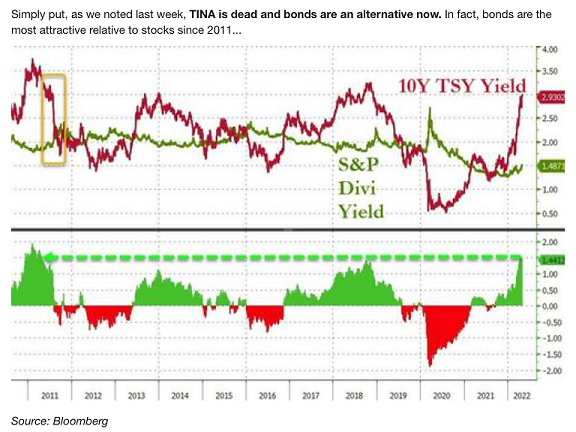
Se in particolare ci occupiamo di TINA, la ragione per la quale oggi non leggiamo più di TINA nei titoli degli articoli di giornale è semplice: adesso, una alternativa alle azioni esiste, come ci racconta il grafico qui sotto.

Il grafico qui sopra, ed il grafico qui sotto, ci servono per mettere in evidenza che l’aumento dei rendimenti delle obbligazioni oggi rende meno conveniente, rispetto al recente passato, l’investimento in azioni: almeno da questo punto di vista, ovvero se mettiamo a confronto il rendimento delle obbligazioni ed il rendimento delle azioni in termini di dividendi distribuiti.

Ovviamente, questo elemento di valutazione non è sufficiente, da solo, a spiegare i recenti cali degli indici azionari, né può da solo spiegare il cambiamento nell’atteggiamento e nella psicologia degli investitori retail che aveva messo in evidenza, poco più sopra, l’articolo del Wall Street Journal.

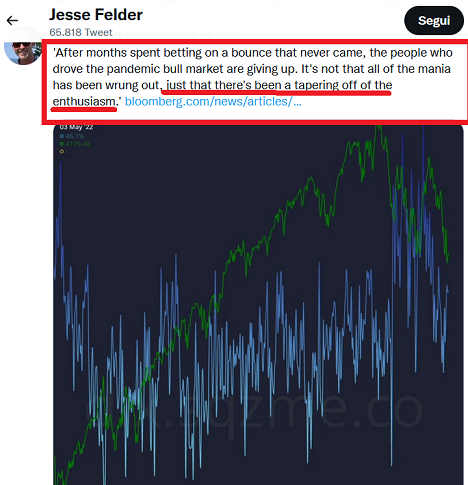
Secondo un certo numero di commentatori, come leggete nell’immagine sotto, quei soggetti che avevano alimentato la mania del 2020-2021 hanno semplicemente … mollato la presa, si sono arresi all’evidenza, ed hanno ridotto il loro entusiasmo, dopo avere aspettato per mesi un rimbalzo che non arriva..

Ma questo è solo un “si dice”, è una cosa che circola tra gli operatori di mercato, è semplicemente uno dei tanti aneddoti a proposito del comportamento degli investitori.

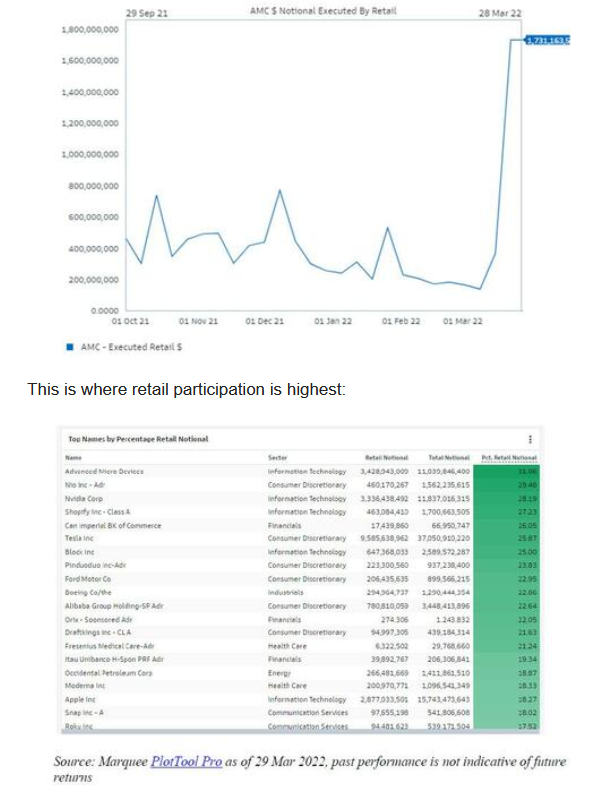
Trattandosi di aneddoti, di cose raccontate e non di dati certi, sarà utile ricordare che soltanto qualche settimana fa, ovvero tra fine marzo ed inizio aprile, si registrò un rimbalzo molto ampio degli indici delle Borse, in coincidenza con la fine della prima fase della guerra in Ucraina.

E proprio in quel periodo si parlava ancora di BTD, di “buy-the-dip”, ovvero di “compera il ribasso” (della Borsa) come atteggiamento prevalente tra i piccoli investitori al dettaglio. Lo leggete qui sotto nell’immagine, che (ripetiamo) è solo di qualche settimana fa.

Su questo argomento, noi riteniamo che vi sarà utile rileggere un commento che fu scritto allora, quando sui mercati di Borsa si registrò quel rimbalzo di fine marzo: abbiamo selezionato per voi lettori l’articolo che segue, articolo che allora (ripetiamo, a fine marzo: ma è utile leggerlo oggi) ci spiegava “le ragioni del rimbalzo”.

L’articolo è molto significativo, perché ci riporta le osservazioni di chi, dall’interno di Goldman Sachs, osserva in modo diretto i flussi di acquisto, ed i flussi di vendita: da dove vengono i soldi, e dove se ne vanno i soldi.

Goldman Sachs solo un mese e dieci giorni fa osservava (come potete leggere) che nelle chat tra investitori retail in quel momento ai temi macroeconomici come inflazione e i tassi di interesse non era attribuita grande rilevanza, mettendo in evidenza che gli investitori individuali negli Stati Uniti sono ancora la categoria che detiene in portafoglio la quota più importante del totale delle azioni in circolazione, e che (secondo Goldman Sachs) sono pronti a ritornare “investitori aggressivi” come prima.

Ne usciva, da questa analisi fatta un mese fa, che l’investimento in azioni avrebbe goduto in quel momento di prospettive favorevoli.

Over the weekend, when looking at the latest JPMorgan Prime Brokerage data, we noted that the "pain trade" remains higher as unlike retail, hedge funds have been selling every rally aggressively with the largest US bank seeing "net selling in 8 of the past 9 days," during which stocks have staged a torrid rally.

At the same time, we also observed that the bulk of the recent market meltup has been on the back of a massive short squeeze and covering of puts (creating a delta and gamma squeeze) which makes it especially difficult to predict what happens next as most if not all of the recent market meltup has been due to technicals and positioning, not fundamentals.

Still, one can conclude that either hedge funds will reverse their selling soon and jump on board the retail buying bandwagon (at which point it will again be time to short), or retail will run out of buying power amid the hedge fund-to-retail "distribution", and stocks will tumble once again.

The outcome of that tensions is, according to Goldman's flow trader Scott Rubner, the $64 trillion question: as he writes in his latest Tactical Flow of Funds note - in which he says that the top institutional investor question has been "who is buying the market +500 points in the last two weeks?" - do retail traders force institutional investors to re-leverage back into the equity market above (the prior ceiling of $4600).

Here are Rubner's 5 main (bullish, of course) observations:

  1. The S&P 500 has closed up more than >1% in 6 out of the last 8 trading days. In the last 80 years, that’s only happened 2 other times.

  2. US bonds are down -6.3% so far this year, on pace for their worst year on record (record is - 2.9% in 1994).

  3. If the month closed today, US bonds would have the worst monthly performance in 42 years.

  4. "I expect a MASSIVE rotation into equities in Q2. When do we start talking about new all-time highs for US Equities? Great Rotation / Great Migration type of stuff."

  5. Global PWM’s are making the calls today for next week. “hey, so we have these bonds, and we are sitting on cash”..... but inflation, yadda yadda yadda. new Q = new inflows.

Going back to the divergence between retail and institutional investors, here is why Rubner is "tracking the message boards again":

  1. US Households own 39% of the $80 Trillion US Equity Market. ($31 Trillion)

  2. Hedge Funds own 2% of the US Equity Market. Households own 20x more market cap than Hedge Funds (ZH: this, however, is a grossly inaccurate at best, since household ownership is a plug in the Fed's Flow of Funds report, and if anything, represents how little the Fed actually knows where the money ends up).

  3. Goldman's analysis shows that the largest owner of the equity market, has scope to become the largest trader of the equity market yet again.

  4. This is the biggest swing factor in the market today, and also the largest source of aggressive trading demand (at a time when liquidity and value traded has decreased).

  5. You have to remember, despite the bearish macro backdrop and investor sentiment, this is not true for message board traders. Open the apps’s today to get the vibe.

Rubner then takes a look at the bigger tactical flow of funds checklist, and gives the lists the following 12 reasons why the S&P rallied ~500 handles in 11 trading days, and why he expects it will keep rallying?

  1. April is a strong seasonal month. Over the last decade the average return for April is 2.34%, the second best month after November.

  2. Great Rotation - Investors are reducing money in bonds, 11 straight weeks of outflows, and huge redemptions from cash funds losing to inflation by -7%. Households have $15 Trillion in cash holding.

  3. Retail is back. Retail participation has dramatically increased and retail are buying weekly calls again. (+50% moves in GME, and huge gains in core retail favorites, TSLA/NVDA). Watch TSLA stock split news. They have fully paid their April 18th tax bill.

  4. Great Repatriation Migration “I’m coming home”. This was the largest monthly move back into the USA on record (out of rest of world). Lot of $ is parked in low quality overseas. Foreigners also coming back to the US.

  5. Systematic. We have +$46B worth of equities to buy from CTAs. This will take us through the end of the quarter.

  6. Corporates are still the largest buyer in market, in a modest blackout window. Net demand (buybacks ex-issuance) is expected to be a record $700 Billion.

  7. $3.5 Trillion worth of option notional rolled off two weeks ago. Gamma is short. The street is very short gamma around ATM strike.

  8. PWM Model portfolios are aggressively selling bonds / credit, and moving back into US quality / tech / dividends.

  9. Our PB team, showed a further capitulation of gross and net HF exposure.

  10. HF’s generally are under exposed to a rally, and want not lag indices before statements go out on quarter-end.

  11. Sentiment remains below COVID, March 2020 lows. (-1.8%)

  12. Liquidity remains challenged. You can trade $5M on the screens of ESA (E-mini futures), this ranks in the 4th percentile in the last decade. This has had the most impact on the shorts trying to cover.

Goldman's bottom line: "flow of funds are still positive for the next two weeks, and there is a lack of supply."

La lettura dell’articolo per voi è interessante, perché vi chiarisce in che modo ragiona ed in che modo “legge i dati dei mercati” chi lavora sui mercati stessi in una posizione che è analoga al grossista che lavora ai Mercati Generali per l’ortofrutta: non decide, ma osserva chi compera e chi vende e in quale quantità.

Le cose poi, per la Borsa USA e per le altre Borse del Mondo, non sono andate nel modo previsto da Goldman Sachs nell’articolo appena letto, e questo per voi è utile perché vi conferma che non è sufficiente guardare ai flussi di ieri per immaginare i flussi di domani.

Ad esempio: leggete l’intervista che segue, in cui ci parla il creatore di una APP per il trading-on-line che fa concorrenza a Robinhood: questo inventore di APP ripete la ben nota storiella che “i giovano hanno molta fiducia in sé stessi e nelle loro risorse, voglio investire su sé stessi e quindi in azioni, e guardano al futuro con fiducia e quindi sono sempre bullish”.

Ammettiamo per un attimo (ma solo per un attimo) che queste frasi abbiano un senso compiuto, ma leggiamo anche il resto: ovvero che “i giovano stanno facendo la punta alle loro matite per capire che cosa fare durante una fase di ribasso”.

Ci pare interessante che questo imprenditore di APP dica queste cose, ovvero che i suoi clienti

  1. stanno cercando di capire che cosa sia una fase di ribasso; e che

  2. non abbiano ancora deciso che cosa fare in una fase di ribasso.

Tra i possibili sviluppi, c’è anche la possibilità che … tutti diventino meno “bullish”?

Vi lasciamo alla lettura dell’intervista e riprendiamo più sotto.

Our call of the day, from the founder and chief executive officer of competitive stock trading app Zingeroo, says institutional traders would be wise to keep paying attention to an increasingly sophisticated retail investor.

Prepandemic, notes Zingeroo’s chief Zoë Barry, the retail crowd represented 10% of the volume that was traded and didn’t share trading ideas — often seen in the Gen. X and older crowd. That figure then hit a high of 25%, and with it came much chattier investors.

“[Wall Street] completely underestimated what it would be like if 25% of the volume turned in a certain direction and turned away from institutional,” Barry told MarketWatch in a recent interview.

“…Gen. Z has actually started sharpening their pencils and doing the research as to what to do in a bear market.”

— Zoë Barry, CEO of Zingeroo

“And now Wall Street is all over sentiment data and they’re looking at what people are seeing, but they also want the core trading numbers because there’s a gap between what people chatter about and say online, versus what they actually trade,” she said.

As a former analyst at Dawson Capital, Barry said she wants to know what traders are saying versus what they’re trading, and why there are inflows on certain stocks. “If I were an institutional, I would be very, very wary of shorting a stock that has the potential to be a heartthrob of retail investors,” she said.

Barry’s app, which launched last autumn, is a rival to Robinhood, but features “bullpens” — chat groups to discuss investing topics — and “zones,” where performances can be benchmarked against others, while trades can be verified by “trading cards.”

The serial entrepreneur said 80% of Zingeroo’s users are millennials and Gen. Z, with the rest Gen. X plus. The younger crowd, she said, views trading activity as their so-called “M.B.A.” — investing in themselves and their own financial diversity.

“I think young retail investors are beginning to have a longer-term outlook than just you know, what is happening this week in the markets. I think that’s an overall positive for them,” she said. “They’re investing in the stock market and they’re investing in themselves and increasing their financial literacy and that’s positive.”

And in the first part of the quarter, there was lots of chatter about young investors being lost in the wilderness of a bear market. “And what we saw was Gen. Z has actually started sharpening their pencils and doing the research as to what to do in a bear market,” said Barry.

As for differences between generations, she said the Gen. X plus category will auto liquidate via stop losses, millennials tend to buy the dip, while Gen. Z is even more sophisticated. For example, she noted recent action on the SQQQ, a three-times leveraged inverse exchange-traded fund that tracks the Nasdaq-100, and called that “definitely unusual behavior for a retail investor.

“They basically said we’re not sure which of the growth stocks are going to be impacted most, so I’m not smart enough as a retail investor to pick exactly what stock will pull back,” said Barry. They are also not worried about catching the exact bottom of a market, but instead are looking at stocks they think will have a greater chance of being a future fundamental success.”

And this crowd “understands the future tools that are happening right now,” and are overall more bullish on themselves, their future potential and the economy overall, despite the geopolitical meltdown and rising inflation, said Barry.

La lettura che avete appena fatto è molto interessante, perché oggi sui mercati giocano un ruolo importante (più importante che in passato) anche questo tipo di intermediari e per conseguenza anche questo tipo di investitori.

Al punto di vista che avete appena letto noi vi suggeriamo di contrapporre quelli che leggerete nell’articolo che segue.

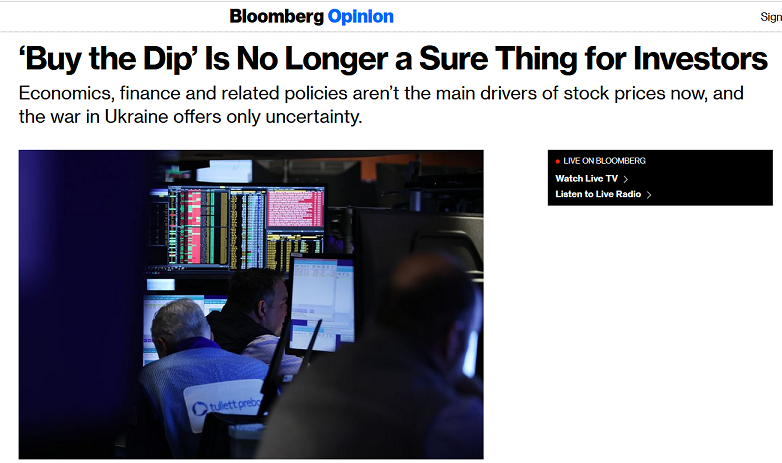
In questo articolo di Bloomberg, datato 9 marzo 2022 (due mesi fa), Mohamed El Erian anticipava che “il buy-the-dip” non costituisce più un guadagno assicurato per gli investitori, dopo essere stato l’atteggiamento dominante per quasi due anni.

Per il momento, quello che El erian aveva previsto si è verificato. Ma domani, che cosa succederà?

Ritornando alle nostre domande di apertura, potrebbe essere proprio questo l’elemento-chiave per rispondere alla domanda sul “rimbalzo” e sulla “correzione”: tutti noi lettori oggi siamo chiamati a rispondere alla domanda del titolo, de “TINA se ne è andata e non ritorna più”, come accadeva in quella nota canzone della musica leggera italiana, cantata dalla presentatrice dell’Eurovision Contest in questi giorni in TV.

Ci auguriamo di avere aiutato, come sempre in modo puntuale, qualificato e articolato, tutti i nostri lettori chiamati a decidere dei loro soldi in questo complicato momento di mercato.

By

Mohamed A. El-Erian

9 marzo 2022, 11:30 CET

Mohamed A. El-Erian is a Bloomberg Opinion columnist. He is president of Queens’ College, Cambridge; chief economic adviser at Allianz SE, the parent company of Pimco where he served as CEO and co-CIO; and chair of Gramercy Fund Management. His books include "The Only Game in Town" and "When Markets Collide." @elerianm

Whether it was friends or total strangers, everyone seemed to have the same question for me on a recent trip. Is it time to buy the dip in stocks? After all, U.S. stock markets have already had a few encouraging bounces in the past two weeks of trading, though they proved both temporary and more than fully reversible.

Few have liked my answer because it contends that economics, finance and related policies have been relegated to the back seat when it comes to the drivers of price action. At this stage, their market question is closely related to a political and national security calculation associated with Russia’s invasion of Ukraine: Is there an offramp for Vladimir Putin anytime soon? If there is, the occasional bounce could translate into a sustainable longer-term rally. Absent that, more unsettling financial market volatility is in the cards.

The war aggravated what was already an unpleasant start to 2022 for stock investors. The top U.S. stock indexes are now down 10% to 18% this year, while widely followed indexes for Europe and emerging markets have fallen 15% and 12%, respectively.

Until recently, BTD was a profitable strategy — so much so that the investor conditioning that came with it made the dips less pronounced and shorter, especially as “fear of missing out” and “there is no alternative” to stocks joined the fray. What made BTD particularly successful is that markets were consistently supported by huge and predictable injections of liquidity from central banks as well as interest rates pinned near zero.

Data suggest that, during the first week of the war, retail investors were inclined to maintain this approach. But their purchases collided with sales from institutional investors, rendering the strategy less effective in maintaining and building on a short-term bounce. Behind this apparent change is a weakening of the central bank shield that, for too many years, decoupled ever-higher asset prices from fundamentals.

With raging inflation threatening to worsen in the next few months, the Federal Reserve has little choice but to ease its foot off the stimulus accelerator — a necessity that is amplified by the extent to which the central bank’s prolonged mischaracterization of inflation as transitory has damaged its credibility and caused it to lose control of its policy narrative. With that, markets are now a lot more exposed to the four-level economic impact of the war: direct repercussions on Russia and Ukraine, spillbacks to advanced countries, spillovers to developing countries, and changes in the functioning of the multilateral system. 

The longer the war continues, the greater the magnitude of these four effects and the larger the scope for their adverse interactions. With that comes a simple but critical question: Can Putin find his way out anytime soon?

Without an orderly end to the war, the disruptions to commodity markets and supply chains will intensify, as will “self-sanctioning” by the corporate world; Europe will be pushed into an inflationary recession; China and the U.S. economies will slow notably; some commodity-importing developing countries will risk foreign-exchange and debt crises; and the new stagflationary baseline for the global economy as a whole will be associated with a growing risk of an outright global recession.

Neither economic and financial policies nor markets are well positioned to deal with this combination, let alone overcome it.

Traditionally, stagflation has been one of the hardest challenges for policy making. It is compounded because the war in Ukraine came when the Fed had already fallen behind inflation realities and failed to build the much-needed flexibility for its policy responses.

Meanwhile, energy policy is stymied by the extent to which the world has been losing the fight against climate change. Fiscal and debt balances have yet to reset after their aggressive deployment to fight Covid-19. And financial supervision and regulation are lagging behind the significant morphing and migration of risk from banks to nonbanks.

Markets have similarly been caught offsides. And it’s not just positioning. Already, market liquidity has proved patchy at times, including for U.S. Treasuries and, of course, individual stocks and commodities. In what fortunately remains a rarity for now, market malfunction has also reared its ugly head: Witness the London Metal Exchange’s suspension of chaotic nickel trading this week.

Without a halt to the atrocities against Ukraine and its people, the global economy and financial markets will face more disruption. 

This is not a comforting context for the continued success of BTD. Unless investors can identify the so-far elusive Putin offramp, their heavily exposed equity positions would be better served by rationalizing them during the bounces rather than buying the current dip outright and hoping for the immediate initiation of a long rally. They should use this opportunity to focus more on selecting individual stocks while positioning for a future of greater dispersion in global economic performance.

Vi ricordate Riccioli d'oro? Non è stato facile.
 

Non è stato facile.

Non è stato facile mantenere la lucidità, in quei mesi infiammati. Durante l’anno 2021.

A pollice alzato, come nella foto qui sopra. Si andava così.

Ognuno si sentiva un genio. Il private banker, il wealth manager, il robo-advisor, il family banker: ognuno di loro aveva capito, e poteva spiegare a voi come diventare ricchi subito.

Era lo scenario Goldilocks: Riccioli d’oro.

Appunto, come nelle favole.

Il merito? Della Federal Reserve e della BCE.

A voi, che cosa raccontava in quelle settimane, il wealth manager? Il personal banker? Il vostro promotore finanziario?

FINECO, Mediolanum, Fideuram, Allianz, Generali e tutti gli altri: a voi, che cosa dicevano di fare allora, un anno fa?

E noi? Noi di Recce’d ai nostri Clienti che cosa abbiamo detto, un anno fa?

Facile: quello che c’è ancora oggi scritto, come testimonianza, in questo Blog.

In sintesi abbiamo detto, e ripetuto: Goldilocks è una favola, ed alle favole è giusto che credano i bambini.

Un adulto che crede alle favole è un ingenuo.

Investire il proprio denaro su una favola, è una stupidaggine.

Chi vi ha spinto a farlo, non pagherà il conto. Il conto lo pagate voi lettori.

Come leggete nell’articolo del Financial Times che segue: dove si riassume la situazione. Leggete fino al fondo, dove si scrive di Anni Settanta, che è un tema di investimento di Recce’d da due anni.


Remember Goldilocks? We are unlikely to be hearing much about that fairy tale character in the near future. For Jay Powell, the US Federal Reserve chair, the odds are that the American economy will either run too hot or too cold, or go from one to the other.

Unlike in the 1990s, or indeed for most of the last generation, it would be rash to bet on a soft landing for the US economy. The era of easy money was also one of relatively easy central banking. That job is getting much tougher.

Goldilocks has left the building. Some of the Fed’s woes are self-created. Its chief sin has been wishful thinking — a trait that was also shared by the markets. The Fed has not yet explained why it got inflation so wrong in the last year. For most of 2021, the Fed insisted higher inflation was “transitory” even as evidence accumulated that it was not.

Then in November the Fed switched to admitting the problem was stickier than it thought. But it did not act as though it meant it. It took another four months to end its monthly injection of $40bn into a housing market that was already booming. Even after proclaiming a turn in the interest rate cycle, the Fed signalled the shift would be modest. Its first interest rate increase of 25 basis points came in March — months after inflation began to overshoot its 2 per cent target. Real monetary conditions have in fact got easier since then.

Inflation has risen by more than the Fed funds rate, which makes America’s real interest rate even more negative than it was before. It is as though Powell, reappointed Fed chair, cannot bring himself to let go of Goldilocks’ hand. It is hard to blame him. For decades, the markets have thrived on the one-way bet that when conditions got rough the Fed would prop up asset prices with steep rate cuts and quantitative easing. It thus always made sense for investors to “buy on the dip”.

Even when the Fed complained that it was the only game in town — in frustration with the fiscal gridlock that disabled Washington for most of the years after the financial crisis — it carried on playing. Not to have done so would have been far worse for everybody. But the super-rich have been the overwhelming beneficiaries, which has not been healthy for democracy.

On the one occasion the Fed did try to alter the rules, it was quickly whipped into line. Ben Bernanke’s attempt to end quantitative easing in 2013 was shut down by the market’s “taper tantrum”. The pandemic returned the Fed to the 2008 mindset of “whatever it takes” — only this time with the fortunes of the non-rich explicitly in mind.

A few months after Covid-19 struck, the Fed replaced its strict 2 per cent inflation target with far more fungible language. Almost everybody, not just the Fed, converted to the view that the US economy could be run far hotter than theory dictated for the sake of full employment. That stance has now sadly been discredited.

Inflation, it turns out, is still a death eater of income gains. In addition to fast wage growth, China’s addiction to “zero Covid” lockdowns and the war in Ukraine are likely to sustain inflation across a broad range of products for months. Though the Fed can do nothing to ease global supply chain problems, the risk is that it will have to overcompensate for its failure to tackle inflation sooner.

On Wednesday, Powell is likely to announce the first 50 basis-point increase in years. That is already priced in. But with headline inflation at 8.6 per cent, a doubling of the Fed funds rate to 1 per cent is hardly disinflationary.

This underlines two growing threats to the Fed. The first is that it might be forced to induce a US recession with far higher interest rate increases than it now anticipates. The Fed’s last dot plot predicts a 1.9 per cent rate by the end of this year.

Last week Deutsche Bank predicted the Fed would have to lift that rate to 5 or 6 per cent to tame inflation. For similar reasons, Morgan Stanley warned that the US was entering a bear market. Both views are a minority.

But consensus forecasts, including the Fed’s, have been so badly off that it would be unwise to take the majority literally. The middle class wage renaissance may turn out to be fleeting. The second worry is about the harm to the Fed’s credibility. Powell did not acknowledge that inflation was non-transitory until after President Joe Biden reappointed him. Doubtless this was a coincidence.

Either way, the institution that was until recently seen as Washington’s most effective may be forced to relearn the lessons of the 1970s and early 1980s — even if today’s woes are not as great. Credibility is bought at great expense over a period of years. Alas, it can also be risked with remarkable ease.

edward.luce@ft.com

Il 9 maggio e la guerra di logoramento
 

Come abbiamo scritto già nelle due settimane precedenti, in Recce’d seguiamo con particolare attenzione l’Europa in questo momento.

Ciò che vediamo negli Stati Uniti, per noi rientra nel prevedibile: non ci stupisce e quindi non ci colpisce. Non dobbiamo spiegare nulla ai nostri Clienti, che erano (da tempo) preparati.

In Europa, a noi sembra che la situazione sia diversa, e da più di un punto di vista.

Spieghiamo: le ricadute di ciò che vedete succede sui mercati finanziari, per l’Europa e per la zona Euro in modo particolare sono più ampie, rispetto alla situazione degli Stati Uniti.

Anche negli Stati Uniti vedremo ricadute sulla vita sociale e politica. Ma in Europa potrebbero essere più profonde.

Ne scriviamo da una settimana, ogni mattina nel The Morning Brief per i nostri Clienti.

Con questo Post, noi vogliamo mettere all’attenzione dei nostri lettori soltanto uno, dei tanti aspetti che a noi fanno ritenere particolarmente delicata la situazione dell’Europa e dell’Area Euro in questo momento.

Si tratta del conflitto in Ucraina.

Già nel mese in febbraio, ed anche in forma pubblica attraverso questo Blog, Recce’d scriveva che questa guerra tra Ucraina e Russia è “una cosa per il lungo periodo”.

Oggi, ritrovate il medesimo concetto scritto sulla stampa nazionale ed internazionale (immagine qui sopra.

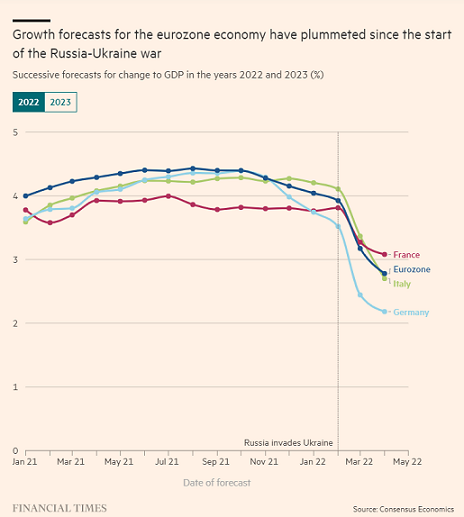
I mercati finanziari, e noi investitori, siamo chiamati a fare i conti daccapo, a rivedere tutte le stime, non solo epr il 2022 ma per il medio termine.

Allo scopo di fare proprio questo, Recce’d ha selezionato per i suoi lettori un recente articolo del Financial Times, che vi aiuterà a capire in che modo siamo tuti costretti a modificare i numeri, le stime e le previsioni per le economie europee, e quindi per conseguenza anche per i mercati finanziari europei.

Nell’articolo scritto da Martin Wolf potrete leggere in particolare le ragioni per le quali, per l’Europa, le conseguenze della guerra in Ucraina sono economiche ma anche politiche e morali.


How should the EU manage the economic costs of Vladimir Putin’s war? That is not the same as minimising those costs. This is a war, one on which the future of Europe, perhaps of democracy itself, will depend. In such times, the aim of economic policy is to support the war effort. Policy should seek to maximise costs to the aggressor relative to those to the EU, particularly to its most vulnerable citizens. How should this be done? If we are to think about this question, we need an analytical framework. Olivier Blanchard, former chief economist of the IMF, and Jean Pisani-Ferry provide that in a recent paper.

They list three challenges: first, “How best to use sanctions to deter Russia, while limiting adverse effects on the EU economy”; second, how to deal with cuts to real incomes that result from the rise in the cost of energy imports; and, third, how to manage the increased inflation caused by higher energy and food prices, which has come on top of the post-Covid surge in inflation. Needless to say, any such analysis is provisional. In times of war, the future is even more uncertain than usual. (See charts.)

On the impact of sanctions on Russia, consider a recent comment by Rystad Energy: “Despite the severe oil production cuts expected in Russia this year, tax revenue will increase significantly to more than $180bn due to the spike in oil prices . . . This is 45 per cent and 181 per cent higher than in 2021 and 2020, respectively.”

This is not to deny the damage done by sanctions: the IMF forecasts that Russia’s economy will shrink by 8.5 per cent this year. But it means that higher prices are more than offsetting reductions in volumes. Consumers are suffering, but they are also financing the invasion of Ukraine.

This is bad policy. The aim must at the least be to lower the revenue Russia receives from its exports, not increase it. A number of economists have considered what this might require.

Seven points emerge from their analyses.

  1. First, the EU’s vulnerability to Russia, but also power over it, is greater in gas than oil, because gas depends more on a fixed infrastructure. That makes diversification of sales by Russia (though also of purchases by the EU) more difficult.

  2. Second, the most effective way to lower revenue to Russia is not an embargo but a punitive tax or tariff, which should shift Putin’s “energy rent” to consumers.

  3. Third, imposing tariffs would generate revenue that can be used to help those suffering losses in real incomes at present.

  4. Fourth, a tax imposed by the EU alone on Russian exports would achieve more in gas than in oil, because of the greater difficulty of diversifying gas exports.

  5. Fifth, trade sanctions would be more effective the greater the number of participating countries.

  6. Sixth, one might extend sanctions on oil by placing sanctions on shipping. Finally, the cost of such measures to Russia would be a large multiple of their costs to the EU and allies. Reaching consensus on effective measures is hard, but crucial.

A way has to be found to shift more of the revenue of Russian exports to consuming countries. Yet, whatever is done on that, there will be significant costs to wealthy importing countries from the war: increased spending on defence; greater spending on energy infrastructure; assistance to refugees; and, not least, substantial support for hard-hit developing countries. Inevitably, the salient political issue will be how to cushion the blow to domestic consumers.

Should this be done via subsidies on energy, transfer payments or price controls? A big part of the answer depends on the sanctions regime that is adopted. But the general point is that subsidies will tend to offset sanctions by increasing consumption rather than reducing it. It would be better to increase transfers of purchasing power to vulnerable households, leaving them to decide how to spend it.

Price controls on oil were a disaster in the 1970s. I can see no good reason why they would do any better now. If one wants to limit windfall profits, it would be better to tax them. How, also ask Blanchard and Pisani-Ferry, should transfers or other spending measures be financed? Since a war is a short-term emergency, the case for additional government borrowing is strong.

Moreover, at current long-term interest rates (still very low) and prospective increases in nominal gross domestic product (boosted by inflation), extra debt would be affordable.

This then raises the issue of monetary policy. The impact of the war is to strengthen upward pricing pressures, risking an inflationary wage-price spiral, while simultaneously weakening demand as real incomes are squeezed. Blanchard and Pisani-Ferry suggest these two effects offset each other. In that case, they argue, monetary policy should remain on the tightening path laid out before the Russian invasion. But they also suggest fiscal measures might be targeted at lowering price inflation, so reducing the risks of the wage-price spiral. They also suggest that such fiscal measures could be brought into the wage-bargaining process directly. I am sceptical. Yet it just might work in northern Europe.

The conclusion I draw from these analyses is that the war is a significant economic shock, but it is very much more a political and moral one. A brutal conflict has come to Europe of a kind not seen since the second world war, and even where some of its worst atrocities occurred. For Germany in particular, it is a moment of challenge and opportunity. The challenge is to defend Europe’s liberal civilisation. The opportunity is for historic redemption. Russia must not prevail. This is what matters most. There will indeed be pain. But it must be borne for a far greater cause.

martin.wolf@ft.com Follow Martin Wolf with myFT and on Twitter

Perché c'è una tigre nella piscina?
 

Nella nostra Lettera al Cliente di oggi, abbiamo analizzato i fatti dell’ultima, confusa e persino caotica, settimana dei mercati finanziari.

In modo particolare, abbiamo messo in evidenza i cambiamenti, significativi, che noi abbiamo rilevato, nel comportamento dei mercati finanziari, e quindi degli investitori, nelle ultime cinque sedute.

Cambiamenti che, come abbiamo illustrato nella Lettera, determineranno presto un cambiamento, probabilmente molto ampio, dei nostri portafogli modello.

In questo Post, noi portiamo all’attenzione di tutti i lettori un tema di mercato che, fino ad oggi, non abbiamo ancora letto sulle prime pagine dei quotidiani, e non abbiamo ancora ascoltato a CNBC.

Noi siamo però del parere che, nei mesi restanti del 2022, e nel 2023, questo argomento acquisterà progressivamente importanza, fino a diventare centrale.

Recce’d ne aveva già scritto, e solo pochi giorni fa (prima della riunione della Federal Reserve) anche qui, nel nostro Blog. Potete leggere quel Post cliccando qui.

Di questo argomento, Recce’d scrive in modo più specifico in un altro Post pubblicato oggi. In questo Post che state leggendo, invece, richiamiamo la vostra attenzione su un fatto concreto dell’ultima settimana che a molti di voi è sfuggito e che funziona come spunto.

Come dice il titolo di questo Post, c’è una tigre sott’acqua in piscina: fuori di metafora, questo significa che uno dei più grandi Fondi Hedge del Pianeta è in (forte) difficoltà, come potete leggere nell’immagine che trovate qui sopra.

Nei primi 4 mesi del 2021, il valore di questo Fondo è sceso di oltre il 50%.

C’è un grande numero di temi, che si dovrebbero affrontare prendendo spunto da questa notizia, notizia che, lo ripetiamo, riguarda uno dei più acclamati, e grandi, Fondi Hedge del Mondo.

Molti di questi argomenti (dalla gestione del rischio alla composizione del portafoglio all’utilizzo della leva) noi li affronteremo anche nella nuova pagina del sito che si chiama GESTIONE DI PORTAFOGLIO).

Oggi nel Post ci fermiamo al caso specifico. e chiediamo, ai nostri lettori, se ricordano LTCM. Oppure, se ricordano il Fondo di Goldman Sachs che si chiamava Global Alpha.

Sono vicende del 1998, e poi del 2006, che influenzarono l’intero mercato finanziario globale: azioni, obbligazioni, valute e materie prime.

I nostri lettori che non ricordano questi episodi, farebbero bene a fare un’indagine al proposito sul Web, e poi ad informarsi di altri episodi analoghi.

Perché diamo al lettore questa indicazione oggi? Lo leggete sotto, nell’immagine che chiude il Post.