Longform'd. Anni Settanta: similitudini e differenze.
 

Non abbiamo alcun timore di smentita: Recce’d ha scritto e parlato con i propri interlocutori di stagflazione prima di chiunque altro, nell’ambito degli operatori sui mercati finanziari.

Ne sono testimoni prima di tutto i nostri Clienti. Poi tutti i nostri interlocutori sui mercati finanziari. Ed anche tutti gli amici che ci hanno contattato nel 2020 e nel 2021.

Ne è ovviamente testimone anche il nostro Blog.

Oggi, dopo quindi mesi dai nostri primi allarmi su questo rischio, ne scrivono e ne parlano tutti, ma proprio tutti tutti tutti.

Molti di questi non ne capivano granché quindici mesi fa, e capiscono ancora meno oggi. Altri, per fortuna, sono più qualificati.

Un esempio è il quotidiano The New York Times, dal quale noi abbiamo ricavato e selezionato la’rticolo che leggete di seguito.

2021_Jan_1314.png

By Matt Phillips

Oct. 13, 2021

Vaccine mandates seem to be working, younger children may be approved for shots by Halloween, and the coronavirus appears to be in retreat. But those hopeful signs herald a messy new phase for the country’s economic recovery — and that’s putting Wall Street more on edge than it’s been in months.

The Federal Reserve has signaled it could begin dialing back programs that have helped prop up the markets for the past 18 months as soon as next month, while the breakneck pace of economic growth seems to be slowing, a fact underscored by a disappointing September jobs report.

And price increases that grew out of pandemic-related shutdowns and supply chain disruptions have been stubbornly persistent. A key measure of inflation released Wednesday, the Consumer Price Index, climbed 5.4 percent in September compared with the prior year — more than expected in a Bloomberg survey of economists and faster than its 5.3 percent increase through August.

“There’s a lot for the market to digest at one point in time and a lot of unknowns, frankly, that investors are grappling with,” said Matt Fruhan, who manages the nearly $3 billion Large Cap Stock Fund, as well as other funds, for Fidelity.

That uncertainty has halted the momentum that propelled stocks to a series of record highs over the summer. Last month, the S&P 500 endured its deepest drop — 4.8 percent — since the start of the pandemic. Investors have regained a bit of ground in October, but the market has been unable to muster any real momentum. After the inflation report on Wednesday, the S&P 500 slipped again in early trading, then swung back to close up 0.3 percent, snapping a series of three straight declines.

By any objective measure, it has been a good year for stocks, with the S&P 500 up roughly 16 percent through the end of trading on Tuesday. But the recent bumpiness reflects a growing uncertainty about the next chapter of the recovery-driven rally, with share prices swinging more from day to day — and even hour to hour — than they had in months.

The update on the American job market on Friday almost perfectly encapsulated the confusing economic backdrop that investors face: The number of new jobs fell far short of expectations, but wage growth rocketed higher.

“The rate of growth is moderating, yet the rate of inflation is increasing,” said Paul Meggyesi, a currency analyst with JPMorgan in London. “It’s an unusual decoupling.”

Many are looking to history to try to make sense of it, which is why Wall Street is chattering about the chances of a return of an economic specter from the 1970s: the toxic mix of sluggish economic growth and high inflation that came to be known as stagflation.

The comparison isn’t perfect. Back then, inflation hit double digits, and unemployment sat at nearly 9 percent. Neither inflation nor unemployment is anywhere near that high now.

But on Wall Street, the level of attention on stagflation is soaring. Last week, the volume of articles mentioning the term “stagflation” published by the financial news service Bloomberg hit a record, the company reported.

Mr. Meggyesi, who described the current situation as “stagflation lite” in a recent note to clients, is part of that surge of analysts reconsidering the idea, along with the risks it could pose to markets.

The most obvious echo is the surprising, and durable, rise in prices. As costs for things like lumber, microchips and steel climbed this spring, officials from the Federal Reserve took pains to say the rise would prove “transitory.” Once companies returned to normal, officials said, production would increase, supply lines and inventories would be replenished, and prices would fall.

But after a renewed round of economic disruptions caused by the Delta variant of the coronavirus — including many in key Asian manufacturing hubs such as Vietnam — there’s little sign that the upward pressure on prices is going away anytime soon.

A report this month showed that the Fed’s preferred gauge of inflation rose at the quickest pace in 30 years in August, and this week a measure of wholesale used car prices — an increasingly important factor in calculating inflation — hit a historic high.

The rise in prices worries investors for a couple reasons. For one thing, climbing costs can cut into corporate profits, a key driver of stock prices. Traders also worry that if inflation rises too fast, the Fed may lift interest rates to try to control it. At times in the past, rate increases from the Fed have tanked the market. Higher rates make owning stocks less attractive compared with owning bonds, prompting some investors to dump shares.

“I think the reason we’ve gotten more volatile is the market is starting to warm up to the belief that inflation is not as transitory as the head of the Federal Reserve keeps on telling us,” said John Bailer, a portfolio manager at Newton Investment Management, where he oversees mutual funds with more than $4 billion in client assets.

If anything, the upward pressure on prices seems to be growing.

In another echo of the 1970s — when stagflation dynamics were set off by the Arab oil embargo of 1973 — Russia has resisted increasing shipments of natural gas to Europe in recent months despite surging demand. That has sent prices up sharply, halting some industrial activity and producing painful energy bills in continental Europe and Britain.

Oil prices climbed to their highest level in seven years in recent weeks, after the powerful Organization of the Petroleum Exporting Countries moved to lift production only gradually. In Britain — where the term “stagflation” is generally thought to have originated — a fuel shortage last month that grew out of a shortage of truck drivers prompted panic buying and long lines at gas stations, another strange echo of the disorderly 1970s.

“Historically, stagflation has often been accompanied by oil shocks,” said Jill Carey Hall, a stock market analyst at BofA Securities. “There’s definitely a rising concern that we could be in that type of environment.”

The effects of the rise in oil prices have been less dire in the United States, but prices are also up for a variety of major commodities. The S&P GSCI Commodity Index, which tracks 24 traded commodities — like aluminum, copper and soybeans — rose to its highest level since late 2014 in recent days. That suggests inflationary pressures will pinch for a while longer.

The comparison between today and the 1970s seems to break down with the “stag” component of stagflation. By almost every measure, economic growth is expected to be remarkably strong this year.

Analysts polled by Bloomberg forecast that gross domestic product will grow 5.9 percent this year — a number that would be the best mark since 1984.

But predictions for growth are being dialed back. On Sunday, analysts at Goldman Sachs trimmed their 2021 growth forecast for the United States to 5.6 percent. It had been as high as 7.2 percent in March.

And on Tuesday, the International Monetary Fund lowered its 2021 global growth forecast to 5.9 percent, down from the 6 percent projected in July, while warning of the risks of supply chain disruptions feeding inflation. Its forecast for the United States was pared back to 6 percent, from the 7 percent growth projected three months ago.

Even so, Kristalina Georgieva, the managing director of the I.M.F., brushed off any talk of stagflation in an interview on Tuesday. Ms. Georgieva said that the world was experiencing a “stop and go” recovery, and that even if the United States was losing some of its considerable momentum, other areas — including Europe — were gaining it.

“We are not seeing the world economy stagnating,” she said. “We are seeing it not moving in sync across the globe.”

Steven Ricchiuto, chief U.S. economist at Mizuho Securities USA, said the breakneck growth of the first half of the year was never going to be sustainable. “Expectations have gotten out of line with reality,” he said.

But any sense of disappointment — despite numbers that are objectively good — may weigh on the market over the next few weeks, as major corporations begin to report their financial results for the third quarter.

G.D.P. growth is a key driver of revenues for major corporations. A slightly weaker economy could translate into lower sales numbers than expected, just as inflationary pressures mean climbing costs.

That has already been an ugly combination for some companies’ corporate profits. The share prices of several notable corporations — FedEx, Nike, CarMax and Bed Bath & Beyond among them — have been clobbered over the past few weeks after the release of disappointing quarterly reports.

Shares of Lamb Weston, an Idaho-based maker of frozen potato products, tumbled after it fell short of earnings expectations because everything from potatoes to cooking oils to packaging is more expensive. The company’s shares are down about 10 percent since it reported its results and revised its outlook last week, saying its profits would remain under pressure for the rest of the fiscal year.

“We had previously assumed these costs would begin to gradually ease,” said Bernadette Madarieta, the company’s chief financial officer, told analysts.

Other stocks could suffer a similar fate.

“People are going to be further disappointed,” said Mike Wilson, chief U.S. equity strategist at Morgan Stanley. “Even if the economy is OK, it may not translate into the kinds of earnings that people are expecting.”

L’articolo che avete appena letto vi aiuterà a mettere a fuoco le maggiori somiglianze, e le maggiori differenze tra gli anni Venti del nuovo Millennio e gli anni Settanta del XX secolo: ovviamente non tutto è uguale, e sicuramente risulterà diversa anche la reazione dei mercati finanziari.

Recce’d non è in grado di dire al lettore come andrà a finire: questa esperienza che stiamo tutti facendo è del tutto nuova, da più punti di vista.

Recce’d però è stata in grado di dirvi, già quindi mesi fa, che quella del “boom economico” era una balla, e che quella della “inflazione transitoria” era una sciocchezza.

E voi lettori, quali qualità andate cercando in un gestore di portafoglio?

2021_Jan_1315.png

Sul tema degli Anni Settanta abbiamo selezionato, per il nostro Longform’d, un secondo articolo, pubblicato questa volta dal settimanale The Economist.

Il nostro suggerimento è di leggere con attenzione anche questo articolo, ed in particolare di leggere con attenzione la parte finale, proprio per mettere voi stessi in condizione di cogliere al meglio le differenze e le somiglianze con gli Anni Settanta.

Ma soprattutto, potrà aiutarvi a comprendere perché allora, negli Anni Settanta, la situazione era molto, ma molto, più facile da risolvere di quella che oggi abbiamo davanti. Noi, ed i nostri investimenti in titoli.

It is nearly half a century since the Organisation of the Petroleum Exporting Countries imposed an oil embargo on America, turning a modest inflation problem into a protracted bout of soaring prices and economic misery. But the stagflation of the 1970s is back on economists’ minds today, as they confront strengthening inflation and disappointing economic activity. The voices warning of unsettling echoes with the past are influential ones, including Larry Summers and Kenneth Rogoff of Harvard University and Mohamed El-Erian of Cambridge University and previously of pimco, a bond-fund manager.

Listen to this story

Enjoy more audio and podcasts on iOS or Android.

Stagflation is a particularly thorny problem because it combines two ills—high inflation and weak growth—that do not normally go together. So far this year economic growth across much of the world has been robust and unemployment rates, though generally still above pre-pandemic levels, have fallen. But the recovery seems to be losing momentum, fuelling fears of stagnation. Covid-19 has led to factory closures in parts of South-East Asia, hitting industrial production. Consumer sentiment in America is sputtering. Meanwhile, after a decade of sluggishness, price pressures are intensifying (see chart 1). Inflation has risen above central-bank targets across most of the world, and exceeds 3% in Britain and the euro area and 5% in America.

The economic picture is not as bad as the situation during the 1970s (see chart 2). But what worries stagflationists is less the precise figures than the fact that an array of forces threatens to keep inflation high even as growth slows—and that these look eerily similar to the factors behind the stagflation of the 1970s.

One parallel is that the world economy is once again weathering energy- and food-price shocks. Global food prices have risen by roughly a third over the past year. Gas and coal prices are close to record levels in Asia and Europe. Stocks of both fuels are disconcertingly low in big economies such as China and India; power cuts, already a problem in China, may spread. Rising energy costs will exert more upward pressure on inflation and further darken the economic mood worldwide.

Other costs are rising too: shipping rates have soared, because of a shift in consumer spending towards goods and covid-related backlogs at ports. Workers are enjoying greater bargaining power this year, as firms facing surging demand struggle to attract sufficient labour. Unions in Germany, for instance, are demanding higher pay; some workers are going on strike.

Stagflationists see another similarity with the past in the current policy environment. They fret that macroeconomic thinking has regressed, creating an opening for sustained inflation. In the 1960s and 1970s governments and central banks tolerated rising inflation as they prioritised low unemployment over stable prices. But the bruising experience of stagflation helped shift thinking, producing a generation of central bankers determined to keep inflation in check. Then, after the global financial crisis and a period of deficient demand, this single-minded focus gave way to greater concern about unemployment. Low interest rates weakened fiscal discipline, and enabled vast amounts of stimulus during 2020. Now as in the 1970s, the worriers warn, governments and central banks may be tempted to solve supply-side problems by running the economy even hotter, yielding high inflation and disappointing growth.

These parallels aside, however, the 1970s provide little guidance to those seeking to understand current troubles. To see this, consider the areas where the historical comparison does not hold. Energy and food-price shocks typically worry economists because they could become baked into wage bargains and inflation expectations, causing spiralling price rises. Yet the institutions that could underpin a new, long-lived era of labour strength remain weak, for the most part. In 1970 about 38% of workers across the oecd, a club of mostly rich countries, were covered by union wage bargains. By 2019, that figure had declined to 16%, the lowest on record.

Cost-of-living adjustments (cola), which automatically translate increases in inflation into higher pay, were a common feature of wage contracts in the 1970s. But the practice has declined dramatically since. In 1976 more than 60% of American union workers were covered by collective-bargaining contracts with cola provisions; by 1995, the share was down to 22%. A paper published in 2020 by Anna Stansbury of Harvard and Mr Summers argued that a secular decline in bargaining power is the “major structural change” explaining key features of recent macroeconomic performance, including low inflation, notwithstanding the decline in unemployment rates over time. As dramatic as the pandemic has been, it seems unlikely that such a big shift has reversed so quickly.

Moreover, stagflation in the 1970s was exacerbated by a sharp decline in productivity growth across rich economies. In the decades after the second world war, governments’ commitment to maintaining demand was accommodated by rocketing growth in productive capacity (the French called the period “les Trente Glorieuses”). But by the early 1970s the long productivity boom had run out of steam. The habit of stoking demand failed to help expand productive potential, and pushed up prices instead. What followed was a long period of disappointing productivity growth.

Since the worst of the pandemic, however, productivity has strengthened: output per hour worked in America grew at about 2% in the year to June, roughly double the average rate of the 2010s. Booming capital spending could mean such gains are sustained.

Another important break with the 1970s is that central banks have neither forgotten how to rein in inflation nor lost their commitment to price stability. In the 1970s even some central bankers doubted their power to curb wage and price increases. Arthur Burns, then the chairman of the Federal Reserve, reckoned that “monetary policy could do very little to arrest an inflation that rested so heavily on wage-cost pressures”. Research by Christina and David Romer of the University of California at Berkeley suggests that Mr Burns’s view was a common one at the time. But the end of the era of high inflation demonstrated that central banks could rein in such price rises, and this knowledge has not been lost. Last month Jerome Powell, the Fed’s current chairman, declared that, if “sustained higher inflation were to become a serious concern, we would certainly respond and use our tools to assure that inflation runs at levels that are consistent with our longer-run goal of 2%.”

The new fiscal orthodoxy likewise has its limits. Budget deficits around the world are forecast to shrink dramatically from this year to next. In America moderate Democrats’ worries about excessive spending may mean that President Joe Biden’s grand investment plans are pared down—or fail to pass at all.

What next for the world economy, then, if it does not face a 1970s re-run? Rocketing energy costs pose a serious risk to the recovery. Soaring prices—or shortages, if governments try to limit rises—will dent households’ and companies’ budgets and hit spending and production. That will come just as governments withdraw stimulus and central banks countenance tighter policy. A demand slowdown could relieve pressure on supply-constrained sectors: once they have paid their eye-watering electricity bills, Americans will be less able to afford scarce cars and computers. But it would add a painful coda to nearly two years of covid-19.

Another important respect in which the global economy has changed since the 1970s is in its far greater integration through financial markets and supply chains; trade as a share of global gdp, for instance, has more than doubled since 1970. The uneven recovery from the pandemic has placed intense stress on some of the ties binding economies together. Panicking governments could hoard resources, causing further disruption.

Past experience, therefore, is not the clearest lens through which to view the forces buffeting the global economy. The world has changed dramatically since the 1970s, and globalisation has created a vast network of interdependencies. The system now faces a new, unique test. ■

For more expert analysis of the biggest stories in economics, business and markets, sign up to Money Talks, our weekly newsletter.

An early version of this article was published online on October 5th 2021

Mercati oggiValter Buffo
Quisquilie e pinzellacchere
 

Per noi è fonte di sostentamento: e per questo, il mercato finanziario noi di Recce’d lo trattiamo sempre con rispetto, massimo rispetto, ed in modo molto serio.

Per operare in modo profittevole sul mercato finanziario, però, è importante, ed anzi deciso, riconoscere anche i (pochi, ma ricorrenti) aspetti del suo funzionamento che risultano tutt’altro che seri: risultano al contrario ridicoli.

2021_Jan_1307.png

Molti esempi, li abbiamo evidenziati nel corso degli ultimi dieci anni nel nostro Blog. Oggi, ve ne propioniamo un ennesimo.

Richiamiamo la vostra attenzione sul tema delle “materie prime 2021”, ed in particolare sul tema del “petrolio 2021”.

Il tema è caldo, anzi caldissimo: tutti i media ci si buttano a pesce, sapendo che aumenta il numero di click, e questo perché dal petrolio si ricavano beni di uso comune, come benzina, gasolio e carburanti per il riscaldamento domestico.

L’immagine qui vicino è una recentissima copertina del settimanale The Economist, ma anche sui quotidiani e TG nazionali i termini “shock energetico” sono di uso comune.

Qualcuno avrà fatto i conti? Qualcuno avrà aggiornato le previsioni? E su che cosa? E chi? Qualcuno, almeno qualcuno, avrà idea di che cosa si sta esaminando, di che cosa si parla?

Boh.

Recce’d la settimana scorsa, nel proprio quotidiano The Morning Brief, ha fornito al proprio Cliente una serie ordinata e selezionata di dati concreti, in particolare sul petrolio.

Poi ha spiegato nel dettaglio al Cliente, con riferimento alle nostre attuali posizioni di portafoglio, perché questo allarme sullo “shock energetico”, benché preso in modo molto serio, non modifica le nostre scelte di portafoglio.

In questo Post, in modo molto più sintetico, vogliamo regalare ai lettori un aiuto concreto: vogliamo aiutare i lettori a rispondere alla domanda “Che cosa cambia nella gestione del mio portafoglio con il petrolio a 80$?”

Prima di tutto, e come facciamo sempre, vogliamo aiutare il lettore a ricordare: vogliamo aiutare i nostri lettori a ricordare che negli ultimi cinque anni le oscillazioni del prezzo del petrolio sono state molto frequenti e molto ampie in assoluto (dollari) ed in percentuale (50-60-70%). Lo vedete sotto nel grafico.

2021_Jan_1298.png

Non c’è nulla di singolare, di unico, di “senza precedenti” nel recente rialzo del prezzo del petrolio greggio. Se soffrite di ansie da volatilità, tenetevi alla larga, o se siete almeno un po’ equilibrati, limitate la vostra esposizione.

Sempre richiamando in causa la vostra memoria, riguardatevi il grafico dell’oro qui sotto.

2021_Jan_1299.png

Tornate con la memoria a 12 mesi fa: ricordate? Ogni dubbio era svanito, e tutto era chiarissimo: l’oro avrebbe potuto … soltanto salire.

Come il petrolio oggi.

Ritornando per un attimo all’oro: vi sarà utile ricordare anche un po’ più indietro, e guardare qui sotto il grafico di lungo periodo.

Le materie prime hanno, tutte, un utile effetto, che potremmo dire da “equilibratore” ovvero “ammortizzatore” nei vostri portafogli. ma attenzione: non sono un Bancomat. proprio quando credete “adesso lo so, che guadagno”, loro scattano nella direzione opposta. Un investitore VINCENTE lo sa che è necessaria pazienza, se si vogliono fare veri guadagni.

2021_Jan_1301.png

E qui arriviamo al ridicolo, ovvero a quei momenti ridicoli dei mercati finanziari, e soprattutto di chi opera sui mercati ed intorno ai mercati.

Sui mercati ed intono ai mercati, da sempre, c’è chi spinge sulle materie prime come “occasioni di facili guadagni”, facili e soprattutto veloci.

Basterà avere capito “a che punto è il ciclo”.

2021_Jan_1303.png

Lo scorso mese di maggio, come vedete sopra, era chiaro che un “super-ciclo” delle materie prime, petrolio in testa, era già iniziato. Le ragioni erano evidenti a tutti: stimolo all’economia e dollaro USA debole.

Ora, vediamo: dollaro USA debole, mmmmm …

E poi lo stimolo all’economia, beh …. mmmmm … vediamo, dunque …

Ma allora era comunque chiaro a tutti: persino a settimanali autorevoli come The Economist.

2021_Jan_1305.png

Nel mese di agosto, e quindi due mesi dopo, i toni vengono in parte moderati: e si scrive, come vedete qui sotto, che “Forse” ma solo forse, il “Superciclo” esiste davvero. Forse.

2021_Jan_1306.png

Poi arriva settembre. Sono trascorsi appena 90 giorni. E cosa accede?

Arriva la triste notizia di un lutto.

2021_Jan_1304.png

Sta morendo, il Superciclo, ci dice il Wall Street Journal.

Che cautamente aggiunge, però, che “Non è detta l’ultima parola”.

Da allora, dalla morte del Superciclo, è trascorso solo un mese. ma chi se ne ricorda? E chissenefrega? Le grandi banche globali, insieme con i TG e i quotidiani, devono spingere qualcuna a fare, qualcuno a aprire nuove posizioni, qualcun altro a chiudere posizioni già in essere, qualcuno almeno a scrivere nella chat oppure mandare un messaggino ad un amico oppure fare click sul sito.

Fare, fare, fare. come se stesse davvero succedendo qualcosa.

E così arriviamo ad oggi. Il petrolio WTI tratta a 82 dollari USA, ed è chiaro che può andare in una sola direzione, e per quali ragioni (ah, no, non il dollaro debole, e no, neppure il boom economico) … e fesso chi non c’era.

Per nostra fortuna, noi in Recce’d abbiamo sufficiente esperienza, e nervi saldi, per leggere questi episodi per quello che sono nella realtà. Episodi dell’avanspettacolo, poi arriverà lo spettacolo quello vero.

Intanto voi, amici lettori, tenetevi questo Post in memoria: ne riparleremo sicuramente, come sempre facciamo, ritornando sui nostri Post, anche di anni prima. Lo facciamo anche oggi, negli altri due Post con la medesima data.

Solo così si vince, nel gioco degli investimenti. Non rincorrendo i titoli dei siti e dei quotidiano, come quelli che a campione vi abbiamo riportato nel nostro Post. Investire è una cosa seria, più seria di questi titoli: che sono solo … pinzellacchere.

Mercati oggiValter Buffo
Il denaro NON compera la felicità
 
2021_Jan_1268.png

In questo ottobre del 2021, è utile ed opportuno farsi delle domande.

In particolare, per tutti gli investitori, è arrivato il momento di chiedersi che cosa non ha funzionato. E se c’è mai stata, davvero, la possibilità ragionevole che potesse funzionare. Oppure se abbiamo assistito ad una ubriacatura collettiva, come accade la notte del Capodanno.

2021_Jan_1269.png

In questo ottobre 2021, un mese nel quale tutti voi lettori leggete sul quotidiano di preferenza che l’economia rallenta, l’inflazione aumenta, e siamo destinati alla stagflazione, è diventato inevitabile chiedersi che cosa non ha funzionato, di una manovra di politica economica (fiscale e monetaria) che solo qualche mese fa prometteva “boom della crescita” e benessere economico per un tempo illimitato.

Ricordiamolo: negli Stati Uniti, le nuove risorse messe a disposizione dalla politica monetaria (Federal Reserve) e politica fiscale hanno raggiunto, sommate, il 25% del PIL annuale di quella economia. A pochi mesi di distanza, siamo tutti qui a ragionare di una crescita al 2%. Se va tutto bene.

Qualcosa non è andato come previsto. Almeno, come era stato previsto dalle banche globali di investimento e dalla totalità dei promotori finanziari, dei wealth managers, dei private bankers, dei consulenti addetti alla vendita.

Recce’d, al contrario, nell’agosto 2020 aveva illustrato, anche in questo Blog, le ragioni per le quali si andava già allora verso uno scenario di stagflazione.

Noi restiamo del parere che sia questa, l’essenza del nostro lavoro: gestire il portafoglio dei Clienti sulla base di quello che, di lì a poco, succederà nella realtà dei fatti: senza lasciarsi trascinare dalle mode che prevalgono in quel momento sui mercati finanziari.

L’illusione di ricchezza per tutti ed a costo zero, creata da politiche economiche poco ragionate e mal calcolate, che si stanno manifestando per quelle che sono, ovvero dannose per l’economia, mettono in pericolo la stabilità dei mercati finanziari ed anche il benessere finanziario di ogni singola famiglia.

2021_Jan_1270.png

La ricchezza ed il benessere, infatti, non possono essere “creati per decreto”, ed i valori sui mercati finanziari non possono essere fatti “salire per legge”. Siamo, e saremo forse in futuro, tutti più ricchi unicamente nel caso in cui i soldi che noi andiamo ad investire produrranno nel futuro un miglioramento della situazione sottostante, della realtà dell’economia.

In questo specifico caso, del post-pandemia, non è andata così e non andrà così: tutta la ricchezza che è stata “creata dal Parlamento” verrà inevitabilmente cancellata dalla realtà dei fatti: tutto quello che resta, già oggi, è una ricchezza di carta, come quella dello Zio Paperone.

La consapevolezza di questo stato di cose ormai la trovate in prima pagina su tutti i quotidiani, e ne sentite parlare in televisione al TG Economia.

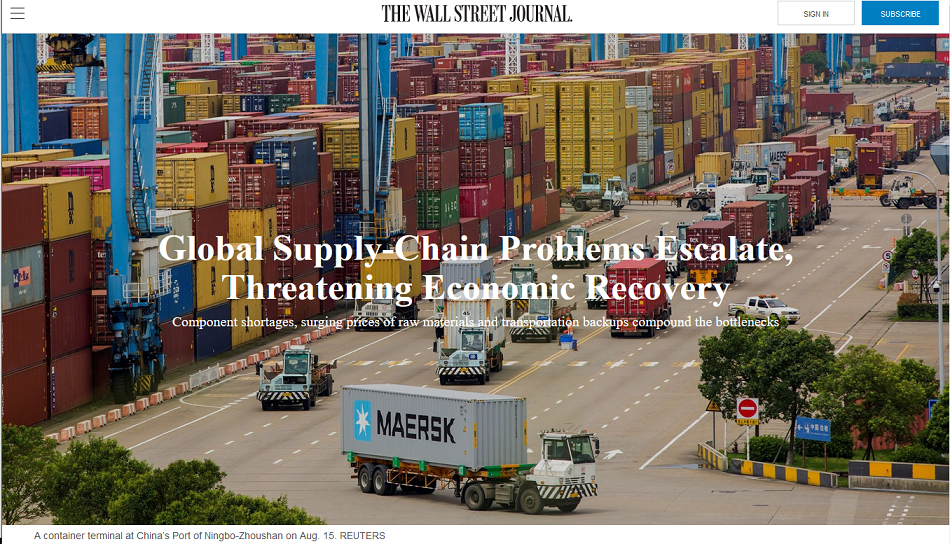
Un esempio ve lo forniamo qui sotto, dove leggete un titolo di un articolo pubblicato la settimana scorsa dal quotidiano Wall Street Journal, che parla di “ripresa economica messa in pericolo dai problemi nella catena di produzione globale”.

Il fatto notevole, per noi investitori, è che si possa legittimamente affermate che “la ripresa economica viene messa in pericolo” a pochi mesi di distanza dai titoli sul “boom economico”, che anche il quotidiano in questione, come ogni altro quotidiano, aveva ripetutamente utilizzato fino a poche settimane fa.

A voi, amici lettori ed amici investitori, risulta credibile il fatto che nssuno, al mondo, ci avesse pensato in agosto? Luglio? Giugno? Maggio? O anche prima?

Nessuno, con l’eccezione di noi di Recce’d: vi pare credibile?

2021_Jan_1283.png

Cosa è, che non è andato come previsto? Come venivano fatte, le previsioni solo qualche settimana fa? E soprattutto: quali interessi andavano ad alimentare, quelle previsioni di “felicità eterna” che dominavano sui mercati finanziari fino a qualche settimana fa?

Questa, detta in estrema sintesi, è la ragione per la quale ogni investitore dovrebbe chiedersi “che cosa non ha funzionato”. Comprendere le ragioni che ci hanno portato a questa situazione è essenziale, se vi interessa (e dovrebbe interessarvi) di comprendere come la situazione potrà evolversi, da oggi in poi.

Il suggerimento di Recce’d è il seguente: andate a cercarvi l’articolo del Wall Street Journal, che vedete citato nell’immagine più in alto, e che qui noi no riportiamo per ragioni di spazio in questo Post.

Leggete con attenzione quell’articolo, e poi leggete subito dopo l’articolo che segue, che noi abbiamo trovato nel settimanale The Economist. Il settimana ha scelto di etichettare lo stato attuale dell’economia come “shortage economy”, l’economia del razionamento. sarà proprio questo, il futuro che ci attende?

La lettura combinata dei due articoli vi sarà utile per comprendere in che modo la situazione delle economia si modificherà e si evolverà nei prossimi mesi.

Una volta completata questa lettura, avrete le idee molto più chiare: noi di Recce’d più in basso riprendiamo l’analisi delle implicazioni di questa “shortage economy” per gli investimenti e per la gestione del portafoglio titoli.

For a decade after the financial crisis the world economy’s problem was a lack of spending. Worried households paid down their debts, governments imposed austerity and wary firms held back investment, especially in physical capacity, while hiring from a seemingly infinite pool of workers. Now spending has come roaring back, as governments have stimulated the economy and consumers let rip. The surge in demand is so powerful that supply is struggling to keep up. Lorry drivers are getting signing bonuses, an armada of container ships is anchored off California waiting for ports to clear and energy prices are spiralling upwards. As rising inflation spooks investors, the gluts of the 2010s have given way to a shortage economy.

The immediate cause is covid-19. Some $10.4trn of global stimulus has unleashed a furious but lopsided rebound in which consumers are spending more on goods than normal, stretching global supply chains that have been starved of investment. Demand for electronic goods has boomed during the pandemic but a shortage of the microchips inside them has struck industrial production in some exporting economies, such as Taiwan. The spread of the Delta variant has shut down clothing factories in parts of Asia. In the rich world migration is down, stimulus has filled bank accounts and not enough workers fancy shifting from out-of-favour jobs like selling sandwiches in cities to in-demand ones such as warehousing. From Brooklyn to Brisbane, employers are in a mad scramble for extra hands.

Yet the shortage economy is also the product of two deeper forces. First, decarbonisation. The switch from coal to renewable energy has left Europe, and especially Britain, vulnerable to a natural-gas supply panic that at one point this week had sent spot prices up by over 60%. A rising carbon price in the European Union’s emissions-trading scheme has made it hard to switch to other dirty forms of energy. Swathes of China have faced power cuts as some of its provinces scramble to meet strict environmental targets. High prices for shipping and tech components are now triggering increased capital expenditure to expand capacity. But when the world is trying to wean itself off dirty forms of energy, the incentive to make long-lived investments in the fossil-fuel industry is weak.

The second force is protectionism. As our special report explains, trade policy is no longer written with economic efficiency in mind, but in the pursuit of an array of goals, from imposing labour and environmental standards abroad to punishing geopolitical opponents.

This week Joe Biden’s administration confirmed that it would keep Donald Trump’s tariffs on China, which average 19%, promising only that firms could apply for exemptions (good luck battling the federal bureaucracy). Around the world, economic nationalism is contributing to the shortage economy. Britain’s lack of lorry drivers has been exacerbated by Brexit. India has a coal shortage in part because of a misguided attempt to cut imports of fuel. After years of trade tensions, the flow of cross-border investment by companies has fallen by more than half relative to world gdp since 2015.

All this might seem eerily reminiscent of the 1970s, when many places faced petrol-pump queues, double-digit price rises and sluggish growth. But the comparison gets you only so far. Half a century ago politicians got economic policy badly wrong, fighting inflation with futile measures like price controls and Gerald Ford’s “whip inflation now” campaign, which urged people to grow their own vegetables. Today the Federal Reserve is debating how to forecast inflation, but there is a consensus that central banks have the power and the duty to keep it in check.

For now, out-of-control inflation seems unlikely. Energy prices should ease after the winter. In the next year the spread of vaccines and new treatments for covid-19 should reduce disruptions. Consumers may spend more on services. Fiscal stimulus will wind down in 2022: Mr Biden is struggling to get his jumbo spending bills through Congress and Britain plans to raise taxes. The risk of a housing bust in China means that demand could even fall, restoring the sluggish conditions of the 2010s. And an investment boost in some industries will eventually translate into more capacity and higher productivity.

But make no mistake, the deeper forces behind the shortage economy are not going away and politicians could easily end up with dangerously wrong-headed policies. One day, technologies such as hydrogen should help make green power more reliable. But that will not plug shortages right now. As fuel and electricity costs rise, there could be a backlash. If governments do not ensure that there are adequate green alternatives to fossil fuels, they may have to meet shortages by relaxing emissions targets and lurching back to dirtier sources of energy. Governments will therefore have to plan carefully to cope with the higher energy costs and slower growth that will result from eliminating emissions. Pretending that decarbonisation will result in a miraculous economic boom is bound to lead to disappointment.

The shortage economy could also reinforce the appeal of protectionism and state intervention. Many voters blame empty shelves and energy crises on the government. Politicians can escape responsibility by excoriating fickle foreigners and fragile supply chains, and by talking up the false promise of boosting self-reliance. Britain has already bailed out a fertiliser plant to maintain the supply of carbon dioxide, an input for the food industry. The government is trying to claim that labour shortages are good, because they will raise economy-wide wages and productivity. In reality, putting up barriers to migration and trade will, on average, cause both to fall.

The wrong lessons at the wrong time

Disruptions often lead people to question economic orthodoxies. The trauma of the 1970s led to a welcome rejection of big government and crude Keynesianism. The risk now is that strains in the economy lead to a repudiation of decarbonisation and globalisation, with devastating long-term consequences. That is the real threat posed by the shortage economy. 

Ritorniamo adesso alla domanda che apriva il nostro Post: che cosa è, che non ha funzionato? Semplicemente, non ha funzionato la politica economica adottata in risposta alla pandemia.

Ci sono almeno due millenni di storia, a dimostrare che mettere in circolazione più moneta NON fa stare meglio l’economia e NON rende più ricchi tutti quanti a costo zero.

Non esiste, un modo di rendere più ricchi tutti quanti a costo zero: l’intera storia dell’economia insegna che la ricchezza dei popoli è aumentata grazie alla scoperta di nuove risorse naturali ed all’aumento della produttività.

La quantità di moneta in circolazione non ha mai cambiato, né mai cambierà, la realtà dei fatti.

Lo spiega in modo perfetto la lettura che chiude il nostro Post: in questo articolo si parla, a nostro giudizio correttamente, di “uno shock strutturale e secolare” che ha nulla a che vedere con il ciclo economico e che non sarà risolto da politiche del tipo “regaliamo più soldi a tutti”.

Recce’d aveva scritto, come abbiamo ricordato in più occasioni, già nell’agosto 2020: chi allora decise di seguire le nostre indicazioni oggi può guardare al futuro con serenità, ottimismo e prospettive di guadagno molto sostanziose.

Ma soprattutto ha ben compreso la fondamentale differenza tra i “guadagni di carta” ed i “guadagni che restano” nella gestione del proprio portafoglio di investimenti.

Per tutti gli altri, che tra gennaio e giugno si sono fatti attirare come le falene dalla luce di una candela, adesso è probabilmente troppo tardi.

Perché siamo già oltre: tutto ciò che leggete in questo Post è il presente, ed il passato. Ma un buon investitore deve sapere guardare sempre al futuro. Alla prossima fase, quella che sta per iniziare.

2021_Jan_1263.png

Coming out of the 2008 global financial crisis, it took too many too long to recognize that the economic shock was more structural and secular rather than cyclical. The result was a policy response that, while effective in dealing with the immediate emergency, proved insufficient for longer-term economic well-being.

Covid-19 has amplified the vulnerabilities of the disappointing recovery that followed, particularly when it comes to socioeconomic inequalities, co-opted institutions and distorted financial markets. Meanwhile, what took too long to happen a decade ago — recognition that the world faced a structural deficiency of aggregate demand — is now hindering timely responses to the latest challenges.

While demand is much less of a hindrance today because of the historic levels of fiscal transfers and liquidity injections by central banks, Covid-related factors have upended the supply side. The multifaceted efficiency of a just-in-time global economy has become a source of cascading fragilities and disruptions that haven’t yet sufficiently altered mindsets, let alone produced strong policy reactions. Meanwhile, the risks of continuing with pedal-to-the-metal monetary policy outweigh the benefits.

The need to address the content and mix of policies is urgent, both at the national and multilateral levels. Failure to do so could turn stagflationary winds — that disruptive mix of declining growth and higher inflation— into a much more disruptive phenomenon with economic, financial, institutional, political and social implications.

Among its many teachings, the 2008 crisis exposed the dangers of an economy over-reliant on finance. While in the run-up to the crisis policy makers were captivated by innovations that lowered the barriers to debt and leverage, including securitization and other risk-tranching techniques, an unconstrained and unencumbered financial sector went from funding genuine economic opportunities to fueling rampant speculation, most visibly in housing. Balance sheets ballooned as banks also sold a seemingly infinite range of leverage-heavy products to one another.

When it came to dealing with the inevitable consequences — the simultaneous popping of several financial bubbles — policy makers acted quickly to counter the disruptive spillback to the real economy and to rein in excessive risk-taking among banks. The presumption was that a “timely, targeted and temporary” policy intervention would restore conditions for durable socioeconomic prosperity.

Yet what ailed the global economy went deeper than just excessive and irresponsible finance. The “financialization” of the economy itself had sidelined pro-growth initiatives.

Genuine productivity-enhancing activities, such as infrastructure modernization and agile labor enabling and retooling, became boring and old-fashioned compared with what sophisticated financial engineering seemed to unleash. As such, it did not take long for economies to suffer a new normal of disappointing growth, significant inequalities and endless rounds of exceptional central bank interventions to maintain financial stability, albeit of the artificial variety.

With growth repeatedly falling short of what was expected and needed, the initial over-cyclical mindset of many economists and policy makers transitioned to being laser focused on addressing deficient aggregate demand. Unfortunately, Covid has turned this into a weakness given that supply side issues now dominate.

An early economic lesson of Covid is that its drivers of structural fluidity have transformed the efficiency of a just-in-time global economy from a strength into a notable fragility. Tightly woven cross-border supply chains suddenly fell victim to Covid-related closings in one or more ports. Shipping and container disruptions turned cost-effective value chains into loss-makers. Seeking greater resilience, companies have started to rewire their supply chains, amplifying short-term vulnerabilities. It’s hard to quickly build and bring a new production facility on line. It’s even harder when many try to do the same thing at once.

Labor supply has also become an issue. The greater sensitivity of workers to health risks and lifestyle choices alter the propensity to work. Labor force participation has become less secure, fueling record increases in job vacancies. Labor costs inevitably start increasing across-the-board as companies’ efforts to attract new workers force them to also raise pay to retain those they already have.

While the on-the-ground evidence of supply disruptions is multiplying, the dominant macroeconomic mindset is still overly fixated on insufficient aggregate demand. Several of the recent policy remarks by the Federal Reserve serve, once again, as an example.

This will come as no surprise to behavioral scientists. Cognitive traps (rear-view framing, confirmation bias, blind spots, etc.) can slow the shift of policy makers’ focus to supply disruptions, which have become the main cause of the economic malaise of today and tomorrow. Instead, they reinforce some approaches, particularly in monetary policy, that inadvertently amplify the stagflationary winds that are starting to blow across a growing number of countries.

Cognitive biases are particularly problematic at a time of big changes in the operating environment. This was clear in the aftermath of the 2008 financial crisis with the overly cyclical economic mindset that delayed policy responses to what constituted a structural and secular shock several years in the making. We are seeing it today with one that is evolving too slowly from demand to supply.

The longer it takes for national and multilateral policy mindsets to adjust, the more likely we are to repeat the disappointment of the global financial crisis: Winning the war against the immediate enemy but failing to establish the peace of durable and inclusive socioeconomic prosperity, a platform for addressing dangerous secular challenges such as climate change, and anchoring genuine financial stability

Mercati oggiValter Buffo
Longform’d. Fight the Fed! (parte 3)
 
2021_Jan_1247.png

Un anno fa, in questo Blog, noi di Recce’d abbiamo scritto “Fight The Fed”. Un anno dopo, si leggono messaggi twitter come quello che leggete qui sopra, scritto da un notissimo gestore di portafoglio, dove si afferma che la Federal Reserve per uscire dalla scomodissima situazione nella quale si trova oggi “ha bisogno di una crisi finanziaria”.

Ma soprattutto, ed è la ragione per la quale ci siamo decisi a scrivere questo Post, adesso nell’ottobre 2021 lo dice … persino la stessa Federal Reserve.

Essendo che una crisi finanziaria a moltissimi dei lettori di questo Post (non ai nostri Clienti) farebbe perdere tanti soldi, il tema merita la massima attenzione da parte dei nostri lettori. Molti tra i quali proprio non hanno capito che oggi la Federal Reserve è il principale nemico del loro benessere finanziario.

Molti tra i nostri lettori non lo hanno ancora capito: ed una parte importante di questi non intende proprio capirlo. Non vuole sentire: si sente di avere “diritto alla felicità” e non vuole vedere, assolutamente, la realtà intorno.

A questi lettori sognatori farà bene leggere l’articolo che segue. Perché … adesso anche la Federal Reserve dice “Fight the Fed"!”.

Nell’articolo si racconta che la stessa Federal Reserve, nelle scorse settimane, ha pubblicato un documento che critica le scelte della Federal Reserve post pandemia, e lascia quindi intravedere non soltanto l’esistenza di un conflitto interno alla Fed (che è cosa nota) ma pure un possibile cambio di strategia nella gestione della politica monetaria USA.

Cambio che, se si realizzasse, prenderebbe il mercato del tutto di sorpresa: come già accadde, ma nella direzione opposta, nel gennaio 2019, e quindi poco più di due anni fa.

Vi lasciamo alla lettura per poi procedere più in basso con uno sguardo verso il futuro.

It seemed last week that the Federal Reserve may have avoided a taper tantrum when it signaled that an announcement on the slowing of the rate of bond purchases may come as soon as November, with the buying stopping altogether by the middle of 2022.

The typical market reaction didn’t happen—the yield curve actually flattened at first. Even when that reversed and yields began to jump, stocks were unaffected. That all changed Tuesday, as the technology-heavy Nasdaq Composite tumbled 2.8% on its worst day since March and the S&P 500 declined 2%.

So is this a delayed taper tantrum? It might seem that way, but there’s plenty more going on. Investors are becoming increasingly worried about inflation, particularly in light of surging energy prices, and the prospect of rising interest rates. The Fed now sees the first rate increase next year, while St. Louis Fed President James Bullard said Tuesday there could be two increases in 2022.

There’s also just a lot of uncertainty. Global concerns over the China Evergrande situation may have eased but the crisis has yet to be resolved. There’s the issue of the U.S. debt ceiling, a potential government shutdown, and the question marks over Fed Chair Jerome Powell’s second term were catapulted back into focus Tuesday as Sen. Elizabeth Warren (D., Mass.) said she would oppose Powell’s renomination, calling him a “dangerous man” for making the banking system less safe.

It could also be a dangerous time for investors. The 10-year yield, in the 2013 tantrum, took about seven months to peak.

—Callum Keown

A day after Federal Reserve Chair Jerome Powell said at a press conference that “inflation expectations are terribly important,” Jeremy Rudd, a senior Fed economist who has served at the central bank since 1999, released a new paper.

The title: “Why Do We Think That Inflation Expectations Matter for Inflation? (And Should We?)” His answer to the parenthetical question was a resounding no.

Fed watchers had varying interpretations of Rudd’s paper. Some saw it as validating the new policy framework around inflation, which aims for observed price growth that modestly overshoots 2% for some time rather than making decisions based on potentially erroneous forecasts. Others viewed it as a warning: Counting on surveys that show stable longer-term inflation expectations runs the risk of missing a real-time regime shift in the economy. 

The summary of the paper creates room for reading between the lines. “Economists and economic policymakers believe that households’ and firms’ expectations of future inflation are a key determinant of actual inflation,” it says. “This belief rests on extremely shaky foundations, and a case is made that adhering to it uncritically could easily lead to serious policy errors.”

It’s not until Page 16 that Rudd lays out the practical and policy implications of his argument. Once he does, it’s hard not to read it as expressing doubt about the Fed’s new policy framework and advocating for vigilance and humility about understanding what might be in store for the U.S. economy. The analysis comes at a critical time for the central bank: On Monday, both Boston Fed President Eric Rosengren and Dallas Fed President Robert Kaplan said they would retire within the next two weeks.

This is what Rudd suggests on monitoring for evidence of an inflation regime shift:  

“One development to watch for would be any evidence that a renewed concern with price inflation was starting to affect wage determination — either in statistical form ... or in the form of anecdotes. To the extent possible, we might also try to determine whether quit rates were starting to rise in a manner that was less tied to the state of the labor market and more correlated with consumer price developments, or whether wage increases for new hires were starting to rise appreciably relative to wage increases for workers in continuing employment relationships (the argument being that wages for new hires are more flexible and hence more responsive to economic conditions).”

Yes, the shocks from the Covid-19 pandemic have made parsing economic data trickier than ever. But the Labor Department’s Job Openings and Labor Turnover Survey, or JOLTS, shows that the quits rate remains near a record high at 2.7%. The number of job openings in the U.S. exceeded hires by 4.3 million in July, the most in data going back to 2000. Employees clearly hold the cards — anecdotes abound about businesses scrambling to offer higher wages and one-time bonuses, laying the foundation for the disparity between new employees and existing workers that Rudd highlighted. For now, this is a welcome change, given the power dynamics have favored employers over the past few decades.

Should the quits rate stay elevated for many more months, however, it might raise concern that cost-of-living increases are starting to become front and center in the minds of workers. As my Bloomberg Opinion colleague Noah Smith wrote earlier this month, even though U.S. wages have been rising strongly as of late, on an inflation-adjusted basis, they’re lower than they were in May 2020.

Powell, for his part, said last week that “inflation expectations had drifted down, and it was good to see them get back up a bit.” That was in response to a question about a New York Fed survey, which showed Americans’ median expected inflation rate over the next three years is 4%, the highest ever in data going back to 2013. According to Rudd’s analysis, central bankers’ attempts to influence these kinds of forecasts are a waste of time at best — and dangerous at worst:

It is far more useful to ensure that inflation remains off of people’s radar screens than it would be to attempt to “reanchor” expected inflation at some level that policymakers viewed as being more consistent with their stated inflation goal. In particular, a policy of engineering a rate of price inflation that is high relative to recent experience in order to effect an increase in trend inflation would seem to run the risk of being both dangerous and counterproductive inasmuch as it might increase the probability that people would start to pay more attention to inflation and—if successful—would lead to a period where trend inflation once again began to respond to changes in economic conditions.

Rudd also adds that by assuming inflation expectations are what ultimately drives price growth, “the illusion of control is arguably more likely to cause problems than an actual lack of control.” He warns that “given the huge boon to stabilization policy that results from a stable long-run inflation trend, actions that might jeopardize that stability would appear to face an unusually high cost-benefit hurdle.”

To be clear, the Fed wants to talk a big game on inflation and push expectations higher because policy makers believe that will keep price growth above their 2% target. Rudd argues that:

  1. Inflation expectations are relatively meaningless.

  2. Policy makers should strive to keep inflation off people’s radar.

  3. Engineering above-target inflation risks being dangerous and counterproductive.

“I view Rudd’s policy implications as an indictment of the Fed’s new policy framework,” Tim Duy, a former Bloomberg Opinion contributor who’s now chief U.S. economist at SGH Macro Advisors, wrote in a report. “There is clearly some internal conflict.”

I wrote last week after the Federal Open Market Committee decision that Powell tried to walk back the central bank’s inflation fear, which was evident in the hawkish shift in the “dot plot.” The sort of questions raised by Rudd’s paper only increase the likelihood that policy makers will be leery of inflation that persistently exceeds 2% and that for all the talk about a “substantially more stringent test” to raise interest rates and the steadfast belief that price growth will be transitory, they’ll react similarly to the way they have in the past. 

Bond traders are grappling with what this all means, judging by recent market moves. Eurodollar futures are now pricing in 34 basis points of rate increases in 2022, up from about 25 basis points a week ago. The Treasury yield curve from five to 30 years experienced a rare bout of bear flattening on Monday — it’s just the third time since mid-June that yields on both tenors increased and the curve flattened. That could be seen as investors betting the Fed will raise interest rates in the coming years to avoid inflation that’s too hot.

When Powell revealed the Fed’s shift in strategy in August 2020, his argument went like this: “Inflation that runs below its desired level can lead to an unwelcome fall in long-term inflation expectations, which, in turn, can pull actual inflation even lower, resulting in an adverse cycle of ever-lower inflation and inflation expectations. This dynamic is a problem because expected inflation feeds directly into the general level of interest rates.”

Rudd’s paper calls this whole premise into doubt. The main question investors should be asking: Is inflation high enough to affect Americans’ employment and purchasing decisions? As long as price pressures remain front and center for consumers, the risk remains that Fed officials will be late to notice a structural shift happening right in front of them.

2021_Jan_1238.png

La maggior parte degli investitori nel 2020 ha commesso il medesimo errore. che è quello di pensare che “le cose andranno avanti così per sempre” ed operare sui propri portafogli titoli di conseguenza. Il cambiamento di scenario che è intervenuto fra agosto e settembre 2021 li ha tutti colti di sorpresa, e fino ad oggi molti non si sono mossi solo perché terrorizzati.

Altri cambiamenti stanno arrivando, come spiega benissimo qui sotto William Buiter in un articolo per il Financial Times, e questi ulteriori cambiamenti costringeranno tutti a muoversi, a reagire, a proteggersi e quindi a modificare il proprio portafoglio titoli, come dice proprio in chiusura William Buiter..


The combination of extremely low and relatively stable US government bond yields has confounded many market watchers for quite a while now, also challenging traditional economic analyses. This has made the move up in yields over the past couple of weeks particularly notable, raising interesting questions for markets, policies and therefore the global economy. It is usual to characterise US benchmark government bond yields as the most important market indicator in the world.

Traditionally, they have signalled expectations about growth and inflation in the world’s most powerful economy. They have been the basis for pricing in many other markets around the world. Breaking with a long history, these benchmark measures decoupled in recent years from economic developments and prospects. Their longstanding correlations with other financial assets, including stocks, broke down. And their information content became distorted and less valuable.

Coming out of the 2008 global financial crisis, this was attributed to excess global savings that exerted consistent downward pressures on yields. With time, however, it became clear that the main driver was the ample and predictable purchasing of government bonds by the world’s most powerful central banks under quantitative easing programmes, particularly the US Federal Reserve and the European Central Bank. One should never underestimate the power of central banks intervening in market pricing. The trillions of dollars of bonds purchased by the Fed and ECB have distorted the usual two-sided markets and encouraged many to buy a whole range of assets well beyond what they would normally do on the basis of fundamentals. After all, what is more assuring than a central bank with a fully-functioning printing press willing and able to buy assets at non-commercial levels.

Such purchases legitimatise previous private sector investments and provide assurance that there will be ready buyers of assets for those needing to sell to reposition portfolios. It is a set-up that encourages private sector “front-running” of purchases by central banks at prices that would have traditionally been deemed unattractive.

No wonder that even those convinced of a fundamental mispricing have been hesitant to be on the other side of a bond market dominated by central banks. While these factors remain in play, yields have slowly but consistently been migrating up in the past two weeks from 1.30 per cent for the 10-year bond to 1.50 per cent. With global growth prospects damping somewhat due to the Delta variant of Covid-19, the drivers have been a mix of mounting inflationary pressures and multiplying signs that central banks will struggle to maintain the era of “QE infinity” — that is, endlessly ultra loose financial conditions.

The signs in recent days have included statements from the Bank of England and higher rates in Norway adding to moves in some developing countries. The more rate volatility increases, the greater the risk of yields suddenly “gapping” upwards given that we are starting with a combination of very low yields and extremely one-sided market positioning. The greater the gapping, the bigger the threat to market functioning and financial stability, and the higher risk of stagflation — the combination of rising inflation and low economic growth.

Like a ball deeply submerged in water, a combination of market accident and policy mistake could result in a move up in yields that would be hard for many to handle. Importantly, this does not mean that central banks, and the Fed in particular, should delay what should have already started — that is, embarking on the tapering of what, curiously, is the same level of monthly asset purchases ($120bn) as at the height of the Covid-19 emergency 18 months ago.

On the contrary, the longer the Fed waits, the more markets will question its understanding of ongoing inflationary pressures, and the higher the risk of disorderly market adjustments undermining a recovery that needs to be strong, inclusive and sustainable. For their part, investors should recognise that the enormous beneficial impact on asset prices of prolonged central bank yield repression comes with a consequential possibility of collateral damage and unintended consequences. Indeed, they need only look at how hard it has become to find the type of reliable diversifiers that help underpin the old portfolio mix of return potential and risk mitigation.

Mercati oggiValter Buffo
Un grande futuro dietro le spalle
 
2021_Jan_1287.png

Il titolo che leggete qui sopra è un po’ forte, va riconosciuto: ma lo abbiamo scelto come testimonianza del fatto che il clima, intorno ai cosiddetti titoli Big Tech, sta cambiando.

Come accade per le Banche Centrali, fino a pochi mesi fa giudicate dalla massa degli investitori come Infallibili ed Onnipotenti, anche per i grandi colossi del Big Tech l’epoca del Consenso Unanime è finita.

Come per le Banche Centrali, , anche per i Big Tech si apre una fase nuova, nella quale si perde l’unanime consenso ed aumentano invece in modo rapido le critiche.

Si tratta di critiche ormai diffuse, tanto che vengono raccolte anche dai più potenti mezzi di informazione: a testimonianza di questo fatto, oggi Recce’d sceglie di mettervi a disposizione un articolo del Financial Times della settimana scorsa.

Leggere questo articolo vi sarà utilissimo, proprio per ciò che riguarda la gestione del vostro portafoglio in titoli.

Recce’d vi vuole riportare alla mente due fatti:

  1. non ci sarebbe stato alcun rialzo degli indici di borsa globali, se non ci fosse stato il traino degli indici di Borsa degli Stati Uniti

  2. non ci sarebbe stato alcun rialzo degli indici di Borsa neppure negli Stati Uniti, se non ci fosse stato un rialzo abnorme dei prezzi delle Società Big Tech come Apple, Amazon, Google e Facebook.

Se il titolo scelto dal New York Times, che dice “Facebook è più debole di ciò che pensate”, riflettesse la realtà, e diventasse il pensiero della massa degli investitori al dettaglio, le implicazioni per il futuro del vostro portafoglio titoli dovrebbero esservi evidenti.

Ad esempio, potreste andare a rivedere la storia di Borsa di Philip Morris, come suggerito dalla nostra immagine iniziale.

2021_Jan_1272.png

Published Oct. 4, 2021Updated Oct. 5, 2021, 9:02 a.m. ET

One possible way to read “The Facebook Files,” The Wall Street Journal’s excellent series of reports based on leaked internal Facebook research, is as a story about an unstoppable juggernaut bulldozing society on its way to the bank.

The series has exposed damning evidence that Facebook has a two-tier justice system, that it knew Instagram was worsening body-image issues among girls and that it had a bigger vaccine misinformation problem than it let on, among other issues. And it would be easy enough to come away thinking that Facebook is terrifyingly powerful, and can be brought to heel only with aggressive government intervention.

But there’s another way to read the series, and it’s the interpretation that has reverberated louder inside my brain as each new installment has landed.

Which is: Facebook is in trouble.

Not financial trouble, or legal trouble, or even senators-yelling-at-Mark-Zuckerberg trouble. What I’m talking about is a kind of slow, steady decline that anyone who has ever seen a dying company up close can recognize. It’s a cloud of existential dread that hangs over an organization whose best days are behind it, influencing every managerial priority and product decision and leading to increasingly desperate attempts to find a way out. This kind of decline is not necessarily visible from the outside, but insiders see a hundred small, disquieting signs of it every day — user-hostile growth hacks, frenetic pivots, executive paranoia, the gradual attrition of talented colleagues.

It has become fashionable among Facebook critics to emphasize the company’s size and dominance while bashing its missteps. In a Senate hearing on Thursday, lawmakers grilled Antigone Davis, Facebook’s global head of safety, with questions about the company’s addictive product design and the influence it has over its billions of users. Many of the questions to Ms. Davis were hostile, but as with most Big Tech hearings, there was an odd sort of deference in the air, as if the lawmakers were asking: Hey, Godzilla, would you please stop stomping on Tokyo?

But if these leaked documents proved anything, it is how un-Godzilla-like Facebook feels. The documents, shared with The Journal by Frances Haugen, a former Facebook product manager, reveal a company worried that it is losing power and influence, not gaining it, with its own research showing that many of its products aren’t thriving organically. Instead, it is going to increasingly extreme lengths to improve its toxic image, and to stop users from abandoning its apps in favor of more compelling alternatives.

You can see this vulnerability on display in an installment of The Journal’s series that landed last week. The article, which cited internal Facebook research, revealed that the company has been strategizing about how to market itself to children, referring to preteens as a “valuable but untapped audience.” The article contained plenty of fodder for outrage, including a presentation in which Facebook researchers asked if there was “a way to leverage playdates to drive word of hand/growth among kids?”

It’s a crazy-sounding question, but it’s also revealing. Would a confident, thriving social media app need to “leverage playdates,” or concoct elaborate growth strategies aimed at 10-year-olds? If Facebook is so unstoppable, would it really be promoting itself to tweens as — and please read this in the voice of the Steve Buscemi “How do you do, fellow kids?” meme — a “Life Coach for Adulting?”

The truth is that Facebook’s thirst for young users is less about dominating a new market and more about staving off irrelevance. Facebook use among teenagers in the United States has been declining for years, and is expected to plummet even further soon — internal researchers predicted that daily use would decline 45 percent by 2023. The researchers also revealed that Instagram, whose growth offset declining interest in Facebook’s core app for years, is losing market share to faster-growing rivals like TikTok, and younger users aren’t posting as much content as they used to.

A good way to think about Facebook’s problems is that they come in two primary flavors: problems caused by having too many users, and problems caused by having too few of the kinds of users it wants — culture-creating, trendsetting, advertiser-coveted young Americans.

The Facebook Files contains evidence of both types. One installment, for example, looked at the company’s botched attempts to stop criminal activity and human rights abuses in the developing world — an issue exacerbated by Facebook’s habit of expanding into countries where it has few employees and little local expertise.

But that kind of problem can be fixed, or at least improved, with enough resources and focus. The second type of problem — when tastemakers abandon your platforms en masse — is the one that kills you. And it appears to be the one that Facebook executives are most worried about.

Take the third article in The Journal’s series, which revealed how Facebook’s 2018 decision to change its News Feed algorithm to emphasize “meaningful social interactions” instead generated a spike in outrage and anger.

The algorithm change was portrayed at the time as a noble push for healthier conversations. But internal reports revealed that it was an attempt to reverse a yearslong decline in user engagement. Likes, shares and comments on the platform were falling, as was a metric called “original broadcasts.” Executives tried to reverse the decline by rejiggering the News Feed algorithm to promote content that garnered a lot of comments and reactions, which turned out to mean, roughly, “content that makes people very angry.”

“Protecting our community is more important than maximizing our profits,” said Joe Osborne, a Facebook spokesman. “To say we turn a blind eye to feedback ignores these investments, including the 40,000 people working on safety and security at Facebook and our investment of $13 billion since 2016.”

It’s far too early to declare Facebook dead. The company’s stock price has risen nearly 30 percent in the past year, lifted by strong advertising revenue and a spike in use of some products during the pandemic. Facebook is still growing in countries outside the United States, and could succeed there even if it stumbles domestically. And the company has invested heavily in newer initiatives, like augmented and virtual reality products, that could turn the tide if they’re successful.

But Facebook’s research tells a clear story, and it’s not a happy one. Its younger users are flocking to Snapchat and TikTok, and its older users are posting anti-vaccine memes and arguing about politics. Some Facebook products are actively shrinking, while others are merely making their users angry or self-conscious.

Facebook’s declining relevance with young people shouldn’t necessarily make its critics optimistic. History teaches us that social networks rarely age gracefully, and that tech companies can do a lot of damage on the way down. (I’m thinking of MySpace, which grew increasingly seedy and spam-filled as it became a ghost town, and ended up selling off user data to advertising firms. But you could find similarly ignoble stories from the annals of most failed apps.) Facebook’s next few years could be uglier than its last few, especially if it decides to scale back its internal research and integrity efforts in the wake of the leaks.

None of this is to say that Facebook isn’t powerful, that it shouldn’t be regulated or that its actions don’t deserve scrutiny. It can simultaneously be true that Facebook is in decline and that it is still one of the most influential companies in history, with the ability to shape politics and culture all over the globe.

But we shouldn’t mistake defensiveness for healthy paranoia, or confuse a platform’s desperate flailing for a show of strength. Godzilla eventually died, and as the Facebook Files make clear, so will Facebook.

Kevin Roose is a technology columnist and the author of “Futureproof: 9 Rules for Humans in the Age of Automation.” @kevinroose • Facebook

Mercati oggiValter Buffo