

Evergrande e il servo sciocco
2021_Jan_1219.png

Nella Commedia dell’Arte, da sempre c’è un posto per il servo sciocco, c, personaggio ricorrente perché gradito al grande pubblico perché capace di suscitare la risata. Un tipo divertente perché sciocco.

A volte con frasi sciocche, a volte con atteggiamenti goffi, a volte con interventi fuori tempo e fuori luogo, altre volte per affermazioni sconclusionate. Comunque, fa ridere.

Nelle diverse regioni d’Italia, a questo personaggio della Commedia dell’Arte sono stati dati nomi diversi, tra i quali Arlecchino a Bergamo e Zanni soprattutto Roma

La Finanza globale è, da molti anni, scivolata nella Commedia: si vedono e si sentono cose sconclusionate, prive di senso, prive di agganci con la realtà. Noi di Recce’d le abbiamo messe alla vostra attenzione più e più volte, utilizzando anche questo Blog che state leggendo.

Nella commedia della Finanza globale del Nuovo Millennio, il ruolo dello servo sciocco se lo sono attribuite, da sole, le banche globali di investimento.

Istituzioni cresciute con una velocità che ha pochi termini di paragone dagli Anni Ottanta agli Anni Duemila, sono tutte di fatto fallite con la crisi dei subprime tra il 2006 ed il 2008. Con i soldi del pubblico (e quindi, anche con i vostri soldi: che li abbia stampati la Banca Centrale fa nessuna differenza) queste Istituzioni hanno continuato a vivere, o meglio a sopravvivere, a patto di diventare una cinghia di trasmissione dei desiderata del potere politico dominante.

Accade così che Istituzioni un tempo prestigiose, proprio perché capaci di IMPORRE un criterio critico nella valutazione degli asset finanziari si sono trasformate in servi sciocchi del disegno politico in quel momento prevalente.

Noi di Recce’d abbiamo regalato, attraverso questo Blog, una serie di documentate analisi che sostengono questa lettura dei fatti: episodi del passato nei quali le banche globali di investimento hanno supportato, fino all’ultimissimo momento, scelte azzardate, emittenti fragili o peggio dannosi, e Governi alla deriva che compiono scelte ai danni del pubblico degli investitori.

Oggi, il solo imperativo al quale queste banche globali di investimento rispondono è: vendere qualsiasi cosa ai risparmiatori, vendere comunque e dovunque, piazzare nei portafogli degli investitori anche la spazzatura, e sempre a prezzi elevatissimi.

In questo Post Recce’d vi regala un esempio ulteriore.

Noi in Recce’d non abbiamo la minima idea, di come andrà a finire la vicenda Evergrande. Ci pare però sia una vicenda di grande dimensione , di grande complessità, e poco decifrabile proprio perché si svolge in Cina.

La vicenda viene seguita per i Clienti ogni mattina attraverso il The Morning Brief: a noi sembra utilissimo effettuare un monitoraggio quotidiano, anziché tentare di arrivare a conclusioni (campate per aria) in anticipo su tutti, e prima che si conoscano le mosse dei giocatori che oggi stanno intorno al tavolo.

C’è al contrario che, ogni mattina, si presenta al Mondo raccontando che “lui lo sa già, come andrà a finire”.

A noi sembra notevolissimo il fatto che non solo tutte le banche globali di investimento la vedono esattamente allo stesso modo, ma pure che il modo in cui tutte leggono questa vicenda porti tutte le banche del mondo alla medesima conclusione (almeno, in pubblico): “il Governo cinese ha il pieno controllo, non c’è alcun rischio che la cosa degeneri, e tutti gli investitori devono soltanto stare tranquilli ed attendere che le cose vadano a posto”.

Tutte queste banche sanno, con anticipo, quali saranno le decisioni della Banca Centrale di Cina, e del Presidente Xi.

Un esempio, concreto, di ciò che significa l’espressione “cervelli mandati all’ammasso”.

Ovvio ed evidente che le grandi banche globali, le Goldman Sachs, le Morgan Stanley, le UBS e le BNP Paribas e le JP Morgan (soltanto per citarne alcune) ma pure i gestori di Fondi Comuni come Blackrock e Fidelity, fanno tutti affari con il Governo cinese, e fino a ieri facevano grandi guadagni proprio piazzando il debito di Evergrande.

Per documentare quello che abbiamo scritto fino a qui in questo Post, vi invitiamo a leggere questa sintesi delle opinioni espresse dalle grandi banche di investimento su Evergrande la settimana scorsa. La sintesi è stata pubblicata sul sito di Bloomberg. Fatevi la vostra opinione in merito.

Wall Street analysts are putting their faith in the Chinese Communist Party.

After a harrowing Monday that saw risky assets tumble globally on fears of a collapse in China Evergrande Group, some of the world’s biggest banks and money managers raced to assure investors that this is no Lehman moment.

The message from firms including Citigroup Inc., Fidelity International Ltd. and AllianceBernstein Holding LP: Evergrande may indeed default, but Chinese authorities will take steps to prevent the property giant’s crisis from destabilizing the financial system and the economy.

Here’s a sampling of what strategists and money managers are saying about the prospect of contagion:

Ajay Rajadhyaksha, Barclays

So, is this China’s Lehman moment? Not even close, in our opinion.

Yes, Evergrande is a large property firm. And yes, there could (probably will) be spill-over effects on China’s property sector, with economic implications. And yes, it comes at a time when China’s growth has already started to disappoint. But a true ‘Lehman moment’ is a crisis of a very different magnitude. One would need to see a lenders’ strike across large parts of the financial system, a sharp increase in credit distress away from the real-estate sector, and banks being unwilling to face each other in the interbank funding market. And with all that, we would also need to see massive policy mistakes on the part of Chinese authorities. In our view, the conditions are simply not in place for even a large default to be China’s Lehman moment.

Judy Zhang, Citigroup

We do not see the Evergrande crisis as China’s Lehman moment given policy makers will likely uphold the bottom line of preventing systematic risk to buy time for resolving the debt risk, and push forward marginal easing for the overall credit environment.

We believe regulators may buy time to digest Evergrande’s NPL problem (e.g., guiding banks not to withdraw credit and extend interest payment deadline).

Kenneth Akintewe, Aberdeen Standard Invest Asia 

Our base case is that there will be a relatively orderly restructuring, it’s not in the interest of policy makers, economy or the market to go into a destabilized uncontrollable spillover, and have this impacting other parts of the economy.

Near term there will be uncertainty and volatility, but outside of Evergrande, policy makers will be able to engineer some sort of recovery from this.

Bhanu Baweja, UBS

I don’t think this is a Lehman moment. I think when you try to reduce moral hazard after four major credit cycles, it is going to be messy. The biggest risk out here is not what happens to suppliers or what happens to the financial system in the near term, I don’t think that’s an issue. I think China has managed that reasonably well. Default levels are pretty low in the overall economy and the capital adequacy for banks, particularly the large banks, is quite high.

I think the most important issue is what this does to the collateral of the entire credit boom -- which is property prices -- and therefore confidence in property itself. 

Catherine Yeung, Fidelity International

If we look at the past three years, we have seen restructuring that the government or regulators have been involved in, whether it’s Huarong, China Fortune Land, and other single credit events. So they have the confidence in terms of this potential restructuring. 

The likely scenario is that they will avoid bankruptcy when it comes to Evergrande [and] seek restructuring with strategic investors or bridge investors. The priority from a domestic perspective and a sentiment perspective is projection completion and supply chain cash settlements.

Vishwanath Tirupattur, Morgan Stanley

The expectations of a broad contagion may be overdone. Clearly the impact on growth is there. But I think the key point here is I continue to believe this is not a moment like what we had in 2008. There has certainly been a subtle change of signal from the policy makers in China. A lot of that we think is already reflected in price.

Marko Kolanovic, JPMorgan Chase

[The market sell-off] is primarily driven by technical selling flows (CTAs and option hedgers) in an environment of poor liquidity, and overreaction of discretionary traders to perceived risks. Our fundamental thesis remains unchanged, and we see the sell-off as an opportunity to buy the dip.

Risks are well-flagged and priced in, with stock multiples back at post-pandemic lows for many reopening/recovery exposures. We look for cyclicals to resume leadership as delta inflects.

Shujin Chen, Jefferies

Against the market view, we see regulators keeping a close eye on Evergrande and think it could soon put forward a plan or meaningful progress to reduce the impact.

We expect a plan to resolve the issues, or help make meaningful progress to be out by the end of the year (also possible within 1-2 months) as China will focus on boosting 1Q22 economic growth starting from 4Q21.

Larry Hu, Macquarie

A major concern is the contagion risk for other high-leveraged developers, as banks, suppliers and homebuyers would all turn more cautious in view of the Evergrande saga. As the result, a self-fulfilled liquidity crunch could happen to other high-leveraged developers. That said, the government has the will and capability to intervene, if the market goes panic. 

It could break the negative feedback loop by easing liquidity, as what it did during the interbank credit crunch in 2013. Moreover, given property policy is unprecedentedly tight at this moment, policy makers have plenty of room to loosen if they want. It seems that they are willing to wait a bit longer to reduce the moral hazard in the future, but they could step in anytime for the sake of financial and social stability.

John Lin, AllianceBernstein

There is very little likelihood of default spilling over into a systematic crisis. First, Chinese regulators are the ones triggering the most recent fall of Evergrande.  The regulators have prepared for it, and they will be able to manage through it.

Because there is low likelihood of a systematic crisis, many of the Chinese developers – particularly the higher quality companies with strong balance sheet, capable management and good product reputation – will survive this round of correction.  In the market panic over the last two weeks, their valuations have already overshot on the down side.  In our opinion, these select quality developers present compelling return opportunities for long-term minded investors.

Tommy Wu, Oxford Economics

Concerns over the rising default risk of Evergrande, the property developer, have roiled financial markets over the last week. While we think the government doesn’t want to be seen as engineering a bail out, we expect it to step in to conduct a managed restructuring of the firm’s debt to prevent disorderly debt recovery efforts, reduce systemic risk, and contain economic disruption.

— With assistance by Abhishek Vishnoi, Chloe Lo, Sofia Horta e Costa, Jan Dahinten, Ishika Mookerjee, and Low De Wei

Mercati oggiValter Buffo
La stagflazione 2021-2022
 

Il lavoro di Recce’d è essenzialmente questo: anticipare per conto del Cliente ciò che nella realtà sta per accadere, a distanza di qualche mese o magari di un anno, e modificare il portafoglio in titoli nel modo più redditizio, più profittevole e più performante. Il vostro portafoglio deve essere preparato ed organizzato PRIMA degli eventi. Dopo, non servirà più a nulla.

Recce’d agisce in modo tale da mettere il proprio Cliente almeno un passo avanti agli altri investitori, consulenti, private banker, banche globali di investimento, wealth manager e robot advisor.

2021_Jan_1183.png

Per questa ragione i nostri Clienti ci riconoscono le commissioni di gestione.

Recce’d scrisse quindi mesi fa di stagflazione, in sede pubblica (ad esempio qui in questo Blog, e poi anche su Soldionline.it ed in altre sedi pubbliche), ma soprattutto ai propri Clienti

Poi nella pratica abbiamo fatto del tema stagflazione il tema centrale della nostra gestione del portafoglio: così che oggi, 25 settembre 2021, i nostri portafogli sono perfettamente posizionati per ciò che adesso tutti leggono sul proprio quotidiano o settimanale .

Perché oggi, nel settembre 2021, chi ha un minimo, ma proprio un minimo, di conoscenza delle economie e dei mercati finanziari, e chi ha un minimo, ma proprio un minimo, di competenza e decenza professionale, oggi parla di stagflazione.

E questo è precisamente il nostro lavoro quotidiano. Parlarne con un ampio anticipo con i nostri Clienti.

2021_Jan_1207.png

Considerato il fatto che oggi, nel settembre 2021, quel tema che noi abbiamo messo alla vostra attenzione nell’estate del 2020 è diventato il tema al centro di ogni dibattito e discussione sui mercati finanziari, noi preferiamo non ripetere i nostri (forti e solidi) argomenti già pubblicati qui nel Blog ed offrire al lettore qualche squarcio su quello che si dice appunto dui mercati in questi giorni.

Pochi commentatori oggi dispongono dell’autorevolezza, della credibilità e dell’influenza di Mohamed El Erian, nel mercato internazionale.

Ecco la ragione per la quale noi oggi vi proponiamo in lettura il suo più recente articolo, che (non a caso) è dedicato proprio al tema della stagflazione.

El Erian dice nell’articolo: visto che la stagflazione ormai è arrivata qui ed ora, vediamo quali sono le mosse da fare e le iniziative che andrebbero prese.

El Erian si concentra sulle iniziative, sulle mosse e sulle contromisure da prendere a livello di politica monetaria e di politica fiscale: per ciò che riguarda invece le mosse più opportune in termini di gestione del risparmio e del proprio portafoglio titoli, noi siamo ovviamente disponibilissimi a dialogare coi lettori che ci contatteranno attraverso il sito.

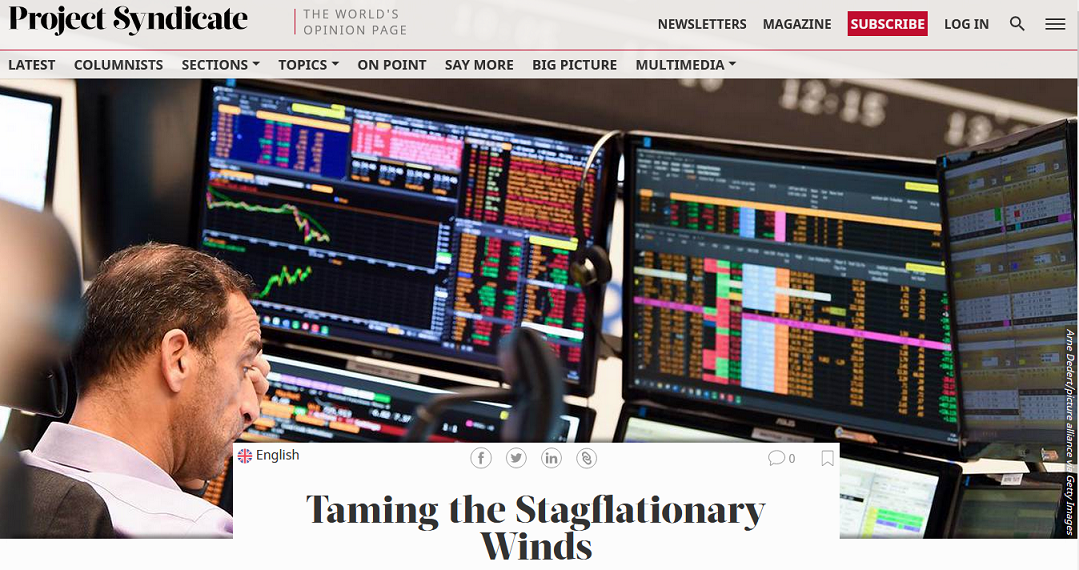
Sep 22, 2021 Mohamed A. El-Erian

Rising inflation and declining growth are more likely to be a part of the global economy’s upcoming journey than features of its destination. But how policymakers navigate this journey will have major implications for longer-term economic well-being, social cohesion, and financial stability.

CAMBRIDGE – A stream of recent data suggests that the global economy is showing signs of stagflation, that odd 1970s-style mixture of rising inflation and declining growth. Those who have noticed it – and there are still too few of them – fall into two broad camps. Some see the phenomenon as temporary, and quickly reversible. Others fear that it will lead to a renewed period of unsatisfactory growth, but this time with unsettlingly high inflation.

But a third scenario, which draws on both of these views, may well be the most plausible. Stagflationary winds are more likely to be a part of the global economy’s upcoming journey than a feature of its destination. But how policymakers navigate this journey will have major implications for longer-term economic well-being, social cohesion, and financial stability.

The much-needed global economic recovery has recently been losing steam as growth in its two major locomotives, China and the United States, has undershot consensus expectations. The more contagious Delta variant of the coronavirus has dampened spending in some sectors, such as leisure and transportation, while hampering production and shipments in others, particularly manufacturing. Labor shortages are becoming more widespread in a growing number of advanced economies. Add to that a shipping-container shortage and the ongoing reordering of supply chains, and it should come as no surprise that the headwinds to a strong and sustainable global recovery are being accompanied by higher and more persistent inflation.

Higher inflation is putting pressure on those central banks that wish to maintain an exceptionally loose monetary policy. At the same time, decelerating economic growth presents a problem for central banks that are more inclined to scale back stimulus measures. All this also risks eroding political support for much-needed fiscal and structural policies to boost productivity and long-term growth potential. Some economists, and the majority of policymakers, believe that current stagflationary trends will soon be muted by a combination of market forces and changes in human behavior. They point to recent declines in previously spiking lumber prices as indicative of how competition and increased supply will dampen inflation. They think the sharp fall in Delta-variant cases in the United Kingdom foreshadows what lies ahead for the US and other countries still in the grips of the latest COVID-19 wave. And they take comfort from multiplying signs of booming corporate investment in response to supply disruptions. Others are more pessimistic. They argue that demand headwinds will intensify due to reductions in fiscal schemes that were supporting household income, citing the expiration of supplementary unemployment benefits and direct cash transfers. They also worry about the gradual exhaustion of the cash buffers that many households unexpectedly accumulated as a result of exceptionally generous government support during the pandemic.

On the supply side, the stagflation pessimists welcome higher business investment but fear that its benefits won’t come fast enough, especially as supply chains are redirected. Supply disruptions will therefore persist for much longer, in their view, and central banks will fall behind with the needed policy response.

I suspect that neither of these scenarios is likely to dominate the period ahead. But they will influence the alternative that does materialize. Ideally, policymakers would respond in a timely and self-reinforcing manner to the increasing evidence of stagflation. The US would lead by progressing faster on a policy pivot, with the Federal Reserve already unwinding some of its ultra-loose monetary policy and Congress enabling President Joe Biden’s administration to advance its plans to enhance US productivity and longer-term growth by boosting investments in physical and human infrastructure.

Meanwhile, national and international financial authorities would coordinate better to strengthen prudential regulation, especially as it pertains to excessive risk-taking among non-bank market participants. These measures would lead to declining inflationary pressures, faster and more inclusive growth, and genuine financial stability. And such a desirable outcome is attainable provided the needed policy response proceeds in a comprehensive and timely manner. Absent such a response, supply-side problems will become more structural in nature, and therefore more prolonged than the transitory camp expects. The resulting inflationary pressures will be amplified by the higher wages that many firms will have to offer to attract the workers they currently lack and retain the ones they have. With central banks lagging in their policy response, inflationary expectations risk being destabilized, directly undermining the low-volatility paradigm that has helped push financial-asset prices ever higher.

Because the Fed would then be forced to hit the policy brakes, higher inflation would be unlikely to persist. Unfortunately, reducing it would come at the cost of lower and less inclusive growth, especially if the Biden administration’s plans remain stuck in Congress (which would be more likely in the high-inflation scenario). Rather than prolonged stagflation, the global economy would repeat what it experienced in the aftermath of the 2008 global financial crisis: low growth and low inflation.

The recent appearance of stagflationary tendencies serves as a timely reminder of the urgent need for comprehensive economic-policy measures. The faster such a response materializes, the greater the probability of anchoring economic recovery, social well-being, and financial stability. But if policymakers delay, the global economy will neither be saved by self-correcting forces nor pushed into a prolonged stagflationary trap. Instead, the world will return to the previous “new normal” of economic underperformance, stressed social cohesion, and destabilizing financial volatility.

Mercati oggiValter Buffo
Tra Panglossiano e stagflazione
 

In Recce’d sono poche le occasioni nelle quali la nostra visione dello stato delle cose coincide con quella di Nouriel Roubini, notissimo commentatore di ampia fama anche sui media tradizionali, al quale è stata attribuito il merito di “avere previsto la Grande Crisi Finanziaria 2007-2009”.

2021_Jan_1183.png

Non entreremo nel merito delle capacità di previsione di Nouriel Roubini, ma ripetiamo che negli anni precedenti e successivi alla GCF noi di Recce’d ci siamo spesso trovati in disaccordo con lui, soprattutto per i toni (catastrofisti) utilizzati, ma pure di frequente nel merito delle analisi e delle conclusioni.

Se oggi vi presentiamo un recentissimo articolo di Roubini, pubblicato la settimana scorsa, è perché a nostro giudizio contiene alcuni spunti originali, che sono degni di approfondimento e che possono aiutare i lettori di Recce’d a rendersi conto di quale è, oggi, lo stato delle cose sui mercati finanziari. Che non è lo “scenario Panglossiano” offerto, ancora oggi, dalle Reti dei private bankers, che sono rimasti ancora oggi fermi al “boom economico” che andava di moda fino ad aprile 2021. Allora “vendeva bene” ma oggi “non vende più”.

In particolare, ci sembra utilissima la classificazione offerta da Roubini, che chiama lo scenario nel quale ci troviamo oggi una “moderata stagflazione” e che poi etichetta i quattro possibili (secondo l’autore) scenari futuri come:

  • Boccoli d’oro

  • surriscaldamento

  • piena stagflazione

  • recessione

2021_Jan_1206.png

Che cosa c’è di utile in questa classificazione, per noi investitori? Suggeriamo un processo in tre stadi:

  1. primo stadio: scorrendo le caratteristiche dei quattro scenari, ogni investitore potrà fare un confronto e scegliere quale è lo scenario che giudica più probabile (ad esempio: giudicate sostenibili le previsioni OCSE che leggete nell’immagine? e perché sono così tanto diverse da quelle di inizio 2021?)

  2. sulla base dello scenario che all’investitore risulta più probabile, non sarà difficile stimare il comportamento dei diversi asset finanziari proprio in quello scenario

  3. infine, l’investitore potrà prendere in mano il proprio portafoglio, e calcolare (applicando le previsioni di cui al punto 2) quanto potrà perdere, o guadagnare, nello scenario da lui prescelto, da qui a fine 2021 e poi nel 2022.

Se l’investitore non si sentisse in grado di effettuare queste (semplici) operazioni, potrà quanto meno chiedere al proprio private banker, personal banker, al wealth manager, al promotore finanziario, e anche al robot-advisor: “quale dei quattro scenari ritieni più probabile? e come si sposa questa visione con il portafoglio di Fondi Comuni che mi hai appena venduto, al modico prezzo del 3% l’anno fatto di commissioni che io pago senza che mi vengano esplicitate?

In alternativa, può contattare Recce’d e risolvere ogni problema oggi esistente nel suo portafoglio titoli, e per sempre.

Given today’s high debt ratios, supply-side risks, and ultra-loose monetary and fiscal policies, the rosy scenario that is currently priced into financial markets may turn out to be a pipe dream. Over the medium term, a variety of persistent negative supply shocks could turn today’s mild stagflation into a severe case.

How will the global economy and markets evolve over the next year? There are four scenarios that could follow the “mild stagflation” of the last few months.

The recovery in the first half of 2021 has given way recently to sharply slower growth and a surge of inflation well above the 2% target of central banks, owing to the effects of the Delta variant, supply bottlenecks in both goods and labor markets, and shortages of some commodities, intermediate inputs, final goods, and labor. Bond yields have fallen in the last few months and the recent equity-market correction has been modest so far, perhaps reflecting hopes that the mild stagflation will prove temporary.

The four scenarios depend on whether growth accelerates or decelerates, and on whether inflation remains persistently higher or slows down.

Wall Street analysts and most policymakers anticipate a “Goldilocks” scenario of stronger growth alongside moderating inflation in line with central banks’ 2% target. According to this view, the recent stagflationary episode is driven largely by the impact of the Delta variant. Once it fades, so, too, will the supply bottlenecks, provided that new virulent variants do not emerge. Then growth would accelerate while inflation would fall.

For markets, this would represent a resumption of the “reflation trade” outlook from earlier this year, when it was hoped that stronger growth would support stronger earnings and even higher stock prices. In this rosy scenario, inflation would subside, keeping inflation expectations anchored around 2%, bond yields would gradually rise alongside real interest rates, and central banks would be in a position to taper quantitative easing without rocking stock or bond markets. In equities, there would be a rotation from US to foreign markets (Europe, Japan, and emerging markets) and from growth, technology, and defensive stocks to cyclical and value stocks.

The second scenario involves “overheating.” Here, growth would accelerate as the supply bottlenecks are cleared, but inflation would remain stubbornly higher, because its causes would turn out not to be temporary. With unspent savings and pent-up demand already high, the continuation of ultra-loose monetary and fiscal policies would boost aggregate demand even further. The resulting growth would be associated with persistent above-target inflation, disproving central banks’ belief that price increases are merely temporary.

The market response to such overheating would then depend on how central banks react. If policymakers remain behind the curve, stock markets may continue to rise for a while as real bond yields remain low. But the ensuing increase in inflation expectations would eventually boost nominal and even real bond yields as inflation risk premia would rise, forcing a correction in equities. Alternatively, if central banks become hawkish and start fighting inflation, real rates would rise, sending bond yields higher and, again, forcing a bigger correction in equities.

A third scenario is ongoing stagflation, with high inflation and much slower growth over the medium term. In this case, inflation would continue to be fed by loose monetary, credit, and fiscal policies. Central banks, caught in a debt trap by high public and private debt ratios, would struggle to normalize rates without triggering a financial-market crash.

Moreover, a host of medium-term persistent negative supply shocks could curtail growth over time and drive up production costs, adding to the inflationary pressure. As I have noted previously, such shocks could stem from de-globalization and rising protectionism, the balkanization of global supply chains, demographic aging in developing and emerging economies, migration restrictions, the Sino-American “decoupling,” the effects of climate change on commodity prices, pandemics, cyberwarfare, and the backlash against income and wealth inequality.

In this scenario, nominal bond yields would rise much higher as inflation expectations become de-anchored. And real yields, too, would be higher (even if central banks remain behind the curve), because rapid and volatile price growth would boost the risk premia on longer-term bonds. Under these conditions, stock markets would be poised for a sharp correction, potentially into bear-market territory (reflecting at least a 20% drop from their last high).

The last scenario would feature a growth slowdown. Weakening aggregate demand would turn out to be not just a transitory scare but a harbinger of the new normal, particularly if monetary and fiscal stimulus is withdrawn too soon. In this case, lower aggregate demand and slower growth would lead to lower inflation, stocks would correct to reflect the weaker growth outlook, and bond yields would fall further (because real yields and inflation expectations would be lower).

Which of these four scenarios is most likely?

While most market analysts and policymakers have been pushing the Goldilocks scenario, my fear is that the overheating scenario is more salient. Given today’s loose monetary, fiscal, and credit policies, the fading of the Delta variant and its associated supply bottlenecks will overheat growth and will leave central banks stuck between a rock and a hard place. Faced with a debt trap and persistently above-target inflation, they will almost certainly wimp out and lag behind the curve, even as fiscal policies remain too loose.

But over the medium term, as a variety of persistent negative supply shocks hit the global economy, we may end up with far worse than mild stagflation or overheating: a full stagflation with much lower growth and higher inflation. The temptation to reduce the real value of large nominal fixed-rate debt ratios would lead central banks to accommodate inflation, rather than fight it and risk an economic and market crash.

But today’s debt ratios (both private and public) are substantially higher than they were in the stagflationary 1970s. Public and private agents with too much debt and much lower income will face insolvency once inflation risk premia push real interest rates higher, setting the stage for the stagflationary debt crises that I have warned about.

The Panglossian scenario that is currently priced into financial markets may eventually turn out to be a pipe dream. Rather than fixating on Goldilocks, economic observers should remember Cassandra, whose warnings were ignored until it was too late.

Mercati oggiValter Buffo
L'angolo del divertimento: una barzellettina veloce veloce
 

Del Salone del Risparmio, lo riconosciamo, noi di Recce’d non abbiamo mai capito il senso.

In generale, un Salone è un’occasione per esporre le proprie merci al pubblico, ed in particolare al pubblico dei grossisti che poi si rivolgono al cliente finale. Il Salone, in generale, serve al compratore per fare al meglio le proprie scelte, il proprio interesse.

Ma è chiaro come l’acqua che nel settore del risparmio non esistono prodotti da smerciare: non esistono prodotti con caratteristiche proprie, soltanto contenitori di cartone dentro ai quali, alla fine, ci ritrovate sempre la stessa roba, magari mischiata in un modo un po’ diverso.

Ecco quindi il caso di un Salone, il Salone del Risparmio, che serve solo ai venditori, e per nulla ai compratori, ovvero i risparmiatori, come noi.

I contenitori nel settore del risparmio servono per ingannare e per guadagnare. L’inganno sta nel fatto che si fa credere all’investitore individuale che dentro la scatola di cartone ci sia qualche cosa di diverso da ciò che si ritrova in tutte le altre scatole di cartone.

Il guadagno (e questo va ancora una volta sottolineato) è tutto per il distributore: l’industria del risparmio, nella sua versione attuale (abominevole) riconosce a chi piazza la merce quasi per intero il guadagno che viene dagli addebiti al Cliente.

Il produttore (la Società di gestione del Fondi Comuni) non percepisce più nulla o quasi, e questo dimostra in modo non equivocabile che il produttore in questo caso non produce nulla, solo confezioni, involucri, pacchi e pacchettini, senza metterci dentro nulla che l’investitore non potrebbe trovare da solo senza sforzo, e soprattutto senza costi.

Ad esempio, parlando con Recce’d.

Detto della totale inutilità del Salone del Risparmio, noi di Recce’d abbiamo però colto uno spunto, che potrebbe risultare utile per chi legge il nostro Blog.

2021_Jan_1194.png

Come leggete qui sopra, il più importante quotidiano nazionale ha colto l’occasione del Salone del Risparmio per pubblicare le Tavole della Legge: ovvero l’elenco dei cinque consigli più utili di ogni tempo per il risparmiatore, che consentono al risparmiatore di mettere a frutto “l’arte di investire e fare fruttare il risparmio”.

Fantastico.

E quindi, leggiamoli e … il gioco è fatto.

Li ripetiamo qui per voi:

  1. Rendimenti troppo alti? Il pericolo è in agguato

  2. Un secondo grave sbaglio: mettere tutto in un unico paniere

  3. Calcolare male i tempi: e se i soldi investiti mi servissero prima del previsto?

  4. Non sapere quanto si è disposti a perdere

  5. Ignorare la possibilità di eventi negativi straordinari: la metafora del cigno nero

Lo sforzo fatto dal Corriere della Sera è apprezzabile, e lo spirito è condivisibile. la semplificazione è necessaria, giornalisticamente parlando, ma Recce’d su numerosi temi che vengono qui accennati ha scritto in modo più esteso e (almeno a nostro giudizio) appropriato.

Beh, che dire? Tutto a posto.

Oppure … oppure si potrebbe osservare che questi “criteri di investimento” non sono molto apprezzati, oggi, dai “piccoli investitori”. Si potrebbe forse notare che (come gli stessi quotidiani, anche in Italia, hanno scritto in varie occasioni) l’attività dei piccoli investitori è andata esattamente nella direzione opposta.

Poi, volendo, ci si potrebbe domandare perché, di fronte ad evidenze clamorose di atteggiamenti sconsiderati e privi di raziocinio non ci sia stata una sola voce capace non diciamo di esprimere una critica, ma quanto meno di farsi delle domande.

Volendo, si poteva chiedersi perché visto e considerato che i piccoli investitori non agiscono nel modo che qui è suggerito, non ci sia stato un solo intervento concreto per orientare gli investitori nella direzione qui indicata.

Perché nessuna delle Autorità competenti ha ritenuto quanto meno di valutare il rischio per l’intero sistema di atteggiamenti opposti a quelli qui indicati.

Si potrebbe persino arrivare a farsi domande scomode, del tipo: se gli investitori si comportando nel modo opposto a quello da noi indicati, non sarà che, forse, magari, vengono spinti a fare in quel modo dalle scelte delle Banche Centrali?

Il Corriere della Sera non ha ritenuto di farlo, in questa sede, oppure al Salone del Risparmio. E tutti, ma proprio tutti, gli altri ci hanno spiegato che ciò che vediamo sembra folle, ma è assolutamente normale e tranquillo e accettabile e non mette in pericolo la nostra futura stabilità finanziaria.

E quindi, tutto a posto.

E ci aspettiamo, da domani, sul Corriere della Sera, di rivedere articoli come quello che trovate qui sotto., datato 23 agosto 2021, giusto pochi giorni prima del Salone del Risparmio.

Naturalmente è un articolo “di servizio”, vi spiegheranno gli amici del Corriere: che non ritengono utile, però, scrivere articoli “di servizio” sulle centinaia di altri temi che i mercati finanziari ogni giorno offrono.

2021_Jan_1199.png
Mercati oggiValter Buffo
E' sufficiente un po' di semplice aritmetica
 

Già quindici mesi fa, nell’agosto del 2020, scrivemmo che per tutti noi investitori (alcuni consapevoli, e la grande maggioranza inconsapevoli) oggi il principale nemico sono le Banche Centrali.

Noi scrivemmo, quindici mesi fa in questo Blog: “Fight the Fed”, combatti la Federal Reserve.

Oggi, quel nostro atteggiamento è largamente condiviso, almeno tra chi è consapevole di ciò che sta facendo e raccontando in giro.

Come vedete nell’immagine qui vicino, gli stessi Banchieri centrali, o almeno ex-banchieri centrali, si rendono conto degli enormi rischi che l’azione della Banche Centrali ha accollato a tutti noi investitori finali.

Ci siamo impegnati, pubblicamente, a non scrivere più di Banche centrali per qualche tempo: questo perché l’azione delle Banche Centrali oggi è del tutto irrilevante, per noi investitori, per i nostri portafogli in titoli, e per i rischi e rendimenti degli asset finanziari. Le Banche Centrali non hanno più spazi di manovra e possibilità di decisione: sono costrette a fare la sola cosa che possono fare.

2021_Jan_1195.png

Ribadito tutto questo, oggi siamo qui a presentarvi un recente articolo di John B. Taylor, che qualcuno di voi ricorderà come teorico della “Taylor Rule” di cui si discute con sempre maggiore frequenza dentro e fuori i mercati finanziari internazionali.

La ragione per la quale vi sottoponiamo questo articolo è presto spiegata: in poche righe Taylor spiega le ragioni per le quali oggi tutte le Banche Centrali si trovano in un vicolo cieco. Il tema è di particolare attualità, in vista della riunione di settimana prossima della Federal Reserve, che nelle ultime sedute ha generato grande nervosismo sui mercati finanziari, come potete vedere anche dal cambio tra dollaro USA ed euro del venerdì 17 settembre 2021.

Vi chiediamo un pizzico di pazienza, per leggere la lingua inglese. E poi vi chiediamo un poco (ma molto poco) di calcolo aritmetico, per fare solo somme e sottrazioni. Nessuno meglio di John B. Taylor vi può illustrare la ragione per la quale il costo ufficiale del denaro, negli Stati Uniti, oggi dovrebbe stare al 5% invece che a zero.

E non c’è un modo più semplice, ed efficace, per mettere tutti voi lettori di fronte ai rischi, davvero folli, che tutti state correndo a causa delle politiche della Federal Reserve.

I rischi sono, per dirla in parole povere, quelli che vi porterebbero a perdere molti soldi.

The Fed’s State of Exception

Aug 12, 2021 John B. Taylor

Despite the recent surge of inflation in the United States, the Federal Reserve is keeping the federal funds rate in a range far below what its own monetary-policy rules would prescribe. But since history shows that this deviation cannot last indefinitely, it would be better to normalize sooner rather than later.

STANFORD – Over the past few months, there has been a growing chorus of economic observers voicing concerns about the increase of inflation in the United States. Much of the commentary (including my own) has focused on the US Federal Reserve’s apparent continuation of easy monetary policy in the face of rising prices. Despite a sharp increase in the rate of money growth, the central bank is still engaged in a large-scale asset-purchase program (to the tune of $120 billion per month), and it has kept the federal funds rate in the range of 0.05-0.1%.

That rate is exceptionally low compared to similar periods in recent history. To understand why it is exceptional, one need look no further than the Fed’s own July 9, 2021, Monetary Policy Report, which includes long-studied policy rules that would prescribe a policy rate higher than the current actual rate.

One of these is the “Taylor rule,” which holds that the Fed should set its target federal funds rate according to the gap between actual and targeted inflation. The Taylor rule, expressed as a straightforward equation, has worked well when it has been followed over the years. If you plug in the current inflation rate over the past four quarters (about 4%), the gap between GDP and its potential for the second quarter of 2021 (about -2%), a target inflation rate of 2%, and a so-called equilibrium interest rate of 1%, you get a desired federal funds rate of 5%.

Moreover, the Taylor rule implies that even if the inflation rate falls to 2% by the end of this year (which would be well below most forecasts), and economic output reaches its potential, the federal funds rate still should be 3%. That is a long way from the near-zero level implied by the Fed’s forward guidance.

Since these calculations use the inflation rate averaged over the past four quarters, they are consistent with a form of “average inflation targeting” that the Fed itself endorsed last summer. They also follow the Fed’s own recently suggested equilibrium interest rate of 1%, rather than the 2% rate that has traditionally been used. If the latter had been used, the discrepancy between the policy rate in the rule and the actual level of the funds rate would be even larger.

These higher possible levels for the federal funds rate are largely being ignored in the Fed’s reported discussions. Instead, the Fed insists that today’s higher inflation is a temporary byproduct of the pandemic’s effect on inflation last year. Those who defend its current stance point out that market interest rates on longer-term bonds remain very low. On safe Treasury assets, the five-year yield is only 0.81%, and the ten-year yield is only 1.35% – well below the rates suggested by the Taylor rule when averaged over these maturities. Considering these factors, many commentators are saying not to worry: the markets are probably being rational when they forecast low rates.

The problem with this line of reasoning is that the low longer-term rates are likely being caused by the Fed’s own insistence on keeping low rates as far as the eye can see. As Josephine M. Smith and I show in a 2009 study, there is a “Term Structure of Policy Rules” to consider. Effectively, the policy rule for longer-maturity bonds depends on the policy rule for the much shorter-term federal funds rate, as perceived by people in the market. If the Fed convinces the market that it will stay low, the term structure of interest rates will imply lower longer-term rates.

Today’s situation is similar to that of 2004, when then-Fed Chair Alan Greenspan noticed that ten-year Treasury yields did not seem connected to moves in the federal funds rate. He called this a “conundrum,” because the actual short-term interest rate was not generating as large of an increase in long-term interest rates as one would expect based on previous experience. Monetary-policy tightening was not having as much of an effect on longer-term rates as it had in previous periods of tightening.

During this period, the federal funds rate deviated significantly from what would have been predicted by the Fed’s typical response, much as it is doing today. When the actual federal funds rate deviated significantly from the level suggested by policy rules, the short-term interest-rate response to inflation appeared to be much lower, at least from the perspective of market participants trying to assess Fed policy. And this perception of a smaller response coefficient in the policy rule may have led market participants to expect smaller longer-term interest-rate responses to inflation, and therefore lower long-term interest rates.

Today, it appears that the Fed is deviating from monetary-policy rules. It has beaten its own path for forward guidance, and the market is basing its estimates of future rates on the expectation that this deviation will continue. But history tells us that it cannot continue indefinitely. Eventually, the Fed will have to return to a policy rule, and when it does, the conundrum will disappear. The sooner this occurs, the smoother the recovery will be. There is still time to adjust and get back to a policy rule, but time is running out.

John B. Taylor, a former under-secretary of the US Treasury (2001-05), is Professor of 999Economics at Stanford University and a senior fellow at the Hoover Institution. He is the author of Global Financial Warriors and co-author (with George P. Shultz) of Choose Economic Freedom.

Mercati oggiValter Buffo