Longform'd. Come investire con i matti
 

“Tin foil hat”.

L’espressione è utilizzata dagli anglosassoni, ed in particolare negli Stati Uniti, per definire una particolare categoria di persone con disturbi mentali.

Potremmo definirli, in modo un po’ grezzo, i “matti inoffensivi”.

Il “cappello di carta stagnola” di cui si parla è quello che servirebbe a proteggere il proprio cervello dall’essere influenzato e controllato da onde di sconosciuta natura in arrivo dall’esterno.

In questo post, Recce’d sicuramente si occuperà di “matti”, ovvero persone che soffrono di gravi disturbi mentali. Se poi le persone di cui scriviamo nel Post siano “inoffensive”, beh … questo giudicatelo voi.

Se Recce’d dovesse scegliere una sola immagine, con la quale commentare e riassumere tutto il 2021 dei mercati finanziari, sceglierebbe l’immagine che qui sopra accompagna il titolo di Bloomberg

Il titolo dice che tra gli investitori americani si è diffuso un nuovo stile di investimento. E lo battezza (Bloomberg) come stile paranoico.

Il sottotitolo poi aggiunge: “Nel 2021, profeti della finanza e casse di risonanza su Internet hanno preso il predominio sui mercati delle azioni e delle criptovalute, hanno gonfiato la bolla finanziaria, ed hanno aperto la nuova era dello “identity investing”.

In linea teorica, noi potremmo anche chiudere qui il nostro Post: quale sintesi potrebbe essere più efficace?

E tuttavia, abbiamo deciso di proseguire: la ragione? Presto spiegata: ci è venuto un dubbio.

Abbiamo dubitato, e più di una volta nel 2021, che il malessere mentale che Bloomberg ha messo in prima pagina non sia limitato ai soli Stati Uniti. Sicuramente, negli Stati Uniti è più concentrato e più visibile.

Sicuramente, nessun mercato al Mondo è così gonfio ed inflazionato come quello degli Stati Uniti. Il fenomeno dei “cappelli di stagnola” (tin foil hats) è concentrato negli USA: non ci sono dubbi.

Ma anche qui da noi, in Italia, abbiamo registrato qualche segnale che disturba: atteggiamenti del tipo “non ho ancora guadagnato abbastanza”, “si sarebbe potuto guadagnare di più” e così via.

La confusione tra “investire” e “guadagnare” è grandissima: si investe solo se e quando si è consapevoli di poter perdere denaro, solo se si prende da subito in considerazione il fatto che è necessario gestire delle minusvalenze, e soprattutto quando si è consapevoli che proprio dal fatto che si potrebbe perdere denaro deriva il fatto che dopo, e solo per alcuni, ci sarà una ricompensa, un rendimento, una performance.

Se al contrario si diffondono atteggiamenti che con l’attività di investimento hanno nulla a che fare, e che guardano soltanto il lato del guadagno, allora tutti noi sappiamo di essere in una nuova fase dei “cappelli di stagnola”. Proprio quello dell’immagine più sopra, quel cappello, e quel soggetto che c’è sotto.

Per questo ci siamo detto: questo è stato il tema più importante del 2021, per tutti gli investitori del Mondo, e lo sarà anche nel 2022, ma in modo del tutto diverso dal 2021.

Nel 2022 ci saranno quelle che si definiscono le “inevitabili conseguenze”.

Per questa ragione è utile, ai nostri lettori, approfondire. Vi invitiamo a farlo leggendo il qualificatissimo articolo che segue, e che Recce’d ha scelto per voi.

Il succo di questo bellissimo articolo, però, lo trovate nelle ultime righe: ragione per cui, se proprio avete fretta …

… ma è un peccato, se non leggete quello che viene scritto prima.

Every age has its peculiar folly; some scheme, project, or phantasy into which it plunges, spurred on either by the love of gain, the necessity of excitement, or the mere force of imitation.

Failing in these, it has some madness, to which it is goaded by political or religious causes, or both combined.”

--“Extraordinary Popular Delusions and the Madness of Crowds,” Charles Mackay

“When the going gets weird, the weird turn pro.”

-- “Fear and Loathing in Las Vegas,” Hunter Thompson


The year 2021 will be remembered as one in which markets tumbled down a rabbit hole and entered financial wonderland: A once-elite undertaking became more populist, tribal, anarchic and often downright bizarre.

Retail investors upstaged hedge funds, crypto squared up against fiat currencies and financial flows crushed fundamentals. Farewell stocks, hello “stonks”: Memes matter now.

Here’s a taste of the madness: Entrepreneur and social media puppet master Elon Musk became the world’s wealthiest person. Tesla Inc.’s market capitalization exceeded $1.2 trillion, more than the next nine largest automakers combined.

One of those others, Rivian Automotive Inc., went public in November and only recently started generating revenue. It was soon valued at $150 billion.

Hundreds of special purpose acquisition companies, or SPACs, together raised more than $150 billion to find a company to list on the stock exchange, with their targets often more of a business plan than a business.

SPAC Attack

Cryptocurrencies, the bulk of which have no intrinsic value, were at one point collectively worth more than $3 trillion. A non-fungible token artwork (NFT) — in this case, a JPG file by an artist named Beeple — sold at a Christie’s auction for $69 million.

Struggling video games retailer GameStop Corp. and cinema chain AMC Entertainment Holdings Inc. soared as much as 2,450% and 3,300%, respectively, when Redditors coordinated online to punish hedge funds that were betting on the companies’ demise. 1

And because there’s no gold rush without pickaxes, retail brokerage Robinhood Markets Inc. and crypto exchange Coinbase Global Inc. became two of the year’s biggest initial public offerings: At the peak they were valued at $59 billion and $75 billion. (In December the home of WallStreetBets, Reddit Inc, announced it had filed confidentially for an IPO)

Monthly active users measures how many customers interact with Robinhood services during a given month. It does not measure the frequency or duration of those interactions.

Investors have poured an astonishing $1 trillion of cash into equities funds in the past 12 months, or more than the combined inflows of the past 19 years. At the peak in January, retail investors accounted for almost one quarter of U.S. equities trading, according to Bloomberg Intelligence.

An estimated 16% of U.S. adults have invested in crypto, according to Pew Research Center; among twenty-something men, that proportion is closer to half. In 1929 shoeshine boys gave out stock tips; today’s teenagers ask their parents to open a crypto trading account on their behalf.

Crypto Demographics

The short explanation for all this feverish activity is that thanks to central bank and government stimulus, far too much money is sloshing around in the financial system. The aggregate money supply has increased by $21 trillion since the start of 2020 in the U.S., China, euro zone, Japan and eight other developed economies. “Stocks only go up” isn’t just a wry catchphrase: Essentially it’s been the lived experience of young investors this past decade. And so they ignore nosebleed valuations and buy the dip.

But something’s changed too in the culture of investing. It’s no longer enough to admire a company or asset and buy the stock or token. Some of the biggest investing trends have become an extension of personal identity, akin to your religion or your sports team. Sometimes that connection is overt: From Christmas Day the home of the L.A. Lakers will be renamed the Crypto.com Arena. Footballer Tom Brady has launched his own NFT collection.

These movements can be fun and empowering, but financial super-fandom can quickly become toxic. I worry that the same forces diminishing modern politics — partisan divisions, pervasive distrust, social media echo chambers, misinformation, cancel culture and conspiracy theories — are seeping into the investing world, where they’re warping capital allocation, inflating a series of bubbles and challenging the ability of regulators to protect investors and the markets.  

In some respects, this time really is different. Easy to use, commission-free brokerage apps like Robinhood have given millions of neophytes the tools to play at being a Wall Street trader.

Instead of sticking their money in a boring index fund, young investors are making concentrated bets on single stocks and using cheap short-dated out-of-the money call options (speculating the price of the stock will quickly increase before the option expires). It’s the financial equivalent of buying lottery tickets.

Options Mania

Shows small trader call buys to open minus put buys to open as % of NYSE share volume. Small trades defined as ten contracts or fewer, which is mostly retail order flow.

It can be an effective way to squeeze the underlying shares higher (because option sellers hedge their position by buying the stock). It often attracts momentum-buying from hedge funds and other institutional investors, which magnify the price moves. And options are also a huge money-spinner for digital brokerages. Problem is, inexperienced retail investors may not fully understand the risks, until it’s too late.

“It’s much more like gambling,” says Bloomberg Intelligence market structure analyst Larry Tabb. “The options premiums might seem pretty small but you can easily end up losing your entire investment.”

Speculative assets have evolved, too. In 2000 investors could easily comprehend the business model of a Pets.com, say. There’s now a much higher degree of financial abstraction: Think SPACs, NFTs, Web3, DeFi ( “decentralized finance”) and the metaverse. This abstraction excites intellectual curiosity but the harder something is to explain, the easier it is for promoters to hype it to people lacking a financial or technical background.

Fearing they’ll be accused of stifling innovation or capital formation, regulators have mostly allowed the party to continue. Digital assets typically aren’t registered and regulated as financial securities. Crypto trading often happens on opaque, offshore exchanges. SPACs can publish fantastically optimistic financial projections, which traditional IPOs avoid due to liability risks. It smacks of regulatory arbitrage on a grand scale.

Another important check on speculative excess, the short-sellers who think a stock is overvalued, had a difficult year. That’s not to say they didn’t enjoy some successes — former SPACs have been particular fertile ground for the shorts — but the market’s relentless rise and the danger of being caught up in a GameStop-like squeeze convinced some to give up the game entirely. To cap it all, much to the delight of the Reddit crowd, short-sellers now face a U.S. Justice Department criminal investigation into their activities.

The GameStop saga and similar events also torpedoed a key theoretical foundation of Wall Street — the notion that markets are efficient. Securities prices are supposed to reflect all known information and the discounted value of expected future cash flows. If prices rise more than is justified by financial fundamentals, more sophisticated investors should sell.

Defying Gravity

An emerging theory, the Inelastic Markets Hypothesis, postulates that retail buying is able to warp prices for prolonged periods because so much of the market is now passive, not actively managed, and is therefore insensitive to changes in prices.  

“Demand shocks and inelastic markets are the tissue that connects the meme stocks, Tesla and even crypto” says Philippe van der Beck, a researcher at the Swiss Finance Institute. 2 “Bitcoin can be seen as an extreme version of today’s stock market: it’s almost entirely detached from fundamental value as there are no cash flows for investors to discount. People are just betting on how they think demand for the asset will change in the future”

When flows trump fundamentals and financial prophets, not accounting profits, drive investment decisions, attention becomes the only trading currency that matters.

True, retail investors are a heterogenous bunch, and include green eyeshade value investors who pore over spreadsheets. But increasingly, the hallmarks of the retail investing world have been dizzy-eyed techno-optimism, tear-it all-down nihilism and cult-like fanaticism.

This transition shouldn’t come as a surprise. Not only have markets been roiled by the same events and forces that stoked fear, division, turmoil and mistrust in society at large, but the 2008 financial crisis set back a generation’s earnings prospects and engrained a feeling that Wall Street always wins. Politics appears irredeemably broken, mainstream media is no longer trusted, and technology upstarts that once promised a better and more equitable world have become impregnable behemoths. 

And that was before Covid hit.

Young people are starting careers with massive student debts and housing has again become crazy expensive: It’s no wonder they dumped their stimulus checks into the stock market and gamble to keep up. The FOMO is real.

Those who now proclaim a new financial dawn find a receptive audience. Hence the excitement around decentralized finance (who needs bankers?!), and the collective elation during the GameStop phenomenon: Ordinary investors suddenly feel incredibly powerful. “Professional investors would never have paid attention to Reddit boards two to three years ago,” says Tabb. Now they do. 

Of course it’s hard to fully rationalize buying a joke dog token or one named after a coronavirus variant — but you only live once (YOLO). And as long as the prices go up, who cares why?

Memes and in-group language foster a feeling of togetherness that people have missed during an insolating pandemic.

Online forums like r/wallstreetbets help day traders to share sophisticated ideas, champion the little guy (it’s often men) and humorously commiserate about spectacular losses.

Users of YouTube, TikTok, Discord, StockTwits and Twitter also push out a wealth of financial information that theoretically enables better investment decisions.

But there’s a catch. The retail investor commandment to “do your own research” sounds responsible, but financial influencers often hold positions in the assets they’re touting. A lot of digital financial content is little more than shilling.

Retail investors can also end up in digital echo chambers and fall prey to confirmation bias. “It can affect the information you see. A Tesla bull may only see positive news about the company whereas on the same day a Tesla bear’s news feed will tend to have much more negative news in it,” says Tony Cookson, an associate professor of finance at the Leeds School of Business, University of Colorado, who has researched this phenomenon. “It’s financially costly to selectively read things that reinforce your existing views.”

Moreover, some of the year’s defining financial obsessions pretend to be egalitarian and freewheeling but at their core are highly dogmatic. Don’t just take my word for it. “These days even the most modest critique of cryptocurrency will draw smears from the powerful figures in control of the industry and the ire of retail investors who they’ve sold the false promise of one day being a fellow billionaire. Good-faith debate is near impossible,” the co-creator of Dogecoin, Jackson Palmer complained in July. (Dogecoin is a joke cryptocurrency that became a $23 billion meme sensation when Musk touted it to his followers.) Palmer wasn’t done: 

The cryptocurrency industry leverages a network of shady business connections, bought influencers and pay-for-play media outlets to perpetuate a cult-like “get rich quick” funnel designed to extract new money from the financially desperate and naive.

— Jackson Palmer (@ummjackson) July 14, 2021

True believers seek to reinforce these financial echo chambers, by attacking even mild “fear, uncertainty and doubt” (FUD). And rather than engage with them, they often block out or cancel critics.

There are guides on how to troll “no-coiner” journalists like me — “have fun staying poor!” is a common refrain — and they emphasize the importance of getting information only from like-minded crypto people.

In this climate, scams and misinformation proliferate. New coins are pumped and then dumped by their creators. Retail investors are encouraged to HODL (never sell) and have “diamond hands,” even though if the price collapses they’ll be left holding the bag. “It’s typical of mania environments that the crowd is no longer capable of distinguishing the predators,” says Peter Atwater, president at Financial Insyghts LLC and an expert in social psychology.

A common enemy, real or imagined, disciplines the herd so investors don’t get bored and take their money elsewhere.

Bitcoin “maximalists” argue all other coins are inferior: In their laser-eyed view of things, central bank money-printing will end in ruin and Bitcoin is destined to become a new global reserve currency.

Digital Gold?

Goldbugs have been obsessed with sound money for decades, but their philosophy has now been more effectively weaponized. With crypto “we’ve decided to do the most American thing ever, to commoditize our rage at the financial system into a financial product,” writes the software engineer and crypto critic Stephen Diehl.

After raging against hedge funds that shorted GameStop, the “apes” shifted their ire to discount brokerage Robinhood Markets Inc, claiming it conspired with market-maker Citadel Securities to restrict their trading. “There are those who still refuse to believe an American landed on the moon,” Citadel tweeted in September lambasting “internet conspiracies and Twitter mobs” for ignoring the facts.

Similarly, hardcore AMC shareholders are obsessed with the idea that the mother of all short-squeezes (MOASS) will propel the stock to new, incredible heights. The stock has fallen more 50% since the June peak. Salvation must wait.

Waiting for MOASS

No wonder it’s hard for members of the financial elite to come across as authentic to retail investors — witness this cringe-inducing endorsement of Crypto.com by the actor Matt Damon.

Attracting ordinary investors can also backfire, as billionaire hedge fund manager Bill Ackman discovered this year when his $4 billion SPAC, Pershing Square Tontine Holdings Ltd., announced and then abandoned buying a stake in Universal Music, much to Reddit’s chagrin

But that hasn’t stopped establishment figures from trying to co-opt the retail wave for their own purposes: After all, the rewards can be huge.

Nobody has pulled this off better than the crypto-touting, master of memes Elon Musk. “If you drew a Venn diagram of every major financial theme in the past decade then you’d find Musk in the middle,” says Atwater. “Normally you can’t be folk hero and the richest person in the world, but he’s done a masterful job of selling people the dream they wanted to buy, at least for now.” And Musk seems very aware of his power. 

thinking of quitting my jobs & becoming an influencer full-time wdyt

— Elon Musk (@elonmusk) December 10, 2021

AMC boss Adam Aron embraced the “apes” and saved his company by selling more stock. Since then the cinema chain has jumped on seemingly every populist investing trend, from accepting meme coin Shiba Inu (SHIB) as payment to issuing NFTs.

Cathie Wood’s futuristic pronouncements made her a star on social media and sucked more cash into her risky Ark Investment Management strategies.

And former Facebook executive Chamath Palihapitiya parlayed anti-establishment rhetoric into a portfolio of SPACs — the “poor man’s” private equity, with as many egregious fees.

Politicians are catching on too. Donald Trump’s digital media venture struck a SPAC deal that seeks to harness the same tribalism he nurtured and exploited as president. So far, the price has risen five-fold. El Salvador’s “millennial authoritarian” president Nayib Bukele was embraced by the crypto crowd after he declared Bitcoin legal tender. When crypto prices crashed in early December, the head of state informed his social media followers that El Salvador was buying the dip...

As we neared the end of 2021, crypto, unprofitable tech and the meme stocks have all sold off, hurting retail portfolios. With persistent inflation bringing forward expectations of interest rate hikes, Wood’s Ark funds and Palihapitiya’s SPAC bets were among those caught in the downdraft.

Lifeboat Needed?

These bubbles may not have burst for good; retail investors may just have shifted their attention once more. They began feverishly buying Apple Inc. call options, for example, helping to push the iPhone maker’s valuation toward a mind-boggling $3 trillion. Shares of new Reddit favorite Ford Motor Co. have lately outperformed Tesla. 

Speculative excesses aren’t all bad: Some of the cash that’s poured into markets into 2021 will fuel real innovation — Musk’s technological achievements are impressive.

However, the longer manias persist, the more capital is misallocated and the greater the risks for financial stability. The implosion this year of property giant China Evergrande Group, family office Archegos Capital Management and U.K. fintech Greensill Capital revealed fragilities that ever-rising markets conceal, as well as the dangers lurking in leverage, derivatives and concentrated exposures. Moreover, today’s most speculative assets are often interconnected — people who own Tesla also own Bitcoin; indeed Tesla owns Bitcoin! 3 — amplifying potential volatility.

So I’m glad Gary Gensler, the new head of the U.S. Securities and Exchange Commission, has outlined an ambitious policy agenda, spanning the “gamification” features of trading apps, SPAC financial disclosures and “Wild West” crypto markets, including lending and so-called stable-coins (the most important of these, Tether, is supposedly fully backed by dollar financial reserves but not everyone’s convinced).

Here’s my non-virtual two cents: I think we need greater oversight of crypto trading platforms and more digital assets should be regulated as financial securities. And I’m in favor of tightening access to options trading to prevent inexperienced investors losing their shirts.

But let’s face it: Regulators can’t turn back the clock. It’s not their job to heal societal divisions and they can’t police everything investors do and say on the internet. Democratized finance is here to stay. We must learn to live with it.

In a world of social media hype and increasing financial abstraction, teaching basic financial literacy and how to find unbiased investing advice will be vitally important.

Sadly, I fear the current generation of young investors may have to learn the hard way. Eventually people will tire of phony financial prophets and pump-and-dump markets. And then, as everyone makes for the exit, of the losses that pile up in their Robinhood accounts.

L’articolo che avete appena letto (ci auguriamo che lo abbiate letto tutto) restituisce in modo efficace il clima che tutti hanno respirato, sui mercati finanziari, nel 2021.

C’è chi ha abboccato a queste esche, c’è chi ha esitato lasciandosi influenzare emotivamente, c’è chi ha resistito al richiamo di questi lustrini accattivanti.

La ragione, chi ce l’ha?

Ce lo dirà il 2022.

Nel mondo degli investimenti, i guadagni sono quelli che si misurano nella realtà, e non sulla carta.

Quando la fase di mercato dei “cappelli di stagnola”, a tutto oggi estremamente fragile (lo avete visto tutti nel dicembre 2021) si sarà completata, allora (e solo allora) si tireranno le somme.

Solo alla fine, quando sui quotidiani e ai TG si scriverà e si parlerà di una avvenuta “normalizzazione”, potremo dire con fondate ragione, chi ha avuto torto, chi ha saputo gestire gli investimento e chi invece si è soltanto molto agitato ed emozionato per qualche cosa che non è mai esistito.

La stessa cosa, ad esempio, la avete vista tutti con l’inflazione 2021: nel mese di aprile, tutti avevano ragione, sia chi sosteneva che a dicembre l’inflazione sarebbe scesa di nuovo al 2,5% negli Stati Uniti (ed a zero da noi) sia chi sosteneva che sarebbe salita ancora, magari al 7%.

Tra i due soggetto, però uno solo aveva ragione: l’altro, si sbagliava.

Ed è così, e sarà sempre così, anche nel mondo degli investimenti.

La linea di Recce’d, e la strategia che ne deriva per la gestione dei portafogli modello, è molto chiara e ben nota ai nostri lettori ed amici, e sicuramente non la abbiamo modificata per rincorrere quelli “con il cappellino di stagnola”.

Ci mancherebbe altro.

Il ruolo di ogni gestore di portafoglio che sia professionale e non spegiudicato, consapevole e non azzardato, orientato al rendimento e non alle scommesse di azzardo, in momento come questi è esattamente quello di pensare prima alla protezione dei patrimoni dei propri Clienti, e solo dopo all’inseguimento delle opportunità

E, lo ripetiamo ancora una volta, le opportunità di guadagno, quelle vere, partono dal COMPRENDERE la situazione 2021, e sfruttare le opportunità che ne DERIVANO.

Non fare la prima mossa: guadagnare con la SECONDA.

Di recente, ne ha scritto sul Financial Times persino lo strategista della divisione Fondi Comuni di Investimento (ovvero dei prodotti finanziari) di Morgan Stanley, la grande banca globale di investimento.

Persino loro, persino Morgan Stanley, uno dei player che hanno alimentato, nel modo più attivo, questa ondata di follia nel mondo degli investimenti, persino loro riconoscono (un po’ tardi, ma sempre meglio che niente ..) che il panorama del mondo degli investimenti nel 2021 è stato alterato, profondamente, dai comportamenti dei “cappelli di carta stagnola”.

Nell’articolo si parla degli investitori al dettaglio, e ricorre il termine “mania”: un termine che noi giudichiamo del tutto appropriato, per il 2021 dei mercati finanziari, e in questo ci sentiamo pienamente supportati dai dati che leggete qui sotto nell’immagine.

L’articolo di Morgan Stanley che segue è rilevante per molte ragioni: tra le tante, vi segnaliamo l’accenno, importantissimo (e già fatto anche da Recce’d in questo Blog) ai problemi di natura sociale e soprattutto politica che verranno generati proprio da questa situazione anomala, ai limiti della follia, dei mercati finanziari.

Leggendo l’articolo che segue, vi convincerete che mai come nel 2021 era opportuno adottare criteri e strategie di investimento diverse dal solito, e protettive, e sganciate dagli indici dei mercati finanziari.

Esattamente ciò che Recce’d ha fatto, per i propri Clienti.


Arguably, the bull market of 2021 is the same one that started in 2009, with one big change. Retail investors, who sat on the sidelines for so many years, rushed in after the pandemic-induced flash crash last year and have since been buying every dip with mounting enthusiasm.

They represent not only a new cohort of investors but a new voting bloc, increasing the risk of populist backlash should one of the dips turn into another bear market. Remember that policymakers played a big role in starting this craze. Flush with government support cheques and fresh liquidity from central banks, new investors began pouring part of their income into markets, helping to turbocharge the bull run into a 13th year. More than 15m Americans downloaded trading apps during the pandemic, and surveys show many of them are young, first-time buyers.

Retail investors have also been hyperactive in Europe, doubling their share of daily trading volume, and in emerging markets from India to the Philippines. All told, US investors alone poured more than $1tn into equities worldwide in 2021, three times the previous record and more than the prior 20 years combined. After retreating last decade, US households overtook corporations as the main contributors to net demand for equities in 2020. They now own 12 times more stock than hedge funds.

Media coverage tends to peak at the zaniest moments, such as when the Robinhood crowd was going gaga for GameStop and other meme stocks last winter, but the craze never slowed. Retail investor “interest”, measured by internet searches for popular market news and trading outlets, has continued to climb skyward. US households bought at an astonishing pace throughout 2021, peaking in the third quarter when their stock holdings rose by more than 16 per cent over the previous year. That level of new retail flows matches the prior record, set in 1963.

Alas, going back to the crash of 1929, one common feature of bull markets is that retail investors catch on too late. Today, they continue to buy even as corporate insiders are selling in record amounts, with insider sales topping $60bn this year. And insiders have the opposite record: they tend to sell at the peak. Should the market turn sharply, the fact that high-profile CEOs moved to reduce their risks in time will only serve to encourage outrage among smaller investors who did not. Instead of counselling caution, however, Democrats and Republicans, in a rare bipartisan show of unity, have cheered the “democratisation” of markets and defended the right of Americans to speculate freely on meme stocks — even if it seems irrational. Another warning sign of impending trouble for the markets is heavy borrowing to buy stocks, or margin debt.

Net margin debt in the US now amounts to 2 per cent of GDP, a high since records began three decades ago. A large chunk of it is on the tab of retail investors: their borrowing to buy stock rose by more than 50 per cent over the past year to record levels, much as it did before the crashes of 2001 and 2008. Democratisation of markets would be an unalloyed good, if the risks were managed sensibly. Big players never had a corner on “smart money”, and that may be more true now than ever, since internet technology has at least partly equalised access to market intelligence for investors of all sizes.

Retail investors are hardly the only ones showing signs of mania, which are also visible in the markets for IPOs, mergers and art. But many retail investors are placing their bets in a highly speculative way, for example by buying one-day call options or stocks with low nominal value that are easy to lever up. It is a surreal sign of confusing times to hear avowedly socialist political leaders defend extreme capitalist risk-taking by a class of investors that includes many lower and middle-income voters.

The result is a market that is historically overvalued, over-owned and to a perhaps unprecedented extent, politically flammable. Americans now have an unusually high level of savings and the share of their portfolios that they hold in stocks now matches the all-time high, going back to 1950. None of this necessarily portends an imminent crash. There is still plenty of liquidity sloshing around the system and even some of the most sophisticated investors fret that there is no alternative to owning stocks with interest rates so low. But having done so much to inspire this retail investor mania, governments and central banks could face a major backlash when the next bear market inevitably arrives.

The writer, Morgan Stanley Investment Management’s chief global strategist, is author of ‘The Ten Rules of Successful Nations

Come avete letto nell’articolo di Morgan Stanley, fin dalla grande Crisi del 1929, una caratteristica ricorrente dei grandi disastri finanziari è che “i piccoli investitori al dettaglio arrivano alla festa sempre troppo tardi”.

A questo proposito. Noi abbiamo segnalato, ai nostri Clienti, attraverso il bollettino quotidiano che si chiama The Morning Brief, che ci sono stati negli ultimi due mesi alcuni segnali che si potrebbero definire “strani”: rispetto a ciò che abbiamo visto nel recente passato, ci è sembrati di cogliere in alcune dichiarazioni di alcune Autorità (politici e banche centrali) una sfumatura molto diversa, a proposito dei mercati finanziari. Ci è sembrato di leggere, tra le righe, che una “piccola crisi finanziaria” toglierebbe molte … castagne dal fuoco.

Siamo certi che tutti quelli del “cappello di carta stagnola” a questo non hanno pensato. E sono in tanti, col cappellino.

Ci ha pensato, invece, il Wall Street Journal, pubblicando il testo del qualificato articolo che trovate che segue qui sotto, e che è stato pubblicato subito dopo la riunione di metà dicembre della Federal Reserve, la riunione della ulteriore “svolta ad U” della Banca Centrale più grande del Mondo, ormai del tutto in balia degli eventi.

L’articolo che segue, e che chiude il Longform’d di oggi, vi può essere utile anche come introduzione al tema delle “financial conditions”, un indicatore che risulterà la chiave delle vostre performances nel 2022: forse, quello più importante in assoluto.

Oggi noi non abbiamo tempo e spazio per approfondire, in questo post, ma sicuramente lo faremo in un prossimo Post.

Nel frattempo, ne scriveremo ogni mattina in The Morning Brief, per i nostri Clienti.

Vi lasciamo alla lettura per poi proporvi, più in basso dopo l’articolo, le nostre conclusioni sul tema di questo Post.

The Fed May Have to Kill the Stock Market’s Rally to Quash Inflation

By Randall W. Forsyth

Updated Dec. 16, 2021 7:56 am ET / Original Dec. 15, 2021 6:46 pm ET

Inflation will ease markedly while interest rates remain historically low and negative in real terms, even as the labor market returns to full employment, according to the latest economic projections from the Federal Reserve.

This would be the best of all economic possible worlds. Indeed, it is a forecast worthy of Dr. Pangloss from Voltaire’s Candide, who called this the best of all possible worlds—in contradiction to the reality around him. 

In an apparent sigh of relief Wednesday, stocks reversed earlier losses following the widely anticipated announcement by the Federal Open Market Committee that it will taper its purchases of Treasury and agency mortgage securities twice as quickly as previously indicated, by a total of $60 billion per month in January. 

That, in turn, would set the stage for the initial liftoff in the federal-funds target rate, from the current rock-bottom 0%-0.25%, by the spring. According to the FOMC’s “dot plot” of forecasts of committee members, their median guess is for three quarter-percentage point increases by the end of 2022, with another three hikes in 2023 and two more by the end of 2024.

Conventional wisdom calls this a hawkish pivot, which it may be given that the Fed’s previous dots envisioned only a single quarter-point hike next year and maybe a couple more in 2023. But Fed Chairman Jerome Powell admitted inflation has proved anything but transitory (with the T word excised from the FOMC’s policy statement). And at his press conference, he acknowledged the labor market has made much faster progress toward the central bank’s goal of full employment than expected. 

“Powell did his job to explain how the world has changed and how a lot of their forecasts were based on assumptions that have proved incorrect,” Julian Brigden, head of Macro Intelligence Partners, told Barron’s. “He’s now addressing inflation and a labor market that for all intents and purposes has healed.”

What the markets fail to grasp, however, is that a far greater tightening of financial conditions will be needed to bring about the descent in inflation envisioned in the Fed’s Summary of Economic Projections, Brigden added.

The Fed’s preferred inflation measure, the personal consumption expenditure deflator, is expected to be cut by more than half next year, to 2.6% from the current estimate of 5.3% for 2021. From there, the PCE deflator is expected to enter a glide path to 2.3% and 2.1% in 2023 and 2024, respectively, or virtually spot on with the Fed’s long-run target of 2.0%.

Unemployment is forecast to fall from 4.3% at the end of 2021 to 3.5% in the next three years. Powell wouldn’t be pinned down about what would constitute the Fed’s goal of maximum employment, which he said at his Wednesday press conference couldn’t be captured in a single number, as with inflation.

Brigden says for all intents and purposes, full employment has been met. Powell himself took note of key indicators consistent with full employment, including wage growth and the quits rate. And as Joseph Carson, former chief economist of AllianceBernstein, points out in his blog, after a steep fall in the jobless rate this year, there are 11 million job openings, four million more than there are unemployed.

What the stock market doesn’t realize is how much financial conditions have to tighten to tamp down inflation as the Fed forecasts, Brigden says.

Even with its latest pivot, monetary policy will remain accommodative. The Fed will still be expanding its balance sheet (thus adding liquidity), only more slowly. Hiking the fed-funds rate three times, to 0.75%-1%, by the end of 2022, would leave this key rate still sharply negative in real terms (that is, well below the rate of inflation), an easy policy by any criteria.

Other components of financial conditions include the dollar’s exchange rate, short-term Treasury rates, longer-term Treasury yields, corporate-credit risk spreads, and, last but not least, the equity market. A significant correction in stock prices would be consistent with the requisite tightening in financial conditions needed to slow inflation, Brigden concludes.

The stock market’s post-Fed rally was based on the pleasant notion that the central bank would be able to achieve its objectives of bringing inflation back into line along with full employment, all while continuing easy financial conditions. In other words, the best of all possible economic and financial worlds, as seen by Dr. Pangloss.

Le conclusioni di questo lavoro sono le seguenti: quando sul mercato prevalgono i matti (come dice anche il titolo di Bloomberg qui sopra) allora anche noi, tutti noi investitori, al dettaglio oppure professionali, ogni giorno ed ogni ora siamo costretti a ragionare come ragionano i matti.

Per poi fare, naturalmente, tutto l’opposto di ciò che fanno i matti. Ma a questo, ci siete già arrivati anche voi lettori: camminare sui cornicioni dei palazzi di trenta piani, come tutti sanno, non è salutare, non lo è nel breve, non lo è nel medio e anche nel lungo termine.

Di questo tratterà la nostra Lettera al Cliente che verrà spedita la settimana prossima, che è l’ultima del 2021 e che anticipa le prime scelte operative del 2022. Un anno che sarà per i nostri Clienti e per noi un grande anno, un anno decisivo nella storia di Recce’d.

L’anno della riconciliazione, come spiegheremo proprio nella Lettera al Cliente di fine anno.

Mercati oggiValter Buffo
E' la fine del sogno: e dopo c'è il risveglio
 

“Non possiamo più aiutarvi”.

Sono finiti così 18 mesi di follia: 18 mesi di continuo “pompaggio” dell’euforia collettiva.

La pagliacciata è finita: l’inflazione non è più transitoria, la Borsa non sale sempre, non saremo tutti infinitamente ricchi.

Era, appunto, una pagliacciata: ed è finita a metà dicembre 2021.

Chi, come la Banca JP Morgan, aveva pubblicato a inizio dicembre il proprio annuale Outlook, tutto improntato all’ottimismo ed all’euforia, come vedete proprio qui sotto nella tabella, oggi è costretto (a distanza di soli 15 giorni) a riscrivere tutto.

Perché tutti i numeri che vedete qui sotto sono, semplicemente, senza senso alla luce di ciò che è appena successo. Il 2022 sarà un anno senza QE e con i tassi di interesse che salgono.

O almeno, così ci è stato raccontato nell’ultima settimana.

I mercati come hanno reagito nelle prime ore? Come se non ci credessero.

La reazione dei mercati finanziari è stata del tipo: “non ce la faranno mai”. La reazione dei mercati è stata: “l’economia reale cede prima ancora che loro riescano ad alzare i tassi di interesse”.

Recce’d è d’accordo: e lo abbiamo scritto da oltre un anno. Non è l’inflazione, oggi, il problema. E tanto meno lo sono i tassi ufficiali di interesse.

Il problema è l’economia reale.

Parliamo in modo semplice: la grande manovra, il GO BIG di Janet Yellen nel 2020, non funziona e non funzionerà. L’economia reale non è in ripresa: i consumatori hanno speso i soldi dello “stimolo”, e dopo che quelli sono finiti l’economia sta peggio di prima.

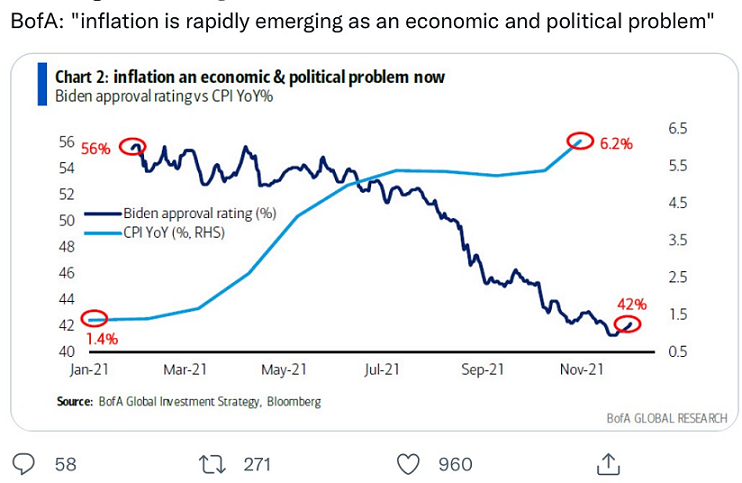
Il che ovviamente crea problemi reali: il prezzo del combustibile per riscaldamento che sale dell’80%, oppure la popolarità del Presidente USA Joe Biden che è crollata, oppure lo sciopero generale in Italia.

Come un anno fa nel Blog Recce’d ha scritto che “le probabilità che le cose vadano come dice la Fed e la BCE sono pari a zero”, oggi Recce’d vi dice che “le probabilità che le cose vadano come scrive Goldman Sachs nell’immagine qui sotto sono pari a zero”.

E questo, ovviamente, determina il rendimento di tutti gli asset finanziari in futuro.

Abbiamo più volte anticipato questa situazione, quella che tutti vedete oggi, proprio qui nel nostro Blog.

Approfondimenti sono stati pubblicati nel nostro The Morning Brief ed in altre sedi. Altri approfondimenti saranno pubblicati la prossima settimana.

Per chi tra i nostri lettori vuole comprendere meglio per quale ragione oggi Recce’d vi anticipa che il problema è l’economia reale, pubblichiamo di seguito qui un ottimo articolo che spiega che è necessario guardare al lato dell’offerta, e non a quello della domanda.

Lato dell’offerta, lo ripetiamo ancora una volta, a proposito del quale né i Governi né le Banche Centrali possono fare nulla.

La fase della stupidità è finita. e si torna quindi alla realtà. La lettura di questo articolo vi sarà utile per capire dove si va adesso, illustrando con dettaglio dove stanno oggi i problemi che ci portano alla stagflazione.

The Revenge of Supply, at Project Syndicate

Surging inflation, skyrocketing energy prices, production bottlenecks, shortages, plumbers who won’t return your calls – economic orthodoxy has just run smack into a wall of reality called “supply.” 

Demand matters too, of course. If people wanted to buy half as much as they do, today’s bottlenecks and shortages would not be happening. But the US Federal Reserve and Treasury have printed trillions of new dollars and sent checks to just about every American. Inflation should not have been terribly hard to foresee; and yet it has caught the Fed completely by surprise. 

The Fed’s excuse is that the supply shocks are transient symptoms of pent-up demand. But the Fed’s job is – or at least should be – to calibrate how much supply the economy can offer, and then adjust demand to that level and no more. Being surprised by a supply issue is like the Army being surprised by an invasion. 

The current crunch should change ideas. Renewed respect may come to the real-business-cycle school, which focuses precisely on supply constraints and warns against death by a thousand cuts from supply inefficiencies. Arthur Laffer, whose eponymous curve announced that lower marginal tax rates stimulate growth, ought to be chuckling at the record-breaking revenues that corporate taxes are bringing in this year. 

Equally, one hopes that we will hear no more from Modern Monetary Theory, whose proponents advocate that the government print money and send it to people. They proclaimed that inflation would not follow, because, as Stephanie Kelton puts it in The Deficit Myth, “there is always slack” in our economy. It is hard to ask for a clearer test. 

But the US shouldn’t be in a supply crunch. Real (inflation-adjusted) per capita US GDP just barely passed its pre-pandemic level this last quarter, and overall employment is still five million below its previous peak. Why is the supply capacity of the US economy so low? Evidently, there is a lot of sand in the gears. Consequently, the economic-policy task has been upended – or, rather, reoriented to where it should have been all along: focused on reducing supply-side inefficiencies. 

One underlying problem today is the intersection of labor shortages and Americans who are not even looking for jobs. Although there are more than ten million listed job openings – three million more than the pre-pandemic peak – only six million people are looking for work. All told, the number of people working or looking for work has fallen by three million, from a steady 63% of the working-age population to just 61.6%. 

We know two things about human behavior: First, if people have more money, they work less. Lottery winners tend to quit their jobs. Second, if the rewards of working are greater, people work more. Our current policies offer a double whammy: more money, but much of it will be taken away if one works. Last summer, it became clear to everyone that people receiving more benefits while unemployed than they would earn from working would not return to the labor market. That problem remains with us and is getting worse. 

Remember when commentators warned a few years ago that we would need to send basic-income checks to truck drivers whose jobs would soon be eliminated by artificial intelligence? Well, we started sending people checks, and now we are surprised to find that there is a truck driver shortage. 

Practically every policy on the current agenda compounds this disincentive, adding to the supply constraints. Consider childcare as one tiny example among thousands. Childcare costs have been proclaimed the latest “crisis,” and the “Build Back Better” bill proposes a new open-ended entitlement. Yes, entitlement: “every family who applies for assistance … shall be offered child care assistance” no matter the cost. 

The bill explodes costs and disincentives. It stipulates that childcare workers must be paid at least as much as elementary school teachers ($63,930), rather than the current average ($25,510). Providers must be licensed. Families pay a fixed and rising fraction of family income. If families earn more money, benefits are reduced. If a couple marries, they pay a higher rate, based on combined income. With payments proclaimed as a fraction of income and the government picking up the rest, either prices will explode or price controls must swiftly follow. Adding to the absurdity, the proposed legislation requires states to implement a “tiered system” of “quality,” but grants everyone the right to a top-tier placement. And this is just one tiny element of a huge bill. 

Or consider climate policy, which is heading for a rude awakening this winter. This, too, was foreseeable. The current policy focus is on killing off fossil-fuel supply before reliable alternatives are ready at scale. Quiz: If you reduce supply, do prices go up or go down? Europeans facing surging energy prices this fall have just found out. 

In the United States, policymakers have devised a “whole-of-government” approach to strangle fossil fuels, while repeating the mantra that “climate risk” is threatening fossil-fuel companies with bankruptcy due to low prices. We shall see if the facts shame anyone here. Pleading for OPEC and Russia to open the spigots that we have closed will only go so far. 

Last week, the International Energy Agency declared that current climate pledges will “create” 13 million new jobs, and that this figure would double in a “Net-Zero Scenario.” But we’re in a labor shortage. If you can’t hire truckers to unload ships, where are these 13 million new workers going to come from, and who is going to do the jobs that they were previously doing? Sooner or later, we have to realize it’s not 1933 anymore, and using more workers to provide the same energy is a cost, not a benefit. 

It is time to unlock the supply shackles that our governments have created. Government policy prevents people from building more housing. Occupational licenses reduce supply. Labor legislation reduces supply and opportunity, for example, laws requiring that Uber drivers be categorized as employees rather than independent contractors. The infrastructure problem is not money, it is that law and regulation have made infrastructure absurdly expensive, if it can be built at all. Subways now cost more than a billion dollars per mile. Contracting rules, mandates to pay union wages, “buy American” provisions, and suits filed under environmental pretexts gum up the works and reduce supply. We bemoan a labor shortage, yet thousands of would-be immigrants are desperate to come to our shores to work, pay taxes, and get our economy going. 

A supply crunch with inflation is a great wake-up call. Supply, and efficiency, must now top our economic-policy priorities.

*********

Update: I am vaguely aware of many regulations causing port bottlenecks, including union work rules, rules against trucks parking and idling, overtime rules, and so on. But it turns out a crucial bottleneck in the port of LA is... Zoning laws! By zoning law you're not allowed to stack empty containers more than two high, so there is nowhere to leave them but on the truck, which then can't take a full container. The tweet thread is really interesting for suggesting the ports are at a standstill, bottled up FUBARed and SNAFUed, not running full steam but just can't handle the goods. 

Disclaimer: To my economist friends, yes, using the word "supply" here is not really accurate. "Aggregate supply" is different from the supply of an individual good. Supply of one good increases when its price rises relative to other prices. "Aggregate supply" is the supply of all goods when prices and wages rise together, a much trickier and different concept. What I mean, of course, is something like "the amount produced by the general equilibrium functioning of the economy, supply and demand, in the absence of whatever frictions we call low 'aggregate demand', but as reduced by taxes, regulations, and other market distortions." That being too much of a mouthful, and popular writing using the word "supply" and "supply-side" for this concept, I did not try to bend language towards something more accurate. 

Mercati oggiValter Buffo
Il Mondo è cambiato: per la terza volta in due anni
 

In molte occasioni, Recce’d negli ultimi 18 mesi vi ha menzionato gli Anni Settanta. E ancora più di frequente vi ha scritto di stagflazione.

Ora che ci siamo, ora che avete i dati sotto gli occhi, dovete solo chiedervi se vi siete già preparati, se avete adattato i vostri investimenti a questo scenario.

Che non è una sorpresa: assolutamente. Si tratta di uno scenario già ben visibile da oltre un anno. Ai meno attenti, ed ai più creduloni, è stato fatto credere che le cose stavano diversamente.

Chi ci ha seguiti, adesso forse è pronto. Tutti gli altri devono invece correre.

Può essere utile rileggere oggi quello che uno dei più noti ed esperti economisti al Mondo, John H. Cochrane, scriveva qualche settimana fa, prima della Festa del Thanksgiving negli USA, a proposito dell’inflazione e del comportamento dei consumatori.

John H. Cochrane

Nov 26

Black Friday begins tonight, and Americans, after emerging from our collective turkey coma, will dive into our sacred, national ritual: shopping. 

Those who haven’t shopped lately are in for a rude awakening: Many items will be out of stock, delayed or cost a lot more than they used to. Welcome to inflation, back from the 1970s!  

As you look for a deal on a Peloton to work off your pandemic paunch, here is a brief explanation about what’s going on with our economy, why so many things are becoming more expensive, why this hurts all of us, and why the government can’t spend its way out of this mess.

Why are prices rising? 

The news is full of “supply chain” problems. Shipping containers can’t get through our ports. Car-makers can’t get chips to make cars. Railroads look like the 405 at rush hour. 

What’s underlying many of these problems is the fact that businesses can’t find enough workers. There aren’t enough truck drivers, airline pilots, construction workers and warehouse workers in the “supply chain.” Restaurants can’t find waiters and cooks. There are 10 million job openings and only seven million people looking for work. About three million people who were working in March 2020 are no longer working or looking for work.

But supply chains wouldn’t be clogged if people weren’t trying to buy a lot. The fundamental issue is that demand is outstripping supply.

Strawberry prices go up in the fall because the supply is lower; apples are cheap, because they are abundant. Prices of one good relative to another change, and induce us to shop effectively. 

That’s normal.

Inflation is different. Inflation describes all prices and wages going up at the same time, straining supply throughout the economy. That’s the situation right now. Even the Dollar Tree stores just became the buck and a quarter stores, raising all prices 25%.

What’s driving current inflation?

Widespread inflation always comes from people wanting to buy more of everything than the economy can supply. Where did all that demand come from? In its response to the pandemic, the U.S. government created about 2.5 trillion new dollars, and sent checks to people and businesses. It borrowed another $2.5 trillion, and sent more checks to people and businesses. Relative to a $22 trillion economy, and $17 trillion of existing (2020) federal debt, that’s a lot of money. 

People are now spending this money, the economy can’t keep up, and prices are rising. Milton Friedman once joked that the government could easily create inflation by dropping money from helicopters. That’s pretty much what our government did.

(I do not here argue the wisdom of this policy. The government helped a lot of people and businesses to get through the lockdowns. One can quibble that money could have been distributed more thoughtfully, but we’re here to think about inflation, not Covid policy.) 

 What’s wrong with inflation?

Prices and wages all rising at the same rate doesn’t sound so bad. But it’s never that simple. Inflation is chaotic! Some prices go up faster than others. You can’t get things you need. Neither can businesses. And wages tend to lag behind prices, so workers lose in real terms, as do those on fixed incomes. 

What was the Fed’s role in all of this?

The Federal Reserve failed at its most basic job: to figure out how much the economy can produce, and to bring demand up to, but not beyond, that supply. To that end, the Fed controls interest rates. If people get a higher interest rate on money in the bank, they will leave it there rather than spend it. But the Fed failed to see inflation coming, and kept interest rates at zero, where they remain. The Fed says it is keeping interest rates low to improve “labor market conditions,” despite the widespread worker shortages and the eruption of inflation.

Will inflation continue? 

It’s hard to say. If the Federal Reserve’s immense staff of economists can be caught off guard, so can you and I. 

That said, there is some momentum to inflation, so further price increases are likely. Higher property prices will feed into higher rents; rising input costs and wages will lead to higher prices; trillions of those extra savings are still waiting to be spent. 

Where inflation goes after that depends on how much more our government continues to print or borrow to send people checks and expand social programs. This doesn’t seem likely to end soon. And if people believe that monetary policy will never return to controlling inflation, and taxes and spending will never come into line so the government can start to repay mounting debts, inflation spirals out of control.

The good news is that long-term interest rates—the kind you pay to borrow for a mortgage or car—have not yet risen, as they tend to do when bond markets expect inflation. Bond markets think inflation will quickly subside. It’s still very cheap to borrow, a bright light for consumers. And low rates make it easier for the government to slow inflation. 

Okay, so what can Washington do about it?

Simple: It has to stop printing and borrowing money. And it has to reassure people who hold our debt that there really is a plan for paying it off. And the Fed has to return to the unglamorous job of curbing inflation, rather than endless “stimulus” and “accommodation.” 

To ease supply constraints, our government has to remove the sand in the gears. The ports are clogged because of countless regulations—like zoning laws that forbid stacking empty containers. Multiply anecdotes like this by tens of thousands throughout the economy and you’ll begin to get a picture of where we are. We need a long-overdue Marie-Kondoing of public affairs.

If inflation is as simple as you say it is, why are politicians singing another tune?

Politicians hate inflation because it means they can’t keep spreading money around. Supply constraints reverse political rhetoric. When a politician says a new program will “create millions of jobs,” those jobs are now a cost, not a benefit, because there aren’t any available workers.

So they offer a string of excuses, just as they did in the 1970s—including lots of talk about “supply shocks” and “bottlenecks” and “transitory” inflation —while hoping it all goes away. 

The Biden administration, having just cancelled the Keystone pipeline, is now begging the Saudis and Russians to turn on the pumps, just as Richard Nixon pleaded with OPEC. The White House is accusing oil companies of colluding to raise prices. They will likely pressure other companies to limit price increases, as presidents from Kennedy to Ford did. This shouldn’t come as a surprise: Every past inflation has sparked a witch hunt for “speculators,” “hoarders,” “middlemen,” “price-gougers,” and other phantasms. Let’s hope the government doesn’t try price controls, as Nixon did, precipitating gas lines and shortages of everything. 

Meanwhile, the administration is re-messaging its spending plans as inflation-fighters. It won’t work. Consider the childcare plan, to take just one example, which they say will lower costs. The government will subsidize childcare while mandating higher wages for staff, more licensing requirements and inspections. Childcare costs will inevitably rise for the country as a whole. One can believe that it’s a good policy, and that it’s worth the cost, but it will make costs higher, not lower. 

Politicians don’t want to face the hard reality that inflation brings, but inflation has a way of forcing change, as it did in 1980. 

So, should I try to buy things on Black Friday and Cyber Monday? 

Only if you really need it. Prices are the neurons that transmit information in the economy. High prices tell you to wait and to let someone who values that Peloton more than you do have it. Most Americans should take this golden opportunity to build up some savings, look for a job or a better job, and enjoy those leftovers.

E’ sufficiente spendere meno, dice qui sopra nell’articolo John H. Cochrane: non sappiamo come la pensano i nostri lettori, alle prese con le spese di carburante aumentate del 80%.

Ma ciò che qui è importante è proprio quel suggerimento: spendere meno. Come abbiamo già scritto oggi in un altro Post, il punto centrale del nuovo scenario è proprio questo: la crescita dell’economia.

Nell’immagine che segue, Recce’d vi ricorda che:

  • l’errore fatto dalle Banche Centrali (e riconosciuto proprio questa settimana) è un errore di proporzioni epiche, mai visto prima nella Storia; e poi che

  • Banche Centrali e Governi possono fare nulla per risolvere i problemi dal lato dell’offerta

A tutti voi lettori, i private bankers, i promotori finanziari, i wealth managers e i robot advisor hanno spiegato che non c’è da preoccuparsi, che non fa nulla, che va tutto bene, che l’inflazione tornerà al 2%, che il Mondo va benissimo.

Come avete già visto, e come vedrete nei prossimi mesi, queste sono semplicemente frasi pronunciate in modo leggero, superficiale, spregiudicato allo scopo di inzuccherare, confondere ed illudere; hanno nulla a che vedere con la realtà

Il vostro private banker, il vostro wealth manager, il vostro promotore finanziario, il vostro robot advisor a voi ha raccontato quello che Goldman Sachs gli diceva di raccontarvi: e quello che vi ha raccontato lo potete rileggere qui sotto nell’immagine.

Goldman Sachs aveva nel mese di aprile una previsione per il tasso di inflazione a dicembre 2021 del 2,77% ancora in aprile, ovvero otto mesi fa. Il tasso di inflazione oggi sta al 7%.

.Si tratta soltanto di un errore grossolano ai limiti dell’incredibile, oppure Goldman Sachs ed il vostro private banker non ne capiscono assolutamente nulla?

Oppure (terza possibilità) sono riusciti a fregarvi, facendovi tutti fessi?

Visto che tutti voi lettori siete dotati di un’ottima capacità di giudizio e discernimento, per il futuro fareste bene a NON fidarvi: fareste bene a ragionare usando la vostra testa, informandovi, ed usando le vostre capacità critiche insieme ad un pizzico di scetticismo.

Noi vogliamo aiutarvi, e per questa ragione ci trovate sempre disponibili contattandoci attraverso il nostro sito. In aggiunta, vi aiutiamo attraverso questo Blog, gratuitamente: ad esempio, mettendovi a disposizione qui sotto un secondo articolo.

Perché questo articolo vi può essere utile, da un punto di vista pratico? Perché si tratta di un articolo scritto nel mese di settembre, e quindi tre mesi fa.. Può essere molto utile, per tutti voi, confrontarsi con quello che si scriveva e leggeva tre mesi fa.

In questo caso, chi scrive è autorevole, una mente brillante capace di ragionare in modo critico, evitando in questo modo di cadere nella trappola di Goldman Sachs e dei promotori finanziari. L’articolo che leggete di seguito fu scritto in settembre, eppure c’era già scritto ciò che leggete stamattina sui quotidiani.

Ma attenzione: ci trovate scritto anche ciò che leggerete tra tre e sei mesi.

Questo è un contributo utile, per la gestione dei vostri investimenti sui mercati finanziari: l’articolo è molto, molto chiaro nello spiegare ciò che i mercati dovranno affrontare (“political and economic pain”) quasi altrettanto chiaro quanto era chiaro, 12 mesi fa, che la “inflazione transitoria” era soltanto una stupidaggine.

Come abbiamo scritto oggi in un altro Post, la fase della stupidità è finita. Auguriamoci che non si arrivi alla “crisi della fiducia” della quale, in questo Post, scrivemmo qualche mese fa.

Today’s inflation is transitory, our central bankers assure us. It will go away on its own. But what if it does not? Central banks will have “the tools” to deal with inflation, they tell us. But just what are those tools? Do central banks have the will to use them, and will governments allow them to do so?

Should inflation continue to surge, central banks’ main tool is to raise interest rates sharply, and keep them high for several years, even if that causes a painful recession, as it did in the early 1980s. How much pain, and how deep of a dip, would it take? The well-respected Taylor rule (named after my Hoover Institution colleague John B. Taylor) recommends that interest rates rise one and a half times as much as inflation. So, if inflation rises from 2% to 5%, interest rates should rise by 4.5 percentage points. Add a baseline of 2% for the inflation target and 1% for the long-run real rate of interest, and the rule recommends a central-bank rate of 7.5%. If inflation accelerates further before central banks act, reining it in could require the 15% interest rates of the early 1980s.

Would central banks do that? If they did, would high interest rates control inflation in today’s economy? There are many reasons for worry.

The shadow of debt

Monetary policy lives in the shadow of debt. US federal debt held by the public was about 25% of GDP in 1980, when US Federal Reserve Board Chair Paul Volcker started raising rates to tame inflation. Now, it is 100% of GDP and rising quickly, with no end in sight. When the Fed raises interest rates one percentage point, it raises the interest costs on debt by one percentage point, and, at 100% debt-to-GDP, 1% of GDP is around $227 billion. A 7.5% interest rate therefore creates interest costs of 7.5% of GDP, or $1.7 trillion.

Where will those trillions of dollars come from? Congress could drastically cut spending or find ways to increase tax revenues. Alternatively, the US Treasury could try to borrow additional trillions. But for that option to work, bond buyers must be convinced that a future Congress will cut spending or raise tax revenues by the same trillions of dollars, plus interest. Even if investors seem confident at the moment, we cannot assume that they will remain so indefinitely, especially if additional borrowing serves only to pay higher interest on existing debt. Even for the United States, there is a point at which bond investors see the end coming, and demand even higher interest rates as a risk premium, thereby raising debt costs even more, in a spiral that leads to a debt crisis or to a sharp and uncontrollable surge of inflation. If the US government could borrow arbitrary amounts and never worry about repayment, it could send its citizens checks forever and nobody would have to work or pay taxes again. Alas, we do not live in that fanciful world.

In sum, for higher interest rates to reduce inflation, higher interest rates must be accompanied by credible and persistent fiscal tightening, now or later. If the fiscal tightening does not come, the monetary policy will eventually fail to contain inflation.

This is a perfectly standard proposition, though it is often overlooked when discussing the US and Europe. It is embodied in the models used by the Fed and other central banks. [Previous post here on just what that means.] It was standard IMF advice for decades.

Successful inflation and currency stabilization almost always includes monetary and fiscal reform, and usually microeconomic reform. The role of fiscal and microeconomic reform is to generate sustainably higher tax revenues by boosting economic growth and broadening the tax base, rather than with sharply higher and growth-reducing marginal tax rates. Many attempts at monetary stabilization have fallen apart because the fiscal or microeconomic reforms failed. Latin-American economic history is full of such episodes.

Even the US experience in the 1980s conforms to this pattern. The high interest rates of the early 1980s raised interest costs on the US national debt, contributing to most of the then-large annual “Reagan deficits.” Even after inflation declined, interest rates remained high, arguably because markets were worried that inflation would come surging back.

So, why did the US inflation-stabilization effort succeed in the1980s, after failing twice before in the 1970s, and countless times in other countries? In addition to the Fed remaining steadfast and the Reagan administration supporting it through two bruising recessions, the US undertook a series of important tax and microeconomic reforms, most notably the 1982 and 1986 tax reforms, which sharply lowered marginal rates, and market-oriented regulatory reforms starting with the Carter-era deregulation of trucking, air transport, and finance.

The US experienced a two-decade economic boom. A larger GDP boosted tax revenues, enabling debt repayment despite high real-interest rates. By the late 1990s, strange as it sounds now, economists were actually worrying about how financial markets would work once all US Treasury debt had been paid off. The boom was arguably a result of these monetary, fiscal, and microeconomic reforms, though we do not need to argue the cause and effect of this history. Even if the economic boom that produced fiscal surpluses was coincidental with tax and regulatory reform, the fact remains that the US government successfully paid off its debt, including debt incurred from the high interest costs of the early 1980s. Had it not done so, inflation would have returned.

The Borrower Ducks

But would that kind of successful stabilization happen now, with the US national debt four times larger and still rising, and with interest costs for a given level of interest rates four times larger than the contentious Reagan deficits? Would Congress really abandon its ambitious spending plans, or raise tax revenues by trillions, all to pay a windfall of interest payments to largely wealthy and foreign bondholders?

Arguably, it would not. If interest costs on the debt were to spiral upward, Congress would likely demand a reversal of the high interest-rate policy. The last time the US debt-to-GDP ratio was 100%, at the end of World War II, the Fed was explicitly instructed to hold down interest costs on US debt, until inflation erupted in the 1950s.

The unraveling can be slow or fast. It takes time for higher interest rates to raise interest costs, as debt is rolled over. The government can borrow as long as people believe that the fiscal reckoning will come in the future. But when people lose that faith, things can unravel quickly and unpredictably.

Will and Politics

Fiscal policy constraints are only the beginning of the Fed’s difficulties. Will the Fed act promptly, before inflation gets out of control? Or will it continue to treat every increase of inflation as “transitory,” to be blamed on whichever price is going up most that month, as it did in the early 1970s?

It is never easy for the Fed to cause a recession, and to stick with its policy through the pain. Nor is it easy for an administration to support the central bank through that kind of long fight. But tolerating a lasting rise in unemployment – concentrated as usual among the disadvantaged – seems especially difficult in today’s political climate, with the Fed loudly pursuing solutions to inequality and inequity in its interpretation of its mandate to pursue “maximum employment.”

Moreover, the ensuing recession would likely be more severe. Inflation can be stabilized with little recession if people really believe the policy will be seen through. But if they think it is a fleeting attempt that may be reversed, the associated downturn will be worse.

One might think this debate can be postponed until we see if inflation really is transitory or not. But the issue matters now. Fighting inflation is much easier if inflation expectations do not rise. Our central banks insist that inflation expectations are “anchored.” But by what mechanism? Well, by the faith that those same central banks would, if necessary, reapply the harsh Volcker medicine of the 1980s to contain inflation. How long will that faith last? When does the anchor become a sail?

A military or foreign-policy analogy is helpful. Fighting inflation is like deterring an enemy. If you just say you have “the tools,” that’s not very scary. If you tell the enemy what the tools are, show that they all are in shiny working order, and demonstrate that you have the will to use them no matter the pain inflicted on yourself, deterrence is much more likely.

Yet the Fed has been remarkably silent on just what the “tools” are, and just how ready it is to deploy those tools, no matter how painful doing so may be. There has been no parading of materiel. The Fed continues to follow the opposite strategy: a determined effort to stimulate the economy and to raise inflation and inflation expectations, by promising no-matter-what stimulus. The Fed is still trying to deter deflation, and says it will let inflation run above target for a while in an attempt to reduce unemployment, as it did in the 1970s. It has also precommitted not to raise interest rates for a fixed period of time, rather than for as long as required economic conditions remain, which has the same counterproductive result as announcing military withdrawals on specific dates. Like much of the US government, the Fed is consumed with race, inequality, and climate change, and thus is distracted from deterring its traditional enemies.

Buy some insurance! 

An amazing opportunity to avoid this conundrum beckons, but it won’t beckon forever. The US government is like a homeowner who steps outside, smells smoke, and is greeted by a salesman offering fire insurance. So far, the government has declined the offer because it doesn’t want to pay the premium. There is still time to reconsider that choice.

Higher interest rates raise interest costs only because the US has financed its debts largely by rolling over short-term debt, rather than by issuing long-term bonds. The Fed has compounded this problem by buying up large quantities of long-term debt and issuing overnight debt – reserves – in return.

The US government is like any homeowner in this regard. It can choose the adjustable-rate mortgage, which offers a low initial rate, but will lead to sharply higher payments if interest rates rise. Or it can choose the 30-year (or longer) fixed-rate mortgage, which requires a larger initial rate but offers 30 years of protection against interest-rate increases.

Right now, the one-year Treasury rate is 0.07%, the ten-year rate is 1.3%, and the 30-year rate is 1.9%. Each one-year bond saves the US government about two percentage points of interest cost as long as rates stay where they are. But 2% is still negative in real terms. Two percentage points is the insurance premium for eliminating the chance of a debt crisis for 30 years, and for making sure the Fed can fight inflation if it needs to do so. I am not alone in thinking that this seems like inexpensive insurance. Even former US Secretary of the Treasury Lawrence H. Summers has changed his previous view to argue that the US should move swiftly to long-term debt.

But it’s a limited-time opportunity. Countries that start to encounter debt problems generally face higher long-term interest rates, which forces them to borrow short-term and expose themselves to the attendant dangers. When the house down the street is on fire, the insurance salesman disappears, or charges an exorbitant rate.

Bottom line

Will the current inflation surge turn out to be transitory, or will it continue? The answer depends on our central banks and our governments. If people believe that fiscal and monetary authorities are ready to do what it takes to contain breakout inflation, inflation will remain subdued.

Doing what it takes means joint monetary and fiscal stabilization, with growth-oriented microeconomic reforms. It means sticking to that policy through the inevitable political and economic pain. And it means postponing or abandoning grand plans that depend on the exact opposite policies.

If people and markets lose faith that governments will respond to inflation with such policies in the future, inflation will erupt now. And in the shadow of debt and slow economic growth, central banks cannot control inflation on their own.

Mercati oggiValter Buffo
E adesso l'Europa è il vaso di coccio (e l'Italia è l'acqua dentro il vaso)
 

In numerose occasioni, le pubblicità di IKEA hanno avuto la capacità di fotografare in modo efficace qualche aspetto della realtà che ci circonda.

Come scriviamo oggi in altri due Post, stiamo tutti affrontando un passaggio delicatissimo: uno di quei momenti che si potrebbero definire “epocali”.

La fase della euforia economica artificiale, avviata (ed è paradossale e cinico) grazie allo spazio creato dalla pandemia, è finita.

Al tempo stesso, si assiste anche ad altri cambiamenti che si possono definire “epocali”: in Europa, l’uscita di scena di Angela Merkel.

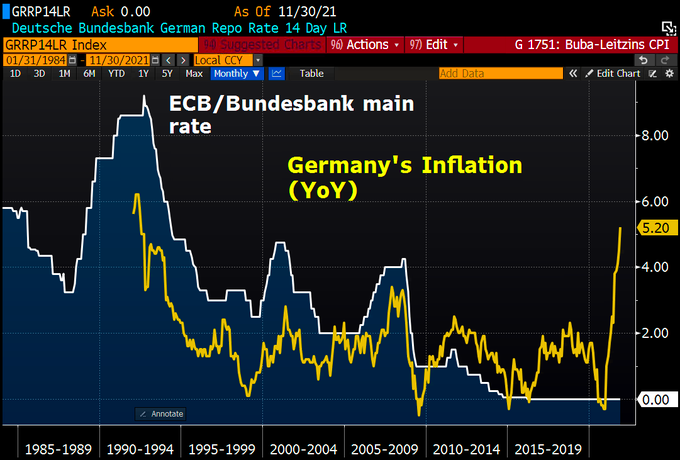
Sempre in Europa, e sempre in Germania l’inflazione sopra il 5%.

I cambiamenti epocali si riflettono sui mercati finanziari, per il momento mettendoli in uno stato di allerta, di confusione, e di mancanza di direzione. Nel grafico qui sotto, potete vedere che l’indice della Borsa tedesca si trova oggi al medesimo livello del mese di aprile 2021, ovvero di otto mesi fa. Nonostante il fatto che l’acquisto di obbligazioni da parte della BCE (e quindi l’immissione di liquidità da parte della BCE) fino ad oggi è continuato senza sosta (la linea bianca del grafico).

Questi cambiamenti epocali mettono l’Europa in una situazione di fragilità che è superiore a quella in cui si trovano oggi gli Stati Uniti, per una lunga serie di ragioni di cui scriveremo nel nostro The Morning Brief riservato ai nostri Clienti.

Per aiutare il lettore, oggi pubblichiamo un articolo dedicato proprio alla situazione in cui si trova oggi la BCE, articolo che mette inevidenza anche il ruolo particolare dell’Italia nella situazione attuale. Notevole il collegamento che viene fatto, in chiusura dell’articolo, tra il “whatever it takes” di Mario Draghi quando era a capo della BCE, delle finalità di quella iniziativa quando fu presa, e la situazione dell’Italia oggi.

I have been emphasizing the Fed's dilemma: If it raises interest rates, that raises the U.S. debt-service costs. 100% debt to GDP means that 5% interest rates translate to 5% of GDP extra deficit, $1 trillion for every year of high interest rates. If the government does not tighten by that amount, either immediately or credibly in the future, then the higher interest rates must ultimately raise, rather than lower, inflation. 

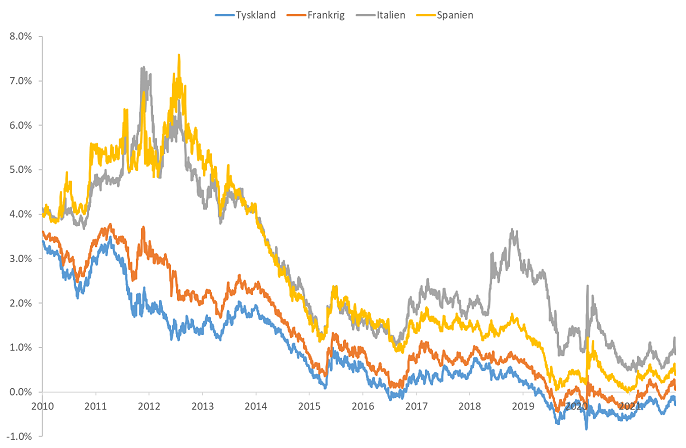
Jesper Rangvid points out that the problem is worse for the ECB. Recall there was a euro crisis in which Italy appeared that it might not be able to roll over its debt and default. Mario Draghi pledged to do "whatever it takes" including buying Italian debt to stop it and did so. But Italian debt is now 160% of GDP, and the ECB is still buying Italian bonds. What happens if the ECB raises interest rates to try to slow down inflation? Well, Italian debt service skyrockets. 5% interest rates mean 8% of GDP to debt service. 

Central banks first stop bond buying and then raise interest rates. Whether U.S. bond buying programs actually lower treasury yields is debatable. But there is no question that the ECB's bond buying keeps down Italy's interest rate, by keeping down the risk/default premium in that rate. If the ECB stops buying, or removes the commitment to "whatever it takes" purchases, debt service costs will rise again precipitating the doom loop. 

Jesper: 

The ECB is caught in a dilemma. 

The ECB knows that very expansionary monetary policy, combined with already high inflation and strong economic growth, creates a serious risk that inflation and inflation expectations run wild. 

The ECB also knows, however, that if it tightens monetary policy, i.e. stop asset purchases and raise rates, debt-burdened Eurozone countries will face severe challenges. 

Take Italy as an example. At the end of last year, Italian public debt corresponded to 160% of Italian GDP. This is a lot of debt. ...

Low interest rates have been kind:

... in spite of a 50% higher debt burden, debt-servicing costs for Italy has been cut by a third from 2007 to 2020. The reason is of course low interest rates.

...In addition to the global fall in rates, though, the ECB has been buying Eurozone government debt in massive amounts, significantly reducing rates even further. ...

Figure 11. ECB holdings of Italian debt securities. Millions of euros.
Source: Datastream via Refinitiv.

The ECB has bought a lot of debt. First, in relation to the Public Sector Purchase Program (PSPP), launched after the Eurozone debt crisis, and, second, in relation to the Pandemic Emergency Purchases Program (PEPP), the program launched to battle the corona crisis. Under the PSPP, ECB amassed Italian debt worth EUR 400bn. Under the PEPP, it amassed EUR 300bn. In total, the ECB holds Italian debt worth EUR 700bn, see Figure 11. The ECB owns close to 25% of all outstanding Italian public debt....

Figure 12. Yields on long-dated Eurozone government bonds.
Source: Datastream via Refinitiv


Many of us remember the Eurozone crisis in 2010-2013. Italian yields reached more than seven percent in 2012, see Figure 12. Yields only came down after Mario Draghi’s famous “we will do whatever it takes” speech in 2012 (link). ECB saved Italy, thereby saving the Eurozone.

This is an important reminder that it can happen. For the U.S. a large default/inflation premium to real interest rates is a theoretical possibility, and perhaps a memory of the early 1980s if one interprets that episode as a fear of return to inflation, or otherwise a memory of the 1790s. For Europe this happened, and only 10 years ago. 

Jesper does not mention the interesting question, what happens to all these bonds on the ECB balance sheet, or the bonds it will surely acquire if Italian spreads widen again, in the event of default. 

Jesper also does not mention one small piece of good news. I gather Italian debt is somewhat longer-term than U.S. debt, though I don't have a good number handy. That fact means that higher real interest rates (including default premium) only spread into interest costs slowly. 

In sum, 

 the ECB is stuck in a corner. Whether one fears this round of inflation will persist or not, the fact that the ECB is constrained by fiscal considerations is problematic. If the ECB one day needs to raise rates, it will face the dilemma described above.

What to do? 

What is the solution? This will take us too far in this blog, but it lies in the old discussion of macroeconomic reforms in certain European member states, directing fiscal policy to a healthy path, improving productivity and competitiveness, and in the end generate higher growth. This is easier said than done.

Draghi was quite clear, that "do whatever it takes" was a temporary expedient, to give Italy room for structural and fiscal reforms. Those (predictably?) did not happen so here we are again. Is it too late?  Italy will surely not reform before a crisis looms, so the case has to be that a crisis is severe enough to finally provoke growth-oriented economics. 

The ECB, however, remains stuck between a rock and a hard place. As the Fed will be if it tries to substantially raise interest rates. 

Mercati oggiValter Buffo
Investire per il 2022: come si fa gestione nella volatilità
 

In questo Blog, alcuni mesi fa, abbiamo già introdotto la figura di Paul Singer, il gestore a capo del gruppo Elliot Management.

Vi abbiamo segnalato questa figura, di grande competenza ed esperienza, e vi abbiamo suggerito di seguirne il pensiero, le analisi e le pubblicazioni.

Se a qualche nostro lettore fosse sfuggito, noi riportiamo qui sotto il contributo di Paul Singer al Financial Times di questa settimana, contributo che più in basso noi riprendiamo e colleghiamo ad altre considerazioni.


The writer is the founder and co-CEO of Elliott Management

Despite recent jitters over the Omicron variant, global stock market prices remain at or near their highest valuations in history. Bond prices reflect the lowest interest rates in history. And is it any surprise that inflation has broken out of the boundaries of the last 20 years, given the stated goal of policymakers to create more of it?

Across the market landscape, risks are building, many of them hidden from view. Yet, in a surprising twist, a growing number of the largest investors in the world — including socially important institutions such as pension funds, university endowments, charitable foundations and the like — are currently lining up to take on more risk, which could have catastrophic implications for these investors, their clients’ capital and the stability of broader public markets.

What is driving this behaviour? In the main, it is driven by the radically expansionary monetary and fiscal policies undertaken by developed-world governments since the end of the global financial crisis, which were accelerated after the Covid-19 pandemic rattled markets and depressed economic activity last year. And in part it is driven by benchmarking — the practice of institutional investors measuring their performance against a benchmark such as the S&P 500.

As monetary and fiscal policies have pushed securities valuations to new heights, institutional investors have been tempted to overweight their portfolios to stocks, even at record-high prices, for fear of missing out on extraordinary gains. The buying pressure created by these strategies is only driving prices higher and herding capital into risk assets.

At present, risks are at, or close to, the highest levels in market history. For instance, the market capitalisation of all domestic US public and private equities is now at 280 per cent of gross domestic product, much higher than the previous peak of 190 per cent just before the collapse of the dotcom bubble. And household equity allocations are at an all-time high of 50 per cent.

Eventually, rising inflation, rising interest rates or some unforeseen turn of events could cause a substantial stock and bond market decline, perhaps in an unpredictable sequence. What then for the institutional managers when the rush for the exits begins? One answer might be that the authorities will never allow a sustained downturn in asset prices to happen again. This points to one of the key problems with the current set of monetary and fiscal policies in the developed world: they mask and minimise risks while preventing stock and bond prices from performing their indispensable signalling roles.

Currently, policies across the developed world are designed to encourage people to believe that risks are limited and that asset prices, not just the overall functioning of the economy, will always and forever be protected by the government. Due to this extraordinary support for asset prices, almost all investment “strategies” of recent years have made money, are making money and are expected to keep making money. The most successful “strategy,” of course, has been to buy almost any risk asset, leaning hard on the latest fads, using maximum leverage to enhance buying power and buying more on the “dips”. So it is no wonder that under these manufactured conditions, investors would “move out on the risk curve” — investor-speak for taking on more risk unconnected to expected returns.

Most investors who say that they are willing to bear more risk do not actually mean that. What they really mean is that they fear missing out on the higher returns experienced by other investors — in other words, missing their benchmarks. However, the ability of governments to protect asset prices from another downturn has never been more constrained. The global $30tn pile of stocks and bonds that have been purchased by central banks in order to drive up their prices has created a gigantic overhang. With inflation rising, policymakers are reaching the limits of their ability to support asset prices in a future downturn without further exacerbating inflationary pressures.

With all this in mind, it is puzzling that a growing number of otherwise sober money managers are in the process of boosting their allocations to riskier assets, rather than trying to figure out ways to make some kind of rate of return without giving back years of capital accretion in the next crash or crisis. Investors who have upgraded their risk levels, relying on policymakers to protect the prices of their holdings, may suffer significant and perhaps long-lasting damage when the government-orchestrated music finally stops.

Recce’d giudica questo articolo eccellente, e da più di un punto di vista: è una sintesi equilibrata ed insieme efficacissima dello stato degli affari, sui mercati finanziari, ed è chiarissimo anche quando fa riferimento agli atteggiamenti delle diverse categorie di investitori.

Se leggete con attenzione questo articolo di Paul Singer (uomo che certamente NON ha alcun interesse personale a deprimere i mercati finanziari) avrete un quadro preciso di dove si trovano, oggi i soldi che avete investito sui mercati finanziari. Non c’è molto altro da aggiungere.

C’è però da rispondere alla domanda: e quindi? Cosa facciamo? Come operiamo? Come modifichiamo il portafoglio titoli?

Recce’d ha una propria risposta, che concretamente si traduce nel portafoglio modello che successivamente si traduce nei portafogli dei nostri Clienti.

Questo è il servizio che Recce’d propone ai propri Clienti: una gestione di portafoglio in remoto, che non impone a nessuno di trasferire i propri soldi, e che risolve ogni eventuale complessità operativa nel modo più semplice e gestibile, consentendo al Cliente di beneficiare dei numerosi vantaggi dei propri portafogli modello, ed al tempo stesso mantenendo sempre il proprio Cliente perfettamente informato ed anche consapevole di ciò che sta facendo, in totale ed assoluta trasparenza.

Noi non facciamo parte della schiera di imbonitori iscritti all’Albo che sono costretti a raccontare sempre che “tutto va bene come meglio non potrebbe”. Non ci tocca di fare “marchette”, come si dice in gergo.

I nostri Clienti sono tra i pochi ad essere consapevoli dei rischi che stanno correndo, e non solo questo: noi siamo capaci di farli guadagnare, mantenendo i rischi sempre sotto stretto controllo.

Un lavoro importante, e risultati che pochissimi sono in grado di garantire. Non parliamo tanto del rendimento, quanto della consapevolezza e l’equilibrio.

Torniamo alle parole di Paul Singer che avete letto più in alto: tra le moltissime cose che meritano una sottolineatura, noi scegliamo oggi di sottolineare l’accenno ai Fondi Pensione ed ai loro problemi, un tema urgente sul quale ritorneremo poi in un Post successivo.

Poi riprendiamo anche nello specifico una frase di Singer: At present, risks are at, or close to, the highest levels in market history.

Quando i prezzi, sui mercati finanziari, risultano scollegati dalla realtà sottostante, nel brevissimo termine questo a molti sembra essere “un successone”, ovvero “una bellissima cosa”, e questo perché “è facile guadagnare”.

Recce’d vi ripete che i VERI guadagni, nella gestione del portafoglio in titoli, NON si fanno così.

I VERI guadagni sono quelli che restano ALLA FINE di una fase di mercato. I conti si fanno alla fine: sempre, ed anche questa volta.

E quindi, come si gestisce il portafoglio in titoli in una fase come quella che Singer più sopra ha descritto alla perfezione?

Noi al Cliente lo abbiamo illustrato, e per diverse settimane, nel nostro The Morning Brief: quando i prezzi sui mercati finanziari sono del tutto scollegati dalla realtà, chi vince lo fa se è capace di gestire la volatilità e le sue improvvise esplosioni.

L’articolo che segue, sempre della settimana scorsa e sempre dal Financial Times, vi sarà utile a comprendere il natura, origini e ruolo della volatilità in una fase nella quale le Banche Centrali mantengono elevata la liquidità per i mercati finanziari: cosa che a molti risulta difficile da comprendere. Perché non rimane sempre tutto tranquillo?

In aggiunta, vi segnaliamo che, come già fatto da Paul Singer, anche in questo articolo si mette in evidenza l’importanza, negli anni 2020 e 2021, dell’atteggiamento di alcune categorie di investitori verso il rischio: in particolare laddove si dice che: More and more people got sucked into similar positioning. In the process, the risk of systemic financial instability shifted from banks subject to stronger regulatory oversight to under-supervised and poorly regulated non-bank participants in the market.

E questa, amici lettori, per tuti voi è già una indicazione operativa.


The writer is president of Queens’ College, Cambridge, and an adviser to Allianz and Gramercy

As bouts of market volatility have become more common in recent weeks, it is clear that investor appetite to buy on dips, while still strong, will be tested when the US Federal Reserve withdraws support for asset prices.

For now, overall liquidity in markets remains high. While starting to taper, central bank asset buying programmes are still huge. But the sharp swings in markets experienced in recent weeks illustrate a phenomenon that we are likely to see more of: “illiquidity in the midst of liquidity” — a phrase I first heard from Gramercy’s founder Robert Koenigsberger.

The seemingly counter-intuitive notion is that liquidity dislocations can occur within the context of ample overall liquidity. Having experienced sudden bouts of volatility in recent years, investors seem generally well equipped to navigate their way through it, including by using market drops as a basis for further future gains. Yet the emergence this time round of two factors that were not foreseen just a few months ago complicates matters: inflation and the investability of China and Russia. Investors now need to assess more carefully the possibility not just of pockets of illiquidity in the midst of generalised liquidity, but also of a retreat of overall liquidity.

Global bond and equity investors have been taken on quite a rollercoaster ride in recent days. Last week’s unsettling fall in stocks was followed by this week’s impressive two-day rally and yet more outsized moves in bond yields. The immediate causes of this volatility were concern — on health, economic and financial grounds — about Omicron, the new and more infectious coronavirus variant, and the manner in which Fed chair Jay Powell chose finally to retire the gross mis-characterisation of inflation as “transitory”. The volatility caused by disorderly closing of “pain trades” was amplified by a longstanding structural imbalance: the lack of sufficient risk-absorbing capital in the face of a sudden shift in conventional market wisdom.

This is not just about the multi-year reduction in the willingness and ability of intermediaries (broker-dealers) to act counter-cyclically. It also reflects the greater uniformity of portfolio positioning in the context of protracted Fed-induced market distortions. Until now, episodes of sudden illiquidity in the midst of liquidity have proved to be temporary and reversible, and for good reason: The Fed’s constant flooding of financial markets with liquidity reinforced the markets’ conditioning to buying the dip, for “fear of missing out”.

Markets are more fragile than investors think With such high market confidence in the “Fed put”, every bout of localised illiquidity encouraged the private sector to extend its leverage to take advantage of a reversible market drop. More and more people got sucked into similar positioning. In the process, the risk of systemic financial instability shifted from banks subject to stronger regulatory oversight to under-supervised and poorly regulated non-bank participants in the market.

This is where the two new global themes come in — inflation and the investability of major emerging economies. Higher and more persistent inflation limits the Fed’s ability to inject liquidity in a substantial and predictable fashion. It also forces other central banks to become less dovish, resulting in a generalised tightening of global monetary policy. The more this reality sinks in, the greater the risk to the markets’ own factories of leverage and debt, threatening an additional endogenous tightening of global financial conditions. Omicron amplifies this risk given stagflationary tendencies accentuated by the unintended effects of well-intentioned pre-emptive health measures.

This week’s understandable imposition of a vaccine mandate on the private sector by New York mayor Bill de Blasio is just one example. The question of China and Russia is more complex. The greater the uncertainties about the scale and scope of direct Chinese government intervention in markets, the higher the risks to global capital, especially so-called tourist flows that ended up far from their natural habitat, “pushed” there by highly repressed yields at home. This can also tighten global financial conditions.

Meanwhile, the more the west is concerned about threats to Ukraine, the greater the possibility of a destabilising round of sanctions and counter-sanctions. The hope is that recent market volatility is a simple repeat of past episodes of reversible illiquidity amid conditions of general liquidity. But the risk, which would grow in response to the persistence of high inflation and emerging market uncertainties, is one of a generalised and more permanent receding of overall liquidity.

Mercati oggiValter Buffo